
It would not be too strong to say that I loathe politics. I vote, and have done so since I was first able to at age 19, but mostly without enthusiasm; choosing the least objectionable candidate is gritty, unsatisfactory work. Other than that, I try to ignore politics. Unfortunately, politics does not return the favor, so I occasionally give in to the prodding of my conscience and attempt to articulate a political opinion in a blog post, or write a letter to an elected official, or attend a political meeting.
The last is rare indeed, but that's what I did the other night. Our state representative held a health care "town hall meeting." On my list of preferred activities it was somewhat below scrubbing the bathroom floor with a toothbrush, but I put on my Sunday-go-to-meeting clothes and ventured out into the rain anyway. Not without a bit of grumbling under my breath, but this was one of the few candidates in memory who actually impressed me in his campaign—or maybe credit goes to the campaign worker who rang my doorbell; those of you who know me know that it takes someone really special to impress me after starting out on such a wrong foot! Anyway, I decided to go because I can't very well complain about what they're doing to health care if I don't express my opinion, and because I think our representative is a good guy and what a shame it would be if he held a meeting to get people's opinions and no one showed up. I thought I'd at least go and say hi and maybe get to know him better.Now that was a pretty funny idea! Shows how little I know about politics. I began to suspect I might have been wrong when I saw all the cars in the parking lot. I managed to find a parking space, and later a seat, thanks to the fact that Google Maps is unaware of an important street closing on the way to the hall, so many people arrived late.
Anyway, the room was packed—I'm guessing 300-350 people—with policemen stationed around to prevent...what? Riots? We Central Floridians are pretty civilized folk, I guess. There was some speaking out of turn—though one man who did later apologized—and clearly feelings were running strong, but at least up to the time I left, it was pretty calm.
Yes, I left early. I had decided soon after seeing the crowd that I would listen, not speak, and many of those who spoke expressed my concerns for me. So after about an hour I decided I'd had enough. I'm the kind who leaves ball games in the middle of the ninth and exits EPCOT before the fireworks—anything to avoid the madding crowd of cars all trying to leave the parking lot simultaneously. The headache induced by the strobe effect of the ceiling fans that hung below the lights was all the excuse I needed. Fortunately, the Mozart clarinet concerto on the radio on the way home brought relief; Advil and hydration at home completed the cure.
It was worth the effort, even if our representative has no idea I was there. Here are a few observations:
- Feelings, as said, were strong. What's happening with health care is an important issue to a whole lot of people who have far better things to do than go out in the rain to a political meeting. (Scrubbing the bathroom floor, for instance.)
- Our representative, along with others, is sponsoring a bill that would (if it makes it through the many necessary steps) enshrine in the Florida Constitution an individual's freedom of choice when it comes to health care and insurance. My first reaction was that the idea was pretty silly, because if the federal government imposes dislocations in the health care market that drive out private competition, our state constitution isn't going to make any difference. Upon reconsideration, however, I think it's a worthwhile effort. Governmental and corporate subsidization of public education, for instance, has indeed placed a burden on private and home education, but that's all the more reason the right to the alternatives needs to be clearly established. What's more, if successful, this and similar efforts under way in other states will make a clear point, one which the national government will do well not to ignore.
- The crowd was far from uniform, but a great majority were very worried that we are about to dismantle the best health care system in the world. As one person put it, sure, there are some changes needed, but if 85 percent of the population is content with the health care they have now, is it necessary to take such drastic action to please the remaining 15? At the risk of ending up with much more than 15 percent unhappy?
- Dissenters generally spoke well, and made some good points, though sadly they were by and large irrelevant. It sounds good—and we no doubt need the reminder—to plead that we need to be compassionate and care for the poor and needy, but it begs the question as to what policies will best accomplish that goal. It reminds me of a "status message" that made its way around Facebook recently: "No one should die because they cannot afford health care, and no one should go broke because they get sick." True, but you might as well say, "no one should die, and no one should go broke." The issue is not a simple, "Should we help people?" but the much more difficult, "What is the best way?"
- Which brings up another point from the meeting: health care rationing. Everyone speaks of this as a bad thing, and I agree, but what most people are unwilling to acknowledge is its inevitability. Thirty years ago a physician friend of ours shocked people with this idea, and I haven't forgotten his logic: as medical care becomes more and more technological, complex, and expensive, it will become impossible to give the highest level of care to everyone. He was a Catholic and as pro-life as you could want, but even he spoke of triage, of the necessity of addressing the issue of the best allocation of healthcare resources. Whether the allocation is done economically (some will die because they are too poor to afford care), or through availability (some will die because they must wait too long or travel too far for care, or because innovations have been discouraged), by policy (the old and disabled will die because care is diverted from them to those younger and more fit), or by some other means, there is no getting around it: people will die. So far, my own opinion is that the economic allocation is actually the fairest of these, because it holds out more hope for individuals: financial obstacles, difficult as they may be, are easier to overcome than unavailable care or bureaucratic rules.
- On the lighter side, the crowd at this meeting was not only civil, but educated. We began with the Star Spangled Banner, sung by the representative's young daughter, who turned out to have a very nice voice. But you couldn't hear her for long, because most of the audience joined in the singing—and knew the words. Best of all, the daughter must be an alto, because the song was pitched so that no one screeched on the rocket's red glare. It's a pity we didn't sing my favorite verse,* but then no one would have known all the words, not even me.
- One final note. No one should hold a public meeting without giving the audience members a quick lesson in microphone use: hold the mike close to your mouth if you aren't a trained singer, a regular church lector, or a trial attorney. Clearly this crowd had not been to enough karaoke bars....
*Oh! thus be it ever, when free men shall stand
Between their loved home and the war's desolation!
Blest with vict'ry and peace, may the heav'n-rescued land
Praise the Pow'r that hath made and preserved us a nation.
Then conquer we must, when our cause it is just,
And this be our motto: "In God is our trust."
And the star-spangled banner in triumph shall wave
O'er the land of the free and the home of the brave!
I don't expect most of my Loyal Readers to wade through the entirety of Paul Gottfried's Voices Against Progress: What I Learned from Genovese, Lasch, and Bradford at the Front Porch Republic, but I include the link for those of us who were students at the University of Rochester during those times. I find it fascinating to glimpse the political maneuverings that were going on over the heads of mere students. I knew neither Eugene Genovese nor Christopher Lasch; I stayed as much as possible in the science and engineering part of the school, and never set foot in that "hotbed of the New Left, the University of Rochester history department." But everyone had heard of Genovese, whom we usually referred to as Our Resident Commie, and his wife, Elizabeth Fox-Genovese, the Resident Feminist.
Of even more interest is how the thoughts and ideals of these people changed over time. I don't regret having avoided the U of R history department in the 1970's, but find myself wishing I had known these folks as friends.I'm filling out a political survey. My friends can now pick themselves up off the floor, as they know that in our house such things go immediately into the trash without passing Go. Political surveys, from either party, are inane nonesense with loaded questions on the order of, "You certainly don't support our evil opposition's murderous polices, do you?" and of which the true purpose is to solicit contributions. But this survey is different. Oh, it's inane, all right, with all of the above problems. But this survey, which is REGISTERED IN MY NAME ONLY and MUST BE ACCOUNTED FOR, which requires my immedate attention, and which assures me that my answers are important in the battle against the Obama Democrats' aggressive push to expand the federal government into every area of our lives and businesses; this survey from the National Republican Senatorial Committee that is sent only to a select few to represent ALL Republicans living in my voting district because it is cost-prohibitive to send a Survey to every registered Republican in my area; this survey is addressed to me.
It appears to have escaped the attention of the National Republican Senatorial Committee that I've been a registered Democrat for all 38 years of my voting life.
Well, I commend them, inane questions or no, for reaching out to the opposition even at the cost of slighting the registered Republicans. I hope they enjoy my answers, which for some questions will indeed sound as if I were "one of them" and for others will leave them scratching their heads. But they're not getting the $11 contribution they ask for "to help cover the cost of tabulating and redistributing my Survey," even though $11 isn't out of line for a days' amusement.On June 12—tomorrow—Food, Inc. opens. As usual, we'll probably wait for the DVD, but it's definitely one I want to see. Do I really want to hear more about the dangers of our factory farming system? Unfortunately, yes. True, it produces plenteous, apparenly low-cost food—we spend less of our paychecks on food than in any time in our history—but the true costs are hidden, and high. Did you know that 90% of the items in our grocery stores contain some form of corn or soy? That our supply of beef, chicken, potatoes, and many other foods is driven by the fast-food industry? One reason I'm looking forward to the movie is that supposedly it is not entirely a doom and gloom horror flick, but also celebrates the power of the individual to make a difference. We shall see. Thanks to DSTB for the alert.
Here's the official Food, Inc. website, where you can see the trailer.
And a PBS show about the movie.
Not only does North Korea continue to flaunt its testing of nuclear explosives and ballistic missiles, but it has abrogated the 1953 armistice that ended the Korean war.
The situation in North Korea, with what appears to be a madman brandishing nuclear bombs, will require more knowledge and wisdom than even President Obama's most ardent supporters can claim for him. Hence the prayers; feel free to join me.Since its nuclear test Monday, North Korea has issued a stream of harsh rhetoric, even declaring that the armistice that ended fighting in the Korean War is null and void.
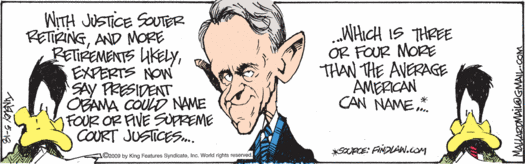
For every presidential election in recent history (meaning at least the last 30), I have had one overriding concern: the nomination of Supreme Court justices. I was asked once why it would be a problem if President Obama merely replaces retiring liberal justices with more liberals—other than missing the opportunity to "pack" the court to my liking. That's when I realized that I don't want a biased Supreme Court, at least not in the sense my friend was implying. But neither do I want a "balanced" Supreme Court. I want one that will rule based on the Constitution, whether they are for or against me. I don't want the Judiciary taking over the role of the Legislature. If our Justices are chosen based on their positions on particular issues rather than for their position vis–à–vis the Constitution and the Law, I think we have little hope for real justice.
But enough heavy thinking! Mallard Fillmore can make me smile, even about such an important issue.
Permalink | Comments | Edit
Category Politics Just for Fun
In the back corners of my "to blog about" list, I finally found In Defense of "The Rich," by Larry Elder. I'd originally bookmarked it because of the facts about charitable giving (see below); I'd remembered, from another source, George W. Bush's impressive record in this matter, but couldn't find it when I needed it in a debate with my brother. This article gave the hard numbers for my hazy memory, but at that point it was but l’esprit de l’escalier, so I filed it under "sometime"...you know.
But sometime is now here, and I find that the article has several good points, and complements my previous post, Think You're Rich? Or Poor?A recent poll commissioned by Investor's Business Daily asked, in effect, "What share [of the tax burden] do you think the rich pay?" Their findings? Most people are completely clueless about the amount the rich actually do pay.
The top 5 percent (those making more than $153,542) pay 60 percent of all federal income taxes. The rich (aka the top 1 percent of income earners, those making more than $388,806 a year)...pay 40 percent of all federal income taxes. The top 1 percent's taxes comprise 17 percent of the federal government's revenue from all sources, including corporate taxes, excise taxes, social insurance and retirement receipts.
[Of those polled,] 36 percent thought the rich contribute 10 percent or less of all federal income taxes. Another 15 percent thought the rich pay between 10 and 20 percent, while another 10 percent thought the rich's share is between 20 and 30 percent. In other words, most people thought the rich pay less—far less—than they actually do. Only 12 percent of those polled thought the rich pay more than 40 percent.
A U.S. News & World Report blogger went to the Democratic National Convention in Denver and conducted an informal poll of 24 DNC delegates. He asked them, "What should 'the rich' pay in income taxes?" Half the respondents said "25 percent"; 25 percent said "20 percent"; 12 percent said "30 percent"; and another 12 percent said "35 percent." The average DNC delegate wanted the rich to pay 25.6 percent, which is lower than what the rich pay now.
Thirty percent of American voters pay nothing—zero, zip, nada—in federal income taxes.
And here's the above-mentioned charitable giving data.
- In 2007, President George W. Bush and his wife had an adjusted gross income of $923,807...and donated $165,660 to charity—or 18 percent of their income.
- Vice President and Mrs. Cheney, in 2007, had a taxable income of $3.04 million...and donated $166,547 to charity—or 5.5 percent of their income.
- Barack Obama and his wife, Michelle, earned between $200,000 and $300,000 a year between 2000 and 2004, and they donated less than 1 percent to charity. When their income soared to $4.2 million in 2007, their charitable contributions went up to 5 percent.
- Joe and Jill Biden...made $319,853 and gave $995 to charity in 2007, or 0.3 percent of their income. And that was during the year Biden was running for president. Over the past 10 years, the Bidens earned $2,450,042 and gave $3,690 to charity—or 0.1 percent of their income.
Liberal families earn about 6 percent more than conservative families, yet conservative households donate about 30 percent more to charity than do liberal households. And conservatives give more than just to their own churches and other houses of worship. Conservatives, especially religious conservatives, give far more money and donate more of their time to nonreligious charitable causes than do liberals—especially secular liberals.
Permalink | Comments | Edit
Category Politics Random Musings
(This is a follow-up to previous posts: Options In Childbirth: A Personal Odyssey; The Trial; The Trial, Part II; and The Trial, Part III.)
I am not a lawyer, and I have no idea what Judy or her lawyer really think, but that doesn't stop me from pondering what happened in Judy's trial. It has been an interesting look into our criminal justice system. We know, personally, good policemen and excellent prosecutors who work hard for truth, fairness, and speedy justice, so any negative comments are not a blanket indictment, but food for thought.- I can't help wondering if Heather and Jon were treated differently because they lived in the city, rather than in a wealthy suburb, where the police might be more likely to find themselves facing a lawsuit for interrogating a cold, naked, hungry, and exhausted woman immediately after a traumatic birth and in the midst of unimaginable grief.
- I learned that if you are accused of a crime the police can take away your computer, no matter how essential it is for your for your daily life and business, and no matter how much personal and irreplaceable data is on it. Memo to self: buy an "emergency" computer, make frequent backups of all data, and figure out a search-warrant-proof hiding place. I'm not planning to get in trouble with the police—but who does?
- The proceedings were dragged out for seven years, prolonging the agony for Heather and Jon, leaving Judy and her family in limbo, and incurring great financial costs to both Judy and Allegheny County. Why not, since there was little incentive for the powers that be to move it along? The prosecution got what it wanted in the interim—Judy prohibited from doing her work—so why should they rush to judgement, and risk losing their case, as they did? Delay increases lawyers' fees, and even ordinary civil servants go to work and go home and get paid, independent of whether any one particular trial takes seven years or seven days. The only person with any incentive for speedy justice was Judy herself. And in the cases where the defendent knows himself guilty, even his desire would probably be to delay the verdict. No wonder our court system is overwhelmed.
- I learned something of how frustrating it is for those who know better to see false evidence enshrined as truth. In this case, the medical examiner, who exhibited an obvious prejudice against all midwives, testified—and his word was taken as authoritative—that the injuries he found on Isaac were due to Judy's efforts to assist the birth, despite the verifiable fact that all injuries except for one (a small mark on the back of Isaac's head) corresponded exactly to the locations of the various injections, sensors, and other bodily indignities that were part of the attempt to save Isaac during his two-day stay in the hospital. I wish this testimony had been properly contradicted during the trial, but it was apparently not part of the defense attorney's strategy, so it was left to become "truth" forever. (See Jon's comments after this Daley Ponderings post.)
- Knowing that the judge was also a medical doctor, I wondered at the decision of Judy's attorney to go with a non-jury trial. There is a strong and often acrimonious division between physicians and midwives, especially traditional midwives who work independent of a doctor's control, but even nurse-midwives feel the sting. My guess is that he knew the integrity of the judge, whereas juries can be swayed by emotional appeals. The judge clearly wanted to throw the book at Judy, and, had he had the authority, at Heather. (What he thinks about Jon he apparently kept to himself, but I doubt it's complimentary.) However, in an exercise of that increasingly rare commodity, judicial restraint, he ruled according to the law, contenting himself with a tongue-lashing from the bench and imposition of the maximum allowed penalty ($100 fine) for the most minor charge of practicing midwifery without a certificate, a grey area in Pennsylvania's law. (See the ruling in midwife Diane Goslin's case.)
- While I had been hoping for an enthusiastic endorsement of the rights of Pennsylvanians to be attended in childbirth by the assistants of their choice, and of the value of traditional midwives in retaining critical knowledge that is rapidly being lost in an overly-litigious and highly medicalized society, I consider this case a solid victory for midwives, because a judge with an intense desire to convict Judy ruled that Pennsylvania's law would not allow him to do so.
Tribune-Review article, with Heather interviewed
Post-Gazette article, with Jon interviewed
KDKA report, with misinformation including number of subsequent childrenPermalink | Comments | Edit
Category Health Politics Random Musings Everyday Life
Let's not do it again. Back in 1976, panic over swine flu led to a mass-vaccination program in which nearly a quarter of the U.S. population received immunizations at a cost of $137 million—followed by millions more the government paid out in damages to victims of vaccine-related Guillain-Barre syndrome. Working in a medical facility at the time, I stood in line and received my free shot and thought no more about it. However, the whole affair is now considered a debacle, a textbook case of governmental over-response to fears of a pandemic, fears that turned out to be unfounded. Let's not do it again.
Panic and misinformation are spreading online, aided and abetted by the mainstream news media, which I know from local hurricane reports are adept at the art of crying wolf, deliberately creating fear because fear keeps people glued to the news reports, no matter how little real information is imparted.
Should the government be aware, alert, and prepared to act if this becomes a true emergency? Certainly. But let the ordinary citizen take reasonable precautions of the kind we should always be taking (handwashing, keeping sick people home), and avoid spreading panic, which is itself a dangerous disease.
(Standard legal disclaimer: I am an Ordinary Citizen, not a doctor. If your doctor tells you to panic, don't let me stop you.)
I couldn't have told you anything about Mary Ann Glenon before turning to Wikipedia, except for this: the former U.S. ambassador to the Vatican has both principles and courage. The University of Notre Dame, which has apparently forgotten that it is a Catholic University, is planning to bestow an honorary degree upon President Obama, who will be giving the commencement address. Glenon, who had been scheduled to receive the University's Laetare Medal at the same time, demurred. To deflect speculation, her letter of refusal was released to the press and published in First Things. (Hat tip to Patrick Deneen.)
[I am] dismayed by the news that Notre Dame also planned to award the president an honorary degree. This, as you must know, was in disregard of the U.S. bishops’ express request of 2004 that Catholic institutions “should not honor those who act in defiance of our fundamental moral principles” and that such persons “should not be given awards, honors or platforms which would suggest support for their actions.” That request, which in no way seeks to control or interfere with an institution’s freedom to invite and engage in serious debate with whomever it wishes, seems to me so reasonable that I am at a loss to understand why a Catholic university should disrespect it.
When Notre Dame suggested that her acceptance speech might be good for the President to hear, she correctly reminded the university that graduation is a time for honoring the students, not for political debate.
Brava! I am not a Catholic—but courage is courage, and someone needed to remind Notre Dame that being Catholic isn't only about praying for your football team to win.A commencement, however, is supposed to be a joyous day for the graduates and their families. It is not the right place, nor is a brief acceptance speech the right vehicle, for engagement with the very serious problems raised by Notre Dame’s decision—in disregard of the settled position of the U.S. bishops—to honor a prominent and uncompromising opponent of the Church’s position on issues involving fundamental principles of justice.
Permalink | Comments | Edit
Category Politics Random Musings
The Internal Revenue Service has released tax statistics for 2006. You can view them yourself, at the IRS site. Having neither the time nor the mental energy to sort it all out, however, I'm glad the tax folks at J.K. Lasser have done the job already, and I'm going to take their word for it. You are welcome to take my word for their word, if you'd like.
How rich—or poor—do you think you are? Are you paying your fair share of taxes? What about the other guy? Forget, for the moment, comparison with the rest of the world—how do you compare with your fellow Americans? Statistics are slippery things, so take these as you will. Bear in mind, also, that the percentages given here are based on the number of income tax filers; anyone who did not file an income tax return for the year 2006 is not counted, and neither is any money made in underground economy. AGI = Adjusted Gross Income, Line 37 on Form 1040.
| Share of Total | Share of Total | Average | ||
| % of Filers | AGI Threshold | AGI | Income Tax | Tax Rate |
| Top 1% | $388,806 | 22.06% | 39.89% | 22.79% |
| Top 5% | $153,542 | 36.66% | 60.14% | 20.68% |
| Top 10% | $108,904 | 47.32% | 70.79% | 18.86% |
| Top 25% | $64,702 | 68.16% | 86.27% | 15.95% |
| Top 50% | $31,987 | 87.49% | 97.01% | 13.98% |
| Bottom 50% | under $31,987 | 12.51% | 2.99% | 3.01% |
A few intereting things to note. For simplicity, I'm using terms like "income," "taxes," and "population" loosely; remember that the statistics are for AGI, Federal income taxes, and those who file Federal income tax forms.
- Half the tax filers have an AGI of under $32,000.
- The bottom 50% earns less than 13% of the total income, while the top 1% earns 22%.
- Forty percent of all income tax revenues come from the top 1%.
- Half the population (more, when you count non-filers) pays less than 3% of the taxes.
Permalink | Comments | Edit
Category Politics Random Musings
Three diverse takes on China:
Although written nearly a year ago (note the line, "Assuming that the global economy does not decline now, it will at some point"), George Friedman's geopolitical analysis of China (via InvestorsInsight) is perhaps frightening, perhaps reassuring, but certainly fascinating. The concluding summary provides an introduction to the ideas, though it by no means does justice to the long article.Geopolitics is based on geography and politics. Politics is built on two foundations: military and economic. The two interact and support each other but are ultimately distinct. For China, securing its buffer regions generally eliminates military problems. What problems are left for China are long-term issues concerning northeastern Manchuria and the balance of power in the Pacific.
China's geopolitical problem is economic. Its first geopolitical imperative, maintain the unity of Han China, and its third, protect the coast, are both more deeply affected by economic considerations than military ones. Its internal and external political problems flow from economics. The dramatic economic development of the last generation has been ruthlessly geographic. This development has benefited the coast and left the interior—the vast majority of Chinese—behind. It has also left China vulnerable to global economic forces that it cannot control and cannot accommodate. This is not new in Chinese history, but its usual resolution is in regionalism and the weakening of the central government. Deng's gamble is being played out by his successors. He dealt the hand. They have to play it.
The question on the table is whether the economic basis of China is a foundation or a balancing act. If the former, it can last a long time. If the latter, everyone falls down eventually. There appears to be little evidence that it is a foundation. It excludes most of the Chinese from the game, people who are making less than $100 a month. That is a balancing act and it threatens the first geopolitical imperative of China: protecting the unity of the Han Chinese.
A recent Slate article by William Saletan highlights another destabilizing factor in China: the bitter consequences of the government's one-child policy. Bizarrely, the author manages to find a postive twist, but he can't change the facts.
Sixteen million girls are missing in China. And now we know what happened to them: They were aborted because they weren't boys.
Worldwide, the number of boys born per 100 girls ranges from 103 to 107. (The numbers later equalize due to higher male mortality.) Among Chinese children born from 1985 to 1989, the number of boys per 100 girls was 108, close to normal. But among those born from 2000 to 2004, the number rose to 124.
[T]he boy-girl ratio escalates radically among children who were born second or third in their respective families.....For third births, the sex ratio rose to over 200 in four provinces.
Two hundred boys for every 100 girls. The number is mind-boggling.
[T]he "one-child" policy [limits] family size but allows exceptions, with variations from province to province, for couples who have only daughters. Essentially, the exceptions give you a second or, in some cases, a third chance to have a son. That's why, as couples approach the family size limit or the exception allotment, the boy-girl ratio goes up. You get the ultrasound, and if the fetus is a girl, you abort it and try again for a son.
The government...has openly expressed concerns about the consequences of large numbers of excess men for societal stability and security....The old problem was too many children. The new problem is too few girls. Without enough girls, the boys become unruly.
Finally, for a less depressing look at China, visit the Virtual Forbidden City. I haven't downloaded it myself yet, but include it here because I hope to get to it, eventually—and because I know there are those of my readers who will immediately pull out their virtual passports.
The Forbidden City: Beyond Space and Time is a partnership between IBM and the Palace Museum in Beijing, China....[It] is the world's first online virtual world dedicated to a country's cultural heritage. This is presented as a three-dimensional replica of the square-kilometer palace grounds called The Virtual Forbidden City. The project partners' goal was to create an experience that is as authentic as possible by being true to important Chinese principles of balance and harmony.
Rather than being an isolating virtual experience, the Virtual Forbidden City allows visitors to see and interact with each other and with a wide range of volunteers, staff, and automated characters. To welcome the broadest range of visitors, a simple, easy to use interface guides interactions with the Virtual Forbidden City. As they explore the Virtual Forbidden City, visitors can choose to simply observe the buzz of activity, participate in activities that provide insights into important aspects of the Qing dynasty, or even take guided tours that uncover new insights into the stories of the Forbidden City.
Permalink | Comments | Edit
Category Politics Children & Family Issues Random Musings Just for Fun
Thanks to Percival Blakeney Academy for publicising Southern Utah University communicatio major Jeffrey Wilbur's direct and pithy denunciation of restrictive "free speech zones." (Brilliant, even if he did exclude Alaska and Hawaii.)
In light of SUU officials [sic] plan to designate "Free Speech Zones" on campus, I thought I'd offer my assistance. Grab a map. OK, ready?
All right, you see that big area between Canada and Mexico, surrounded by lots of blue ink on the East and West? You see it?
There's your bloody Free Speech Zone.
Once again I wonder why people can't make their points without resorting to offensive language, but as a great deal of blood was spilled to put the First Amendment into effect, perhaps it's appropriate.
Unfortunately, free speech—like free markets—can do great damage when not moderated by ethical principles. (Nothing complex required: the Golden Rule would suffice.) Stepping out from under the restrictions of a moral code invites the imposition of far greater—and often irrational—restrictions in response to real, perceived, or potential public harm.Permalink | Comments | Edit
Category Politics Random Musings
I know—the last thing you need is another blog to read! And the one I’m about to recommend had several authors and consequently great risk of overwhelming your feed reader. Especially since nearly all the posts are thought-provoking and well-written.
The Front Porch Republic is new—the first posts were on March 2 of this year—but has already produced so many shareable articles that it deserves its own post. Treat yourself and subscribe to the Front Porch Republic; they have a Comments RSS feed as well, though I can’t usually keep up with it. A mark of the quality of this blog (and its readers) is that the comments are so far above the “Your a &%$#& moron!” level seen all too often on websites without benefit of sufficient editorial oversight.
Knowing that most of you would be overwhelmed by the sheer volume of meaty reading available there, however, I will continue my practice of sharing excerpts. Here are a few by way of introduction:
Architecture matters. I knew I missed our front porch; now I know why. It’s a much easier way to interact with the neighbors than cleaning up after a hurricane.
[In his essay, “From Porch to Patio,” Richard Thomas] explores the social implications of the architectural practice of building porches on the front of homes and its eventual abandonment in favor of patios behind the house…. As with any central feature in our built environment, this is more than merely a passing fashion trend or a meaningless design change: the transition from porch to patio was one of the clearest and significant manifestations the physical change from a society concerned with the relationship of private and public things—in the Latin, res publica—to one of increasing privacy. The porch, as a physical bridge between the private realm of the house and the public domain of the street and sidewalk, was the literal intermediate space between two worlds that have been increasingly separated in our time, and hence increasingly ungoverned in both forms.
Why entrepreneurs, the self-employed, family farms, small businesses, and craftsmen are the bellwethers of liberty.
In 1913…Hilaire Belloc looked forward and anticipated our moment. He argued that what we today call corporate capitalism was fundamentally unstable and would eventually cease to exist.
The instability would be caused by the slow but inexorable concentration of property into fewer and fewer hands. As property became concentrated, power also would become concentrated, and concentrated power is a threat to the state unless, of course, it is co-opted by the state. Furthermore, as property became concentrated, the security of individuals would be threatened. People would find themselves in the precarious situation of living paycheck-to-paycheck. Because they possess no capital, they would not be able to provide for themselves in the way that a small farmer or craftsman could. They would be completely dependent upon their wages, and when economic crisis struck and wages were threatened, the insecurity of their situation would become acute. In such a time, it is not hard to image the people clamoring for a solution, rejoicing over a new kind of leader who promises change, if only he is empowered. Yes we can.
According to Belloc, the most obvious solution to this economic instability, the path of least resistance, is the acquisition by the state of the major economic interests, e.g. collectivization. This is sometimes called socialism, and, according to Belloc, it is the most natural course. But socialism is not benign or even honest, for the collectivization of property under the authority of the state results not in a more just society but one characterized by glaring inequalities and the loss of freedom for most. As Belloc puts it, “in the very act of collectivism, what results is not collectivism at all, but the servitude of the many, and the confirmation in their present privilege of the few; that is, the servile state.”
The unlikely alternative is what Belloc calls the “distributist state.” It is characterized by widely distributed private property so that the general character of the society is shaped by individual property owners. By “property” Belloc means “capital.” That is, property that can be used to make a living. When a critical mass of citizens possesses capital and are therefore economically independent, a stable situation exists. According to Belloc, private property is the only means of achieving security with freedom. Collectivization does, in fact, provide security. The price, though, is freedom.
The choices are stark. The Obama administration likely will continue to seek ways to nationalize the economy unless and until the American people rise up and demand a different direction. Do we even remember this better way? Can we imagine a world of free men and women who own real property and do not look to the state for happiness or economic security?
From a related post:
Here we can see the curious state of affairs in our waning republic: Democrats tend to be suspicious of big business but they trust big government to rein in abuses; Republicans express suspicion of big government but no fear of economic centralization. Both are half right but half blind. Here is a principle that we would do well to grasp: concentrations of power in any form are a threat to liberty. It may be too late for this generation to see this vital truth, or if seeing, to do anything about it. But nothing is inevitable, and there are hopeful signs that people are beginning to think seriously about the importance of localism, human scale, limits, and stewardship, the very things woefully lacking in the current spending orgy. While a return to these ideals is still only in its infancy, change is afoot. This represents a glimmer of sanity in a world succumbing to the apparent security promised by centralization.
Tobacco farming and community life. My antipathy towards tobacco products is well-known, and I thought Barbara Kingsolver inexplicably inconsistent when in Animal, Vegetable, Miracle she decried our unhealthy farming practices yet bemoaned the loss of small tobacco farms. I still can’t rationalize subsidizing such an unhealthy crop, but here’s another side to the story.
[E]very community must be bound together by something it shares—and for the ties to bind strongly there need to be several somethings. Here in Henry County, when everyone used to raise tobacco, everyone had the crop’s seasons and its demands in common.
My state is one of the few that still has a good number of small farms, and for years here tobacco was the mortgage crop. It made keeping those small farms possible for many families, and it was a vital part of a farmer’s mixed use of his land. The federal tobacco program and the Burley Tobacco Growers’ Co-op acted as a brake for the small farmer on the pitilessness of the international market….Today farmers here and in the several burley-growing states are free from any buttressing power between the small growers and the supranational tobacco companies that buy their crop. They are free to contract with the companies directly (and typically do, as otherwise there is no guarantee their crop will sell), and in one of those rhetorical equalities that is so unequal in fact, the companies are likewise free to set the price and limit the production, in a world market in which it is cheaper, of course, to grow tobacco in Brazil.
But my point is not only that farmers in my area have lost a good source of revenue. We’ve also lost a shared experience intimately tied to this place in which we live. Tobacco gave us something in common…tobacco was our common language…. [I]f the weather for curing was wet, everyone waited. If blue mold hit the county, everyone compared their losses. And everyone had a near-disaster story from working high in the rafters of the barn, to be retold every fall.
[W]ith the end of the program, most of us took the buyout and quit. The relative few farmers who still grow tobacco grow significantly larger crops now, which is a different sort of operation. People were growing something like two to twelve acres; now farmers often grow forty, or eighty, or even more. This is factory farming, and there is no way a family can manage it alone. There is too much to cut all at once, and hang all at once; it requires jobbed-in crews of migrant labor. Raising a few acres of tobacco was good and satisfying work….Toiling under the pressure of eighty must be something else.
So it is that here in Henry County we have lost the bond that tobacco gave, and one important part of our shared history is only history. And at times of real disagreement….we find we have fewer acres of common ground.
(My personal favorite tobacco farm is not in Kentucky, but Virginia. The Claude Moore Colonial Farm lives in a time warp—1771—and raises tobacco along with other heirloom crops and livestock.)
The Front Porch Republic—I’m reserving a rocking chair, as I plan to be a frequent visitor.
Permalink | Comments | Edit
Category Reviews Politics Random Musings Conservationist Living
I grew up on orange juice reconstituted from frozen concentrate, but I have since forgiven my parents. It was convenient and inexpensive, and oranges did not grow on our New York State trees. It tasted fine to me, because I didn't know any better. Why I was so ignorant I'm not certain, since every two years we visited relatives in Florida—and this was in the days before a cooling cycle in the weather teamed with developers to destroy most of Central Florida's citrus groves. Perhaps orange juice from concentrate simply tasted better to me because that's what I was accustomed to, much as many children who grow up with Aunt Jemima often prefer the imitation to real maple syrup. Or maybe I simply didn't care enough, but ate what was set before me without giving it much thought.
With maturity came discrimination. When "not-from-concentrate" orange juice appeared in the grocery stores I winced at the price, but never looked back, as it made the frozen concentrate taste like so much flavored sugar water. (Later, when I read John McPhee's marvelous Oranges, I learned that flavored sugar water is a fairly accurate description of the product.) It would be another 20 years before I discovered orange juice that was orders of magnitude better than the best not-from-concentrate available in the grocery stores.
My ignorance was annihilated when a friend married into a citrus grove and juice-producing facility. There I learned that "orange juice" is not a single product with a single flavor, but varies from month to month as different varieties of orange reach their peak season. There I discovered more varieties of orange and other citrus fruit than I could imagine, and tasted the delights of many. Who knew kumquats are best eaten whole: rind, seeds, and all?
Real orange juice has not one but many incomparable flavors. And real orange juice is not pasteurized. Our friends were certified by the State of Florida to sell juice just as it came from the fruit, making the hour-plus trip to their grove worth the drive. Alas, the forces of development overcame that grove, and I have yet to find a substitute.
No substitute grove, that is. There are a couple of stores in the area where I can usually find unpasteurized orange and grapefruit juice, and our recent visit to the Winter Park Farmer's Market yielded delightful, unpasteurized tangerine juice. Lately, however, I've been closing the circle, putting our citrus juicer to full use and making our juice directly from the fruit. There is not as much variety of citrus in our grocery stores as I would like, but there is some—and I can make blends. Valencia and red grapefruit, tangelo with a hint of lemon, navel and tangerine.... Sure, it's more work, especially since I can't bear to thrown the rinds out but bury them under our backyard grapefruit tree. But 100% worthwhile!
Now if only making my own cider were so easy. The same lessons I learned at our friend's grove I re-learned on a visit to a New Hampshire apple orchard: apples come in many wonderful varieties that you will never see in the grocery store, and unpasteurized cider is incomparably better than the treated kind. Growing up in New York meant that what I lacked in good orange juice I made up for in flavorful cider. Unfortunately, even New Yorkers have a hard time finding good cider these days—and cider is a lot harder to make than orange juice.
We must take our victories where we can find them, however, and good citrus juice is within your reach even if you live far from the groves. Invest in a citrus juicer and teach yourself and your children that orange juice does not grow in cardboard cartons!

