
Porter discovered a YouTube channel called Mentour Pilot, and we both quickly became fascinated.
Petter Hörnfeldt, a well-credentialed airline pilot, uses this channel to inform both fellow pilots and ordinary airline passengers about aviation practices, procedures, and safety, mostly through exploring spectacular aviation accidents: what caused them, how they were handled, what was learned from them, and what changes were then made.
You might think that learning the details about mostly gruesome aviation events would make people afraid to fly at all, but I find that it actually demonstrates why flying continues to be an exceedingly safe mode of transportation. These videos have greatly increased my admiration for pilots, air traffic controllers, and flight attendants. (Contrary to popular opinion, the flight attendants are not chiefly on the plane to serve us drinks.) Not to mention they've given me more respect for the safety rules and procedures that I tend to respond to with a mental, "Yeah, yeah, yeah. I've heard all this a zillion times; just let me get back to my book."
Most of the stories are long and detailed, as they must be to provide any substantial information, but to whet your appetite, here's a short (two-minute) video that highlights why the airlines are so particular about lithium batteries. (Plus it gives you the opportunity to hear his delightful Swedish accent.)
Naturally, having a pilot in the family makes these videos of particular interest to us, but any airline passenger could enjoy and benefit from them.
Permalink | Read 370 times | Comments (0)
Category Travels: [first] [previous] YouTube Channel Discoveries: [first] [previous]

Someone on Facebook captured the hippocampe ailé (winged seahorse) in the winglet of an Air France jet. That's what Porter was trying to get while we were flying from Paris to Florence. Instead, the emblem is completely missing, and all you see is a large, white dot.

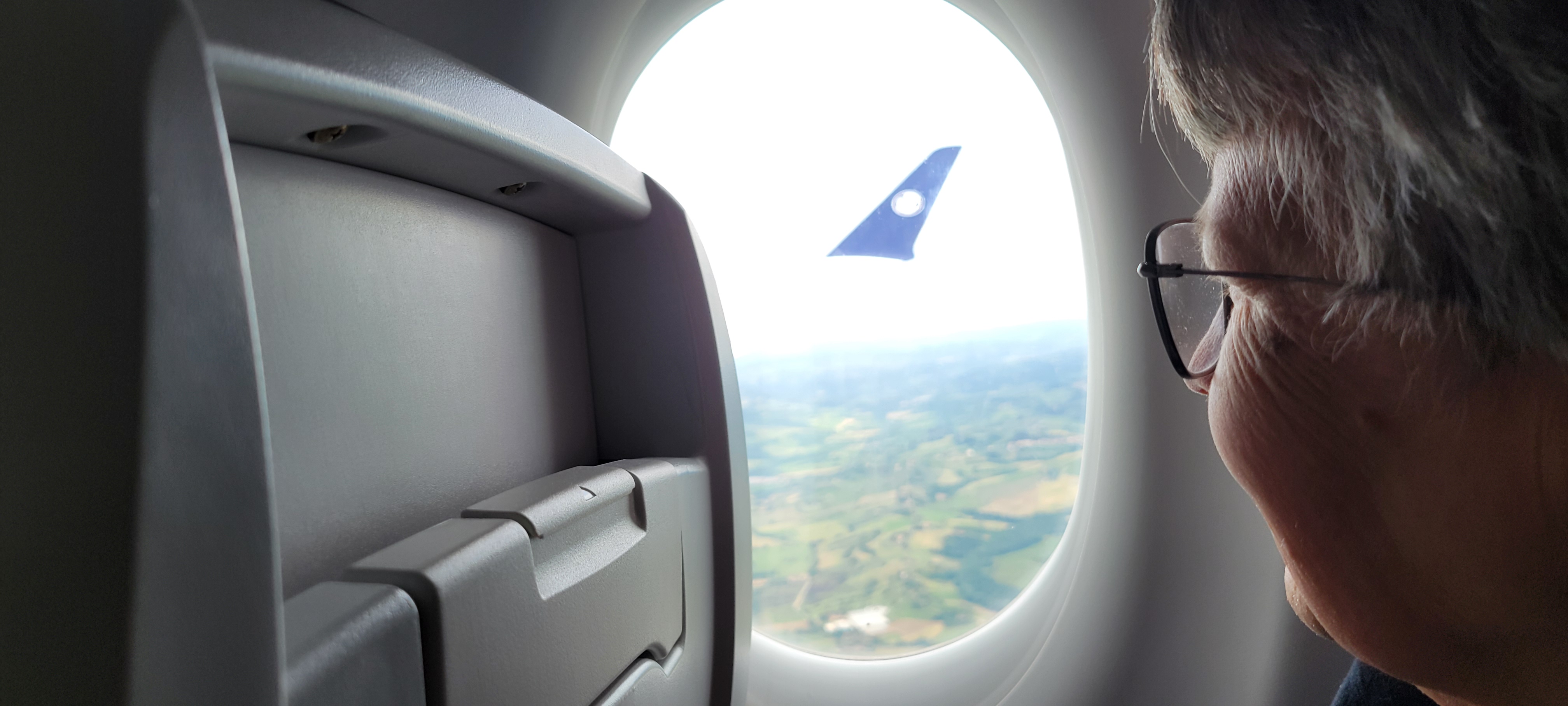
But that's not the strangest part of this photo. You beautiful Italian countryside, you see the winglet—but where's the wing?
When I was young, it was more acceptable than it is today to mimic the speech of people who speak English with a recognizable accent. I remember that the stereotype of an Italian accent ended practically every-a word-a with the schwa sound-a. It's funny that I never questioned why, because none of the Italians I knew spoke like that.
Now I'm wondering if what the mimics were copying was not a generalized Italian accent, but specifically a Sicilian accent. That way of speaking was startlingly prevalent in our recent, and admittedly narrow, experience of Sicily. It marked the speech of our tour guide so strongly that a non-native speaking as she did would be accused of mockery.
I wrote the above when I documented our travel experiences; finally, my curiosity got the better of me and I decided to ask Claude about it. I'll skip the technical aspects of Claude's response, but the upshot is that I was right, though it's a feature not just of Sicily but of southern Italy in general. Italians from the more northern parts of Italy do not speak that way. Here's what Claude had to say about how it came to typify the "Italian" accent in America.
The overwhelming majority of Italian immigrants to the US between the 1880s and 1920s came from the Mezzogiorno — Sicily, Naples, Calabria, Campania — not from Tuscany or the north. The "Italian accent" that got absorbed into American pop culture (vaudeville, early film, later Chef Boyardee commercials and mob movies) was really a caricature built on Southern Italian and Sicilian-inflected English, filtered through immigrant communities in New York and elsewhere. It got flattened into "the" Italian accent in the popular imagination, even though it's specifically a regional feature.
It is as if all Americans were portrayed in foreign movies, commercials, and comedy shows as being from the Deep South, or maybe Brooklyn.
In the spirit of Trust but Verify, before posting I ran this through Gemini, which caught one typo and a couple of awkward sentences. (I reworded the latter, though not with Gemini's suggestions.) It also suggested the nuance that the "Italian accent" is present even in northern Italy, because the Italian language "favors...words ending in vowels. When native Italian speakers speak English, they naturally append a schwa to words ending in consonants to fit their native speech patterns." That makes sense, although I would say it is very much less marked in northern Italians.
On our last day in Florence, Italy, we visted the Museo Galileo, a museum of the history of science. So many amazing ancient scientific instruments, both serious and playful!
One that lands on the playful scale is an optical toy from 1642, designed and built by Jean-François Nicéron, a French mathematician and friar. (The intersection of Faith and Science showed up again and again during our time in Florence.) Looking through the instrument at an apparently jumbled and nonsensical painting reveals an image of a portrait of Grand Duke Ferdinando II de' Medici.
On the more serious side, I was delighted to find a 17th century calculator (for addition) with dials turned by a hand-held stylus. It looked and functioned remarkably like the addition machine I remember my parents using when calculating their income tax in the 1950's (most likely a Sterling Dial-a-Matic).
And there I also saw my first Faraday Net. Looking remarkably as if you would use it to catch butterflies, it's actually the device Faraday used to demonstrate that an electric charge resides entirely on the outside of a charged conductor. It's a predecessor to the Faraday Cage, and explains why your cell phone stops working in elevators and why some people like to wear tin-foil caps.
The following gets a little technical, but if like me you have a particular interest in American Sign Language, you might enjoy it.
Sign Language in the Museum
There was one feature of the museum itself that puzzled me. Throughout, there were video screens displaying an image or video, along with text in both English and Italian, and a sign language interpreter (for what version of sign language I could not tell). At first I was just thrilled that they thought to include Deaf people—but then I thought, Why? Anyone old enough to be interested in the material would also be old enough to read the text.
The question intrigued me sufficiently that I posed it to Gemini, and received a detailed answer, which I've edited slightly for compactness. It simultaneously opened my eyes and left me with more questions.
[This] touches on a really fascinating aspect of how language, literacy, and accessibility work for the Deaf community.
To answer your first question: the version of sign language being used here is LIS (Lingua dei Segni Italiana), which is Italian Sign Language.
As for why the museum includes an LIS interpreter when written text is already available on the screen, there are a few very important reasons that usually surprise hearing visitors:
For many profoundly Deaf people, a sign language like LIS is their native, first language, while the written language of their country (like Italian or English) is actually a second language. Because sign languages have completely distinct grammar, syntax, and structure that don't match spoken or written languages, reading a dense paragraph of text can feel like reading a foreign language. Having a sign language interpreter allows them to receive the information in their natural, native language.
I knew this, but had not thought of it in a museum context. What it brings to mind immediately is the German-speaking Swiss. Their native language is the many dialects of Swiss German. High German is their written language, generally acquired when they enter school, and thus a second language. As far as native vs. acquired language is concerned, how is this different?
[A] hearing person can look at [a moving 3D object] while simultaneously listening to an audio track. A Deaf person cannot look at the text and look at the changing details of the historical instrument at the exact same time without constantly fracturing their attention. A sign language video allows for a much more fluid, visual processing of information that matches the natural rhythm of how Deaf individuals absorb visual content.
That's also a point I hadn't considered, perhaps because as a hearing person I had a similar problem. I'm certain there was audio available somehow for these displays, but they were silent as far as I was concerned, and I, also, had to "look at the text and look at the changing details…at the exact same time." I don't know enough to guess how watching both the changing details and the interpreter simultaneously fractures the attention less.
Many European museums receive funding or accessibility mandates to follow Universal Design principles. This means creating an environment that doesn't just provide a workaround (like text), but actively treats different language communities equally. By providing LIS, the Museo Galileo ensures that Deaf visitors get the same depth of engagement, tone, and emphasis that a hearing person gets from an audio guide.
It is a subtle layer of cultural and linguistic accessibility that hearing people rarely have to think about, but it makes a world of difference for the Deaf community.
The question of whether or not there are enough native speakers of Italian Sign Language to justify privileging them over others who also miss that depth of engagement—Deaf speakers of American Sign Language, for example, or visitors who speak neither Italian nor English—is an issue I can't effectively address. But as a former resident of Rochester, New York, which has a sizeable Deaf community, and having a daughter who took a college minor in American Sign Language, I enjoyed diving deeper into the reasons for the existence of these displays.
Buc-ee's not only has low-priced gas, decent food, and the best restrooms on I-95, it also rivals South of the Border for billboard advertising. Seen recently:
OPERATION EMPTY BLADDER
and my personal favorite,
EVERY LICENSE PLATE STOPS HERE
If you know, you know.
Gemini is very good at photo identification, but I wasn't expecting much from this one. I didn't need the identification, but thought it would be fun to see what Gemini could do. (Click on the photo to see it better.)
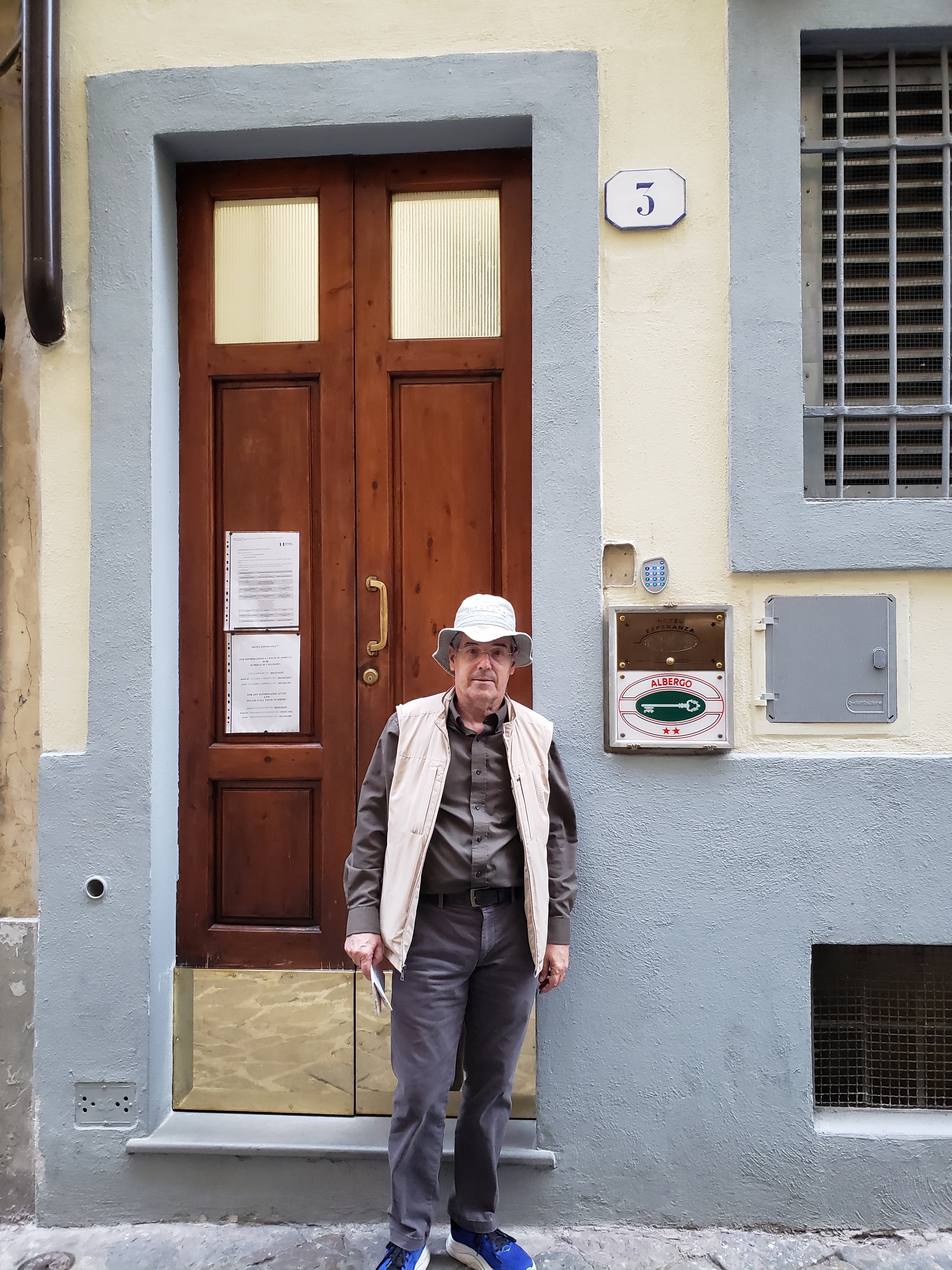
Here's how the chat went:
Me: I don't expect this photo to have enough information for an identification; I'm just curious as to what you can guess from it.
Gemini:
There is surprisingly a wealth of hidden clues in this photo that let us piece together quite a story!
Here is what we can deduce like a detective:
1. You are definitely in Italy
The dead giveaway is the word "ALBERGO" on the sign, which is the Italian word for a hotel or inn. Furthermore, that specific red, white, and green design with the key symbol is an official regional regulatory plaque used in Italy to display a property's classification.
2. It’s a modest, traditional stay
The two red stars prominently stamped at the bottom of the plaque tell us this is a cozy, no-frills 2-star hotel. The brass plaque right above it reads "Hotel Speranza" (or a very closely related name), which translates beautifully to Hotel Hope.
3. The exact street address
The number 3 is displayed in the classic, blue-bordered white ceramic tile style that you see on buildings all across Italian towns and cities.
4. Classic Italian alleyway architecture
The heavy, solid wood double doors with the polished brass kickplate at the bottom, the smooth painted plaster facade, and the security bars over the high window are incredibly characteristic of historic, narrow Italian streets—the kind where you turn a corner and suddenly find yourself right at the entrance of a hidden local guesthouse.
5. Ready for exploration
The traveler in the photo is perfectly geared up for a classic European day out: a sun-protecting bucket hat, a practical multi-pocket travel vest, comfortable walking shoes, and a map or guidebook clutched in hand.
It captures that quintessential, wonderful travel feeling of pausing outside your hotel just before heading out to explore the city!
Me: That was a fantastic piece of detective work. There's a lot more in the photo than I had noticed. Did you make use of the photo's exif data to help, or was that just from the image?
Gemini:
That was 100% just from the visual clues in the image itself!
When you share an image directly here, any hidden EXIF metadata (like the exact GPS coordinates, camera model, or the timestamp of when it was taken) is automatically stripped away for privacy. I couldn't see any of the digital "breadcrumbs" even if I wanted to.
Everything came down to zooming in on the physical details: reading the text on that small brass plaque, identifying the regional hotel classification symbol, and recognizing the style of the house number tile. It’s amazing how much data a single historic European storefront or doorway naturally puts on display if you know what to look for!
I'm coming to think of Artificial Intelligence as a Swiss Army knife: not one tool but many, our job being to discern the one best suited to each particular task. That applies not only to the multitude of tasks a particular Large Language Model can handle, but also to the different LLMs themselves, and the various AI Assistants (such as Copilot and Leo) that they lurk behind. I initially thought I'd pick one particular system and stick with it, but I'm finding that although Claude is now my go-to LLM (and the only one I'm paying for), it's also very handy to be able to get multiple answers from the same prompt, and to draw on the strength of "many counsellors" with different skill sets.
Currently Google's Gemini has moved into position as my second-best sword.
I've already had success working with both Copilot and Claude at the same time in order to harness the particular strengths of each. For my latest project, writing the story of our recent travels, I'm refining the text in Claude, where my preferences are well-known and where we have already established a good working relationship when it comes to proofreading, editing, and writing style. Gemini, having the power of Google's vast image library and search capabilities, has also become a powerful collaborator, helping me to remember the events as told by the photographs we took. Gemini not only identifies locations, buildings, and works of art, but adds much more—so much information about the scene and its history that it functions as a highly intelligent and experienced tour guide.
Without this collaboration—and Claude's gentle nagging, which got me started and keeps me on task—the story of this trip would in all likelihood have joined the many other events in our lives which are languishing in photo files and manila envelopes filled with memorabilia. Our trip to Venice, for example, got as far as to have its own category here, but ground to a halt after a single entry. There's a glimmer of hope that the new collaboration might breathe new life into those dry bones. If I live long enough.
Although we occasionally checked in with the home front while we were overseas, for three weeks we had very little exposure to news headlines and social media. I'm not saying that was a bad thing, but it meant we were met with some surprises when we returned home. One very encouraging surprise was that the Internet had been flooded with reports and stories from international visitors who had come to the United States on the occasion of the World Cup and had had their stereotypes of America and Americans overwhelmed by reality.
For the last 20 years or so I have experienced a lot more foreign travel than I ever imagined, and one thing I have noticed is that very few people have any idea of how vast and how diverse America is. Looking at a map of Texas alone, superimposed on a map of Europe, I see that it covers all or part of Denmark, Germany, the Netherlands, Belgium, Luxembourg, France, Switzerland, Italy, Liechtenstein, Austria, Slovenia, Croatia, Bosnia and Herzegovina, Serbia, Hungary, Slovakia, Czechia, and Poland! That kind of vastness is hard for many Europeans to imagine.
As for culture, even Americans get their impressions of our country from Hollywood and whatever highly-curated news filters their way—how much more so those who don't live here? I've learned the futility of trying to convince Europeans that their conception of America does not reflect the reality of America, but where I failed, the World Cup succeeded. Visitor after visitor reported, with amazement, "Everything I was told about the United States was wrong!" They were astounded by what they found, so different from what they had expected, everything from the flavor of ranch dressing to the kindness and warm welcome they experienced in the Deep South—from the people they had been taught to hate. (Indeed, I had to unlearn that low opinion of the American South myself, having grown up in the Northeast.) Americans, trapped in self-flagellation because we allow our flaws to mask our strengths, need to see our country through such eyes!
Why is this relevant to our trip? Because these happy stories mirror ours, both on this trip and indeed on all the trips we've taken to foreign parts. "Everyone said" that the French, especially Parisians, are rude and hate Americans, but our experience was exactly the opposite. We met one, just one rude cab driver in Paris; everyone else was friendly and kind and patient with my very broken French. In our experience—which can't be the same as someone else's but is the only experience by which we can truly judge—people in Europe, and Japan, and Brazil, and The Gambia are as kind and friendly as people anywhere, and do not universally hate Americans. My greatest surprise on this trip was the respect and even admiration we heard expressed for American leadership; I had expected dismay and contempt. Fear-mongering reports flow both ways across the Atlantic!
But we rarely talked politics, at least not directly; ordinary stories about our own lives and all that we have in common were what everyone delighted in sharing. We spoke with people from all over the U.S., Canada, the U.K., Norway, Sweden, France, Portugal, Zimbabwe, South Africa, the Philippines, Indonesia, Vietnam, Germany, Turkey, and more—and found nearly everyone to be interesting, friendly, polite, kind, and sometimes above-and-beyond helpful.
Not everyone can, or should, take a Mediterranean cruise or travel far to see World Cup soccer in person, but surely the world would be better off if we spent less time listening to stories that make us angry and more time experiencing the humanity of our neighbors.
Permalink | Read 482 times | Comments (0)
Category Politics: [first] [previous] [next] [newest] Travels: [first] [previous] [next] [newest] Social Media: [first] [previous] [newest] Here I Stand: [first] [previous] [next] [newest] Med Trip 2026: [first] [next] [newest]
Now that we're back from three weeks in the Mediterranean region, people are wondering how we survived Europe's heat wave. The answer is simple: the same way we survive Florida's summers. Nowhere that we went did the temperatures exceed Florida's numbers: high 80's to low 90's were the worst we experienced. That's actual temperature. Having lived more than seven decades with that as my measure of ambient temperature, my brain rebels against the modern "feels like" idea, which always makes me feel more miserable than I am. For what it's worth, the UV Index at its highest in a day was generally 8—like a normal Connecticut summer. In Florida at this time of year that number is routinely 12. I was barely aware of the UV Index until I acquired the dminder app for my phone to help me keep track of the vitamin D my body is making. If I'm wearing shorts and a t-shirt, a 15-minute walk in the midday sun at UVI 12 easily gets me 1500 IUs (and a warning that it's time to go inside). On the UV Index scale, 1-2 is considered Low, 3-5 Moderate, 6-7 High, 8-10 Very High, and 11+ Extreme.
Our first four days were in Florence, and were undeniably hot, because we wanted to make the most of our short time there. Our hotel was convenient to everything we wanted to see, so we walked everywhere and were on the go most of the time the sun was up. (Sane Floridians avoid the midday hours outside if possible. "Mad dogs and Englishmen," you know.) The Mediterranean sun was intense, the humidity was high, the cobbled sidewalks a challenge to walk on, and Florence's many staircases a trial for legs accustomed to flat surfaces. What made this only a minor inconvenience?
- This was early in our trip, when we were fresh and eager.
- Hats and sunglasses. Generally I hate wearing a hat, but keeping the sun off my face was a necessity.
- A Floridian's practiced eye for finding shade. Walk on the shady side of the street. Rest in a shady spot. It makes a significant difference, even when the humidity is high.
- Air-conditioned respites. This is huge. As with cold in the winter, one can stand a much greater intensity and duration of heat if one can occasionally retreat to a more comfortable situation. In our case, we spent much of our time walking from one museum to another, and generally recognize that great art survives better in a hospitable climate. So do people, but art refuses to be bullied. The museums were comfortably air conditioned—not the frigid situation one finds in Florida restaurants, for example, which is why I keep a sweatshirt in the car at all times and occasionally pull it out even during the hottest summer days.
- We didn't hesitate to adjust our schedule to accommodate our physical needs.
- Frequent gelato stops. Never underestimate the importance of this Italian staple.
For the remainder of our trip, we were on a Princess cruise, visiting Italy, Greece, Turkey, and Montenegro. The ship itself was over-airconditioned, but an occasional trip to the blistering sun of the top decks took care of that nicely. And the otherwise-excessive A/C was admittedly glorious upon returning from a long, midday excursion of hiking, under a cloudless sky, through ancient ruins.
Overall, to those who asked us how we managed in Europe's "terrible heat wave," my first thought was always, "What heat wave?"
But I do understand unrelenting heat, as I'll explain in my next post.
I've been out of the country for three weeks, and I never look at Tik Tok anyway, but I hear that it has been blowing up with European visitors to America (mostly thanks to the World Cup), expressing their pleasure, appreciation, and astonishment at how different their experiences were compared with all they had been told about the U.S. Some of those commentaries made it into Facebook Reels, and I enjoyed seeing them. Everything from the trivial (discovering ranch dressing) to the profoundly encouraging (finding that the Americans they met were friendly, helpful, and delightful—not at all they way we had been portrayed to them back home.
It works both ways, too. During our recent three weeks in Europe, we met many new people from many different countries, including England, Scotland, Canada, Norway, Sweden, Greece, Italy, Germany, Montenegro, Turkey, South Africa, Zimbabwe, Vietnam, Brazil, and the Philippines. We discovered that without exception they were interesting people, delightful to converse with, rational and reasonable, and that we held much in common. What's more, I saw no anti-American sentiment at all. I'm sure it exists, but in three weeks among ordinary folks, we met only friends.
The apple doesn't fall far from the tree. Possibly I inherited my attitude toward dancing from my father. The following is taken from his write-up of his Elderhostel in Uruguay (emphasis mine).
The after-dinner event last night was tango lessons at the Alianza. I have failed to learn anything about dancing in the past 71 years, so I saw no reason to start now. But tonight they had a live orchestra playing tango music, so those who had learned their lessons could put it all into practice. I went, and although a few demonstrated their skills, I was content to listen to the music, which I enjoyed.
That said, several of my grandchildren greatly enjoy contra dancing, which is something like square dancing, and I think I would like it reasonably well if I were 30 years younger. As it is, I got too dizzy to find it pleasurable. Like my father, however, I enjoyed the music.
Here's another excerpt from my father's Elderhostel travels, this time to Uruguay in 1993.
The Mayor of Montevideo is the second most powerful political person in the country. In a recent election, the Communists brought in Uruguayans who were living in foreign countries, paying their way home so they could vote. The result was that a card-carrying, certified Communist was elected mayor. The first thing he did was to double taxes, and everyone paid them and settled back. No one worries about anything in Uruguay. Now they want to double taxes again, and people are beginning to object. The Uruguayan Communist Party no longer receives any money from Cuba or Russia, and it is suspected that any new taxes will end up in the Party treasury.
This may not be a case where history repeats itself, but it certainly rhymes.
In 2001, just a couple of days after September 11, we moved from Florida to near Boston, Massachusetts. What's one of the first things one must do after a move? Get a new driver's license.
After reading the following story of my adventures in doing just that, my father—who had himself lived in the Boston area for a while—responded,
Back in 1932 there was a general rule that said: "Don't drive in Boston." It is interesting to note that there really are some things that don't change.
Today's Travels
Technically speaking, I have driven in Boston and lived to tell about it. Okay, it was not the downtown Boston of infamy, but it was quite enough for me.
The closest Department of Motor Vehicle office to our house is in Roslindale, they told me. They even provided clear directions. At least, the directions LOOKED clear. Next time I think I'll try for an office a little further away.
The driving wasn't so bad at first, though my heart did skip a beat when I saw the sign, "Welcome to Boston," and another as I crested a hill and saw the Boston skyline in front of me. Long before getting to that part of the city, however, I found the street I was looking for. I wanted the Municipal Building "across from Roslindale Square." When I'd read the directions, my suburbanite mind translated Roslindale Square as a shopping center or a park—at any rate, a place that would have parking. Wrong. I don't know what Roslindale Square IS, the only indication to that effect being at the post office parking lot, said parking lot being graced with a sign bearing the forbidding inscription, "Absolutely no parking at any time."
After some wandering around, made considerably more difficult by the presence of seemingly random one way streets, I found a parking place and was able to complete my business. The fact that the Municipal Building is labelled as a health center was only a minor hindrance.
In my meanderings, I had noticed that I would be unable to return home the way I'd come, as Washington Street had suddenly become one way at the point where I needed to turn left. Thanks to the help of the person ahead of me in line, I gained a general idea of what to do, and managed to get back onto Washington, going in the right direction, after not much more than a dozen twists, turns, reversals, and one-way streets.
City driving precludes the use of two of my most powerful navigating strategies: (1) When you realize you've gone the wrong way, turn around and go back to where you knew you were right. This works poorly when one-way streets are involved. (2) If you don't know what you're doing, pull off into a parking lot and study the map. This strategy requires the existence of a place to park.
I take great satisfaction in having succeeded in the adventure, and am grateful the trip was made in the rain rather than the snow.
In 1992 my father and one of my brothers made a trip to London to visit another brother who was living and working there. When he returned, he wrote a detailed, 15-page report of their adventures. As I was proofreading ChatGPT's transcription of my scanned pages, I came upon this gem:
From there we walked down to the area of Big Ben and the Parliament Buildings and then across the Westminster Bridge and down along the River to the Lambeth Bridge. As we were crossing the Lambeth Bridge I recalled that back in my high school days there had been a popular song called “Doing the Lambeth Walk”.
Later that day...
Since it seems to be an unwritten rule that everyone who goes to London has to see a show, we next went to the Adelphi Theater and bought tickets to “Me and My Girl”. This was a revival of an old show written during the Great Depression so it was not as costly as some of the new shows like “The Phantom of the Opera” which is sold out until who knows when. Still, we paid 17 pounds for second row in the balcony seats.
And after dinner....
We then went to the show which we all enjoyed. One of the main songs was “Doing the Lambeth Walk”.
Neither the song nor the musical is one that I'd ever heard of. But I doubt I'll ever forget it now. Here you go.
When my father, an avid Elderhosteler, discovered a course with lots of outdoor activities intended for grandparents and their grandchildren, he promptly invited his oldest grandchild to accompany him to Vancouver Island in British Columbia. The year was 1990.
On their way, they stopped briefly to visit my father's cousin Sylvia, who lived in the Seattle area. I'd known that Sylvia was a remarkable woman, a world traveller who at the time of their visit had justreturned from trekking in Nepal—at nearly seventy years of age. Re-reading Dad's Elderhostel report, I realized something else remarkable that I'd missed before:
Sylvia seems very happy. She is very interested in acting and when I last saw her she was quite dejected as she had just been rejected for a part in "Harvey" because she was too old. She is now doing more acting in films, is a member of the Screen Actor's Guild, and was going to Portland tomorrow for a second audition for a minor part in a film.
A quick look at imdb.com reveals that the actress Sylvia Langdon played a townsperson in Season 1 (1990), Episode 5 of the TV series, Northern Exposure ("Russian Flu"). Was that our Cousin Sylvia? I think the odds are pretty good. The probability that I will have the opportunity to watch that show is very low, but if I do, I'll be scanning the townspeople for a familiar face.

