
If you were reading Lift Up Your Hearts! regularly back in 2020, thank you. The following may consequently sound familiar, but it's worth reprising. C. S. Lewis is well-known, and classic. George MacDonald is much less so, though he has enjoyed somewhat of a revival thanks to renewed availability of his writings. What is worth bearing in mind is that he was Lewis's mentor, though they never met; it was his writings—and the character they revealed—that influenced Lewis so greatly. Lewis put it clearly and boldly:
I have never concealed the fact that I regarded him as my master; indeed I fancy I have never written a book in which I did not quote from him.... I dare not say that he is never in error; but to speak plainly I know hardly any other writer who seems to be closer, or more continually close, to the Spirit of Christ Himself.
C. S. Lewis showed me a God who made sense of the world; George MacDonald showed me a God I could wholeheartedly love.
As I neared the end of my C. S. Lewis retrospective—reading (mostly re-reading) all the books we own by or about the prolific author—I was challenged by my friend, The Occasional CEO, to relate a few of the most significant things I have learned from Lewis. I began with the idea of trying to distill a Top Five from his many areas of influence in my life.
It soon became clear that of everything I have learned from Lewis—from faith to literature to history to the changing meaning of words to the critical importance of one's model of the universe—two stood out, orders of magnitude greater than the rest.
All is gift. I am Oyarsa not by His gift alone but by our foster mother’s, not by hers alone but by yours, not by yours alone but my wife’s—nay, in some sort, by gift of the very beasts and birds. Through many hands, enriched with many different kinds of love and labor, the gift comes to me. It is the Law. The best fruits are plucked for each by some hand that is not his own. [from Perelandra]
The first gift I received from C. S. Lewis was his Narnia stories. I was introduced to them in mid-elementary school: The Lion, the Witch, and the Wardrobe was a gift from my mother, who brought it to me in a stack of books from the library when I was sick in bed. The remainder of the series came about two years later, a gift from a neighbor, who owned all seven and shared them around our group of friends. I was delighted, enthralled. However, my attempt to find similar delight in his other fiction was at the time unsuccessful. I tried the first of his Space Trilogy, but I was a hard-core science fiction fan—Asimov, Heinlein, Clarke—and Out of the Silent Planet was not sufficiently science-based for me. One of Lewis's earliest books, it lacks the beauty and enchantment of the Narnia stories, and was intended for an adult audience. I have since come to enjoy it, but I wasn't ready then.
I rediscovered Narnia in college, thanks to the University of Rochester's Education Library, which was well-stocked with children's books. There I also first encountered Mere Christianity: the gift of my roommate, and my introduction to Lewis's nonfiction. To my shock, there I discovered that all the delight—the goodness, truth, and beauty—that I had encountered in Narnia was for Lewis an expression of reality, a reality far greater than he could depict, even in fantasy. I came later to respect the background in Christianity I had received in my childhood, but it was through Lewis and Narnia that the reality of God began to make sense to me.
This is the first and great gift, and the second is like unto it.
I went on to read more of Lewis's non-fiction, and to gain from it, but his next pivotal gift came many years later, through a friend—all is gift—who shared with me Lewis's George MacDonald: An Anthology.
If Narnia had shown me a God who made sense of the world, MacDonald showed me a God I could love.
George MacDonald is another author I had met before—as a child through his Curdie books and At the Back of the North Wind—but I'd never followed through to find what else he might have written. To be fair to myself, his other books weren't easy to find back then.
Of MacDonald, Lewis wrote,
In making these extracts I have been concerned with MacDonald not as a writer but as a Christian teacher. If I were to deal with him as a writer, a man of letters, I should be faced with a difficult critical problem. If we define Literature as an art whose medium is words, then certainly MacDonald has no place in its first rank—perhaps not even in its second. There are indeed passages, many of them in this collection, where the wisdom and (I would dare to call it) the holiness that are in him triumph over and even burn away the baser elements in his style: the expression becomes precise, weighty, economic; acquires a cutting edge. But he does not maintain this level for long. The texture of his writing as a whole is undistinguished, at times fumbling. Bad pulpit traditions cling to it; there is sometimes a nonconformist verbosity, sometimes an old Scotch weakness for florid ornament (it runs right through them from Dunbar to the Waverly Novels), sometimes an oversweetness picked up from Novalis. But this does not quite dispose of him even for the literary critic. What he does best is fantasy—fantasy that hovers between the allegorical and the mythopoeic. And this, in my opinion, he does better than any man.
(Unless otherwise noted, all quotations are from Lewis's preface to George MacDonald, An Anthology.}
MacDonald's works can be divided roughly into three parts, though they overlap: the fantasy that so impressed Lewis; books of sermons; and his many adult novels—the craft of which left Lewis so unimpressed—which served both to feed his family of thirteen and as vehicles for reaching a wider audience with his preaching. The last sounds dreary, but in reality the preaching is what makes his novels shine. (Those who know my lack of appreciation for most sermons will recognize the peculiarity of such a statement coming from me.)
Having been reawakened to MacDonald by Lewis's Anthology, I looked around for more, and the best I could find were modern re-workings of his novels, some by Michael R. Phillips and some by Dan Hamilton. I give credit to both authors for their obvious respect for MacDonald, and their faithfulness to his ideas, even though in their efforts they exaggerated the parts I like least from the originals (the Romantic elements) and reduced the best (the preaching). The library had most of them, and I wolfed them down.
Most of my extracts are taken from the three volumes of Unspoken Sermons. My own debt to this book is almost as great as one man can owe to another.
The next contributor to my journey was a church secretary who had obtained photocopies of all three Unspoken Sermons books, which she graciously shared. I wonder if the generations who grew up with easy access to a universe of electronic resources can even imagine how valuable bound photocopies could be. Or what an incredible gift it was to the world when, in the 1990's, Johannesen began republishing all of MacDonald's works, in beautifully-crafted sets. All of these treasures were given to me, over several years of birthdays and Christmases, by my father. He himself had no particular appreciation of MacDonald—I doubt he read any of the books—but a great deal of love for his children and grandchildren, for whom I consider the collection a legacy. Now, Kindle versions of almost all of MacDonald's works are available at no or very little cost.
I have never concealed the fact that I regarded him as my master; indeed I fancy I have never written a book in which I did not quote from him.
Lewis is not exaggerating the frequency of MacDonald's influence on his own works. Having tackled my MacDonald retrospective first, I easily recognized his ideas and often his words when I encountered them in Lewis.
I know nothing that gives me such a feeling of spiritual healing, of being washed, as to read George MacDonald. (from a letter of Lewis to Arthur Greeves)
I dare not say that he is never in error; but to speak plainly I know hardly any other writer who seems to be closer, or more continually close, to the Spirit of Christ Himself.
What greater endorsement could there be?
Lewis was puzzled as to how people could idolize him and ignore MacDonald. I have some ideas. MacDonald's books were old, even then—he had died before Lewis turned seven—and our society's "chronological snobbery" was well established. Although full of gold, many of his books are difficult to read, even those not laden with Scottish dialect. I can now say that it's well worth the effort, and the reading and understanding get much easier with practice. But I can't forget that I had actually encountered MacDonald's novels years before, deep in the stacks of our main college library. But apparently this, too, had to wait to be a gift rather than my own choice: to my everlasting embarrassment, I turned aside from those unattractive, ancient, brown, and dusty tomes. Perhaps it was the library's revenge that I later became a genealogist, whose blood now quickens at the mere scent of such books.
Then, too, from the beginning MacDonald was plagued by charges of heresy and branded "Universalist" for his belief that, in the end, God's love would triumph. Lewis did not see him that way, but it led (and still leads) some to dismiss MacDonald out of hand.
Reaction against early [strict Scottish Calvinist] teachings might ... have very easily driven him into a shallow liberalism. But it does not. He hopes, indeed, that all men will be saved; but that is because he hopes that all will repent.
Nowhere else outside the New Testament have I found terror and comfort so intertwined.
Inexorability—but never the inexorability of anything less than love—runs through [MacDonald's thought] like a refrain; "escape is hopeless"—"agree quickly with your adversary"—"compulsion waits behind"—"the uttermost farthing will be exacted." Yet this urgency never becomes shrill. All the sermons are suffused with a spirit of love and wonder which prevents it from doing so. MacDonald shows God threatening, but (as Jeremy Taylor says) "He threatens terrible things if we will not be happy."
The effect of C. S. Lewis's writings on my thinking is incalculable, and not just from his most popular books. Who would have guessed, for example, that I would give a five-star rating to Studies in Words—a book on philology, addressed to scholars, of which I understood less than half? But I was fascinated, and my eyes were opened to the pernicious habit (especially common among both literary critics and high school English teachers) of simply seeking meaning in what we read, instead of seeking what the author meant by his words and what his contemporary audience understood him to be saying.
There's no doubt that Lewis was quirky, humble, and absolutely brilliant—all the more brilliant that so many of his writings were written to be accessible to the ordinary British public, yet there's no hint of condescension. I could start my Lewis retrospective over again from the beginning and learn a lot more.
But for all that, Lewis's greatest influence on my life came less through my mind than through my spirit. Lewis said that reading MacDonald's Phantastes "baptized his imagination." The Narnia books first, and then George MacDonald directly, did the same for me.
This surprising realization came nearly sixty years after my first encounter with The Lion, the Witch, and the Wardrobe, and was itself a gift—thanks to my friend's challenge.
It hurts to have your name stolen.
I'm not talking about identity theft, horrific as that is, but something deeper, more personal. I think of all the Kevins in Europe, where "Kevin isn't a name; it's a diagnosis." All the women whose parents innocently named them "Alexa." My own husband, Porter, whose name precludes calling for him in an airport or train station.
And heaven help the many lovely people I know named "Karen."
Recently, heaven got a little assistance from Mikayla Hedrick, in her article "Get me the manager: In defense of Karens." Well worth the short read, and maybe sending the article to a beleaguered Karen you know.
The Millennial and Gen Z generations who adopted the term grew up with a “Karen” as their elementary school teacher, or the mom down the block, or, like me, as their aunt. Now, those Karens are middle-aged women, a thankless season in the lives of females everywhere, and the pejorative is hurled upon them ceaselessly.
They’ve been accused of racism, of being too quick to call the police, of caring too much about their neighbor’s lawn, and of being a causeless nag at a perfectly good restaurant.
And because I was not a Karen...I said nothing.
No one came to defend our mothers, aunts, or middle-school teachers. They were early victims of rising wokeness, and most of us fed them to the wolves without thinking twice. Conservatives who would later reject the labels of DEI culture said nothing while their wives subliminally imbibed the idea that to be a middle-aged woman who cared enough to join the PTA may subject them to internet bullying and character defamation: all hidden behind the label “Karen.”
That ends now.
Rather than perpetuating the stereotype that a “Karen” is a nuisance whose behavior should be avoided, it’s time to admit that it’s Karens who make the world go round.
While working diligently to resurrect a sense of perpetual racial tension, the label “Karen” has cunningly inflamed prejudice, not against women of a certain race, but against all women of a certain age.
It’s the rightful role of the middle-aged woman to guard her community — to ensure its safety, cleanliness, and standards. But standards aren’t cool anymore. If you care too much about such things, you’re mocked with the air of a middle-school bully taunting you for doing your homework.
And the middle-aged woman is the personification of standards.
She is the mother who has known you since birth and can tell you’re slacking off, even when no one else can. She is the neighbor who is tired of you driving into the cul-de-sac blasting loud music when you know good and well that the babies are sleeping.
She is no longer the gullible maiden you can charm with sweet words. She is a matriarch in training and can see right through your BS.
That’s her job in the neighborhood, and that’s her role in the country.
Don’t try to push Democratic Socialism on a real Karen. She will remind you that you still haven’t paid her back for that window you broke as a kid. Don’t expect her to toe the line on your new pronouns. And definitely don’t let her catch you looting a Walgreens in the name of “justice,” because she will personally escort your butt to prison.
She’s not here to play.
And that’s why she’s demeaned. Because she is a vanguard in a culture that wants to get away with everything.
No thank you.
I’ll take safe streets, good service, and the ladies keeping it all together for the rest of us.
Permalink | Read 343 times | Comments (0)
Category Children & Family Issues: [first] [previous] [next] [newest] Random Musings: [first] [previous] [next] [newest] Everyday Life: [first] [previous] [next] [newest] Here I Stand: [first] [previous] [newest]
Although we occasionally checked in with the home front while we were overseas, for three weeks we had very little exposure to news headlines and social media. I'm not saying that was a bad thing, but it meant we were met with some surprises when we returned home. One very encouraging surprise was that the Internet had been flooded with reports and stories from international visitors who had come to the United States on the occasion of the World Cup and had had their stereotypes of America and Americans overwhelmed by reality.
For the last 20 years or so I have experienced a lot more foreign travel than I ever imagined, and one thing I have noticed is that very few people have any idea of how vast and how diverse America is. Looking at a map of Texas alone, superimposed on a map of Europe, I see that it covers all or part of Denmark, Germany, the Netherlands, Belgium, Luxembourg, France, Switzerland, Italy, Liechtenstein, Austria, Slovenia, Croatia, Bosnia and Herzegovina, Serbia, Hungary, Slovakia, Czechia, and Poland! That kind of vastness is hard for many Europeans to imagine.
As for culture, even Americans get their impressions of our country from Hollywood and whatever highly-curated news filters their way—how much more so those who don't live here? I've learned the futility of trying to convince Europeans that their conception of America does not reflect the reality of America, but where I failed, the World Cup succeeded. Visitor after visitor reported, with amazement, "Everything I was told about the United States was wrong!" They were astounded by what they found, so different from what they had expected, everything from the flavor of ranch dressing to the kindness and warm welcome they experienced in the Deep South—from the people they had been taught to hate. (Indeed, I had to unlearn that low opinion of the American South myself, having grown up in the Northeast.) Americans, trapped in self-flagellation because we allow our flaws to mask our strengths, need to see our country through such eyes!
Why is this relevant to our trip? Because these happy stories mirror ours, both on this trip and indeed on all the trips we've taken to foreign parts. "Everyone said" that the French, especially Parisians, are rude and hate Americans, but our experience was exactly the opposite. We met one, just one rude cab driver in Paris; everyone else was friendly and kind and patient with my very broken French. In our experience—which can't be the same as someone else's but is the only experience by which we can truly judge—people in Europe, and Japan, and Brazil, and The Gambia are as kind and friendly as people anywhere, and do not universally hate Americans. My greatest surprise on this trip was the respect and even admiration we heard expressed for American leadership; I had expected dismay and contempt. Fear-mongering reports flow both ways across the Atlantic!
But we rarely talked politics, at least not directly; ordinary stories about our own lives and all that we have in common were what everyone delighted in sharing. We spoke with people from all over the U.S., Canada, the U.K., Norway, Sweden, France, Portugal, Zimbabwe, South Africa, the Philippines, Indonesia, Vietnam, Germany, Turkey, and more—and found nearly everyone to be interesting, friendly, polite, kind, and sometimes above-and-beyond helpful.
Not everyone can, or should, take a Mediterranean cruise or travel far to see World Cup soccer in person, but surely the world would be better off if we spent less time listening to stories that make us angry and more time experiencing the humanity of our neighbors.
Permalink | Read 491 times | Comments (0)
Category Politics: [first] [previous] [next] [newest] Travels: [first] [previous] [next] [newest] Social Media: [first] [previous] [newest] Here I Stand: [first] [previous] [next] [newest] Med Trip 2026: [first] [next] [newest]
The flag still stands for freedom, and they can't take that away.
You know you're aging as fast as the country when you tell people you were almost a quarter of a century old when America celebrated her 200th birthday, and they say, "Oh, wow...." But I remember celebrating the Bicentennial in Philadelphia, and hearing President Ford speak there.
I approached this post feeling entirely inadequate to write about America's 250th birthday. It demands something more profound, more intense than I can give at the moment, despite my deep feelings. I love our country now more than I ever have, perhaps because never in all my decades as an American have I felt our freedom to be in more danger, and the number of those attempting to take it away—or give it away—to be so overwhelming. But the flag still stands for freedom.
Lee Greenwood's God Bless the USA was from my children's era, not mine, and it doesn't often come to mind when I think about patriotic songs. But the other day I heard it, unexpectedly, and it equally unexpectedly brought tears to my eyes. I paused and stood taller as if I were hearing our national anthem. It's a fitting tribute to a great country.
If tomorrow all the things were gone
I'd worked for all my life
And I had to start again
With just my children and my wife
I'd thank my lucky stars
To be living here today
'Cause the flag still stands for freedom
And they can't take that away
And I'm proud to be an American
Where at least I know I'm free
And I won't forget the men who died
Who gave that right to me
And I'd gladly stand up
Next to you and defend her still today
'Cause there ain't no doubt I love this land
God bless the USA
From the lakes of Minnesota
To the hills of Tennessee
Across the plains of Texas
From sea to shining sea
From Detroit down to Houston
And New York to L.A
Well there's pride in every American heart
And it's time we stand and say
That I'm proud to be an American
Where at least I know I'm free
And I won't forget the men who died
Who gave that right to me
And I'd gladly stand up
Next to you and defend her still today
'Cause there ain't no doubt I love this land
God bless the USA
And I'm proud to be an American
Where at least I know I'm free
And I won't forget the men who died
Who gave that right to me
And I'd gladly stand up
Next to you and defend her still today
'Cause there ain't no doubt I love this land
God bless the USA
Permalink | Read 402 times | Comments (0)
Category Everyday Life: [first] [previous] [next] [newest] Here I Stand: [first] [previous] [next] [newest]
It was a small gesture, but it felt so good.

The government gave us these for free, and they've been stashed in our closet ever since. The last time I used one was ages ago, in order to be able to assure members of our choir that my symptoms were seasonal allergies, not covid. They are now three years past their putative expiration dates, and I needed the space in the closet—and in my mind.
Tossing these boxes into the trash did nothing to undo the harm that was done during the covid era, nor to erase the shame I carry for my own behavior in that time of mass delusion and conformity.
But it still felt really good.
As promised in a previous post, here's a follow-up to my dad's thoughts about happiness, during a 1993 Elderhostel lecture in Uruguay.
An event on the same day inspired similar thoughts on fun.
The same thing happened later that night. A friend of one of the speakers joined us at dinner and he sat across from the man next to me. At one time he asked my neighbor "Which of your activities so far has been the most fun?" My answer would have been that none has been fun. "Fun" describes a roller coaster ride (at least if you are much younger than I). "Fun" describes a short-term activity that has a lot of action with it. Our activities were interesting and/or educational but they were not fun. If you are not happy, you are not necessarily unhappy; if you are not having fun, you are not necessarily bored. Or at least that is the world as I see it. But I think I have the wisdom not to argue about it with anyone.
Living in the land of high-speed theme park thrill rides, at my age I no longer find most roller coasters pleasant, let alone fun. Research, writing, and the process of creation are usually quite enough action for me, and a sufficient response when someone asks, "But what do you do for fun?" Even if they then think I'm crazy.
I agree with my father, even if I generally lack the wisom in his final line.
Permalink | Read 550 times | Comments (1)
Category Random Musings: [first] [previous] [next] [newest] Glimpses of the Past: [first] [previous] [next] [newest] Here I Stand: [first] [previous] [next] [newest]
This was my father's comment, from a 1993 letter, on the prevalence of creative wedding vows. I think that trend started in the 1960's.
I think the standard words are just fine if people would only listen while they repeat the marriage vows.
Permalink | Read 505 times | Comments (0)
Category Children & Family Issues: [first] [previous] [next] [newest] Glimpses of the Past: [first] [previous] [next] [newest] Here I Stand: [first] [previous] [next] [newest]

I have created my first, and I hope only, anti-Trump political cartoon. I usually give the president grace for decisions he makes that I disagree with, but supporting year-round Daylight Saving Time is a bridge too far. As most of my readers know, I'd be fine with permanent Standard Time, but being so far out of sync with the sun is just not right. (I'll give you time zones, for practical reasons, but see no such excuse for pretending that noon is one o'clock.)
This work was inspired by a political cartoonist whose name I don't know, who published a cartoon using the blanket-snipping idea back when President Nixon had the same crazy thoughts about permanent DST. I tried to find the cartoon online, but failed. So I decided to create my own, with a little help from Copilot. Okay, a lot of help. It can draw, and I can't.
Copilot may be able to draw, but its rules can be very frustrating, as I've said before. However, there's a certain creative challenge in trying to make one's point within the restrictions; it was actually rather fun.
At first I tried re-creating the old cartoon as I remembered it. My prompts are in italics, Copilot's responses in bold. These are excerpts from a much longer conversation, as we worked through the creation and refinement process. Most the design work was mine, but Copilot made the speech bubbles, and I thought they were great so I left them in.
Please draw a cartoon of President Trump in bed, with a blanket and a pair of scissors. In the first panel, he is snipping off the bottom of the blanket; in the second he is sewing the cut-off part onto the top.
I can help you create a cartoon — but I can’t generate or depict current political candidates or elected officials in new images. That includes drawing President Trump in any scene.
All right, make it President Nixon, then.
I still can’t generate this cartoon, Linda — even with President Nixon — because he is a real political figure, and I’m not allowed to create new images depicting actual politicians, even historical ones, in fabricated scenes.
Hmm. How about if you use a generic man but indicate somehow that he is a U.S. president?
It got a little further, but eventually came back with,
I can’t create this cartoon, Linda. The request was blocked because it still counts as depicting a U.S. president, even a fictionalized one, in a political‑cartoon scenario, which falls under the same safety restriction.
At this point, I changed the scene entirely, keeping the main idea but taking the president out of bed (which looked ridiculous; I don't remember how the original cartoon made it look otherwise) and putting him behind a desk, with a salesman selling the blanket-cutting idea. I added the caption to make it clear that the man was president of a fictional country. That passed! and the rest of the work was just refinements.
Permalink | Read 601 times | Comments (0)
Category Politics: [first] [previous] [next] [newest] Glimpses of the Past: [first] [previous] [next] [newest] Here I Stand: [first] [previous] [next] [newest] AI Adventures: [first] [previous] [next] [newest]
Traditionally sung on Palm Sunday, Ride On, Ride On in Majesty is a musical journey through Holy Week, from Jesus' triumphal entry into Jerusalem (Palm Sunday) through his crucifixion (Good Friday) to his glorious Resurrection (Easter).
Ride on! ride on in majesty!
Hark! all the tribes hosanna cry;
Thy humble beast pursues his road
with palms and scattered garments strowed.
Ride on! ride on in majesty!
In lowly pomp ride on to die;
O Christ, thy triumphs now begin
o'er captive death and conquered sin.
Ride on! ride on in majesty!
The angel armies of the sky
look down with sad and wond'ring eyes
to see the approaching sacrifice.
Ride on! ride on in majesty!
Thy last and fiercest strife is nigh;
the Father on his sapphire throne
awaits his own anointed Son.
Ride on! ride on in majesty!
In lowly pomp ride on to die;
bow thy meek head to mortal pain,
then take, O God, thy power, and reign.
I can't have a favorite line in such a wonderful hymn, but if I did, it would be "The Father on his sapphire throne awaits his own anointed Son." Nothing that happened during Holy Week came as a surprise, but was known and expected since the beginning of time. It was not, as a priest tried to tell us one Easter, something that caught Jesus off guard, but rather the very sequence of events for which he was born—and he knew it.
Today is Good Friday. But Easter is coming!
The Father on his sapphire throne awaits his own anointed Son.
Here's a very short Facebook reel that I have found worthwhile and encouraging. Some of you may pass it by simply because it is Glenn Beck speaking, and I'd be in sympathy with that reaction. There are some people—he's not one, but there certainly are some people—with whom I have a hard time following my own motto, "The wise man recognizes truth in the words of his enemies." If you feel that way about Glenn Beck, don't torture yourself.
But I appreciate hearing wisdom and truth spoken calmly, clearly, and succinctly, facing reality without anger and without fear. I share it for those of my readers who may find it inspiring.
Permalink | Read 509 times | Comments (2)
Category Inspiration: [first] [previous] [next] [newest] Here I Stand: [first] [previous] [next] [newest]
Yesterday, January 6th, was the holy day of Epiphany, celebrating the revelation of God's Light to the Gentiles (the Three Wise Men) and marking the end of the Twelve days of Christmas. Recently, however, some people have tried to appropriate that day for political purposes—Left and Right alike.
I will have none of that!

Before dawn yesterday morning, I was up performing the ritual of Chalking the Door, a practice we ran into in Europe before spending a few years in a church that honored that custom. We still have the chalk which was officially blessed in 2020. It only gets used once a year, so we're not likely to outlive it.
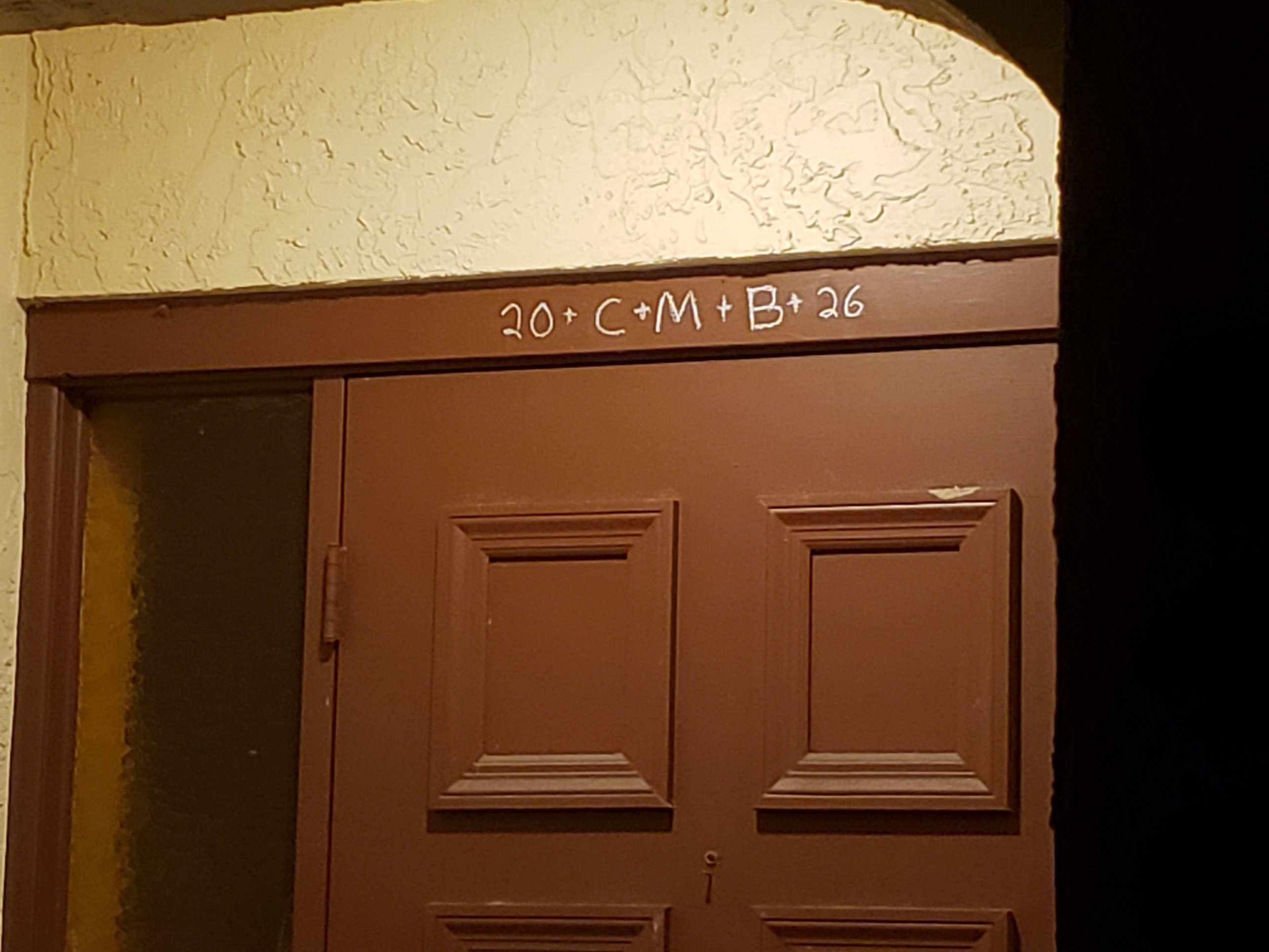
Lord God of heaven and earth, you revealed your only begotten Son to every nation by the guidance of a star. Bless this house and all who live here and all who visit. May we be blessed with health, kindness of heart, gentleness and the keeping of your law. Fill us with the light of Christ, that our love for each other may go out to all. We ask this through Christ our Lord. Amen.
Permalink | Read 532 times | Comments (0)
Category Everyday Life: [first] [previous] [next] [newest] Here I Stand: [first] [previous] [next] [newest]
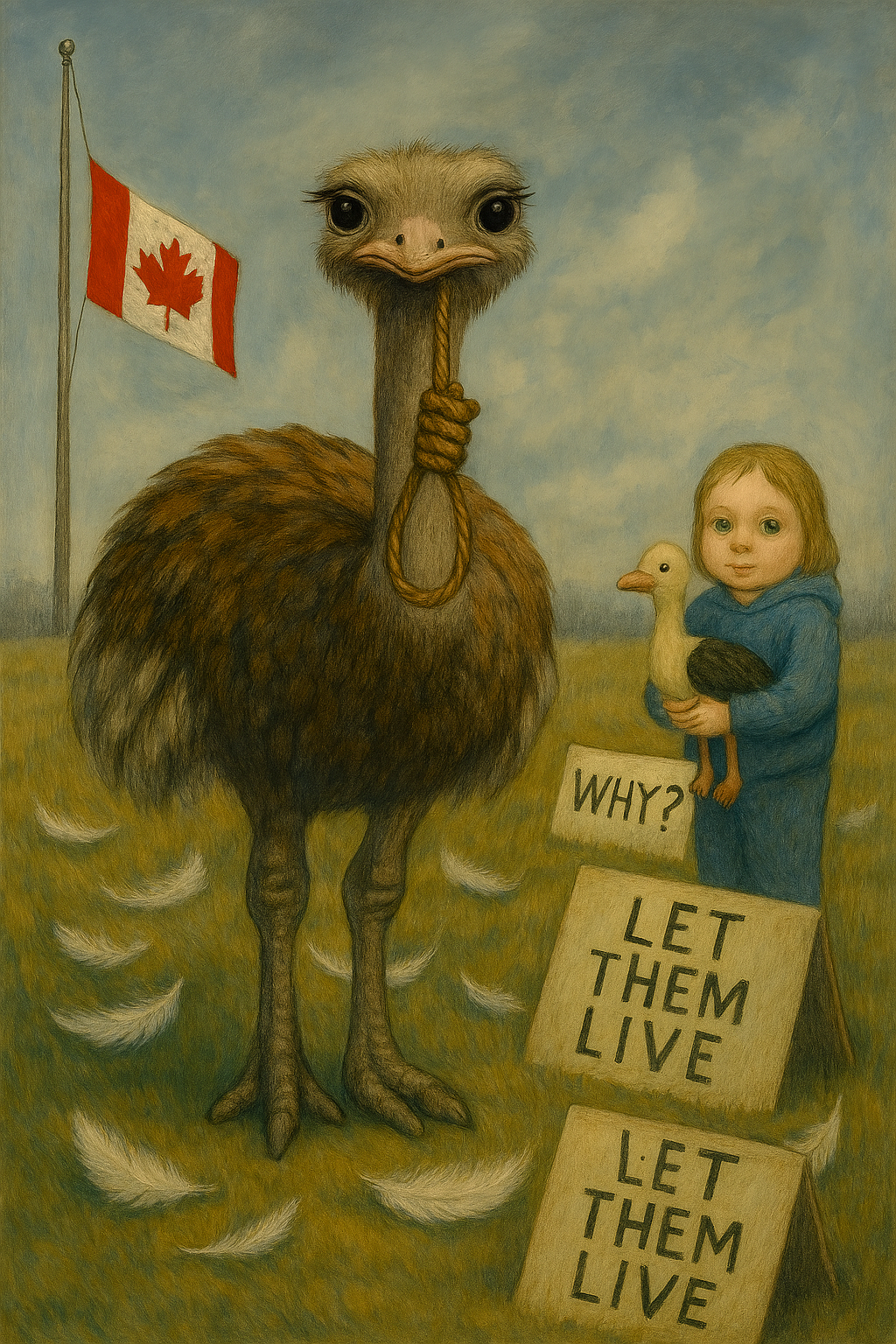
Porter had the idea for this image, and I had fun with Copilot on this. It steadfastly refused to make an image of an ostrich with a noose around its neck and a Canadian flag in the background. But it then asked what I was trying to express, and had a number of suggestions for making the point without violating its guidelines. After about 15 minutes of back and forth I was quite pleased with this. Not with the circumstances of course, but with the picture.
Although I read all of the original Harry Potter books when they first came out, I saw only a few of the films. Thanks to a friend's gift, however, we've recently been watching the early ones, and I was able to enjoy them thoroughly because it's been so long since I read the books that I can't whine about the differences.
A few days ago we viewed Goblet of Fire for the first time. You can imagine the powerful impact of the following scene. I knew I had to find it online and share it here.
Permalink | Read 1343 times | Comments (0)
Category Reviews: [first] [previous] [next] [newest] Politics: [first] [previous] [next] [newest] Everyday Life: [first] [previous] [next] [newest] Inspiration: [first] [previous] [next] [newest] Here I Stand: [first] [previous] [next] [newest] Heroes: [first] [previous] [next] [newest]
I try to ignore the insane TikTok (and other platform) postings celebrating Charlie Kirk's death, figuring there's a good chance that many of them are either AI-generated or (more likely) people being paid to cause trouble. That kind of thing is real, and it's not new: political propaganda and agitation predate social media by millennia. But it's impossible to avoid it altogether without cutting oneself entirely off from the world; you don't need to stand near a forest fire to be overcome by smoke.
Tragically, there's abundant evidence that much vile sentiment does come from real people who appear to believe the horrific things they are saying, and claim without apology their First Amendment right to free speech. Real people. Real teachers even.
I hear the "freedom of speech" claim a lot, attempting to justify bad behavior, from the merely rude to the heinous. In such situations I'm compelled to point out that no, their actions are not protected as much as they hope by the First Amendment. Constitutionally, they are in most cases protected from governmental interference in their speech, though even then there are exceptions (e.g. yelling "fire!" in a crowded theater, slander/libel, and certain threats). But there is nothing that I know of that prohibits a private enterprise from saying, "Your publicly-expressed opinions are antithetical to the culture and mission of our organization and give us concern that your inability to control them will put the comfort and safety of our customers at risk. Therefore it is time to go our separate ways."
I saw that play out here locally, when Penzey's Spices pressured (and eventually laid off) the employees of our local store who did not share the corporate political positions. And it was the company's right to do so. Only the court of public opinion can prevail against that.
(The Second Amendment is similarly limited: I have the right to "bear arms" but if my local grocery store puts up a sign saying, "No guns allowed" I don't have the right to at the same time carry my pistol and fill my shopping cart. It's complicated; if the Constitution and our laws were perfectly clear, too many lawyers would be at risk of unemployment.)
A shockingly large number of folks have crossed a sacred line in the glorification of cold-blooded murder. I'm not completely comfortable with the people who are exposing these obscene posts and making sure the posters' employers—and in the case of teachers, their students' parents—are made aware of them, but sometimes light needs to be shined into dark places.
What kind of human being cheers the assassination of an innocent man? If I were a business I would seriously worry about putting such a person in a position where he could do harm to a customer he happened to dislike.
What I really don't understand is the teachers who make such posts. Have they lost their minds? I know a guy who became a teacher after serving honorably in another profession. I was sorry that I could no longer follow his interesting and often wise posts on Facebook, because one of the clear rules of his school was that teachers were to have no social media presence whatsoever. At first I thought that was harsh, but now I see the wisdom in it. Even where social media posting is not forbidden by the school, how can a teacher want to advertise that parents have entrusted their children to one who lacks the common sense—not to mention the common humanity—to refrain from exulting in violent death? Much less the violent death of someone for whom many of their students are deeply grieving?
Young people are often warned to be careful what they post online, because their future may hang in the balance. That's a lesson we all need to learn. Sometimes it's a risk we must take: speaking the truth can be costly. But as the Bible says, it's one thing to suffer for doing good, and quite another to suffer from doing evil.
Sadly, I can't stick my head in the sand and deny that hatred and horrific behavior are real. We have to acknowledge it, be aware of our surroundings, and prepare to face trouble, just as we prepare to face hurricanes, earthquakes, illness, job loss, and other challenges.
Possibly the best preparation of all would be to strengthen our relationships within our families, among our friends, and in our neighborhoods.
There are no guarantees. I can't forget the Rwandan Genocide, where neighbors raped neighbors, friends slaughtered friends, and the man standing next to you in church on Sunday might do unspeakable things to your children on Wednesday. It was a time when political, cultural, and racial lines were drawn hard and fast.
We. Must. Do. Better. "It can't happen here" is a tragic epitaph.
Where do I find hope? In God, first of all. The second is like unto it: In what I know, and whom I know, from my own experience.
We could all benefit from spending less time watching the news and scrolling through social media, and more time looking around at our families, friends, and neighbors. Of the people we really know and interact with, how many actually hold that kind of hatred in their hearts? I have many friends whose political views are sharply opposed to mine—yet by living, working, and playing together we make opportunities to observe and appreciate each other's humanity, and to prove that we have each other's backs in times of need.
That's where the most important reality lies.
Permalink | Read 1427 times | Comments (0)
Category Politics: [first] [previous] [next] [newest] Random Musings: [first] [previous] [next] [newest] Here I Stand: [first] [previous] [next] [newest] Heroes: [first] [previous] [next] [newest]
I found the following list in in The Art of Manliness, a publication I rarely read, but have respect for, and not just because their site is hosted by our own Lime Daley, which also hosts this blog. Their article reprints The Children’s Morality Code for Elementary Schools from 1926, which is old enough that I have no qualms about reproducing it here. You're unlikely to see these rules for being a good American in any public elementary school today, more's the pity. I believe I can heartily endorse all the precepts, except for the penultimate, XI-2: I will be loyal to my school. I supposed one has to expect that, given that this list was intended for school children, but I see no particular reason for loyalty to a school any more than to a favorite grocery store or brand of jeans.
As for the rest of them, I say we should bring them back, beginning with our politicians.
THE ELEMENTARY MORALITY OF CIVILIZATION
Boys and girls who are good Americans try to become strong and useful, worthy of their nation, that our country may become ever greater and better. Therefore, they obey the laws of right living which the best Americans have always obeyed.
I. THE LAW OF SELF-CONTROL
GOOD AMERICANS CONTROL THEMSELVES
Those who best control themselves can best serve their country.
1. I will control my tongue, and will not allow it to speak mean, vulgar, or profane words. I will think before I speak. I will tell the truth and nothing but the truth.
2. I will control my temper, and will not get angry when people or things displease me. Even when indignant against wrong and contradicting falsehood, I will keep my self-control.
3. I will control my thoughts, and will not allow a foolish wish to spoil a wise purpose.
4. I will control my actions. I will be careful and thrifty, and insist on doing right.
5. I will not ridicule nor defile the character of another; I will keep my self-respect, and help others to keep theirs.
II. THE LAW OF GOOD HEALTH
GOOD AMERICANS TRY TO GAIN AND KEEP GOOD HEALTH
The welfare of our country depends upon those who are physically fit for their daily work. Therefore:
1. I will try to take such food, sleep, and exercise as will keep me always in good health.
2. I will keep my clothes, my body, and my mind clean.
3. I will avoid those habits which would harm me, and will make and never break those habits which will help me.
4. I will protect the health of others, and guard their safety as well as my own.
5. I will grow strong and skillful.
III. THE LAW OF KINDNESS
GOOD AMERICANS ARE KIND
In America those who are different must live in the same communities. We are of many different sorts, but we are one great people. Every unkindness hurts the common life; every kindness helps. Therefore:
1. I will be kind in all my thoughts. I will bear no spites or grudges. I will never despise anybody.
2. I will be kind in all my speech. I will never gossip nor will I speak unkindly of any one. Words may wound or heal.
3. I will be kind in my acts. I will not selfishly insist on having my own way. I will be polite: rude people are not good Americans. I will not make unnecessary trouble for those who work for me, nor forget to be grateful. I will be careful of other people’s things. I will do my best to prevent cruelty, and will give help to those who are in need.
IV. THE LAW OF SPORTSMANSHIP
GOOD AMERICANS PLAY FAIR
Strong play increases and trains one’s strength and courage. Sportsmanship helps one to be a gentleman, a lady. Therefore:
1. I will not cheat; I will keep the rules, but I will play the game hard, for the fun of the game, to win by strength and skill. If I should not play fair, the loser would lose the fun of the game, the winner would lose his self-respect, and the game itself would become a mean and often cruel business.
2. I will treat my opponents with courtesy, and trust them if they deserve it. I will be friendly.
3. If I play in a group game, I will play, not for my own glory, but for the success of my team.
4. I will be a good loser or a generous winner.
5. And in my work as well as in my play, I will be sportsmanlike—generous, fair, honorable.
V. THE LAW OF SELF-RELIANCE
GOOD AMERICANS ARE SELF-RELIANT
Self-conceit is silly, but self-reliance is necessary to boys and girls who would be strong and useful.
1. I will gladly listen to the advice of older and wiser people; I will reverence the wishes of those who love and care for me, and who know life and me better than I. I will develop independence and wisdom to choose for myself, act for myself, according to what seems right and fair and wise.
2. I will not be afraid of being laughed at when I am right. I will not be afraid of doing right when the crowd does wrong.
3. When in danger, trouble, or pain, I will be brave. A coward does not make a good American.
VI. THE LAW OF DUTY
GOOD AMERICANS DO THEIR DUTY
The shirker and the willing idler live upon others, and burden fellow-citizens with work unfairly. They do not do their share, for their country’s good.
I will try to find out what my duty is, what I ought to do as a good American, and my duty I will do, whether it is easy or hard. What it is my duty to do I can do.
VII. THE LAW OF RELIABILITY
GOOD AMERICANS ARE RELIABLE
Our country grows great and good as her citizens are able more fully to trust each other. Therefore:
1. I will be honest in every act, and very careful with money. I will not cheat nor pretend, nor sneak.
2. I will not do wrong in the hope of not being found out. I can not hide the truth from myself. Nor will I injure the property of others.
3. I will not take without permission what does not belong to me. A thief is a menace to me and others.
4. I will do promptly what I have promised to do. If I have made a foolish promise, I will at once confess my mistake, and I will try to make good any harm which my mistake may have caused. I will speak and act that people will find it easier to trust each other.
VIII. THE LAW OF TRUTH
GOOD AMERICANS ARE TRUE
1. I will be slow to believe suspicions lest I do injustice; I will avoid hasty opinions lest I be mistaken as to facts.
2. I will stand by the truth regardless of my likes and dislikes, and scorn the temptation to lie for myself or friends: nor will I keep the truth from those who have a right to it.
3. I will hunt for proof, and be accurate as to what I see and hear; I will learn to think, that I may discover new truth.
IX. THE LAW OF GOOD WORKMANSHIP
GOOD AMERICANS TRY TO DO THE RIGHT THING IN THE RIGHT WAY
The welfare of our country depends upon those who have learned to do in the right way the work that makes civilization possible. Therefore:
1. I will get the best possible education, and learn all that I can as a preparation for the time when I am grown up and at my life work. I will invent and make things better if I can.
2. I will take real interest in work, and will not be satisfied to do slipshod, lazy, and merely passable work. I will form the habit of good work and keep alert; mistakes and blunders cause hardships, sometimes disaster, and spoil success.
3. I will make the right thing in the right way to give it value and beauty, even when no one else sees or praises me. But when I have done my best, I will not envy those who have done better, or have received larger reward. Envy spoils the work and the worker.
X. THE LAW OF TEAM-WORK
GOOD AMERICANS WORK IN FRIENDLY COOPERATION WITH FELLOW-WORKERS
One alone could not build a city or a great railroad. One alone would find it hard to build a bridge. That I may have bread, people have sowed and reaped, people have made plows and threshers, have built mills and mined coal, made stoves and kept stores. As we learn how to work together, the welfare of our country is advanced.
1. In whatever work I do with others, I will do my part and encourage others to do their part, promptly.
2. I will help to keep in order the things which we use in our work. When things are out of place, they are often in the way, and sometimes they are hard to find.
3. In all my work with others, I will be cheerful. Cheerlessness depresses all the workers and injures all the work.
4. When I have received money for my work, I will be neither a miser nor a spendthrift. I will save or spend as one of the friendly workers of America.
XI. THE LAW OF LOYALTY
GOOD AMERICANS ARE LOYAL
If our America is to become ever greater and better, her citizens must be loyal, devotedly faithful, in every relation of life; full of courage and regardful of their honor.
1. I will be loyal to my family. In loyalty I will gladly obey my parents or those who are in their place, and show them gratitude. I will do my best to help each member of my family to strength and usefulness.
2. I will be loyal to my school. In loyalty I will obey and help other pupils to obey those rules which further the good of all.
3. I will be loyal to my town, my state, my country. In loyalty I will respect and help others to respect their laws and their courts of justice.
Permalink | Read 2216 times | Comments (1)
Category Children & Family Issues: [first] [previous] [next] [newest] Inspiration: [first] [previous] [next] [newest] Here I Stand: [first] [previous] [next] [newest]

