
I've been told it's a peculiar affliction, but I've always enjoyed listening to beginning Suzuki music students. There's a warm place in my heart for the Book 1 repertoire, both piano and violin. I'm not a music teacher of any kind, but recently I had the privilege of introducing my six-year-old grandson to pre-Twinkle and Twinkle on the violin. He has been taking piano lessons with his other grandmother for a year, and his mother laid the foundations for violin playing with him, so I was able to step in and reap the benefits of a prepared and eager student.
It was glorious. I can't begin to describe how much fun it was. He's very responsible with his half-sized violin, and the need to put it away carefully did not deter him in the least from getting it out several times a day, begging me to teach him something new. He has a good ear and an observant eye, and catches on very quickly.
His excellent violin is a gift from his aunt—it was hers during her Suzuki days—and has only a first finger tape on the fingerboard, she having passed the beginning stages with a smaller size. When it was time for him to learn a song involving the second and third fingers, I explained that he could use his ear to help him find the right finger placement, or I could put on some additional tapes. He asked for the tapes. While I was searching the house for appropriate materials, I suggested he listen to the piece and see what he could figure out on his own. As I was returning with scissors and tape, I could hear him playing: playing the whole phrase in perfect tune.
I put the tape away. He's not always perfect by any means, but if the note is off he's learning to notice and make the correction. I find this awesome.
I know most people aren't as enamored of beginning violin music as I am, but there are some relatives who might enjoy the following. The first is a pre-Twinkle piece called See the Pretty Flowers, and the second is the first Twinkle variation. The videos were made after he had practiced the pieces maybe half a dozen times.
The sad part is that for most of the year we're 1300 miles apart, so teaching him is a rare and special privilege. It's a relay, and I've handed the baton back to his very capable (though very busy) mother. Too bad his aunt—who is both a music teacher and a violinist—is almost three times as far away as I am.
Permalink | Comments
Category Everyday Life Music
 When Life and Beliefs Collide: How Knowing God Makes a Difference by Carolyn Custis James (Zondervan, 2001)
As I mentioned before, I first read When Life and Beliefs Collide in personal circumstances that led to a great reluctance to tackle any of the author’s excellent subsequent books. Only a few years previously, we had left the church which remains to this day both our best and our worst church experience. Because James’ husband was in the leadership of what had become (or revealed itself to be; I’m still not certain which) an oppressive, even abusive situation, I had assumed that he and his family were in agreement with and partially responsible for the oppression. This was confirmed in my mind when I read glowing, positive comments about “our church” in When Life and Beliefs Collide. Re-reading it now, I’m amazed at how effectively that blinded me to the strengths of the book, how bold it was, and indeed how much of a risk James took in writing it.
This is a “women’s book,” written as it was in a situation where women, no matter how qualified, did not teach men, but as theologian J. I. Packer said, “[This] book seems to me to be a must-read for Christian women and a you'd-better-read for Christian men, for it gets right so much that others have simply missed.” The heart and soul of James’ work is the importance of theology in the lives of everyone: male and female, young and old. Don’t let the word scare you into thinking this is a dry, academic subject: as James says on the masthead of her website, the moment the word “why” crosses your lips, you are doing theology.
James makes many excellent points, every single one of which I missed the first time because of the prejudice I brought to my reading. Mighty scary, that.
As usual in my reviews, the following quotations are not meant to be a summary of the book as a whole, but are instead ones that struck me for one reason or another and which I want to remember.
Many Christian men seek wives who know far less than they do or who have little interest in theology. The assumption is that a woman who knows less will make a better wife. Her ignorance will be an asset to the relationship, or as another woman put it, “The less a woman has in her head, the lighter she is for carrying.” This assumption leads women to conclude that the godly thing to do is hold back for his sake. And so the age-old game carries on—a woman keeps herself in check to make a man look good. It happens all the time.
How differently the Bible portrays women. There they are admired for their depth of theological wisdom and their strong convictions. Women in the Bible did not need anyone to carry them. Their theology strengthened them to get under the burden at hand. Contrary to current fears, these wise women did not demean, weaken, or overthrow the men. They empowered, strengthened, and urged them on to greater faithfulness and were better equipped to do so because of their grasp of God’s character and ways.
Far from diminishing her appeal, a woman’s interest in theology ought to be the first thing to catch a man’s eye. A wife’s theology should be what a husband prizes most about her. He may always enjoy her cooking and cherish her gentle ways, but in the intensity of battle, when adversity flattens him or he faces an insurmountable challenge, she is the soldier nearest him, and it is her theology that he will hear.
Glory is the uncovering of God’s character—the disclosure of who God is.
I love that last quote. I haven't thought much about it yet, but if it's a reasonable description of what is meant when the Bible talks about God's glory, many Biblical passages suddenly make a lot more sense, particularly the ones that appear to show God as a petty tyrant, concerned most of all with making himself look good at others' expense.
[T]he Father’s glory—his reputation—is on the line in our race. God’s glory cannot be separated from what he does, from his plan for you and for me. God cannot be glorified if his goodness breaks down along the way. If he fails to be good for a split second, or if even one runner crosses the finish line with a negative report of his faithfulness, then shame will displace glory. The promise of God’s glory is the guarantee that no story will put God to shame; they all will only add to the mounting evidence of his great goodness.
The night Mary [of Bethany] went public with her theology [anointing Jesus for his burial], my search to find a great woman theologian ended. In Mary’s ministry to Jesus, I found what I had been looking for and more. She was, as I have argued, not simply a great woman theologian. She was the first great New Testament theologian. On the dark side of the cross, she was the first to understand the gospel. She listened and believed, and so she was the only one who ministered to Jesus.
[W]e would do well to ponder some important issues raised by Mary’s actions that night. Her actions poke all sorts of holes in the notion that it is ungodly, unfeminine, insubordinate, and pushy for a woman to take the initiative. Here we see Mary taking the initiative in public, on a theological matter, and in a gathering of male leaders. What is more, she did it right in front of Jesus. And to everyone’s astonishment, Jesus praised her for her actions. Jesus taught a brand of theology that was living and active. It did not lead Mary to withdraw into passivity or wait for a man to do the job; it led her to accept responsibility, step out, and take action where she saw a need.
This is not to suggest, however, that Mary’s actions leave room for women to be offensive, insensitive, or cavalier toward others. Mary didn’t elbow her way into the room or behave disrespectfully toward the disciples, although they were in fact offended by her actions. Her conduct was above reproach, filled with grace and graciousness. The fruit of the Spirit must always govern how Christians interact with one another. This underscores the importance of fixing our eyes on Jesus to know him and his ways, so we will reflect him when we step out. Mary was not putting herself forward, fighting for herself, her rights, or her sex. She was fighting for her Lord.
The point of Mary’s story is not … that women will do a better job of things than men but that in the body of Christ, men and women need each other.
When Mary sat at Jesus’ feet for the first time, the door to learning theology opened wide to women. But when she knelt at his feet this last time, the door to ministry swung open for women too. The need Mary sensed in Jesus wouldn’t have been answered by the sumptuous plate of food on the table before him. Nor would it have been good enough for her to wait passively on the fringes, praying for one of the male disciples to notice what was needed and do something. The Holy Spirit had opened her eyes to the need. Jesus had trained her to be active and to contribute … and so she stepped out to anoint Jesus, not to shame anyone else or because there wasn’t a man who was willing to do it but because this job belonged to her. Mary offered pastoral ministry to Jesus, which he warmly and publicly accepted. Jesus’ response to Mary’s critics gives women permission to think in wider categories for how we can minister to others. On this momentous night, Mary set a precedent for us to follow. A woman’s theology opens new spheres of spiritual ministry in which she can readily engage—spiritual ministry to other women, to children, and also to men.
Some military organizations ban women from their ranks. But Jesus wants them in his. Furthermore, female recruits, such as Mary, are not in the way or a liability to the troops, as some might fear. Neither are they a disgrace to their sex. In the trenches of the war zone, God’s army is stronger for its female theologians. It is the crown of our womanhood, the essence of true femininity, the highest praise ever accorded a female that it should be said of any of us, she was “a brave and godly soldier in the army of the Lord.”
The war zone is no respecter of gender. The inclusion of women in the ranks of God’s army is not to meet some affirmative action requirement or to ensure women receive the same treatment as the men. The simple yet revolutionary reason for including women is because the army needs them. God never intended for women to sit on the sidelines and await the outcome of the battle the men are fighting. He meant for us to be theologically active and engaged right alongside the men on the front lines of the battle.
The Bible doesn’t teach a theology of women that applies only to a subset of the female population or fits only certain seasons of a woman’s life. God’s calling for women applies to all of us from the cradle to the grave, whether we are single or married, divorced or widowed, childless or moms, infirm or able bodied. Our conclusions (if they are true) should fit any woman’s life, under any circumstance, at any point in history, and at any location on the planet. That is the nature of truth and the reason we need to stick together as we study.
[Adam and Eve’s] “bone of my bones” union meant no one shared a greater interest in his welfare or a deeper concern for his struggles. She was his rib, formed to protect and defend his vital organs. God did not create her to let her husband do the thinking while she flattered, cajoled, complied, and shored up his male ego. Her mission was to build him up in God, to stand with him in truth and to oppose him whenever he veered onto wrong paths.
The greatest asset a woman brings to her marriage is not her beauty, her charm, her feminine wiles, or even her ability to bear a child. It is her theology. Every wife is her husband’s partner, pastor, spiritual counselor, motivational speaker, and his fellow soldier in the war zone. With her eyes fixed on Jesus, she is less inclined to make her husband, herself, or her children the center of the universe. With head and heart filled with the knowledge of God, she will find strength to enter the fray and wrestle with all of life’s problems alongside her husband. As she lives in the light of God’s sovereign goodness, she will radiate hope and courage to him in the darkest hours. With her feet firmly planted on God’s holy character, she will find boldness to stand up to her man when his disobedience is tarnishing God’s glory. And her husband will only be the better for it.
When God raised the problem of Adam’s aloneness, he never said, “I am all you need.” Instead of giving Adam a lecture on contentment or a sermon on God’s sufficiency, God formed a woman—a tangible, flesh and blood human being—to come alongside and, in her own imperfect way, enter into his struggles. He commissioned a person to stand in the gap and be there for the man. But women aren’t somehow better suited to cope with aloneness than the man was. Everyone needs an ezer ("strong helper")—especially women who are living in crisis. The ezer’s ministry is not simply about the role of women in marriage. It is something all Christians are called to do for one another.
There are plenty of times in my life that I look back on and hate to think what would have happened if someone hadn’t been there for me. Often the friend who reached out didn’t have any experience with my particular struggle. But that didn’t seem to stop them from trying or hinder them from getting through. Elderly women were strong for me when I was a teenager and a young adult. When I was single, my greatest support came from three women who had married in their teens. Sometimes, the one who is an ezer for me is my daughter. There’s no minimum age to do his work.
Fitness-conscious Americans should have little trouble grasping the implications of this biblical imagery for the church. Health is a whole body concern that is jeopardized if any organ or limb is weak or not functioning properly. The person who has one strong leg and one that is weak is not viewed as strong because they have a strong leg. To the contrary, they are lame and in need of physical therapy to restore the weak leg to full strength. … When women are encouraged to take a passive role, the church becomes more like a stroke victim shuffling down the road, dragging a limp and lifeless leg along behind.
A woman’s ministry in the church (and the principle holds true for a man too) is defined in concentric circles, beginning with those nearest to her and moving out until the entire church is encompassed. This principle isn’t taken from some book on ministry methods and guidelines but from the Scriptures that establish marriage and family as the primary ministries both for men and for women. During certain phases in a woman’s life, her family may be her only ministry. But who can overstate the importance of investing ourselves in our marriages and in the lives of our children? Ministry to the family is kingdom work that edifies the body of Christ. A mother rocks the next generation of the church in her arms, and one way or another, the church to come will feel the effects of her spiritual influence. Her husband and her children will either draw strength from or be weakened by her efforts as a pastor, teacher, and counselor at home.
Sadly, in the church today, important ministries are overlooked or done poorly because the feminine perspective is missing. Again the point is not that women have superior gifts to offer the church but that men and women need each other in the church and that we harm the church when we minister selectively rather than freely to anyone who needs our help.
Mary may have the privilege of anointing Jesus for his burial. But Martha claims the honor of being the only woman in the Gospels to proclaim his true identity. Martha’s confession ranks her as one of the few individuals who, before the resurrection, affirmed Jesus as the Son of God. “Yes, Lord,” she tells him, “I believe that you are the Christ, the Son of God, who was to come into the world.”
Those who know God find deeper meaning in the ordinary and extraordinary moments of their lives. They know that he is in control and that he is good here and now, no matter what is happening. Strange as it sounds, theology belongs in the kitchen every bit as much as it belongs in the pulpit or the seminary classroom, perhaps even more.
Priscilla Dunstan is a super-hearer with a photographic memory for sounds. What this did for her when she became a mother could be a breakthrough for all newborns and the parents they are trying to train. (Many thanks, Jon, for the link.)
Permalink | Comments
Category Children & Family Issues
Don't miss the latest post from the Occasional CEO. I don't have time now to summarize it, so you'll have to read the whole thing, which you should anyway. Here's a teaser:
I truly appreciate software. I also love my cotton Hanes, sugar on my Grapenuts and enough gas to get to the beach this summer. But, if there’s nothing else three centuries of sugar, cotton and oil have taught, it’s that first we own the advantaged commodity, and then it owns us.
Permalink | Comments
Category Random Musings
For the sake of all else I have to do, I took the Front Porch Republic off my feed reader, but I still get, and read, their weekly updates. Which means that sometimes ... often ... I get caught. This time it was a piece by Anthony Esolen, who turns out to be the author of Ten Ways to Destroy the Imagination of Your Child, a book highly recommended to me but which I still haven't read, though I have requested that our library order it. I hope they acquiesce, because reading just one of Esolen's essays made me long for more. Hence less was accomplished this day than intended....
What I read in this week's FPR update was Play and No Play, which is but the latest in a series entitled Life Under Compulsion. Of course I then had to read the whole series:
2012-10-08 Life Under Compulsion
2012-10-22 From Schoolhouse to School Bus
2012-11-06 The Billows Teaching Machine
2012-11-19 If Teachers Were Plumbers
2012-12-03 Human-Scale Tools and the Slavish Education State
2012-12-17 Curricular Mire
2012-12-31 Bad Universality
2013-01-21 The Dehumanities
2013-02-11 The Itch
2013-03-11 Music and the Itch
2013-05-13 Noise
2013-06-10 Play and No Play
It's not as if I want to suck up all your time, too—but it wouldn't be time wasted. You can always quit after the first one....
Permalink | Comments
Category Education Children & Family Issues
You have to crawl before you can walk.
Except that you don't. Some babies roll, some scoot on their bottoms, some never develop a nice, clean, cross-pattern crawl (or "creep" to use the technical term), and most of them still learn to walk. Do they suffer later in life for the lack of crawling? Officially, doctors no longer think so, and have removed crawling from the list of important childhood milestones. Based on my own observations over a long life, and on much reading on the subject, I think they're wrong. It is no less than hubris to decide that a normal part of human development is not important, and most systems we used to think vestigial—tonsils, for example—turn out to have a distinct purpose and function. We can live without tonsils; many do, and for some their presence does more harm than good, but that doesn't mean we should excise them from healthy children, as was common half a century or so ago. The burden of proof for crawling's importance should be on those who insist it isn't, not the other way around, and "we see no evidence that crawling matters" isn't good enough for me, especially since there are plenty of therapists who disagree.
But I'm no doctor, and I'm not going to take on the American Academy of Pediatrics here, not now. What I view as blatantly irresponsible, both on the part of doctors and on that of writers like Nicholas Day, whose article deriding the importance of crawling hit our local paper recently, is the reason and the timing behind this change.
Since the implementation of the Back-to-Sleep campaign, in which parents are intensely pressured not to let their children sleep on their stomachs for fear they might die of SIDS, the age at which babies are meeting the customary developmental milestones has increased, and more and more children are skipping the crawling stage. It's not that doctors don't notice: as one said, after the mother fearfully confessed that her child had always slept on his tummy, "I knew that. Look at his head shape! Look at how advanced he is! This is no back-sleeping baby." But few dare not to push Back-to-Sleep.
Nor am I recommending tummy-sleeping here. If I did, I'd hear immediately from my brother in the insurance business. It's a personal, parental decision, best reached by careful research and deliberate decision, although I have known of babies who have made the decision themselves, by flatly refusing to sleep in any position other than prone. Parents are only human.
Besides, I no longer think Back-to-Sleep is the chief culprit here, except insofar as it makes parents afraid to put their babies on their stomachs at any time. This is not the first time doctors have insisted that there is a right way for babies to sleep: When my eldest brother and I were born, it was important for us to be on our backs "so the baby won't smother." By the time my next two siblings came around, tummy-sleeping was pushed, "so the baby won't spit up and choke." None of us had any trouble learning to crawl.
Here's what I think the critical difference is: although there were a few baby-entertainment devices back then—I had a bouncy seat and my brother an early Johnny-Jump-Up—we didn't spend a lot of time in them. A baby on his tummy learning to crawl is a baby learning to entertain himself, and a self-entertaining baby is critical to a parent's sanity. It takes a lot of work to learn to propel oneself forward to a toy one has accidentally pushed out of reach, but babies are hard workers when motivated. Today, the goal seems to be to sell more baby equipment to make the job easier by keeping both the kid and the toys corralled, so they don't have to work (i.e. become frustrated and cry) to reach them. That's easier for the parents, too, but in the same pernicious way that plunking children down in front of the television for entertainment also makes a parent's life easier—in the moment.
I won't even get into the amount of time children these days spend strapped into car seats, where they can barely move. And we used to think the Native American habit of confining their babies to cradle boards was cruel. Car seats, entertainment devices, strollers—sometimes all three wrapped into one so the baby doesn't even get freedom of motion in transfer—the proliferation of these is keeping our babies off the floor, and not crawling.
Bottom line: American babies are not meeting the traditional developmental milestones because of lack of opportunity. So what do we do about it? We change the milestones.
New York State students are failing the math Regents exam? We make the questions easier.
SAT scores have fallen? We "re-center" them, to reflect the lowered average.
Florida schools can't meet the new standards? We lower the standards.
High school students can't handle your tests? Give them easy extra-credit work to pull up their grades.
America's children can't seem to leave the nest and support themselves, even after college? Force their parents to pay for grad school, and to keep them on their own insurance policies until they're 26.
From birth through extended adolescence, we keep lowering the bar for our children. Some day they may forgive us, but I wouldn't blame them if they don't. It is good to recognize that "normal" is a range, and relax about minor variations in timetable and achievement. It is appalling, however, to respond to a general decline by redefining normal as average, and lowering the bar. Again.
Our children deserve a better future than we are preparing them for.
Permalink | Comments
Category Children & Family Issues
This was posted at Free-Range Kids this morning, and I can't resist sharing it. I have no love for Allstate, but insurance companies know the risk/benefit business better than anyone else, and this is just great.
Permalink | Comments
Category Children & Family Issues Random Musings
Difficult Personalities: A Practical Guide to Managing the Hurtful Behavior of Others (and Maybe Your Own) by Helen McGrath and Hazel Edwards (The Experiment, 2000, 2010)
When I was in college, I remember this complaint from the psychology majors: taking the required Abnormal Psychology course convinced them that they—and all their friends—were abnormal and psychotic. Reading Difficult Personalities is like that, or like reading a list of symptoms and convincing yourself that you have some deadly disease. The book is an exhausting, if not exhaustive, description of difficult personality types, and it's impossible not to think, "Oh, that's just like him," "She does that all the time!" and "Oh, no! Is that really what I'm doing to others?" Worst of all is the section on the sociopathic personality, which will have you seeing sociopaths around every corner and looking askance at those you think you know best. That may be a slight exaggeration, but it's pretty scary to realize that most sociopaths are hard to identify before it's too late and they've done extreme damage.
What makes the book more useful is realizing its limitations. In this I was saved before the page numbers got into double digits, since the section on signs of extroversion includes that extroverts "tend to think out loud. In talking, they find out what they think," and "often interrupt without realizing that they are doing it." That is such an accurate description of dyed-in-the-wool introvert me that I wasn't a bit surprised to find that not only I but nearly everyone I know has some characteristics of most of the personality categories the authors analyze, even those that appear to be polar opposites.
Although meant to be accessible to a lay audience, the book reads more like a textbook: quite technical, and frequently referencing the American Psychiatric Association's Diagnostic and Statistical Manual of Mental Disorders. I think it might be more useful as a reference book than as one borrowed from the library for casual reading. There are many suggestions for (1) dealing with someone who exhibits difficult personality traits (especially in the workplace), and (2) controlling one's own quirks and minimizing the damage done to others. If I knew that I, or someone else, was clearly struggling with a particular problem, I might find the suggestions useful, but short of that I find the content far too broad—even contradictory—and overwhelming. The authors do give some real-life, specific examples, but the book could use a lot more of them, and more examples of successful ways of dealing with problems, rather than just delineations of the problems themselves.
Traits covered include Extroverts and Introverts, Planners and Optionizers, Thinkers and Feelers, Negativity, Superiority, Bossiness, The Anxious Personality, The Inflexible Personality, The Demanding Personality, The Passive-Aggressive Personality, The Bullying Personality, and The Sociopathic Personality. Each is discussed in terms of how normal people exhibit these traits, what is typical of someone for whom this is a significant pattern of behavior, what the person is thinking as he acts in that way, reasons behind such behavior, strategies for dealing with someone of this personality, and strategies for changing your own behavior if you see the trait in yourself. Sometimes the authors point out the positive side of a particular disordered trait as well.
Here are a few quotations, in no particular order and of no particular importance other than they were the ones I typed up before getting tired of the exercise.
Some people prefer a relatively decisive lifestyle in which events are ordered and predictable. ["Planners"] prefer to have closure and structure in their lives and make reasonably speedy decisions in most areas.. Deadlines are kept. They like structure, routine and order, and they plan to make their lives reasonably predictable.
Others have a preference for a less structured and ordered lifestyle, characterized by keeping their options open. ["Optionizers"] are reluctant to make decisions, always feeling they have insufficient information and that something better might come along. An optionizer prefers a lifestyle that is flexible, adaptable, and spontaneous, and not limited by unnecessary restrictions, structure or predictabillity.
I sent the following quote to Lenore Skenazy of Free-Range Kids, who is always berating "worst-first thinking." Turns out it has a psychological category all its own.
Protective pessimism can take many forms, but essentially it is about always assuming the worst will happen and behaving accordingly. Protective pessimists believe that if something can go wrong, it will. If something bad can happen, it will happen, and it will happen to them. Rarely do they expect good outcomes. So they miss out on the joy of anticipation and dwelling pleasurably on the "nice" aspects, in case the gap between pleasurable "dreams" and the reality is too great. They are not game to tempt fate by hoping, dreaming, or wanting, in case they get caught unprepared by negatives. They prepare for disillusionment, sadness and tragedy by protecting their projections with pessimism so they will not get caught by future disappointments. Instead of living up to expectations, they live down, and are often negative in other ways. Other people don't like being around pessimistic people because they can be contagious.
Mistakenly, bullies are often perceived as poor souls with a marked inferiority complex and low self-esteem who bully others because of inadequacy. Research, however, suggests that few playground or workplace bullies are like this, although domestic bullies may be. Bullies were once believed to be socially inept oafs, but research now confirms that they are more likely to be highly skilled people capable of sophisticated interpersonal manipulation of others. They can send a victim over the edge without anyone seeing the "pushes" they use.
Only about 5 percent of the population has such severe problems with anxiety that their behavior would meet the criteria for a diagnosis of generalized anxiety disorder. ... However, research suggests that maybe up to 30 percent of the population has an anxiety predisposition, that is, a mild to severe tendency to magnify threat and, too readily, release adrenaline and other fear hormones into their bloodstreams. They often feel stressed all day with no real justificaton.
Early experiences of fearful situations can then create minds that are biased toward exaggerating the potential for danger. They remember every frightening experience and, on being exposed again to similar situations or reminders of those situations, retreat from the threat or freeze in fear. ... [W]e have termed these people flooders as they are often flooded with fear.
- Flooders have a hair-trigger response to any situation that they perceive to be threatening, even if sometimes they are not verbalizing to themselves that a situation is actually threatening.
- They experience fear reactions to a great many situations that others would not interpret as threatening. Because their body is often awash with fear, they train their brains to retain fearful memories, to selectively attend to potential threat, and to overinterpret situations as threatening.
- They tend to be less able to "turn off" the fear hormones once they are discharged into the bloodstream. It can take up to 60 minutes for the body to return to normal after a strong adrenaline surge, and flooders have often had several surges in a row without realizing it.
That hit home to me more than anything else in the book. Most of the authors' suggestions for dealing with the problem, such as "focus on facts and statistics to reassure yourself that the likelihood of a particular danger is less than you believe it to be," I don't find to be of much help. I know that. But in the fraction of a second it takes my body to react to the ringing of the phone, a loud noise, or even the quiet but potentially painful words, "we need to talk," there is no room for rational thought. I know that it's only a very small portion of phone calls that bring me news of death or disaster, that most loud noises are harmless, and that few conversations actually require me to make difficult decisions or accept painful criticism. But that knowledge only allows me to begin the process of calming the fear reaction after it has begun; it's not preventative.
["Successful sociopaths"] are no less sociopathic than the "unsuccessful" type, they just do it differently. There is often no violence involved, although some pay others to be violent on their behalf. They differ from the "unsuccessful" category in that they are adaptive, that is, they have enough skills and advantages to be successful by honest effort if they choose. But they don't. Out of greed, an overwhelming drive for power, and a thrill-seeking orientation, they choose deceit and dishonesty instead. They are more likely to get away with their sociopathic behavior for a long period, as they are often charming, well-networked, and know how to exploit the system. Their associates often cover for them, not realizing the extent of their antisocial and exploitive orientation. ... Sociopathic patterns of behavior are found in many powerful individuals who achieve political, entrepreneurial, sports, and business success. But their behavior threatens the safety, well-being, and security of individuals, businesses, and our overall society.
One other thing I learned from Difficult Personalities: As I had suspected, psychologists think we're all crazy, and the line between normal and abnormal is only a matter of degree. It reminds me of a brain developmental specialist who said that everyone is brain-damaged, but it's more obvious in some than in others.
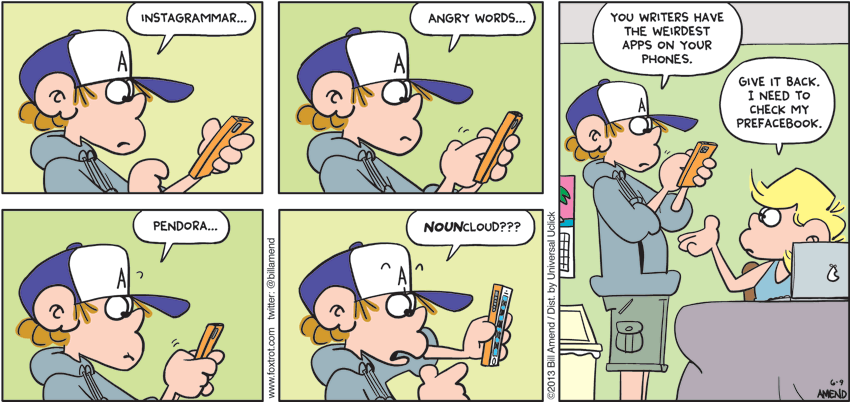
Still love FoxTrot.
Permalink | Comments
Category Just for Fun
Most of you know that I'm not fond of Presbyterian sermons. In my experience, even if they're good they're too long, because the preacher says everything three times. But I'm posting this for three reasons:
- It's local: First Presbyterian Church of Orlando. It was never our church, but both kids had musical gigs there at one time or another.
- It's fascinating: I'd never have guessed this was a Presbyterian preacher. Baptist maybe. Even Pentacostal. But Frozen Chosen? Nah.
- It's a good take on the whole egalitarian/complementarian debate, with points for both sides.
Do I agree with everything? Rhetorical question. You know I never do. But you know there must be something to it if I think a sermon that long is worth listening to.
Permalink | Comments
Category Random Musings
I suppose that title requires some explanation. I don't wish any of our grandchildren harm, but I do wish for them a better good.
Jonathan (age 9 1/2) and Noah (almost 7) have it pretty bad: poison ivy over much of their bodies, faces red and swollen and bound to get worse when the blisters come. I'm not happy that they're suffering.
But they've seen a doctor, who was not at all concerned; they've started treatment, which should help a lot; and they seem to be weathering it surprisingly well (being not nearly as wimpy as their grandmother when it comes to anything skin-rash-related). Therefore I feel free to be delighted at this evidence that life for them is an adventure.
Physically, they were only in their backyard, but who knows where they were in their imaginations? Whatever the adventure was, it required bows and arrows. At some point, both Native Americans and English longbowmen learned that you don't use poison ivy vines for bowstrings, and that if you use your teeth in place of a knife, you'd better know what it is you're cutting into. Jonathan and Noah know that now, too.
They also know that adventure entails risk, and sometimes you get hurt. To be honest, this is not the first time they've learned that particular lesson. My hope is that with each small risk and each small hurt they develop not only muscles and grit, but also discernment, so that by the time they are teens they have a good idea how to tell a reasonable risk from a stupid one.
The following is a multi-hand story. I no longer remember which of my blog- or Facebook-friends pointed me to Brave Moms Raise Brave Kids, though now that I've found it again through a Google search on a phrase I remembered, I'm guessing it was something on Free-Range Kids. It turns out that the story wasn't the author's anyway; her source was a sermon by Erwin McManus. (Don't expect to get much from that link unless you're a subscriber of Preaching Today.)
The gist of the story is this: McManus's young son, Aaron, came home from Christian camp one year, frightened and unable to sleep because of the "ghost stories" told there about devils and demons. He begged his father not to turn off the light, to stay with him, and to pray that he would be safe. Here's his father's unconventional response:
I could feel it. I could feel warm-blanket Christianity beginning to wrap around him, a life of safety, safety, safety.
I said, "Aaron, I will not pray for you to be safe. I will pray that God will make you dangerous, so dangerous that demons will flee when you enter the room."
There's nothing wrong with praying for safety. I pray constantly for the safety of those we love, and of others as well. But McManus's point is well taken: Safety is not much of a life goal. I want our grandchildren (boys and girls) to grow up dangerous to all that is evil, and to all that is wrong with the world.
Sometimes poison ivy is just poison ivy, but sometimes it is warrior training.
Permalink | Comments
Category Health Children & Family Issues Everyday Life
Asian buffet restaurants are kind of like IHOP as far as I'm concerned: you need to go there every few years to remind yourself of why you don't go there more often. The idea always sounds so good ... and the reality always disappoints.
We had a coupon for the new World Gourmet restaurant in town, so we went there after church on Sunday. (The link is to the one in California, but it looks like the same thing.) You can't say they don't have variety: I wouldn't go so far as to say world, but there was what I'd call standard American fare in addition to the Asian food. But as usual, the quality just wasn't there, nor can you expect it with all that quantity and variety.
Still, the selection was nice, the honey chicken was especially good, and—when I made a point to be the first one in line when the new batch came out—so were the French fries. Whenever I'm in a place like that, I think of a football-playing friend of Heather's in high school: he could really have done it all justice. Me? I took what I liked, and for once didn't eat too much. Someone has to make up for the football players.
Sunday, June 2: How Great Is Our God (Chris Tomlin, arr. Jack Schrader, Hope Publishing Company, C5491).
(A reminder, for the record: neither of these recordings is of our choir.)
UPDATE 10/25/19: I see that the automated update of Flash to iFrame has once again chopped out a section of the post between the first video and the last line, hence The Gift of Love is missing.
Cooked: A Natural History of Transformation by Michael Pollan (Penguin, 2013)
(This is a long post, with many excerpts from the book. Consider it an appetizer.)
I almost always start writing reviews in my mind before finishing the book. I'd planned to begin this one with, "I've never met a Michael Pollan book I didn't love. Having made my way through the 468 pages, I can still say that with honesty, though honesty also compels me to admit the last quarter of the book was somewhat of a trial.
For all his interest in food, Pollan hadn't given cooking much thought.
Until, that is, I began trying to unpack a curious paradox I had noticed while watching television, which was simply this: How is it that at the precise historical moment when Americans were abandoning the kitchen, handing over the preparation of most of our meals to the food industry, we began spending so much of our time thinking about food and watching other people cook it on television? The less cooking we were doing in our own lives, it seemed, the more that food and its vicarious preparation transfixed us.
I see this less as a paradox and more as a repeated pattern: the less we commit to and invest of ourselves in the heart and meaning of something, the more we extravagantly value the form, and set others to doing it for us. When the marriage itself was the raison d'être of a wedding, a reception created and overseen by "women of the church" was sufficient to honor the couple and the guests. Now we have devalued the marriage vows and it's the reception, professionally catered, decorated, and orchestrated, into which the time, money, and attention are poured. The less we make music ourselves, in our families and communities, the more we value the concert tickets, recordings, and iPods that bring the work of the professional musician into our lives. How many sports fans, ever-ready to critique the missed basket, the dropped ball, the faulty kick, get any closer to a real game than driving their children to practice?
But I digress. What Pollan did was to get serious about cooking for himself and his family.
[The decline of home cooking] is a problem—for the health of our bodies, our families, our communities, and our land, but also for our sense of how our eating connects us to the world. Our growing distance from any direct, physical engagement with the processes by which the raw stuff of nature gets transformed into a cooked meal is changing our understanding of what food is. Indeed, the idea that food has any connection to nature or human work or imagination is hard to credit when it arrives in a neat package, fully formed. Food becomes just another commodity, an abstraction. And as soon as that happens we become easy prey for corporations selling synthetic versions of the real thing—what I call edible foodlike substances. We end up trying to nourish ourselves on images.
It has been argued that it is more efficient to work an extra hour at the office, doing what we do well, and let restaurants do what they do best.
Here in a nutshell is the classic argument for the division of labor, which, as Adam Smith and countless others have pointed out, has given us many of the blessings of civilization. It is what allows me to make a living sitting at this screen writing, while others grow my food, sew my clothes, and supply the energy that lights and heats my house. I can probably earn more in an hour of writing or even teaching than I could save in a whole week of cooking. Specialization is undeniably a powerful social and economic force. And yet it is also debilitating. It breeds helplessness, dependence, and ignorance and, eventually, it undermines any sense of responsibility.
Pollan divides his cooking adventures, cleverly and classically, into Fire, Water, Air, and Earth. Fire is a dissertation into the earliest and most primitive cooking method: meat over flame. Along the way he explores the "cooking hypothesis," a recent theory that attempts to explain the development of Homo erectus, "the first primate to bear a stronger resemblance to humans than apes."
Anthropologists have long theorized that the advent of meat eating could account for the growth in the size of the primate brain, since the flesh of animals contains more energy than plant matter. But ... the alimentary and digestive apparatus of Homo erectus is poorly adapted to a diet of raw meat, and even more poorly adapted to the raw plant foods that would still have been an important part of its diet, since a primate cannot live on meat alone. The chewing and digestion of raw food of any kind requires a big gut and big strong jaws and teeth—all tools that our ancestors had lost right around the time they acquired their bigger brains.
The control of fire and discovery of cooking best explain both these developments. ... Appliying the heat of a fire to food transforms it in several ways—some of them chemical, others physical—but all with the same result: making more energy available to the creatures that eat it. ... [C]ooking opened up vast new horizons of edibility for our ancestors, giving them an important competitive edge over other species and, not insignificantly, leaving us more time to do things besides looking for food and chewing it. ... [Anthropologist Richard Wrangham] estimates that cooking our food gives our species an extra four hours a day. (This happens to be roughly the same amount of time we now devote to watching television.)
By freeing us from the need to feed constantly, cooking ennobled us, putting us on the path to philosophy and music. All those myths that trace the godlike powers of the human mind to a divine gift or theft of fire may contain a larger truth than we ever realized.
Yet having crossed this Rubicon, trading away a big gut for a big brain, we can't go back, as much as raw-food faddists would like to. ... By now, "humans are adapted to eating cooked food in the same essential way as cows are adapted to eating grass," Wrangham says.
Pollan discusses animal sacrifice, and why fire-cooked meat-eating grew up as a sacred act, hedged in by a multitude of rules and governed by a priestly class. From there he moves naturally to the modern barbecue, which retains obvious vestiges of those ancient cultures. I dare you (unless you happen to be a diehard vegetarian) to read this section of the book without your mouth watering. For the record, "authentic barbecue" has nothing to do with what you do when you slap a steak on your gas grill. It is pork, pork alone, and preferably the whole pig, cooked with as many rules as any ancient sacrifice. It's a pity I didn't know anything about barbecue culture when my in-laws lived in South Carolina!
Cooking with water came later in our history, since it required the development of some sort of pot. It also almost universally became "women's work," whereas fire cooking, full of ceremony, drama, and religious significance, was the purview of men.
There's nothing ceremonial about chopping vegetables on a kitchen counter, slowly sautéing them in a pan, adding a liquid, and then tending the covered pot for hours. For one thing, there's nothing to look at. (And please don't even try, since a watched pot never boils.) For another, this sort of cooking takes place indoors, in the prosy confines of a kitchen. No, this is real work.
So why would you—why would anyone?—do it if you didn't have to? When you could go out or order in or pull "a home meal replacement" from the freezer and nuke it in the microwave? This is of course precisely what more and more people are doing today instead of cooking. Cooking is no longer obligatory, and that marks a shift in human history, one whose full implications we're just beginning to reckon. No one has to chop onions anymore, not even the poor. Corporations are more than happy to chop them for us, and often at bargain rates.
Somewhat more than half of the evening meals an American eats today are still "cooked at home," according to the market researchers. That sounds like a lot, until you discover that the meaning of the verb "to cook" has been defined radically downward in the last few years.
I learned this from a veteran food-industry market researcher named Harry Balzer ... with whom I've now spent several illuminating, if discouraging, hours discussing the future of cooking. ... "People call things 'cooking' today that would roll their grandmother in her grave," he explained. "Like heating up a can of food or microwaving a frozen pizza." [So his firm] decided to tighten up, at least slightly, the definition of what it means to cook. ... To cook "from scratch," they decreed, means to prepare a main dish that required some "assembly of ingredients." [Under this definition, pouring bottled dressing on lettuce counts as cooking, as does making a sandwich.] ... I kept asking him what his reasearch had to say about the prevalence of the activity I referred to as "real scratch cooking"—the kind of cooking that begins with chopping onions. ... Apparently the activity has become so rarefied as to elude his tools of measurement.
"Here's an analogy," Balzer offered. "A hundred years ago, chicken for dinner meant going out and catching, killing, plucking, and gutting a chicken. Do you know anybody who still does that? It would be considered crazy! Well, that's exactly how cooking will seem to your grandchildren. Like sewing, or darning socks—something people used to do when they had no other choice. Get over it!"
Discouraging, indeed. But Pollan has hope: "[I]t could simply be that [Balzer] subscribes to the general view in a modern specialized consumer culture that 'leisure activities' should involve consumption, whereas any activity involving production is leisure's opposite: work." And work, of course, is something to be avoided. Fortunately for future generations, that belief is not universal. In our extended family nearly everyone cooks—including the younger generation, from preschool to college student. Several sew, some knit, and if none raise and eat their own chickens, we know people who are "crazy" enough to do so.
Which raises an interesting question: As a political matter, is home cooking today a reactionary or a progressive way to spend one's time?
Water is mostly about braising, and I never knew there was so much to it.
Porter and I are presently watching The Everyday Gourmet: Rediscovering the Lost Art of Cooking, a very enjoyable Great Courses DVD class. A constant source of amusement has been to note how free the chef is in his use of salt as a seasoning. The chef who taught Pollan to cook feels the same way:
"Use at least three times as much salt as you think you should," she advised. (A second authority I consulted employed the same formulation, but upped the factor to five.) Like many chefs, Samin believes that knowing how to salt food properly is the very essence of cooking, and that amateurs like me approach the saltbox far too timorously. ...
Samin prefaced her defense of the practice by pointing out that the salt we add to our food represents a tiny fraction of the salt people get from their diet. Most of the salt we eat comes from processed foods, which account for 80 percent of the typical American's daily intake of sodium. "So, if you don't eat a lot of processed foods, you don't need to worry about it. Which means: Don't ever be afraid of salt!"
If cooking with fire made the nutrition in flesh more available to humans, cooking with water did the same for plants.
Many of the important crops humankind has domesticated require boiling (or at least soaking) for us to be able to eat them.... The cook pot is a kind of second human stomach, an external organ of digestion that allows us to consume plants that would otherwise be inedible.... These auxiliary clay stomachs made it possible for humans to thrive on a diet of stored dry seeds, which in turn led to the accumulation of wealth, the division of labor, and the rise of civilization. These developments are usually credited to the rise of agriculture, and rightly so, but they depended as much on the cook pot as on the plow.
Cooking food in pots also helped expand the human population, by allowing for earlier weaning of children (thereby increasing fertility) and a longer life span, since both the very young and the very old could now be fed soft foods and nutritious soups out of the pot, no teeth required. ...
According to the historian Felipe Fernández-Armesto, the invention of the cook pot (and its offshoot, the frying pan) is the last innovation in the history of cooking until the advent in our own time of the microwave oven.
Braising brings out the taste of umami, or savoriness.
The most important chemical known to stimulate the umami receptors [which are in the stomach as well as on the tongue] is the amino acid glutamate and the nucleotides inosine and guanosine, all of which are by-products of the breakdown of protein.
Which is of course precisely what is going on in a long-simmered stock.... In fact, chicken stock is loaded with glutamate, which has been contributed not only by the protein-rich meat but by the slow cooking of the aromatic vegetables as well. ... But though umami can make a food taste "meaty," meat is only one of the many sources of glutamate. ... Ripe tomatoes, dried mushrooms, Parmesan cheese, cured anchovies, and a great many fermented foods (including soy sauce and miso paste) ... can be added to a dish to boost its quotient of umami. ... And the reason we sometimes, à la Julia Child, [brown] our meat in bacon fat? Because bacon is a veritable umami bomb, containing all of the umami compounds that have thus far been identified. [emphasis mine]
Pollan calls the Japanese fish stock, dashi, "a cooking water designed, albeit unwittingly, to contain as much umami and as little of anything else as possible." I use it in making a version of katsudon; the last time I did so, I commented that it was so rich that next time I was going to leave the pork out altogether, since what I liked best was the broth/rice/egg combination. Pork-less katsudon is an oxymoron, but I'll bet it will taste delicious even so.
In the "who would have guessed?" department, it turns out that breast milk is rich in umami, and contains nearly as much glutamate as dashi.
Cooking with water may have made grains edible, but Air is the element that made them into that divine food, bread. Most of the third part of Cooked is devoted not only to bread, but specifically to bread made with a sourdough starter and its wild yeasts and bacteria. My sourdough bread is good, but is based on commercial yeast. I'm going to have to try again to make a natural starter, having now learned that my previous attempts were too timid: I didn't leave my flour/water batter open to the elements nearly long enough. I still wonder how well it will work with Florida's combination of microbes. Interestingly, Lactobacillus sanfranciscensis, which is critical to the process and the flavor, is not, as was once thought, limited to San Francisco, but is found in bakeries all over the world. It is also found only in sourdough bread cultures. So maybe my success or failure will be dependent on how many other sourdough bakers there are in Florida ... no wonder San Francisco reigns supreme.
For [bread baker] Richard Bourdon, the problem with most bread is that it is essentially undercooked, and therefore more difficult to digest than it should be. This is why he favors long fermentations and unusually wet doughs. Wet dough was the norm before the mechanization of baking. Human hands can't handle dry doughs very well (even if they are easier to shape, they are much harder to mix and knead), and machines can't handle wet ones at all. But they make much better breads. Bourdon is fond of saying, "You would never cook a cup of rice in half a cup of water." Even more than flavor or beauty, Bourdon is after the perfect nourishment that only the most thorough cooking can ensure. He came out of the macrobiotic movement, and is something of a poet of human digestion. Which, he explains, begins in the mouth the moment you bite into a bread.
"This is why the acids in sourdough are so important! They make your mouth water, so the enzymes in your saliva can begin to digest the starches. That's how you can tell good bread from bad: Roll a little ball of it and put it in your mouth. What happens? Does your mouth feel dry, like you want a sip of water, or is it nice and wet?"
I'm a head-over-heels fan of King Arthur Flour's White Whole Wheat flour, which they claim has all the nutrition of "regular" (red) whole wheat but a lighter color and flavor. They also say to use it like red whole wheat, mixing it with white flour in recipes, but I've found I sometimes prefer it at 100%. I still make my bread with a mixture, but for cookies, brownies, and even cakes I now find I prefer the flavor imparted by the white whole wheat flour.
King Arthur calls the red wheat "traditional whole wheat," but I began to question that when, in my genealogical research, I came upon newspaper ads advising farmers to throw over their old-fashioned white wheat for the new and "better" red variety. Cooked confirmed my suspicions.
More than just a new food product, white flour helped usher in a new food system, one that would extend all the way from the field to the loaf of presliced and fortified white bread, which now could be manufactured on an assembly line in three or four hours without ever being toughed by human hands. The wheat plant changed, too. The new roller mills worked best with hard-kernelled red wheat; the big, tough bran coat on this type of wheat could be sheared cleanly and completely from the endosperm, whereas softer white wheat left infinitesimal specks of bran in the flour. So, over time, breeding changed the plant to better suit the new machine. But because hard wheat has tougher, bitterer bran, it made whole-grain flour even coarser and bitterer than it had been before—one of several ways that the triumph of white flour made whole wheat less good.
Whole-grain bread has been enjoying something of a renaissance. Actually, that renaissance got a first, false start during the 1960s, when the counterculture, steeped in romantic ideas about "natural food," seized on white bread as a symbol of all that was wrong with modern civilization. Brown bread, being less processed than white, was clearly what nature intended us to eat. They probably should have stopped there, but did not, alas. Baking and eating brown bread also became a political act: a way to express one's solidarity with the world's brown peoples (seriously), and to protest the "white bread" values of one's parents, who likely served Wonder Bread at home. These ideals resulted in the production of some uncompromising and notably bricklike loaves of dark, seedy bread, which probably set back the revival of whole-grain baking a generation. "That hippie texture" is a cross that whole-grain bakers still bear today, along with the widespread belief that whole-grain bread promises rather more nutritional and ideological rigor than eating pleasure.
Using commercial yeast to leaven whole-grain flour so rapidly may present another problem for our health. All whole grains contain phytic acid, which locks up minerals not only in the bread but, if you eat enough of it, in the body of the bread eater as well. One of the advantages of a long sourdough fermentation, as we've seen, is that it breaks down the phytic acid, freeing up those minerals. It also makes the gluten proteins more digestible and slows the body's absorption of starch. That's why a sourdough white bread actually has a lower glycemic index than a commercially yeasted whole-grain bread.
That doesn't sound like great news for my cookies and brownies and cakes, which are not fermented. But they still taste better.
Earth was simultaneously the most interesting—because I know less about fermentation than about cooking—and the most depressing section. If you've successfully waded through all the quotations above, you'll be relieved to know that I placed very few sticky notes in the Earth section. The book was due back to the library....
The information about fermentation—which Pollan views as a form of cooking—is fascinating, as are the sections on probiotics, prebiotics, and the human gut.
For years nutritionists were mystified by the presence in mother's milk of certain complex carbohydrates, called oligosaccharides, which the infant lacked the necessary enzymes to digest. Evolutionary theory argues that every component of mother's milk should have some value to the developing baby, or else natural selection would be likely to discard it as a poor use of the mother's precious resources. So why would she produce nutrients her baby can't metabolize? It turns out the oligosaccharides are there to feed not the baby but certain of its intestinal microbes: Their presence in the diet ensures that certain optimal species of bacteria, and specifically Bifidobactgerium infantis, proliferate and get established before less savory characters gain a toehold.
Medical researchers are coming around to the startling conclusion that, in order to be healthy, people need more exposure to microbes, not less; and that one of the problems with the so-called Western diet—besides all the refined carbohydrates and fats and novel chemicals in it—is the absence from it of live-culture foods. The theory is that these foods have a crucial role to play in nourishing the vast community of microbes living inside us, which in turn plays a much larger role in our overall health and well-being than we ever realized. Bacteria-free food may be making us sick. ...
The biggest problem with the Western diet," Stephen O'Keefe, a gastroenterologist at the University of Pittsburgh, told me, "is that it doesn't feed the gut, only the upper GI.... All the food has been processed to be readily absorbed, leaving nothing for the lower GI. But it turns out that one of the keys to health is fermentation in the large intestine." ... We have changed the human diet in such a way that it no longer feeds the whole superorganism, as it were, only our human selves. We're eating for one, when we need to be eating for, oh, a few trillion. ...
A growing number of medical researchers are coming around to the idea that the common denominator of many, if not most, of the chronic diseases is inflammation—a persistent and heightened immune response by the body to a real or perceived threat. ... One theory ... is that the problem begins in the gut, with a disorder of the microbiota, and specifically of the gut wall. For when the integrity of the epithelium has been compromised, various bacteria, endotoxins, and proteins can slip into the bloodstream, causing the body's immune system to mount a response.
[T]he case for getting more live-culture foods in the diet (especially of our children) is already compelling and growing more so.
Pollan tackles fermented vegetables (kimchi, traditional sauerkraut, miso, fish sauce, and much, much more), then the wonders of cheese, and finally, beer and other alcoholic drinks. That's all good, but his dissertation on disgust, and why we (though not I) like stinky cheeses, natto (Japan), and rotted shark (Iceland), gets downright weird, and yes, disgusting. The taboo, the forbidden, sex, death, decay, bodily excretions and odors, the attractiveness of hideous things ... well, as I said, it nearly ruined the book for me. I still highly recommend 97% of Cooked, but if your stomach isn't a lot stronger than mine, you might consider avoiding the worst by skipping pages 359 to 370. It's a long book; you won't be missing much. What's impossible to avoid is the random sprinkling, mostly in the last two sections and usually when quoting someone, of words that until recently never showed up in a "decent" book—at least none that I read. Now I can't avoid them, and I think literature is much the poorer for it. Then again, I don't like stinky cheeses, either.... So even though it feels like a slap in the face every time, I grit my teeth and endure.
On to happier things:
Knowing how to bake bread or brew beer with your own two hands is to more deeply appreciate a really good beer or loaf of bread—the sheer wonder of it!—when you're lucky enough to come across one. You won't take it for granted, and you won't stand for the synthetic.
But even better, I found, is the satisfaction that comes from temporarily breaking free of one's accustomed role as the producer of one thing—whatever it is we sell into the market for a living—and the passive consumer of everything else. Especially when what we produce for a living is something as abstract as words and ideas and "services," the opportunity to produce something material and useful, something that contributes directly to the support of your own body (and that of your family and friends), is a gratifying way to spend a little time—or a lot.
Of all the roles the economist ascribes to us, "consumer" is surely the least ennobling. It suggests a taking rather than a giving. It assumes dependence and, in a global economy, a measure of ignorance about the origins of everything that we consume. Who makes this stuff? Where in the world does it come from? What's in it and how was it made? The economic and ecological lines that connect us to the distant others we now rely on for our sustenance have grown so long and attenuated as to render both the products and their connections to us and the world utterly opaque. You would be forgiven for thinking—indeed, you are encouraged to think!—there is nothing more behind a bottle of beer than a corporation and a factory, somewhere. It is simply a "product." ... To brew beer, to make cheese, to bake a loaf of bread, to braise a pork shoulder, is to be forcibly reminded that all these things are not just products, in fact are not even really "things." Most of what presents itself to us in the marketplace as a product is in truth a web of relationships, between people, yes, but also between ourselves and all the other species on which we still depend. ... The beer in that bottle, I'm reminded as soon as I brew it myself, ultimately comes not from a factory but from nature—from a field of barley snapping in the wind, from a hops vine clambering over a trellis, from a host of invisible microbes feasting on sugars.
[S]urely the most important of all the relationships sponsored by this work is the one between those of us who elect to do it and the people it gives us the opportunity to feed and nourish and, when all goes well, delight. ... Cooking is one of the more beautiful forms that human generosity takes.
And just as surely this puts the calling and profession of homemaker in a new light. But I'll leave the elaboration of that thought to my able—and hopefully less bleary-eyed—readers.
Make the Bread, Buy the Butter: What You Should and Shouldn't Cook from Scratch—Over 120 Recipes for the Best Homemade Foods by Jennifer Reese (Free Press, 2011)
In 2008, like many people, Jennifer Reese lost her job. I don't know what that job was, but if it didn't involve writing, losing it was not a tragedy, but a blessing. She's a wonderful writer: clear, informative, and funny. Definitely funny.
Faced with the opportunity to reconsider her life, Reese decided to focus on food, and the modern tension between do-it-yourself and buy-it-off-the-shelf:
Where is that sweet spot between buying and making? What does the market do cheaper and better? And where are we being deceived, our tastes and habits and standards corrupted? Could I answer this question once and for all? I didn't want an answer rooted in ideology, or politics, or tradition, or received wisdom. I wanted to see the question answered empirically, taking into account the competing demands—time and meaning, quality and conscience, budget and health—of everyday American family life.
And so, over the next months and years, I got some chickens, which I loved; and some ducks, which I loathed; and some turkeys, which we slaughtered. I learned to make cheese and keep bees and worried that the neighbors were going to call Animal Control. I cured bacon and salmon, canned ketchup, baked croissants, and made vanilla extract and graham crackers. I planted tomatillos and potatoes and melons and squash. My son, Owen, joined 4-H and practically moved into the yard, while my teenage daughter, Isabel, refused to step outside the back door at all, especially after the goats turned up. My husband, Mark, rolled his eyes at all of it except the homemade yogurt. That, he ate by the quart. At the height—or maybe it was the depths—of my homemaking experiment, I had pickles lacto-fermenting on the counter and seven varieties of jam, ranging from banana-chocolate to plum, arrayed in the pantry, and absinthe and Taleggio cheese mellowing in the crawl space behind my closet. I was overwhelmed and a bit of a mess, but I had my answers.
Turkeys? Homemade bacon? This was no simple save-money-by-making-my-child's-school-lunch project. But the results make for marvellous reading. It's a treasure trove of recipes, too, and I would be tempted to add a copy to my collection, if I weren't busy trying to get rid of a vast collection of cookbooks gathering dust on the shelves because when I need a recipe and it's not handy, I immediately turn to Chef Google.
The answer to the question that drove me to reading the book, Why not make the butter? is a simple matter of economy. Making butter is easy, and the result delicious, but cream is expensive. Store butter is good enough that the author can't justify the extra expense of homemade. "Unless," she adds, "you have a cow."
Reese might have chosen a different title: Make the Bun, Buy the Hot Dog. What she went through to make hot dogs leaves me all the more glad that Oscar Mayer now has a nitrate/nitrite-free hot dog that is delicious.
Make the Bread, Buy the Butter is much more than a recipe book. For each entry, you get a story (often funny), a recipe, a difficulty rating, a cost comparison, and a "make it or buy it" recommendation. Sometimes the answer is "both." There's nothing like homemade mayonnaise, for example, but "Hellmann's has its place."
Maybe my favorite quote:
"Eat all the junk food you want as long as you cook it yourself," Michael Pollan writes in Food Rules. ... "Chances are good it won't be every day."
Oh Michael Pollan, you underestimate me.
Finally, a longish quote from the Afterward, which sums things up well:
It's empowering to know I can cure bacon, brew vanilla, age Camembert, extract honey from a hive, and behead a chicken, even if I have no desire to do at least one of those things ever again. Even if, in the end, I spent more money than I saved. (A few costly projects like the chickens and the bees ate up all the savings of from scratch cooking.) Big food companies flatter us by telling us how busy we are and they simultaneously convince us that we are helpless. I am moderately busy, but not all that helpless. Neither are you. Everything I did in the course of my scratch-cooking era—with the possible exceptions of eviscerating poultry and stuffing hot dogs—was very, very easy. [She must have blocked out the experience of making croissants: "unbelievable hassle," though she still recommends making them, unless you live near a good French bakery.]
But the more helpless we feel, the lower those food companies move the bar of our expectations, and the bar is now very low at your local supermarket. Trust me. I have eaten my way through mine. It makes me quite furious when I think about the sicketating powdered hollandaise sauce, the extortionate price of the vanilla extracts, the pathetic bread, the soups sweetened with corn syrup, the abomination of Pillsbury "creamy vanilla" canned frosting that contains neither cream nor vanilla. It upsets me that we pay as much for these foods as we do.
Almost everything is better when it's homemade. While this may have started out as opinion (though I'm not sure it did), I would now state it confidently as fact. Almost everything. But not everything. Which makes me inordinately happy. Because I think it's reassuring that you can walk into a supermarket and buy a bag of potato chips and a tub of rice pudding that are better than anything you can make at home. I wish there were more foods like that. I really don't want to spend my life standing over a stove, muttering about the evils of ConAgra and trans fats. It seems a tragic waste to shape one's life around doctrinaire rejection of industrial food. Which means, I suppose, both insisting on high standards most of the time and then, sometimes, relaxing them.
Jennifer Reese has a blog, The Tipsy Baker. I haven't read much yet, but I'm sure I'll find it clear, informative, and funny.

