On this day in 1989 the gates opened, and the German people themselves answered President Reagan's famous call.

Porter, who more than two decades before had crossed over to East Berlin (and back) at the terrifying Checkpoint Charlie, understands best the wonder and glory of the day, but our kids each have a souvenir piece of the Wall, thanks to friends who were living in Germany at the time.

Thanks be to God.

posted by sursumcorda on Friday, November 9, 2012 at 10:48 AM
Permalink | Comments
Category Politics

No one I know wrote this letter, but it was posted on Facebook by a friend I respect, who called it thought-provoking.  I agree.  I'd never heard of Steve Elliott, nor his Grassfire Nation organization, and a quick glance tells me he's a little too far to the political right for my comfort.  But no matter.  He's written a very wise letter, one that people of all political persuasions would do well to consider when events don't go their way.  The whole letter is worth reading, but here's the heart of it.  (Elliott openly invites sharing via Facebook, Twitter, and other social networking sites, so I'm hoping he won't mind my extensive quotations.)

I'm writing to you to explain why, even after a late and discouraging evening that stretched past 1:00 a.m. on the East Coast, I was back at the office before 8:00 a.m. this morning.

And why the sinking feeling I felt last night has already been replaced with a deep determination.

And why I'm going out to buy equipment for our new office this afternoon. 

And why we are going to build, build, build -- despite a stunning and, for me, unexpected defeat.

I want to share with you a letter that, although 2,500 years old, it could have been written this morning. For us. For faithful patriots who feel like they just discovered they will have to live at least the next four years in exile.

This letter was written to Jewish exiles who had been pushed out of Jerusalem and forced to live under a tyrannical ruler named Nebuchadnezzar.

The exiles wanted one thing: they wanted to be re-established back in Israel. They even had a prophet named Hananiah come to them and tell them that their time of exile would only last two years.

You can read about it in Jeremiah 28.

Hananiah was a false prophet. He died.

And so Jeremiah wrote a letter to the exiles. You've probably heard a part of that letter recited many times. It's one of the most commonly quoted passages in the entire Bible. Unfortunately, this passage is mostly taken out of its proper context and delivered as a "feel good" word that everything is going to be O.K.

One of my friends was quoting this verse yesterday morning:

 "For I know the plans I have for you," declares the Lord, "plans to prosper you and not to harm you, plans to give you hope and a future."

Those words sound so good. The future is bright. God has a plan for prosperity, for a real hope and a real future. On the eve of the election, it must have meant a Romney win, the GOP takes the Senate and we start the rollback of the Obama regime, right?

Not exactly.

Here's the shocking context of Jeremiah 29 (and I offer to you, the context for November 6, 2012): the plan was exile.

That was the "plan" Jeremiah's letter was talking about. I encourage you to go read all of Jeremiah 29. Here is the immediate context:

This is what the Lord says: "When seventy years are completed for Babylon, I will come to you and fulfill my good promise to bring you back to this place. For I know the plans I have for you ..."

The plan was 70 years of exile. Keep that in mind the next time someone quotes Jeremiah 29:11 to encourage you that your time of trouble will soon end. Not only was the exile going to last 70 years, the exile WAS the plan!

If you don't believe me, go back and read the beginning of the letter, from Jeremiah 29:4. Here you'll see the Lord (through Jeremiah) giving the Jewish exiles specific instructions on how to conduct themselves in exile:

--Build houses and settle down.

--Plan gardens and eat what they produce.

--Marry and have sons and daughters.

--Marry off your sons and daughters so they can have children.

--Increase in number; do not decrease.

Again, remember the context. A false prophet had just come and said the time of exile would only last two years. That prophet died. The truth is, the people will be in exile for 70 years. And the directive is to build families, grow businesses, think trans-generationally and increase.

It gets better. Because Jeremiah's letter makes it clear that building and marrying is not enough. People in exile must do something else -- they must be a blessing to the land.

"Also, seek the peace and prosperity of the city to which I have carried you into exile. Pray to the Lord for it, because if it prospers, you too will prosper."

So let's review. First, the plan is exile. Second, build. Third, bless. Simple, clear instructions.

But why was this important? Why a "plan" for exile with specific instructions on how to act in exile?

Historians tell us it was during the Babylonian captivity that the Israelites moved from a Temple/Jerusalem focused society to a synagogue and community focused society. Simply put ...

It was the lessons learned during their time in exile which enabled the Jews to survive 2,500 years in exile. But not just survive -- but to thrive and become the most prosperous, most successful and most innovative people group in the history of civilization.

Exile was the plan.

So that's why, today, I'm going to build. And I'm going to plant. I'm going to bless. And I'm going to pray.

For that is the final piece to the puzzle ...

"Then you will call on me and come and pray to me, and I will listen to you. You will seek me and find me when you seek me with all your heart."

So let's get building. Let's get planting. And let's get praying. And let's bless this land. There are lessons to be learned in exile.

posted by sursumcorda on Friday, November 9, 2012 at 06:13 AM
Permalink | Comments
Category Politics

Actually, it was a private letter, from Porter to the President.  But I liked it so much I begged permission to post it.

Mr. President,

Congratulations on your re-election.  I believe you now have 80 days to establish your legacy.  Just as it took a “conservative” Nixon to open the door to Red China and a “liberal” Democrat—Clinton—to establish welfare reform and NAFTA so, I believe, it will take the “champion of the 47%” to effectively reform (which is to say cut) Social Security and Medicare.

This coming lame duck session is your best hope to get this started.  With Joe Lieberman and others retiring they have a chance to do what is right for the country as opposed to what will get them elected in the next cycle. I believe these next 80 days will establish your legacy—as the President who courageously faced the “fiscal cliff” with meaningful reform—or as the President who muddled along relying on QE3, 4, 5 ad infinitum to inflate away the national debt and the national greatness.  Please take on the challenge.

Respectfully yours,

It can happen.  If President Obama has the will, the strength, and the courage he can lead his party to make the difficult but necessary choices that they would never have agreed to under a Republican president.  The Republicans will do well to support and encourage him in this, verbally and by making their own painful compromises.  The object is not to "win," not to score points, it's not even to get (re)-elected.  The object is to climb out of this economic pit and leave for our children an economy that is strong, sane, stable, and just.  The blame for this pit is well spread among Democrat and Republican; rich and poor; financial institution, big business, and average American.  The sooner we admit that, the sooner we can make progress.  If there is a fair solution to be found, it will succeed only insofar as it inspires everyone to participate—and yes, to sacrifice—beginning with those who by running for office made the choice to assume the responsibilities of leadership.

The American Dream was never about getting rich, nor about security, but about a country where hard work and thrift were rewarded by opportunity, and about parents whose goal was not their own comfort but the well-being of their children and grandchildren.

Dare to dream, Mr. President.  Dare to be a leader!

posted by sursumcorda on Thursday, November 8, 2012 at 02:54 PM
Permalink | Comments
Category Politics
  • If your candidate loses, the next four years will not be as bad as you fear.
  • If your candidate wins, the next four years will not be as good as you hope.

So, winners, please do not be downcast tonight, but do your best in the next four years to support a president who will need all the encouragement and prayers he can get. Losers, please do not gloat tonight, but do your best in the next four years to support a president who will need all the encouragement and prayers he can get.

posted by sursumcorda on Tuesday, November 6, 2012 at 05:57 PM
Permalink | Comments
Category Politics

I love Air New Zealand.  Back in 1997, we flew Air New Zealand to ... well, to New Zealand!  It was the longest flight I've every taken; nonetheless, it was the most enjoyable.  They actually encouraged us to get up and walk laps around the spacious jet, instead of restricting us to one small aisle and requiring us to remain seated most of the time.  The food was great, too.

Unfortunately, I don't see the opportunity to check out what might have changed in the ensuing 15 years, but if this safety video is any indication, they're still a great airline.  I've flown enough to be bored and blasé when the attendents begin to instruct us how to fasten our seat belts, but this presentation would have my full attention.  I enourage you to watch it full-screen.  Thanks, Dawn, for sharing it!

posted by sursumcorda on Saturday, November 3, 2012 at 06:39 PM
Permalink | Comments
Category Just for Fun

As a homemaker, I don't find Mondays to be the horror that many people do.   But at the moment I'm feeling a little more sympathy with that point of view.

I will soon find myself in the Phildadelphia area with a day to spare.  A Monday, to be precise.  "Ah ha!"  I thought.  "A perfect day for some genealogy research."  It's not all that infrequently that I find myself somewhere interesting, genealogically speaking, but my time is almost always taken up by Higher Priorities, i.e. family.  But I will be briefly at loose ends this time, and was looking forward to a lovely day spent with books, papers, and my computer.

Lancaster, Pennsylvania, holds some important clues for one of my genealogical brick walls.  My first stop I intended to be at the Lancaster County Historical Society's library.  It looks promising, but it is

Closed on Mondays.

Okay, on to Plan B.  The Lancaster Mennonite Historical Society also has some of the books I'm interested in.  But alas, it is also

Closed on Mondays.

Well, how about a Plan C?  Harrisburg is the home of the Pennsylvania State Library, which holds potential material for both my eastern and my western Pennsylvania family, and it's not all that far from Philadelphia.  But, you guessed it:  it is

Closed on Mondays.

Garfield would approve.

posted by sursumcorda on Friday, November 2, 2012 at 09:58 AM
Permalink | Comments
Category Genealogy

Mea culpa!  It's been nearly a year since my post about Stephan's Dots book (numbers in four languages), and I never did update it with Joseph's response.  It was an immediate hit, and is still one of Joseph's very favorite books.

Here are a few videos showing Joseph and the book in action:

The book arrives!

The book has proved very durable under heavy use, and if the $70 cost seems extravagant, I'd say Joseph has definitely gotten his parents' money's worth already.

Update 10/16/19:  As has happened with several old posts containing videos, I'm pretty sure a chunck of the post between the video and the final sentence was accidentally removed in the process that switched the videos from Flash to <iframe>.  Someday I may try to recover them ... but realistically, probably not.

posted by sursumcorda on Thursday, November 1, 2012 at 08:37 PM
Permalink | Comments
Category Reviews Education Children & Family Issues Everyday Life

At first, I thought I was reading about an incredible medical breakthrough, instead of the evacuation of a hospital in New York City.  No, that's not true.  At first, I passed over the numbers, as I often do.  So, I suspect, do most people.  (Okay, not Joseph.  But most people.)

New mom Jo-An Tremblay-Shepherd said, "The power went off completely, and all of the monitors, you're seeing all these monitors here, and there's a lot of buzzing and whatnot and everything just went."

Tremblay-Shepherd's son, Jackson, born 27 weeks prematurely, was carried in the dark by a nurse who also held his oxygen tank.

But the back of my mind wouldn't let it go.  Born 27 weeks prematurely?  So I stopped to calculate.  Normal gestation is 40 weeks, 40 minus 27 is ... 13?  Thirteen weeks?  The quintuplets I pray for were born at more than twice that age, just shy of 28 weeks, which is 12 weeks prematurely, and although they are doing well for their age, life has not been easy for any of them.

So I turned to Google, and learned that the youngest premature baby to survive was born at 21 weeks, five days.  At 13 weeks, the baby is but three to three-and-a-half inches long.

So, obviously, the CBS News article was wrong.  The baby was no doubt born at 27 weeks gestation, not 27 weeks prematurely.  Not much more than a typo.  But it set me thinking:  How many of the numbers that assail us in news articles and broadcasts do we absorb without thought, let alone fact-checking?  How much information that is just plain wrong has become part of our national consciousness?  What inaccuracies, mistakes, and downright lies do we propagate unthinkingly?

Scary.

posted by sursumcorda on Wednesday, October 31, 2012 at 12:45 PM
Permalink | Comments
Category Random Musings

It's easy to request books from the library, but if others are in line before me, I never know when they will become available.  Three books, requested at different times and with different numbers of people ahead of me, suddenly became available at the same time—just before my trip to New Hampshire.  (Yes, I realize I haven't written about that yet....)  No problem, I thought.  I have two long plane rides, with intermediate stops, and I'm sleeping all by myself in the new house, so I'll have plenty of time to read.

I always think that, and it's never true.

The short version of the story is that I found myself with three books to read and four days before they were due back at the library.  And all of them so popular they couldn't be renewed, because you can't renew a book that has a hold on it.  The fine assessed for overdue books isn't large, but when people are waiting, I feel an obligation to be on time.

Four days, 750 pages, three reviews.  What is this, college?

Actually, the third review is only half done.  Last night I hurriedly typed in the quotations I had marked for the last book (I hope they're legible; I realized at one point that I'd typed a sentence with my fingers skewed on the keyboard), then jumped in the car and made it to the library five minutes before closing.  But when you get an extension on a paper deadline, the first thing you do isn't sit down and finish the paper.  (Wait.  Maybe that's why I didn't do better in college.)

On Sunday we went to a picnic that we attend annually.  The food's great, and the people pleasant, but even though the friends are mostly Porter's, I always feel that I should, as my father put it, "be more sociable." Thus I rarely do what i'd prefer to do on a sunny day in the park:  read a book.  But I was under the gun this time, so I brought one with me to read on the car ride.  I chatted happily during the meal, but when we were finished eating and the others at my table had drifted off to other activities and conversations, I once again pulled out my book.

One of my favorite truisms about the difference between introverts and extroverts is this:  An extrovert believes it's okay to interrupt someone sitting and reading, on the grounds that that person is surely only reading because he has no one to talk to.

Sure enough, I had read not one page when someone came and sat down with me, wanting to know what I was reading, and why.  I didn't really mind the interruption, as she was a pleasant person, so I explained the situation.  She was sympathetic, and soon left me to my book, but not without shaking her head incredulously at the idea that I would write a book review when no one was paying me for it.

Sometimes I wonder myself.

posted by sursumcorda on Wednesday, October 31, 2012 at 08:33 AM
Permalink | Comments
Category Everyday Life

altA Million Miles in a Thousand Years:  What I Learned by Editing My Life by Donald Miller (Thomas Nelson, 2009)

I started (mentally) writing this review when only a few pages into the book.  The review began something like this:

Given which of us is the famous author and which is not, it would not be wise to say Donald Miller can't write.  But what is definitively true is that, whether he can or not, he doesn't write in a style that I enjoy reading.  It's narcissistic, informal bordering on stream-of-consciousness and slangy bordering on vulgar.  Considering the endorsements from big-name Christians (Jim Wallis, Brian McLaren, Rob Bell, Gary Haugen, Max Lucado) I was expecting a little less nonchalance about casual sex, drug use, smoking, and nihilism.  And it jumps around like one of those modern movies where you don't know what's real and what's not, what's then and what's now.

Before I met the filmmaker guys, I didn't know very much about making movies.  You don't think about it when you're watching a movie, but there's a whole world of work involved in making the thing happen.  People have to write the story, which can take years; then raise a bunch of money, hire some actors, get a caterer so everybody can eat, rent a million miles of extension cords, and shoot the thing.  Then it usually goes straight to DVD.  It's a crap job....

But I like movies.  There's something about a good story that helps me escape.  I used to go to movies all the time just to clear my head.  If it was a good movie, the experience felt like somebody was resetting a compass in my brain so I could feel what was important in life and what wasn't.  I'd sit about ten rows back, in the middle, and shovel sugar into my mouth until my brain went numb....

I'd go to the movies because for an hour or so I could forget about real life.  In a movie, the world faded away and all that mattered was whether the hobbit destroyed the ring or the dog made it home before the circus people could use him as a horse for their abusive monkey.

Really, how much of that can a reader be expected to take?  But there's a reason I finish a book before publishing the review.  It gets much better, mostly because Miller eventually starts focusing on things other than himself.

The change in Miller's life came when two filmmakers approached him with the idea of making a movie of his best-selling memoir, Blue Like Jazz.  (Here's the movie's trailer, which reminds me of why I don't usually watch movies.)  Miller is not happy to discover how much his life must be changed to make a good film.

"[W]hat is wrong with the Don in the book?" The question came out of my mouth more personally than I wanted.

Steve sat thoughtfully and collected his ideas. ... “In a pure story,” he said like a professor, “there is a purpose in every scene, in every line of dialogue. A movie is going somewhere.”

That last line rang in my ear like an accusation. I felt defensive, as though the scenes in my life weren’t going anywhere. I mean, I knew they weren’t going anywhere, but it didn’t seem okay for someone else to say it.

In the process of discovering what makes a good story for a movie, Miller has a revelation:  What makes a good story for a movie, makes a good story for a life.  I'm not at all sure I agree—I've said many times that romantic tragedy makes for great opera but a lousy life—but when he begins to consider his actions in light of the question, "Is this part of a good story?" Miller turns his aimless life around.  He goes hiking in Peru, finds the father he hasn't seen in 30 years, rides his bike across America, and founds The Mentoring Project, which works with churches to provide mentors for fatherless (and effectively fatherless) children.

I was haunted by a feeling of familiarity—with negative connotations—as I read this book, and I finally realized that the style reminds me of Confessions and Reflections of a Traveler.  What saves A Million Miles in a Thousand Years is that, despite my comments above, Miller writes better than Brett McLean.

It's not my kind of book.  I can't say that it makes me want to ride my bike across America or to (personally) drill wells in Africa, but it does make me want to learn more about the art of telling a story.  And viewing life as a story is a fascinating thought.

[Quoting storytelling expert Robert McKee]  "Writing a story isn't about making your peaceful fantasies come true.  The whole point of the story is the character arc.  You didn't think joy could change a person, did you?  Joy is what you feel when the conflict is over.  But it's conflict that changes a person." His voice was like thunder now.  "You put your characters through hell.  You put them through hell.  That's the only way we change."

I think joy does change a person; plenty of growth comes through real joy.  But the story arc analogy puts a different perspective on the age-old problem of pain.

[Reflecting on a tragic story of terrorism]  When we watch the news, we grieve all of this, but when we go to the movies, we want more of it.  Somehow we realize that great stories are told in conflict, but we are unwilling to embrace the potential greatness of the story we are actually in.  We think God is unjust, rather than a master storyteller.

The belief that we enjoy seeing characters "put through hell" may explain why there are so many movies I don't want to watch.  I love stories of life and growth through the sweet joys and minor tragedies of ordinary life, such as Miss Read's (Dora Jesse Saint) Thrush Green and Fairacre books.  One of my favorite scenes in The Lion, the Witch, and the Wardrobe is the ordinary dinner at the Beavers' house.  Likewise in J.R.R. Tolkien's epic books, it's the meals, the conversations, and the everyday parts of life that really capture my attention.

In the end, Miller acknowledges that a "good story" life is not all epic adventures.

It's interesting that in the Bible, in the book of Ecclesiastes, the only practical advice given about living a meaningful life is to find a job you like, enjoy your marriage, and obey God.  It's as though God is saying, Write a good story, take somebody with you, and let me help.

I've over 20 post-it notes adorning the pages of A Million Miles in a Thousand Years, but on reflection I'll skip the rest and quote a longer section that is perhaps my favorite.  It's about Miller's first encounter with Bob Goff and his family, while kayaking in British Columbia.  Bob is a real person, and not the local politician of the same name who handed Heather her diploma when she graduated from high school.  His life is the kind of story that makes you remember not all lawyers deserve the opprobrium many have earned.

We broke camp, packed our boats, and began paddling for home.  But before crossing the inlet, our guide wanted to show us a lodge a man had built the previous year, a massive house set on a ledge just off the water.  i thought it was odd that anybody would build a house back there, since you could only get to the place by seaplane or boat.  But indeed, a home had been built.  And it was an enormous and beautiful place, snug against the gray cliff of the mountain, with decks cascading down to the waterfront where there was a dock and some boats and a plane.  The man was a lawyer, one of my friends said, who lived in San Diego but had a law firm in Seattle.  He was also the American consul to Uganda.  He gives most of his money away, my friend said.  He'd actually bought five thousand acres in the area to save the trees and preserve the beauty.  We were only going to paddle by and take a look at the house; but as we got closer, we saw a man coming down the steps to the dock.  "That must be him," my friend said.  "That must be Bob. ...

He walked down the stairs to the dock and smiled and pulled his gray hair back and waved at us in large, graceful swings.  He waved at us then with both hands to call us closer to the dock. ...

"Are you hungry?" we heard Bob shout. ...

Bob got down on his knees and helped us out [of our boats] as though he'd been waiting a week for our arrival.  "We saw you coming, and Sweet Maria put fruit out on the table," he said.  "There's plenty.  And she made lemonade too.  Let's go up to the house and get you guys fed."  At first I thought Sweet Maria was the maid or something, but it turns out Sweet Maria is Bob's wife. ...

For the better part of an hour, they asked where we'd come from and what we did back home. ... I asked Bob how he'd come to build a lodge sixty miles from the nearest road, and he told us he'd grown up going to the Young Life camp nearby and always loved the place.   He said the real reason for the lodge was to host leaders from foreign countries and talk about peace, to talk about how leaders can bring peace to their countries.

I was curious about how he got world leaders to fly into the middle of nowhere to talk about peace.  Bob smiled and looked at his wife and said, "Well, now, that's an interesting story.  I suppose we stumbled into that one, didn't we?" ...

When his children were young, he told us, he was spending time in Uganda, helping the government work through some legislation, and they asked him if he would be willing to serve as the American consul, essentially Uganda's official American lawyer.  Bob agreed; but while he was a good lawyer, he'd never had to interact with diplomats.

On the flight home, he wondered what he'd say if he had to meet with the president of South Africa or the ambassador from France.  When his kids asked how the trip went, he told them he'd been asked to serve as Uganda's official lawyer, and he was a little nervous to meet the dignitaries.  So Bob asked the kids what they would say if they had to meet with the leader of a foreign country.  Adam, the youngest, said he'd ask them if they wanted to sleep over.  Bob said that was a terrific idea, because when people sleep over you get to know them really well.  Lindsey said she'd want to ask them what they put their hope in, and Bob and Maria agreed that was a beautiful and important question.  Richard, the oldest, who had recently been given a video camera, said he'd want to record the interviews so he could make a movie.  Bob and Maria thought that was a terrific idea, too.  Bob said that if he ever met with a foreign leader, he'd remember their suggestions.  But after thinking about it, Bob decided that the suggestions were too good to risk to chance.

"Let's write letters," Bob said.  The kids wondered what their dad was suggesting.  "I'm serious," Bob said.  "Let's write all the leaders in the world and ask if they want to come over for a sleepover, and if we can interview them and ask what they hope in." The kids got very excited.  Maria smiled and loved the idea.  Bob told the kids that if any of the world leaders said yes to the interview, even if they couldn't come for a sleepover, he'd fly them to that country and they could video tape Lindsey asking what they hope in.

Bob didn't expect anybody to write back, so he brought home more than a thousand pieces of stationery and the kids researched world leaders and came up with more than twelve hundred addresses for heads of state and assistants.  For a while they heard nothing, and Bob confessed he was relieved, but then a single letter came in, and a few days after, another.  Both of them granting an interview.  And then another letter, until in all twenty-nine world leaders contacted the Goffs instructing them on how to make arrangements to interview their countries [sic] leader.  ...

[Bob] put his family on planes, flying them all over the world.  The kids' teachers were furious, saying that he was harming his children by taking them out of school.  But Bob convinced them that his children might learn more interviewing the president of Paraguay than by reading a book about him. ...

Bob said the world leaders fell in love with his kids.  He said there was no way he could have received as much hospitality on his own. ... At the end of each interview, Adam presented the world leader with a box that had a key in it, explaining that the key was an actual key to their family home in San Diego.  He said they sometimes lock the door when they go to the store, but that he could just let himself in, and that if he ever wanted to have a sleepover, he was welcome in their home.

The relationships the family began that year would sustain.  The world leaders wrote the children letters, and the children wrote back.  And one world leader even came to San Diego and used his key and stayed over with the Goff family.

That year Bob said he learned that people are just people, even if they are world leaders.  He said most people want what's best for their friends and their families, and if they are given the opportunity to talk out their differences, they will.  And so when the law firm did very well one year, he bought the land around the lodge and built a place for world leaders to come and have a sleepover.

"And they come?" I asked.

"We've had a few," Bob said.  "I hang their flags from the banister, and we sit and eat and talk.  We explore the inlet on the boats and usually do a little cliff jumping."

I tried to imagine a foreign diplomat jumping from one of the cliffs around the inlet. ... Bob said that before the dignitaries leave, they sit and write a peace treaty, just some informal language that commits to making the world a better place, about how they will live sacrificially and try to do things for others as often as possible.  He said each of the leaders signs the treaty and takes a copy home to remember their [sic] time at the lodge.

Bob and Maria's kids, now grown and in high school and college, each have a quiet dignity and confidence.  They also have an informal charm, as though they just know they would like us if we'd take the time to get to know each other.  It is obvious they'd played the roles in the story their family was living, the roles of foreign dignitaries, traveling with their parents on the important assignment of asking world leaders what they hope in.  Their story had given them their character.

posted by sursumcorda on Tuesday, October 30, 2012 at 06:52 AM
Permalink | Comments
Category Reviews

alt

Photo credit Grammy (probably)

posted by sursumcorda on Monday, October 29, 2012 at 09:41 AM
Permalink | Comments
Category Everyday Life

altHappier at Home:  Kiss More, Jump More, Abandon a Project, Read Samuel Johnson, and My Other Experiments in the Practice of Everyday Life by Gretchen Rubin (Crown Archetype, 2012)

Before I finished The Happiness Project, I knew I wanted to read its sequel.  You have to admire a person who can spend a year concentrating on her own happiness and then write a best-selling book about it.  Twice.  Seriously, I do admire Gretchen Rubin, whose simple-yet-profound ideas are inspirational and potentially life-changing, as I've found those of Don Aslett, Stephen Covey, Malcolm Gladwell, Mary Pride, David Allen, Marla Cilley, John Holt, Glenn Doman and others in my eclectic tribe of inspirational writers.  If you're looking for formulas and specific techniques, however, you won't find them here.  I read books like this for ideas and inspiration, preferring to throw them all into the mix of my thoughts and see what precipitates.  As Rubin herself says, just because something is fun for someone else doesn’t mean it’s fun for you.  But behind her approach to maximizing happiness are principles that are as universal as her applications are specific.

Enough review; on to the quotes!

As I thought about ways to cultivate a loving atmosphere at home, I reflected on my own childhood.  One important element:  My parents had never permitted unkind teasing in the form of mockery, name-calling, or put-downs—even when done in a joking way. ... Teasing ... has more negative weight than many people assume. ... Although the teaser believes he or she is conveying a spirit of warmth and playfulness, to the one being teased, the teasing seems more annoying and mean-spirited. ... True, some skillful people use teasing to help people feel closer to one another, to praise, or to broach a difficult subject. ... More commonly, however, I see people wince at teasing comments, or I hear teasers excuse rude remarks by claiming they're "just joking." But the test of whether I'm being funny is if someone else finds me funny; the test of whether my teasing is friendly is whether the teased person finds it friendly.

Finally, someone puts into print the way I feel about teasing, and especially mockery and put-downs.

If I hadn't already liked Gretchen Rubin from her previous book, she'd have won me over simply for articulating a story that could almost have been taken from my diary.  People will cheerfully confess to all sorts of proclivities, but who will admit to being afraid to drive?  That's positively un-American!  I'm many years further on my phobia-fighting journey than she is, but it's still comforting to find a kindred spirit.

Ever since I was a teenager, I’ve been scared to drive. ... I postponed taking my driver's test until I'd already been sixteen for a few months—a shocking delay for a Midwesterner.  When I lived in Missouri and in Washington, D.C., I did drive every day, but I was a nervous driver.  Once I moved to New York City, I practically quit driving altogether; in fact, easy public transportation is one of my favorite things about living here.  In New York City, having a car is a real luxury, so we're very lucky to have a car to drive, but I made Jamie do all the driving. ... I'm not a particularly fearful person.  Flying doesn't bother me.  I don't carry germ-fighting hand sanitizer in my bag.  I don't worry about child abduction.  I took the subway right after September 11, without even thinking about it.  but driving!  ... I'd adjusted to my fear of driving, but I knew that it cramped my sense of freedom and possibility. ... And although my fear of driving was very personal, it felt like a weight on my marriage, because it loaded too much responsibility on Jamie.  Anytime we had to go anywhere in a car, and even when he was feeling sleepy or needed to take a work call, he had to do all the driving.  To his great credit, he never once complained about it; he never reproached me for feeling scared or not doing my share, and on the few occasions when I did drive, he was encouraging and reminded me that I was a perfectly good driver.  Which I was.

Rubin also understands my obsession with working, the oppression (pleasant as it paradoxically is, sometimes) of a burgeoning to-do list and an increasing sense of mortality.  Perhaps both that and a driving phobia are more common than I think, but few that I know of will admit to either.

I always have the feeling that I should be working.  I always feel pressed for time, as if someone were shoving a pistol in my back and muttering "Move, move, move!" ... I love all this work, and I look forward to working.  But my feeling that I should be working, or my choice to work instead of doing other things that are also important, sometimes interferes with my long-term happiness.  Because I feel this perpetual pull toward my desk, there has always been a tension between my work and other parts of my life. ...

More important than the particular activity ... was the decision to set aside a specific time to be together [with my daughter].  It would be hard for me to give up those prime work hours ... because I always wanted to work.  I wanted more time to think, read, and write—or at least to answer a few emails.  I itched to be reunited with my laptop.  But I knew that looking aback, years from now, these hours would be far more memorable and meaningful if I spent them on an adventure with [my daughter].

I adopted a resolution suggested by a reader who wrote from a research ship in Antarctica.  Her team leader, she reported, had urged them to "Underreact to problems":  not to ignore or minimize problems, but just to underreact to them.  And surely the problems in my apartment were more deserving of underreaction than the problems arising on a ship in the Antarctic.  By "underreacting to problems," and acting in a serene and unflappable way, I'd help myself cultivate a calm attitude. ...

Now, on the spectrum of problems [mine were] very minor. ... Nevertheless, underreaction was a real challenge. ... I didn't successfully manage to avoid a massive overreaction to the computer glitch [that cost me two full days of work].

I'm pretty much an underreactor when it comes to normal computer frustrations, but I don't even want to think about the loss of two days of work.

I considered the three major types of happiness leeches:  The grouches, who are chronically unhappy, pessimistic, anxious, irritable, or needy. ... The jerks, who show no respect for others, who constantly challenge or find fault, behave rudely or cruelly, spread malicious gossip, embarrass others, indulge in mean teasing or pranks, boss others around, unfairly claim credit, withhold necessary information or dominate the conversation. ... The slackers, who don't do their fair share of the work. ... Not only do happiness leeches behave badly themselves, but they also spread their bad behavior. ... [W]hen we see others act like grouches, jerks, or slackers, we're more likely to imitate them. ... In my experience, the grouch is the most common form of happiness leech.

Of course, it's not always possible to avoid a particular happiness leech. ... I came up with a list [of strategies to use as protection against a person who is a constant negative influence]:

  • Avoid being alone with the happiness leech.  The presence of other people often dilutes his or her power.
  • Communicate through email, if possible.  I find it much harder to control my emotional reactions to people when I'm face-too-face with them.  Email allows me to react more calmly.
  • Keep a sense of humor.  Over and over, I see that levity helps diffuse practically any difficult situation—which is too bad for me, because my sense of humor is the first thing that deserts me in a trying situation.
  • Instead of contradicting pessimistic or negative statements, acknowledge them.  Happiness leeches are often less emphatic when they feel that others recognize their views.
  • Act the way I want to feel; behave the way I want to behave.  Too often, when I find myself around a happiness leech, I ape that behavior—complaining more, making sharper criticisms.  I want to live up to my own standards.
  • Most important:  Mind my own business.  It's tempting to try to cheer up a grouch, but instead of trying to fix someone else's mood, I [remind myself] I can't make someone be happy.

Psychologist Robert Levine calculated the "pace of life" in many American cities by considering factors such as walking speed, bank teller speed, and speed of speech, and he found that the more hurried the pace of life, the less helpful people were apt to be:  They were less likely to perform courtesies such as returning a pen that a researcher "accidentally" dropped or giving change for a quarter.  New York City ranked as the third fastest city (after Boston and Buffalo) and the least helpful.

I get New York City, and maybe Boston, though in my experience New Yorkers walk faster than anyone.  But Buffalo?  Maybe they're walking fast in order to keep warm....

Someone else told me of the following e-mail strategy; forgive me, but I don't remember who.  I have that problem a lot, now that there are so many sources of information in my life.  The other day I eagerly told Jon about something that he gently pointed out I had read on his blog....

One friend told me he didn't answer email on the weekend.  "But on Monday morning, how do you face the huge buildup you've accumulated?"  I asked.  "I check my email constantly, just to stay on top of it." ... "Actually," he confided, "I do read and answer email but my emails don't get sent out until Monday morning.  That way, I enforce the expectation that I won't be answering email, and I don't get into back-and-forth exchanges over the weekend."

Brilliant!

The sheer numbers of hours of deliberate training is the factor that distinguishes elite from lesser performers.  Persistence is more important to mastery than innate ability, because the single most important element in developing an expertise is the willingness to practice, and while you can make a child practice, you can't make a child want to practice.

When I marvel at Joseph's ability, at 28 months, to count to 100 (and beyond) in four languages, or by twos, or by sixes, Janet reminds me that in his mind, numbers are a full-time job.  When I visit Heather's kids, I'm constantly being asked to read books (which of course I love to do).  Joseph, although he enjoys stories, is more likely to want to count with me.  (At this point I'm probably too boring for mere counting, since he already can count in English.  Grossvater scores by knowing Russian.)  When Jonathan marvelled at Joseph's ability, I told him that if he thought as much about numbers as Joseph does, he'd probably be doing 10th grade math next year—and that's close to true.

On the flip side, although we often enjoy activities more when we're good at them, facility doesn't guarantee enjoyment, whether in work or play.  In fact, being good at something can sometimes mask the fact that it's not enjoyable.  I was very good at lawyerly work, which I suspect delayed my realization that I wanted a different career.

I can identify with that.  I started college as a physics major, because the heroes of my favorite books were scientists, and I did well in physics in high school.  (I did well in chemistry and biology, too, but physics was the last high school science course I took.  Heather says her favorite color is green because her "favorite color" was always the color of the bulb in her night light, and green happened to be the color when she gave up using a night light.  Like mother, like daughter, I guess.)  It wasn't until my junior year, when the classes got a lot harder, that I realized that not only did I not understand physics, I didn't actually like it enough to put the necessary time into it.  I had only enjoyed it in high school because it had come easily to me.

In his book The Relationship Cure, relationship expert John Gottman emphasizes the importance of responding to "bids"; when someone makes an attempt to connect with a touch, question, gesture, comment, or look, we should answer with a comment, a laugh, or some kind of acknowledgment.  To be attentive and playful is best; to be nonresponsive, critical, or sarcastic is hurtful.

When I was writing my biography of John Kennedy, I'd been struck by a remark that he made to his aide Dave Powers:  "So much depends on my actions, so I am seeing fewer people, simplifying my life, organizing it so that I am not always on the edge of irritability." I hadn't just been elected president, but I also often found myself on the edge of irritability, and I, too, wanted more tools for self-mastery.

Every once in a while, I spend the day without stepping foot outside our apartment, and I consider it a great treat.

One of Rubin's resolutions was "Embrace good smells."  Her research led her to Demeter Fragrance Library.

I was intrigued by a reference I'd seen in Rachel Herz's fascinating book The Scent of Desire, where Herz mentioned the naturalistic, unusual scents created by Demeter Fragrance.  I looked up Demeter Fragrance online and was staggered by its offerings.  Bamboo.  Clean Windows.  Dust.  Bourbon.  Snow.  Grass.  Laundromat.  Lilac.  Frozen Pond.  Gardenia.  New Zealand.  Steam Room.  At first I thought wistfully, "I wish I could smell some of these myself." Then I realized—I could!  As an under-buyer [someone who hates to shop and tends to buy less than is optimal for her situation], I have to remind myself that, yes, I can buy things. ... I started putting scents in my online shopping cart:  Bonfire, Pure Soap, Salt Air.  Bulgarian Rose, because I love the smell of roses....  And I had to order Paperback.

I could so do that.  I know this sounds weird and out of character to anyone who knows me.  I don't wear perfume, and I don't like smelling perfume on someone else.  I've never been into scented candles.  Or incense—except in church and for a brief teenaged fling in the 60's.  Even when it wasn't masking the smell of marijuana (which in my case, trust me, it wasn't), incense was the thing.  But I do love natural scents—lilac, roses, gardenias, garden soil, fresh-baked bread, newborn baby, the air after a storm—and, like Rubin, I find odors to be strongly evocative of memories.  The Demeter scents I would love to try include, but are by no means limited to, Gardenia, Wet Garden, Vanilla Cake Batter, Tomato (more the scent of tomato leaves on your hands than the fruit itself), Thunderstorm, Salt Air, Snow, Holy Water, Ginger Cookie, and Earthworm.  However, I will pass on Mildew, and Turpentine.  

I looked for ... ways to cultivate a thankful frame of mind—for instance, about money.  Money, like health, affects happiness mostly in the negative:  It's easy to take it for granted unless you don't have it, and then it can become a major source of unhappiness.  We had enough money to feel safe ... and this feeling of security was one of the greatest luxuries that money could buy.  To remember this major contributor to my daily happiness, every time I sat down for another session with my checkbook and a big stack of household bills, I thought, "How happy I am to be able to pay these bills," instead of thinking, "What a drag to sit down to pay bills."

Now is the time ... to be happier—not once I've finished my manuscript, not once I've caught up on my email.  Elias Canetti observed, "One lives in the naïve notion that later there will be more room than in the entire past." If there's not time now to decorate graham cracker houses, or to kiss Jamie good-bye, or to visit the Eleusis panel at the Metropolitan Museum, I must make time.

posted by sursumcorda on Sunday, October 28, 2012 at 08:00 AM
Permalink | Comments
Category Reviews

altEarthen Vessels:  Why Our Bodies Matter to Our Faith by Matthew Lee Anderson (Bethany House, 2011)

It took me much too long to read this book, especially considering I had been looking forward to it.  Because the Incarnation—the taking on of human flesh by God, the creator and sustainer of the universe—Christmas!—is a critical distinctive of Christianity, our human bodies should matter to our faith.  The Church must not dishonor that which God himself honors so highly.  Yet it is all too easy to fall into the common belief that who we "really" are is something unrelated to our physical form.  Thus a particularly Christian look at the body should make an instructive and informative book.

Unfortunately, Anderson does not deliver, at least not for me.    I was expecting a book that would address the Church as a whole, but Earthen Vessels is specifically aimed at a very narrowly-defined Evangelical (uppercase E), American subdivision.  Rather than being a book for all Christians, much too much ink is spent trying to reassure those whom "talking about Lent, Advent, and other seasons makes ... nervous."  For them, there is much of substance in Anderson's work.  But I imagine Catholics, Anglicans, Lutherans, Methodists, mainline Presbyterians, and many others gritting their teeth and saying, "All right, already!  Can we get past Step 1, please?"  This is particularly frustrating because the other major flaw of the book is its attempt to cover too much ground.  Consumerism, sexuality, tattoos, cremation, vampires, the Sabbath, worship, yoga ... it's too much.  Especially for a book of only 231 pages.

On top of it all, I'm always frustrated with writers who assume their readers are conversant with what's shown on television.  "We are a nation of people who want to be vampires like Edward Cullen."  [Anderson does have the courtesy to explain that Edward Cullen is a character on an American TV show called Twilight.]  Excuse me?  Never in my weirdest dreams have I desired to be a vampire.  I know nothing about the "zombie apocalypse" and care less.  My car does not feature "Counting Crows blaring on the radio."  Until I looked it up, I had no idea whether Counting Crows was a music group, a song, or a talk-show host.  Assumptions such as these lead me to wonder if Earthen Vessels has anything at all to say to me:  If his diagnosis is so obviously wrong, why should I trust his prescription?

And why, I wonder, do I find more that speaks to me in books written 50, 100, 500, or 2000 years ago than I do in many of today's writings?

My own dissatisfaction, however, should not condemn the book in the eyes of those who like to count crows, believe in the undead, and/or are made nervous by the mention of Lent.  Anderson's logic is not always clear, let alone faultless, but he has some good ideas and puts many interesting and important points on the table for discussion.

Moreover, one cannot totally fault someone who quotes G. K. Chesterton more than John Piper, and a plethora of sticky notes festoon my book. Here are a few of the passage that struck me one way or another.

The tools we use, the words we hear, the images we see—each of them shapes our inner lives in ways that we do not always understand.

Young men [today] see more images of beautiful women in a single day than an average man might have seen in a lifetime 200 years ago. ...

[Quoting Hollywood publicist Michael Levine] The strange thing is, being bombarded with visions of beautiful women ... doesn't make us think our partners are less physically attractive.  It doesn't change our perception of our partner.  Instead, by some sleight of mind, it distorts our idea of the pool of possibilities.  These images make us think there's a huge field of alternatives.  It changes our estimate of the number of people who are available to us as potential mates.  In changing our sense of the possibilities, it prods us to believe we could always to better, keeping us continually unsatisfied.

The promise of technological mediation is that we can control how our external lives appear to others.  We choose when we want to update our statuses and what we want to say.  We are not present online—we present ourselves.  But in a mediated world, presentation will constantly threaten to overwhelm our bodily presence, invariably pushing the body to the margins.  When humans gather face-to-face, we take emotional (and sometimes physical) risks.  Yet in a mediated world, those risks either go away or are significantly curtailed.

I absolutely agree with Anderson on the importance of personal, physical, bodily presence.  But as one whose friends and family members are spread all over the world, I'm grateful for the technology that allows us to see and hear, if not touch and hold, those far away in body.

The longing for stability and significance isn't unique to younger evangelicals.  It is a distinctly human need.  We internalize the events that happen to us and incorporate them into our understanding of the world around us, organize them into a coherent pattern, and externalize the meaning through speech, poetry, painting, and other forms of cultural creation.  it is how we make sense of ourselves, how we develop our sense of what it means to be a specific person before God.  Yet before the past twenty years, evangelicals would have never thought to express that self-understanding by marking their bodies.  With all the possible options for organizing and expressing our self-understanding, my question is simply, "Why are tattoos now being embraced?" Something has changed that has made them a plausible option.

If there were a sexual arms race, the evangelicals would be winning. ... Evangelical Christianity has undergone in the past three decades what is tantamount to its own sexual revolution ... [maintaining] a profound focus on maximizing pleasure between the sheets—or wherever else we happen to be when inspiration strikes. ... The implicit—and occasionally explicit—argument is that because God designed sex to be kept within marriage, Christians should be having belter and more frequent sex than anyone else.  Or, as two scholars who analyzed evangelical sex manuals in the early 1980's put it, we are apparently "God's chosen people in matters of sexuality." The increasingly common challenges from evangelical pulpits to have daily sex suggests the calling is irrevocable. ...

The loud arguments from evangelicalism that pleasure is good border on defensively shouting, "Hey, we've got pleasure, too!" in a world that cares about little else.  Evangelicals can and should win the pleasure war but not on the same terms as the world.  And judging by our literature and manner of life, we are closer to treating sexual pleasure as an idol than we have ever been to treating is as a curse.

Most evangelical churches are wary of single male pastors (especially young ones).  The belief is that single men are incapable either of controlling themselves sexually, or of counseling married couples on the dynamics of human sexuality.  This basic inhospitality toward single people in church leadership suggests, i suspect, a tacit commitment to standards of sexuality that are taken less from Scripture and more from the world around us. ...

The idea of a vocation—or a calling—to lifelong celibacy for the kingdom of God does not minimize the importance of marriage.  Each calling bears witness to different aspects of our world. ...

The possibility of finding full human flourishing without sex stands in stark contrast to one of the most prevalent notions of sexuality both inside and outside the church:  Thanks in part to Sigmund Freud and Abraham Maslow, sex has been transformed from an expression of our humanity to a physiological or psychological need that is essential to our human flourishing. ...

The teaching that our wholeness depends upon sexual fulfillment lies behind many of the problems in evangelical teaching about sex.  We implicitly convey to young people that sex is a need by marginalizing those who are single or cordoning them off in singles groups so that they hopefully will get married.  Then we expect them to live some of the most sexually charged years of their lives without yielding to temptation.  No wonder young people struggle to stay sexually pure:  either sex is essential to their flourishing as humans or it isn't.  And if everyone who is married thinks it is, then young people will too—regardless of whatever else we tell them.

[T]he objectification of women—or men—in pornography depends upon a prior objectification of our own bodies.  When we turn people into sexual objects so we can have an artificial sense of connection with them, we treat our bodies as machines meant to maximize our experience of pleasure.  It is fundamentally depersonalizing for everyone involved—for the viewer and the viewed.  Wendell Berry writes, "Our 'sexual revolution' is mostly an industrial phenomenon, in which the body is used as an idea of pleasure or a pleasure machine with the aim of 'freeing' natural pleasure from natural consequence."

[L]abeling oneself gay or lesbian treats sexual orientation as a core part of one's identity as human persons.  Unfortunately, this narrative of sexual identity stops any dialogue about the morality of same-sex desires and practices before it can even begin; any disagreement goes against the core of the other person's identity. ... This means that as long as those with same-sex orientations treat the fulfillment of their sexual desires as a necessary part of their identity, the most sensitive traditional responses to same-sex attraction and acts will inevitably be reduced to bigotry.  The possibility of real conversation is over before it begins.

But what of the log in our own eye?  The language of "sexual identity" (rather than attraction or desire) glorifies sexual expression by establishing it as necessary to our humanity. ... [I]t is heterosexuals who first took this step and made sexual expression a "need" on which human flourishing depends. ... [T]he gay and lesbian communities have simply followed our lead, using the language of sexual fulfillment and identity that heterosexuals have been using since at least Freud.

[T]he path to closing [the gap between our lives now and the life to which we are called] may not always seem straight, especially as same-sex relationships become more embedded in the structures of American life.  For instance, what would happen ten or twenty years from now if an atheist lesbian couple and their eight-year-old adopted daughter became Christians and affirmed traditional sexual morality?  Should the home be broken up so the child can have a father?  Should the couple live together as celibates so the child's stability is preserved?  And do the answers change if the child is six—or sixteen?  The questions are but variations on a theme:  How does the gospel pervade cultural institutions that are inhospitable to its presence?  Does Paul's suggestion in 1 Corinthians 7 that each person should "remain in the condition in which they were called" provide a template for a sensitive pastoral response, one akin to that which some missionaries have taken in polygamous cultures?

The danger of turning worship of the living God into theater isn't limited to any denomination.  The evangelical liturgy—welcome, worship, announcements, worship, prayer, giving, reading, sermon, worship—has just as much room for becoming theater as the "highest" liturgical church.

Well, duh.  I would say more so—because traditional liturgical worship doesn't look at all like the "theater" of today, whereas many modern church formats do, with some even being nearly indistinguishable from rock concerts.  And I certainly agree with him on this point:

A practical place to start ... would be to turn down the volume.


Legal Blather Disclosure of Material Connection: I received this book free from Bethany House Publishers. I was not required to write a positive review. The opinions I have expressed are my own. I am disclosing this in accordance with the Federal Trade Commission's 16 CFR, Part 255: "Guides Concerning the Use of Endorsements and Testimonials in Advertising."
posted by sursumcorda on Thursday, October 25, 2012 at 12:24 PM
Permalink | Comments
Category Reviews

I appear to be in the mood for quick posts sharing other people's brilliance.  They're much more entertaining than what I can come up with on my own at the moment.  Try me again after Li'l Writer Guy is revived by a week with four creative and lively grandchildren.  :)

This gem is from thduggie's blog, the work of a creative and lively son-in-law.  Thanks, Stephan!

A Modern Once-ler

“You’re Glumping the pond where the Humming-Fish hummed!
No more can they hum, for their gills are all gummed.”

“Oh no!  OMG!  Mr. Lorax, I’m bummed!
I’m glad you have told me, for I do not wish
To cause the demise of these dear Humming-Fish.
So I’ll tweet a tweet from my satellite dish
To make sure my followers all are aware.
For, once they’re aware, I am sure they will care
And caring, aware, as a group we will dare
To start a petition, a fundraiser – sure,
A Kickstarter project, a race for the cure:
These sick fish are more than what I can endure!
And then, with the funding and grassroots support,
We’ll clean up the gills, and if that should fall short,
We’ll hire some experts, the scientist sort,
Who’ll work on a coating that we can apply
To Humming-Fish gills.  I am sure that will fly!
Those gills, they will auto-de-gloppetify!
Our problem is solved.  Boy, you gave me a fright!
I’ll buy an indulgence on eBay tonight,
If offers are there and the prices are right.
On Farmville I’ll plant a few truffula seeds
And tell all my friends they’re what everyone needs.
There.  Now can I get back to knitting my Thneeds?”

posted by sursumcorda on Tuesday, October 16, 2012 at 06:00 PM
Permalink | Comments
Category Just for Fun

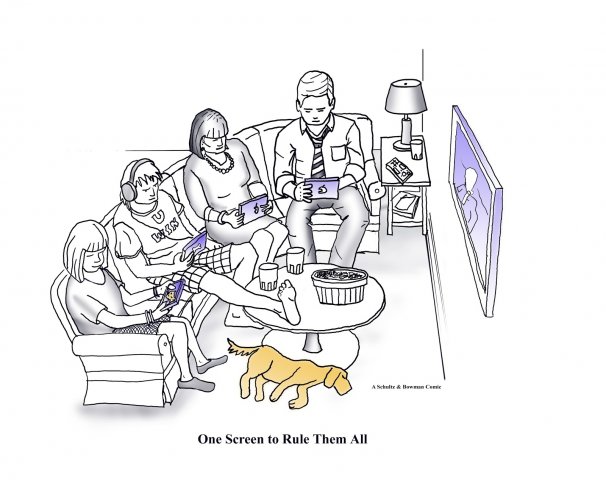
Once again, Eric Schultz (The Occasional CEO) has come up with just the right note.  My list of his serious posts I want to share and comment on grows longer, but this one popped right to the top.  So true, so true.

alt

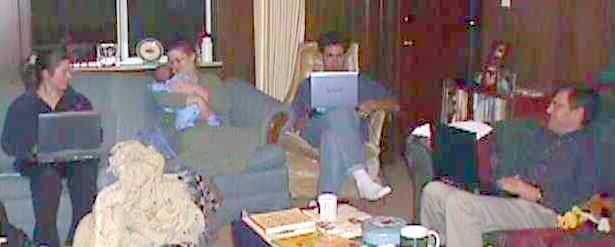
As I said in a comment to his post, it reminded me of a Christmas scene from 2003:  Like this one, it's a living room setting with five people. Three are busy with computers on their laps. (This was almost 10 years ago: no iPhones, no iPads.) The fourth is also intently focussed, not on a computer screen but on the fifth, a newborn baby. No, not that newborn baby, but I did title the picture, We Three Nerds.  Oh, wait.  This is my own blog; I can include the picture itself.

alt

Sorry it's such a lousy picture.  Our camera at the time was an old Sony Mavica, at one time high tech, but it created small files and saved them to a 3.5 inch floppy disk, which couldn't hold even one picture from my present (inexpensive, Kodak) camera.

posted by sursumcorda on Monday, October 15, 2012 at 09:16 PM
Permalink | Comments
Category Computing Just for Fun
Go to page: 1 2 3 … 144 145 146 … 247 248 249