
If a good neighbor is one who watches out for your home while you are gone, and a great neighbor takes care of your mail and pets (even if there are 10,000 of them), what can you say about a neighbor who will take you to the airport at 4:30 in the morning? That was the first leg of our trip to Hawaii. (Technically, “Hawai‘i,” with the left single quote, but I’m going with the simplified spelling.)
Hawaii? What were we doing there? That’s what I asked myself.
Ever since my class in elementary school debated the relative merits of our new states, Alaska and Hawaii, I’d preferred the former. What a pernicious influence our early experiences can have! My mind later realized that outside of the debate context, this is not a choice—one can, and should, like both—but my prejudices from that forced decision remained.
Thus I was not as excited as some might be when Porter announced that he had made a commitment to go to Hawaii. I wasn’t upset; I knew he wanted to get there sometime, and I find vacations a lot more fun if someone else makes the arrangements. Not upset, but surprised, because we usually debate such plans for months before acting.
As it turned out, he had debated for months, until he was worn down by a Hilton Vacation Club salesman at the hotel where he had stayed while working in New York City. So our great deal came at the cost of a 2 ½-hour timeshare presentation. (It was well worth the price, but more on that in a later post.) The deal included three days at the Hilton Waikoloa Village resort on the Big Island, a rental car, a luau, and a $200 voucher to use sometime in the next six months at another Hilton property of our choice. We added a fair amount of our own money to extend the stay to six days, but used frequent flier points for our plane tickets, so I guess Porter earned this dream trip in several ways!

We travelled relatively light—it’s easier when you don’t have friends and family on the other end—but still ended up with one checked bag and three small carry-ons. It didn’t seem as if we were bringing that much, but snorkelling equipment, a video camera, extra shoes, and clothes for both hot and cold weather do take up space. Not to mention a computer, though we only brought one this time.
The flight from Orlando to Atlanta was fine, although we were disappointed to learn that apparently flying on points disqualifies you for upgrades, which we had been looking forward to thanks to Porter’s super-elite status. Ah, well. First class doesn’t get to the runway any sooner than coach. Later, actually!
It was in Atlanta that things appeared to go wrong. I missed the part where we had signed up for the Delta Fitness Plan, but the inevitable gate change didn’t surprise me. We began to suspect more than a simple gate change when boarding time came and went. Then we were told there was an equipment problem, but Maintenance was working on it. And working on it. “You don’t want to fly all the way to Los Angeles with non-functional bathrooms, do you?” Given that we had a connection to make, I would have been willing to take my chances, but Delta wasn’t.
Finally, we decided to investigate other options, as the odds of making our Kona flight were diminishing rapidly. As it happened, we were right at the entrance to the Delta Customer Service area when the cancellation of our Atlanta – L.A. flight was announced; thus we found ourselves at the head of what soon became a very. long. line.
Platinum status may not have gained us a first class upgrade, but it did shove us to the front of the next line, inside Customer Service itself. There, the kind and very efficient agent booked us on a flight directly from Atlanta to Honolulu, and a puddle jumper thence to Kona. Level II of the fitness program: this gate change required racing to the most distant wing of the airport. We made it—but if we had not been where we were when the cancellation was made, or if we had had to wait in the non-status line, we would have had plenty of time to use the generous $16 worth of food vouchers we had been given.
The new arrangements turned out to be much nicer than the originals. We skipped L.A., added an additional island to our tour (albeit for less than an hour), and landed in Kona not much later than originally scheduled. The hardest part was believing we were still in America after having flown so far. Door-to-door travel time was about 19 hours; after all that, shouldn’t we have been in Switzerland?

The Kona airport is tiny. About a dozen gates, and none of those enclosed jetways: You walk down the stairs from the plane, and through the weather. Fortunately, Kona is on the dry side of the island.
First impression: Hawaii is bilingual. Much as Florida’s signs are in English and Spanish, the signs at the airport, rental car agency, and resort are in English and Japanese. Seventy years after the attack on Pearl Harbor, the Japanese invasion of Hawaii is going strong—in the form of tourists, dropping yen instead of bombs. It was great to hear Japanese once again, and brush up on important skills, like recognizing the Japanese characters for “exit.” (As it turns out, we saw more Hawaiian than Japanese once we left the resort area. More on the Hawaiian language later.)
After check-in, we took an evening walk around the huge resort, and ate what turned out to be our one-and-only resort restaurant meal. I had a moderately outrageously priced teriyaki chicken sandwich that was quite good, and Porter had a $25 “lobster burger” that was not.

The view from our window
The night was breezy and not too hot, the sunset-and-ocean view was soothing, and dolphins were playing in the nearby lagoon. We were in Hawaii!
We were in Hawaii: jet-lagged, and with a busy day scheduled for tomorrow. Grateful for the day’s many blessings, we collapsed into bed.

Waikoloa sunset
Here's a quick story for you while I work on the Hawaii posts. First the bad news. The report is from Australia, but the practice is legal in America, though they are supposed to tell us about it in the fine print.
Yes, it's Frankenfood—but you can't deny it has a coolness factor, too.
As far as I can tell, there are two major problems:
- Contamination. Those of us who like our beef to be mooing know that a rare hamburger is much riskier than a rare steak. With the steak, even brief cooking kills surface bacteria, but with the hamburger the "surface" has been mixed all through the patty. Thanks to meat glue, your piece of meat may look like a steak yet have all the contamination risks of a burger.
- Dishonesty. It's like the carton of juice that proudly proclaims, "Unsweetened," but in the fine print admits it contains sucralose. I wouldn't make using transglutaminase illegal, but I would require a clear, open acknowlegement that the food is not natural.
Don't ban the foods; be honest and let the consumer decide.
This is the best thing to do with a soda bottle since Diet Coke and Mentos. The insructions are clear, and the cost of materials low. I know some grandchildren who would love it. (H/T Conversion Diary.)
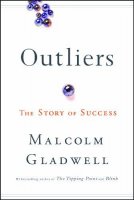 Outliers: The Story of Success, by Malcolm Gladwell (Little, Brown & Co., New York, 2008)
Malcolm Gladwell’s books always turn my mind upside down. He may not always be right, but he’s always exciting.
What makes a superstar? What differentiates Bill Gates from the average computer geek, the Beatles from a garage band, the top athletes from the wannabes? Talent, certainly, and hard work—but Outliers reveals that the most critical factors are often surprising, even random.
The 10,000 hour rule Talent, we generally believe, is something we are born with. Intelligence, musical ability, athletic skill: you either have it, or you don’t. There is more excuse than truth there, however. There is a threshold of talent required in any field, but beyond that, experience is the all-important key.
Practice isn’t the thing you do once you’re good. It’s the thing that makes you good.
Study after study has shown that it takes about 10,000 hours of practice to achieve world-class expertise in any field. That’s 2,000 hours per year—the equivalent of a full-time job—for five years. The opportunity to get those 10,000 hours, at the right place and time, makes superstars. For Bill Gates it was a series of unusual circumstances, beginning in middle school, that gave him access to computers that even most college students did not have. Before he dropped out of Harvard to make history, Gates had been programming for well over 10,000 hours.
Thanks to a chance encounter—and some illicit incentive—the Beatles found themselves in a set of gigs that required an extraordinarily long performance commitment: up to eight hours per night, seven days a week. It was the making of the group. By the time they came to America in 1964, they had some 1200 live performances under their guitar straps.
Or, as Shinichi Suzuki said, “Skill equals knowledge plus 10,000 times.” Another gem from the Suzuki world (though I’ve seen it attributed in several ways, most commonly to Vince Lombardi): Practice doesn’t make perfect. Only perfect practice makes perfect. Clearly one must put more into those 10,000 hours than just time.
Inequities When it comes to sports, astrology would appear to rule: the month of your birth will make or break you. Because children’s sports leagues are sorted by age, and because a year’s growth makes a tremendous difference in a child’s physical strength and coordination, the oldest members of a team have a considerable advantage over the youngest. They appear more talented, and are moved to the better leagues, where they get better coaching, and, significantly, more playing time. The effect is cumulative, with the “rich” getting richer at each step.
In school, another institution segregated by age, the same effect is devastating to those who start kindergarten less mature than their classmates. The achievement gap that appears then rarely closes.
At four-year colleges in the United States…students belonging to the relatively youngest group in their class are underrepresented by about 11.6 percent.
Such systems are tremendously wasteful of talent. Potential hockey stars—and Nobel Prize winners—are being squandered merely because they were born at the end of the year.
Full many a gem of purest ray serene
The dark unfathom'd caves of ocean bear:
Full many a flower is born to blush unseen,
And waste its sweetness on the desert air.
— Thomas Gray, Elegy Written in a Country Churchyard
How much genius is necessary? Christopher Langan is arguably one of the world’s most intelligent people, a genius from infancy—talking at six months, teaching himself to read at three—and he was not only intellectually gifted, but artistically and musically as well. Yet his dysfunctional family left him without the life skills necessary to succeed in college and become the superstar he might have been.
I include this quote from Langan for Porter, who dreamt solutions to programming problems, and for Janet, whose hand would write the answers to math problems without apparent help from her brain.
I found if I go to bed with a question on my mind, all I have to do is concentrate on the question when I go to sleep and I virtually always have the answer in the morning. … Other times I just feel the answer, and I start typing and the answer emerges onto the page.
Above-average intelligence is a good predictor of academic success, but beyond a certain level, other factors become more important for success.
The psychologist Barry Schwartz recently proposed that elite schools give up their complex admissions process and simply hold a lottery for everyone above the threshold.
…
In 2008, 27,462 of the most highly qualified high school seniors in the world applied to Harvard University. Of these students, 2,500 of them scored a perfect 800 on the SAT critical reading test and 3,300 had a perfect score on the SAT math exam. More than 3,300 were ranked first in the high school class. How many did Harvard accept? About 1,600, which is to say they rejected 93 out of every 100 applicants. Is it really possible to say that one student is Harvard material and another isn’t, when both have identical—and perfect—academic records? Of course not. Harvard is being dishonest. Schwartz is right. They should just have a lottery.
What about art? Surely some people are born with musical or artistic talent, and the rest of us left out. Well, no. It’s like intelligence. Yes, there is a range of abilities, but apparently many more of us could be really good if we were willing to put in the time.
Studies done in the 1990’s of violinists at an elite music school, and of amateur and professional pianists revealed the one critical factor in success was simply how much practice time the musicians put in.
[The researchers] couldn’t find any “naturals,” musicians who floated effortlessly to the top while practicing a fraction of the time their peers did. Nor could they find any “grinds,” people who worked harder than everyone else, yet just didn’t have what it takes to break the top ranks. Their research suggests that once a musician has enough ability to get into a top music school, the thing that distinguishes one performer from another is how hard he or she works. That’s it. And what’s more, the people at the very top don’t work just harder or even much harder than everyone else. They work much, much harder.
This is incredibly good news: We can all be much greater than we think. But it comes with important questions (mine, not Gladwell’s): Are we willing to do the work necessary to achieve greatness? What must be sacrificed to reach that level? Is it impossible for a Christian, or a parent, or anyone else with broad responsibilities, to be this good at anything without “gaining the whole world and losing his soul”? Must the needed time be stolen from more important activities, or can it be reclaimed from wastage? The average American watches 34 hours of television per week. If we give up television for six years, could we all become excellent in some area? Is there a level below the top at which we can all be much better at many things than we are now? At what level is “good enough” better than perfect for most of us?
The language advantage, part 1 Why were so many Korean Airlines plane crashing? Intensive analysis revealed no mechanical problems, and no lack of skill on the part of the pilots. The source of the disasters was something called a Power-Distance Index. Safe flying requires the cockpit crew to feel free to inform and correct the captain, and the input necessary to keep unusual situations from becoming critical was not coming forcefully enough to the Korean pilots from crews that had bowed to them before the flight. They key to the airline’s remarkable turnaround? Insisting that English be the language of the cockpit.
Their problem was that they were trapped in roles dictated by the heavy weight of their country’s cultural legacy. They needed an opportunity to step outside those cultural roles when they sat in the cockpit, and language was the key to that transformation. In English, they would be free of the sharply defined gradients [of formality in the Korean language]: formal deference, informal deference, blunt, familiar, intimate, and plain. Instead, the pilots could participate in a culture and language with a very different legacy.
The language advantage, part 2
[T]here is a reproducible correlation between the time required to pronounce numbers in a given language and the memory span of its speakers. In this domain, the prize for efficacy goes to the Cantonese dialect of Chinese, whose brevity grants residents of Hong Kong a rocketing memory span of about 10 digits.
…
The number system in English is highly irregular. Not so in China, Japan, and Korea. They have a logical counting system. Eleven is ten-one. Twelve is ten-two. Twenty-four is two-tens-four and so on.
That difference means that Asian children learn to count much faster than American children. Four-year-old Chinese children can count, on average, to forty. American children at that age can count only to fifteen, and most don’t reach forty until they’re five. By the age of five, in other words, American children are already a year behind their Asian counterparts in the most fundamental of math skills.
The regularity of their number system also means that Asian children can perform basic functions, such as addition, far more easily. Ask an English-speaking seven-year-old to add thirty-seven plus twenty-two in her head, and she has to convert the words to numbers (37 + 22). Only then can she do the math….Ask an Asian child to add three-tens-seven and two-tens-two, and then the necessary equations is right there, embedded in the sentence. No number translation is necessary: It’s five-tens-nine.
Meaningful work What advantage did the late-18th century New York garment industry confer on the children of Jewish immigrants from Eastern Europe, and how is that related to rice farming in Asia? Independence, meaningful work, and the conviction that success is a direct result of effort. (Read the book to find out why.)
[A]utonomy, complexity, and a connection between effort and reward…are, most people agree, the three qualities work has to have if it is to be satisfying.
Virtually every success story we’ve seen in this book so far involves someone or some group working harder than their peers.
Success is a function of persistence and doggedness and the willingness to work hard for twenty-two minutes to make sense of something that most people would give up on after thirty seconds.
Every four years, an international group of educators administers a comprehensive mathematics and science test to elementary and junior high students around the world.
… [The students] also have to fill out a questionnaire. It asks them all kinds of things, such as what their parents’ level of education is, and what their views about math are, and what their friends are like. It’s not a trivial exercise. It’s about 120 questions long. In fact, it’s so tedious and demanding that many students leave as many as ten or twenty questions blank.
… As it turns out, the average number of items answered on that questionnaire varies from country to country. … [C]ountries whose students are willing to concentrate and sit still long enough and focus on answering every single question in an endless questionnaire are the same countries whose students do the best job of solving math problems.
The rankings aren’t just similar: They are identical.
[W]e could predict precisely the order in which every country would finish [in a hypothetical Math Olympics] without asking a single math question.
I can’t agree with Gladwell on everything—for one thing, he has far too much admiration for the institution of school. But Outliers is well-written, easy to read, and challenging.
It is not the brightest who succeed. … Nor is success simply the sum of the decisions and efforts we make on our own behalf. It is, rather, a gift. Outliers are those who have been given opportunities—and who have had the strength and presence of mind to seize them.
… To build a better world we need to replace the patchwork of lucky breaks and arbitrary advantages that today determine success … with a society that provides opportunities for all.
Those who would create their utopias at the level of society more often create dystopias, it would seem. But at local, particular levels—school, community, soccer league, and most especially, family—it might be accomplished.
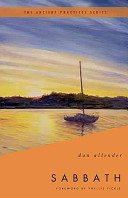 Sabbath, by Dan B. Allender (Thomas Nelson, Nashville, 2009)
Mystical poets who enjoy attempting to express the inexpressible may find working through Allender's Sabbath a productive exercise, but those looking for a practical, rational discourse on how to honor the Sabbath Day will find themselves banging their heads in frustration. I know I did.
It's clear that Allender has experienced an otherworldly delight in his own celebration of the Sabbath; unfortunately, like many mystics of old, his attempts at sharing that experience fall flat. First, there is a language barrier. Poetical prose as a literary device can work, but like straight poetry it takes effort to make out the sense, and even then you're not sure you've got it right. When you're expecting an informative book, the attempt at poetic language quickly becomes annoying.
Second, Allender appears to inhabit a different world from me. When he diagnoses a problem, and recommends a cure, he loses me at the first step. How can I trust his cure when he seems to be describing a different patient?
Finally, he persists in using the term "sensual" when his meaning would be better served by "sensuous." I'll admit I'm nitpicking, but he uses the word so frequently that it presents a significant distraction.
Sabbath is not without merit, and what were stumbling blocks for me may be stepping stones for others. Even I found some worthwhile ideas, especially the question with which I am still wrestling, "What do I find delightful, and why?"
The Sabbath is the day to experiment with beauty that teases your hunger to know more glory. It is a day of study and silence on one Sabbath, a cutting out of a new kite pattern to fly on a wild breezy Sabbath another. It is crawling through wetlands below your home like hunters stalking big game in Patagonia or an exploration of string theory and Heisenberg's uncertainty principle as it relates to quantum physics on the next. What intrigues, amazes, tickles your fancy, delights your senses, and casts you into an entirely new and unlimited world is the raw material of Sabbath.
If the Sabbath sends us anywhere, it is to nature. To spend the day entirely inside on the Sabbath is to forget the sounds of bird twill, the rush of the wind, and the warming fragrance of the dawn. It is to forget God even if we are indoors thinking about him. We must enter the earth to be struck dumb by the beauty of the Trinity. Our task is to plan to be near the face of God, in his creation, and then allow our plans to take shape as we are made alive by the surprise of his world.
Even in the nonhuman kingdom, play is part of the creational mandate. Diane Ackerman says, “The more an animal needs to learn in order to survive, the more it needs to play.”
To play in the fields of God will vary from Sabbath to Sabbath. There will be countless Sabbaths spent indoors in front of a fire, reading a novel; and there will be others on the side of a stream watching a bull trout meander with feckless disregard as fleeing cutthroat escape their most potent rival.
An example, though far from the most egregious, of the language that makes my head spin.
We are divided, and the day of reconciliation seems farther away than the bright moon that still shines in the early morning sky. Division always enlists, forms, and feeds new communities. Division breeds new alliances that provide us with the ability to survive the heartache. We tell our story to a friend who suffers the injustice with us. This friend sides with us to some degree, and as a result he judges the one who brought the pain. The new alliance spills out to others through gossip, and deeper fissures are created in relationships much the same way that an earthquake tears a landscape to bits.
And one of the "diagnosing the wrong patient" problem. Say what???
Envy is the craving to possess what another owns in order to fill our desperate emptiness…. And it is usually not enough to have something similar or slightly less than what they own—it has to be bigger and better…. When one looks deeper into the dark hole of envy, it is far crueler than merely the desire to better oneself…. The deepest envy desires to take from the other what they possess in order to bask before their humiliation. We have determined that our destitution will only be resolved if we can simultaneously deprive our rivals of their goods and possess what they own.
How do we articulate the difference between labor that gives life and work that extinguishes hope? It may be as simple as saying all labor is done to create something that goes beyond the completion of a task—it seeks as connectedness to someone for something greater than mere compensation. Work is painting a wall; labor is starting a painting business so that one can choose how a job will be finished with integrity. Work is taking a literature class; labor is writing a poem to address the death of one’s parent. Working allows us to control the outcome and therefore achieve our manageable dreams. Labor calls us to risk our dreams without much control to create something that goes beyond what we can imagine. It is labor, not work, that we hate. We prefer to kill the hope of what labor may bring forth rather than to risk so much for possibly so little.
Allender does tie in (though not expressly) some of the ideas I gleaned from Josef Pieper's In Tune with the World, for me a needed reminder of good ol' New Year's Resolution #2.
David Ford writes, “All the senses are engaged in a good feast. We taste, touch, smell, see, hear. Salvation as health is here vividly physical. Anything that heals and enhances savoring the world through our senses may feed into a salvation that culminates in feasting….Jesus went to meals, weddings and parties and had a feast-centered ethic….That combination of sharing and celebrating is, perhaps, the most radical of all the implications of the teaching and practice of Jesus.” Jesus is the presence of superabundance. The Sabbath is the weekly entry into a taste of lavish, sensuous delight. [Note here the use of “sensuous” rather than “sensual”; thank you, Mr. Allender.]
One Sabbath night in Ethiopia, my wife and I had the privilege of being at the home of our translator…. It was abundantly clear that we were eating an extravagant meal that may have cost what the family would spend on food in a month. The sacrifice of the family was part of their joy; there was no way to reciprocate other than to join in their joy and to add to their immense sacrifice, our humble gratitude in being so undeservedly blessed. Jesus’ way of being with others was a feast ethic. All meals, and all joy around a table, are a reminder of the feast of the coming kingdom.
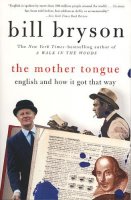
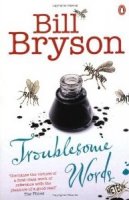
The Mother Tongue: English and How It Got that Way (first published 1991, reissued by Perennial 2001) and Troublesome Words (first published 1984, revised 1997, reissued by Penguin Books 2009), both by Bill Bryson
My father and my sister-in-law became hooked on Bill Bryson as a writer; perhaps it is now my turn.
For the first twelve chapters, The Mother Tongue is an accessible, page-turning look at the English language: where it came from, why it’s so popular, and how it came to be simultaneously one of the easiest and one of the hardest languages to learn.
Unfortunately, the book peters out a bit after that, with a few less interesting, apparently random diversions. The chapter on swearing, for example, was dreary. As a child I would have devoured it, such words being the kind with some magical power that required one to step over the square on the sidewalk where one occasionally saw them scrawled. Graffiti was my only contact with profanity then: no one I knew used such language, and it was certainly not in any books, movies, or TV shows of my experience—not even the dictionary (trust me, we looked). But that was then, and this is decidedly now. There is no longer anything rare, titillating, or even informative about bad language—at best it is irritating, and keeps me from giving The Mother Tongue the wholehearted recommendation it otherwise deserves. With that caveat, however, this is still a delightful and worthwhile book.
One of the undoubted virtues of English is that it is a fluid and democratic language in which meanings shift and change in response to the pressures of common usage rather than the dictates of committees. It is a natural process that has been going on for centuries. To interfere with that process is arguably both arrogant and futile, since clearly the weight of usage will put new meanings into currency no matter how many authorities hurl themselves into the path of change.
But at the same time, it seems to me, there is a case for resisting change—at least slapdash change. Even the most liberal descriptivist would accept that there must be some conventions of usage. We must agree to spell cat c-a-t and not e-l-e-p-h-a-n-t, and we must agree that by that word we mean a small furry quadruped that goes meow and sits comfortably on one’s lap and not a large lumbering beast that grows tusks and is exceedingly difficult to housebreak. In precisely the same way, clarity is generally better served if we agree to observe a distinction between imply and infer, forego and forgo, fortuitous and fortunate, uninterested and disinterested, and many others. As John Ciardi observed, resistance may in the end prove futile, but at least it tests the changes and makes them prove their worth.
We in the English-speaking world have often been highly complacent in expecting others to learn English without our making anything like the same effort in return. As of 1986, the number of American students studying Russian was 25,000. The number of Russian students studying English was four million…. In 1986, the Munich newspaper Süddeutsche Zeitung investigated the studying of German as a foreign language around the world. In the United States, the number of college students taking a German course was 120,000, down from 216,000 in 1966. In the Soviet Union, the number was nine million. The problem is unlikely to get better. Between 1966 and 1986, 150 American colleges and universities canceled their German programs. In 1989, some 77 percent of all new college graduates had taken no foreign language courses.
A presidential commission under Ronald Reagan called the situation scandalous. In 1987, in an effort to redress the balance Congress voted into law the Education for Economic Security Act, which provided an extra $2.45 million to promote the study of foreign languages—or a little over one cent per person in the country. That should really turn the tables.
Granted, these figures are old—but somehow I doubt there’s been significant improvement since. Personally, I think we need an Education for National Security Act, which would forbid going to war against people who speak a language for which we do not have a strong base of fluent translators.
Not only are we not doing terribly well at foreign languages, we’re not even doing terribly well at English. The problem was well voiced by Professor Randolph Quirk, president of the British Academy and one of that country’s leading linguistic scholars, when he wrote: “It would be ironic indeed if the millions of children in Germany, Japan and China who are diligently learning the language of Shakespeare and Eliot took more care in their use of English and showed more pride in their achievement than those for whom it is the native tongue.”
We might sometimes wonder if we are the most responsible custodians of our own tongue, especially when we reflect that the Oxford University Press sells as many copies of the Oxford English Dictionary in Japan as it does in America, and a third more than in Britain.
For those who care to be better custodians of our language, I can recommend Bryson’s Troublesome Words. Although written in dictionary format, I found it enjoyable to read cover to cover. Do you want to know when to use “fewer,” and when to use “less”? Or how to spell the name of that pleasant airport in Amsterdam? Or the crucial difference between “sensual” and “sensuous”? Troublesome Words will let you know, and entertain you at the same time.
(Thanks, Janet and Stephan!)
Ride on! ride on in majesty!
Thy last and fiercest strife is nigh;
the Father on his sapphire throne
expects his own anointed Son.
I love Ride On! Ride On in Majesty! for its profound overview of Holy Week. We sang it this past Sunday, to the Winchester New tune, and as always I was especially moved by the verse above. Last year I was inspired by those words to consider the effect of Good Friday on Jesus' parents. Today I am struck by the realization that Easter was not a surprise, nor an afterthought, nor a Plan B. In the drama of Holy Week, all scenes—from Palm Sunday through Maundy Thursday, Good Friday, and Holy Saturday—point toward the finale: Easter. The Author includes some dark, excruciating (literally) moments, but the triumphant last scene is never out of His sight.
Ride on, ride on, in majesty!
In lowly pomp ride on to die;
Bow Thy meek head to mortal pain,
Then take, O God, Thy power, and reign.
Permalink | Comments
Category Random Musings
Music is such a personal, touchy subject—as is worship. Put them together and you might as well be mixing sulfur, charcoal, and saltpeter. Nonetheless I will boldly go where too many have gone before, in order to draw attention to “Pop Goes the Worship,” an interview in Christianity Today (March 2011) with T. David Gordon, author of Why Johnny Can’t Sing Hymns: How Pop Culture Rewrote the Hymnal.
I wasn’t expecting much when I began the article (who writes these titles, anyway?), but was quickly drawn in. A sure way to my heart is to say what I’ve been saying myself, or wanted to say, only much better and with authority. The article is worthwhile in its entirety; here are a few excerpts to whet your appetite—or raise your blood pressure. [Emphasis in the following is mine]
T. David Gordon argues that modern worship choruses have trumped hymns in many congregations because for decades, we have been inundated with pop music—to the point that many of us don't know better. If you eat nothing but Big Macs, Gordon says, you will never appreciate a filet mignon.
Regarding church music, Gordon says, media ecologists should ask how music, "once a participatory thing, became a passive thing. What happens when people who used to sing folk music around the house are now surrounded by Muzak? How does that alter our sensibilities of music?"
Many are promoting an "aesthetic" that it is our duty to patronize living artists and not artists who are dead. Should we also not read books that are more than 50 years old, or enter buildings that are more than 50 years old? Christians aren't abandoning their buildings, and they haven't stopped reading Spurgeon or Edwards or Luther or Calvin. We haven't rejected other art forms that are not new. We've done so only with music.
Unless an individual chooses to listen to different kinds of music, the only thing that individual will hear (most of the time) is pop. Sure, one's sensibilities can be shaped deliberately, and many of us have developed tastes that we once did not have. (I spent years cultivating a taste for Brahms, whom I now love, and I spent about two years cultivating my appreciation for jazz.) If I did not believe that sensibilities could be cultivated, I wouldn't have written the book; it is, in some senses, a plea to shape them differently from the way commercial pop culture shapes them. But for people who do not take ownership of the cultivation of their sensibilities, other cultural gatekeepers will shape them for them—and in this case, they will shape them to prefer pop.
In the book, I candidly state that many traditional hymns are outright dogs—just terrible. I never give specific examples, however, because there are always some people who love those dogs, and if I call their beloved song a dog, they will never hear anything else I say. I also think some contemporary hymns are very good; I especially appreciate Getty and Townend (e.g., "How Deep the Father's Love," "In Christ Alone").
Hymns should be easy enough to learn for people who do not read music, so people can pick up the melody quickly. When I was a young child and we'd take drives, the family would sing folk music or hymns. If Mom or Dad started singing "Fairest Lord Jesus," we sang along, and before long we were harmonizing. And we couldn't read music. Hymns aren't too difficult to sing; most of them are easier to sing than the contemporary stuff. I find it ironic that if I'm attending a blended service, the hymns will have the full musical score, though they don't need it, while the contemporary stuff, which is unfathomable without the musical score, doesn't have it. It's just lyrics up on the screen.
[Modern tunes] are not really easier to learn than hymns (unless they are profoundly simplistic). They seem easier to some people whose sensibilities have difficulty with anything that is not pop. But musically speaking, they are not, as a genre, substantially easier; they just sound more familiar to our culture. When people describe them as "easy," what they mean is "familiar-sounding."
Thank you, Dr. Gordon. I am so tired of people telling me that "praise music" is easy. Now I know there are at least two of us in this world who find it "unfathomable" without the music. (I'm getting better, with practice, at muddling through when I can get my hands on the sheets the band uses, which have chords as well as lyrics; that's rather fun, actually. I'm still hopeless in the congregation.)
What Why Johnny Can't Sing Hymns will contribute to the ongoing music and worship conflagration discussion, I can't predict. All I know is that the article cheered me up.
Permalink | Comments
Category Reviews Random Musings
It's not the New York Times, or even the Hartfort Courant, but I'll thank the East Haddam-Haddam Patch for their article on the quilt show, and their mention of Phoebe's Quilt. (H/T PJS) As is true with most newspaper articles I've known the truth about, this one manages to tell gist of the story accurately while erring in the details.
One of the most interesting ... had to be Prudence Sloane’s quilt.
“I inherited a trunk from my mother, this was in the bottom of it,” Sloane said. The quilt contained the names of family ancestors stitched into it.
It turned out the quilt belonged to Phoebe (Burr) Scovil, Sloane’s first cousin four times removed. It was most likely a wedding present from friends and family around 1849. Sewn into each square section of the quilt was a different person’s name.
Sloane’s sister-in-law, Linda Wightman, who was very interested in the family’s genealogy, did research on all the names of the people on the quilt. Wightman even went to Boston to investigate the names in a genealogy library.
Wightman made a booklet and gave it to Sloane as a Christmas present with information on Phoebe and how each person sewn into the quilt was related to her.
The quilt actually belonged to Phoebe L. (Scovil) Bonfoey, who is, indeed, Prudence's first cousin four times removed (and my fourth cousin four times removed, for that matter). Phoebe (Burr) Scovil was her mother. The creation of the quilt was most likely around 1849, the year one of the signers died and one, who signed with her married name, got married. Phoebe herself married Horace A. Bonfoey in 1852.
To say that I "even went to Boston to investigate the names in a genealogy library" sounds rather pathetic unless you realize that I, unlike the quilt, don't live in Connecticut. In any case it's not something to be impressed about; whenever I make the (all too rare) visit to Boston, New York, Hartford, or other research hot spot, it's for a lot more than just the quilt. Most of my research for this project was done using the amazing resources available online. That's not to say I couldn't have walked to Boston in the time it took me to gather the information—not true, but at times it felt like it.
And, hey—they spelled my name right! I'm sure I have Prudence to thank for that.
Permalink | Comments
Category Genealogy Phoebe's Quilt
I created a Wordle picture of all the surnames I have associated with the people who made Phoebe's Quilt: maiden and married names, names of parents, spouses, and spouses' parents. (Click on the image for a larger view.)

Permalink | Comments
Category Genealogy Phoebe's Quilt
Piazzolla: Tangazo
Mozart: Sinfonia concertante in E-flat major, K. 297b
Tchaikovsky: Symphony No. 4 in F minor, op.36
Alondra de la Parra, conductor
Nikolay Blagov, clarinet
Jamie Strefeler, oboe
Diane Bishop, bassoon
Mark Fischer, French horn
Alondra de la Parra. Thirty years old, and already an exciting conductor. Watch out for her. Seek out her performances.
As OPO supporters, we are invited to attend one of the open Friday night rehearsals before a concert, and we chose this one for the compelling reason that it was the only one scheduled for when Porter was able to attend. What a fortunate Hobson's choice!
Back when Janet was in the Florida Symphony Youth Orchestra, we enjoyed listening to rehearsals because the orchestra would play, the conductor would make some suggestions, and then the orchestra would play again—with obvious improvement. Orlando Phil rehearsals are not usually fun in that way, because, of course, they are better players.
And then Alondra de la Parra came as guest conductor. I don’t know how the musicians felt, being treated like youth orchestra students—for Maestra De la Parra stopped them, and worked them, and even at one point had them play to the accompaniment of a loud and disconcerting rim-tap metronome sound from the percussion section. She made them play chords again and again, until she heard the right balance: “I need more of the C!” She ran late, much to the annoyance of the union rep, who checked his watch every minute and a half.
But what a difference the work made! The before and after contrast was as discernable as it had been with the students, and the next day's performance was even more brilliant. I have always loved the OPO, but I had no idea they could play like that. I loathe the “grade inflation” that has led to standing ovations at nearly every concert, but this time I was one of the first on my feet.
De la Parra is fun to watch, too. With the baton she is as commanding as a four-star general, and yet she dances her directions, playing the orchestra like a beloved instrument, coaxing out the sound.
She gave most of her rehearsal attention to the Tchaikovsky, and it was consequently the most stunning. But the Mozart was delightful because of the players: Jamie Strefeler handled the oboe part with skill, Mark Fischer is always good on horn, Nikolay Blagov would make even Heather like the clarinet, and Diane Bishop’s bassoon playing amazes me every time. (To be completely honest, my favorite part of the Tchaikovsky was some exquisite solo bassoon notes.)
The Piazolla was fun, all the more so because we recognized both the name and the style from a concert in Japan a few years ago. There we had heard his Libertango played by a talented cellist, who, like other notables such as Diane Bishop and Janet Stücklin-Wightman, graduated from the Eastman School of Music. She is now teaching at an arts school in Africa. This completes your It’s a Large World trivia diversion for today.
We capped the evening by enjoying some drinks (okay, it was water) and cookies (oatmeal) at a table by a fountain, while the rest of the crowd struggled to get out of the parking lot. Twenty minutes later the way was clear; we packed up our belongings and drove home in peace.
Permalink | Comments
Category Reviews Everyday Life
The Olde Cup & Saucer, Jamestown Place, Altamonte Springs, Florida
This is for our friend, Nancy: I'm taking you to tea at The Olde Cup & Saucer. All you have to do is figure out how to get here from North Carolina.
It's a pity the Olde Cup & Saucer is in a storefront rather than a garden setting, but if you sit with your back to the window and ignore the fact that you can read the menu, you can at least imagine you're sitting in a European café. Better, because no one's smoking.
The restaurant serves lunch and afternoon tea; we went for the former, and will be back to check out the latter. There's a good assortment of teas available, though we chose the specials of the day for the cheaper price and free refills. True, even $1.25 is a lot to pay when we have a store of many excellent teas at home, but hey, I once spent four Swiss francs for a cup of tea in Bern. (As that cup came with shelter from a storm, as well as a cookie, the price was not too high.)
It was a good Irish Breakfast, served in a lovely cup that brought instantly to mind the above-mentioned friend. (Porter enjoyed the Arctic Raspberry, iced.) From the lunch menu, I chose the Classic, with a cup of the soup of the day and two tea sandwiches. The cheddar cheese and bacon soup was served as hot as I like it, which is rare in restaurants, and I could have happily eaten a large bowl. For the sandwiches I chose curry chicken salad, and spinach. They were out of the spinach, so I substituted cucumber. Both were delicious and creatively presented. Porter couldn't resist the dish named for our mutual ancestor, Henry II: shrimp salad, and a side of hearts of palm with Vidalia dressing. Again, the food was creative and delicious: the shrimp salad included, among other, less-identifiable treats, walnuts and olives. Quantities were decidedly un-American, a "tea sandwich" being the size of half of what I'd call a sandwich, and thus even smaller than normal restaurant fare. But it was enough, just right. Smaller portions lend themselves better to savoring.
The Olde Cup & Saucer also sells a modest selection of loose teas; my only disappointment was discovering that what they call Russian Caravan is noticeably smoky, unlike the other teas I've had under that name. Ah, well—we know people who pass through the Basel train station now and then....
Although I generally prefer to have people come to our house to share meals, sometimes folks would rather meet at a restaurant. I'm confident enough in my cooking not to let this bother me (much), but heretofore I've not had a suggestion to make when asked, "Where would you like to meet?" Now I can't wait for the next opportunity.
Permalink | Comments
Category Reviews Everyday Life Food
You may remember Michael Merzenich as one of the major researchers mentioned in The Brain that Changes Itself by Norman Doidge. Merzenich is no doubt a better researcher than a speaker; this lecture is not nearly as good—and certainly not as comprehensive—as the book. But it will take less than 25 minutes of your time, and is worthwhile if only for his explanation of the dangers of white noise—continuous, disorganized sound—to an infant's brain, and for the hope he holds out to those of us who grew up with the depressing idea that once you reach adulthood (or perhaps early teens, or even age six, depending on who you believe), you are basically stuck with the brain you've got.
Michael Merzenich on re-wiring the brain
(Granchild warning: I don't know if you consider "crap" objectionable, but there are a few instances between 17:00 and 18:30.)
Permalink | Comments
Category Education Health Children & Family Issues
Not long after we moved to here, we planted a couple of blueberry bushes in the backyard. As with many of our Florida gardening ventures, this one could not have been called a rousing success. Or perhaps it could, in a relative sense, simply on the grounds that the bushes are still alive. But they never seemed to bear more than a handful of berries each year, and the birds always got to most of those before we did.
This year, however, was different. I have no idea why; but look at all the berries on this branch! (Click on the picture for a larger view.)

So Porter decided it was about time we stopped ceding the crop to the birds, and built this:

Was he more clever than the birds? We'll let you know when the berries ripen.
Permalink | Comments
Category Everyday Life Food
 The project that consumed my life since mid-January has now reached—not completion, but a stopping point. Deadlines can be a blessing.
This particular deadline was the Haddam Neck Congregational Church Annual Quilt Show, coming this Saturday, April 9. Phoebe’s Quilt will be exhibited there, meaning the real thing, not my book about the signers of this Friendship Quilt. Fortunately, the quilt owner gave me plenty of notice, because when she asked for a few copies of the book to have at the show, I knew I couldn’t simply print them off.
The first edition of Phoebe’s Quilt had bumped up against its own deadline, which was Christmas 2009. I hadn’t thought much about it since, but the knowledge of what had been left undone would not let me rest until I had completed a revised version for the quilt show.
Amazingly, much of what is in the second edition could not have been done two years ago, even without the Christmas deadline. Many of the new facts became available online only in the last few months; even as I was buttoning up the revision more data was appearing, making a third edition inevitable.
Don’t hold your breath. I’m quite happy with Version 2 for now, willing to scale back the work for a while (and return to normal life) and see what new information will appear in the next few months. I’m hoping the quilt exhibition will bring to light people with knowledge of the of the quilt signers’ families, people who could provide not only missing facts but also stories of the signers’ lives.
For a mere $30 you can have your own copy of Phoebe’s Quilt. I know, I know. That’s why people who publish genealogies don’t make any money. If you buy a copy at the show, you’ll get the special show price of $25. At that price, I lose money—but maybe I’ll gain some information.
Or, you can have a PDF version of Phoebe’s Quilt for free. I make much use of paid genealogy websites, and I don’t think those companies need to apologize for charging for the services they provide. But I also benefit greatly from genealogical information that is available free of charge, the result of uncounted hours and untold effort on the part of those whose only reward is the value of the work itself. Hence my desire to make the genealogical information in the book freely available.
If you would like a PDF of Phoebe’s Quilt, e-mail me and let me know why you are interested. I love to hear about other people’s research! I’ll be delighted to send you the document, asking in return that you not share the file with others, but instead direct those who are interested here, where they can obtain their own copes.
And if you live within a reasonable distance of Middletown, Connecticut, I hope you’ll take the opportunity to see Phoebe’s lovely quilt, in person. Here is the show information, taken from QuiltQua. (Note: Phoebe’s Quilt will only be shown on Saturday, and if you want to be sure to see it, arrive early, as it may leave before closing.)
HADDAM NECK CONGREGATIONAL CHURCH QUILT SHOW
Haddam Neck, CT
Sat 09 Apr 2011 - Sun 10 Apr 2011The annual Haddam Neck Congregational Church Quilt Show will take place on Saturday, April 9, 2011 from 10 a.m.-5:00 p.m. and on Sunday, April 10 from 11 a.m.-5:00 p.m. The Church is located at 408 Quarry Hill Road in Haddam Neck, CT 06424. Over 100 quilts will be on display in the church and in the adjacent meeting house. Admission is $5.00 for adults and children under 12 are free. The show includes a quilt vendor, raffle table and refreshments.
Contact information:
email: rdmchutchison@sbcglobal.net
Phone: 860-267-2848 or 860-267-4513
The following is a list of genealogically important names from my quilt research, solely for the edification of search engines, so that other researchers may find their way here.
Anna (Tryon) Bailey, Christopher Bailey, Bela Baldwin, Betsey (Hibbard) Baldwin, Laura Jane (Prior) Baldwin, Oliver E. Baldwin, Mary E. Bannister, Ashbel Bidwell, Daniel Bidwell, Lucy Ann (Johnson) Bidwell, Mary J. Bidwell, Thankful (Hubbard) Bidwell, Abbie E. (Holmes) Blinn, Elizabeth (Franklin) Blinn, John S. Blinn, Leander W. Blinn, Benanuel Bonfoey, Concurrence (Smith) Bonfoey, Eliza (Burr) Bonfoey, Horace Bonfoey, Horace Andrew Bonfoey, Phoebe L. (Scovil) Bonfoey, Susan Clarke Bonfoey, Susannah (Smith) Bonfoey, Alvin Brainerd, Anna (Brainerd) Brainerd, Ansel Brainerd, Asa Brainerd, Betsey (Pelton) Brainerd, Clarissa (Thomas) Brainerd, Daniel Brainerd, Deanthum Brainerd, Elizabeth (Welsh) Brainerd, Ezra Brainerd, Fanny (Smith) Brainerd, Frederick Brainerd, Heber Brainerd, Jerusha (Smith) Brainerd, Martha (Tyler) Brainerd, Nehemiah Brainerd, Sally Maria (Dickinson) Brainerd, Sarah (Brainerd) Brainerd, Sarah (Day) Brainerd, Aaron Burr, Amelia Melissa (Bonfoey) Burr, Asa Burr, Chloe (Hubbard) Burr, David Burr, DeWitt C. Burr, Elizabeth (Brainerd) Burr, Emma (Wellman) Burr, Esther (Spencer) Burr, Flora Betsey (Burr) Burr, Flora Betsey (Kelsey) Burr, George Burr, Joanna (Lane) Burr, Lucretia (Hubbard) Burr, Martha (Kelsey) Burr, Nelson Burr, Noah Burr, Noah P. Burr, Polly (Kelsey) Burr, Rebecca (Bulkley) Burr, Rebecca S. (Wilcox) Burr, Sarah (Johnson) Burr, Sarah (Johnson) Burr, Sylvester Burr, William Burr, William Hollis Burr, Willoughby F. Burr, Admiral M. Clark, Angeline (Cushman) Clark, Lucy (Clark) Corey, William Corey, Anna Colton (Brainerd) Day, Louisa (Bailey) Dewey, Milton B. Dewey, Sabra (Holcomb) Dewey, Samuel Dewey, Adeline F. Corey Elliott, Almira (Gillett) Elliott, Benjamin P. Elliott, Clark Elliott, Dolly (Smith) Flagg, George Flagg, Susan M. Flagg, Ann T. (Wright) Gardner, Henry F. Gardner, Jedediah R. Gardner, Vest (Rathbun) Gardner, Amelia Bullock (Abrahams) Gay, William A. Gay, Henrietta (Squires) Goodrich, Samuel Goodrich, George W. Guy, Lois (Hall) Guy, Nancy Smith (Brainerd) Guy, Orchard Guy, Clarissa C. (Loveland) Harris, Daniel Harris, Henry C. Harris, Huldah H. (Coe) Harris, Phoebe Ann (Smith) Harris, William Henry Harris, Lathrop Holmes, Mabel (Tryon) Holmes, Almira Tryon (Hubbard) Hubbard, Asa Hubbard, Charles Hubbard, Delia S. (Birdsey) Hubbard, Elisha Sears Hubbard, Lucretia (Bidwell) Hubbard, Samuel Birdsey Hubbard, Sarah Anne (Tryon) Hubbard, Alphonso Marsh Hyde, Arunah Waterman Hyde, Mary Ann Hyde, Mary S. (Wright) Hyde, Sarah (Kilbourn) Hyde, Didymus Johnson, Ruhama (Stephens) Johnson, Amon Judd, Austin Judd, Julia (Miller) Judd, Julia A. (Austin) Judd, Emerson F. Judson, Orin Judson, David Kelsey, Eli Jarvis Kelsey, Elizabeth G. (Hyde) Kelsey, Harmon J. Kelsey, Mehitable (Burrows) Kelsey, Olive (Parmalee) Kelsey, Esther Maria (Scovil) Leete, Frederick William Leete, Jeanette S. (Fowler) Leete, William Gilbert Leete, Clarissa (Cone) Loveland, Isaac Loveland, Caleb Miller, Clarissa (Whitmore) Miller, Hannah A. (Corey) Miller, Jane W. Miller, Mary B. (Hendley) Miller, Stephan Miller, Stephen Whitmore Miller, Abner Newton, Phoebe A. (Harris) Newton, Sarah (Hall) Newton, Daniel Peck, Daniel A. Peck, Maria (Olmstead) Peck, Thankful (Hubbard) Peck, Cynthia (----) Priest, Daniel Priest, Edwin Priest, Lucretia (Sizer) Priest, Daniel Prior, Daniel Harris Prior, Elizabeth (Skinner) Prior, Joanna Lane (Burr) Prior, Charlotte (Spencer) Redfield, Frederick Redfield, Abijah Roberts, Elnora (Ella) F. (Bidwell) Roberts, Fidelia (Hubbard) Roberts, Jasper A. Roberts, Adelaide (Holmes) Robinson, Alpheus Robinson, Harvey Robinson, Lydia (Dickinson) Robinson, Atwood Scovil, Cynthia Scovil, Esther Maria (Burr) Scovil, Frances Louisa (Bonfoey) Scovil, Joseph Scovil, Phoebe (Burr) Scovil, Phoebe (Spencer) Scovil, Sarah (Spencer) Scovil, Sarah A. Scovil, Sylvester Scovil, William Scovil, Alma (----) Smith, Barbara (Johnson) Smith, Eliza A. (Smith) Smith, Jesse Smith, John Smith, Joseph Smith, Oliver Phelps Smith, Phoebe H. (Childs) Smith, Simon Gardiner Smith, William Smith, Zeruah (----) Smith, Alvah W. Spencer, Ezekiel Spencer, Fanny (Bailey) Spencer, Fanny M. (Bailey) Spencer, Jane E. Spencer, Joseph Spencer, Maria (Hudson) Spencer, Martha (Tibbals) Spencer, Samuel Brown Spencer, Lowry Stone, Mary (Arnold) Stone, Robert Earl Stone, Susan Virginia (Scovil) Stone, Ebenezer Thomas, Elizabeth (Bailey) Thomas, Halsey Thomas, Israel Thomas, Mary (Brainerd) Thomas, Sarah R. (Burr) Thomas, Albertie Tryon, Franklin B. Tryon, Jane A. Tryon, Jane E. (Squires) Tryon, Anna Maria (Brainerd) Wallace, Betsey (Walker) Wallace, George W. Wallace, Thomas Wallace, Eliza (Stevens) Wellman, Henry L. Wellman, Ebenezer Wilcox, John Wilcox, Noah Post Wilcox, Rachel Florilla (Post) Wilcox, Sally Maria (Smith) Wilcox, Sarah Maria (Wilcox) Wilcox, Sarah (Crosby) Wright, William Wright.

