
Not that we're anywhere near January 1, but I seem to have begun a habit of making a new resolution on the 8th of the month, so why not?
If you look at the three I've made so far, it does seem as if I'm working on a book entitled, 12 Joyful Resolutions that Will Change Your Life. Maybe I am. Happy resolutions are so much more fun to keep! Not any easier, however, especially when, like this one, they are vague and not easily measurable.
I was casting around for the next resolution—in fact, I had a couple of others in mind—when this one came to me, out of the blue. It's a good one, though. For more than 25 years, any complaints I bring to a doctor have been met with two responses: (1) you're getting older, and (2) you're under too much stress. The former no resolution will help, but the latter bears examination. It's not so much that my life is stressful—even when it was far more stressful than it is at the moment—but that I let it control me. I react badly to stress, carrying it around in my mind and body, as anyone knows who has given me a shoulder massage. My blood pressure is edging up, too—not a problem yet, but I don't want it to become one. Perhaps when I was younger my body could handle these assaults, but—see #1 above. So it's time to get a handle on stress: to learn to relax.
Easier said than done, and I'm not sure exactly how I'll approach it. Some ideas include:
Stress relief
- Exercise, with increased frequency, intensity, and consistency
- Periods of intentional relaxation/deep breathing/meditation
- Conscious awareness of my muscles at various times during the day, especially when working at the computer, and deliberate relaxation
- Getting more, and more consistent, sleep
Stress reduction
- Renewed attempts at organizing my life, aiming for George MacDonald's "labor without perturbation, readiness without hurry, no haste and no hesitation" (This is a huge area, and could have several subheadings, but I'll leave it open for now.)
- Increased time spent in prayer
Increased time. Alas, that is what all of the above will take, and shortage of time is probably the greatest cause of stress all by itself. But what good is a resolution if it is too easy?
So...what about my previous resolutions?
#1 Read More Books Still going great; I've read 15 books so far this year. Unless I read several short books in parallel, my rate should slow down this month, as I'm now tackling Susan Wise Bauer's 800+ page The History of the Ancient World: From the Earliest Accounts to the Fall of Rome.
#2 Rediscover Feasting This one's harder to measure, and I'm not totally satisfied. But I'm not unsatisfied, either. I've experimented with fasting, and discovered that I can fast for a day each week without any hardship at all. They say that for fasting to be a spiritual discipline you should dedicate to prayer the time you would have spent preparing food and eating. I don't think that's necessary, but in any case I'll take the physical discipline for now. At the moment, fasting works much better if I'm kept busy with distracting tasks. The silence of prayer only makes the stomach growling more obvious.
As for "ordinary time," I'm mostly focusing on healthier foods. For one thing, I've discovered that I like oatmeal (especially the more flavorful steel-cut oats) with no salt or sugar added! I dropped the salt quite a while ago, but doing without sugar was a revelation. I do add raisins, however.
And feasting itself? Not much progress there. One thing I've determined is that feasts were meant to be shared, preferably with several people. I'd like to have people over for dinner once a week, the perfect opportunity for feasting. The trouble is that while I love fixing meals for guests, I loathe making the social arrangements, especially when most people are so busy and it takes several back-and-forth rounds to fix a date. After a few attempts I tend to give up. Definite room for improvement here.Permalink | Comments
Category Everyday Life
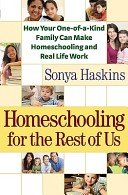 Homeschooling for the Rest of Us: How Your One-of-a-Kind Family Can Make Homeschooling and Real Life Work, by Sonya Haskins
(Bethany House, Minneapolis, 2010)
Sonya Haskins is a calm and reasonable voice speaking to the homeschooler—and potential homeschooler—who is overwhelmed and intimidated by the image of the "perfect" homeschooling experience: "Matching outfits, polite toddlers, award-winning students, fifteen-passenger vans, and family Web sites." (Raymond and Dorothy Moore did the same thing in the 1980s with Homeschool Burnout, which was updated and revised in the 1990s as The Successful Homeschool Family Handbook.) There's a lot of hype, confusion, and contradictory information out there, and Haskins' practical, back-to-basics approach and helpful suggestions will reassure timid beginners that they can, indeed, safely navigate the homeschooling waters.
It's a pity, then, that she "narrowcasts" her message to a small branch of Christian homeschoolers. Most of her suggestions are excellent and appropriate for anyone, but the evangelistic message and the assumptions of a young-earth Creationism are bound to make the general audience uneasy about the rest of the book. If its focus were broadened, this could become a classic introduction to homeschooling. But perhaps the author (or publisher) is not looking for "classic": the annoying sidebars and references to websites give it the feel of a magazine or "disposable book." As I said, a pity, because there's much good here.
A book of under 200 pages cannot hope to be both broad and detailed; Haskins elects for broad—one reason why it's good introductory material—but still manages to provide helpful lists and examples.
Rather than propounding one method of homeschooling, Homeschooling for the Rest of Us generally presents suggestions appropriate for many approaches. If she has an overarching philosophy, it is that character building is of primary importance.
Several years ago a mom came to me and asked how she should start homeschooling her children, then ages six and four. I suggested three things: reading to them frequently, training them to obey, and spending the first year or two focusing on relationships. In my opinion, it is that third step that isn't emphasized enough in homeschool households. We forget how important it is to teach our children how to get along, respect one another, and love others. Parents have plenty of time to introduce academics, field trips, and outside activities, but if children don't learn how to develop positive relationships while they are young, it is difficult for them to attain this ability later.
I meet parents all the time who are so proud that their two-year-old can recite the alphabet, but when the parent tells the child not to do something, she does it anyway. You can teach an obedient child new things, but it is very difficult to teach a disobedient child anything!
She is quite right, and I always say that the most important factor in determining the potential success of a homeschool situation is how well the parent and child get along. Emphasizing academic excellence while allowing character to slide is setting a child up for ultimate failure. Unfortunately, Haskins swings the pendulum too far the other way. Her lackadaisical approach to academics is likely to be taken by those who are already too lax academically as an excuse to do even less. Young children can learn obedience and the alphabet as well.
A basic belief among Christian homeschoolers is that the education of children is at heart a parental responsibility, not a governmental responsibility. Homeschooling for the Rest of Us goes an important step further, making the critical point that, ultimately, education is the responsibility of the student. (Unschoolers and secular writers such as John Holt and John Taylor Gatto would agree.)
Before the mid-1800s, the burden of education was not on the government. Nor was it on the parents.... Students knew that the burden of education was on their shoulders. If they wanted to learn something, they borrowed books or found someone who could teach them what they wanted to know. Education was considered a privilege.
When your child takes control of his or her education, this doesn't mean you throw discipline, structure, and guidance out the window. It simply means that you allow your child to be the one responsible for his education.... You may choose to continue with a schedule.... You might even choose to have a structured curriculum. But do not waste time every day arguing with a child about doing his schoolwork.
Here are a few more of my favorite quotes:
Over the years, I've discovered that the problem usually is not that [naysayers] disagree with the concept of homeschooling, but they think you disapprove of their choice to send their child to public or private school. Each of you surely loves your child, and opinions differ on many parenting issues, including discipline, eating habits, and clothing choices. But strangely, while friends can politely disagree on many things, it's often education choices that cause relationship problems.
[W]e parents should treat our children fairly, but there is a huge difference between fair and equal.
If you're still feeling pressure because experts or others tell you to "do it this way" or "if you'd only follow my plan, your life will be perfect, your children will obey, and they will love learning" or any other "just do it my way" kinds of statements, my advice is simple: Find different experts!
I'm not convinced that Homeschooling for the Rest of Us is a book worth buying, though at $10 it's hard to complain much. In any case, if you're new to homeschooling, frustrated in your own homeschooling efforts, or merely curious, and if you can appreciate—or at least ignore—the narrowness of its theological focus, it's a book well worth reading. But please don't let her minimalist approach to academics deprive your children of the educational excellence they can and should achieve.
Permalink | Comments
Category Reviews Education Children & Family Issues
Ralph Vaughan Williams: Fantasia on
a Theme by Thomas Tallis
Mozart: Concerto No. 1 for Flute in G Major, K. 313 (285c)
Dvorak: Symphony No. 7 in D minor, op. 70
Permalink | Comments
Category Reviews Everyday Life
 Pirates of the Caribbean: The Curse of the Black Pearl (Walt Disney Pictures, 2003, PG-13)
I realize I'm seven years behind most of the rest of the country in watching this movie, but at last I understand why our nephews love it so much. Maybe it's another example of the value of low expectations, but I can't remember the last time I enjoyed a movie so much. Just pure fun. Probably not grandchild material yet, but I wouldn't rate it worse than PG myself.
Sure, it's as unrealistic as Indiana Jones, and they break the rules of physics, biology, history, and more, but it's easy to suspend disbelief because it's not pretending to be real, or true to a book I love. It's plain fun, like the Disney Pirates of the Caribbean ride that inspired it. Perhaps the ride is one reason I enjoyed the movie so. Having had virtually unlimited access to the Disney parks when the kids were growing up, we became very familiar with this ride, and catching references to it in the movie is more fun than finding hidden Mickeys in the parks. The music is great, too.
We missed having Janet around, though. She would have told us in the beginning, "Hey, that guy played Legolas in The Lord of the Rings," whereas we only figured it out when the credits scrolled by.I had to watch it, since my genealogical organizations, websites, and contacts kept bringing it to my attention: NBC's new genealogy show, Who Do You Think You Are? My reactions? Mixed.
Each week, apparently, the show will present an investigation into the family history of one person. Supposedly these are famous people; I haven't heard of any of them, but that helps me concentrate on the data, which I find more interesting anyway.
As I watched, I tried not to take the jaundiced position of expert amongst novices. Not that I'm an expert in genealogy by any means, but I do know a whole lot more than I did when I began nearly eight years ago, and had to make a point of remembering those initial days of knowing nothing and being amazed by everything. Not that making new discoveries ever gets routine. But I would be very dull on a show like that, since I react to such revelations with "that's interesting," or maybe "that's really cool," but do not keep repeating, in an overly loud and dramatic voice, "Oh my God!" and "That's un-be-LEEV-able!"
The hyper-dramatic approach was not limited to the featured guest, but part and parcel of the show, and that did drive me nuts, even more so than the constant commercial breaks, which at least provided an opportunity to get the dishes done. There is about 15 minutes of really excellent material in the show, and if they hadn't stretched it out to an hour, it would have been great. It was fun to follow the research that led to the 49-er ancestor in California, and the accused witch in Massachusetts. Enough fun that I may watch the next episode, but now that I know you can watch it on Hulu, I won't feel obligated to plan my life around 8 p.m. on Fridays.
On a personal note, the best part was seeing my Boston home-away-from-home, Li'l Writer Guy's sanctum sanctorum, the sixth floor reading room of the New England Historic Genealogical Society's library.
Recently I let my Ancestry.com membership lapse, on the grounds that they had doubled the cost. It's a wonderful resource, but I couldn't let such an increase go unprotested, and was in a period of life when I couldn't use it effectively, anyway. The membership had been costing me $150/year, which I had decided was worthwhile to keep the service available no matter how much or how little I used it. I've not yet decided that it's worth $300, but have been hoping Ancestry will have a special membership sale sometime when I can rejoin. The question now hangs in the air: Will Who Do You Think You Are? encourage Ancestry to offer such a sale? Or will it inspire a flood of new demand that will keep the price high?Beer, bread, cheese...and now musical instruments. Jan Swafford's recent Slate article, In Search of Lost Sounds, mentions that in Europe, artisanal craftsmen are creating reproductions of period instruments for those interested in more flavors than the standardized, homogenized, modern sound. This comes as no surprise, since Janet owns at least three such instruments.
The article is long, and some of my readers will be tempted to skip it, but please don't. Skip the text if you wish, but don't miss the recorded excerpts, which are Flash objects that I can't reproduce here. Hear Beethoven, Brahms, and Debussy on the pianos of their day, and compare the sound to the same music on today's instruments. Whichever you like best, you'll agree that the older instruments have a different and often exciting flavor. (They also occasionally sound out of tune to me, and I'm wondering if it's my ears, the recording, or a different tuning of the pianos—though I thought equal temperament tuning was common by Beethoven's time.)
The end of the article resonates especially well with one who mourns the lost days when orange juice did not all taste the same, but varied with the season and the fruit, when cider did not have a bland "apple juice" flavor, and when the taste of milk depended on what was growing in the fields in which the cows grazed.
Why should everything be the same? Why should three or four piano makers, however splendid, especially the Steinways that inhabit the majority of concert halls, dominate the scene? It's like the beer situation 30 years ago, when you had about a half-dozen standard brands to choose from. Now we have myriad brews flowing around the land—the way it was in the 19th century.
In music, the situation works something like this. In classical as in other varieties, most of the time people hear music in recordings. When people go to a live concert, they tend to want it to sound like a recording. When you're a classical pianist, you get ahead by winning competitions, where they tend to want you to play as perfectly, and as impersonally, as a recording. And they want you to sound pretty much like everybody else, which means you play a Steinway, as in most recordings. And Steinways are voiced to an even, velvety sound from top to bottom. The number of companies making a dent in Steinway's supremacy—these days mainly Bösendorfer, Baldwin, Bechstein—have receded steadily (except for home sales, where cheaper Korean pianos rule). The standardization of pianos and of piano performing are two sides of the same coin, and the main culprit is recordings.
To be sure, Steinways are tremendous instruments and have earned their glory. But should any one brand be that dominant? A modern piano is a matter of iron and steel and high-tech and some degree of assembly line. In the days of Beethoven and Schubert, it was a matter of one man or woman (such as the legendary Nannette Streicher) with hammers, saws, planes, and chisels, and there were myriad visions of what a piano could be.
Permalink | Comments
Category Random Musings
 Saint Patrick, by Jonathan Rogers
(Thomas Nelson, Nashville, 2010)
This new biography of the man whose feast day we celebrate this month is part of Thomas Nelson's Christian Encounters series. I was pleasantly surprised by the intellectual seriousness of this book, which I had expected to take a light and popular approach. It is certainly accessible, and short—just over 100 pages of text, plus appendices and notes—but packed with what little definitive information there is about this 5th century saint.
Although legends about St. Patrick abound, all that we truly know of him is deduced from two documents, written by Patrick himself later in life. Translations of both are included in the appendices. Rogers weaves together passages from these texts with cultural and historical background information to create a picture of both the man and his times.
In a very few places I was brought up short by what seems to me to be anachronistic language. For example, "Again, Patrick was unusual among Roman Catholics of his era in believing that 'all the world' meant there would be believers from the world beyond the Roman Empire." Surely "Roman Christians" would have been a better choice when referring to a time period more than a millennium before the Reformation.
The reader who picks up St. Patrick hoping for an easy read, or a story that will keep the attention of an average pre-teen, will be disappointed. But for someone looking for solid information on Ireland's patron saint and the world he lived in, this is a good place to begin.
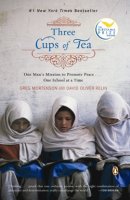 Three Cups of Tea: One Man's Mission to Promote Peace...One School at a Time, by Greg Mortenson and David Oliver Relin
(Penguin Books, New York, 2007)
Greg Mortenson, the son of missionary parents, had a happy childhood in Africa, but his return to the United States as a teenager was rough, and it took him a long time to find his way. As he tells it, it took a dramatic failure to lead him to his calling—but I disagree that someone has failed who has not succeeded in climbing the infamous K2 because he expended too much time and energy rescuing a climber in distress. Whatever you call it, from that point in 1993 on, Mortenson's energies would be spent on a different form of rescue: building schools and promoting education, especially for girls, in the remote, impoverished villages of Pakistan and Afghanistan. Mortenson was nominated for the Nobel Peace Prize in 2009; even President Obama's most enthusiastic supporters cannot read Three Cups of Tea without entertaining a doubt or two as to the wisdom of the Nobel Committee's final choice. (The Nobel Committee overlooked Gandhi, too, so their peculiar judgement is not without precedent.)
The book is not especially well-written; I can't help thinking that David Oliver Relin's English teachers laid a little too much emphasis on metaphors and descriptive adjectives. But the story is far too compelling to allow any sins of style to distract for long.
Mortenson's fumbling, single-handed efforts became the Central Asia Institute, which struggled slowly and painfully, through war, natural disaster, political disaster, war, kidnappings, death threats, war, treacherous terrain, treacherous criminals, and war to bring quality, secular education—and incidentally bridges, water works, hope, and a reason to love, not hate, Americans—to the desperately needy tribes of Northern Pakistan, and later Afghanistan. It is a four-star (highest) rated charity, according to Charity Navigator, although its recent explosive growth (thanks in good measure, no doubt, to this book) may strain it a bit for a while. But the groundwork appears as solid as the love and respect Mortenson has earned, from once-timid village girls, fearsome warlords, and the highest political, military, and religious authorities.
I am not a pacifist. I reluctantly acknowledge that military intervention is sometimes necessary. But I can't help thinking that if our government bothered to understand and appreciate other cultures and peoples the way Greg Mortenson has, we wouldn't keep getting ourselves interminably entangled in unwinnable wars. They're listening to him now, so perhaps there is hope for a turnaround.
Mortenson has a new book: Stones into Schools: Promoting Peace with Books, Not Bombs, in Afghanistan and Pakistan. Stay tuned: there are only 14 people ahead of me on the library's waiting list.
Those in the Pittsburgh and Philadelphia areas might note that Mortenson will be speaking at public events in both places this April.
 National Treasure (Walt Disney Pictures, 2004, PG)
I may have discovered the secret of enjoying movies: low expectations. All I had known about National Treasure was that it had something to do with a puzzle in American history, and when I learned that it was instead more along the lines of The Da Vinci Code, I wanted nothing to do with it. My knowledge of history is shaky enough as it is—the last thing I need is another set of false "facts" cluttering up my brain, a la Braveheart and Amadeus. But I was assured the movie is so unbelievable that would not be a problem, and indeed that I probably wouldn't like it because of the great, glaring impossibilities.
So, armed with that knowledge, I really did enjoy the movie, in the same way that I enjoyed Raiders of the Lost Ark. Once you know it's ridiculous, it's actually funny. They even got some of the history right.
Between the two of us, we guessed a lot of the plot and even some of the lines, but the movie is about a puzzle so that only added to the enjoyment. And I always like seeing places I know, like Philadelphia's Franklin Institute and Independence Hall.
The rating is PG, but I didn't find anything that would make me issue a granchild warning—in fact, it reminded me of the McGuyver shows they like so much.What drives spam? Money, obviously. And sin. Sin on both ends: the sin of greed on the part of the spammer, and the sin that the spammer is hoping will entice his victim to throw money his direction. Spam, therefore, may be a diagnostic tool, an x-ray scan revealing the broken and diseased places of our society.
If the spam that hits this blog (and is mostly filtered out before you see it) is any measure, the sickest area of our society is sex, although that observation is a bit like peering at an x-ray and announcing that the patient's leg is broken when anyone can see the jagged bone protruding from the flesh. Porn of the worst kind, body part enhancements, "performance" drugs: "greed meets lust" is a terrible combination.
Then there's "greed meets greed," the get-rich-quick schemes, from online gambling to fraudulent investments to Nigerian banking scams.
I don't know what to make of the drug spams. Most are obviously either lust spam or promoting illegal drugs, but some appear to be illegitimate sources of legitimate drugs. (Unless there's a street use for Retin-A that I'm unaware of.)
Every once in a while there appears a spam that actually looks as if it might be an ad for a real company that decided to try a new marketing ploy. Poor judgement, but at least inoffensive.
The latest wrinkle, although also inoffensive, has me both worried and frustrated: essay spam. Greet meets dishonesty? Greed meets incompetence? Have students become so lazy, so insecure, and so convinced of the uselessness of their classes that the market for essays has become lucrative enough to attract spammers? Is anyone really so stupid as to buy an English essay written by someone who could pen the following?
Students have a chance purchase the research paper or buy custom essay papers at the essay writing service about this good post.
Lots of critical essay writing about will be done for some people that wanna to have some knowledge superb facts close to to our terms .
This need very long time to find more ideas just about this post but the essay writing can aid somebody to get the proper custom papers and to buy essay
The thesis service is perfect and the company appreciate you for the hot data about this good post. Thence, after this some people really get know just about buy dissertation and buy a paper.
This kind of spam is difficult for the filters to manage, it hardly seeming reasonable to ban the word "essay." I delete it when i see it, but that's usually not before feedreaders have picked it up. That's frustrating—but at least the amusement factor eases the sting.I probably will come along your incredible information about this post in time of the term paper and just art essay completing. Thus, thanks a lot for work.
Permalink | Comments
Category Computing Random Musings
Someone else posted an enthusiastic link to Michael Hyatt's Do You Make These 10 Mistakes When You Blog? That I am not so enthusiastic is probably due to having a serious problem with the first sentence, which reads,
Assuming you want to increase your blog traffic, there are certain mistakes you must avoid to be successful.
After reading Hyatt's article I realized that not only do I make several of the mistakes, but I often make them on purpose. That's when I realized the real problem: I'm not convinced I want to increase my blog traffic.
Neither am I convinced I don't. What writer puts that much effort into his work and doesn't want it read? I like to hope that each post manages to inspire, inform, or encourage someone, somewhere. It's a big world out there, so I don't think that's a vain hope. Nonetheless, "going viral" is not my idea of a good thing. Staying under the radar is much more my style. Fortunately, my blog is likely to keep its low profile, as long as I continue to score well on Hyatt's list of mistakes.Mistake #1: You don’t post enough.
Mistake #2: You post too much.
I'm guilty of both, thanks to life constraints, a varied audience, and an inner conviction that if something exists, it requires my commentary. It's impossible to please both those who check my blog once a week, if that often, and those who check more than once a day. So I mostly post as I have time and inspiration, though I have been known to write a post but hold back from publishing it for a day or two, just to spread things out.
Mistake #3: Your post is too long.
Guilty, though not as much as I thought. I frequently exceed his recommended limit of 500 words, but include enough short posts to keep the average in line. Considering only my last 10 posts, I averaged 450 words, with the maximum being nearly 1200 and the minimum a mere 18. I could learn something from his suggestion to make longer posts "scannable" by including such devices as subheadings and lists.
Mistake #4: You don’t invite engagement.
I want engagement, comments, and discussions, but then again I don't like controversy and acrimony, which permanently excludes me from major blog status, I guess.
Mistake #5: You don’t participate in the conversation.
Ha! That's not my problem!
Mistake #6: You don’t make your content accessible.
By this he means catering to people with short attention spans who like the fragmented style that drives me nuts in newspapers and magazines: short paragraphs, side bars, pull quotes, lists, etc. I can learn a bit from this; in fact, I've notice my style changing somewhat in this direction, but in general I consider it a vice.
Mistake #7: You don’t create catchy headlines.
Not gonna change here. The site he recommends for learning to write good headlines made me gag. However, I do need to learn to make the headline more informative of the content.
Mistake #8: Your first paragraph is weak.
Definitely a problem. I often prefer to use the first paragraph for background or to set up the main point, but that's because I egotistically assume people want to read everything I write. I need to learn to put more relevant information content up front, so people will know sooner whether or not they are interested.
Mistake #9: Your post is off-brand.
If you are a hobby blogger, you can get away with the occasional post that strays from your primary message or brand. But if you are trying to build traffic, you need to find an editorial focus and stick to it. A tighter focus leads to higher traffic.
Hobby blogger it is. I would have to have a lot more time to devote to writing to pull this one off, because I could only do it by having several blogs, each with a different focus. I guess my brand is "eclectic."
Mistake #10: Your post is about YOU.
Yep. Self-centered and egotistical as it may be, I write about what I know best. My first, largest, and most important audience is family and friends, and they really do want to know what's going on in our lives.
I realize this makes it boring for the wider audience, but so be it; they have Google. That kind of reader comes here via search engines, thus finding the posts that might be helpful without having to wade through the rest. These readers are as eclectic in their tastes as I am. If my statistics are accurate, they are most especially interested in converting between Celsius and Fahrenheit, why Firefox might suddenly seem invisible, xylitol, American Sign Language, the dangers of epidural anesthesia in childbirth, and the connection between homosexuality and fertility. Who'd have thought?Permalink | Comments
Category Computing Random Musings
 A Journal of the Plague Year, by Daniel Defoe (New American Library, New York, 1960)
I first read this as a requirement for school, I believe, though I remember nothing of it, not even the grade I was in. It has long been my theory that many schoolteachers take good books and make them boring, either by being bored themselves, or by presenting the books to students who don't have enough life experience to appreciate them. A Journal of the Plague Year is proof that some required books don't need any pedagogical interference to be boring.
The plague in question is the Great Plague of London in 1665. Defoe had been born about five years earlier, and wrote the Journal in 1722. It is a work of fiction, but written in such detail and with so much obvious research that it is impossible to tell where history ends and fiction begins.
It's not the history that makes it boring, but that Defoe writes as if he is being paid by the word. It's not that long a story, but at least twice as bad as a Presbyterian sermon, in which the same point is merely repeated two more times than necessary. The story of the plague and the Londoners' responses to it is truly interesting, but my eyes started to glaze over long before the sixth repetition.
In 1721, the plague was again sweeping across Europe and threatening England, which may have been Defoe's inspiration. He might even have written it by request, as he was at the time working for the government, but in any case he would have been keenly aware of the heightened public interest in such a book. Accordingly, it reads like part history, part political pamphlet, and part religious tract. The supposed author—a saddler,* like Defoe's own journal-keeping uncle—praises the governmental officials and high class people a bit overmuch, offers his suggestions for regulations and behavior in case the plague should return, and exhorts his readers in spiritual matters as seriously as any preacher. It's all quite interesting—the first and even the second time.
That the Journal is undated and not divided into chapters adds to the reading difficulty. I needed to mark my place carefully to be certain that the repetitive nature of the narrative was real and not an artifact of losing my place.
Is it worth reading? I'm not sure. It would be a good supplement to a study of the various outbreaks of the plague in Europe, or of the history of England during those times, or even of the nature of political propaganda. But I probably wouldn't insist that a reluctant reader finish it in its entirety.
You can read A Journal of the Plague Year online in your choice of versions, including this one at Google Books.
Jamie Oliver, a British chef, is apparently a big hit in Europe. (Perhaps here, too; that I had never heard of him doesn't mean a lot.) He has cooking shows, a Tupperware-style home party business, and has taken on school meals in England and the eating habits of an entire West Virginia city. I find his flamboyant style annoying, and some of his information dated or controversial (e.g. demonizing saturated fat without mentioning the more problematic trans fats), but there is still plenty worth watching. (H/T Janet)
Grandchild warning. Forty-five years ago, my British-born Girl Scout leader explained to us some of the differences between the US and the UK when it comes to acceptable and unacceptable language. Some words considered normal here were horribly offensive there, while certain words for bodily functions were unacceptable here but commonplace there. She tried to clean up her language in deference to her adopted country, but sometimes slipped—hence the explanation. Oliver's videos are best watched without grandchildren in the room.
Oliver's TED lecture on teaching children about food and good eating habits. He's not a great speaker in this context, but I like the format better than the other videos. He's a little too inclined to look into non-personal (i.e. government and business) solutions, but an important message nonetheless. If nothing else, this one's worth it for the clip at 11:16 where he asks schoolchildren to identify foods in their natural state—and they are baffled by tomatoes and potatoes.
This article about the mathematics department at the University of Rochester credits much of their recent success to an online homework system developed by two U of R professors.
Any system that results in 80 percent of undergraduates taking calculus, without any requirement to do so, bears looking into.
I wish they'd had WeBWork when I was at the University of Rochester! However, since it was developed in 1995, and yet Janet never experienced it when she was there several years later, I'm guessing that they must not have it for the more advanced classes where I could really have used it. I don't see it working well for analyzing proofs. Nonetheless, there is great potential there for introductory classes in many fields, and I hope the open courseware movement will quickly adopt the WeBWork system.The program, called WeBWorK, was developed by Professors Michael Gage and Arnold Pizer in 1995 to help them give better and more timely feedback to students on calculus homework. Instead of handing out hundreds of identical homework assignments, professors assign homework via WeBWorK and the software customizes the problems for each student. No two students receive the same problems, so copying answers is not an issue, but more importantly, the program gives students real-time feedback on whether their solutions are correct. Gage and Pizer found that with such instant feedback, students try again and again at a problem, seeking the help of fellow students to understand the concepts that will lead to the correct solution.
The program has proven such a success that it has been adopted by more than 100 schools and universities around the country, with more than 100,000 mathematics students checking their homework every week, says Ravenel. A study at Rutgers University in 2002 showed that students who used WeBWorK fared far better on tests and in the mathematics course overall when they used WeBWorK for their homework.
The National Science Foundation has invested more than $2.5 million to help support the development and implementation of WeBWorK, and recently the Mathematics Association of America took over administration of WeBWorK to help spread it to more institutions and students.
 Just Courage: God's Great Expedition for the Restless Christian, by Gary Haugen (InterVarsity Press, Downers Grove, Illinois, 2008)
Christianaudio.com offers a free download each month, and a few months ago the offering was Just Courage. I'd rather read a book than listen to it, but audio books are perfect on my walks or when driving. It sounded interesting, and the price was certainly right.
Gary Haugen is the president and CEO of International Justice Mission.* I was not familiar with the organization before reading (listening to) Just Courage, but it's enough to make one hesitate before making the next lawyer joke. The description from their website sums their mission up well.
International Justice Mission is a human rights agency that secures justice for victims of slavery, sexual exploitation and other forms of violent oppression. IJM lawyers, investigators and aftercare professionals work with local officials to ensure immediate victim rescue and aftercare, to prosecute perpetrators and to promote functioning public justice systems.
Much of what is spoken and written about "justice," especially among Christian writers, does not sit well with me. There is altogether too much of a communist, or at least socialist, approach: the idea that if you have money or education or power or land, it is at someone else's expense; that the rich (meaning just about everyone in the West) are wealthy because they have stolen from and oppressed the poor. There may well be something to this, but I know too much about our own hard work and sacrifices, and those of our parents and other ancestors, not to find it offensive. Certainly it's neither helpful nor inspiring.
Haugen's approach is altogether different. If I could paraphrase it, it would be that there is much suffering and injustice in the world, and those who have resources are invited to be a part of the great and joyful work of liberation and healing. That positive viewpoint is the greatest benefit I received from Just Courage, though it's almost incidental to Haugen's main point about the spiritual growth that comes in bringing justice to the oppressed and in choosing courage over safety.
When I first heard the challenge to put oneself in a position—as the IJM lawyers, undercover agents, and criminal investigators do daily—of guaranteed failure if God does not "show up" and bring about a miracle, my reaction was that in our current choir situation we do that every Sunday! But somehow I think that's not what Haugen has in mind.

