
I've been avoiding this topic for some time, hoping people would come to their senses and get on with real political debate, but it just won't go away. President Carter now chimes in:
What is so intriguing, and frustrating, about these remarks is that they are held by so many otherwise intelligent, educated, and reasonable people. What is it in the mental make-up of what I'm loosely calling the American Left that blinds them to two stunningly obvious facts:"I think an overwhelming portion of the intensely demonstrated animosity toward President Barack Obama is based on the fact that he is a black man....[The] racism inclination still exists, and I think it's bubbled up to the surface because of belief among many white people...that African-Americans are not qualified to lead this great country....[Responses like comparing Obama to a Nazi] are not just casual outcomes of a sincere debate on whether we should have a national program on health care...."
- Many of President Obama's apparent ideals and attitudes, and certainly his stated policies, are anathema to a large segment of the American population. Not a majority, as the election proved, but enough that even such an unattractive candidate as McCain garnered almost half the vote. If the opposition to Obama were coming from those who largely agreed with his policies, then perhaps one could wonder if racism were playing a part. But when the opposition comes from those who have all along favored alternative ideals and policies, it's nonsense to claim that they'd be supporting Obama if only he were 100% white.
- The accusations, invective, and foam-at-the-mouth hatred thrown at President Bush were orders of magnitude worse than President Obama has received—he hasn't even seen his first shoe yet. I know, it's still early, and in any case that's no way to treat a person. But it should give one pause before assuming that racism is behind political opposition.
The only thing I can conclude is that we are so divided in our country (and in our world) that we not only do not understand each other's positions, but at some gut level we can't even believe that a normal human being can truly hold a position opposite from ours. That our ideals are so right and so obvious that there simply must be something else, something dark and sinister, behind our opponents' position.
During my teen years I was amused by the editor of a small, local newspaper who insisted on seeing Communist influence behind everyone who didn't think as he did. It was an idiosyncracy of the kind one lovingly puts up with in one's own family or amongst one's neighbors. Widespread, however, such an attitude is poison.
I've written before on the value of cultural exchange programs among countries; it may be that our own country is so diverse that we need an internal cultural exchange. Perhaps then we might reach the point of one husband I know: An extreme extrovert who is energized by the presence of other people, he cannot understand why his introvert wife needs quiet time alone to recharge. What is most important, however, is that he worked to understand and respect his wife in this area. By getting to know each other better, they developed the give and take—the respect and deference—that makes life so interesting and enjoyable.
So, too, I wish for our country.Google Fast Flip seemed like just another gimmick, but having given it a test drive I'm already hooked. Pick a newspaper, say the New York Times. Or a topic, such as Health. You're presented with an eye-catching snapshot of the beginning of the first article. You can see the headline, the first several paragraphs of text, and probably a graphic, pull-quote, or summary. Oh, and also some ads—but (shhh, don't tell Google) the ads are blessedly easy to ignore.
If you like what you see in the article, you can click on it to read the rest. Or you can hit your computer's arrow key and move quickly on to the next article. Did I say quickly? That's why I'm so excited about this. No point-and-click, no waiting for a page to load, just one keystroke and you're there. In a flash. It takes me about a second per article to determine whether or not I want to know more—usually not, it doesn't take much time to scan a lot.
This is far more satisfying than scanning news headlines in a feed reader. The headline itself does not usually give enough detail, and I find myself wasting too much time clicking on links that might have been interesting but are not. With Fast Flip I can take most stories with a single glance, while for many others I find that reading the first several paragraphs tells me what I want to know without having to bother to click through to the whole article. When I want more detail, it's there—but doesn't intrude unless I seek it out.
What will Google think of next? I hope this catches on in a big way; as yet there is not a great choice of sources.Permalink | Comments
Category Reviews Computing Everyday Life
 Chances are, whatever you got for a high school graduation gift, it wasn't what Steven Perezluha received: the opportunity to ride his bicycle to Alaska and back. It was Steven's idea, but if you want that kind of adventure, it certainly helps to have Danny Chew, former Race Across America (RAAM) champion, as your uncle. Steven's part of the trip began June 8, when he departed Florida for Pittsburgh, where Danny lives.
There the real adventure began. They biked north, then across Canada's vast spaces until they entered Alaska. There they met up with Steven's parents and toured the state together for a while before heading homeward on a more southerly course. The journey's not over yet.
You can read the Orlando Sentinel story about Steven and his trip, at least as long as the link still works.
And I thought our grandkids had a "long leash." Must be the Pittsburgh air....
Update One hundred forty days and 13,769 miles after Steven pedaled out of his driveway, he and Danny returned. As the follow-up Orlando Sentinel article reports, if the trip to Alaska was exhilarating, the return was excruciating, plagued by accidents, illness, and blizzards. But thanks to friends; some kindly churches that opened not only their doors but also their pantries to the exhausted travellers; Steven's dad, who relieved them of their heavy trailers for the last leg of the journey; and most of all to their own grit and near-incomprehensible determination, they never gave up.
"It was one of the best feelings in my life. Ever," Perezluha said.
Here are some pictures, and a map of their journey.
Update 22 January 2010 Articles from the Pittsburgh Tribune-Review:
Family, Friends not Surprised by Pair's Ride
Million Mile Man Chew Completes an Epic Trip
Permalink | Comments
Category Everyday Life
My Google Calendar, into which I've imported the US Holidays collection, has been reminding me for a couple of weeks that tomorrow is Patriot Day. Something seemed wrong about that, but I put it down to the careless omission of the "s"—and perhaps an apostrophe. Whether you choose to spell it Patriots' Day, Patriot's Day, or Patriots Day, there's supposed to be an "s" there. In these hurried days, it seems, no one has time for effective proofreading (moi aussi).
But wait! There's more wrong than that—Patriots' Day is, of course, in April, commemorating Lexington and Concord and all that flurry that started the American Revolution. Boston Marathon 2009 (traditionally held on Patriots' Day) has already been run. So what's with Google Calendar and tomorrow? Tomorrow? Ah, September 11.Where have I been for the last six years? According to Wikipedia*
On September 4, 2002, President Bush....proclaimed September 11, 2002, as Patriot Day. On this day, the President directs that the American flag be flown at half-staff at individual American homes, at the White House, and on all U.S. government buildings and establishments, home and abroad. The President also asks Americans to observe a moment of silence beginning at 8:46 A.M. (Eastern Daylight Time), the time of the first plane crash on September 11, 2001.
That's Patriot Day. No "s." I had no idea. If the mail is delivered and we don't get presents, it must not be a holiday, right?
I do remember where I was on that day in 2001, and not just because I was alone with the strangers who were dismantling our home for the move to Boston. I was already so numb I hardly had room to register more distress. But I remember, and honor those who died, especially those who put themselves in harm's way to save others.
Stay safe out there tomorrow, especially those of you who (1) are in New York City, (2) are travelling, or (3) both.

Permalink | Comments
Category Everyday Life

If you were given an unexpected two weeks in New York City (actually 8.5 weekdays), how would you spend them? Not the way I did, it's a safe bet. While I did manage one or two obligatory tourist trips (more on that later), most of my time was spent at the New York Public Library—you know, the place with the magnificent lions out front, where everyone goes who wants to film something in a library because it's so beautiful. Though in truth I never saw the main part of the building. I made my home in Room 121, the Irma and Paul Milstein Division of United States History, Local History and Genealogy. One of the best resources in the world, a perfect complement to my beloved New England Historic Genealogical Society Library in Boston.
As with February's research trip to Boston, this was an intense time. I estimate I spent 40 hours of those eight and a half days in the library itself; it turned out to be more blessing than bother that it didn't open till 11 a.m., as I needed the morning time to prepare. The library is less than half a mile, a mere eight minute walk, from the Times Square Hilton hotel where we stayed, and what a pleasure it was to sling on my backpack, descend via the Hilton's two elevators to 42nd Street, walk past Bryant Park, and enter the cool, dark research room with its intoxicating smell of old books; then to re-emerge—after gentle prodding by the librarians, who reminded me that the building was about to close—and reverse the trip with a head swimming with new data, and my sweet, hard-working husband and a late dinner to look forward to.
Researching, writing, sitting for hours at a desk poring over books—that which was anathema during my school years gives me such great pleasure now. Who'd have thought?Permalink | Comments
Category Genealogy Everyday Life
(You know who you are.)
Permalink | Comments
Category Everyday Life
It would not be too strong to say that I loathe politics. I vote, and have done so since I was first able to at age 19, but mostly without enthusiasm; choosing the least objectionable candidate is gritty, unsatisfactory work. Other than that, I try to ignore politics. Unfortunately, politics does not return the favor, so I occasionally give in to the prodding of my conscience and attempt to articulate a political opinion in a blog post, or write a letter to an elected official, or attend a political meeting.
The last is rare indeed, but that's what I did the other night. Our state representative held a health care "town hall meeting." On my list of preferred activities it was somewhat below scrubbing the bathroom floor with a toothbrush, but I put on my Sunday-go-to-meeting clothes and ventured out into the rain anyway. Not without a bit of grumbling under my breath, but this was one of the few candidates in memory who actually impressed me in his campaign—or maybe credit goes to the campaign worker who rang my doorbell; those of you who know me know that it takes someone really special to impress me after starting out on such a wrong foot! Anyway, I decided to go because I can't very well complain about what they're doing to health care if I don't express my opinion, and because I think our representative is a good guy and what a shame it would be if he held a meeting to get people's opinions and no one showed up. I thought I'd at least go and say hi and maybe get to know him better.Now that was a pretty funny idea! Shows how little I know about politics. I began to suspect I might have been wrong when I saw all the cars in the parking lot. I managed to find a parking space, and later a seat, thanks to the fact that Google Maps is unaware of an important street closing on the way to the hall, so many people arrived late.
Anyway, the room was packed—I'm guessing 300-350 people—with policemen stationed around to prevent...what? Riots? We Central Floridians are pretty civilized folk, I guess. There was some speaking out of turn—though one man who did later apologized—and clearly feelings were running strong, but at least up to the time I left, it was pretty calm.
Yes, I left early. I had decided soon after seeing the crowd that I would listen, not speak, and many of those who spoke expressed my concerns for me. So after about an hour I decided I'd had enough. I'm the kind who leaves ball games in the middle of the ninth and exits EPCOT before the fireworks—anything to avoid the madding crowd of cars all trying to leave the parking lot simultaneously. The headache induced by the strobe effect of the ceiling fans that hung below the lights was all the excuse I needed. Fortunately, the Mozart clarinet concerto on the radio on the way home brought relief; Advil and hydration at home completed the cure.
It was worth the effort, even if our representative has no idea I was there. Here are a few observations:
- Feelings, as said, were strong. What's happening with health care is an important issue to a whole lot of people who have far better things to do than go out in the rain to a political meeting. (Scrubbing the bathroom floor, for instance.)
- Our representative, along with others, is sponsoring a bill that would (if it makes it through the many necessary steps) enshrine in the Florida Constitution an individual's freedom of choice when it comes to health care and insurance. My first reaction was that the idea was pretty silly, because if the federal government imposes dislocations in the health care market that drive out private competition, our state constitution isn't going to make any difference. Upon reconsideration, however, I think it's a worthwhile effort. Governmental and corporate subsidization of public education, for instance, has indeed placed a burden on private and home education, but that's all the more reason the right to the alternatives needs to be clearly established. What's more, if successful, this and similar efforts under way in other states will make a clear point, one which the national government will do well not to ignore.
- The crowd was far from uniform, but a great majority were very worried that we are about to dismantle the best health care system in the world. As one person put it, sure, there are some changes needed, but if 85 percent of the population is content with the health care they have now, is it necessary to take such drastic action to please the remaining 15? At the risk of ending up with much more than 15 percent unhappy?
- Dissenters generally spoke well, and made some good points, though sadly they were by and large irrelevant. It sounds good—and we no doubt need the reminder—to plead that we need to be compassionate and care for the poor and needy, but it begs the question as to what policies will best accomplish that goal. It reminds me of a "status message" that made its way around Facebook recently: "No one should die because they cannot afford health care, and no one should go broke because they get sick." True, but you might as well say, "no one should die, and no one should go broke." The issue is not a simple, "Should we help people?" but the much more difficult, "What is the best way?"
- Which brings up another point from the meeting: health care rationing. Everyone speaks of this as a bad thing, and I agree, but what most people are unwilling to acknowledge is its inevitability. Thirty years ago a physician friend of ours shocked people with this idea, and I haven't forgotten his logic: as medical care becomes more and more technological, complex, and expensive, it will become impossible to give the highest level of care to everyone. He was a Catholic and as pro-life as you could want, but even he spoke of triage, of the necessity of addressing the issue of the best allocation of healthcare resources. Whether the allocation is done economically (some will die because they are too poor to afford care), or through availability (some will die because they must wait too long or travel too far for care, or because innovations have been discouraged), by policy (the old and disabled will die because care is diverted from them to those younger and more fit), or by some other means, there is no getting around it: people will die. So far, my own opinion is that the economic allocation is actually the fairest of these, because it holds out more hope for individuals: financial obstacles, difficult as they may be, are easier to overcome than unavailable care or bureaucratic rules.
- On the lighter side, the crowd at this meeting was not only civil, but educated. We began with the Star Spangled Banner, sung by the representative's young daughter, who turned out to have a very nice voice. But you couldn't hear her for long, because most of the audience joined in the singing—and knew the words. Best of all, the daughter must be an alto, because the song was pitched so that no one screeched on the rocket's red glare. It's a pity we didn't sing my favorite verse,* but then no one would have known all the words, not even me.
- One final note. No one should hold a public meeting without giving the audience members a quick lesson in microphone use: hold the mike close to your mouth if you aren't a trained singer, a regular church lector, or a trial attorney. Clearly this crowd had not been to enough karaoke bars....
*Oh! thus be it ever, when free men shall stand
Between their loved home and the war's desolation!
Blest with vict'ry and peace, may the heav'n-rescued land
Praise the Pow'r that hath made and preserved us a nation.
Then conquer we must, when our cause it is just,
And this be our motto: "In God is our trust."
And the star-spangled banner in triumph shall wave
O'er the land of the free and the home of the brave!
I cogitated upon this video all day before finally deciding to post it. I'm hiding it behind the "more" tag because it's replete with highly offensive words. So much so that it's almost not offensive: nothing is said with anger, or malice; it's as if the man is one of those poor unfortunates who can't speak without using "um" or "like" every other word—only those aren't his filler words of choice.
The reason I decided to bear with the profanity is that this comedy routine is perhaps the neatest expression I've yet seen of Purple Ketchup Syndrome. When Heinz came out with purple ketchup, I knew the mental disconnect between what we eat and where it comes from was complete.(If you watch the video, do it here rather than clicking through to the YouTube site; the comments there are worse than the video.)
Permalink | Comments
Category Random Musings Food
Here's a contrast for you.
Most folks know by now the story I wrote about in It's Not about Race, of the Harvard professor who got into an altercation with the Cambridge police while breaking into his own home, and ended up with an invitation first to a jail cell and second to the White House. But here's a more encouraging tale from NPR, about an encounter between the New Jersy police and someone who might have expected more recognition and respect than a university professor.
Cops: You're Bob Dylan? Never Heard Of YouThe link takes you to a transcription, but there you'll also have the opportunity to listen to the 2 1/2 minute show, which I recommend, if only for the way the journalist skillfully wove in bits of Bob Dylan's songs.
What chance this kindness and cooperation will get Dylan and the officers a beer at the White House?Finally, in the end, the three of them all went back to Dylan's hotel where the staff IDed this man, who is arguably one of the most well-known songwriters of all time. The officers thanked Dylan for cooperating and later they said he seemed as kind as could be.
Permalink | Comments
Category Random Musings
I made cheese today, my first effort since succumbing to the lure of Ricki Carroll and her New England Cheesemaking Supply Company. It was not, perhaps, an auspicious beginning, since the never-fail, easy-enough-for-a-seven-year-old mozzarella recipe...failed. Maybe I need a grandchild or two to help.
On the other hand, what I did manage to produce is a great, lower-fat substitute for cream cheese, and if I knew what it was I did wrong, I could replicate it. My biggest mistake was clearly to ignore Ricki's instructions to keep a cheese journal, logging everything from ingredients to procedures to the ambient temperature and humidity. Cheesemaking is an art, and at some point you're bound to create something you'd like to be able to make again; keeping a log doesn't guarantee that you'll be able to, but it greatly increases the odds.
For now, I'l enjoy my "cream cheese," and try again with the mozzarella another day.Permalink | Comments
Category Everyday Life Food
I don't expect most of my Loyal Readers to wade through the entirety of Paul Gottfried's Voices Against Progress: What I Learned from Genovese, Lasch, and Bradford at the Front Porch Republic, but I include the link for those of us who were students at the University of Rochester during those times. I find it fascinating to glimpse the political maneuverings that were going on over the heads of mere students. I knew neither Eugene Genovese nor Christopher Lasch; I stayed as much as possible in the science and engineering part of the school, and never set foot in that "hotbed of the New Left, the University of Rochester history department." But everyone had heard of Genovese, whom we usually referred to as Our Resident Commie, and his wife, Elizabeth Fox-Genovese, the Resident Feminist.
Of even more interest is how the thoughts and ideals of these people changed over time. I don't regret having avoided the U of R history department in the 1970's, but find myself wishing I had known these folks as friends.Color to use for background of images to appear transparent in a post: fdf2d2 = r/g/b 253/242/210
Specify start and stop times of embedded YouTube video:
<p><iframe class="true" width="425" height="355" src="https://www.youtube.com/embed/sBg6F2oQW7o?start=4001&end=5045" frameborder="0" allow="autoplay; encrypted-media; fullscreen"></iframe></p>
The future may belong to the Indians, or perhaps the Africans—or anyone who grows up in a multilingual environment. Adding to the evidence of the benefits to the brain of speaking multiple languages is the research of Lera Boroditsky at Stanford University. (Newsweek article by Sharon Begley.)
When the world's tallest vehicular bridge,* the Viaduc de Millau, opened,
German newspapers described how it "floated above the clouds" with "elegance and lightness" and "breathtaking" beauty. In France, papers praised the "immense" "concrete giant." Was it mere coincidence that the Germans saw beauty where the French saw heft and power?
Not coincidental, and also not conforming to my stereotypes, in which Germans focus on strength and organization while the French are concerned with beauty and grace. However,
In German, the noun for bridge, Brücke, is feminine. In French, pont is masculine. German speakers saw prototypically female features; French speakers, masculine ones.
Nor is this an isolated phenomenon.
Germans describe keys (Schlüssel) with words such as hard, heavy, jagged, and metal, while to Spaniards keys (llaves) are golden, intricate, little, and lovely. Guess which language construes key as masculine and which as feminine?
Our language shapes not only our thoughts but our very ability to see. People whose language has more precise words discern differences faster and better. Russian, for example, has separate words for what English calls different shades of blue; experimenters found native Russian speakers to be faster than English speakers at distinguishing the differences.
Similarly, Korean uses one word for "in" when one object is in another snugly (a letter in an envelope), and a different one when an object is in something loosely (an apple in a bowl). Sure enough, Korean adults are better than English speakers at distinguishing tight fit from loose fit.
In Australia, the Aboriginal Kuuk Thaayorre use compass directions for every spatial cue rather than right or left, leading to locutions such as "there is an ant on your southeast leg." The Kuuk Thaayorre are also much more skillful than English speakers at dead reckoning, even in unfamiliar surroundings or strange buildings.
There's more to this than the obvious thought that knowing multiple languages opens the mind to more ways of thinking and perceiving. The most potent statement in the article is this:
Having a name for something allows you to perceive it more sharply.
People have wondered why I am so interested in the idea of sharing "encyclopedic knowledge" (sometimes derided as "baby flash cards") with very young children. (I've written a small bit about it at Jonathan's Happy Hunger.) This connection between naming and perception underscores one of the primary reasons: the more one knows, the more one sees...and generally, the more one enjoys, as well. Whether it's birds or automobiles or paintings or constellations, knowledge increases both observation and enjoyment, which in turn increase appreciation, respect, and the desire for more knowledge.
Maybe if Adam had taught Eve the names he gave to all those animals, her thirst for knowledge wouldn't have led her in the wrong direction.
Permalink | Comments
Category Education Children & Family Issues
Hat tip to Andy Bonner for this humorous look at the copyright mess.
Permalink | Comments
Category Just for Fun
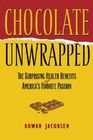 Chocolate Unwrapped: The Surprising Health Benefits of America's Favorite Passion, by Rowan Jacobsen (Invisible Cities Press, Montpelier, Vermont, 2003)
Like chocolate, this delicious book goes down easily, and the facts about chocolate's health benefits are not hard to swallow. At a mere 126 pages from introduction through references, it's a quick and easy read—I read most of it on the way to and from church today—and yet manages to cover the history and production of chocolate, a good deal of detail on why chocolate—which begins as a fruit, after all—should be considered a health food, environmental and labor issues in the production of chocolate, unusual chocolate recipes, and list of great chocolate sources. It is necessary to ignore a few insults to Columbus, the Puritans, and anyone who likes milk chocolate, but on the whole these are minor annoyances.
Did you know that there are three types of cacao plant? The criollo beans of Mesoamerica have the best flavor; but the forastero beans of South America (transplanted to Africa) have taken over 90% of the market, because their trees are hardier and more productive. Trinitario, a hybrid of the two, was developed in Trinidad and though it supposedly carries the best characteristics of each, it runs a far-distant second. It is a familiar story, this choice of quantity over quality: think instant coffee, Velveeta cheese, cheap wine, Wonder Bread, and red-rock tomatoes. But as more and more people join the taste revolution, choosing to enjoy whole grains, local vegetables, and espresso, so also are the more flavorful varieties of cacao becoming popular. And as with wine and cheese, where chocolate comes from—the soil, the climate, the environment—makes a difference in the flavor.
It's not too surprising that the darker the chocolate, the more beneficial components it retains. The author recommends 70% cacao, as beyond that the melt-in-your-mouth effect is lost. I figure I'm close enough with my Ghirardelli 60% cacao chocolate chips. :)
And what are those beneficial components? Legion. Anti-oxidants galore—it blows away the competition, including blueberries, red wine, and green tea. "[O]ne good-quality dark chocolate bar can have more polyphenols than two whole days' worth of fruits and vegetables." You know how some doctors prescribe daily 81-milligram doses of aspirin for its clot-prevention effects? Turns out a couple of squares of dark chocolate have the same effect. Hmmm...I know what my choice would be.
Chocolate also contains a whole slew of low-dose, mood-altering chemicals, including anadamide, which is nearly identical to the THC found in marijuana. Seems those marijuana brownies of our college days did more than just disguise the illegal drug. (And no, I didn't partake, didn't even have the opportunity. But I can't follow President Clinton in saying I didn't inhale, because second-hand smoke of more than one kind was unavoidable back then.) There's a reason eating chocolate makes us feel better.
The section on environmental and labor issues is balanced, pointing out that the issues are complicated. In attempting to combat child labor on cacao plantations in Côte d'Ivoire, for example, one must take care not to do more harm than good.
For these cacao laborers, a poor-paying job is still better than none. And preteens working in agriculture alongside their parents has been part of African culture for centuries, if not longer. Of the one million cacao farms in West Africa, the vast majority are tiny (less than five acres) family affairs. The child labor abuses reported were confined to the few large plantations, but boycotting cacao from Ivory Coast would affect the family farms even more severely than the plantations.
Jacobson supports the Fair Trade program, which has grown beyond coffee to include cacao, and has two sets of standards, one for small farmers and another for plantations and factories. He also recommends buying organic chocolate, which is grown in a more environmentally-sustainable fashion—and also is more likely to contain the better-tasting criollo beans.
There's one more delightful side effect of Chocolate Unwrapped: last night I read a section of it out loud after dinner, and Porter immediately brought me a bowl of Publix Chocolate Trinity ice cream and a glass of red wine. :)


