
I hate to give such horrors any more publicity, so if you already view Planned Parenthood as evil incarnate, don't follow any of the links on John C. Wright's post, Footnote to Modern, Ever-Changing, Ever-Evolving Moral Standards. If, on the other hand, you still cling to the hope, as I did for a long time, that the omni-present organization might not be utterly irredeemable, you owe it to your children to take a look (with them out of the room, of course—preferably out of the house). I wish I could cleanse my brain of those cute, Sesame Street-like videos, but sometimes it's useful to know just how bad the situation really is.
I like the idea of socially responsible investing, but this has reminded me that whatever harm might be done by an undesirable gnat stock amongst those in our mutual funds is dwarfed by the camel damage paid for with our tax dollars.
Oh, by the way. In case you miss it (which I recommend), take my word for it that when the folks at Planned Parenthood use the word "abstinence," they mean something entirely and disturbingly different from what you, I, and the dictionary do. So define your terms carefully (and make them define theirs) before conceding agreement on any point.Permalink | Comments
Category Education Children & Family Issues
My first reaction to the good news that girls are now doing as well as boys in mathematics, at least through high school, was to laugh at the headline, which was "Numbers don't lie: Girls equal to boys in math." Anyone who knows anything at all about numbers knows that they are frequently used to express untruths. Nonetheless, it's still good to hear that the distressing gap between male and female performance that once appeared between elementary school and high school has disappeared.
And yet, I wonder. I don't give any more credence to the idea that boys might be inherently better in math than girls, any more than I do to the idea that girls are naturally superior in reading. (I do leave room for the idea that certain ways of thinking, some approaches to problems, and even some narrow fields of mathematics, might show sex-specific correlations, because, after all, men and women are inherently, biologically different. I'm quite certain, however, that differences among individuals are great enough to make sex-related differences of little import.) What makes me less than elated about this new study is a nagging suspicion of anything that sees parity as the goal. From the school principal who told me that the ultimate purpose of kindergarten was to get all students on the same level, to the school board members who were much less concerned with student achievement than with making sure no school in the district looked any better or worse than another, I've found that a victory in mere equality often masks a decline in real accomplisment. Both kindergarten and school district "parity" are often achieved as much by holding some students back as by bringing others forward. I'm certainly glad girls are doing "as well" as boys in mathematics—but much more interested in how all our students are doing, not only in comparison with each other, with students of the past, and with students of other countries, but most importantly in consideration of actual achievement. "As good as" is a slippery measurement, and "better than" is little better. In the company of serial rapists, a "mere" adulterer might feel pretty good about himself.
(It is also worth mentioning that the reason given for poor female performance in the past, that people expected girls to be stupid when it came to math, was certainly not universal, even "50 years ago." My parents never expected that I would not do as well as my brothers, nor did any of my teachers offer me such a flimsy excuse as gender for poor performance!)John C. Wright's post about his discussion with a utopian communist awakened memories of my own encounters with people who look back with affection to the time of the 1960s and 70s. It's probably good, in general, that human beings tend to forget the sorrows of the past and remember it with a golden tinge, but when it's the sufferings of others, rather than our own, that we ignore, we are in danger of making grievous mistakes.
No age (nor philosophy) has a monopoly on evil, and I'm the first to admit both that my own life was largely insulated from the pain of that time and that some good things came from it, but the era was one of selfishness, incivility, and disastrous policies unequalled in my (admittedly limited) experience. Worse, it was the spawning-ground for much future harm.
Perhaps if more people remembered those decades with suspicion, rather than admiration, the present age wouldn't be as likely as it threatens to repeat them.O Divine Master, grant that I may not so much seek...to be understood, as to understand.—St. Francis
I can't resist taking a moment to share another excellent post from Random Observations, which gently reminds me that I need to spend more time trying to understand the point of view of those with whom I disagree, especially if I disagree strongly and emotionally.
 Planet Narnia: The Seven Heavens in the Imagination of C. S. Lewis, by Michael Ward (Oxford University Press, 2008)
It is hard to overstate the excitement with which I read Planet Narnia. I'll return shortly to Michael Ward's discovery of the pattern and scheme under which C. S. Lewis wrote all seven of his Narnia books, but it's also worth noting that Ward's writing itself was a delight to read. I am so very, very tired of the recent trend of informal, conversational writing that appears to have been put together in haste, without benefit of editor or even proofreader. That style is good for blogs, but in a book the lack of consideration for sentence and paragraph structure, the grammatical mistakes, the impoverished vocabulary, and what often comes across as a condescending tone detract significantly from the message proclaimed.
Planet Narnia is a cool stream dancing through a thirsty land. It is intellectual and academic without being in the least bit dry, a book clearly written for the general public—but an intelligent and educated general public. It was not, perhaps, the best of books to take to the shore where one is constantly in (delightful) danger of being interrupted by friends who drop by or grandchildren who want to play, but it was too fascinating to give up for lighter fare, and will well bear re-reading, probably several times.
As soon as I heard about Ward's identification of the relationship between the Narnia books and medieval cosmology, I knew I had to rush right out and buy the book. (Note: "rush right out and buy" is used in the same sense as "dial a phone number." What I actually did was order it from Amazon. To be fair, I did try first to get it from our library or a local bookstore, but without success. I want to support local businesses, but what can I do if they so rarely have what I want to buy?) If you are not as impatient as I was, you can get a preview at the Planet Narnia website.
(In case anyone is confused, I should probably note that Lewis's use of this cosmology has nothing to do with believing in a geocentric universe, but rather its symbolic and philosophical meanings. As Aslan explains, in The Voyage of the Dawn Treader, "a huge ball of flaming gas" is not "what a star is, but only what it is made of.")
A little background will help explain one reason I was so excited about Ward's ideas. I have not (yet) read Dante's Divine Comedy, but Porter is in the middle of Purgatorio, having finished Inferno a while back, so for his birthday or some such occasion I bought the Teaching Company lectures on the Commedia. This is a course I recommend very highly for anyone contemplating reading Dante's masterpiece. I had no idea what an absolute genius Dante was! While listening to the lectures, I was struck repeatedly by how much parts of the Divine Comedy reminded me of the writings of C. S. Lewis. Planet Narnia showed me why this is no coincidence: Lewis was a great admirer of Dante, and much that is in Dante's great poem, particularly the Paradiso, is reflected in Lewis's works.
Although I've always loved to read, I never liked literature classes in school, despising the way teachers would take what otherwise might have been an interesting book and analyze it to death; I see now that my distain developed because I had never seen such analysis done right. Both the Teaching Company lectures and Planet Narnia showed me that the right analysis of the right book is like solving an enormous cryptic crossword puzzle.
Ward's work also helped me understand one reason I've been so disappointed by the movie versions of The Lord of the Rings and the Narnia books (so far). Even where they are true to the characters and plot of the stories, even where they have caught some of the ideas conveyed by the books, they have largely missed what Lewis called the "Kappa element"—roughly, the atmosphere, flavor, or tone—that makes each book what it is.
Is an understanding of medieval cosmology, or the way it infuses the Narnia tales, necessary for appreciating the books? Of course not; they have been well loved ever since they were written, by people who, like me, had no clue that all the references to gold in The Voyage of the Dawn Treader were part of its "Solar" flavor. The Kappa element was apparently intended not to be seen (except by puzzle solvers), being much less obvious than the Christian element, which Lewis states he deliberately kept low-key. Its importance is on the imaginative, not the rational level.
The distinctive roles of the imaginative and the rational are expressed much more clearly in Planet Narnia than I was able to articulate in a recent, frustrating discussion with a friend, and thus particularly welcome reading. Although Truth is one and undivided, we cannot see it correctly if we do not look at it through both lenses. I doubt that C. S. Lewis ever used the terms "left brain" and "right brain," but he would have appreciated the value of both approaches.
Enjoy the Narnia tales just as they are, if you wish. You don't need to know the Jovial elements in The Lion, the Witch, and the Wardrobe, nor how Mercury influences The Horse and His Boy. But rest assured that J. R. R. Tolkien was wrong in considering the Narnia septet to be a literary hodge-podge. Planet Narnia makes a convincing argument that the apparently random elements are instead carefully placed stones in a brilliant mosaic.
A friend of ours has four children. They're all still less than eight years old, and have yet many years to develop their tastes in music, but where they stand now offers some food for thought.
When the oldest was in utero, his musician mother was teaching at a college, and was totally immersed in classical music, particularly opera. He is now very bright, intense, and serious, with a lovely boy soprano voice and a love of classical singing to go with it.His siblings, all girls, are no doubt equally bright, but their musical tastes are quite different. When she was pregnant with the next two, our friend was the music director of a traditional church; they are now mellow, happy children who love traditional hymns. The youngest spent her formative pre-natal days listening to her mother rehearse with the "praise band" at another church, and she is the rocker of the family—the louder and more intense the guitars and drums, the better she likes it.
"So whence," I asked, "comes the delight all the children have in Broadway music?" "Subliminal," our friend replied. She and her husband sing together every night after the kids are in bed, and Broadway tunes are a favorite. Every night, as their son solemnly informed me, even when they get home really late, they take time to sing together.
No wonder the kids love music, and are singing all the time themselves. And no wonder theirs is such a delightful family.Permalink | Comments
Category Children & Family Issues
My to-do list is too long for me to indulge much in long stories or philosophical musings, so today you get just plain fun. Sometimes I think I'm the last person in the world to see things that have apparently been circulating on the Internet for years, but just in case I'm only the second-to-last, don't miss this.
Be sure to check out Matt's site for more details and other videos. You know how many teenaged boys dream of getting paid to play and design video games? Well, Matt had that dream job, and chucked it over for this. And I thought Janet was good at getting paid to travel.
(Parental advisory note: Once you get past the name of the site, which only matters if you can read, the video is perfectly safe and enjoyable for all ages. At least this one is; I haven't checked them all. See above comment about time limitations.)Permalink | Comments
Category Just for Fun
We celebrated my birthday with a three-way phone call (Florida/Pittsburgh/Basel), good wishes from family and friends, and a dinner at the Kobé Japanese Steakhouse. We'd been to the Kobé before, but that was probably 15 years ago. Their teppanyaki service doesn't remind me in the least of our experiences in Japan, but that doesn't mean the food wasn't good. We didn't even spring for the $80 Wagyu beef; the $18 sirloin was quite delicious enough. And the $15 birthday bribe was worth a bit of mild embarrassment.
Today was a bigger birthday, with a slightly bigger celebration. For our part, we once again joined the Greater Geneva Grande Award Marching Band for Geneva, Florida's genuine, old-fashioned, small-town Independence Day celebration, the only Independence Day parade in Central Florida to occur on July 4th. I love Geneva's celebration—I hope that it is not a bad sign that the cow-chip toss game used plastic "chips" this year—and I love the band even more. It was 15 years ago that we first marched with some of those great folks!As usual, I made loud crashing noises with cymbals, and Porter kept the band members well hydrated. He's had that job ever since our first gig, Atlanta's Independence Day parade in 1993. Geneva lacks the television coverage, the long parade route, the melting tar in the pavement under our feet, and the real, desperate need for frequent hydration—in Atlanta we were the only band not to have someone faint—but his efforts and antics are no less appreciated.


Geneva's Master of Ceremonies challenged us to take this patriotic quiz in today's Orlando Sentinel, claiming that he only missed two questions. I was more than pleased that I missed none at all, though on one question I used my multiple-choice test taking skills more than my real knowledge. (Porter, of course, easily got them all right.) The pride was somewhat short-lived, however, since I found the full version of the test and only scored 90%. That would still be a respectable score if I did not have the nagging feeling that I've seen that test somewhere before, so it doesn't really count.
I hope you all had a great day, however you celebrated!Permalink | Comments
Category Everyday Life
For a monolingual person, I have an inordinate love of languages. Not only is multi-lingualism increasingly important in today's world, but it does wonderful things for the brain—from increased brain growth in babies to decreased dementia in the elderly. I wish the great resources available for teaching young children another language had been around when our kids were little, and I wish I had more aggressively pursued what there was. Be that as it may, I am only a language dilettante, enjoying learning a few phrases of Japanese before our trip there, brushing up on my minimal high school French, and listening to the language CDs from the Hippo Family Clubs. I wish I were multi-lingual, but face the reality that at my age it just isn't going to happen.
Nonetheless, I should be able to learn, if I put the time and effort into it, enough of a language to get along reasonably well with basic, necessary communication. Which brings me to the question of why I find myself attracted to almost any language other than the two that would be of the most immediate practical use to learn: Spanish and German.The source of my prejudice against Spanish was not hard to discern: I don't react well to threats and pressure, and the increasing dominance of Spanish in Florida makes me feel about that language the way many Québécois feel about English. Unreasonable prejudice, I know, but at least I understand its origins.
German is another matter. Anticipating many future trips to Switzerland, not to mention German-speaking grandchildren, learning German should be a high priority. And it will, when I can talk myself past the mental block. But why the reluctance? Why does the German language sound ugly and angry to me? Sophie Scholl helped me untangle this puzzle: My association with German and Germany is too much influenced by World War II.
Not that I ever experienced WWII myself, nor did my parents express any particular anti-German sentiment. But when I was growing up, the memory was yet green in American culture, and Germans were not presented positively in the books we read, the movies we saw, the television shows we watched, and even the games we played. The bad guys barked "Heil Hitler!" and "Seig heil!" and "Ya voll!" and spewed angry-sounding, though incomprehensible, strings of harsh consonants. For some reason, perhaps because I grew up on the East Coast rather than the West, Japanese was spared this treatment.
I'm sure that German words out of the mouth of a young grandchild will sound perfectly lovely.
And fortunately for me, Schwyzerdütsch k'valt mir goed. (Real Swiss German speakers please forgive my attempt at spelling what I hear.)
Having worked my way (the first time) through the Pimsleur Swiss German lessons (unfortunately there are only 10 of them), I can now say hello, goodbye, please, and thank you, ask you to repeat what you just said, tell you my name, and ask how to get to Bahnhofstrasse or Marktgasse. I can also order a restaurant meal—though only if it's Gschnätzlets mit rösti—and a drink, if I'm willing to have coffee, beer, wine, or mineral water, which means I'd get pretty thirsty if it weren't for those great Swiss public drinking fountains. I can make a date with you; that is, if you're willing to come at 9:30, 10:00, 1:30, or 2:00.
Schwyzerdütsch ish schön! Especially if spoken by someone you love.Permalink | Comments
Category Education Everyday Life
I shouldn't be surprised when what is said in comic strips mirrors opinions expressed by essayists in more serious venues. After all, both get their inspiration from the same human condition, and humor is an efficient and effective way to make a point. Nonetheless, I always take note when I hear the same message from widely divergent sources, as happened when I read in close succession Francis Schaeffer's The God Who Is There and John Taylor Gatto's The Underground History of American Education. When an evangelical Protestant theologian living in Switzerland and a self-described lapsed Catholic schoolteacher from Pittsburgh, writing on issues that apparently differ markedly, make the same historical and philosophical point, perhaps I had better listen.
The conjunction of Mallard Fillmore and Mike Thomas, about which I wrote yesterday, is less portentous, perhaps, but today's has signficant social and philosophical implications.Safe Havens is one of the quirkier comic strips I like to read, but if the following strip is incomprehensible to you, it's not because you don't understand about the mermaid, the grandmother's ghost, the genetically-altered animals now serving as roadies. I follow all that and was still confused.
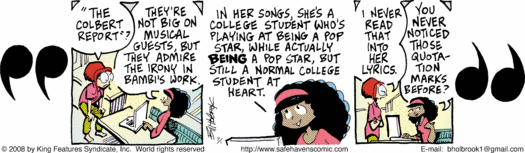
Yesterday's mail brought a letter from Ken Myers, whose Mars Hill Audio Journal I enjoy greatly. The purpose of the letter was an appeal for support, but the content shed light on the Safe Havens strip.
With my children grown, I have been blessedly even more clueless of pop kid culture than I was when they were young, but I did hear the name Hannah Montana thanks to a friend of Heather's who blogged about the effort she went through to secure concert tickets for her Hannah Montana-crazy daughter. That's all I knew though—she sings, and she's enormously popular with the younger set. Thanks to Myers' letter, however, I know—and worry—more.
So that's the Safe Havens strip, complete with "ironizing quotation marks."
- Miley Cyrus (now 15) plays the lead character on Hannah Montana, a character named Miley Stewart. Stewart has migrated west from her humble Tennessee origins to live in Malibu, to pursue her dreams as a superstar singer known to the public as Hannah Montana. Hannah Montana is thus a persona, an alternate identity assumed by Miley Stewart. Miley Stewart is also a character, performed by Miley Cyrus. What makes it even more reflexive is that Miley Cyrus performs in concert as Hannah Montana, bypassing Ms. Stewart entirely. One might ask if Miley Cyrus is really a celebrity pop sensation, or whether she just pretends to be a pop sensation when she’s in character.
- The image in Vanity Fair of Miley Cyrus [apparently nude, though provocatively draped in a sheet]…has evoked intense media scrutiny and widespread parental anxiety over the apparently important question: Has this wholesome role model been stained by this arguably provocative photo.
- The question moms (and dads) need to be asking is not whether Miley/Miley/Hannah is going to go all Britney on them, but whether their six- and seven-year-old daughters really benefit from having as a guide to growing up a performer playing a performer playing a performer. Just as the most important lesson taught by Sesame Street is that learning must be fun, so the most important lesson taught by Hannah Montana may be that growing up is about learning how to perform one’s life, how to define your identity as a desirable commodity, how to assemble and project the brand called Me.
- The culture of celebrity and personal performance which permeates our society is profoundly destructive. It’s not simply that being well-known for simply being well-known (in Daniel Boorstin’s classic formulation) is a thin and vapid achievement. More fundamentally disordering is the way in which the deeply sensed notion of “identity as performance” promoted in the culture of celebrity undercuts the very idea of reality or real life; more than the work of nihilistic philosophers, the prominence of performers in our society nudges us toward referring to “reality” (with the ironizing quotation marks) rather than to Reality.
Permalink | Comments
Category Children & Family Issues Random Musings
Mike Thomas, an Orlando Sentinel columnist, has had a special place in our hearts ever since he interviewed Heather for a magazine article about her summer camp experiences. That I often disagree with his opinions in no way keeps me from appreciating his intelligence and writing skills.
His recent column, The Sea Is Coming, makes the excellent point that, whatever we do or don't do about global warming, or global cooling, we in Florida are fighting a losing battle against natural forces. Florida's coastline comes and goes, advances and retreats, and the worst thing we can do is to cover it with lots of big, expensive buildings. The second worst is to encourage that overgrowth, as we do, with government-subsidized property insurance—considered necessary because real insurance companies know how foolish it is to build one's house upon the sand while standing in a hurricane's path.Mike also takes the time to explain to younger generations why some of us older folks refuse to take too seriously all the global warming hysteria. We've lived long enough to see theories come and theories go, and hear the cry of "Wolf! Wolf!" once too often. That doesn't stop me from being in favor of fuel-efficient cars, public transit, and non-motorized transportation, along with recyling, sustainable agriculture, water conservation, and other ways to make our envionmental impact more beneficial than harmful. But my opinions and actions in these matters are more in spite of the hype than because of it.
[I]n 1975, Newsweek ran a story warning climate change could cause famines and political unrest. This was based on growing scientific evidence Earth was cooling. There even was a proposal to keep the polar ice cap from expanding by covering it with black soot.
Mike's article was on my "possible blog fodder" list for a while, but Mallard Fillmore's comic of yesterday pushed it to the top of the list.

[Insert whistling here]
Front entrance lights and tiles


Kitchen bar lights and hand-crafted wine rack


Yep, he did it all, plus about a dozen more cool things on a smaller scale!

Permalink | Comments
Category Everyday Life
Sophie Scholl: The Final Days is a simply made but powerful German film (with English subtitles) about a young woman arrested for treason after distributing some anti-Nazi leaflets. Don't expect a happy ending; the setting is Nazi Germany, where happy endings were few. Nonetheless I recommend the movie highly. Such depictions of goodness and heroism are rare—much less without resorting to graphic violence or sentimentalism.
Four things struck me in particular:
Sophie's courage, while lamentably rare, was of an everyday kind. She is no saint, no Mother Teresa, no doer of grand deeds. Initially, she seems less like a serious member of an underground resistance movement and more like a young college activist with no serious understanding of the dangers of the game she is playing. Indeed, as the scenario works out, she is often dazed, as if she can't believe what is happening. Yet this is where her courage shines: she is calmly, grimly, and articulately faithful to her beliefs. Whether or not Sophie Scholl's actions made a bit of difference in ending the Nazi insanity is debatable; what is clear is that her kind of heroism is within reach of everyone, and comes not from being especially saintly, but from character established and nourished over the years, resulting in a well-ingrained habit of doing the right thing despite the cost.
The horror that was Nazi Germany did not happen overnight. Ordinary people, attempting to live ordinary lives—working, playing, learning, raising families—found themselves gradually entrapped by a system which multiplied minor evils into great obscenities, rewarded playground bullies with power and authority, and convinced normal folks that compromise and complicity were necessary for survival.
One reviewer (I don't remember who deserves the credit, or the blame) noted that Sophie Scholl: Die letzten Tage is a German film, and remarked with pleasure that it was good to see Germany dealing with its darker history. I'm not so sure. It's awfully easy to repent of other people's sins. Sophie Scholl is now a hero in Germany, especially among young people. From the Wikipedia article: [I]n 2003, Germans were invited by ZDF Television to participate in a nation-wide competition to choose the top ten most important Germans of all time. Voters under the age of 40 helped catapult Sophie and her brother Hans Scholl into fourth place, winning over Bach, Goethe, Gutenberg, Bismarck, Willy Brandt and Albert Einstein. If the votes of young viewers alone had been counted, Sophie and Hans Scholl would have be[en] ranked first. No one under 40 could have participated in the Nazi terrors, and it's quite unlikely that their parents did. Repentance is a grand thing, but it's important not to let our horror at a past regime distract us from similar evils, extant or potential, in our present lives.
Without negating one bit of the evil that Hitler perpetrated, it's hard not to detect a bit of racism in our treatment of Nazi Germany. The 20th century alone is filled with insane dictators and horrific blood baths: Joseph Stalin, Mao Zedong, Pol Pot, Idi Amin, Saddam Hussein, Nicolae Ceausescu.... You can add plenty more to the list, yet Adolf Hitler, Nazi Germany, and the Holocaust are put forth again and again as the ultimate evil. It is almost as if we look at Asians, Africans, and even Eastern Europeans and expect them to be uncivilized...but Germany? How could such horrors arise in Western Europe? I know, it doesn't take much knowledge of European history to find plenty of evil in the West—which is why it smacks of racism to give Hitler such prominence.
Perhaps one reason we are so shaken by Nazi Germany is that much of the harm that was done was within the law. The purpose and the glory of the law is to protect the people; when ideologues use it instead as a weapon against a country's own citizens, we are right to be frightened.
I don't recall the era of the 1960s with fondness; it wasn't all bad, but it was a messy, unkind time that accelerated our culture's decline in the areas of civility and decent behavior. However, there must be more of the 60s in my make-up than I thought: I'm finding good reasons to distrust The Man. :)
Just as the National Education Association adamantly opposes home education, the American Medical Association, unnerved, perhaps, by Ricki Lake's popular home birth movie, The Business of Being Born, has taken direct aim at home birth.* Reaction against yet one more threat to personal freedom has come from across the political spectrum, from the far left to the far right. Congratulations to the AMA for provoking agreement between pro-choice and pro-life groups.
Naturally one would expect professional associations for doctors (and teachers, and plumbers for that matter) to fear and oppose anything that threatens to take even a small amount of business away from their members. This conflict of interest, however, does make it difficult to believe that the driving motivation for their actions is altruistic. They would do better, I think, to consider the advice of wise Gamaliel to the Sanhedrin (Acts 5:12-39) when they threatened to kill Peter and the other apostles who were disrupting Jerusalem (and the Sanhedrin's business) with their stories about Jesus:
Leave these men alone! Let them go! For if their purpose or activity is of human origin, it will fail. But if it is from God, you will not be able to stop these men; you will only find yourselves fighting against God.
*If you follow this link to the U.S. News and World Report article, some of you will be particularly interested to note the first comment.
In considering the Supreme Court's nullification of Louisiana's law that allows a death sentence for one convicted of raping a child, I asked, Shouldn't the question before the Court be, "Is there anything in the Constitution of the United States that prohibits the State of Louisiana from imposing this sentence?"
The Court's subsequent decision on the District of Columbia's ban on individual ownership of handguns addressed the issue in just that way: Is there anything in the Constitution that prohibits the city from imposing such a law? "Yes," they concluded— although the vote was shockingly close. The Second Amendment confers a right to gun ownership that this law attempts to take away. I applaud the decision, not because I like the idea of a gun in the hand of every irresponsible idiot, but because it was the right answer to the right question. If our society has diverged so much from our origins that the "right of the people to keep and bear arms" is no longer tenable, we, the people of the United States, have the right and power to take it away via a new Constitutional amendment. The Court's job is to examine the law in light of the Constitution as it stands
I have not taken the time to read the entire, lengthy decision, but even a cursory glance shows how critical to sound decision-making is a good understanding of not only law, but also history, grammar, linguistics, and above all logic.
