
Awaking before the rest of the household, I slipped outside to explore the grounds in the peaceful early morning light. Just me, God, and the neighbor's cows. It was what I needed after eight days of intense tourism. We spent the morning enjoying our friends and their home. Easter Monday is a holiday in France, and most places are closed, which was fine with us!
Later our friends took us to a nearby park. We ate lunch at a small restaurant there, listening in on another group that was sitting on the steps and singing folk songs in French with an accordion accompaniment. We enjoyed a leisurely walk past cliffs and climbers, and saw why this area was attractive to its very ancient inhabitants. (There are cave paintings nearby, though we didn’t get to them.)
There are caves…

springs of clean water….

wildlife (okay, these are sheep, but there must have been plenty of game in such a place)…

and even beautiful butterflies. They certainly took a shine to Porter while the rest of us were stretched out in the warm sunshine.

What more could a prehistoric family want?
Dinner that night was at a very fancy restaurant. A very fancy French restaurant, and not just because we were in France. I'm not a fancy restaurant type of person, but it's a nice experience to have on occasion, especially if you are sharing it with good company.
I should mention that the Fairy Princess is the daughter of an American mother and a British father, but she lives in France and attends a bilingual school. I could have listened all night to her speaking French with the waiter. It's not perfect French, more the French of a five-year-old. But after all, she is only five. I wouldn't want my grandchildren to be an ocean away—it's bad enough they're in Pittsburgh—but there are compensations, and the opportunity to grow up bilingual is certainly one of them.
Permalink | Comments
Category Travels Everyday Life
When our friends asked what our Easter traditions were, my immediate reaction was, "total exhaustion, following a glorious church service for which we had a good deal of responsibility, and into which we had put an enormous amount of time in preparation. That was the truth for many of our favorite Easters, and it left little time and less energy for other traditions. We had some, such as decorating eggs, having an Easter egg hunt (though not, as had been in my childhood, with the decorated eggs, as in Florida the real, hard-boiled eggs spoil too quickly in the often hot Easter weather), Easter baskets full of candy (jelly beans for me, SweeTart eggs, chicks, and bunnies for the girls, and chocolate for everyone; I couldn't interest anyone in marshmallow chicks). More often than not, we shared the day with friends, in not-too-energetic pursuits. As far as meals go, my family's Easter tradition was ham, and Porter doesn't care for ham, so we never really settled on anything in particular. "Easy" was a good criterion.
We certainly did not have the tradition of spending Easter at a château in France, but I could get used to that! We awoke to a big, chocolate chicken hanging (in a basket, nothing morbid here) from Janet's doorknob, and of course the Fairy Princess had her own wonderful Easter basket.
This may be a good place to mention that Janet and the Fairy Princess fell in love with each other almost immediately, and it was painful for both of them when we left. It helps that the FP is not only well-behaved and charming, but that she also plays the harp! Did I mention that this castle came equipped with a harp? The two of them had great fun inspiring each other.
We went to church. Not the big, fancy, English-speaking church in Paris, where we would have experienced all the beauty and glory of the biggest holiday of the church year. Not even in the cathedral at Laval. But in a small French Catholic church in a nearby village, and even though I believe the service wasn't much different from other Sundays (though with more joy and a few more Alleluias), it was certainly special for us, because it was, of course, all in French. One advantage to being an Episcopalian is that the Catholic Liturgy is not so much different; we were able to follow along quite well. Even our exposure to contemporary praise songs helped; I'm finally learning how to fake the tune when all the bulletin provides is the words. Even when they're in French. (Or Japanese.)
Remember what I said about my French being absolutely minimal? It's true, and Porter's is even less. But the priest deserves a lot of credit for clear diction, as we were able to understand a great deal of the words. Of the words, mind you, not the sense. In, say, a ten-word sentence, I might have understood five or even more of them, but the words I couldn't figure out were the key to the meaning of the sentence itself. Oh, well, I was just happy to be able to understand enough to feel like a worshipper rather than a spectator.
Our hosts have an Easter tradition: a big party with an egg hunt and a buffet full of incredible food! I won't show many pictures, because so many have people in them, and I don't like to show people unless I'm pretty sure they won't mind. But here are a few.
Our contribution, with help of course from the Fairy Princess, was the deviled eggs; I had brought our recipe with that in mind. It was our hostess's brilliant idea to dye the whites, though!

There were five children for the Easter egg hunt, which was just the right number. We all agreed that the Easter Bunny (who curiously goes by the initials wpw) did a great job. Afterwards we enjoyed the fabulous buffet, and conversation with interesting people from as far away as New Zealand and as near as down the road a piece.


When the guests had all left, we approached that state of exhaustion that I mentioned as our own Easter tradition. Porter and our host enjoyed watching Manchester United cream Roma in a very exciting football (aka soccer) match, while Janet and I joined our hostess in relaxing conversation. The Fairy Princess, being a highly intelligent creature, was asleep.
Permalink | Comments
Category Travels Everyday Life
Having slept off our Thanksgiving dinner-style museum orgy, and packed our suitcases for departure, we were ready to indulge in another museum, this time the Musée d'Orsay. The Orsay begins where the Louvre leaves off, covering more recent (but not too recent) art. You know, Rodin, van Gogh, Gauguin, Cézanne, Monet, Manet, Matisse, Homer, Renoir, and the like. Being a converted train station, this museum is not as user-friendly as the Louvre; that is, it was much easier to get stuck in the middle of a hoard of other tourists. I didn't mind so much waiting my turn to get in front of a painting, but when most of the people both ahead and behind me seemed impatiently intent only on snapping a photo with their cell phone cameras, it got rather annoying. Besides, I'm not much better with crowds than I am with heights.
Still, it was a great visit (and free with our Museum Passes). Even this much smaller museum has 'way too much to take in on one visit. Paris would be a great place for a homeschool year abroad!
Porter and Janet graciously made allowance for my nervousness by planning to get to the train station much earlier than we really needed to. This was Gare Montparnasse, not the station we had come into from Basel (which was Gare de l'Est), and I wanted plenty of time to check it out and for things to go wrong. So we closed up the apartment, grabbed our bags, and walked to the bus stop. (To give some credit to my insecure need for checking and rechecking, we did benefit from having rehearsed this earlier, since it turned out we needed to get a different bus from the one we had been planning on.)
The bus came quickly, and took us to the station in good time. This one is much better organized than Gare de l'Est (which is under construction), and we were able to find our train on the schedule board (though it was too early for the track number to be up) and also the luggage storage area, which would be important on our return. Then we settled down at a café to eat and wait.
Our train to Laval was the high-speed line, the TGV. Porter, having seen what second class train accommodations were like his previous time in Europe, had pushed to get first class tickets. But the TGV is expensive, even for second class, and Janet and I talked him into it. Much has changed in 40 years, and second class was delightful. Two hours later we were in Laval. Our friend picked us up at the station, and soon we were here:


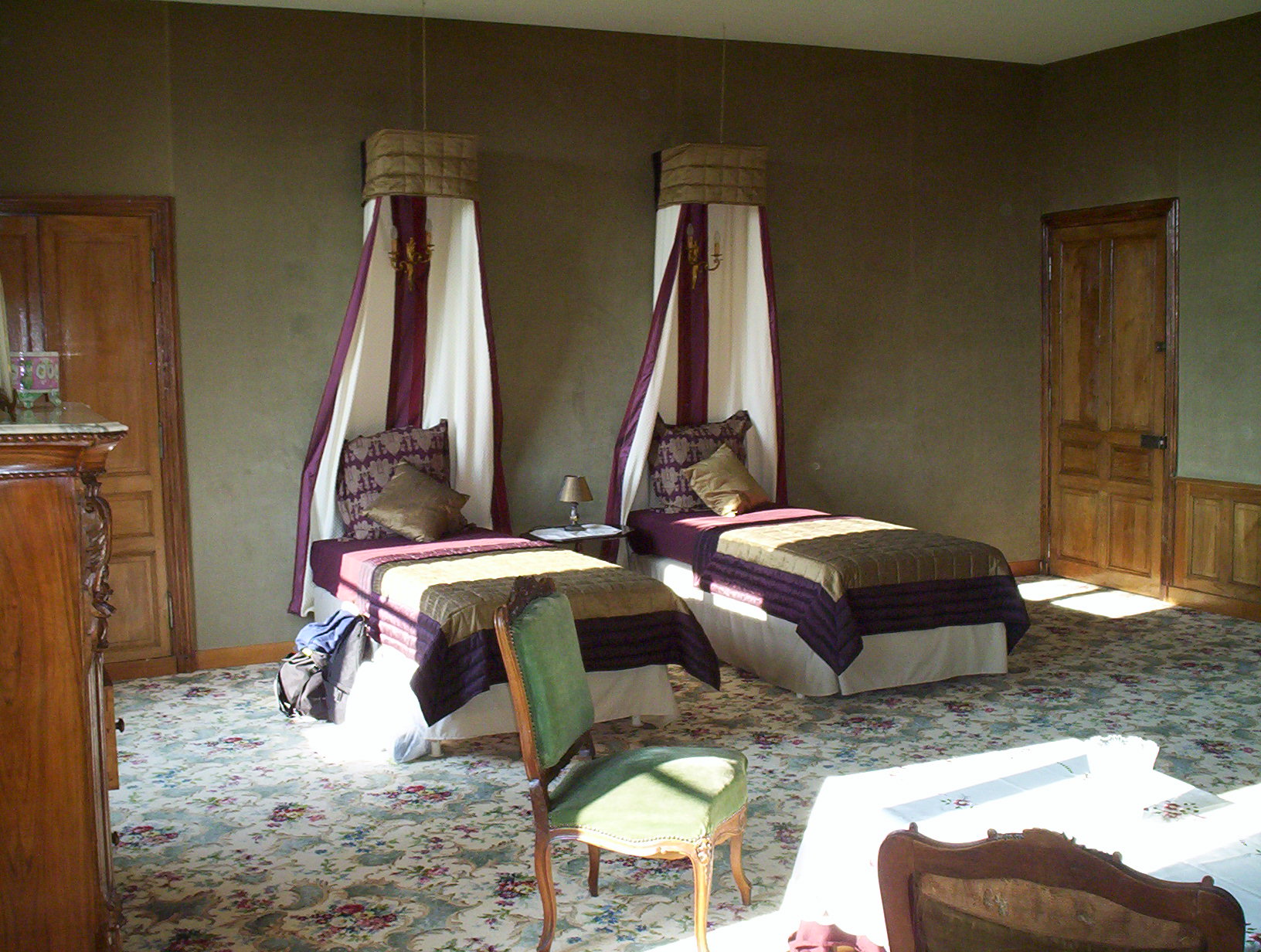
If it looks like a magical fairyland, it is. We would have been happy to visit our friends and their young daughter fairy princess in a small shack, but this was beyond our dreams. It's not everyone who can say that her birthday celebration included both a museum in Paris and a gourmet dinner at a château in the French countryside. Speaking as her unprejudiced mother, if anyone deserves such a treat, it's Janet, and we are so thankful to those who made it possible.
And so to bed, to rest, to dream….


Permalink | Comments
Category Travels Everyday Life
Ah, to wake up in Paris, and eat breakfast in the café next door! So what if croissants/bread, orange juice, and tea/coffee/hot chocolate for three cost $40? When you stay with friends rather than at a hotel, you can afford not to worry too much about the meals. It was a lovely breakfast, and the orange juice was squeezed from real oranges seconds before being brought to the table. The orange juice was part of the package, or I wouldn't have ordered it, since I'm a Florida snob who believes that the only real citrus juice is not only "not from concentrate," but hasn't been pasteurized, and that's impossible to get at a restaurant—unless the juice truly is fresh-squeezed. So this was a delightful surprise.
So was being able to communicate in French! I haven't mentioned that yet, but it was one of the most enjoyable aspects of this trip. My French is of the three years in high school forty years ago variety, supplemented by some recent, desultory language tape practice. Nonetheless, the French people were very patient and never switched to English unless it was necessary, and I experienced the thrill of actually communicating in another language! Readers from other countries may find it hard to imagine that one can study a language without ever communicating, but language study in the U. S. tends to be much more theoretical than practical. It was very exciting to understand and to be understood in another language, even if only at the most basic level. I believe Americans would be much less resistant to foreign language study if they had the opportunity to experience this. Saying "Bonjour, comment allez-vous?" to a fellow student does not count.
The Louvre. We could have spent a week, or a month, or a year there, but we settled for all day today. It was an easy walk from the apartment, and we got a good start by not having to wait in the long line at the entrance. Because we spend so much time at the Louvre, instead of hopping from museum to museum, we didn't, in one sense, get our money's worth out of our Paris Museum Passes. It would have been less expensive to pay direct admission. But we highly recommend getting the passes anyway, because their true value lies in shunting you to the front of all those long lines. (Actually, it's usually a separate line altogether.) Too bad they don't work at the Eiffel Tower!
I. M. Pei's infamous Pyramid Entrance may not fit with the style of the Louvre, but it stands atop (and brings light to) a huge improvement in crowd-handling. The underground hub also makes it easy to navigate from one wing to another of the huge museum, and is a great place to meet up if you've been separated. I don't suppose most tourists think of the Pyramid as "just another work by the guy who designed Wilson Commons," but most tourists at the Louvre didn't attend the University of Rochester.

We split up, arranging to meet again at a café under the Pyramid in two hours to compare notes. Janet wanted to be free to explore at her own pace, and rented an audio guide. I went with Porter because I enjoy his commentary; we shared our mp3 player with Rick Steves' audio tour. Actually, we quickly abandoned Rick, as his commentary didn't fit well with our style, and we had gotten out of sync anyway, because one of the exhibits had been moved. Not to worry; there was plenty to see, read, and learn without help.
Speaking of help, this is as good a place as any to insert a plea to all parents of small children: Do yourself and your kids a really big favor, and make every effort to familiarize them with great works of art, particularly while they are young and have not learned that museums are supposed to be boring. (I could say the same about music, but right now we're at the Louvre.) I don't mean dragging them to art exhibits (not at first), nor making "art appreciation" a formal topic of study. But there are so many other ways to introduce them to famous art and artists, from showing Bits of Intelligence to babies (Jonathan loved them), to hanging art pictures all over the walls and talking about them together, to books and videos, such as the excellent ones by Mike Venezia. (I didn't know until today that he has videos! I'll have to investigate further.) Talk about the art works with your child; it helps if you know something about them yourself, but even if you don't, you can still make comments; this will help your child notice and remember. When you do visit a museum, try to get pictures of some of the works you will see, and let your child become familiar with them first. Do what you can, but do it! And the younger you begin, the better. It's never too late, but early can be a lot easier.
Why am I so emphatic about this? Because we found our visit to the Louvre to be so much more exciting and interesting for having watched Museum Masterpieces: The Louvre, a Teaching Company course. There's nothing like walking into a room and suddenly coming upon a painting that you "know," even if it's not one of the better-known works. I believe the line at the Mona Lisa would have been a lot less long if it weren't just about the only work many tourists are familiar with. How else to explain their ignoring the other famous da Vinci works just a few feet away?
Okay, back to our tour. Porter and I spent our time in the Denon wing, mostly with French and Italian paintings; on the way, we caught the Venus de Milo and the Winged Victory of Samothrace. We went at a much faster pace than we had at Basel's Kunstmuseum, but still were caught in the middle of a huge wing when it was time to head for our meeting place. Janet, it turns out, had spent the whole time on the second floor of the Sully wing. So we departed, planning to meet again in three hours.
I believe we more or less swapped wings, Janet heading for Denon and we for Sully, where we learned why she had spent so much time amongst the French paintings on the second floor. We saw much else, as well, but museum fatigue was definitely setting in. There is only so much the brain can handle all at once, not to mention the feet.
The Louvre is too much. It has too much. They can't take proper care of their immense store of treasures. At the Kunstmuseum, the artwork is protected by an invisible, electronic barrier that alerts a vigilant guard if you inadvertently cross it. At the Louvre, we saw many examples of people getting up very close, breathing on the delicate paintings, stroking the sculptures, touching frames and probably even the paintings themselves! The museum generously allows photography in almost all of the exhibits, but asks that flash not be used. This was in large measure ignored, with the paintings being subject to bright light after bright light.
I don't understand why so many people bother to come to the Louvre, only to view the art through a camera lens. I did understand the men who wanted their pictures taken next to the Venus de Milo, but why take a picture of a famous painting (without even yourself in it to show that you were there, in the same room as that famous painting), when you could buy a much better picture of the same thing on a postcard in the museum shop? Or even pull one off the Internet? It's true there were a few things I should have taken pictures of, because they aren't famous enough to be on a postcard, but for the most part the effort seems a complete waste of time.
So, we were exhausted, dehydrated, and hadn't eaten anything since breakfast. Probably not the best circumstances under which not to have a specific plan as to what to do next. We wandered through part of the Tuileries, which I found disappointing, largely because I hadn't done my homework and was expecting more in the way of flowers for something with jardin in its name. There we had a small bite to eat and the tensest moments of our entire trip, before and after. But we got through it, and decided it made sense to split up again. Porter, who was still gung-ho and energetic, walked to the Monnaie de Paris, a coin museum, while Janet and I went back to the apartment to rest. The time actually wasn't very restful, as it was spent trying to plan the rest of the evening, but at least we were off our feet.
Happily reunited, we decided we couldn’t possibly do all we wanted to, and would "settle" for some bread and cheese in the apartment and a return to the Louvre. This time we saw a little more of each other, as we both had missed parts of the first floor of the Denon wing, and also wanted to get to the Richelieu wing. In the latter, Porter spent the most time amongst the Dutch painters, and Janet was amazed by (among other things), Napoleon III's apartments. She'll have to tell you about it, though, as we didn't get there. You can't see everything in a day. You can't even walk by everything. But I think we did very well for the time we had.
Today was Good Friday, and though we didn't spend it as we usually do, we certainly saw enough paintings that did not let us forget the significance of the day.Permalink | Comments
Category Travels Everyday Life
Transition! We took the tram to the train station, where we bought drinks to go with the food we had bought yesterday to eat on our trip to Paris. Janet knew exactly what to do and guided us to the train—it helped, too, that the signs were clear and the station logically organized. "Did you notice the border control?" she asked, as we neared the train. Well, no, we hadn't, unless you counted the big sign labelled "FRANCE," and that was her point. Apparently we were technically in French territory at that point, but no one had asked for our passports, nor did they when we reached Paris. Eventually the conductor did take our tickets, but that was all.
[Update: Here is a Gmaps Pedometer view of our train trip. ]
We left shortly after 8 a.m., and the five hour trip flew by, probably because I spent much of it either pouring over our Paris and France guidebooks trying to make some decisions, or else doing last-minute cramming of useful French phrases. The announcements were all in French, and I caught enough to conclude we didn't really need to know what they were saying until we arrived at Paris (at Gare de l'Est), and then all we did was follow the crowd.
Into mass confusion. The French could learn a bit from the Swiss about transportation systems. (I'm not particularly knocking France; I expect most everyone could learn a great deal from the Swiss about transportation systems.) We had planned to pick up some euros at the train station, but even though one was clearly marked on the directory, it was equally clearly not there. We finally gave up and went to find a taxi, but as soon as we exited the station, Janet noticed something across the street: a bank building with an ATM.
(Note to anyone planning to visit Europe: a debit card from your bank is a very good thing. There were several places where our ATM cards did not work. Our credit union had suggested we get a debit card, as they work in more ATM machines than the regular cards do. In Paris we were very glad we had followed that advice. We didn't use credit cards nearly as much as we have done before when traveling, as they now charge a significant foreign transaction fee, which the credit union does not.)
Flush with euros, we stood in line at the taxi stand, and it wasn't too long before it was our turn, and I gave the address in my well-rehearsed and best French. I also had it written out, because my best French is none too good. It was probably just as well, because I'm fairly certain French wasn't the cab driver's native language, either.
It was an exciting (okay, harrowing in places) ride through the streets of Paris, and we couldn't stop looking back and forth from window to window. Janet followed our progress on our little pop-out map of Paris.
Soon we were there, on the narrow street,

walking through the flower shop (are you sure this is right?),

keying in the secret entrance code (it worked—we must be in the right place),

climbing the winding stairs,

passing through the next set of doors,

tentatively ringing the doorbell of what we guessed might be the right apartment.
It was! Our host was on his lunch break from work, but took time to introduce us to the necessities of the apartment and the neighborhood. Then we were on our own—we didn't see him again till he picked us up at the train station in Laval. (There I am, getting ahead again.) Did I mention that these gracious friends not only welcomed us into their home in the French countryside, but gave us free rein in their Parisian flat?
At some point I suddenly realized that we were in an artist's apartment in Paris! What a romantic notion! This was far from a garret, however, but a beautifully designed, comfortable, and highly functional use of a very small space. The Maggie P. with a French accent. (Our friend is an artist, and I'll publish a link to her works if I get her permission. She's rather well-known, but alas doesn't yet command the kind of prices that will allow Janet and Heather sell the sketches she made of them years ago and never have to worry about money again. Someday, maybe!)
So there we were, on our own in Paris! What to do first? Well, how about a walk to the Louvre, only a few blocks away? What a huge building! Time enough to see it tomorrow, let's cross over to Ile de la Cité. Here are Janet and Porter on Pont Neuf.

Hmm, very nice walk. Oh, there's a nice place—Sainte-Chapelle. A long line to wait in, but not as long as the Louvre will be tomorrow, let's buy our Paris Museum Passes here. Oops, unlike Basel, where the pass is good for 48 hours, this one is only good for two days, so if we activate it tonight we don't get much out of it. Better save it for tomorrow and Saturday, and pay separately to get into Sainte-Chapelle. Very good to have the passes, though, and avoid the lines tomorrow.

Sainte-Chapelle was built by Louis IX (okay, he ordered and funded it; a lot of other folks built it) in the middle of the 11th century. The lower section, built for ordinary folks, is beautiful enough, but the upper, royal floor has the spectacular stained glass windows Sainte-Chapelle is famous for. The altar area was shrouded in plastic, undergoing some restoration work, but there was enough to see in the rest of the room! Many of the windows are original, but extensive repair was also necessary because of vandalism during the French Revolution. We recently watched an excellent Teaching Company course on Western civilization that portrayed the French Revolution in what I thought was quite a positive light, but there was a very dark side as well. It would be interesting to do a comparative study of the French and the American revolutions, because I get the impression that—granted there were knaves and heroes on both sides—ours was less destructive, less angry and hate-filled, more about constructive change than random, violent destruction. But that may be ignorance and prejudice on my part.
Next stop, Notre Dame! It must be very difficult to maintain a working church and a tourist attraction at the same time, especially during Holy Week. Notre Dame was beautiful, of course, and interesting, but I was beginning to suffer from Tourist Fatigue. That is, I was tired myself, as a tourist, and I was very tired of being surrounded by so many other tourists.

So we took a much-needed break and walked to the Pompidou Centre. We didn't go inside, having had our fill of ultra-modern art yesterday. But we did marvel a bit at its exoskeleton (like a lobster, its bones—plumbing, electrical, HVAC fixtures—are on the outside) while enjoying crêpes (note to Janet—you're not crazy; it turns out savory crêpes are traditionally made with buckwheat flour!) at a nearby café.

And what was beside the café? The Stravinsky Fountain, another creation of You-Know-Who!

Thus refreshed, we enjoyed the sights from the #69 bus, which we took to the Eiffel Tower. And I thought there were too many tourists at Notre Dame! The Eiffel Tower is romantic, and taking the could-be-scary elevator to the top is a must-do, IF you are a romantic person and can get there when there's no line. It's like Disney World—only worth doing when other people aren't. We had hoped to see the sunset from the top, but we passed from daylight to dark in the long, snaky line. It didn't help that there was some event going on that caused certain people to be cut into the front of the line, people who were probably famous rock stars or something, given the number of photographers and autograph-seekers hounding them. At least we enjoyed talking with our neighbors in line.
At last we bought our tickets and were inside. Gotcha! Again, like Disney, more lines, more waiting. Then you take the elevator up part way, and get out—to wait in another line for another elevator to the top. The view from the top was very nice, with the city lights and all, and we were determined to enjoy it after all that waiting. I maintain I got more for my money than the others, because in certain circumstances I find mere height to be scarier than the best roller coaster I've ever ridden—so I got the tourist sights and a thrill ride, too.


Despite the lines, it was an enjoyable visit, until it came time to go down. The first elevator ride was fine, but we then found ourselves trapped on the second level. You see, those same bigwigs that cut in front of us at the entrance, were all leaving their private party and had taken over the elevators. Every elevator that came opened its doors on their side first, and then only had room for a couple—more usually, none—from our side. This went on, and on, and people finally started to get angry. I began to wonder what the French Revolution had accomplished. Didn't they want to get rid of aristocratic privilege? Was it time for another one? Porter, along with many others, finally decided to reduce the number of those waiting for the elevator by taking the stairs, but Janet's knee was bothering her and she didn't want to pull up lame at the very beginning of our stay in France. So we waited. The chief problem was the same as it was in the Superdome during Hurricane Katrina: lack of information from those in charge. No signs, no announcements, no explanations, no advice, nothing. All the other elevators, and most of the stairs, were closed down. We really had no idea what to do. Finally, two of the angry folks (an Italian lady and a British man) made enough of a nuisance of themselves that some workers took pity on us and took us out through the "employee only" elevator, thus ending our three and a half hour ordeal visit to the Eiffel Tower. My advice: if you're not the romantic type mentioned above, skip La Tour Eiffel altogether and go to the top of Tour Montparnasse. It's much quicker, less expensive, and has a great view.
We were down, but we weren't home yet. The buses had long ago stopped running for the night. There were no taxis to be seen. We decided to hoof it. About halfway home, near Les Invalides, we saw some taxis, and I pleaded for relief. We found taxis to be surprisingly inexpensive in Paris. The only thing wrong with this ride was that we had our one and only encounter with a rude person. I'm tired of hearing how rude the French—especially Parisians—are. In all of our other experiences they were friendly and helpful. And even the taxi driver got us home.

Permalink | Comments
Category Travels Everyday Life
I thought our Sunday was exciting, until I read about the Daleys'!
It was Sunny on Sunday here, too, at least for the morning. Porter put our bikes on the back of the car and the skies were blue and clear as we headed out for 8:00 church. The service was glorious, with lots of great hymns—we needed to double up on the hymn board! The 8:00 service at Messiah rocks! (Though not literally.) Afterwards there's always a great breakfast, at which we fortified ourselves for our adventure.
After changing into cooler clothes, we hopped on our bikes and headed to the West Orange Trail. It was our first time on this trail, and covering new ground is always fun. The day was hot, but not unpleasantly so as long as we kept moving. Our plan had been to travel about five miles westward to the beginning of the trail, and return to the eastern leg at another time. You will not be surprised to learn that we got sidetracked.
The first diversion came when we decided to drop in on some friends we hadn't seen since before we moved to Boston. They used to host a wonderful bed and breakfast place, and it's now for sale. It would be a great place to live for someone who could afford it, i.e. had won the lottery or else had recently sold a small shack in California or Boston. In any case, they were very gracious about receiving unplanned guests this morning, and it was great to see them again and catch up a bit. I'm still sorry they no longer run the B&B, though. :(
On the road trail again, we thoroughly enjoyed the breeze, the sun, the shade from the giant oaks, passing field and forest, cute buildings, tiny towns, dirt roads, and major highways. And many other travelers, enjoying the trail by bike, skates, foot, and stroller. We came all too soon to our goal, and the conspicuous "End of Trail" sign. But it wasn't! Feeling a little like the Swallows passing the Beach End buoy, we continued on the paved trail with no end in sight. It turns out that only a few days ago the South Lake Trail had been completed, linking the West Orange with the Lake Minneola Scenic Trail in Lake County. We pedaled on for another couple of miles before reluctantly turning back, not without making definite plans to return. As it was, we stayed out longer than we had planned, and perhaps made a little too much vitamin D. We should have stopped somewhere and put on sunscreen, but we survived with only a very mild sunburn in a few places. It was a good reminder that we've entered the season when the Florida midday sun is not to be trifled with. And that haircuts leave vulnerable skin that had previously been protected.
As we drove home, hot, tired, and happy, we noticed that the once-blue sky had turned grey, and not the sky only but the air all around was shrouded in a smoky cloud. This happens occasionally in the dry season, when smoke from a Central Florida wildfire spreads our way. We wondered if this might have been from Wekiva Springs Park, where they keep the occurance wildfires down with controlled burning, but sometimes they happen anyway. Turns out this smoke was from just a little further away—the Okefenokee Swamp! I hope Pogo and Porky Pine are being careful....
We topped off the day by having a friend for dinner. I don't mean that quite the way it sounds. We had lasagne, salad, cheese bread, and fruit (apple/blueberry/peach/rhubarb) crisp, accompanied by good conversation.
I commented this morning that I should have pre-cooked the fruit a bit, because the apples and rhubarb were not fully cooked. It was still good, I added, but I like my crisp a little softer. We laughed almost as much as we did over the "It's only a little wet" incident.
We had so much fun last year at the Mad Cow Theatre's Orlando Cabaret Festival: It Was a Very Good Year that it wasn't hard to decide to return. As we had last year, we gilded the lily by eating dinner at the nearby Napasorn Thai restaurant, although this time we saved a whole lot of money by dining there without buying the parking/show/dinner package. We lost out on parking, though. There was some big bash going on downtown, which meant we paid a flat "event parking" fee of $5 instead of 50 cents/hour it should have been. Ah, well. Last time we parked in Boston it cost some $32, so I guess I shouldn't complain.
Whereas last year we chose the earliest possible date (1925), this year we picked the latest: 1949. This time I recognized 15 out of the 19 songs, some of which I hadn't heard in many years, so it was quite natsukashii.- Music Music Music (Weiss/Baum)
- A You're Adorable (Kaye, Wise & Lippman)
- Let's Take an Old Fashioned Walk (Berlin)
- Mona Lisa (Evans/Livingston)
- I've Got My Love to Keep Me Warm (Berlin)
- Here's that Rainy Day (Burke/Van Heusen)
- That Lucky Old Son (Cillespie/Smith)
- Lavender Blue (Traditional)
- I Can Dream Can't I? (Fain/Kahal)
- Give Me Your Tired, Your Poor (Berlin)
- Peter Cottontail (Burke & Haggart)
- Rudolph (Marks)
- Ghost Riders (Jones)
- Jackie Robinson (Johnson)
- I've Got a Loverly Bunch of Coconuts (Heatherton)
- It's So Nice to Have a Man Around the House (Elliott/Spina)
- C'est Si Bon (Seelan/Hornez & Bett)
- Diamonds Are a Girls' Best Friend (Robin/Styne)
- South Pacific Medley (Hammerstein/Rodgers)
The performance we attended was the first of four, and they had not quite got all the kinks out, but for the most part it didn't matter. The only time it really bothered me was in the South Pacific medley. I played in the pit orchestra for a production of South Pacific, and even though that was forty years ago (!) I heard the songs so many times I can still sing a good deal of most of them. So when the singers messed up their lines, I knew it. But forgotten lines don't have to detract from a performance. What was upsetting was that it was clear to us the performers, or not all of them anyway, didn't really know the show. They were singing the songs, but not in a believable way, if you know what I mean. Even the amateur community acting troupe I played for sang them better, though their voices were not nearly as good, because the actors were in character. They knew whereof they sang.
A most notable exception was Stephan Jones, whom I mention by name because I was so impressed. The way he sang Some Enchanted Evening stood head and shoulders above every other singer and every other song of the very good evening. It was stunning, it was incredibly moving. That's far from my favorite song from the South Pacific; it was the way Jones sang it that mattered. He was Emile.
Here's a puzzle. Why would they change the lyrics of There Is Nothing Like a Dame (which they sang very well by the way)? They replaced the verse below with other words that I can't remember. Is there something offensive about them that I'm missing?
We get packages from home,
We get movies, we get shows,
We get speeches from our skipper
And advice from Tokyo Rose,
We get letters doused with perfume
We get dizzy from the smell!
What don't we get?
You know darn well!
Permalink | Comments
Category Reviews Everyday Life
In case you'd like a professional writer's view of Basel, this article was in Pittsburgh's Post-Gazette this morning.
I'm glad she didn't find what she was expecting. "Bling" does not sound like something particularly desirable in a city.Today Janet was feeling the pressure of work to be done, and she decided we knew enough to be let out on our own for a while. So—even though our stock of German comprised little more than "zwei Tageskarten," "bitte," "danke," and of Basel Swiss German merely "greutzi" and the word for thank you, which sounds passably enough like the French "merci"—off we went.
Janet's version is here.Taking the tram to Barfüsserplatz brought us within easy walking distance of more museums than we could handle. We began with the Puppenhausmuseum. We did not expect to spend much time there, and at first I had flat-out refused, having heard much about their new Barbie exhibit. Barbies, yuck! The only reason any of those ridiculous dolls ever entered our house was as gifts that I did not have the heart (or courage) to dispose of. But we both have fond memories of the Margaret Woodbury Strong Museum in Rochester, which is about much more than their incredible collection of dolls, and our Basel Cards granted us free admission, so we decided to give the Puppenhausmuseum a chance. It was well worth it! Even the Barbie exhibition was somewhat interesting, as she was only the vehicle for displaying over 200 hand-made outfits—and I have a weakness for miniatures. The rest of the museum was filled with other dolls and toys, including the most amazing collection of teddy bears I've ever seen, plus doll houses, stores, and other buildings filled with miniatures, and also tiny working carousels.
In contrast, at our next two museums we spent much less time than we had expected. Architecture can be fascinating, but the Architekturmuseum Basel had only a special exhibit: Unaufgeräumt / As Found, which focused on "the reactivation and transformation of found spaces and existing buildings." It was housed in a couple of small rooms, and there's only so long we can look at photographs when we can't understand the commentary.
There was more to see at our next venture, the Kunsthalle Basel, but it was all about Bas Jan Ader. I have decided that performance art really doesn't do it for me. This exhibit was worthwhile as a lesson in why I shouldn't waste any time worrying about this lack of culture on my part. There are too many wonderful things to do in this world to choose to spend much time watching a video of someone deliberately falling off a roof while sitting in a chair, or standing on a path then slowly falling sideways. I'm assured by musicians that modern musical compositions that seem like random noise are in reality complex creations with a definite purpose, so I'm sure it's true with art as well. But in both cases I'm left with the same reaction: There's already too much noise, ugliness, brutality and despair in the world. There is a place in art for reflecting the darker side of our lives—but if it does so without offering at least a small spark of hope, hasn't it just multiplied the sorrow? In any case, I certainly don't feel the need—nor the responsibility—to seek out additional pain in my life.
It was much more pleasant to return to the Historical Museum at the Barfüsserkirche and see some of the exhibits we'd missed on our first visit, after which we met up with Janet and returned home. After a rest we went shopping, then ate rösti once again at the Stöckli.
The Historical Museum has other divisions, and we could have used a lot more time at the Musikmuseum. Janet has described this collection of historical instruments so well there's no need for me to say much more, except that it would be a terrific place for homeschoolers. The abundance of excellent, multimedia commentary is worth many visits. Alas, we're unlikely to return, but I’m sure Janet will be back several times.
We all returned to the school, where we had a break in the cafeteria then attended Janet's Renaissance dance class. Porter and I had planned to leave after a short time of observation, but it was so much fun to watch we ended up staying the whole time. I even danced a little! Afterwards we went out with the teacher and another student, and the conversation was even better than the delicious Flammkuchen.
Thus ended another wonderful, busy and exhausting day, and the next wasn't promising to be any more restful….Permalink | Comments
Category Travels Everyday Life
Perhaps Porter was missing Europe and our museum-overload, I don't know. But the Morse Museum is free on Friday evenings this time of year, so he suggested we visit. As usual, it was delightful. There's always something new to see if you take the time at the Tiffany windows, and their beauty evokes such a calm, peaceful atmosphere. After refreshing ourselves for a while with the windows, we moved on to a new exhibit: Dickens To Benton—Rare Books and Works on Paper from the Morse Collection.
The Park Avenue area of Winter Park does feel a little bit like Europe, with its small stores, its cafés, its park...and the Morse. Here, as in Paris, we enjoyed works by Cassatt, Manet, Whistler, Gauguin, and Cézanne—and if they were sketches and etchings of the kind that we passed by quickly at the Musée d'Orsay in favor of the artists' paintings, at least here there were no crowds to contend with and the works could be better appreciated away from the shadow of their more famous cousins.
We concluded the evening with a stop at Chamberlin's for kefir, kombucha, and other interesting drinks, then went home to make mushroom-and-spring-greens stuffed chicken breasts served with cole slaw and asiago cheese bread, and followed by a decadent treat of Ben and Jerry's ice cream (on sale, six pints for ten dollars, at Albertsons). I guess we both miss Europe!
Permalink | Comments
Category Everyday Life
Janet's version is here.
Today we made the most of both our tram passes and our Basel Cards, the latter providing us free admission to most of the museums (Janet used her Swiss Museum Pass) and various other discounts. We began with the Kunstmuseum, which has a collection of art that is quite impressive, at least for people who have not been to the Louvre in 40 years or so. In many ways I actually liked this better than the Louvre, because it is limited enough in scope that we felt we could devote as much time as we wanted to particular pictures. You can take your own tour here.Next, a walk along the Rhine to a very old, but still working, paper mill. On the way we stopped by part of the old city wall.

The Swiss Paper Museum was particularly fun because Porter's dad was in the papermakers' felt business for most of his life. The machinery in this living history museum is driven by a working water wheel, which you can see below, and which must be replaced every 25 years. Visit the museum virtually and see, floor by floor what it's all about.

We then enjoyed a ride on one of several ferries across the Rhine. They are powered solely by the flow of the current as they move along a wire stretched from bank to bank.


What better after a leisurely walk along the beautiful Rhine than a coffee/tea/hot chocolate break at one of the many cafés with a great view of the river and the people passing by.

After fortifying ourselves with a Basel specialty bread that looks and tastes somewhat like a very large, soft pretzel, we hopped a bus to the Tinguely Museum. I told you Jean Tinguely would return to our story.
I'm not a fan of modern art. I find it generally weird and frequently depressing. But Tinguely is intriguing enough to be interesting. His sculptures invite viewer participation, and the way he uses odd, discarded objects and scrap metal is fascinating. One of his works, made as a kind of memorial "altar piece" from items recovered from a tragic fire, made me think of my own "Morbid Mobile," which I made as a project for physics class, out of pieces from a plane that had crashed in the Adirondack Mountains. It wasn't until quite some time after the crash that my father and I were hiking on that mountain, but we found a few pieces that I took home with me. What inspired me to make them into a mobile several years later, I have no idea. But I'm sorry I let my physics teacher talk me into giving it to him. Otherwise, I'd now have my own Tinguely-esque sculpture.
One non-Tinguely exhibit at the museum featured the student uprising of May 1968 that began in Paris. It was surrealistic in more ways than one. It's bad enough to see the events of one's life become history—but to have them become art!
Baracca Zermatt. That's were we ate dinner. If Janet gets into grad school at the Schola and returns to Switzerland for another two or three years, I know that some of my readers are going to find a way to visit her. If so, Baracca Zermatt is a must. When in Switzerland, one must experience fondue, and I can't imagine it any better than this. Only three things could have improved the night: (1) had the restaurant been non-smoking, (2) had they been willing to serve us tap water instead of expensive bottles of spring water, and (3) had it been cold and snowy outside—the wood stove in the center of the lodge-like dining room gave out a glorious heat, an effect that was quite wasted on such a warm, spring day. The Baracca Zermatt had just opened, and was recommended by one of Janet's teachers. Until the guidebooks discover it, you won't find it unless you know where it is, or else happen to be wandering around near the zoo. One other indication that it's not primarily designed for tourists is that our waiter was uncomfortable with English—we were glad in more than one way to have Janet with us!
We each ordered the Kleines Matterhorn. Don't be deceived by the adjective kleines. There was nothing small about this meal. The first picture shows you what we ate, at least if you read German; the second is the appetizer portion (a meal in itself) and the third, the fondue itself. Yes, we polished off that huge bowl of cheese! It was fabulous. It was so, so good. When the waiter brought the fondue, he also brought each of us a small glass of clear liquid, as you can see in the third picture. Janet inquired, "Wasser?" to which he replied, "Nein, Kirsch." Firewasser. Even though Porter looks in the picture as if he has already consumed some of it, none of us tried more than a taste, it was that powerful. I know kirsch is often used in fondues, in fact I include it when I make fondue at home and like the addition. We considered adding some to the cheese mixture, but it was so delicious as it was, we couldn’t bring ourselves to make any changes.


Permalink | Comments
Category Travels Everyday Life
We slept late this morning but otherwise showed more effects from all our walking yesterday than from jet lag. Janet gave up her bedroom to us and is sleeping on the couch, so she awoke early with her host family, but had no trouble falling back to sleep. Fortunately she was awake when the call came from the airport: Porter's suitcase had arrived and would be delivered between ten and eleven this morning if someone would be here to receive it. Janet handled the entire conversation in German, by the way.
This is what I didn't know about the Swiss yesterday at the airport: They don't deliver an item "sometime tomorrow between 8 a.m. and 8 p.m.," and when they say someone will arrive between ten and eleven, he will. In this case, right at 10:30.
So we had a leisurely morning, received Porter's lost luggage, and had the rest of the day to explore Basel. Once again, I recommend you read Janet's version of the day, but here are my own thoughts.
We bought our Tageskarten and went everywhere via a combination of tram, bus, and lots of walking. It's hard to remember that Basel is a city—Switzerland's third largest, in fact. Although it is not as clean as I remember Swiss cities being in 1969, it is still remarkably so. It is a peaceful place, and quiet. While we were visiting I noticed the noise only once, and that was at a construction site. No car radios blaring obscene lyrics over a booming bass. No horns blasting. No incessant radio/television noise, no background music, no Muzak. Only an occasional street musician, and that's a pleasant sound and never loud. Janet is right that the Swiss at first appear unfriendly as they go about intent on their own business, but I tend to be focused like that myself, so I didn't take offense. There's a lot we can learn from the Swiss about city living, but I must also remember that, third largest city or not, it is still only about the size of Huntsville, Alabama, considerably smaller than Orlando, and only four times the size of Altamonte Springs! There's more than one reason why it doesn't feel like a city.
We ended up spending much more time at the Münster Cathedral than Janet had planned. Several days later, after spending most of the day at the Louvre, ours sensibilities glazed over and we learned to take our sights at a faster pace. But this was very early in the trip, and there is much to see at the Münster.
The grave of Jacob Bernoulli, for instance. The Bernoulli family was replete with famous mathematicians, though Jacob's brother, Daniel, is the one who makes airplanes fly and sailboats sail.

Erasmus is also buried there at the Münster. Another one of Basel's famous sons is mathematician Leonhard Euler, but he is buried elsewhere.
The crypt was closed, but we could see some of the Romanesque frescos through the bars. The sign said it is closed at certain times to protect them; as far as we could tell, this was one of the times it should have been open, but then again even Janet's German isn't always up to technicalities.
This is one of the two towers. The other, behind, is shrouded in scaffolding because it is being repaired. One or the other of the towers is always under repair, because of the red sandstone of which they are constructed is deteriorates rapidly. Note the sundial.

The stairs to the top of the tower are often narrow and difficult, and probably dangerous. They certainly felt that way to me, though I'm not at my best when dealing with heights. Nonetheless, for a small fee (and no liability waiver!) one is welcome to climb them, so climb them we did.


Graffiti isn't so bad when it's two and a half centuries old.
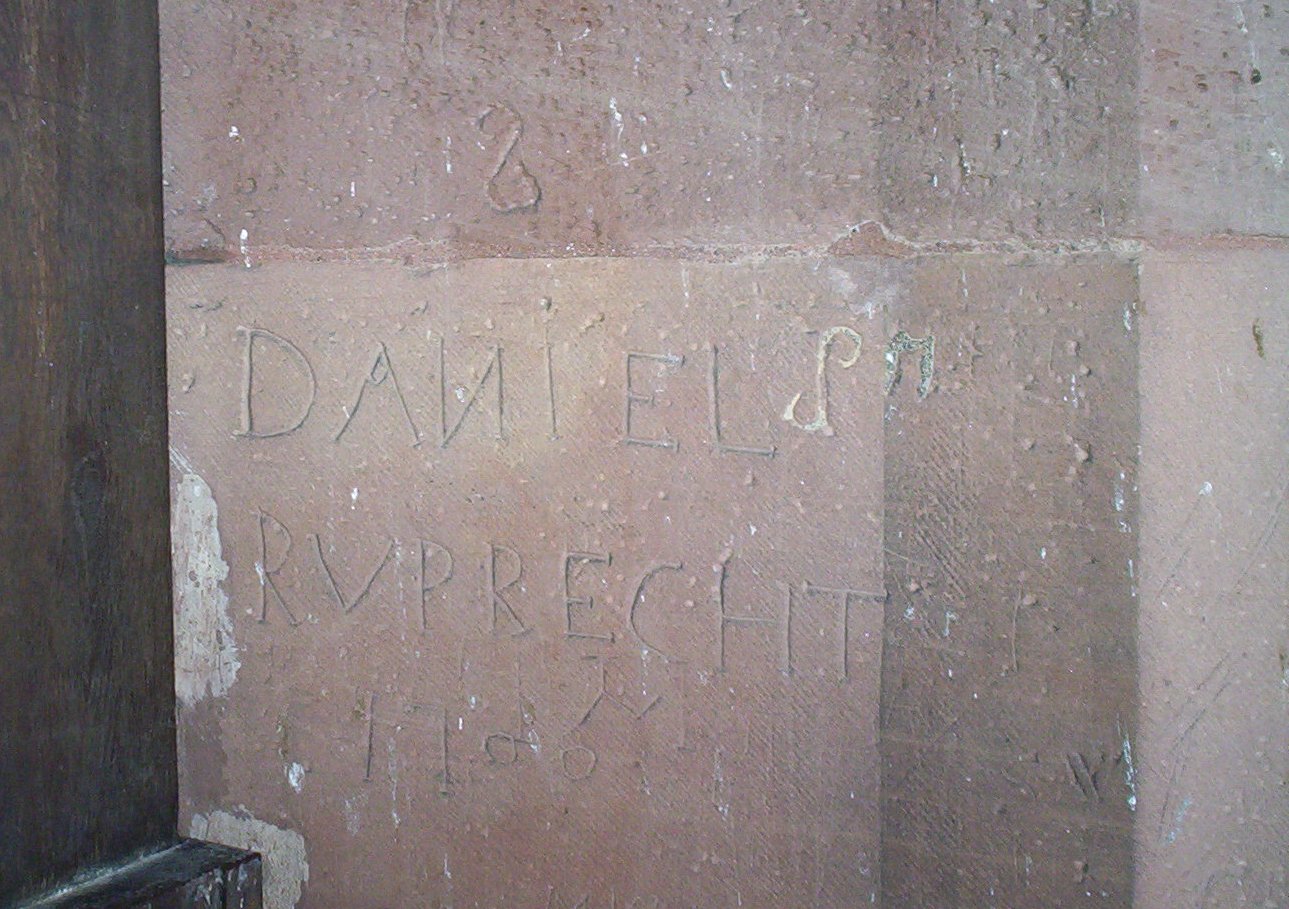
The tower was our favorite part of the visit! The fact that such a thing can no longer be done in the U. S. (thanks to overly cautious insurance companies in fear of overly zealous lawyers) certainly added to the pleasure. Here are some views from the top.


Next stop, lunch! The Marktplatz features a daily farmers' market of sorts with colorful tents and luscious food. We shared a lunch of wonderful sausage, cheese, and bread, as well as many samples along the way. The vendors would cut off a sample and hold it out, expecting us to remove it with our fingers, which took a bit of getting used to, accustomed as I am to food handling being done here with gloves and single-use toothpicks, sample cups, and tasting spoons. I wish I had been able to be bold (or subtle) enough to take a picture of one Swiss lady who was also eating her lunch at Markplatz, deftly cutting off slices and conveying them to her mouth with her pocketknife—a Swiss Army knife, of course!


Lunch was followed by a bus ride and a goodly walk to the Roman ruins of Augusta Raurica. Yes, those Romans got around. It was exciting for me because, unlike Porter and Janet, I'd never seen Roman ruins in person. All of us were disappointed that much of the area had been restored, however. Thinking—always!—like a homeschooler, I could see the educational advantages, but as a tourist I would rather have been able to be certain what was old and what was new. I'm pretty sure the remains of the baths below are old. The crane is new.

Here we're underground, in the well area. It was cool and damp and felt wonderful to us because we were hot from hiking in the sun, but it did give me a hint as to how miserable it might be to be chained in a dungeon even on the best of days.

I took these two pictures because I love unexpected connections. Note the reference to Sebastian Münster's Cosmographia in the first picture, and the illustration it refers to in the second. You see, I had heard of it before…. Not because I'm a well-educated person who naturally had learned about such a famous book, but because I love good mystery stories, and the Cosmographia features prominently in Dorothy Sayers' Peter Wimsey story, The Learned Adventure of the Dragon's Head. Don't ask me to explain my memory; I can actually enjoy reading mysteries multiple times (if they were worth reading once) because I've forgotten so much of what happened, yet details like this one will stick with me clearly and forever. This Münster, too, was a son of Basel, by the way—not born here, but lived much of his life and died here. He really should be buried in the Münster Cathedral with Bernoulli and Erasmus, but if he is, I don't know about it.


On our walk to the ruins, we came upon this sign, which serves as an excuse to mention the often-wordless signs here. It's quite a good idea when people might not speak the language, but of course one still must understand the sign language. We are accustomed to a slash through the red circle indicating that something is forbidden, but in Switzerland (and maybe Europe in general) it's the red circle that is indicative of taboo. For example, in the lower sign, an American might infer that dogs are allowed, whereas I believe it is really saying, no dogs except on a leash. The top sign was a mystery and I interpreted it as saying, "Whatever you were thinking about doing, don't." But it turns out it's more like a "No Vehicles" sign, not nearly so interesting.

Janet had arranged for us to have dinner with a couple from her church, but half of them ended up with the flu and, generous as they are, this was one thing they did not want to share. So the other half took us on a tour of Riehen, their village, where we saw many things from mansions of those who made their money in Basel's chemical industry to beautiful scenes like this:

The Foundation Beyeler museum is in Riehen, and was featuring a special Edvard Munch exhibit, but it was closed at that hour and we never did make it back. Ah, well, we did see fair amount of other art on this vacation….
A lovely bakery provided rest and refreshment. Take a look at the coffee cups in this picture. They represent a confection that's more dessert than drink: layers of espresso, chocolate, cream, and caramel.

It was great to have the opportunity to talk with Nils, who is a native-born Swiss, though I understand that even so he is not long allowed to forget that he is from Bern, not Basel, and doesn't speak the language right. :) We learned a lot about Swiss culture, good and bad. Question: Why do Swiss people seem so pessimistic? Answer: Because they expect everything to be perfect, and are therefore always disappointed. After a few days of experiencing the transportation system, I understood a little better. It very nearly is perfect! When they say a tram, bus, or train will arrive at 6:15, it does. Being three minutes late is a shocking occurrence, and more than that a catastrophe!
Nils assured us that what I had experienced nearly forty years ago is still true: the lovely public fountains in Switzerland are safe to drink from. To someone from a state that is increasingly worried about its water supply, the idea of fresh water continually pouring out of the fountains and draining away seems wasteful, but it's wonderful to experience. One of my less pleasant memories of my 1969 trip to Europe was of being perpetually thirsty, except in Switzerland. We were cautioned not to drink the water in France or in Italy—though I was thirsty enough to break the rule in both places, and had no trouble—and it was never offered at a drink when we ate. There were wine and coffee in abundance, which I suppose should have been a daring trip to a group of high school girls from the U. S., but I didn't like either and they certainly didn't quench my thirst. Even on the rare occasions when we ate at restaurants instead of youth hostels and convents, it wasn't much better. Bottled water was not readily available, and ice nonexistent.
Oddly enough, I found myself thirsty on this trip as well. Bottles of water met our needs well on our hikes, but mealtime was another story. For all I know, Europeans are shocked at the waste in America because restaurants provide as much water as you want, even if you don't ask for it. We ate in many restaurants and cafés this trip, and I believe only once were we provided a pitcher of water. Water is considered a drink; you buy it as you would a soda, a beer, or a glass of wine, and it can be as expensive, too. So I almost never had enough to drink at mealtimes. It's easy to become dehydrated on vacation, I've found, and this one was no exception. Except for our stay at the château in France, where our American-born hostess had installed a modern refrigerator with ice and cold water dispenser. Ah, bliss! But once again I am jumping ahead.

We capped the evening with a concert at Kartäuserkirche, a beautiful old church. Sponsored by the Schola Cantorum Basiliensis (Janet's school), it was entitled Der Liebesschmerz: Guillaum do Machaut und seine Vorgänger. (The last part means "Guillaum de Machaut and his predecessors," but der Libesschmerz appears to be "the dear pain," so maybe Janet can suggest something more reasonable.) At any rate, this was a concert of Medieval music and featured a singer and a host of odd instruments including a fidel and a dudelsack. The featured work was Machaut's Loyauté que point ne delay. It was a delightful piece, and quite a test of endurance for the singer, but really, the protagonist needs to get a life. He goes on and on and on about his lost love—no, it's worse than that. He's not really singing about his love, but about how the loss affects him. Narcissus had nothing on this guy.
Here's another of those surprises Europe apparently has around every corner. This lovely lady is positioned in front of a lovely picture of Basel in older times. The painting is just sitting there, exposed to the elements, in a former boathouse.

Back home again, to collapse into bed after another full and satisfying day. Not satiating, not yet….
Permalink | Comments
Category Travels Everyday Life
Melissa Busekros, the German teen kidnapped from her family by government authorities because she was being homeschooled (see my previous posts here and here) has given herself a birthday present. On the day she turned 16, she ran away from her foster care situation and returned to her family. The response of the authorities remains to be seen, but having turned 16 gives her more legal rights, so there is hope she will be allowed to stay.
As I mentioned before, we recently returned from a delightful two weeks in Europe, visiting Janet in Switzerland and some friends who live in France. There were other friends we wanted to visit, but there's only so much you can do in two weeks and remain sane, so we'll just have to make a return trip.
It was nearly as perfect as such a vacation can be. We had a tense moment or two in Paris, for which I take much of the blame by not having planned the program sufficiently. It is very hard to leave the agenda open when you're trying to take into account the desires of three people, none of whom enjoys making decisions and each of whom will only be happy if the others are happy first! But we got over that, and the rest of the trip was idyllic. Much credit goes to our hosts in Switzerland and in France, and most especially to Janet. As in Japan, she was an excellent tour guide and rarely showed how worried she was that she hadn't done enough to prepare. It was enough! It was perfect! Now she can start worrying that our next trip can't possibly live up to the high standards set by this one....
As you can tell, I've been posting a lot of random stuff lately—mostly because it's much easier than buckling down to the job of editing pictures and preparing this trip journal. But here's a start, with more to follow. Be sure to check out Janet's version (this post and following), if you haven't already. And remember that the pictures are only previews that do not show the complete scene; click on the preview to get the full picture.Our trip began at the Orlando International Airport, and for a while it appeared as if that's where it was going to end, 15 days prematurely. We had nearly two hours to make our connection in Miami, but our flight from Orlando was delayed, and delayed again…by an hour and a half. You can't make up that kind of time in the 200-odd miles between Orlando and Miami. Desperate, I called Heather and Jon to ask them to pray, and to e-mail Janet, who was as anxious as we were that we not miss our flight.
Then came an announcement: Would two adults be willing to give up their seats and move to an emergency exit row? Porter leaped at the chance, because it meant moving from the back of the plane to the front, a critical advantage when you must race to make a connection. And race we did, arriving at the next gate before the boarding process had completed. Whew!
We flew American Airlines this time. If the service was not quite as delightful as on our Continental trip to Japan, it was good enough, and a much nicer (i.e. roomier) plane. Porter, airplane veteran that he is, slept well, but I only dozed. I tried to distract myself by listening to my Pimsleur and Hippo recordings, and I could tell I'd slept some when I awoke in the middle of the Louvre. (Rick Steves' audio tour of the Louvre was next on my mp3 player.)
We landed safely in London, at Heathrow. We had two hours to make our connecting flight, and it's a good thing. First a long walk from our arrival gate: up, down, all around, then outside the terminal, where we caught a bus that took us to Terminal 4 via Wales, I think. All that took us out of the secure area, so we had to repeat the screening process. For those of you who haven't flown through Heathrow lately, this involves stuffing one's purse into one's carry-on bag, because only one carry-on is allowed. (Or, as the British Aviation Authority so politely puts it, of course you can have a personal item in addition to your hand baggage, provided the one fits inside of the other.) Fortunately, we knew about the restriction ahead of time.
The next hurdle was checking in, and that went much better than it might have. For reasons unknown, we were not able to check in on the London-Basel flight ahead of time, and didn't even have seat numbers. The kindly security guard ushered us to a much shorter line (for problem people, I suppose) and we were able to correct the situation with no difficulty at the check-in counter. (They have a check-in counter on the far side of the security screening, so I suppose we weren't the only ones to have need of it.)
The flight to Basel was only half full and very pleasant. Soon we landed in the small and friendly Basel-Mulhouse airport, where we encountered a small glitch: the luggage carousel duly produced my suitcase, but Porter's never appeared. We joined perhaps a dozen others with problems, telling our tales of woe to a friendly, if busy, French lady who fortunately spoke English (and no doubt German as well). She determined that there was no point in waiting around any longer, as the suitcase was still in Miami, but assured us they would deliver it the next day. We gave her Janet's address, and fretted a little because they wouldn't leave it at the door, but required someone be home to receive it. We had plans to spend most of the day sightseeing, and didn't relish staying home all day for a suitcase that might (or might not) come at any hour. We had a lot to learn about the Swiss.
Suitcase or no suitcase, all troubles were swept away when we saw Janet! Here she is with Porter at the tourist information booth, which is half in France, and half in Switzerland. The airport is physically located in France, but part of the airport, and the road leading across the border, are legally Swiss.

As in Japan, Janet guided us onto a bus, but the resemblance ended there. The ride was more like 20 minutes than four hours, and we were not falling asleep. I'll have more to say about Swiss transportation elsewhere, but 8CF for an all-day tram/bus pass is a great deal when public transportation is so clean and convenient. We soon learned to say, "Zwei Tageskarten, bitte" each morning—but I'm getting ahead of myself.
Our first stop was home, for lunch of wonderful bread, cheese, fruit and läckerli, a Basel specialty cookie that reminds me of Christmas, and to meet Stephan and Anu, Janet's hosts, who most graciously allowed us to stay with them as well. Little Tamino was shy at first, but soon accepted us as another set of crazy adults who can't speak either German or Hindi. He's every bit as cute as Janet says he is.
Janet was determined to keep us busy so we wouldn't give in to jet lag, and she succeeded. We did a lot of walking around the center of Basel, and I have to say it was hard to remember that we were in a city, one of the largest in Switzerland. If it was not as clean as the Switzerland I remember from my visit in 1969, it was certainly the cleanest city I've been in since then. I found it quiet and beautiful; there were no hurried crowds and very little traffic—though that was partly because it was a Sunday.
Janet has covered our adventures of this day quite well, but here are a few more comments. We saw a lot for half a day! It helps that Basel is so far north it has a long day this time of year.
The Rein (Rhine) is beautiful, as was the walk across the Mittlere Rheinbrücke (Middle Bridge) from Kleinbasel to Grossbasel. Here we are with the statue of Helvetia, on the Kleinbasel side.

The Historical Museum at the Barfüsser Church is free on the first Sunday of the month, and we were not done exploring its wonders by the time it closed. Barfüsser means "barefoot," and the church was so named because of the barefoot Franciscan monks who were its first inhabitants in the 13th century.
I couldn't resist taking this picture of Chief Sitting Duck.

The Rathaus, or city hall, is beautifully decorated, and all those paintings are unprotected in the open air.

The Spalentor is an old city gate that was nearly torn down in the 19th century because the tram wouldn't fit through its arch. Cooler heads prevailed and the tram tracks now curve around the gate.

Here's what it looks like from inside the Spalentor if you're aiming an arrow at your enemies outside.

This delightful fountain is in at Theaterplatz, and was created by Basel-trained Jean Tinguely. Little did we know then that this would not be our last encounter with hitherto-unknown (to us) Tinguely. The only thing wrong with this fountain is that children are not allowed to play in it. I'm told, however, that children do, despite their law-abiding Swiss heritage. I like to think Tinguely, whose art often encouraged audience participation, would approve.

As delightful as all these sights were, for me the most special visit was to the Musik-Akademie der Stadt Basel and the Schola Cantorum Basiliensis, its early music division. One of the things I like best about traveling, whether across the world or merely to another city, is that I feel so much closer to those who live there if I have been there myself. It was very good to stand on the grounds where Janet has discovered so much that she loves!


We had hoped to meet Stephan and Anu for dinner, but that didn't work out, so we had to come up with a Plan B. What made that especially difficult was the fact that Switzerland does not have many non-smoking restaurants. We'd pick one out, walk in, and walk right out again, overcome by the smoke. Finally we found Zum Alten Stöckli, which had been recommended to us. It, too, allowed smoking, but for most of our meal we were the only customers in the small restaurant, so we were able to enjoy our meal. Röschti is a traditional Swiss potato dish and we all agreed that the variety made with cheese was our favorite.

Before collapsing into bed we hand-washed some clothes for Porter to wear the next day. Stephan lent him some clothes to sleep in, and I was able to provide a toothbrush, because after my experience with delayed luggage in Connecticut, I'd learned to pack one in my carry-on. We sank gratefully into bed, while Janet manfully stayed awake to report on our first day to her loyal blog readers.
Whew! I have all new respect for Janet's faithfulness in writing up her adventures. It takes a LONG time!Permalink | Comments
Category Travels Everyday Life
Well, no, not really. Sunscreen has an important role in preventing sunburn and skin problems. But I've long thought that we are now going overboard to avoid the sun, and this article on vitamin D deficiency encourages that belief. It turns out that vitamin D is valuable for far more than preventing rickets, and the recommended daily dose is probably much too low. A few interesting quotes from the article (since I know it will become inaccessible after a while):
A series of recent studies has found that vitamin D, the so-called sunshine vitamin—once thought to be critical only to bone health—is useful throughout the body to strengthen the immune system and control cell growth. Yet researchers estimate that as many as half of all Americans are likely deficient in the nutrient.
[R]esearchers say [vitamin D] may help you stave off everything from osteoporosis to multiple sclerosis to diabetes, schizophrenia and breast cancer.
A mere SPF-8 sunscreen...uts vitamin D synthesis by roughly 95 percent.
[F]ew foods offer even modest amounts of natural vitamin D....They include cream, egg yolks, cod liver oil and fatty fish.
[T]hough milk and some cereals are fortified with D in this country, the vitamin is often delivered in the form of synthetic D2, which is more stable but not easily used by the body. Many multivitamins also use D2.
"Make sure you're taking D3...the same compound that is made in sun-exposed skin," advises best-selling author Dr. Andrew Weil, a physician and strong proponent of holistic medicine. "So often, you see orange juice or foods that say they're vitamin D-fortified. But many times, those are fortified with D2. [And] vitamin D has to be taken with fat. Taking a vitamin D pill with orange juice isn't going to work; it won't stick to you."
"It has taken science and medicine a long time to figure out how vitamin D really works," explains Dr. Luke Bucci, a biochemist and vice president of research for Schiff Nutrition International. "People were afraid because they thought it accumulates in the body. Well, no, it doesn't."
Gotta go. It's almost time for my daily walk vitamin D-making session.

