
The good news is that if a day care worker can wield the equipment after a week of training, so can a parent. When our children were young we were blessed with a doctor who respected our powers of observation and judgment; he spared us many unnecessary trips to his office by dealing with minor problems over the telephone. Although few doctors these days are so accommodating, perhaps this new equipment will make them feel more comfortable with trusting their patients.
For the most part, however, I don't think this development is worthy of the enthusiasm with which it is being received.
- 92 percent of parents said the hassle-free option allowed them to stay at work when they otherwise would have taken their children to a family doctor or an emergency room
- doctors have diagnosed mostly everyday illnesses like colds, rashes, asthma, ringworm and pink eye that account for almost three-quarters of all pediatric office visits
- any patient with a fever or a contagious disease is sent home
- ...available where children spend the majority of their time, such as schools and child-care centers
I know we must make decisions based on the knowledge we have at the time, and have no problem with honest errors. My quarrel is with those—I include myself—who in the certainty of their own convictions would use the force of law or their position to shut down contrary beliefs.
"First, do no harm."Permalink | Comments
Category Everyday Life
However, there is a downside to all this screening that is now beginning to be recognized.
In an article questioning the wisdom of celebrity endorsements of cancer screening, I came upon these astonishing statements:
- Counterintuitive as it may sound, it's sometimes better not to find out about cancer
- Some cancers are likely to resolve themselves without treatment
- Some patients may be likely to die of another ailment before cancer becomes an issue
- The risk of false positives seems to increase with more screenings
- Overdiagnosis…is an increasing problem
The U.S. Preventive Services Task Force has a collection of current recommendations for cancer screening, plus a lot more. I don't know anything about this organization, and in any case it is no ultimate authority, but it's a place to start.
Having known people whose lives were probably saved by cancer screening, and people whose lives were probably shortened by cancer screening, I can only conclude that life is never as simple as we want it to be.- All the teachers among our family and friends
- Teachers who struggle year after year in increasingly difficult situations for the sake of making a schoolchild's day less bleak
- Teachers who quit the system for the sake of conscience
- Teachers who brave dismissal and lawsuits, daring to hug their students
- Teachers who still believe that rigorous study and high achievement are important goals for everyone
- Teachers who work with parents and not against them, respecting their values, insights, and goals
- Students who succeed in making their education their own business, in spite of school
- Students who take back the joy of learning and refuse to submit to school's stultifiying regimen
- Parents who embrace their responsibilities as their children's primary teachers, exercising extreme caution when delegating any of the work to others
- Parents who not only love but respect their children
- All babies and very young children, who know that learning is the most fun game of all, and who excel at it, until we crush their spirits
"The girl has gone into hiding with her family in Ontario to avoid blood transfusions that a [British Columbia] court ordered should be given."
"B.C. courts ruled the girl is capable of making a decision, but B.C. law requires that a person be 19 years or older before they are allowed to refuse lifesaving medical treatment."
"April 11 B.C. Supreme Court ruling said she couldn't refuse treatment despite her religious beliefs."
"The B.C. Ministry of Children and Family Development was granted custody of the girl last week."
"All children are entitled to be protected from abuse and harm . . . the ultimate threat of harm would be death. . . her religious beliefs don't override her right to life and death."
"[An] order of apprehension issued in B.C. remains on police computers."
"We are using all of the resources available to us to make sure that we know where she is."
"An air ambulance to return her to B.C. is on standby."
Think about it.Hard, painstaking work is the toll an independent spirit charges itself for self-respect.
Permalink | Comments
Category Random Musings
Homeschooling families puzzle over this concern, having observed that their children are much more at ease with people of all ages than are most schoolchildren, arguing that peer-socialization is unnatural and generally negative, and pointing to the vast array of sports teams, musical ensembles, church groups, and other associations to which they belong. Why this concern, they wonder, with something as natural and easily attainable as socialization?
Perhaps because getting along with people and functioning well in the world is not the only working definition of socialization. In consideration of the following quote from The Underground History of American Education by former New York State Teacher of the Year John Taylor Gatto, the idea that socialization is a school function not commonly duplicated by homeschoolers makes much more sense (emphasis added):
And sometimes not. Steve, our obstetrician and friend, allowed me to labor 20 hours with our firstborn, with four hours of pushing. This baby was a "left occiput posterior presentation," coming into the world head down, but facing the wrong way. The work was hard, and painful, made more so because somewhere along the line obstetricians lost the knowledge midwives had of the important role labor position plays in baby position. But his patience (and ours) paid off with the birth of a beautiful, healthy girl.
Blame it on doctors, hospitals, insurance companies, lawyers, or all of the above, that scenario would be unlikely today. Long labor and posterior presentation are each indicators for Caesarean section. I'm glad Steve had faith in the natural process.
Back then we had unmedicated deliveries, too, which I still believe is better for both babies and mothers. Recent findings (originally reported in Obstetrics and Gynecology, May 2005) show that epidural anesthesia, widely practiced and proclaimed as harmless, significantly increases the risk of posterior presentation and consequent Caesarean section.You don't have to pay anything now, you'll get a bill later.
As if that had any effect on the cost! Have we become so inured to debt—home mortages, car financing, credit cards, college loans—that the only price tag we care about is what we must pay right now, the copay, the down payment, the minimum monthly charge?
And what are we to think of a health care system that buries the price of its procedures under so many layers of bureaucracy that no one knows the true cost?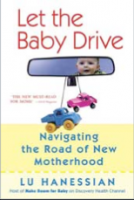
Let the Baby Drive, by Lu Hanessian (St. Martin's Press, New York, 2004)
Recently we opened a bottle of wine of far higher class (and expense) than I could hope to appreciate. (I can occasionally enjoy half of a small glass of wine, but my discernment rarely goes beyond "I like this" or "I don't like this"; I can distinguish red from white with my eyes closed, but "redolent of old oak with faint hints of chocolate, raspberry, and mushroom" is beyond me.) After my first sip or two, I said, "This isn't my kind of wine." By the third sip I had changed my mind, and thoroughly enjoyed the rest of the bottle over the next few days.
That's how I feel about Let the Baby Drive. I saw it advertised in The Compleat Mother magazine, and borrowed it from our local library. For the first several chapters I was thinking, 'Yeah, this is mildly interesting, but I wouldn't recommend it to anyone. Why does this lady make such a big deal out of life with a newborn, something women have been handling for millennia? She is 'way too focussed on herself, her angst, the minutiae of her feelings."
By the third sip I had changed my mind. I stood in awe as her son became the focus of her detailed observations. Let the Baby Drive is a rare, almost unique, look into the first few years of life. Nicholas began talking at 10 months, providing an invaluable window on the surprisingly sophisticated thought processes of children at an age when they are too often considered mere lumps of clay. Banging his spoon on his high chair tray, as every baby does, Nicholas proclaims, "Mah-mee! I'm chopping wood!"
Hanessian's habit of carefully observing Nicholas enables her to get through the stage when he hates her, doesn't need her, wants to throw her in the garbage and never see her again. Thirteen? No, three. Three years old, and dealing with terror over the knowledge that things change, people grow, water goes down the drain and you never see it again. Had she viewed this strictly as an issue of discipline, of misbehavior, instead of respecting her son enough to unravel the puzzle, she would never have known.
When Nicholas is 18 months old, she suddenly hears,
...a rhythmic crashing sound coming from down the hallway in our house. It sounds as though somebody's trying to break in. I hurry toward the bedroom to find Nicholas standing in his crib with his baby fists wrapped tightly around the railing, hurtling himself back and forth like a baby gorilla. For a second, I think I see a glint of delinquency in his eye. I see trouble. Class clown. Street kid. Jailbird. Baby behind bars. Before I can take my thoughts any further, he yells above the noise, "Mah-mee! I make muzak!" Now, the diabolical glint in his eye is more of a twinkle. Suddenly, the baby gorilla is a brilliant child turning inanimate objects into musical instruments. The mother ready to indict her baby on one count of reckless endangerment with intent to destroy private property now sees him as a budding musician.
At three, Nicholas goes to preschool, where his enthusiasm and intelligence fit poorly with the teacher's approach. After much observation, investigation, and agonized soul-searching, his parents conclude this is the wrong school, the wrong teacher, the wrong age, the wrong fit...something is wrong and the best solution is to stop. Now.
Sometimes, you can't tell what's missing until it comes back. And so it was with Nicholas in the weeks after he waved good-bye to the stone school on the hill. We didn't realize how much of his smile had faded until it was restored, until the bounce was back in his step.
Hanessian's habits of observation, and her efforts to know and understand her child, remind me of Nancy Wallace, whose books Better than School and Child's Work have long been among my favorites. Everyone knows that a child needs love; it's a rare parent (and rarer author) who understands how much he needs respect as well.
As part of their efforts to understand Nicholas's problems in preschool, his parents visited a counsellor whose wise comment is a fitting summary of this book:
The world will try again and again to turn out your son's light. It will be your responsibility to keep his light on, and to teach him how to do the same.
UPDATE March 18, 2012 Seven years? It's been seven years since I wrote this? Impossible, yet that's the date stamped on the post. At that time, our only grandchild was barely 17 months old. Now we have six grandchildren, from eight weeks to eight years, and upon re-reading Let the Baby Drive I find I love it all the more. Did I really once find the first several chapters dull, and write, "[The author] is 'way too focussed on herself, her angst, the minutiae of her feelings"? This time I hung on every word, and her inner struggles made fascinating, and important sense. Good books, like good wines, age well.
I was curious to compare the ingredients and nutritional value of the two varieties of soy milk in my refrigerator: Organic Valley Soy Vanilla, and Silk Unsweetened Soymilk. Staring at the nutritional labelling, I couldn't get past the beginning. Two half-gallon containers. Both say "Serving size: 1 cup." The Organic Valley carton says the expected, "Servings per container: 8," whereas the Silk Unsweetened says, "Servings per container: 4."
When kids would come to me for tutoring in mathematics, I would often feed them cookies, claiming this would help their "math brains." I offer the above as evidence that sugar is, indeed, important for correct mathematical thinking.Permalink | Comments
Category Random Musings
What Stern said was this: "If a city builds a symphony hall, there is a cultural benefit to the city, despite the fact that the hall is not likely to make money. The same can be said for having an NBA franchise."
No matter what one thinks about the relative cultural merits of art and sport, the fallacy is unmistakable.
When the top Magic basketball player earns no more than the Orlando Philharmonic's principal oboist; when the team owes its survival to dedicated volunteers, generous donors, and massive fund-raising efforts; when our basketball team becomes a bona fide non-profit organization; then and only then will I consider seriously their claim to public funding.
My letter to the same effect was published in the Sentinel this morning.We enjoyed the beautiful flowers, listened to a lecture on herbs, and wished Jonathan had been with us in the butterfly garden. We almost tried out the new ride, Soaring, open only to passholders, but it broke down while we were in line and we chose not to wait. We had waited two hours in a similar situation with Test Track before it opened, and once was more than enough.
Wandering in a desultory fashion around the park, we made sure to take in a few old favorites before bidding farewell for the foreseeable future to EPCOT, our favorite Disney park. Having heard that the movie at China had been updated, we had to see it. At the risk of being an old stick in the mud, I like the old movie better. It actually seemed like China. In this one there is much more emphasis on China as a cosmopolitan country—lots of views of modern Shanghai and Hong Kong, and emphasis on European influence. Their exultation in having acquired Macao and Hong Kong was also a little unpleasant.
While we were waiting for the movie, we browsed their store. I was intrigued by the CD's they had to offer, but lost respect for the clerk when he insisted a CD that included a hymn to Chairman Mao was "traditional Chinese music."
My hands-down favorite EPCOT movie is Impressions de France, which I believe hasn't changed since we started coming 20 years ago. I have to see it every time we go to EPCOT. The music is fantastic, and I get the feeling the French are proud to show us their country; if we like it, fine, but otherwise it's our loss.
I wonder why Disney keeps exporting my least favorite park? Why is it always "Disneyland" Hong Kong, or Paris, or whatever? Not that I've ever been to any of them, but I assume they are mostly similar to the Magic Kingdom. EPCOT is Disney's best park, I think (Animal Kingdom second), although it has gone downhill markedly in the past 5 years or so. It was always the girls' favorite park, too, even when they were five and two years old.
It's a good thing our passes have expired, as we can't afford being able to go there for free. We spend to much at the restaurants. This time we ate lunch in Italy, at L'Originale Alfredo di Roma Ristorante. We weren't left with much appetite for dinner, but managed an appetizer and dessert (along with the fabulous mint tea) at Restaurant Marrakesh in Morocco. Our first choice had been Akershus in Norway, which used to have a fabulous smorgasbord. Unfortunately, it has been taken over entirely by "character dining." We were assured, "the food is still the same," but we were definitely not in the mood for "a princess experience." It didn't seem to fit with the Viking atmosphere, somehow.
I can't say that any Disney park is worth the extravagant ticket prices, and can't honestly recommend Disney World to anyone who must pay for admission. It can be pretty nice, however, if you manage to get in for free, and I truly will miss some aspects of EPCOT. The restaurants are good, and World Showcase has a pleasant, cosmopolitan atmosphere, albeit somewhat artificial. Certainly in no place outside of the Boston subway have I heard so many different languages, spoken by the foreign nationals who work at EPCOT and the great variety of international tourists.Permalink | Comments
Category Everyday Life

