
Modern American Christians know so little about worship, and I include myself as chief of sinners. I find it a difficult concept because we have few practical referents. Being in Japan has opened my eyes just a little to what we are missing.
Experiencing, albeit briefly, a culture where it is natural to show respect and give honor by bowing gives much more meaning to worship practices like kneeling, bowing, and genuflecting. If we Americans knew more about physical acts of respect in everyday life, we might know more about worship.
And if we lived with Mt. Fuji dominating the landscape, we might know more about awe and reverence. Seeing her suddenly appear, as the haze lifted, was an experience that made me understand a bit why she is seen as a goddess. Fujisan towers with indescribable splendor over the other, much closer, and otherwise quite impressive mountains that ring Janet's Kofu Valley. Seeing her first thing in the morning, from Janet's balcony window, makes my knees weak and causes involunatary exclamations of amazement. I feel like greeting her personally.And yet we (I) claim to worship, not a spectacular mountain, but the Creator of that mountain, of all moutains, of all that is, was, and ever will be. How often is that evident in our church services, let alone our lives? Truly our understanding is minuscule and our faith paltry!
Chronological stories from our trip to Japan will have to wait until I have more time, but I'll try to fit in an occasionally tidbit here and there.
Many people have heard of the really fancy Japanese toilets, the ones with heated seats and more buttons than a DVD player, including Cover-Up Sound, Wash, and Blow Dry. I haven't had the opportunity to try anything but the warm seat feature (especially nice in unheated bathrooms), but we'd certainly have one if they were readily available at a reasonable price in the United States. I suppose we could special order one for an outrageous sum, but they aren't that wonderful.
It would take not money, but a societal attitude change, to make another of the great Japanese toilets available in the United States: the "squatty potty." Nearly flush with the ground (pardon the pun), these toilets are particularly great for public places, as they are much easier to keep clean than the kind we are accustomed to. They are also surprisingly easy to use. Before I tried one, I couldn't picture using it successfully, but it's really no problem at all.
My favorite Japanese toilet is the kind in Janet's apartment. It's a "normal" toilet with one fabulous feature: the tank lid is a faucet/sink arrangement. Flushing the toilet causes water to pour out of the faucet for handwashing purposes; the water drains into the toilet tank and is used for the next flush. What an economical, ecological idea!When the OPO brought renowned flutist James Galway to town we enjoyed that concert tremendously. Last night’s Celtic Fantasy, featuring OPO principal flutist Aaron Goldman was every bit as delightful, if not more so. As Galway had done, Aaron played both flute and pennywhistle with grace and beauty and skill. Memo to the Orlando Philharmonic: James Galway is no doubt a very busy and expensive performer. Forget the big names: give us more Aaron Goldman!
(In the interest of full disclosure: I've been introduced to Mr. Goldman but can't say I know him. He does automatically gain a place in my heart by being a graduate of the Eastman School of Music. Jesus said, "Where your treasure is, there will your heart be also," and a great deal of our treasure, not to mention one of our Greatest Treasures, went to Eastman. The other Greatest Treasure went to Carnegie Mellon University, which was also honored in this concert, though the orchestra may not have been aware of that fact.)
Featured on the program:- Four Scottish Dances (Malcolm Arnold)
- Irish Rhapsody (Victor Herbert)
- Gaelic Love Songs for Flute (Edward McGuire)
- Orkney Wedding, with Sunrise (Sir Peter Maxwell Davies) (With a bagpiper at the end!)
- Scotland the Brave (More bagpipers; for a while, I thought I was back at Carnegie Mellon's graduation.)
- O'Sullivan's March from "Rob Roy"
- Danny Boy (A good arrangement but nothing can beat Greg Barker's.)
- Itsbynne Reel (Say that out loud.)
- Island Fiddle Suite (Scott MacMillan) (With Irish dancers! My heart leaped when they came out, and I noted the curly wigs and the crowns. :) I know they were Irish dancers because they're from a school of Irish dance, but I wish Janet had been there to explain some things. I recognized some of the dances, though I couldn't name them, and noted that the dancers' hands were straight at their sides, as I expected. But at other times their hand were on their hips, or above their heads, or linked with those of other dancers, which I didn't expect.)
- Invernia
- Riverdance (with whistle)
- and an encore, with whistle
Forget the green beer. After having discovered genuine Irish ancestors in my heritage, I'm even more convinced that any good celebration of St. Patrick's Day must include singing his very own hymn, usually called St. Patrick's Breastplate or I Bind unto Myself Today. The words are attributed to St. Patrick himself, with the modern, metrical version provided by Cecil Frances Alexander.
The challenge in St. Patrick's for first time singers is finding the flow; the first verse is shorter than the rest, one or two verses (depending on the version) are sung to a different tune, and usually you must turn the page to complete this hymn. (In my favorite hymnal it covers four pages!)
The tunes are Irish and easily singable, however, and the words packed with theology, beauty, and joy. Do yourself and St. Patrick a favor, and honor him on this day by becoming acquainted with this grand and glorious expression of ancient Celtic Christian faith.
The Oremus Hymnal includes the commonly sung verses and page numbers for St. Patrick's Breastplate in a large collection of hymnals.
The Cyber Hymnal includes two additional verses that are rarely sung but give even more of a feel for the ancient Celtic culture out of which which it arose.
This Irish Culture and Customs site has a non-metrical translation of the poem.Switching hemispheres, we decided instead to use a $10 coupon to check out the new the Habana Grill Cuban restaurant. How excited we were to discover that it was our old Don Pepe’s renewed! We had enjoyed Don Pepe’s for years, having been introduced to it when Heather was taking Spanish in high school. However, the plaza in which it was located underwent major demolition and reconstruction, and Don Pepe’s disappeared, we feared forever.
From the Orlando Sentinel (originally the Chicago Tribune):
A significant part of the growth in home-schooling has been among
Christian conservatives who shunned public and private schools for
reasons that included curriculum, school violence and social trends.
These parents often seek highly structured curricula suited to their
conservative beliefs.
But those who practice unschooling tend
to do so because they think the school system does not allow children
to learn to their full potential.
This ranks right up in fatuousness with such statements as "blacks do better at athletics, and Asians do better at academics." As a Christian conservative who chose to homeschool because the school system does not allow children to learn to their full potential, and whose educational philosophy leans much more toward unschooling than not, I find the characterization insulting.
"There is nothing like the texture of kids having contact with each other, making friends and relating to different adults in a school setting," said David Tokofsky, a longtime educator and member of the Los Angeles Unified School District Board of Education.
He may be right; there is nothing like it. Making friends and relating to people of all ages outside of a school setting is so far superior to what goes by that name in school that I'm surprised he dared mention the subject.For many years before he died, my father would come visit us for a month each year around February (usually a good month to exchange Pennsylvania for Florida temporarily). Once a week he would take us to lunch at the Sakura, the best Japanese restaurant in our experience, including the time when all the restaurants of Boston were at hand.
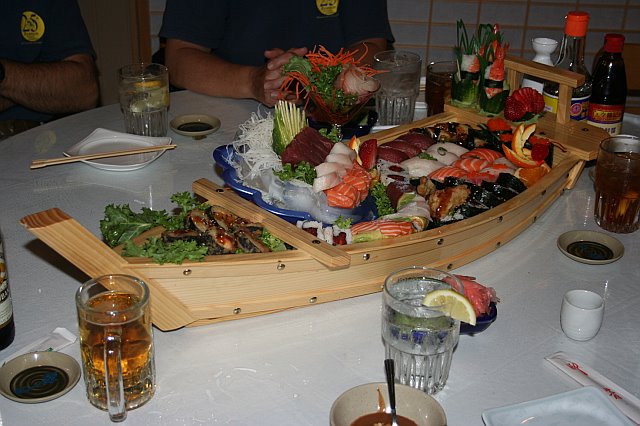
Alas, when we returned from Massachusetts we were able to enjoy only one more meal at the Sakura before it closed. We've spent the last three years searching for a substitute, to no avail. The Asian restaurant that took its place isn't bad, however, and that's where we headed last Monday night. We remembered too late that it is closed on Mondays, but that disappointment quickly turned into a blessing.We decided instead to try out a new (to us) restaurant called the Sake Moon. Or maybe Saikyo; it appears to go by both names. Whatever it's called, I call it fantastic. At last we are consoled for the loss of the Sakura. We ordered the Sushi Boat for One—it was more than enough for the two of us—and were treated to the best sushi I've had in at least three years.
What's more, Sake Moon serves not only Japanese but also Vietnamese food. The owners are Vietnamese, as I discovered when I attempted some of my newly-acquired Japanese phrases. (They graciously then taught me to say "thank you" in Vietnamese.) We returned today for lunch, and were nearly as pleased with the summer rolls and pho as we had been with the sushi. We did not dine in Vietnam alone, but mixed our Asian cuisine today; the vegetable tempura was served with delightful accompaniments of California roll, goyza, Japanese egg roll, soup, salad, and rice, all delicious. And I learned to say "hello" in Vietnamese.
We'll be back; Sake Moon is close to home and reasonably priced. Besides, I have a lot more Vietnamese to learn....
Here's a picture from a subsequent visit of the Sushi Boat for Three (which easily served five).
Permalink | Comments
Category Just for Fun
Marilyn answers questions sent in by readers, and last Sunday featured two that have been high on my list of Questions I Wonder about but Have Been Too Lazy to Investigate.
The first one was why entertainers play their music at such a high volume, to which I would add churches, theaters, theme parks, skating rinks, and many other places. I had thought perhaps it was because the rest of the world is deaf, but here is her very interesting answer:
They’re trying to generate excitement, and a high level of decibels accomplishes that goal. Subjected to such intense sound, listeners’ bodies produce adrenaline, noradrenaline and more. These substances make the heart pound and give an impression of increased muscle strength. Not surprisingly, some people become psychologically addicted to this hormone rush, which is implicated in thrill-seeking behavior.
I'm not sure the churches would take that conclusion very kindly, but some might think it worth considering.
The other question concerns the number of people (specifically, Americans) killed in automobile accidents, as compared to wars. I've often wondered how the automobile-related death rate would stack up against other causes of death, not just wars, but crimes, illnesses, and the like. Here is the answer for war:
Since the start of the Revolution in 1775, about a million Americans have died in wars. And since Henry Ford introduced the mass-produced motorcar in 1913, more than 2.5 million Americans have met their deaths on the road.
Not the sort of statistic that makes me want to jump into the car and drive off. Nonetheless, we leave soon for choir rehearsal.... Which explains why people don't pay much attention to automotive risks: as yet there are few of us who have a reasonable alternative.Permalink | Comments
Category Health Random Musings
Last year I was well prepared for Ash Wednesday, with a rather extensive personal program planned out for Lent. This year, what with company and an intensive two weeks devoted to reroofing our house (and not done yet), it came as a shock this morning to realize that February is over. We were thus saved from having to decide with which of our two churches to celebrate Shrove Tuesday, a small blessing but one we could have done without. No crawfish gumbo, no pancakes.... :(
Maybe I'll dust off some of last year's ideas...they worked pretty well.Permalink | Comments
Category Everyday Life

