
In case you want to see the newest of the World's Most Adorable Grandchildren before I get around to updating my own image collection, you can find pictures of Noah here.
Permalink | Comments
Category Everyday Life
June 28, 6:02 p.m. 10 lb. 3 oz., 22.5" long, 15" head, 15" chest.
This
is the quick post. The birth story is coming soon. (Really! it's
actually all written on paper, just needs to be typed.) Sorry for the
delay, we've had Internet problems, but Jon has it all fixed now.
(The above is from Heather and Jon's blog. Stay tuned for more. There will be pictures, too!)
(Picture added later, as the link below no longer works.)

Permalink | Comments
Category Everyday Life
Permalink | Comments
Category Everyday Life
Jon showed me this Speed Bump comic (by Dave Coverly), and it's too good not to pass on.

Permalink | Comments
Category Just for Fun
The title says it all. We are now past everyone's guess but Heather's, but still only four days past D-Date, and Jonathan was five. You might say it's not worth posting if there's no news, but some of us like to keep in touch even when there's little to say. :)
We went to a wonderful Thai restaurant the other day, and Jonathan asked for chopsticks. They gave him the ones with training wheels—fastened at the top so all he had to do was pinch them together—and he did very well. That's okay if he's not going to have daily opportunities to use chopsticks, but probably not the best way for him to learn. I'm sure he learned to use a regular glass so competently at such a young age because he never had a "sippy cup," which is a convenience for parents but teaches bad habits.Permalink | Comments
Category Everyday Life
Permalink | Comments
Category Everyday Life
Sometimes Jonathan will be in a silly mood and talk in nonsense words. Other than that, I've learned that if what he says doesn't make sense to me, it's not because there's no sense to it. The only example I can think of right now (though there have been many) was when, out of the blue, he asked Heather, "Where do the covers go?" We were riding in the car, and could put no context to such a question, until I remembered that earlier in the day (or it may have been the day before) I had changed his diaper while Heather was asleep. It was a particularly messy one, and he needed not only a new diaper, but also a new diaper cover and new shorts. All these go in separate places in the laundry room; the diaper in the diaper pail, the shorts in the plastic basket...but what about the diaper cover? I asked Jonathan, and he gave me an answer I didn't think was right (though it turned out it would have been the correct answer a few months ago). I put the cover in the diaper pail (which was wrong, but there's a limit to how long I'll stand around holding a dirty diaper cover) and promptly forgot about the issue. But not Jonathan. He was obviously dissatisfied with the solution and continued to think about it until he had a chance to ask the proper authority.
Jonathan has his own laptop, a touch-pad device Jon brought home from work. He knows how to plug in the power cord, and is pretty good at starting and using Microsoft Paint, his favorite program. (This is not "child's computer," so Paint is probably the most interesting program on it for him.) He doesn't always get the timing of the double-click right, and sometimes has trouble with a selection because he's leaning another part of his hand on the screen while pointing with his finger, but in general he handles it capably. It's amusing to see several of us sprawled on the living room couches, working away at our laptops, and Jonathan just as busy beside us with his own.Permalink | Comments
Category Everyday Life
Permalink | Comments
Category Everyday Life
Although the study specifically targeted breast cancer, it's hard to believe other cancers are not similarly affected. Other studies suggest that the problem may be that the hormone melatonin, which slows the growth of cancers and boosts the immune system, is produced by the body only in darkness.
Apparently what matters most is light received through the eyes, rather than that falling on the rest of the body, as breast cancer afflicts blind women at half the rate of those who can see. I would like to see more details of that statistic, specifically how the cancer rate varies among different causes of blindness. When the fault is in the brain, is the protective effect the same as when the problem is directly with the eyes?
Similarly, I'd like to know what variations there are among people who live in different lattitudes, those who have about the same hours of daylight throughout the year, and those whose light and dark patterns vary widely with the seasons. Assuming there are enough people without artificial light to study, that is.
Although other studies indicate the problem is with light itself, the effect of artificial vs. natural light is not clear. One article suggested that lighting manufacturers should develop more natural lighting, but if the problem is light stopping melatonin production, that won't help.
I wonder what this says to those of us who stare at computer screens much of the time? And what about the common practice of putting night lights in children's rooms?
The article linked above made the following suggestions for mitigating the problem:
- Shut out all light: Sleeping in a dark room aids production of neurotransmitter serotonin, which is crucial in making melatonin.
- Get nine hours' sleep: A Finnish study found that women who slept nine hours were one-third as likely to get breast cancer as those who slept seven-eight.
- Get a red lightbulb: Place a red lightbulb in one fixture. If you get up in the night, only use this one.
- Get outside in the morning: Just 10-15 minutes of morning light will send a strong time-keeping signal to the brain's clock, leaving it less likely to be confused.
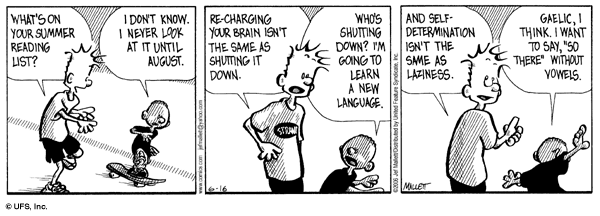
It's been a while since I've posted a Frazz comic here (I always worry about the line between fair use and copyright violation), but it's one of the best comic strips ever, and deserves all the publicity it can get. Though set in a public school, it often captures what homeschooing is all about, and today's strip made me shout in acclamation:
Permalink | Comments
Category Education Just for Fun
To my utter amazement, Jonathan knows his left from his right, not just occasionally but consistently.
He can put on his own sandals, which have Velcro fasteners, though if he undoes the toe strap as well as the ankle strap when he takes them off, he usually needs help redoing the lower one, which is quite tight, especially if he puts his foot too far forward.
When he is either not in a mood to ask for help, or else doesn't see someone to ask, he can be very patient and persistent. As he was working hard to put on his shoes one day, I overheard him encouraging himself with, "I'm getting there, I'm getting there!"
Heather has a gingerbread house cake mold that belonged to my mother, and putting it together is a non-trivial exercise. The other day Jonathan spent about 20 minutes working with it, until he succeeded.
I once read that a study conducted at a preschool revealed a high percentage of the girls' utterances to be recognizable as language, whereas what came out of the boys' mouths was mostly sound effects. Jonathan is a clear exception to that trend. He is verbal to the point of being a chatterbox. Like his Aunt Janet, he embellishes his play with long and detailed narration.
That said, the past couple of days have brought an annoying trend: Suddenly his precociously clear and logical speech has been replaced by deliberate baby talk: words shortened and/or made "cute," vowel sounds altered, pitch raised to a near whine. I know it's normal, especially with a new baby coming. I remember Janet going through that stage, and once when I enjoined her to "talk like a real person," she responded indignantly, "I NOT a real person, I a BABY!" But I do wonder where it came from, as he was never spoken to in baby talk himself.Permalink | Comments
Category Everyday Life
A recent New York Times article on the effort to promote breastfeeding includes this interesting line:
Nursing may even produce a euphoric feeling
So if you can't convince them with the overwhelming evidence of breastfeeding's benefits for the baby, try suggesting it as a new way to get high!In honor of my father, who knew to display an iris on this occasion.

Permalink | Comments
Category Everyday Life
I know hurricane season began June 1, but really, we're not supposed to have to think about this till August, at least! Yet here is Tropical Storm Alberto, with the potential to become the earliest hurrcane in 40 years to hit the United States. Oh, well, my Brother the Insurance Specialist did warn me that Florida has had an unusually easy 40 years. Guess he can say, "I told you so."
On the plus side, the long-delayed rainy season may finally be upon us. My garden should be happy, if Alberto doesn't beat it into the ground.Permalink | Comments
Category Hurricanes and Such
I'm too busy playing with Jonathan to write much about him, but here are a few delightful Jonathan-isms:
I'll friz it to you and you friz it to me. If there's a word for what you're doing when you throw a Frisbee back and forth, it can't be any better than Jonathan's.
There's
an emery board in there. He was looking in my travel kit, and he
was right; I just didn't expect "emery board" to be in a 2.5 year old's
vocabulary.
The baby's head is pressing on my bladder; I need to go to the bathroom again. His baby brother or sister is due in less than two weeks, so I guess he's heard this phrase a few times....
Oh, you DO have nipples! He took a nap with Grandma, and I had to explain to him that, unlike Mommy, I couldn't provide him with any milk. Later, he was with me when I was changing into my pajamas, and that's when he came out with this statement, an expression of amazement and perplexity on his face. Boy did that make me feel old: all the right equipment but totally useless.
While Mommy was cooking, Jonathan and I made up the Word/Horse game. We spread some of his word cards around on the floor, I get on my hands and knees and he climbs on my back. Then he directs his horse, pointing to a word and telling me to go there: Go to "Mommy," now go to "Aunt Janet," now to "loves." He made the game more interesting by asking me to make new cards for "tickle" and "fall off"; you can imagine what happens when the horse and rider arrive at those cards! He also has great fun with the difference between the cards and what they represented. For example, if I trot up to the Mommy card and say, "Hi, Mommy!" he laughs and says in a "how can you be so silly" voice, "That's not the REAL Mommy, that's the WORD Mommy!"Permalink | Comments
Category Everyday Life
We went to the Orlando Science Center last weekend. Because they had three new movies we hadn't seen, we didn't have much time for the exhibits, but that's okay since we know them all pretty well. However, they do have a new traveling exhibit called Invention at Play, at which we spent all the rest of our time, and which is one of the best new exhibits I've seen in a long time, at any science musuem.
What makes it so good? Content, content, content! That's what's missing in so many exhibits these days.
My absolute favorite science museum was always the old Franklin Institute in Philadelphia. When I was in college, I worked for two summers at their research labs, which were located across the street, and nearly every lunch hour I took advantage of the tunnel between the buildings and the fact that my ID badge let me into the museum for free. That was heaven for someone who never had enough time to explore when we actually paid money to visit! You can't see much in half-hour bites (lunch "hour" was never an hour) but over a summer of days the time adds up.
While I was there, the museum opened a large addition, full of new exhibits, and I was so excited! And then so disappointed. All that space, and so little content. The old part of the museum had been focused on education, with information presented in an interesting and multi-dimensional form: hands-on activities (puzzles illustrating mathematical concepts), interactive exhibits (buttons to push), physical involvement (a large locomotive to ride, a model of the heart to walk through—my perennial favorite as a child), and detailed descriptions and explanations to read. One could enjoy it on many levels, at many ages, and there always seemed to be more to learn.
The new section, however, seemed to care more about entertainment than education. This was primarily evident in the striking reduction in the number of words associated with each exhibit. It was as if they wanted people to walk by, take in the flashy display, push a button, and move on. In the old museum I could often explore one display for 15 minutes; not so the new.
In the years since my Summers of Fun I have visited science museums in several other cities, and alas have found them to be modelled on the new (now many years old, of course) Franklin Institute rather than the old. Oh, I've certainly enjoyed them! But the low content density discourages frequent revisits, and I often feel I've been more entertained than educated, which makes me feel I've been cheated.
The Invention at Play exhibit, while not quite up to my old Franklin Institute standards, has a significantly better content/fluff ratio than usual. In addition to all there is to see and do, there is a lot to read, which is why we were able to spend so much time enjoying the displays. Definitely an exhibit for all ages to enjoy!
(Did you know that kevlar, used to make bullet-resistant vests, is also used in many other products, including hockey sticks, heat-resistant gloves, and canoes? The exhibit includes a full-sized, kevlar-based canoe that weighs only 36 pounds.)
Oh, and about the movies. Once again, my complaint is lack of content:
- StarQuest Take a look at some of astronomy's most common questions. Where did the planets come from? What is a black hole? How do you find a constellation? How will the sun die? Plus much more. Sounds good, but the question most seriously considered by the movie was the whereabouts of an escaped hamster. The lame subplot was nothing but an annoying distraction. Maybe they answered all those good questions in the latter part of the movie, but by then I was sound asleep.
- Aliens of the Deep Did you ever see the TV show, 48 Hours? Where they take an hour to cover 10 minutes' worth of material? Aliens of the Deep has the same problem. Lots of shots of deep-diving vehicles maneuvering underwater, and interviews with people telling us much they love their jobs, but almost no explanation of what they actually learned from the explorations.
- Greece: Secrets of the Past This one was great! Lovely pictures, great history, lots of content. The only one of the three films worth watching.
Mere Discipleship: Radical Christianity in a Rebellious World, by Lee C. Camp (Brazos Press, Grand Rapids, Michigan, 2003)
Because I believe Mere Discipleship to be an important book for Christians who are seeking more from their faith than "fire insurance," I want to deal with some of its problems first. There was enough that I found really annoying that I want to get some of it out of the way, so anyone who feels as I do will be encouraged to read past that and receive the good therein.
A minor point, but still important to those who love good books: I don't like the style. The overuse of "unnecessary quotation marks" is like fingernails on a blackboard to me. (Irrelevant question: how long before people no longer know what that expression means?) So too does the repeated use of the phrase, "Constantinian cataract" or "Christendom cataract" to describe the impairment of vision he says has afflicted the Church since the conversion of the Roman Emperor Constantine gave Christianity both legality and status. It's a clever image, but grows thin, and doubly annoying in phrases like, "this is yet another question that flows from the Christendom cataract," flipping the meaning, briefly, from eye problems to waterfalls. And why does the book continually use the term "nation-state," instead of the more commonly-used "nation"? It seems deliberately inflammatory. These minor problems shouldn't deter a reader any more than a prophet's shabby clothes should justify ignoring his message; I want to encourage people to see past it, and acknowledging the problem can sometimes help.
More serious is Lee C. Camp's very obvious pacifist and anabaptist beliefs. I'm sure that to him these follow logically from his basic approach to the Christian life, but many (including me) could benefit from his ideas who have come (at least so far) to different conclusions. It would be a shame to reject the whole package as an all-or-nothing deal.
Finally, Camp seems to set up a straw man to knock down. Having grown up in the Deep South, he can be forgiven for railing against the blind patriotism he saw in that place, at that time. But his experience is so far different from my own as to make that part of the book outdated and nearly irrelevant.
Enough with the negative. I wish I could express the positive as easily. But that which is good—whether I agree with it or not—is deeper than I can express, at least not without a more careful re-reading of the book. (Much of my first reading was done on the long plane flight home from Japan and under the influence of jet lag.) Besides, I don't think it's fair of a reviewer to try to express in a few words what it takes the author a whole book to say. Instead I will end with a few quotes, and invite anyone who reads Mere Discipleship to raise particular points for discussion, for there are many.
I write not so much to instruct as to understand, to make more sense myself out of Christ's call to follow him. I write to share my deep suspicion that our Western culture continues to pervert the word of Christ. I write with a sense of burden, suspecting that even the religious rhetoric that appears to take Jesus so seriously has domesticated him, cleaned him up, made him respectable so as not to embarrass us good church-going folk with our agendas of upward social mobility and social "responsibility," and in so doing has limited the answers believed to be possible or sensible or respectable to that commonly asked question, "What would Jesus do?"
[With the death, resurrection, and ascension of Jesus,] a decisive turn has occurred in human history—the kingdom of God is now in our midst—but its final and ultimate triumph lies yet in the future. The work of God, in forgiving sins, healing disease and affliction, overcoming alienation and estrangement, defeating injustice and oppression—this long-anticipated work of God has now broken into human history and will be completed at the [second coming] of the Lord.
The gospel invites us to participate in the kingdom of God, that long-awaited rule of God, in which the rebellion, with its corollaries of lust and violence and greed and self-seeking, is undone.
Throughout the biblical narrative God calls his people to embody an alternative vision of community life: the people of God live a community ethic that stands at odds with the unbelieving peoples that surround them. Through being a "peculiar people," the people of God can bear witness to the will off God, as well as bring about transformative change for the cities in which they dwell. Only by being what God has called his people to be can his people really bring about good for the cities in which they dwell.
The primary characters in the flow of history are the weak, apparently insignificant characters chosen by God to walk in obedience to God's covenant promises.
"Church" is not about showing the world how to be "religious," but showing the world how it is supposed to be a world that reflects the intentions of its creator. …The church embodies the new social order, the new-world-on-the-way; the church exists as an outpost of the coming kingdom.
A "cultural Christianity," in which many people ascribe to the "Christian faith," but few walk in discipleship, showing the world what God created the world to be—this is apostasy.
The gospel is not merely a "belief system," giving mental assent to "sound doctrine" so that one might "go to heaven." The gospel calls us to participate in the kingdom of heaven, to embody the will of God on earth, empowered by the Holy Spirit to do so.
How often have I preached that we should forgive those who do not merit forgiveness—the murderer, the warmonger, or the terrorist who has decimated or oppressed some third party unknown to me—and yet am offended and resentful when someone doesn't like me or my preaching?! Third-party "forgiveness" is cheap.
It will not do…simply not to kill our enemies. To adopt a stance of refusing to kill our enemies, of course, would be a radical conversion for the Christian church in the Western world. But even such a radical transformation would not be sufficient. It will most certainly not do to hate the war-makers and their military-industrial complex. It will not do to scoff at nationalism and patriotism. Instead, following Christ means we embrace both centurion and zealot alike, calling each to the life-giving way of the kingdom, in which we celebrate the grace and abundance of a God given freely and extravagantly to us all.

