
Permalink | Comments
Category Everyday Life
It is the night of the dear Savior’s birth!
Long lay the world in sin and error pining,
Till He appeared and the soul felt its worth.
A thrill of hope, the weary world rejoices,
For yonder breaks a new and glorious morn.
Fall on your knees, O hear the angel voices!
O night divine, O night when Christ was born!
O night, O holy night, O night divine!
Permalink | Comments
Category Everyday Life
I watched Santa fly over Austria and Germany, so I assume he made his deliveries in Switzerland already; it will be CHristmas in CH in less than an hour.
We're listening to Irish music here, which makes me happy and sad at the same time. Soon we'll have a great fondue dinner and then go to church before returning for dessert fondue and hanging our stockings. We just finished making dream cookies to leave for Santa, along with carrots for the reindeer.
Janet, here's a genuine, real, just for you, Christmas hug from T! [[[[[[[Janet]]]]]]]
We love and miss you so much! (Along with all the other loved ones we aren't with this Christmas.)
Permalink | Comments
Category Everyday Life
They say trying new things keeps your mind young. I should be in good shape, having recently ventured into two areas I was sure I'd never touch, finding them useless at best. One is Facebook, which I had classed—along with MySpace and LifeJournal—as boring, yet time-wasting websites for teenaged girls to gossip and bully each other, and for sexual predators to troll for victims. But Janet was invited to join by her oboe professor, so how could she say no? Then she had so much fun finding people with whom she'd lost contact that I decided to see what it was all about.
No doubt it is a good place for teenaged bullying and dangerous liasons, but it doesn't have to be, and I've been surprised at how many friends I've found or been found by already. I love sending Christmas letters, because it keeps us in contact with friends whose lives for the most part no longer intersect with ours. I sense that this logic has no appeal to the Facebook generation, which may never lose that contact. Perhaps the greatest danger (predators and bullies aside) is in being overwhelmed by trivial, shallow contact. The signal-to-noise ratio is rather poor. At least in a Christmas letter one is forced by space limitations to keep to the more important issues.I've been enjoying my Facebook experience so far, mostly for the contacts I've made with people. It will never replace this blog—I haven't yet figured out how to say something of substance there; I'm sure there's a way, but it's not obvious. And I doubt I'll get into many of the "applications" that abound; most seem like silly time-wasters to me. But so far it's been a good experience.
So, too, with my venture into another young persons' game: SMS, aka texting, aka sending text messages via my cell phone. I never saw the point, prefering either direct phone calls (faster, easier, clearer) or e-mails (definitely easier to type). But then Janet discovered that she can receive SMS's for free, and it suddenly became a great way to send her long-distance hugs. Short messages that don't need to have much substance, but tell her I'm thinking of her. I can send them when I'm away from my computer, and she doesn't have to wait to get home to her computer to receive them. I'm funny about it, though. I hate those texting abbreviations and refuse to send "u" for "you." I'm slowly being weaned from my need always to start sentences with upper case letters and to include all proper punctuation; I'll let that slip and will even abbreviate some wrds whn im in a hrry. But it pains me to do so, and thus I'm a very slow texter. So what? It still works for me.
However, today's Drabble was irresistable:

Permalink | Comments
Category Reviews Computing Everyday Life
[Part 3 will be the last, at least for a while, since the book must go back to the library. Here are Part 1 and Part 2.]
[The best state of mind to promote if you want to encourage someone to be successful is] a fully realistic assessment of the difficulty of the challenge ahead of him, and, at the same time, an unrealistically optimistic belief in his ability to overcome it.
This one is suprising, and no doubt controversial, yet resonates so well with my experience that I am compelled to write about it.[C]onventional wisdom tells us that self-awareness is a good thing; that people who have a realistic assessment of their strengths and weaknesses outperform those whose assessments are inflated.... [C]onventional wisdom is misguided. Current research suggests that accurate self-awareness rarely drives performance, and that in many circumstances, it actively retards performance. Only self-assurance drives performance, even when this self-assurance turns out to be unrealistic.
[For example, researchers] selected two groups of people, one a group of anxious and nervous types, the other more socially active, and measured the social skills of each group—how well did they remember names, how comfortable were they at introducing themselves to a stranger, and so on. To their surprise they found virtually no difference whatsoever in the actual skill levels of each group.... They then asked the members of each group to rate themselves on their social skills. Here the two groups differed dramatically. The anxious, nervous group assessed their skill levels accurately, whereas the more socially active group gave themselves inflated ratings. They thought they had more skills than they actually did.... Their overly positive view of themselves didn't trip them up; instead, it pushed them to apply the skills they imagined they possessed. [That reminds me of a school principal's statement to a friend of mine: "Your daughter is working above her ability." Sounds like nonsense, but Buckingham would understand.]
As the research reveals, people who have a slightly unrealistic confidence in their abilities outperform those whose self-assessments are more realistic. These overconfident optimists are also more persistent and more resilient when faced with obstacles—"I'm not giving up now because deep down I believe I have what it takes to succeed." So if you want a person to achieve his utmost and to persist in the face of resistance, reinforce his belief in his strengths, even overemphasize these strengths, give him an almost unreasonable confidence that he has what it takes to succeed.
Buckingham describes self-assurance, or self-efficacy, as a combination of self-confidence, optimism, positivity, and a feeling of being in control during an activity. At this point in the book, I was beginning to wonder about my disdain for the self-esteem movement as I saw it played out in schools, where more effort seemed to go into training children to chant variations on "I am great!" than into promoting actual accomplishment. But Buckingham quickly distances himself from that.
Self-efficacy is not the same as self-esteem. Self-esteem refers to your general feeling of worthiness, and, while having high sefl-esteem must, in some general sense, be a good thing, unfortunately a recent nationwide study sponsored by the American Psychological Society revealed that high self-esteem predicts nothing at all—not resilience, not persistence, not goal-setting, and certainly not achievement.
Self-efficacy is not a general feeling, but rather is always tied to a specific activiity. You might have feelings of high self-efficacy for selling comptuer software, or for administering injections safely, or for analyzing corporations' annual reports. And, in contrast to self-esteem, your level of self-efficacy for an activity does an excellent job of predicting your subsequent performance. It predicts how quickly you wil lbounce back from failure at the activity, how forcefully you will persevere at the activity when you meet obstacles or setbacks, how high your goals for that activity will be, and, most importnat of all, the likelihood you will actually achieve these goals. When it comes to performance, sefl-efficacy is one of the most powerful of mental states.
Although your self-efficacy is tied to specific activities, it does come in very handy when you are confronted by new challenges. According tto research..., how well you face new challenges is determined by your ability to transfer your self-efficacy from one activity to another. The best way to do this is to look deliberately for simliarities between the new challenge and previous challenges where you have succeeded in the past.
But here's the catch: Self-efficacy isn't enough. It can lead to nonchalance, overconfidence, and arrogance if not combined with sufficient challenge. Not, Buckingham emphasizes, in the areas of weakness, of but strength.
[D]on't try to bring [an overconfident person] down to earth by detailing his many weaknesses and telling him he'd better set about fixing them. At times this may be tempting, particularly with your most arrogant prima donna, but you must resist. You will be fueling his self-doubt, and although self-doubt may occasionally serve a purpose, it's unlikely to spawn excellent performance.... Instead, to combat nonchalance, build up the size of the challenge. Having detailed the outcomes you want, tell him how hard it's going to be to achieve them. Emphasize their scope, their complexity, thier "no one has ever pulled this off before" quality. Do whatever you can to get his attention and make him take his challenge seriously.
Lately a great deal of time and money has been focused on redesigning educational material in order to make it more relevant and accessible for kids—less boring tests, more fun-but-educational television shows and video games. The underlying theory is that kids will learn more from this kind of edutainment.... Unfortunetly, it's not true. [Shows like Sesame Street and Blue's Clues] don't seem to teach very much. In the Journal of Educational Psychology, in a paper titled "Television Is 'Easy' and Print Is 'Tough,'" researchers revealed their finding that "children...invested high cognitive effort and learned much from instructional media they considered difficult," i.e., written tests, "but invested less effort and learned less from the same information conveyed by media they believed to be easy" i.e., television shows.
What strikes me so about these ideas is how much they correspond to the most successful efforts of one of the most gifted choir directors it has ever been my privilege to observe. She worked incredibly hard with us, adults and children, with amazing results. She turned timid singers into soloists, morphed monotones into beautiful voices, taught children to sing difficult classical choral works, and brought our church choir to musical heights I've never seen in an all-amateur church choir, before or since. She excelled at holding the bar high and convincing us we could jump over it, using Buckingham's techniques—though I'm sure she's never heard of him. She praised us extravagantly, and made sure we knew how difficult the task was. As I gained more experience and sang in other choirs, I came to be suspicious of her praise, and to take it with a grain of salt, especially as it became obvious that even she didn't believe all she said. I even accused her of lying to us....
But now I'm wondering if this kind of prevarication is more akin to the "lies" parents must tell to raise healthy children. The world can be a dangerous, frightening place—but if we want our children to grow up confident, competent, and with sound minds able to deal with the terrors and dangers that come, we can't tell them much about that. If we let them grow up fearful, they won't learn well, and the world will be for them more dangerous still.
In any case, the system worked. Magnificently. When I was told the choir music was difficult, but that we would work hard on it and I would be able to do it—I did! And I loved it! In contrast, when we started singing pop-music "praise songs" instead of Bach, Handel, and Haydn, we hardly worked on them at all, because "they're easy." Well, I didn't find them easy. Still don't, though I'm getting better. The music has tricky rhythms that are very difficult to read, and no one ever seems to sing them the way they are written anyway. Being told to ignore the written music and sing "by ear" was like being dropped off a cliff and told to fly. If our director had taken the same approach she had with the "hard" music, telling us that it was difficult and would require hard work and a new way of thinking, but that we could and would be able to do it well—I'm certain I would have learned much faster and better.
Many will claim that my decided preference for the music of Bach, Handel, and Haydn over "praise songs" is the greatest factor in making the former easier to learn. I'll admit there's some truth to that. But what most of those who blithely assume it's the whole cause don't know is that when I began singing in choirs, traditional choral music was as foreign to me as praise songs, possibly more so. I'm now convinced that the "high confidence/high challenge" experience played a much greater part in the development of my musical preferences and abilities than I knew.
I'm curious. Have you had a coach, teacher, manager or mentor who used this approach with you? What was your experience?The One Thing You Need to Know...About Great Managing, Great Leading, and Sustained Individual Success, by Marcus Buckingham (Free Press, 2005)
[This is Part Two. Part One is here.]
The mediocre manager believes that most things are learnable and therefore that the essence of management is to identiry each person's weaker areas and eradicate them.
The great manager...believes that the most influential qualities of a person are innate and therefore that the essence of management is to deploy these innate qualities as effectively as possible and so drive performance.
I find Marcus Buckingham's belief in the essentially unalterable effect of our genetic makeup on our abilities to be disturbing, to say the least. However, that doesn't change my appreciation of his observation that we spend too much time and effort trying to shore up our areas of weakness, and not enough building on our strengths. True, we can't afford to ignore our weaknesses, and well-directed efforts at overcoming them are often in order. Spending the majority of our energy on our strengths, however, generally leads to the most progress, the most satisfaction, and the most achievement.
There's a reason we're strong where we are. Buckingham didn't put it this way, but God created us as unique individuals, with our own special strengths, and it's reasonable to think he had a purpose in mind. Why say to one's creator, "You made me good at X, so I'm going to ignore that and work on Y, where you weren't so generous."
Strength builds on strength. Buckingham indulges in some hard biological explanations of why this is so, but the short version is also obvious: It's easier to multiply knowledge and skill in an area related to those in which one is already knowledgeable and skilled. Progress in areas of weakness requires a greater investment of effort and time—often just to get to the point of being mediocre. Building on one's strengths is a more promising path to excellence.
Concentrating on weaknesses also comes, for most people, with a huge psychological burden.
[I]f you really want to ruin your chances of sustained success, ponder your weaknesses, ruminate on your past failings, chew on your flaws. Pretty soon you'll wonder why it's worth getting out of bed in the morning.
[Y]ou will be more likely to be resilient, persistent, self-confident and effective in those areas where you have developed some mastery, and you will transfer these powerful feelings to new challenges [that] are substantially simlar to your existing areas of mastery.
I'll bet that if you can name someone in your life who consistently inspired you to do be better than you thought you could be, that person focused on your strengths, not your weaknesses. Couldn't it be that one of the reasons most children dislike school is that the classroom is a place where their weaknesses are always in focus? Where teachers are rarely concerned with building on their strengths once they've reached an acceptable level of mastery?
There's wisdom in The One Thing You Need to Know that applies far beyond the business world.
Permalink | Comments
Category Reviews Education Children & Family Issues
The One Thing You Need to Know...About Great Managing, Great Leading, and Sustained Individual Success, by Marcus Buckingham (Free Press, 2005)
Reading, for me, is not a luxury but a necessity, like eating. Ideally, meals should be eaten slowly, savored, and appreciated, preferably in the company of good companions and interesting conversation. So it also should be with books. All too often, however, under the pressures of the day, we gulp a hasty meal and move on. Alas, I have not done justice to The One Thing You Need to Know, but when I read about it on the Prodical Kiwi(s) Blog, I knew I had to grab what I could from it now, and hope to give it a better reading later.Still, I can't resist giving you a few high points, and in this post I'll begin with his insightful classification of learning styles, and I'll quote almost directly quite a bit because he says it so well. His caveat: I am not suggesting that these three styles are mutually exclusive. Certain [people] may rely on a combination of two or perhaps even all three styles. Nonetheless, keep your ear attuned to each of these three styles and you should be able to focus your coaching with greater accuracy.
Analyzing Analyzers understand a task by taking it apart, examining its elements, and reconstructing it piece by piece. And since in their eyes, every single piece is important, they crave information. They need to know all there is to know about a subject before they can begin to feel comfortable with it.
If they don't feel they have enough information they will dig and push until they get it. They will read the assigned reading. They will attend the required classes. They will take good notes. They will practice.
The best way to teach an Analyzer is to give her ample time in the classroom. Role-play with her. Post-mortem with her. Break her performance down into its component parts so that she can then carefully build it back up into a total performance. Always allow her time to prepare.
Remember, the Analyzer hates mistakes. A cliché about learning is that "mistakes fuel learning," but for the Analyzer this just isn't true. In fact the reason she prepares so diligently is to minimize the possibility of mistakes. So whatever you do, don't expect her to learn much by throwing her into the middle of a new situation and telling her to wing it.
Doing In direct contrast to the Analyzer, the absolute best way to teach a Doer is to throw him in the middle of a new situation and tell him to wing it. The most powerful learning moments for the Analyzer occur prior to the actual perforrmance, whereas for the Doer they occur during the performance. The dead ends, the trials and the errors are all integral parts of his learning process.
The Doer learns most in the act of figuring things out for himself. For him preparation is a dry, uninspiring activity. Only the task inself, with its inherent possibility of real failure or real success, is intense enough to get him to concentrate and to apply himself.
If you want a Doer to learn, do not ask him to role-play with you. Role-playing is fake and therefore uninteresting to him. Instead pick a task within his role that is simple but real, give him a brief overview of the outcomes you want, and then get out of his way. Once he has figured out how to complete this simple task, gradually increase the level of each task's complexity until he has mastered every aspect of his role. Sure, he may make a few mistakes along the way, but for the Doer, mistakes are indeed the raw material for learning.
In one sense Doers can be frustating students because they won't give your advice much credence. They have to experience a bad or good outcome themselves before they believe that it's true. But in another sense, they are wonderful to have around. They will always be the first to jump into a new challenge and attack it with spirit.
Watching Watchers won't learn much if you break a task down into its component parts and ask them to practice each part or if you ask them to role-play with you. Since most formal training programs incorporate both of these elements, Watchers are often viewed as rather poor students.
They may be poor students, but they aren't necessarily poor learners. Watchers can learn a great deal, but only when they are given the chance to see the total performance. Studying the individual parts of a task is about as meaningful for them as studying the individual pixels of a digital photograph. For them what's important is the context of each pixel, its position relative to all the others, and they can see this, they can "get" this, only when they view the completed picture.
If you're trying to teach a Watcher, by far the most effective technique is to get her out of the classroom, take her away from the manuals, and make her ride shotgun with one of your most experienced performers.
As with all such categorizations, nothing is 100% for anyone I know, but it's clear to me that Porter is an Analyzer, making all the more amazing how well he has adapted to IBM's continually throwing him into new situations where he must "wing it." And Janet, who favors "learning to swim by drowning," has plenty of Doer characteristics. I see Heather and myself as a less obvious mixture of all three.
[Note: Despite Janet's chosen phrase describing her learning preferences, she did not learn to swim by drowning. Before she was 18 month old she was as joyful, confident, and competent in the water as a porpoise, but the YMCA program under which she (and Heather) learned to swim was as gentle and enjoyable as can be. We did not drown nor even scare the kids! Just in case someone from Child Protective Services is listening....]
I hope this post generates some comments, as I think there's a fair amount of value in Buckingham's analysis.I just posted my complaint that the movies are getting weirder and less enjoyable now that we've reached the last quarter of the 20th century in our Academy Award Best Picture survey, but the very next year (1979) gave me hope. Kramer vs. Kramer is a great film, and not just because it followed on the heels of the horrible Deer Hunter. Dustin Hoffman and Meryl Streep deserved the acting Oscars they won, and I strongly suspect the only reason Justin Henry did not win Best Supporting Actor was reluctance on the part of some to give an Oscar to an eight-year-old child. But he was awesome.
Kramer vs. Kramer works so well, I believe, because of the dedication on the part of director and the cast to making a true story. In The Deer Hunter, truth was sacrificed for the sake of the story; here the director, someone else whose role I forget, and Dustin Hoffman spent months setting the foundation for the movie, in order to tell the truth about divorce.They succeed magnificently. It's all there: the dismal heritage of the self-centered 60s, which demeaned motherhood and encouraged people to "find themselves" at any cost; employers who demanded the sacrifice of family on corporate altars and the workaholics who willingly paid that price; and above all the tragic struggles of the children to survive their personal 9/11. Yet the story is told with such realism and sympathy and understanding that the truth is a surgeon's scalpel, not a bludgeon, and thus far more effective.
Parental warning: In most cases I detest the phrase "for mature audience" on the grounds that anything bad for kids is probably bad for adults as well. However, there are a few movies that I think worthwhile but definitely inappropriate for younger folks, and this is one. Don't be fooled by its PG rating. There's nudity, a sex scene, and objectionable language. It's all brief, appropriate, and in one case even funny. Most of my readers know it doesn't take much of the above to ruin a movie for me, but that was not the case with Kramer vs. Kramer. Still, PG is too low a rating in my opinion, especially since the effect of the nudity, sex, and language on a child would pale to utter insignificance compared with the devastation of the story line itself.
That aside, Kramer vs. Kramer is a powerful movie, incredibly well designed and acted. Even more so when you realize that many of the best scenes were actually improvised. That's not lack of planning—that's the result of thorough preparation and a team working together magnificently.Our Academy Award "Best Picture" quest is getting squirrelier as we move into more modern times. (Okay, so the 70s isn't exactly modern, I know.) We were married but without kids when The Deer Hunter came out, and so might have actually seen it in the theater, but we didn't. Now I know why. We did see One Flew Over the Cuckoo's Nest during that time, and I was haunted and depressed for weeks. I'm a little more hardened now, I guess, or better at thinking of other things, or, more likely, too busy to be able to afford giving it much thought, but this one would have had the same effect. I guess I can understand why someone would make a depressing move, but why anyone would want to watch one is beyond me. It's not that there weren't some redeeming features about it—but not enough to induce me to see it again, or recommend it.
The director did state that he wasn't particularly interested in historical accuracy—to me a fatal flaw if you're going to have a historical setting—but he could at least have gotten the mountains right. Substituting a steel town in Ohio for one in the Pittsburgh area is one thing, and Thailand can do in a pinch for Vietnam, but using the Cascade Mountains in Washington to portray Western Pennsylvania?I have extracted this, completely out of context, from an e-mail in which it made total sense, because nonetheless it amused me. I can so sympathize with the sentiments it expresses, even though they weren't those of the writer.
I am not ready for Christmas. Not only in a secular, material sense (cards to be written, cookies to be bakes, presents to be bought, wrapped, and shipped), but spiritually. As one for whom Christmas has 12 days, and doesn't begin till December 25th, I know that we are now in Advent, that powerful, yet neglected, season of repentance and contemplation, of preparation and anticipation. I'm ready for Advent hymns, not Christmas carols.Many of our friends are making a determined effort to celebrate Advent with their families. (See Simply Serena, Smithical, and Groshlink for some ideas.) I commend them and am impressed by their creativity. And yet I find myself unable to find the right balance between living in the world and living apart, of maintaining our differences while being part of the culture in which we live. To maintain Advent until Christmas Eve, as some do, seems unreasonable, if not impossible. For one thing, as choir members we have been singing about Christmas for weeks in rehearsal. Everywhere we look there are Christmas decorations, and soon there will be Christmas TV specials, Christmas parties, and Christmas music everywhere. If, Grinch-like, we refuse to celebrate, we appear surly to our neighbors, who will in turn be surly to us when we insist on playing Christmas music after noon on December 25th. Somehow it cuts the legs out from under the holiday, and flattens the joy.
So here I stand, one foot on sea and one on shore: I'll keep Advent as I can, and delight in being in a church that won't exchange its Advent purple for Christmas white till the night of December 24. But feel free to wish me a Merry Christmas, even now. ("Happy Advent" just doesn't sound right.) I know it won't be long before I allow our mp3 player to dip into the "Christmas" playlist. After all, when there is no hope of falling flakes to provide an atmosphere conducive to Christmas-card writing, one may be excused for taking stronger measures.Permalink | Comments
Category Everyday Life
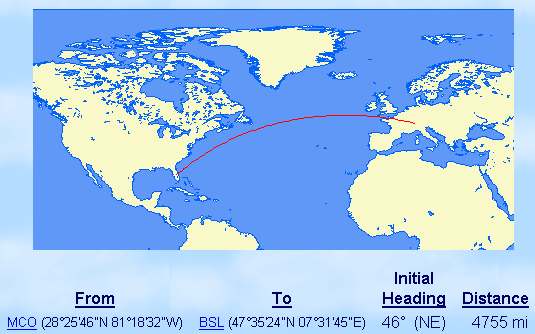
I found this great site while procrastinating doing research for our Christmas letter and want to share it. Did you ever want to know how far it really is from Orlando to Basel? Or the path your airplane would probably take from New York to Paris? Check out Great Circle Mapper!


I normally don't mind that most news stories are bad news. After all, the different, the unusual, that which makes "news" should be bad; good should be so common that it doesn't make headlines.
However, I'm beginning to suspect that some folks actually enjoy reporting bad news, as stories that have both good and bad sides always seem to be reported in the negative. Take the latest housing "crisis." Yes, I know, people who should have known better, and bankers who did know better, behaved stupidly and even wickedly, which led to the sub-prime mortgage crisis and I understand how that's a problem for a lot more people and businesses than those directly involved.
I certainly sympathize with those who are trying to sell their houses and find that prices have fallen and they have to sell for less than they could have received a year ago—maybe even less than they paid. But this is not news. There have always been "buyer's markets" and "seller's markets," and I grew up knowing that one is more likely to be on the wrong end of the swing. Yet now the headlines scream disaster because housing prices keep falling.
Sure, this is bad news to some. But a few years ago the headlines cried woe and doom because housing prices kept rising, squeezing people—especially first-time home buyers—out of the market. We certainly felt that way when we looked at buying a house in the Boston area.
If it must always be bad news, if the country is headed toward disaster when housing prices rise, and again when they fall, I'm likely to cry, "A plague on both your houses!" and toss the paper over in favor of my World of Puzzles magazine.Permalink | Comments
Category Politics Random Musings
Hooray! I love Advent! And I love being home at our church where the season is recognized in all its glory, and we don't plunge suddenly into Christmas. Purple is the order of the day, not red and green, and repentence and renewal more than celebration. Heather, tell your paster I thought of him today, as we started the service by chanting the Great Litany. I particularly like this beautiful, ancient prayer.
Is there anything one can't find on the Internet?
One of the reasons I like Advent is that, like Lent, we sing particularly good and meaningful hymns during this season. The Sequence Hymn was and exercise in sight reading (The King Shall Come When Morning Dawns), but the Communion Hymn was the glorious O Come, O Come Emmanuel, and the Recessional was Rejoice! Rejoice, Believers."
Our choir director greeting us this morning with, "It's great to see you back. Do you know we are singing today?" Fortunately, it was not a difficult piece, and it's a good thing I'd actually rehearsed the alto line a time or two, as I turned out to be the only alto present....
Dear far away, liturgy-loving children: I hope this comforts your hearts, and doesn't make you terribly homesick.
P.S. Our "for schools" prayers today included the Schola Cantorum Basiliensis. :)Permalink | Comments
Category Everyday Life
Today our computer network stopped working.
I needed to access a file on our laptop from our Windows 98 machine. Nothing. Nada. The helpful message from Windows told me the nework was unavailable and I should contact my network administrator. Hello, that's me, and neither I nor me had any clue. Even more helpfully it told me to start the network troubleshooter, which then presented me with a totally blank screen. Apparently it had no more clue than me or I. For the record, Porter was equally stumped, though he manfully plowed through our home networking book for a while.Of course we tried the Universal Cure for Computer Problems: rebooting both machines, and even rebooting the router, although our connection to the Internet was still working fine. Ya never know with computer problems. But no dice.
Figuring the problem might have been caused by some Microsoft updates we had installed today (since everything had worked fine yesterday), I contemplated the other Computer Panacea: a System Restore. But it was dinner time, and then we watched Annie Hall, which movie left me just disoriented enough to be able to accept the absurd fact that when I returned to the computer the network was working cheerfully, just as if it had not stubbornly hidden itself all day. We had not done a System Restore (only contemplated it), we had not rebooted, we had done nothing but eat and watch a movie.
When the problem first became apparent, Porter asked me what I'd done to fix the problem last time it occurred. I was somewhat embarrassed to discovered that I had not made a note of the solution.
Now I know why.
