
[Insert whistling here]
Front entrance lights and tiles


Kitchen bar lights and hand-crafted wine rack


Yep, he did it all, plus about a dozen more cool things on a smaller scale!

Permalink | Comments
Category Everyday Life
Sophie Scholl: The Final Days is a simply made but powerful German film (with English subtitles) about a young woman arrested for treason after distributing some anti-Nazi leaflets. Don't expect a happy ending; the setting is Nazi Germany, where happy endings were few. Nonetheless I recommend the movie highly. Such depictions of goodness and heroism are rare—much less without resorting to graphic violence or sentimentalism.
Four things struck me in particular:
Sophie's courage, while lamentably rare, was of an everyday kind. She is no saint, no Mother Teresa, no doer of grand deeds. Initially, she seems less like a serious member of an underground resistance movement and more like a young college activist with no serious understanding of the dangers of the game she is playing. Indeed, as the scenario works out, she is often dazed, as if she can't believe what is happening. Yet this is where her courage shines: she is calmly, grimly, and articulately faithful to her beliefs. Whether or not Sophie Scholl's actions made a bit of difference in ending the Nazi insanity is debatable; what is clear is that her kind of heroism is within reach of everyone, and comes not from being especially saintly, but from character established and nourished over the years, resulting in a well-ingrained habit of doing the right thing despite the cost.
The horror that was Nazi Germany did not happen overnight. Ordinary people, attempting to live ordinary lives—working, playing, learning, raising families—found themselves gradually entrapped by a system which multiplied minor evils into great obscenities, rewarded playground bullies with power and authority, and convinced normal folks that compromise and complicity were necessary for survival.
One reviewer (I don't remember who deserves the credit, or the blame) noted that Sophie Scholl: Die letzten Tage is a German film, and remarked with pleasure that it was good to see Germany dealing with its darker history. I'm not so sure. It's awfully easy to repent of other people's sins. Sophie Scholl is now a hero in Germany, especially among young people. From the Wikipedia article: [I]n 2003, Germans were invited by ZDF Television to participate in a nation-wide competition to choose the top ten most important Germans of all time. Voters under the age of 40 helped catapult Sophie and her brother Hans Scholl into fourth place, winning over Bach, Goethe, Gutenberg, Bismarck, Willy Brandt and Albert Einstein. If the votes of young viewers alone had been counted, Sophie and Hans Scholl would have be[en] ranked first. No one under 40 could have participated in the Nazi terrors, and it's quite unlikely that their parents did. Repentance is a grand thing, but it's important not to let our horror at a past regime distract us from similar evils, extant or potential, in our present lives.
Without negating one bit of the evil that Hitler perpetrated, it's hard not to detect a bit of racism in our treatment of Nazi Germany. The 20th century alone is filled with insane dictators and horrific blood baths: Joseph Stalin, Mao Zedong, Pol Pot, Idi Amin, Saddam Hussein, Nicolae Ceausescu.... You can add plenty more to the list, yet Adolf Hitler, Nazi Germany, and the Holocaust are put forth again and again as the ultimate evil. It is almost as if we look at Asians, Africans, and even Eastern Europeans and expect them to be uncivilized...but Germany? How could such horrors arise in Western Europe? I know, it doesn't take much knowledge of European history to find plenty of evil in the West—which is why it smacks of racism to give Hitler such prominence.
Perhaps one reason we are so shaken by Nazi Germany is that much of the harm that was done was within the law. The purpose and the glory of the law is to protect the people; when ideologues use it instead as a weapon against a country's own citizens, we are right to be frightened.
I don't recall the era of the 1960s with fondness; it wasn't all bad, but it was a messy, unkind time that accelerated our culture's decline in the areas of civility and decent behavior. However, there must be more of the 60s in my make-up than I thought: I'm finding good reasons to distrust The Man. :)
Just as the National Education Association adamantly opposes home education, the American Medical Association, unnerved, perhaps, by Ricki Lake's popular home birth movie, The Business of Being Born, has taken direct aim at home birth.* Reaction against yet one more threat to personal freedom has come from across the political spectrum, from the far left to the far right. Congratulations to the AMA for provoking agreement between pro-choice and pro-life groups.
Naturally one would expect professional associations for doctors (and teachers, and plumbers for that matter) to fear and oppose anything that threatens to take even a small amount of business away from their members. This conflict of interest, however, does make it difficult to believe that the driving motivation for their actions is altruistic. They would do better, I think, to consider the advice of wise Gamaliel to the Sanhedrin (Acts 5:12-39) when they threatened to kill Peter and the other apostles who were disrupting Jerusalem (and the Sanhedrin's business) with their stories about Jesus:
Leave these men alone! Let them go! For if their purpose or activity is of human origin, it will fail. But if it is from God, you will not be able to stop these men; you will only find yourselves fighting against God.
*If you follow this link to the U.S. News and World Report article, some of you will be particularly interested to note the first comment.
In considering the Supreme Court's nullification of Louisiana's law that allows a death sentence for one convicted of raping a child, I asked, Shouldn't the question before the Court be, "Is there anything in the Constitution of the United States that prohibits the State of Louisiana from imposing this sentence?"
The Court's subsequent decision on the District of Columbia's ban on individual ownership of handguns addressed the issue in just that way: Is there anything in the Constitution that prohibits the city from imposing such a law? "Yes," they concluded— although the vote was shockingly close. The Second Amendment confers a right to gun ownership that this law attempts to take away. I applaud the decision, not because I like the idea of a gun in the hand of every irresponsible idiot, but because it was the right answer to the right question. If our society has diverged so much from our origins that the "right of the people to keep and bear arms" is no longer tenable, we, the people of the United States, have the right and power to take it away via a new Constitutional amendment. The Court's job is to examine the law in light of the Constitution as it stands
I have not taken the time to read the entire, lengthy decision, but even a cursory glance shows how critical to sound decision-making is a good understanding of not only law, but also history, grammar, linguistics, and above all logic.As I wrote earlier, one important idea I took from Marcus Buckingham's The One Thing You Need to Know is the value of expending more energy in our areas of strength than in where we are weak. Self-evident? Maybe, but in practice we often tend to do the opposite.
John Stackhouse's review of another Buckingham book, Go Put Your Strengths to Work, inspired me to reserve it at our library. Although the "I gotta be me" philosophy taken to extremes can lead to unwholesome, selfish attitudes and dereliction of duty, we err in the other direction by not recognizing that God made us who we are and not someone else for a reason. To ignore that design is not only to insult our Creator, but also to risk missing out on the good he would do to and through us.
Buckingham’s counsel—available in this book, on his website, and via other media—coincides powerfully with the counsel of the apostle Paul, who told the early Christians under his care to recognize their inherent particularity, to rejoice in it, to honour each other’s differences, and to work together for mutual benefit. In fact, Paul provides for us an image so apt that it is surprising Buckingham never makes use of it: the parts of the human body working in all of their particularity for each other’s good: eye, ear, hand, foot, and so on (I Corinthians 12).
Life is short, distractions and demands are many, and we can misspend ‘way too much of our time and effort on matters that don’t matter, or in work to which we are neither inclined nor suited. Buckingham’s book is, like all wisdom, deceptively simple and clear, and I’ve found it to be effective. It has helped me move away from activities that I am not good at, or even some that I am, but don’t have much heart for, toward those through which I can do the most good for others and enjoy myself best while doing them.
Permalink | Comments
Category Random Musings
In an earlier post on the Lisbon Treaty, I stated
I"m watching, and here's an example I saw today. The U. S. Supreme Court has nullified a Louisiana law allowing for a sentence of the death penalty following conviction for the rape of a child under 12.[I]n the U.S. we have seen state laws gradually subsumed more and more by national regulation, so that fleeing to Pennsylvania from a repressive law in New York is not as easy as it once was. I'm not saying this is always bad, but it can be, and bears watching.
However devastating the crime to children, Justice Anthony Kennedy wrote in his majority opinion, "the death penalty is not a proportional punishment for the rape of a child." His four liberal colleagues joined him, while the four more conservative justices dissented.
There has not been an execution in the United States for a crime that did not also involve the death of the victim in 44 years, a factor that weighed in Kennedy's decision.... Kennedy said the absence of any recent executions for rape and the small number of states that allow it demonstrate "there is a national consensus against capital punishment for the crime of child rape."
What's wrong here? Why are the judges debating the heinousness of the crime, and why are they judging by perceived national consensus? Shouldn't the question before the Court be, "Is there anything in the Constitution of the United States that prohibits the State of Louisiana from imposing this sentence?"
That, as they say, is why we pay them the big bucks. Questions of the legitimacy of the death penalty and what might be suitable punishment for a man who repeatedly rapes a five-year-old girl can be debated by the voters and their representatives in each state. The purview of those nine experts in Constitutional Law is the Constitution itself.Permalink | Comments
Category Politics Random Musings
The role of joking in the way we deal with one another is a concern of mine, as I've said before. Thanks to Groshlink I've found another excellent essay on the topic, The Gospel and Humor by Tim Keller, pastor of Redeemer Presbyterian Church in New York City. Unfortunately, the article is in PDF format, and you have to weave amongst some other articles to read it, but it's worthwhile. To get you started—and to give those who won't follow the link a taste of what he says—here are some excerpts.
- Your humor has a lot to do with how you regard yourself. Many people use humor to put down others, keep themselves in the driver’s seat in a conversation and setting, and to remind the hearers of their superior vantage point. They use humor not to defuse tension and put people at ease, but to deliberately belittle the opposing view. Rather than showing respect and doing the hard work of true disagreement, they mock others’ points of view and dismiss them without actually engaging the argument.
- There are [also] some people who constantly, bitterly, mock themselves. At first it looks like a form of humility, or realism, but really it is just as self-absorbed as the other version. It is a sign of an inner dis-ease with one’s self, a profound spiritual restlessness.
- There is another kind of self-righteousness...that produces a person with little or no sense of humor. Moralistic persons often have no sense of irony because they take themselves too seriously, or because they are too self-conscious and self-absorbed in their own struggles to be habitually joyful.
- The gospel, however, creates a gentle sense of irony. Our doctrine of sin keeps us from being over-awed by anyone (especially ourselves) or shocked, shocked by any behavior. We find a lot to laugh at, starting with our own weaknesses. They don’t threaten us any more because our ultimate worth is not based on our record or performance. Our doctrine of grace and redemption also keeps us from seeing any situation as hopeless. This groundnote of joy and peace makes humor spontaneous and natural.
- In gospel-shaped humor we don’t only poke fun at ourselves, we also can gently poke fun at others, especially our friends. But it is always humor that takes the other seriously and ultimately builds them up as a show of affection. “We are not to be perpetually solemn. We must play. But our merriment must be of that kind (and it is, in fact, the merriest kind) which exists between people who have, from the outset, taken each other seriously—no flippancy, no superiority, no presumption.” (C.S. Lewis, “The Weight of Glory”)
Permalink | Comments
Category Random Musings
Scott Adams strikes again, with a definitely nerdy variation on this popular saying:

Permalink | Comments
Category Just for Fun
You may have noticed I've been posting a lot recently. At one point I decided to try to write a post a day for the month of June. There were two reasons for this. The first—and this doesn't matter for those who use feedreaders, but not everyone does—is that I want to give people a reason to stop by frequently; if you don't write anything new, people get out of the habit. At least I did, before I let Bloglines keep track of things for me.
The second, more compelling, reason is the accumulating backlog of things impelling me to write. Books lined up for review; interesting tidbits of news and commentary I figure folks might otherwise not encounter; and the everyday happenings in our lives, which is my attempt to close somewhat the 1000 or more (sometimes much more) mile distance between us and those we love. The only problem with this system is that the list grows even as it shrinks. But at least I'm holding my own this month. I suppose I could post more often (this is actually my second post of the day), but there is more to life—like laundry, as the persistent dryer buzzer is now reminding me.Permalink | Comments
Category Everyday Life
Confessions of a Medical Heretic, by Robert S. Mendelsohn, M. D. (McGraw-Hill, 1979)
A quick review of this so I can get it off my desk and back on the bookshelf: There's no doubt that modern medicine has lengthened and improved our lives; the underside of that story is that modern medicine has also shortened our lives, and in many ways diminished their quality. If you're not already half convinced of the second part of that statement, you'll find Dr. Mendelsohn's style hard to get through. I believe him, and I still wanted to scream by about the 40th time he beat to death his otherwise illuminating analogy of modern medicine as a religion.It's worth reading, however, especially if your faith in doctors, hospitals, and prescription medications is strong. A little exposure to the harm that has been done in the name of health care is enough to let in some creeping doubts that nationalizing this commodity is the right path to take. At the very least it will make you a little more alert next time you step into a medical facility.
Sceptics will be quick to point out that the book was written in 1979, but if anyone thinks the basic situation has improved in the last 30 years, I'll point out that while progress has been made in some areas, the underlying philosophies and approaches remain.
I am not denouncing all of modern medicine, much less renouncing it. Mendelsohn himself has good things to say, especially about emergency medicine. But even religion shouldn't be taken completely on faith. An awareness of the dangers lurking behind hospital doors can be very good for our health.I love student recitals. Our kids attended the Suzuki Music Institute of Central Florida for nearly 10 years, so I think I've heard more than my share of recitals. Granted, the quality of music and musicianship was nothing compared with the Eastman School of Music recitals we subsequently enjoyed, but I can honestly say I was never bored, not even by the beginners, nor by hearing the same beginning songs again and again. It was fun hearing the differences, not only from one child to another, but particularly as each child grew and advanced from one recital to another.
Nonetheless, I know that to many people the phrase "student recital" evokes horrifying thoughts of squeaks and off-pitch notes and shaky rhythms, over and over again as student follows student in a seemingly endless parade of classical or modern pieces the audience doesn't know and doesn't understand.Acutely aware of this herself, when the director of the Ellison School of Music planned a summer recital for her students, she was determined that the event be both memorable and fun. Last night we attended their Kaleidoscope Summer Concert, and can say without a doubt that it was both. I say that even though I would like to have heard more classical and modern music that I didn't understand. :)
Seating was at tables, cabaret-style, with delicious food (and real lemonade) from the Tropical Heat Organic Market and Delicatessen.
Pre-, post-, and entr'acte music was provided by the amazing duo of professional musicians Ashley Lochead (vocals) and Dan Flick (guitar/violin). There was also a special guest appearance by a delightful young guy named Justin who really should be a professional singer himself, and a brief but memorable vision of beautiful, blond singers with equally beautiful voices across three generations. In addition to singing, the show featured interpretive dance, skits, and lovely costumes. The students ranged in age from maybe six to adult, including some high school students of considerable talent and training.
For the younger set, there was—perhaps understandably—a heavy emphasis on songs from recent Disney movies, with the older singers concentrating on "golden oldies" from the 40s and 50s, musical theater, movie music, and some just plain fun songs, like "Taylor, the Latte Boy." No doubt you all are 'way ahead of us, and are already familiar with that song, but if not, you can find it on YouTube. One particularly memorable song/skit was a collaboration between two older boys and a little girl on "I Just Can't Wait to Be King" and "Hakuna Matata" from The Lion King.
It was altogether a delightful evening, more like a good place for a Saturday night date than an occasion to show proud parents what they're getting for the money they spend on music lessons. If you're in town for the next recital, you don't want to miss it. And judging by the quality of the singers in this performance, if you're looking for voice lessons in the north Orlando area, you don't want to miss the Ellison School of Music.We throw the term "witch hunt" around pretty loosely, but when it comes to child abuse accusations, apparently it's more accurate than not, at least in one Canadian city, where school officials reported sexual abuse of one of their students on the basis of a psychic's suggestion. As Random Observations noted, the last time we accepted that kind of evidence in North America was during the Salem Witch Trials of 1692.
In this case, the child's mother was able to refute the accusation successfully, because the nature of her daughter's disability, combined with the fact that her elementary school had "lost" her several times, had prompted her to equip the girl with a GPS and a continuous audio monitor that provided clear evidence that the accusation was false. How many other parents could have proven their innocence so easily?
A local man makes his living selling political propaganda, including campaign buttons. Like a mercenary soldier, he plays all sides. He feeds off bumper sticker philosophy, thumb-your-nose attitudes, and mocking humor. It's not exactly the world's most useful occupation, certainly not among the more charitable. But from the reaction to his "If Obama is president, will we still call it the White House?" button, you'd think Jonathan Alcox was a substantially lower form of life than drug pusher or Mafia don, just barely above child pornographer.
Barack Obama does not deny—indeed, he profits from—his partially African heritage. I fail to see anything at all racist about that button; if being aware of someone's ancestry is racist, then we all are, including Obama's supporters, and the term has no meaning other than as an epithet to throw at our opponents when we run out of rational arguments. If truth is no longer a defense, what hope have we for justice?
In the interest of full disclosure, I love word play, and am thus predisposed to finding that button amusing. I wouldn't wear one, but can see the humor and not the offense.
Alcox has other buttons that I find far more beyond the pale. For example,
Another one that Alcox said sells particularly well features George W. Bush next to a chimpanzee beneath the words "The dangers of cloning."
If the same button sported Barack Obama instead of George W. Bush, it would be no less offensive—but also no more. Yet selling that button would push Alcox below the child pornographers in some eyes.
Now that's racism.
Permalink | Comments
Category Just for Fun
Thanks to Andy B.'s suggestion, I just installed the latest version of Firefox. No verdict on it as yet—it was an easy install, and some of it is seamless, some really cool (such as the security information you can get by clicking on the title bar icon, though the number of websites that identify themselves has been disappointing), and some annoying (changed appearance of some of the icons, which will take some getting used to for someone with the kind of visual memory I have). Some of the big new features include lots of things you can do from the title bar, and I see that how bookmarks are organized has changed; also, security has supposedly been significantly enhanced.
So far I've liked the evolution of Firefox, unlike Netscape which got more and more annoying with each new version, as they added features I didn't want and which ate up more and more memory and disk space. Time will tell with 3.0.Last night we enjoyed an outing to the Texas de Brazil restaurant. This is not what I would normally call my kind of restaurant: although I find salad bars, buffets, and all-you-can-eat establishments appealing for their wide variety and options, the high price and the encouragement of overeating make them generally unattractive to me. However, our friends had two-for-one coupons, which brought the $45-per-person price down from the outrageous to the merely ridiculous-but-acceptable-for-a-special-occasion. So we celebrated Father's Day one day late.
Was it Brazil? No. The theme was Brazilian, with the churrasco-style grilled meats brought to the table on huge skewers, but the salad bar included sushi, and while the bar had suco de maracujá it was not sem açúcar, so I was not able to indulge in my favorite Brazilian drink.
Was it delicious? Yes. The first meat to come by our table was the filet mignon, which was so good that we never had more than a taste of any of the other meats. The salad bar, bread, and side dish offerings could have kept me happy (and overstuffed) without any meat at all.
Was it worth $45/person? No. Half that? Yes, for a special occasion. Porter pronounced it one of the best restaurant meals he's had in a long time—and with his travel schedule, he gets a lot of restaurant experience.
Did we overeat? Yes, but it could have been worse. I calculate that if I had stopped five bites sooner I would not have been wishing we'd parked the car further away....Permalink | Comments
Category Reviews Everyday Life
We've been nibbling on the basil, parsley, and Thai basil from our garden, and the hot pepper plant has been producing prolifically and steadily for a year now, but this week saw the first harvest from our radish, lettuce, and stevia plants. The radishes aren't quite ready yet, but the baby lettuces were spicy and delicious.
I've never grown stevia before, and didn't know quite what to do with the leaves, but I cut one stem, stripped off the leaves (maybe a dozen), and poured not qute a quart of boiling water over them. I let that cool and then put it in the refrigerator. Next I took a quarter cup of juice of a fresh lemon, poured it over a glass full of ice, added about half a cup of the stevia infusion (filled up the glass), and stirred it all together. It was a delicious concoction. Still tart, but that's how we like our lemonade.Permalink | Comments
Category Everyday Life
In honor of Father's Day, I present an article that's a bit more challenging than my normal light fare. It's from John Mauldin's InvestorsInsight financial newsletter, and is actually an excerpt from a book called A Roadmap For Troubling Times by Louis-Vincent Gave. The article is The Problem with the Euro, and the excerpt begins a bit down the page, at "The Change in Policy."
It's heavy going, but one interesting thing I took from it, thanks to some help from my own Personal Economist (aka Porter) is this: Countries, unlike people and businesses, don't go bankrupt—because they can always print more money. Yes, that brings on inflation and a whole host of problems, but it keeps them in business. However, this is no longer true of the countries of the European Union. France, which is struggling under a national debt of 70% of its GDP, can no longer cover itself by printing more francs, since its present currency, the euro, is outside of its control. Many other European countries are in similar straits.In the mid 1990s, Europe's leaders got together and, in essence, said: "wouldn't it be great if we all got to borrow at the same rate as Germany?" And everyone around the table agreed that this would be a good thing. The decision was thus taken to a) create a currency which would resemble the DM, b) that this currency would be managed by a central bank with a mandate very similar to the Bundesbank's and c) that countries around the Euroland would strive to harmonize their fiscal policies (Maastricht Treaty rules and Stability and Growth Pact) to ensure the long term survival of the Euro. At the time it was also envisaged that the collapse in interest rates in certain countries (Italy, Belgium, Spain...) would give a tailwind to growth which would allow governments around the more indebted EMU countries to tighten their belts and clean up their fiscal houses.
The collapse in interest rates happened, as yields converged to the German rate... but unfortunately, the clean-up in fiscal houses did not. In fact some countries like France cashed in the "growth dividend" and voted themselves greater benefits such as the 35-hour work week.
There is a credit gap between fiscally strong countries like Germany, Ireland, Finland, the Netherlands, and Austria, and fiscally weak countries like France, Italy, Portugal, Spain, Greece, Belgium, and those of Eastern Europe, and it is increasing. This is manifested by the fact that the yields on bonds issued by the various governments differ despite the fact that they are all denominated in euros. For instance, German bonds yield less than Italian bonds because they are perceived as less risky. This difference is the "spread."
[A] widening of spreads represents the worst of both worlds for European banks. For a start, it puts their balance sheets under pressure. For seconds, it cuts down their income as the writing of CDS on Europe's weaker sovereigns slows to a crawl. For Europe's policy-makers, the widening of spreads poses a serious challenge which, if left unchecked, could cut to the very credibility of the Euro and the European construction exercise. It could also trigger a negative spiral such as the one we saw in the US whereby as the cost of borrowing increases on the weakest signatures, rolling over debt becomes more problematic, hereby inviting higher spreads etc.
This widening is a sign that the market is starting to acknowledge that the promises have not been kept. Thus, the best thing for Europe's governments would be to start keeping the promises that were made ten years ago. [Emphasis in the original] But of course, the main problem with that solution is that it implies that Europe's governments will have to tighten their belts over the coming quarters, i.e.: at the worst possible time in the cycle. After all, it is always hard for a government to pull back and shrink its size of the GDP cake... but in an economic slowdown, it is close to impossible.
It is all the harder to do when there is little political will for far-reaching reforms.... And we should make no mistake about it: reforming Europe's welfare states will take real sacrifices. Take pensions as an example: for years, most European countries have run a pay-as-you-go system whereby people of my generation will pay directly for the retirement benefits of my dad's generation.... In other words, Europe's pension systems are usually massive pyramid schemes; they work as long as the base grows and ever more people contribute to the bottom of the pyramid. The problem, of course, is that in a growing number of European countries, the base is no longer growing.
[T]he credit crunch which has thus far mostly only engulfed the US is starting to make its way into Europe. And soon enough, Europe's banks will likely be reporting losses and write-downs....
A few years before his death, Professor Milton Friedman declared: "It seems to me that Europe, especially with the addition of more countries, is becoming ever-more susceptible to any asymmetric shock. Sooner or later, when the global economy hits a real bump, Europe's internal contradictions will tear it apart." Today, one should question whether the "real bump" is being hit and whether Milton Friedman will end up being proven right.
This bears watching; the EU may have more problems than Ireland's rejection of the Lisbon Treaty. I certainly hope this isn't Friedman's "real bump." And that bit about the government pulling back and tightening its belt? The United States isn't that much better than France when it comes to national debt vs. GDP. Are any of our presidential candidates listening?
Here are some statistics, from the CIA's World Factbook, of the public debt as a percentage of GDP for several countries. (2007 estimates): United States 60.8%, Switzerland 45.3%, France 64%, New Zealand 20.7%, Italy 104%, Brazil 45.1%, China 18.4% (though I'm not sure what this means in a place like China), Canada 68.5%, United Kingdom 43%, Greece 89.7%, Russia 5.9%, Germany 63.2%, Kenya 40.5%, Israel 80.6%, Egypt 105.8%, Japan 195.5%. I'm not at all sure what to make of these figures. Perhaps, like infant mortality statistics, they are so flawed by measurement and recording differences as to be meaningless. But I note two things: (1) The U.S. isn't the only nation with a debt problem, and (2) the world is doing a lot of robbing Peter to pay Paul—or, more accurately, robbing Peter's children to pay Paul's parents.
If you can tough it out through the financial matters, the article is well worth reading.A week ago we paused in the middle of grouting our new entrance tile to turn around and watch the Space Shuttle Discovery sail through the clouds. This morning the twin sonic booms informed us it was time to turn on the television to watch Discovery's return home.
And you thought the thrills of living in Florida had something to do with not shoveling snow.Permalink | Comments
Category Everyday Life
You can look at it that way, and when you do, it sounds unfair that the success or failure of the Lisbon Treaty, which would create a new governing treaty for the European Union, should stand or fall based on what the Irish decide. But so it is with democracy; in a close race, one person's vote can decide the fate of an entire country. Not that it ever does, but it could.
I don't know enough to judge the Lisbon Treaty itself; it may be good or bad in the main, but I can say I am pleased that Ireland is standing by its own constitution, which requires that anything affecting the Irish constitution be decided by the Irish citizens themselves. The Dutch and French people have already been railroaded by their own governments.After voters in the Netherlands and France rejected a previous EU constitution in 2005, no other EU country dared to put such matters to their voters, instead pushing it through their national parliaments. Dutch and French voters have no direct say on the current treaty.
Certainly there are advantages to EU membership, but I'm glad that Switzerland has maintained its independence. I first saw some of the negative consequences of joining the EU on a visit to France, where I learned that the culture of the small, independent French farmer is under attack by the EU. The French government, appreciating the value of local, independent farms for both cultural and national security reasons, has been subsidizing the farmers. I know government subsidies can introduce unfortunate market kinks—and I don't appreciate our own government's subsidies of large agribusiness corporations—but even a "small government" person such as I can see the importance of spending money to protect a valuable, endangered species. But the EU says French farm subsidies are unfair to other member countries, and would rather have France import its food from Eastern Europe.
I know that some are hoping the EU will put a stop to Germany's draconian laws against homeschooling, and no one (except the German families) would like more than I to end that repression, but even I can't help feeling queasy at the thought of an external government dictating their laws.
The new treaty may be a good one for all I know, but I'm glad the Irish government has the courage (and constitutional responsibility) to let their own people vote on matters that will so greatly affect their future.
Not that democracy is everything. People can all too easily be beguiled into voting against their own best interests, to say nothing of the best interests of their neighbors, their country, and the world. That's probably the reason I hate to see the European countries giving up their independence. Many freedoms can be more or less guaranteed by a governing body, or not, but when push comes to shove, true freedom rests on being able to say, "No, thanks" and walk away from a repressive situation, be it a job or a country. That's why it's said that economic freedom is one of the most basic human rights there is, because it enforces the others. A German homeschooling family can currently escape German's persecution by moving to England, as some have done. They shouldn't have to do so, but they can. But what if they couldn't? What if the UK and France and Switzerland and Germany and Hungary and Lithuania were all subject to the same rules? Well, they could come to the United States. Unless we, too, put ourselves under the authority of another governing body that might have different views on the rights of families.
Homeschooling is just an example, which I use because the right to educate one's own children is especially dear to me. But there's a lot more to this issue than that. Alliances among nations are tricky things. Or among states; in the U.S. we have seen state laws gradually subsumed more and more by national regulation, so that fleeing to Pennsylvania from a repressive law in New York is not as easy as it once was. I'm not saying this is always bad, but it can be, and bears watching.
In any case, I'll be eager to see how the Irish people decide.
I've never heard the American Public Media program Speaking of Faith, but somehow (I've forgotten whom to credit) came upon this transcript of Quarks and Creation, an interview with the physicist/priest John Polkinghorne. If you can ignore the annoyances of a word-for-word transcript of an audio program, it's a fascinating interview. (For those who prefer an audio format, that's also available.) Polkinghorne touches on subjects as diverse as beauty, truth, quantum physics, prayer, free will, and the dangerous brilliance of creating a world that creates itself.
In 1997, he was knighted by Queen Elizabeth, though, as tradition dictates, Polkinghorne does not take the honorific title "Sir" because, as an ordained minister, he would not be expected to wield a sword.
And we're expecting Sir Elton John to use a sword? Hmmm.
[B]eauty is a very interesting thing, and a form of beauty that is important to me is mathematical beauty. That's a rather austere form of aesthetic pleasure, but those of us who work in that area and speak that language can recognize it and agree about it. And we've found in theoretical physics that the fundamental laws of nature are always mathematically beautiful. In fact, if you've got some ugly equations, almost certainly you haven't got it right and you should think again. So beauty is the key to unlocking the secrets of the physical world.
[I]t's very hard, of course, to describe any form of beauty....In some sense you have to perceive it. And it's more difficult with mathematics because you have to be able to speak the language. It's a bit like saying, "This is a wonderful Icelandic poem," but if I don't understand Icelandic, I won't get the gist of it. So mathematical beauty is connected, first of all, with things being elegant and economic. You don't write a great sprawling equation that takes half a page to write down. It's very concise, just perhaps a line with only a few symbols in it. But it turns out that it's also very deep, so that when you explore its consequences, you find this very simple-looking thing. It implies this, it implies that, all sorts of surprising and unexpected things. And if it's a successful part of mathematical physics, of course, it will imply all sorts of phenomena happening in the world. And that's what we mean by mathematical beauty.
Permalink | Comments
Category Random Musings
Equality means everyone gets to run the race. It does not mean everyone comes in first.
John C. Wright and I may not agree on Prince Caspian, but we saw the same message in The Incredibles: the loss of excellence, enthusiasm, and initiative that results when we foolishly favor equality of outcome over equality of opportunity.
The inspiration for Wright's post was a soccer trophy won by his five-year-old son. Well, "won" is stretching quite a bit, and that's Wright's point. Everyone on the team received the same trophy, just for showing up. Or even not showing up; the coach also wanted to give a trophy to Wright's other son, who had quit the team mid-season!One can argue that five-year-olds should not be competing for trophies. One can even argue, à la Alfie Kohn, that getting trophies will actually decrease the children's enjoyment of the game. But if you're going to have a competition, make it a contest, not a sham. Don't give out hunks of plastic or cheap metal that waste resources, take up space, gather dust, and have no correlation whatsoever with accomplishment. I like to think that the child who has done well does not need an award to tell him so, and the child who has done poorly will not be fooled by the award into thinking he has done well; unfortunately, my college professor friends won't let me keep that illusion, since they've had plenty of experience with students who have been given (not earned) A's all through high school and nearly break down when they discover they're not the academic whizzes they thought they were. If their parents, teachers, and coaches had not, in effect, lied to them for years, they might have learned to buckle down and work and actually become highly capable students.
Wright found the problem on the soccer field; I've seen it time and time again in the educational system, from the principal who out-and-out told me that the purpose of kindergarten was to get everyone on the same level, to the elementary school "contests" that were rigged so that every student won at least once, to similarly-rigged "Teacher of the Year" awards, to the school board that took a monetary award away from the school that earned it and gave it to a poorly-achieving school. No matter what a school district may say in principle, "making everyone great" means holding down those who are capable of exceling more often than it means raising those who are struggling.None, least of all the winners, likes a situation in which the same few people win all the awards again and again. Dash would soon lose interest in racing, and possibly in running itself, if he blew away the competition every single time. But a coach or a teacher, for example, who wants to reward every student can, with a little creativity, devise competitions where the outcome is by no means certain, and yet in which the winner knows he has truly earned his victory. (John Holt did this with some of his classes, but I've forgotten in which of his books he discusses it.)
Muscles, be they physical, mental, or spiritual, grow with use, and atrophy if left unchallenged. Wright is right to be worried about his sons. Fortunately, awareness of the problem is half the solution.
For two quite different yet effective views of the consequences of "anti-elitist" policies, see Kurt Vonnegut's Harrison Bergeron and C. S. Lewis's Screwtape Proposes a Toast.So. Studies have shown that length of life can be extended by eating a very low calorie diet, twenty to thirty percent less than a "standard diet." Whatever the standard diet is, you can bet it's significantly less than the average American diet, so we're talking severe calorie reduction here.
Thanks to the University of Wisconsin-Madison (my nephew's current college of choice), the National Institutes of Health, and DSM Nutritional Products of [ahem] Basel, Switzerland, there is a better way. Drinking red wine apparently has similar effects and works by nearly the same mechanism. (If you're ambitious you can read the full report.)
Let's see. To drink, or not to eat...is that a question? I don't care much for wine and even then I prefer whites to reds, but I could manage this.
The article doesn't say what happens when you combine the starvation diet with drinking red wine, though the picture it evokes in my mind is not exactly one of robust health....The spectre of mercury poisoning from dental fillings has made the leap from alternative medicine/tabloid fodder to official health concern, as the FDA now acknowledges the possible danger to children, unborn babies, and other sensitive populations. I doubt it's worth having fillings replaced (which I'm guessing could release more mercury than leaving them alone), but certainly a good idea to check with your dentist.
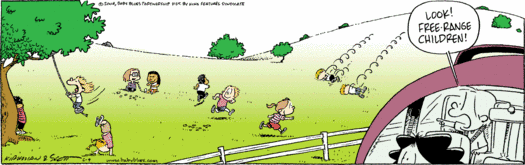
I'd much rather get my mercury from eating tuna and swordfish.The comic strip Baby Blues, like Dilbert, often frustrates me because of its negative views. Its depiction of family life does not usually reflect my experiences, and the recognition of one's own situation is a key ingredient in good humor. But whenever I begin to decide it's not worth reading, Baby Blues (again like Dilbert) comes up with a priceless strip. Today's says so much on several levels that futher commentary would be foolish.
Permalink | Comments
Category Children & Family Issues
Our biggest (and nearly only) success from last year was a hot pepper plant. As I wrote last year, it had been labeled as a sweet green pepper but was clearly not. The first couple of peppers were quite mild, with just a little bite, but I think they were just testing the waters—subsequent fruits have been the fabulous "don't touch your eyes after chopping them up even if you've washed your hands three times" variety. This is the only plant to have survived from last year, and it has been blooming and bearing continuously. Here it is with its new companions, sweet basil (left) and Thai basil (right). Thai basil is that wonderful anise-like herb served with Vietnamese pho, and often in summer rolls.


The radishes, lettuces, and carrots were just starting eight days ago; now they're filling the pot and ready for some thinning. On the right is our parsley and stevia, along with a left-over Christmas poinsettia and some aloe and coleus plants.


Last year's tomatoes never did very well; these heirloom plants look much more promising.

Permalink | Comments
Category Everyday Life
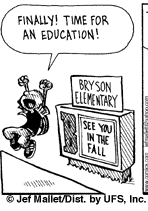
With all due respect for everyone's personal choices, and with free acknowledgement that in our diversity of educational options lies our strength, here's an excerpt from today's Frazz for a moment of homeschooling joy:
I did place an order on Amazon.com this morning...but somehow I doubt that's what brought down the system. Whatever; it has been unavailable for a few hours now: "Http/1.1 Service Unavailable." Just another reminder that we are too dependent on infrastructure over which we have little or no control: water, sanitary services, electrical power, grocery deliveries, police protection, mail, phone, and Internet services. Our ancestors had plenty of worries that we don't, but they dug their own wells, buried their own sewage, grew and/or hunted their own food, and protected their families with their own weapons, and lived among neighbors who could help out when needed.
Communities still share what they can during times of trouble, but for the most part, if we lose one or more of the basic services, so do our neighbors.Permalink | Comments
Category Random Musings
Thanks to John C. Wright for bringing to my attention Story Time by Andrew Klavan, in City Journal.
Read it. It may frustrate you, it may make you despair, it may inspire you; it will certainly break your heart.
Where there is no vision, the people perish. (Proverbs 29:18)
Let me write a nation's songs, and I care not who writes its laws. (various attributions)Permalink | Comments
Category Politics Children & Family Issues
As I said before, I'm not always curmudgeonly. Here, for your morning's delight, is an inspiring story from the blog, "Et tu?" What happens when an introverted mother of three children under four, whose only much-needed time for solitude comes when all three kids are napping simultaneously, finds this time interrupted again and again by neighborhood pranksters who repeatedly ring her doorbell and run? No, this is not a sordid tale of mass murder; I said it was a happy story.
Read the What first, then the How (with further details).
The curmudgeonly protective part of my nature wants to warn her to keep her eyes open, and let the girls help around the house but never leave them alone with her children; I've heard too many horror stories of irreparable damage done to innocent children by street-wise kids from troubled homes. With that caveat, it's a wonderful story, and a glimpse of what neighborhoods used to be like, back in the day when "that house" was "those houses."
Though it's hardly the main point of the story, I love this paragraph:
I've quoted many times the statement that both extroverts and introverts like people and enjoy their company, but for the latter, interacting with a crowd (even a small one) is usually a net loss of energy, while for the former it is generally a net gain. We introverts like being with people, but it drains us, and we need time alone to recover. When challenged on a source for that idea, I couldn't come up with a source, but here's evidence that it wasn't just my own invention.A while back I took a Birkman test, a personality inventory renowned for its accuracy, and on a scale of 1 - 100 with 100 being most extroverted, I was a 1. One. Uno. It doesn't mean that I don't like people, but that being around others is exhausting for me. As the test administrator put it, "You need introvert time where you don't have to be 'on' like normal people need air."
Permalink | Comments
Category Random Musings
Here's a scary article for you: Emily Gould's Exposed, from the May 25, 2008 New York Times Magazine. Andrew Keen (The Cult of the Amateur) would definitely appreciate this story of one woman's venture into a world of publishing unfettered by editorial oversight and subsequent free-fall into the Dark Side of Blogging.
I slumped to the kitchen floor and lay there in the fetal position. I didn’t want to exist. I had made my existence so public in such a strange way, and I wanted to take it all back, but in order to do that I’d have to destroy the entire Internet. If only I could! Google, YouTube, Gawker, Facebook, WordPress, all gone. I squeezed my eyes shut and prayed for an electromagnetic storm that would cancel out every mistake I’d ever made.
Another sad story about a naïve teenaged girl molested by someone she met on MySpace? Not at all. Just an imprudent adult woman seduced by the delights of seeing her thoughts in print. Scary.
Permalink | Comments
Category Computing Random Musings
In a previous post, which was primarily about something else so I won't link to it here, I said:
Having experienced the higher-level coinage of Canada, New Zealand, Australia, Switzerland, and the European Union, I wish the United States had the sense to supplant (not just supplement) the dollar bill with dollar coins. (And maybe the $2 and $5 bills while we're at it.) But the mountain of paper used to print dollar bills comes from Massachusetts, where the Crane Paper Company has a stranglehold monopoly on the business. The $1 bill has a lifespan of under two years and represents about 45% of the U. S. currency production, so it's no surprise that Massachusetts politicians don't like dollar coins.
I've mentioned the idea of getting rid of the lower-denomination bills in favor of coins, and while women generally don't seem to mind, I am likely to get a negative reaction from men. I think this is because women's wallets almost always have a place for change, but men's wallets rarely do. Porter carries his change in a small coin purse (something like this) which keeps the coins handy and protects his pocket. But most men I've talked with tend to keep their change loose in their pockets and then dump them in a jar or on a dresser at the end of the day. This system works because our coins are worth so little.
(Back when I was little and our coins were worth a lot more, this system was a boon to children, who would comb couches and chairs for change that had fallen out of men's pockets.)
Needless to say, these men are less than happy with the thought of heavy coins jangling in their pockets instead of light, thin bills in their wallets. I can see their point. However, I know that Europeans, Canadians, Australians and New Zealanders (and no doubt people from other countries) manage quite well with higher denomination coinage instead of bills. So my question is, What's your secret? How do you handle change?
(I'll admit I only know of one European male who regularly reads this blog and can be counted on to be generous enough to comment, but there are others who occasionally stop by, and I figure the women probably know something about it, too.)
Then again, eveyone else seems to have been able to adjust to the metric system and we still haven't managed that, so maybe I shouldn't hold out too much hope....
Permalink | Comments
Category Random Musings
My feminism tends to be of the on-again-off-again sort. As a child—thanks to parents who encouraged me—I never considered any good character trait, activity, or occupation to be off limits because of my sex. I didn't think much about feminism back then; I just acted, becoming the first girl to break the sex barrier in my high school's stage band, and the only or one of just a few girls in some of my science classes. This sounds tame and silly from a 21st century perspective, but it was a big deal back then.
When Feminism became a movement, however, I soon had to distance myself from it, largely because it distanced itself from me. I was (and am) all for equality of opportunity—as much as is physically possible; I don't ever want to see men getting pregnant—but when Feminism veered into being anti-man and pro-abortion, when it denigrated the role of homemaker and made the two-income family first common and then in some cases necessary, and when it invoked "political correctness" over the very words we speak and even started calling God "Our Mother," that's when I turned away. Not from my beliefs, which hadn't changed, but from the movement and the label. Women were now included, and succeeding, in nearly every possible opportunity; it was time, I believed, to give feminism a rest.
Until I found myself for a few years in the company of some people (mostly men) whose view of women was more oppressive than anything I'd known growing up nearly half a century earlier. Then I realized that even a necessary correction to the movement's faults and excesses (great though they were and are) could send us back too far. I actually worry less about those men now than I do about the Princess infatuation that little girls are embracing as they did Barbie dolls. (And still do? I've been out of the scene for a while.) We're still encouraging our boys to be smart and strong and our girls to be...pretty.
How does one raise boys to be men and girls to be women and all to be intelligent, strong, and competent people? The impetus for this post was an article I read yesterday in a church bulletin insert, which included this paragraph.
A godly father has a profoundly positive influence on the life of his son or daughter. He teaches his son the importance of self-control, respect for women, the value of work, and healthy risk taking. He affirms his daughter's femininity by expressing his appreciation for her as a woman. Dads, keep these thoughts in mind as you nurture healthy gender identity in your children.
Excuse me? The best a father can do for his daughter is to appreciate her as a woman? I thank God my father did a lot more for me than that! Self-control, respect, the value of work, and healthy risk taking are things we all need to learn—not just half of us.
I do believe boys need to be taught how to be good men, and girls to be good women, and that these roles are not identical. But could we please find a way to make boys into men without putting down girls? It must be possible to nurture in boys fatherly and protective characteristics without appealing to pride, which generates worse problems.
Any ideas?
Permalink | Comments
Category Children & Family Issues Random Musings
The Cult of the Amateur: How Today's Internet Is Killing Our Culture, by Andrew Keen (Doubleday, 2007)
It's past time to get this book back to the library; I actually finished it quite a while ago, but have been putting of this post because I haven't known quite what to say. It's a complex book, probably an important one, but it covers so much territory I'll never do it justice. The book is far more than a diatribe against amateurism, but I will skip over the sections on Internet gambling, Internet pornography, privacy concerns, and the demise of an iconic record store. Except for Tower Records—it's hard to mourn the disappearance of something you never knew existed—I'm aware of the other issues and tend to agree that they are, indeed, serious problems. Whether or not the proliferation of amateur voices is boon or bane is a bit more complex.
Now that I've finished reading the book, I still stand by what I've already said (here, and here), and will add that Keen is right to fear that truth, accuracy, responsibility, and excellence are in danger of being lost in our society, but wrong in laying the blame solely or even primarily on the Internet.
It's true that many people are no longer giving professionals the unquestioned respect, trust, and even obedience they once did. But it is not so much because the Internet lets amateurs speak as because the professionals have proven themselves untrustworthy.
When an article runs under the banner of a respected newspaper, we know that it has been weighted by a team of seasoned editors with years of training, assigned to a qualified reporter, researched, fact-checked, edited, proofread, and backed by a trusted news organization vouching for its truthfulness and accuracy. Take those filters away, and we, the general public, are faced with the impossible task of sifting through and evaluating an endless sea of the muddled musings of amateurs.
Most of us assume that the information we take in can be trusted. But when the information is created by amateurs, it rarely can be. And the irony in all this is that democratized media wil eventually force all of us to become amateur critics and editiors ourselves. With more and more of the information online unedited, unverified, and unsubstantiated, we will have no choice but to read everything with a skeptical eye. The free information really isn't free; we all end up paying for it one way or another with the most valuable resource of all—our time.
Anyone who has ever been part of a story reported in a "respected newspaper," magazine, or television news story probably laughed at that first paragraph. I don't believe any of the many stories I've known first hand has been reported completely accurately, and often the errors are significant. The need to read everything with a skeptical eye predates the Internet.
It doesn't take much research into factory farming, modern American childbirth practices, the pharmaceutical industry, the politics of university research, the news media, the educational system, and even the music world to realize that professionals are not necessarily good and wise, and often disastrously wrong. [Keen does not deal with most of these areas directly, but what he says about the amateur vs. the professional applies equally well.]
[E]very free listing on Craigslist means one less paid listing in a local newspaper. Every visit to Wikipedia's free information means one less customer for a professionally researched and edited encyclopedia such as Britannica. Every free music or video upload is one less sale of a CD or DVD, meaning one less royalty for the artist who created it.
I'm not at all sure this is true. I suspect many things are listed on Craigslist that would never make it into a newspaper's classified section, not just because people sell some really weird things on Craigslist but because I think it, like eBay, inspires people to sell things who otherwise wouldn't have bothered. I'm certain that if online references such as Wikipedia were not available, it would not drive many people to purchase an encyclopedia; their question would simply go unanswered. Knowing next to nothing about online music an videos I can't say much about the last thesis, but I do know that the availability of free music samples has helped inform my CD-buying decisions, and that I've bought more CDs than I otherwise would have due to being able to have that data.
I do appreciate the availability of Google News, and free online versions of many newspapers, including our Orlando Sentinel. But that was not what drove us to cancel our subscription of nearly 20 years. Rather, it was because the Sentinel itself had become unreliable, with more and more opinion being inserted into the news stories instead of confined to the editorial pages, and with factual, informative articles being cut in favor of insubstantial fluff and large pictures.
Becoming a doctor, a lawyer, a musician, a journalist, or an engineer requires a significant investment of one's life in education and training, countless auditions or entrance and certifying exams, and commitment to a career of hard work and long hours....Can the cult of the noble amateur really expect to bypass all this and do a better job?
There's the rub. Because Keen is right here: we need the professionals, the ones who will invest their lives and resources in becoming experts in specialized fields, and if the proliferation of amateur works makes it no longer possible for them to earn a reasonable return on their investment, we may very well lose the infrastructure that makes the expertise possible.
The amateurs are, however, performing an important function. In my own field of (amateur) genealogy, I subscribe to the Ancestry.com service. Some people shun commercial sites and believe all information should be freely shared, but I am happy to pay for the work that their professionals have done to gather and make available a tremendous amount of genealogical data. There is also a section of the site that has been created by amateurs: a large database of people's own family trees. This data is not subject to any editorial supervision, is rarely sourced, and is for the most part highly unreliable. I never cite it as a source in my own work, except in a few cases where I have contacted the author and have reason to trust his or her data. I treat the personal family trees in a much different fashion from other Ancestry information, such as their images of census transcriptions, old newspapers, and books. Nonetheless, the amateur data has proven many times to be extremely valuable, giving important clues and sometimes great breakthroughs. Yes, I always need to verify the information, bur without the "collective wisdom" of all those amateurs my search would have been much harder, if not impossible.
I think Wikipedia, amateur news blogs, and the other non-professional works that Keen decries should be approached in much the same way. Schools are right not to allow Wikipedia citations for research papers, but that doesn't mean Wikipedia isn't a great resource for getting started. You'll never get a clear view of the news by reading only a right-wing blog, but it can be a useful balance to your local left-wing newspaper, and vice versa.
But he's right: we do need the experts, and we do need to recognize that some reports are more truthful than others, and some opinions more valuable. What he doesn't say, but what I believe to be the most effective approach to a solution, is that we all need to be better educated, and better trained in logic and discernment. Give a man a professional opinion and you'll feed his mind for a day; teach him to discern truth from error and you'll feed his mind for a lifetime.

