
I like to ignore politics as much as possible. I want to be a well-informed voter, but I don't believe that political propaganda—whether in the form of paid advertising or news commentary—serves that purpose well, and I'd rather change a dirty diaper than listen to a presidential debate. But as Pericles said, Just because you do not take an interest in politics doesn't mean politics won't take an interest in you. And economics even more so.
In the last month I've changed many diapers, and the worst of them did not smell as bad as the current state of our economy and what it might lead to. I've lived through several economic downturns, and haven't yet found them worth the worry they engender, if one has adhered to a policy of regular savings, avoided the get-rich-quick mentality, stayed out of debt for depreciable assets, and been willing (and able) to take a long-term view. "This too shall pass" has always been an effective philosophy.
Our current financial situation, however, looks to pass with all the ease of a monstrous kidney stone. I'm afraid it was easy, at first, to take a rather self-righteous attitude to the subprime mortgage debacle. Sure, I was sorry for people who were losing their homes, but some of them had been downright crooked in the acquisition of their mortgages (taking on debt they knew they could never repay) and most of the others had violated very basic rules of money management (purchasing homes out of proportion to their incomes). What's more, the financial institutions that facilitated such loans were either crooked or stupid themselves.
Be that as it may, when they take you away from the accident scene in a stretcher, it doesn't make a bit of difference that you had the right of way. The many cannot avoid paying for the sins of a few. No one can say, "It's not my problem." If you have not a penny in the stock market, if you don't need a mortgage or a car loan or other credit, you still need a job, gas for your car, and food on the table—and all of these are threatened by the economy's convulsions.
For an insightful look at why we should be worried, yet with minimal political spin, check out what John Mauldin has to say in yesterday's InvestorsInsight. I tried to boil the article down to a few excerpts, since I know many of you will not read the whole thing, but I gave up. It's worth reading in its entirety. The excerpts below (with my own emphasis) will only give you a taste.
[Most people] don't understand why taxpayers should spend $700 billion to bail out rich guys on Wall Street who are now in trouble. And if I only got my information from local papers and news sources, I would probably agree. But the media (apart from CNBC) has simply not gotten this story right. It is not just a crisis on Wall Street. Left unchecked, this will morph within a few weeks to a crisis on Main Street.
First, let's stop calling this a bailout plan. It is not. It is an economic stabilization plan. Run properly, it might even make the taxpayers some money. If it is not enacted very soon (Monday would be fine), the losses to businesses and investors and homeowners all over the US (and the world) will be enormous. Unemployment will jump to rates approaching 10%, at a minimum.
Banks can lend to consumers and investors about 12 times their capital base. If they have to write off 20% of their capital because of losses, that means they either have to sell more equity or reduce their loan portfolios.... At first, banks were able to raise new capital. But now, many banks are finding it very difficult to raise money, and that means they have to reduce their loan portfolios.... [But now] the credit markets have stopped functioning. Because banks and investors and institutions are having to deleverage, that means they need to sell assets at whatever prices they can get in order to create capital to keep their loan-to-capital ratios within the regulatory limits.
[P]art of this started when banks and investors and funds used leverage (borrowed money) to buy more assets. Now, the opposite is happening. They are having to sell assets into a market that does not have the ability to borrow money to buy them. And because the regulators require them to sell whatever they can, the prices for some of these assets are ridiculously low.Last week, I wrote about a formerly AAA-rated residential mortgage-backed security (RMBS) composed of Alt-A loans, better than subprime but less than prime. About 5% of the loans were delinquent, and there are no high-risk option ARMs in the security. It is offered at 70 cents on the dollar. If you bought that security, you would be making well over 12% on your money, and 76% of the loans in the portfolio of that security would have to default and lose over 50% of their value before you would risk even one penny. Yet the bank which is being forced to sell that loan has had to write down its value. As I wrote then, that is pricing in financial Armageddon.... And guess what? There are no buyers.
One of the real reasons these and thousands of other good bonds are not selling now is that there is real panic in the markets.... We are seeing massive flights of capital from money market funds, including by large institutions concerned about their capital. What are they buying? Short-term Treasury bills. Three-month Treasury bills are down to 0.84%.
It gets worse. Last week one-month Treasury bills were paying a negative 1%!!! That means some buyers were so panicked that they were willing to buy a bond for $1 that promised to pay them back only $.99 in just one month.
[T]here is a silent bank run going on. There are no lines in the street, but it is a run nevertheless. It is large investment funds and corporations quietly pulling their money from some of the best banks in the country.... Any whiff of a problem and an institution that is otherwise sound could be brought low in a matter of weeks. And the FDIC could end up with a large loss that seemed to have come from out of nowhere.
There is something called the TED spread, which is the difference between three-month LIBOR (the London Inter Bank Offered Rate which is in euro dollars, also called The Euro Dollar Spread, thus TED) and three-month US Treasury bills. Three-month LIBOR is basically what banks charge each other to borrow money.... Quite literally, the TED spread is screaming panic.
Credit spreads on high-yield bonds that many of our best high-growth businesses use to finance their growth are blowing out to levels which make it impossible for the companies to come to the market for new funds. And that is even if they could find investors in this market! There are lots of other examples (solid corporate loans selling at big discounts, asset-backed securities at discounts, etc.), but you get the idea. Suffice it to say that the current climate in the financial market is the worst since the 1930s.
We are in a recession. Unemployment is going to rise to well over 6%. Consumer spending is going to slow. This is an environment which normally means it is tougher for small businesses and consumers to get financing in any event. Congress or the Fed cannot repeal the business cycle. There are always going to be recessions. And we always get through them, because we have a dynamic economy that figures out how to get things moving again.
Recessions are part of the normal business cycle. But it takes a major policy mistake by Congress or the Fed to create a depression. Allowing the credit markets to freeze would count as a major policy mistake.
Why do we need this Stabilization Plan? Why can't the regular capital markets handle it? The reason is that the problem is simply too big for the market to deal with. It requires massive amounts of patient, long-term money to solve the problem. And the only source for that would be the US government.
If we act now, we will start to see securitization of mortgages, credit cards, auto loans, and business loans so that the economy can begin to function properly.
What happens if we walk away? Within a few weeks at most, financial markets will freeze even more. We will see electronic runs on major banks, and the FDIC will have more problems than you can possibly imagine. The TED spread and LIBOR will get much worse. Businesses which use the short-term commercial paper markets will start having problems rolling over their paper, forcing them to make difficult cuts in spending and employment. Larger businesses will find it more difficult to get loans and credit. That will have effects on down the economic food chain. [We] will see stock market investments off another 25% at the least. Home prices will go down even more. Consumer spending will drop. What should be a run-of-the-mill recession becomes a deep recession or soft depression.
A properly constructed Stabilization Plan...should ultimately not cost the taxpayer much, and maybe even return a profit. The AIG rescue that Paulson arranged is an example of how to do it right. My bet is that the taxpayer is going to make a real profit on this deal. We got 80% of AIG, with what is now a loan paying the taxpayer over 12%, plus almost $2 billion in upfront fees for doing the loan. That is not a bailout. That is a business deal that sounds like it was done by Mack the Knife.
This deal needs to be done by Monday. Every day we wait will see more and more money fly out the doors of the banks, putting the FDIC at ever greater risk. Panic will start to set in, moving to ever smaller banks. Frankly, we are at the point where we need to consider raising the FDIC limits for all deposits for a period of time, until the Stabilization Plan quells the panic.
I understand that this is a really, really bad idea according classical free-market economic theory. You know me; I am as free market as it comes. But I also know that without immediate action a lot of people are really going to be hurt. Unemployment is not a good thing. Losses on your home and investments hurt. It is all nice and well to talk about theories and contend the market should be allowed to sort itself out; and if we have a deep recession, then that is what is needed. But the risk we take is not a deep recession but a soft depression. The consequences of inaction are simply unthinkable.
I've quoted much more than I meant to. I hope some of you are still with me. What it boils down to is that this has the potential to have consequences—not only here, but around the world—far worse than we dreamed of in the Y2K panic. I know people who stockpiled food and water for that one...yet this is receiving a "ho, hum" from most of us.
I'm hardly a fan of most governmental intervention, and one of my greatest fears in all this is that in our panic we will subject ourselves to measures with disastrous long-term consequences, as happened with the Great Depression. We need to analyze the causes of our woes and how best to prevent them in the future. We probably do need a serious restructuring of how our society handles debt. When Mauldin says, "Cheap loans with small down payments are the life blood of the auto selling business" my reaction is to see that as a major part of the problem, and something that needs to be changed. But not now, not so drastically. The patient needs surgery—not amputation. Above all, let's not let the patient die on the table while we argue about who's to blame and who should wield the knife.
In the meantime—where are my old Y2K notes?
Last night the Orlando Philharmonic Orchestra presented Fanfare, its 2008-2009 season opener, featuring the U.S. Army's Herald Trumpets. As always, it was an enjoyable concert, though odd in a way, since I often found the orchestra too loud. I'm accustomed to that in everyday life, and carry earplugs with me nearly everywhere I go, because whatever is amplified is nearly always amplified too much for my taste. Yet this was live, acoustic music, and it wasn't just the guest trumpets that were too loud. Orchestras are supposed to be too loud only if you're sitting directly in front of the percussion or the trumpets—not when you're far away in the balcony. Weird. Perhaps my ears are getting better as my eyes are getting worse.
As the oboe section is of primary importance to our family, we immediately noticed a gaping hole—where was Principal Jared Hauser? And Laura Hauser was not amongst the bassoons, either. There turns out to be a good reason for their absense: Jared left to take the position of oboe professor at the Blair School of Music at Vanderbilt University. Good for them, but very sad for us. I'm particular about oboe playing, and I loved Jared's sound. This reminds me of when Principal Flute Aaron Goldman left to become Assistant Principal Flute of the National Symphony Orchestra. The OPO seems to be a sending-off point for really good (and nice) musicians. I'll never forget the fun we had listening in one night when Jared and Janet played baroque oboe duets together. I was hoping for a repeat some day—but now one is in Nashville, and the other in Switzerland.Oddly enough, in a concert that featured such greats as Verdi, Shostakovich, and Richard Strauss, my favorite work was Tromba Lontana, by the living composer John Adams, whose Short Ride in a Fast Machine I had enjoyed when Janet performed it at Eastman.
Added 2008-09-29: Stephan was kind enough to point out that I had written "Tromba Iontana" instead of "Tromba Lontana." It comes of not knowing Italian, I suppose. (The title was translated as "Distant Trumpet.") I will grumble just a bit and ask why the program chooses to use a lower-case letter in a font where the lower case L and the upper case I are identical, and in a publication where most of the other titles have all major words capitalized—but I checked in the pdf version and it is, indeed, a lower-case L.
In my efforts to confirm the true title, I discovered these two YouTube videos, which you might enjoy. I wonder, just a bit, about copyright issues when works like this are put on YouTube, but for now I'll give them the benefit of the doubt.
Tromba Lontana
Permalink | Comments
Category Reviews Everyday Life
Today we celebrated the Smithsonian Institution's Museum Day by visiting The Maitland Historical Society's Waterhouse Residence Museum. If you're going to get in for free, why not check out a museum you didn't even know existed? The Maitland Historical Society's museums are located on lovely Lake Lily in Maitland, and we enjoyed a walk around the lake after our tour. I believe we can call Museum Day a hit; everyone in our almost-crowded tour had brought web-printed admission passes, and for most of us the museum was a new experience.
Since Mr. Waterhouse came originally from "the north," I can't help wondering if he was a descendant of my eighth great grandfather, Jacob Waterhouse, who immigrated from England to New London, Connecticut in 1676. He had a nice house, much more so than would be expected for a middle class family, because he was a carpenter and buit much of it himself. Part of the museum is his shop, which is filled with antique tools. "Antique," I'm sure—but it let us know how old we are when we found ourselves giving a sotto voce commentary throughout the tour: "This house is the same age as the one I grew up in," "My aunt had a stove like that," and "Those tools look just like the ones in my dad's workshop."Permalink | Comments
Category Reviews Everyday Life
One of my great-great grandmothers, on my mother's side, bore the name Juan Fernandez Pritt. In various census records she is listed as Penandis, Permandus, Joana P., Juann P., Joanne, and Pernandis E. Even though one of the most thorough researchers in the area found her listed as Juan Fernandez in the Weston, West Virginia courthouse, who can blame him, and others, for assuming that was an error and calling her Joanna? Even her middle name would be in question because of the census data.
I'm convinced, however, that Juan Fernandez is her correct name, although she was no doubt called by one or more nicknames throughout her life. The name in that form shows up in a published biography of her eldest son (my great-grandfather), and also on his official death certificate, bizarre as it seems for a child born in the backwoods of West Virginia, with no Hispanic relatives in sight.It took only a few minutes of searching to reveal several women with the same odd appellation. Why would anyone name a little girl Juan Fernandez? Someone else asked, and answered, that question here, in the case of Juan Fernandez Bennett and Juan Fernandez Cuffee.
Was there a seafarer amongst my great-great-grandmother's forebears? What I know so far of her ancestry has her roots firmly planted in the mountains, but there's still room for an old salt, or perhaps an unusually literate hillbilly, somewhere in the family tree.Why would someone name a beautiful African American girl, who ultimately graduated from Philadelphia Medical College in 1888, “Juan Fernandez” Bennett? What kind of name was that for a girl? Family research revealed that Dr. Bennett’s grandmother, known as Johanna F. Cuffee, was originally named Juan Fernandez Cuffee. Apparently William Cuffee, her sea-faring father, named his daughter for the Juan Fernandez Islands off the coast of South America. These islands were the first place that ships set into port after the harrowing experience of rounding the Horn.
Trying to catch up on my e-mail backlog, I came upon the World Names Profiler through my NEHGS newsletter. "The site plots 8 million names, using data that comes from electoral rolls and telephone directories around the world. Covering 300 million people in 26 countries, users can see where certain surnames originated, and where they have migrated to."
Here, for example, is the Wightman distribution map.

(Click map for larger image.)
The site also tells me that "Wightman" belongs to the "European-Other Western" group, that's it's an English language name of the English subgroup, that it is most frequently found (relative to overall population) in the United Kingdom, followed by New Zealand, Australia, the United States, and Canada, and that the most common first name coupled with Wightman is John.
Check it out. It seems to have a limitation when it comes to umlauts, however. "Stücklin" produced no results; "Stuecklin" occurs infrequently and only to any degree in Germany and Denmark. However, "Stucklin," without the umlaut, is truly a Swiss name, with very small additional populations in France and the United Kingdom. The top three cities? Basel, Binningen, and Riehen.One banker's box stuffed to the brim with mail: that's what awaited us as we returned from an extended stay in Pittsburgh welcoming our granddaughter. I spent most of the evening sorting it into piles: Urgent, Important, Interesting, Political, Magazines, and Washinton Mutual. I kid you not. The mail from WaMu rated a pile of its own, as there were 16 envelopes, one for every two days we were away. I can't tell you what's in those envelopes, but I know it's not important: neither of us has an account with that bank. And yet we rate mail from them at a rate of one every two days?
So I wasn't totally shocked when I read this from the New York Times: Washington Mutual, the giant lender that came to symbolize the excesses of the mortgage boom, was seized by federal regulators on Thursday night, in what is by far the largest bank failure in American history. I'd say WaMu's downfall was caused by unwise investments, all right—not in real estate, but in paper and postage!Permalink | Comments
Category Random Musings
The Associated Press hasn't taken up the story yet, though I know from experience that will probably change. I wish private grief could remain private; since it is not, however, I need have no qualms about providing updates for those whose love and prayers support the particpants in this unfortunate drama.
Nearly six years after Isaac's birth, and more than four after she was charged in his death, Judy Wilson's formal trial began. Although they support Judy and never wished her to be charged, Heather and Jon were subpoenaed by the prosecution as witnesses—the only eyewitnesses other than Judy herself. Required to report to the Allegheny County Courthouse by 8:30 a.m. on Monday, we packed ourselves up—three sleepy children, breakfasts for eating in the car on the way, a cooler with lunch and snacks, an overstuffed diaper bag, Jon's laptop bag (Lime Daley service must be available, trial or no), a bag of books, toys and games, plus jackets, blankets, baby slings, and oh yes, legal paperwork—and headed for Pittsburgh, in the middle of rush hour.Eventually we found a parking place and began our assault on the courthouse. If you're going to try to bring half a mountain of belongings through a security scan, make sure at least one of them is an extremely cute two-week old baby. Faith was the hit of the courthouse, winning hearts and smiles all day long, even from people stuffed into the elevator with us—though some folks took one look at our entourage and murmured, "I'll wait for the next one."
After reporting to the witness room, we set up our encampment outside the door, as the room was small and not a good place for two active boys to wait. The courthouse is not exactly laid out to be family-friendly. A door labelled "Children's Playplace" promised to make our stay more enjoyable, but reneged on that promise: children are only allowed in if they leave their parents behind the closed door, and there are strict sign-in and sign-out procedures. Well, the building did originally house the County Jail.... The true function of the Playplace is apparently as a holding area for children whose parents need to be in court and who have no other adult to watch them. Bring your own adults and the cool toys are off limits. The nice lady watching over the often-empty room did thrill the boys by giving them some gummy candies, though.
If the set-up wasn't meant for families, at least the smooth marble floor of the historic courthouse was perfect for racing Matchbox cars. Jonathan was pretty good about keeping the cars away from the other inhabitants of the courthouse, and the people going about their business were pretty good about not screaming when a car whizzed past their feet as they turned the corner.
The people going about their business were an interesting mix. Suit-and-tied attorneys, neatly dressed witnesses, casual reporters, and people so grungy that one hoped they weren't planning on getting anywhere near the inside of some judge's courtroom. People who clearly were comfortable in that imposing and intimidating building, and people who clearly were not. People black and people white, though oddly enough I saw no Asians and heard no Spanish spoken. Male and female there were, but very few on the outer edges of the age spectrum. Jonathan, Noah, and Faith stood out even in this patchwork fabric of humanity.
There was plenty of time to observe the courthouse denizens, because after checking in our chief occupation for seven hours was waiting. There is a definite hierarchy in the witness world, and Heather and Jon were on the bottom of it. Police officers and paramedics have to finish their testimonies early, so they can get back out on the street. Doctors and other bigwigs can't be kept waiting too long, of course, and though the midwives were treated rather shabbily as well, they still came before the self-employed and the parents. I guess they just saved the best for last—from the news reports, it seems the media would agree. But I'm getting ahead of myself.
We spent the morning keeping the boys entertained and somewhat corralled, and feeding, changing, and holding Faith—punctuated by occasional trips to investigate one floor up (where the courtroom was) and one floor down (where the bathrooms were). Memo: if you're two weeks postpartum and supposed to be avoiding stairs, and the ladies room is a very slow elevator ride distant, bathroom breaks require advance planning.
The highlight of the day may have been our lunch break. We enjoyed our tuna sandwiches, kefir, and Hydrox cookies in the courtyard, by the fountain. The boys enjoyed running around (not in) the flower beds, which to our surprise contain lantana—one of my favorite flowers—which I thought would not grow this far north.
If we had been told to come at noon instead of 8:30, we still would have had a three and a half hour wait. The afternoon was much like the morning, only we were all a little more touchy and a lot more tired. Jon created a "nap cave" for Noah out of a table and some chairs; he blissfully slept away a couple of hours of boredom, lying on the floor with some diapers for a pillow.
Jon was to have testified first, but time was getting short, and they (mercifully) decided to call Heather in hopes she would be finished and not have to return for another day. Once again it was a matter of hurry-up-and-wait. She was called up to the hallway outside of the courtroom just as the person before her began to testify. Jon was able to take hungry Faith to her, but the judge was annoyed by the baby noise outside the door. What looked as if it might have been an uncomfortable scene turned 180 degrees when the officials realized the situation, at which point they allowed Heather and Faith to move to a more private (and quiet) spot.
It's a good thing Faith was topped up, because Heather's testimony took up the rest of the afternoon. Apparently she held up well, responding clearly, calmly, and cogently. She masterfully restrained herself from offering explanations and elaborations that she knew were "not her place" and would only rile the judge. I don't think I could have done as well, as frustrated as I am by leading questions and surveys that require yes or no answers to questions that don't have binary answers.
We were all thankful that the cameras were not allowed in or near the courtroom, and that by that point Heather knew the courthouse well enough to return to us via a path that did not take her past where they were set up. Very thankful we were, also, to pack up and be on our way, even though frustrated that Jon would need to return Wednesday.
Since we were now caught in rush hour, we made a side trip back to Carroll Street, where we showed Faith off to some friends and enjoyed a leisurely Thai dinner. It was a great meal, although it was amusing to note that my "6" rated spiciness was hotter than Jon's "8." Jonathan's "2" was fine, however, and he devoured more than half of a full-sized pork, vegetable, and noodle dish.
Rush hour was over by the time we were on the road again, but it was very late before we finally made it home, since we stopped at a friend's house for Jon to help one of their kids with a computer problem. The wait was not bad for the rest of us, however, since it was accompanied by good company, good conversation, and awesome, warm-from-the-oven molasses cookies (yes, the same ones mention in the previous post). But make it home we eventually did, and collapsed into bed. I did take a few minutes to send a "we're okay" e-mail to concerned family members, which turned out to be a good thing, since this blog post has been longer in creation than I had intended.
No matter what those who schedule the order of testimony might have thought, to the media, Heather was the star of the show. The news reports so far, with commentary:
The first one, Monday night, from KDKA. This is the only one with video; click on the left-most thumbnail picture on the right hand side, or click here. Although the report is current, all the pictures are from four years ago. The baby with Heather is Jonathan. It's a good thing court stenographers take more accurate notes than reporters. I can't speak for all of the quotes, but one thing I do know is that Heather did not say that "what happened to their son was not a crime." I suppose that technically that is the same thing as the way it was expressed in a previous report—"They don't feel anyone is criminally liable for this"—but it sure sounds different. Footling breech presentation is what the article means, not footlength.
The best one, Tuesday morning, from the Pittsburgh Tribune-Review. Generally accurate, from a reporter who was more observant than most, noticing that Heather smiled at Judy during the proceedings. One misunderstanding that many people would make (as I would have) is that the statement that Isaac "had no pulse" meant his heart wasn't beating, which was not true. Also, although the reports (and, I suppose, the prosecutor) made much of the fact that Heather spent an hour and 40 minutes pushing Isaac out, that's the same amount of time she pushed with Jonathan, whose birth was completely normal. And I spent four hours pushing when Heather was born.
The not-so-good one. Tuesday morning, from the Pittsburgh Post-Gazette. This seems more of a cut-and-paste effort from previous reports. The statement, "When they learned at about 30 weeks' gestation that the baby was breech and midwives [at the Midwife Center for Birth and Women's Health, where Faith was recently delivered] might recommend an ultrasound or a surgical procedure, the Daleys found Mrs. Wilson," is untrue. Heather and Jon sought out Judy because they wanted a home birth, and the midwives at the Midwife Center do not do home births, no matter what the baby's presentation is. And for a baby to be in the breech position that early in the pregnancy is not unusual, which is why the midwives weren't worried about it. Worse, as an answer to the question of whether or not Heather would have still wanted to continue at home if she'd known there was a risk of Isaac dying, "Yes" is not a fair summary of "There's a possibility a baby could die during any birth. I don't know what I would have done. I can't say I definitely would have transported to the hospital or I definitely would not have."
The local angle. Tuesday morning, from the Butler County Radio Network. Short, but manages to make two new, blatant errors. Heather was 23 years old, not 28, when Isaac was born, and she and Jon did not choose a home birth, nor to be attended by a direct-entry midwife, based on their religious beliefs. Their religious beliefs do, indeed, affect every part of their lives, from birth choices and childrearing to what kind of work they do and how they spend their money. But members of their (very normal) church would sure be surprised to find anything in the Bible forbidding hospital births.
What Heather would like to have been able to clarify in her testimony is the difference between the medical model of care for childbirth, which informs the assumptions of both the prosecution and the doctors who testified, and the Midwives' Model of Care. I trust the defense will do that in due time.Permalink | Comments
Category Children & Family Issues Everyday Life
At lunch today, Jonathan told me he wanted a quarter of a grilled cheese sandwich; he then amended that to "half of a quarter." "So you want an eighth of a sandwich?" I inquired. "Yes," he replied, and proceeded to ask Heather, as he had several times before, "What's half of an eighth?" "A sixteenth." What's half of a sixteenth?' "A thirty-second." Then followed a discussion of just what "one thirty-second" means.
After lunch we had some wonderful molasses cookies made by a friend. There were just enough for each of us to have one, with one cookie left on the plate. So I asked Jonathan what fraction of a cookie each of us would have if we shared the leftover cookie fairly. This was confusing for him, so Jon simplified the question and began to lead Jonathan step by step to figuring out the answer. Jonathan is adept at the concept of one half and one quarter, including the written form that he encounters in recipes. However, this is a little hard to extend to one fifth, because there's no 2 in "half" and no 4 in "quarter."After some drawing and patient discussion, Heather brought out their fraction circles for further exploration and clarification. After Jonathan understood, at least to some degree, the concept of "one fifth" and how to write it, we went back to the original problem of sharing the cookie. He knew he needed to cut it into five pieces, and began—as would many children—by cutting it into halves, then quarters. "Now," he commented, "I cut this piece in half, and I'll have five pieces."
I then asked him which piece he would take for his own, hoping to force the observation that the pieces were not of equal size. But he was 'way ahead of me. "These two," he explained, pointing to the smaller pieces, "are for me and Noah. The adults get the three big pieces." After a brief examination of the one-fifth fraction circle pieces, with Jon explaining that to divide a circle into fifths you can't begin by cutting it in half, we enjoyed our fractional cookies.
It must be noted that while the adults and Jonathan were distracted by the fraction discussion, Noah had taken a more practical approach and put the entire cookie on his own plate.We, meaning our family and friends, were talking about the Y2K problem at least 20 years before it happened. So how did it become such a big deal? If we peons knew, why was it an apparent surprise to the U.S. government and business world? Why were we caught so off guard that we needed a drastic increase in programming staff, which necessitated reaching overseas to Indian programmers, which in turn sparked the subsequent massive exporting of American Information Technology jobs?
We've known for at least as long that our economy was headed for a difficult, possibly even disastrous "correction." Some borrowing is healthy and makes financial and economic sense—reasoned, careful borrowing with every expectation of timely repayment—but an economy as dependent on foolish borrowing as ours is only a house of cards waiting to crash. The wonder is that the fall has been postponed so long, even if our current troubles are the needed correction. (I'm not sure they are; we've weathered disruptions before, and the media live off of doom-and-gloom, making everything seem worse than it really is.) We've buttressed our card house by extending more credit; then putting mothers to work to bring in more cash; then extending more credit; then putting our teenagers to work, not to support their families but to support the economy through foolish consumerism; then pushing credit on those who are least wise in their spending and can least afford to repay; then putting our homes to work through home equity loans; then stretching credit to the absolute breaking point as those in the highest places of most responsibility began behaving like the most foolish neophyte with a brand-new credit card. And all, from the dirt-poor to the wealthiest, expecting the government—which, may I remind you, is you, and me, and all those who still believe in responsible spending—to pay for their mistakes.Enough ranting. The point is, we could see this coming. So why couldn't we find a solution before the crisis point? Are we all so short-term focused that we can't consider long-term implications and actions? Are we so dependent on the whims of voters and stockholders that difficult measures can't be implemented because the bearers of bad news will be kicked out before anything can be accomplished? On an individual level, are we so stressed by getting from one day to another that we can't take action for the future? Is it because neither families nor the government nor business can agree on the prudent course of action?
No answers this time, only questions.Permalink | Comments
Category Politics Random Musings
I never used to pay attention to the weather forecast, and was amused by my mother-in-law's apparent fixation on the topic. She was a Connecticut Yankee, and the weather sometimes meant life or death to her early New England ancestors.
So too, for Floridians, and ever since 2004, when we emerged from our 40-year hurricane lull, I've found it wise to keep an eye on the forecast, at least during hurricane season. I have my favorite Tropical Weather link, and have carefully followed the progress of Fay, Gustav, and Ike recently.Not carefully enough, however. I tend to ignore them once they have gone far inland and are down to tropical storm strength. This proved to be a mistake, as I took my eyes off Ike. I thought its remnants would miss the Pittsburgh area, and in any case were still a coupe of days away from getting near us. Ike did not take its eyes off me, however, and visited us with strong winds Sunday night. Even then I was clueless and did not associate the wind with a hurricane. If I had, I might not have so casually stepped outside to enjoy the weather, even before the dinner dishes were washed. I remember how much I enjoyed a good windstorm as a child, often experiencing them from a perch in one of my favorite climbing trees. But in Florida, strong winds generally mean hurricanes, and hurricanes blow trees down.
Blissfully ignorant that this was anything more than a simple storm, the boys and I cavorted in the breeze. Jonathan especially loved to see the tree trunks swaying, and Noah sought the moon as it played hide and seek amongst the clouds. The ashes from a neighbor's fire pit blew into our eyes, but that was only a minor annoyance.
Expecting rain, Jon decided the new gutters needed some more solid fastenings, so he and Porter braved the wind and the approaching dark to do the job. I really only started worrying when the ladder blew down; after that the boys and I watched the proceedings from the porch. By the time they were finished I was glad to get into the safety of the house, but before we could get back to washing the dishes, the power went off. When the lights had flickered earlier, Jon had filled two five-gallon buckets with water for toilet flushing, and we had some jugs of potable bottled water, so the best course of action seemed to be to go to bed. (The water was needed because the well pump requires electricity.)
Sometime in the middle of the night the power came back on, but for less than a minute. Porter arose at 5:15, intending to catch an early flight, and wondered how he was going to get hot water for shaving. Lo and behold, just as he was asking that question, the power returned, more seriously this time. Porter's flight was delayed by about an hour, thanks to the effects of the storm, but the day was fine and we didn't think more about it, just washed dishes, did laundry, and otherwise savored the joys of having power and water. We could tell that all was not well, however, because we had no Internet connection (the cable company was without power) and two of our three cell phones worked poorly if at all (probably due to the nearest AT&T cell tower being out; Heather's phone uses a different service).
In the mid-afternoon we went for a walk around the neighborhood, and when we returned we discovered that the Internet connection was back. I had just started to catch up when the power went out again! I was able to complete an explanatory e-mail to family members, thanks to the UPS, but soon Heather turned that off to conserve its battery. The power company was less than helpful, with no explanation why we lost power the second time, only an assurance that all would be well by midnight Tuesday.
Jon had spent the day in Pittsburgh, so he didn't have much time before dark to deal with another problem: the wind had blown several shingles from the roof and dislodged others. He was able to make some temporary repairs; fortunately, the storm brought no rain with it. The boys had great fun lighting candles and running around with flashlights, and would have had an even more glorious time had we not been concerned with conserving the batteries. We left another pile of dishes (and some partly-done laundry) and again went to bed.
This time the power returned at about 1:30 a.m. In the morning I tackled the mound of dishes and the interrupted laundry, and was just about to step into the shower when we lost power yet again. Our cell phone service had returned to normal strength, and the Internet still worked, but the latter was not much good without electricity, so Jon spent most of the day with a friend who still had power, and the rest of us went into Pittsburgh. The Church of the Ascension (Women's Bible Study meeting), the Carnegie Library (genealogy research), Trader Joe's (shopping), the bank, and Wendy's (lunch) all had power, but some traffic lights were out and a number of stores were still dark and closed.
We headed for home, hoping the outage would be nearly over, since the power company had said this morning all would be fixed by 6:00 p.m. When we picked up Jon, however, we learned that what they had really said was 6:00 p.m. on Friday! We began to make plans to deal with that eventuality, but returned home to find the lights on, much to our relief. True to pattern, the Internet was down again, but returned fairly soon after that. Once again, we washed dishes and did laundry—Heather was really glad to get a diaper wash done—and I finally got my delayed bath.
We filled the water containers again and made further preparations, not knowing how long the power will last this time—but so far, so good. Annoying as the on-again-off-again behavior has been, it is a blessing, as it gives the refrigerator and freezer time to recover. Many people have been continuously without power and have lost food.
Those of you who have had more reliable access to news probably know more about the broader situation than we do. I know we had record winds, with gusts of nearly 80 mph, though I don't think we personally experienced any that strong. Many trees are down, though none here. There's not a generator to be bought in town. Stores like Home Depot don't stock as many as they do in Florida, and much of what they did have they sent to Florida, Louisiana, and Texas recently, never dreaming how much demand there would be for them right here in Western Pennsylvania.
The morals of this story:
- Be prepared, as the Boy Scouts say
- Keep short accounts—don't count on being able to get anything done at the last minute, whether laundry or e-mail or bathing
- Relax and have fun with unusual circumstances, whether it be enjoying a candlelit dinner or eating up the ice cream so it won't melt
- Take time to be grateful for what you take for granted, such as electricity, phone service, and water
- And keep a weather eye out!
Permalink | Comments
Category Hurricanes and Such Everyday Life
At four days old, Faith saw the pediatrician for a general checkup. The only news of note is that she weighed 9 lbs. 11 oz., up half a pound from birth, putting her right on track to follow Jonathan's lead as "sumo baby," especially since Noah has weaned himself. (Noah followed a more normal weight gain because he shared the abundant milk supply with Jonathan.)
For the most part, Faith eats and sleeps, although she is looking around more, and today had her first opportunity to spend some time on her tummy on the floor. Heather tried to get a picture of her lifting her head, but the duration is still short and the camera delay long, so I don't know if she was successful.Permalink | Comments
Category Everyday Life
Three years ago I read and reviewed Lu Hanessian's Let the Baby Drive, and recently my thoughts have been returning to that insightful book. Today's Frazz brought it again to mind.
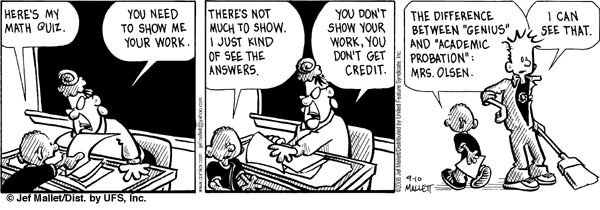
Hanessian's son began talking when he was 10 months old; combined with her habit of careful observation and her incessant efforts to understand him, this revealed amazingly sophisticated thought processes behind seemingly random or rebellious behavior. Banging a spoon on his high chair tray, as infants do, he proclaimed, "Mah-mee! I'm chopping wood!" When he was three years old he went through a frightening phase of what to all appearances was open rebellion, but which she was able to trace to his terror that he might lose her, as he had "lost" his daddy during a two-week business trip, and as the water goes down the drain and never returns. When she dealt with his fear, the misbehavior took care of itself.
When we began homeschooling, I tried to insist that Janet show her work when doing math problems, as I had done as a math tutor and college math Teaching Assistant. If the teacher can't see how you got the wrong answer, what can he do but mark it wrong? How can he understand where your thinking veered off course and steer you in the right direction? However, my effort to elicit from Janet the thought processes behind her answers merely resulted in extreme frustration for us both. Because I was a homeschooling mother and not a classroom teacher with 30 children to deal with, I was able to discover that, like Caulfield above, she knew all the answers, but could not express how she got them. They were just there. Much later she did develop the ability to follow her own thought processes and explain them in proper mathematical logic; in the meantime, by not being forced to learn by rote the educationally-accepted methods of doing math, she developed her own advanced ways of mathematical thinking, which served her well through her college math degree and beyond.
The connection between this and Hanessian's work is the realization that the actions of children, whether babies or students, have meaning and logic, if we will only take the time and effort to understand. I've been relearning that lesson, particularly as I observe two-year-old Noah.Permalink | Comments
Category Education Children & Family Issues
Faith is three days old and mother and daughter are doing great. Heather is healing rapidly, faster than with any of her other births. Faith is a champion nurser. Eating, sleeping, and looking adorable are her primary activities, but she also likes to look around and has quite decent head control for a three-day-old.
A nurse came to visit (part of the package with the Midwife Center) and seemed happy with everything. She did a heel stick on Faith for the PKU and other testing, and as soon as she did, Jonathan and Noah jumped and stood by their sister like knights—they weren't allowed to fight off the nurse, however. The main problem was not the heel stick itself, but trying to get enough blood for the tests required a lot of heel manipulation and squeezing, and Faith's cry was clearly more from anger than from pain.
Dad-o had to fly back to Phoenix, but Grammy and Papa popped in from New Hampshire, thrilling the two boys and soaking up as much "holding time" with Faith as possible given that their visit was actually shorter than the driving time.
Church people have been generous with meals and if they keep up this rate and quantity very long, Heather and Jon will have meals for six months. :)
Sunday night was a difficult one, but last night went better. We're all a bit sleep-deprived, but it's not entirely Faith's fault. I, for example, went to bed early tonight then stayed up to write this post.
Permalink | Comments
Category Everyday Life
Permalink | Comments
Category Random Musings
Click on a picture to see more.
Early and middle labor: Heather's still smiling, and the men are assembling a wheelbarrow.


Proud big brothers and daddy


Happy aunt, happy mother at home


Faith Elizabeth Daley!

Permalink | Comments
Category Everyday Life
On Saturday, September 6, 2008, at 6:35 p.m., Heather delivered a beautiful baby girl! She weighs 9 lbs. 3.5 oz. and is 20.75 in. long. That may sound like a big baby, but she's a pound lighter than big brother Noah at birth.
The name of the newest member of our family, the first girl in over 26 years, is
Faith Elizabeth Daley
Everyone is very happy and doing well. As time permits, I'll publish a longer version of the story, and you can follow it from a more direct perspective on Heather and Jon's blog.Permalink | Comments
Category Everyday Life
Permalink | Comments
Category Random Musings


