
There was an interesting column by Laura Vanderkam from Thursday's USA Today: Tailoring school to the child. From private tutors to online courses to hybrid forms, homeschooling is drawing in many who thought they never could or would. Funny, though, how often the next generation mis-characterizes the ones that have gone before:
[Ahem] Excuse me, but "a way to challenge kids and give them time to pursue their passions" was exactly why we homeschooled more years ago than I want to admit. Hippie religious freaks, hrumph. The fringe is kinda fun, though.Once, people saw home schooling as a fringe religious or hippie activity. These days, many families see it as a way to challenge kids and give them time to pursue their passions.
Isaac Christopher Daley
November 21, 2002 - November 23, 2002
There is a picture of Isaac on the wall of my office. Unlike the pictures of other children, this one will not be replaced, year by year, with the latest documentation of his growth. I won’t pretend that I wouldn’t much rather have the living, growing Isaac to play with, to hold, and to hug, but his picture is there because there is a sense in which he is more present in my life now than if he were nestled in my arms.
When I am sitting at the computer, doing my genealogy work, typing in the many names of children who died at birth or soon after, Isaac is there, and I remember that our road of suffering is a well-worn path.
When I see any lively, healthy baby or young child, Isaac is there, and he reminds me not to take children, health, or life for granted.
When I am frustrated or unhappy in any of the circumstances of my life, Isaac is there to restore my perspective and remind me of what is important.
When life is good around me, and the world is beautiful, Isaac is there to remind me to be thankful for every good thing, and not to forget those who are suffering.
When I am impatient or upset with myself or other people, Isaac is there to remind me that life is too short and people are too important to waste time and energy on unproductive, negative emotions.
When I consider the pleading of Jesus Christ in Gesthemene, Isaac is there, and I remember that God Himself knows what it is like to have His most desperate prayers remain unanswered.
When I consider the death of Christ on the Cross, Isaac is there to show me that God also suffered the pain of a parent watching his child in agony.
And when I consider the unexpected, earth-shattering resurrection of Jesus Christ, and His victory over death, Isaac is there, too, telling me that this grave is not the end of his story, and that one day my first grandchild and I will embrace, and will play together in a world where no sorrow mars the beauty, peace, and joy.
Isaac’s accomplishments in this world are not proportional to the length of his stay in it. God willing, I will have many other grandchildren to play with, to hold, and to hug, whose ever-changing pictures will grace my office wall. But Isaac will always have his own vital place in our lives, reminding us that in the midst of life we are in death, and in the midst of death we are in life.
Permalink | Comments
Category Everyday Life
The Occasional CEO is on the short list of my enjoyable, regular blog-reading. Today's offering, I Love the Swiss Watch, struck my funny bone, perhaps because it's a tad sensitive due to a few stresses and the stock market playing How Low Can You Go?
Did I say I'd take the Swiss trains ahead of a Swiss watch? I really meant I'll take a Swiss son-in-law. Practical and elegant.Permalink | Comments
Category Random Musings
Once when we were visiting Pittsburgh, we had the pleasure of attending a Stephen Foster festival at the cemetery where he is buried. While there, we heard the group Home Front, and bought their CD, Parlor to Campfire. It was somewhat amusing (better to laugh than to cry) to hear our stereo system, which randomly plays tracks from a rather large collection of music, wail forth with Hard Times Come Again No More—right after I had sneaked a look at the rapidly plunging (again! still!) stock market.
As I said to the clerk at the post office—in response to his, "What? You're here again?"—I'm doing my part to support the economy. The world is apparently falling down around me, yet life goes on as usual. I think that's not an unreasonable attitude at the moment, but I also sometimes wonder if there's not a bit of Madame Ranevskaya in me.Permalink | Comments
Category Everyday Life
I've said before that most so-called conspiracies can be more readily explained by simple human stupidity. Take, for example, the recent brouhaha over NASA's Goddard Institute for Space Studies, whose climate data for October reported temperatures to be an astonishing three-quarters of a degree above normal. It turns out the data was badly skewed because in several cases September's data had been used rather than October's.
Some of the commentary I've read accuses the GISS of deliberately putting out a false report, but I see no need to propose a more complicated explanation when a simple one will do: The GISS was expecting to see warming, so they didn't question the data. This is why scientific experiments are double-blind whenever possible. In lieu of that, it might be wise to have your enemies proofread your work: those on the other side of the global warming debate found the error quickly.What happens when an atheistic science fiction writer becomes a Christian? You get Christian blog posts with attitude, such as John C. Wright's response to the rationale behind an anti-Christian ad campaign planned for the Christmas season. As an atheist-turned-Christian science fiction fan, I find the fantasy-style metamorphosis both delightful and amusing. An excerpt:
I realize that, now that I am on the opposing side, I have no more right to feel contempt for weakness in the ranks, but, by Jupiter's holy lightning-flinging scrotum, this kind of whiny talk used to really bug me, and I still suffer flashbacks to my old self. How can you feel lonely during Christs' Mass when YOU DON'T BELIEVE IN CHRIST??!! The crowd of lemmings is rushing off after the Pied Piper to worship the Unseen Flying Spaghetti Monster, and you are feeling all lonesome because you are not in the crowd? Who wants to be in any crowd when the crowd is mad?
(more, simlar ranting, followed by)
As a Xtian, I have to be nice and kind, and invite in to our cheerful feasts and celebrations the poor, the tired, and the unbelieving. All are welcome to partake of the spirit of Peace on Earth and Goodwill toward Man, even if you don't believe in spirits. A lamp is lifted for you by the open door: within, the feast is spread. Come, and be fed.
Permalink | Comments
Category Random Musings
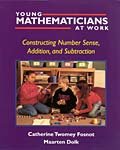 Young Mathematicians at Work: Constructing Number Sense, Addition, and Subtraction, by Catherine Twomey Fosnott and Maarten Dolk (Heinemann, Portsmouth, NY, 2001)
I must return this book to the library today, and I don't have time to finish reading it, but nonethless it deserves mention. This joint effort of American and Dutch mathematics educators is often repetitive and sometimes wearisome to read, but includes ideas well worth exploring by anyone desiring to teach, or to learn, mathematics at its most basic levels. Their strategies for encouraging children to think mathematically are aimed at classrooom teachers—and show, incidentally, some of the advantages of group instruction—but many should be adaptable to home education as well.
When I learned of this book I had intended to order it as a Christmas present for our grandkids. (I know what you're thinking—such an odd grandmother!) However, while it is a great book to learn from, it's not that exciting a book to own. So do what I did, and turn to your favorite library—Interlibrary Loan, if necessary.Distributism, as an economic philosophy, is totally new to me. (My decision to circumvent Pennsylvania's high school graduation requirement of a course in economics, which I ditched in favor of AP physics, continues to haunt me.) I came upon it while looking for a good G. K. Chesterton link for my O God of Earth and Altar post; Chesterton was one of distributism's more vocal proponents.
Since one obviously doesn't hear much about it, distributism may be outmoded, impractical, unworkable, or just plain wrong; I don't have time to learn more about it now, and Li'l Writer Guy is still chanting with the monks. However, I find it most intriguing, since at first glance it accords well with my own philosophies, bringing together such diversities as homeschooling, home birth, home cheesemaking, family farms, independent businesses, public transportation, artisan breads, adn above all recognition of the family unit as the basic structure of society. Here are some quotes from the Wikipedia article:According to distributism, the ownership of the means of production should be spread as widely as possible among the general populace, rather than being centralized under the control of the state (socialism) or wealthy private individuals (capitalism). A summary of distributism is found in Chesterton's statement: "Too much capitalism does not mean too many capitalists, but too few capitalists."
Distributism puts great emphasis on the principle of subsidiarity. This principle holds that no larger unit (whether social, economic, or political) should perform a function which can be performed by a smaller unit.
Distributism sees the trinitarian human family of one male, one female, and their children as the central and primary social unit of human ordering and the principal unit of a functioning distributist society and civilization. This unit is also the basis of a multi-generational extended family, which is embedded in socially as well as genetically inter-related communities, nations, etc., and ultimately in the whole human family past, present and future. The economic system of a society should therefore be focussed primarily on the flourishing of the family unit, but not in isolation: at the appropriate level of family context, as is intended in the principle of subsidiarity.
And here are two excellent essays I found in my brief meanderings, both from the Dallas Morning News, September 23, 2007:
Patrick Deneen: There's a Lesson in Europe's Gardens, Woodpiles and Chickens
Allan Carlson: Here's a Way for America to Give It a Shot
Enjoy!Permalink | Comments
Category Random Musings
I checked the date of the article; it's not April 1. Mexican physicists have made diamonds from tequila. One can only speculate how they came up with the idea of heating tequila to around 800 degrees celsius and turning the resultant carbon atoms into an extremely thin diamond film, but it might make a good comic routine. Uses for the diamond film include the manufacture of ultra-fine cutting instruments, and as an alternative to silicon in computer chips.
The scientists found that even the cheapest of tequila brands, averaging at $3 a bottle, are good enough to make diamonds.
The cost of an 800-degree oven might keep this from becoming a do-it-yourself project, however.
Permalink | Comments
Category Random Musings
Maybe commenter Phil had the right idea after all. Since the government is bound to foul up even the best plan when it involves too much money and power, doing nothing might have been the better course. We had a liquidity crisis from which we probably could have recovered with relative ease had the government bought up massive amounts of undervalued bank debt and sold it at a profit when stability returned. That would have been a $700 million investment, not a bailout.
Instead, we're all but nationalizing our banks, and now Paulson wants to turn this into a bona fide bailout, pouring money into credit card debt, which must be the worst possible kind short of getting involved with a Mafia moneylender. (A friend's credit card company, which recently raised his interest rate to thirty-four percent, might be taking lessons from the Mafia, except that his kneecaps are still intact.) I know we can't change immediately from a society based on massive debt to something more sane, but do we have to discourage reasonable behavior?
It's like Florida taxing people who know better than to build high-rise condominiums on the beach to support those who don't care if a hurricane blows down the building as long as the state continues to underwrite insurance for them.Thanks to Janet's question about one of my favorite hymn tunes, LLANGLOFFAN, I was reminded this morning of one of my favorite hymns, O God of Earth and Altar, with its amazing and always-timely words by G. K. Chesterton. (KINGS' LYNN is another great tune for this hymn.)
O God of earth and altar, bow down and hear our cry,
Our earthly rulers falter, our people drift and die;
The walls of gold entomb us, the swords of scorn divide;
Take not Thy thunder from us, but take away our pride.
From all that terror teaches, from lies of tongue and pen,
From all the easy speeches that comfort cruel men;
From sale and profanation of honor and the sword;
From sleep and from damnation, deliver us, good Lord!
Bind all our lives together, smite us and save us all;
In ire and exultation aflame with faith and free,
Lift up a living nation, a single sword to Thee.
I'd hate to see local bookstores go out of business, even chain stores like Borders and Barnes and Noble. Nothing long-distance and electronic will ever replace the atmosphere of a physical store, and the ability to wander, browse, and hold a book in your own hands. However, I am also one of Amazon.com's more loyal customers, and not solely for their discounts. Frequently both Borders and Barnes and Noble will send me coupons that I would love to use in their local stores. Borders is an easy walk from our house, and I could easily be a frequent shopper there.
Except for one problem: they rarely have what I'm looking for. This morning I received a 30% off coupon offer with pleasure, because there's a book that I thought to buy only after sending of my most recent Amazon order. It's a children's book, and not an obscure one, so I figured the odds of my convenient Borders having it were great. But alas, no. It does no good for the sales clerk to suggest that he order the book for me; I can do that myself. It's rather like calling a reference librarian, having exhausted my own resources, only to hear her typing my question into Google.
Too often, also, the stores not only don't stock what I'd like to buy, but fill their stores with items I most definitely would not like to buy. The experience is similar to that I've had at so-called farmers' markets, which were populated more by gourmet popcorn stands and vitamin sellers than fresh, local produce.
Regardless, I'm thankful for Amazon and other online sellers. The local stores are worse-stocked now, but they never did have much of what I was looking for. How wonderful to have such resources available now for a few clicks (and a credit card).Permalink | Comments
Category Random Musings
It must often be so...when things are in danger: some one has to give them up, lose them, so that others may keep them. (J.R.R. Tolkien, The Return of the King)
Thank you, all veterans and current members of our armed forces.
Almighty God, we commend to your gracious care and keeping all the men and women of our armed forces at home and abroad. Defend them day by day with your heavenly grace; strengthen them in their trials and temptations; give them courage to face the perils which beset them; and grant them a sense of your abiding presence wherever they may be; through Jesus Christ our Lord. Amen. (Book of Common Prayer, American Episcopal Church, 1979)
Permalink | Comments
Category Random Musings
Games are a traditional part of our family gatherings. On any given occasion you are likely to find games in process as varied as Lord of the Rings Risk, Settlers of Catan, pinochle, Quiddler, and n-tuple sol, and a long-time family favorite, Boggle (the 5x5 version, of course). Because one of our number is the perennial, unassailable Boggle champion, I need to stay in practice to be any kind of competitor at all. To this end I occasionally indulge in an Internet version of the came, called WordSplay.
There's some fierce competition out there, and I'm usually happy when I find myself around the 50% mark at the end of a game. Once I almost made it into the top 10 and was elated. (It helps to play at odd hours, such as early on a Saturday morning, when the number of opponents I face is much smaller.) This morning I saw my name in third place, only one point shy of the top score, and can't resist reporting the accomplishment.


Permalink | Comments
Category Everyday Life
Curbing the time I spend writing doesn't mean there won't be new posts; rather, you'll get less of me and more of links to interesting things I find. Here's one in honor of recently-deceased Michael Crichton, author of (among many others) The Andromeda Strain, Jurassic Park, and Five Patients: The Hospital Explained; you probably have not heard of the last one, but it was my introduction to Crichton and the only of his books to reside in our library.
Aliens Cause Global Warming. Check it out with an open mind. Crichton's purpose isn't to tell you (or his Cal Tech audience) there's no other intelligent life in the universe, or that atomic bombs and second-hand smoke are safe, or that there's no such thing as global warming. His concern is that our approach to all these issues (and many more) is that of false prophets, taking the name of Science in vain. (Since apparently Science was Crichton's god, you can see why this would be particularly upsetting to him.) We are invoking Science to back the positions we want to support when in fact there is no truly scientific evidence undergirding our conclusions. The Priests of Science are allowing this to happen, even participating in the abominations, and Science's lesser worshippers follow blindly. If Crichton cannot cleanse the temple, perhaps he can at least clear our minds.My own fears about an Obama presidency and a heavily Democratic Congress notwithstanding, I can see one factor in his election that may do much for both the economy and the country: Hope. Gripe as I may about the messianic adulation of Barack Obama, there are a lot of folks who are happy right now, and people who had all but given up on the American political process who now believe in it. Confidence in the system and hope for a better life can be powerful forces for good.
(Li'l Writer Guy is even now on an airplane, winging his way toward the French Alps. I can still manage short posts on my own, however.)I don't expect my resolve to last long, but I'm going to attempt to put a gag on Li'l Writer Guy. I love to write, and there's always a large backlog of issues, large and small, on which my mind is constantly spewing forth essay fragments. Crafting them into some coherent form and publishing the result usually offers some relief, but recent political and philosophical discussions (of which what is published is but the tip of the iceberg) have instead left me enervated.
When I consider the long hours it takes to get my thoughts into shareable form, hours that have much more pressing needs tugging insistently at their sleeves, I'm thinking Li'l Writer Guy needs to spend some time with the Carthusian monks.Permalink | Comments
Category Everyday Life
Like it or not, our country has placed itself under the threats I mentioned in Part I, and I can only hope that the mitigating factors of Part II will enable me to say, at the end of four years, "That wasn't so bad." Regardless, although I believe the results of this election will make life more difficult, the important things do not change. Here's some of what I believe we need to do in the coming years.
Who is the "we" in the following ruminations? Mostly I'm speaking for myself, to myself, but often there will be a more general application, anyone who wishes to come along for the ride is welcome.
Part III — How We Can Sing the Lord's Song in a Strange Land
By the rivers of Babylon we sat and wept
when we remembered Zion.
There on the poplars
we hung our harps,
for there our captors asked us for songs,
our tormentors demanded songs of joy;
they said, "Sing us one of the songs of Zion!"
How can we sing the songs of the LORD
while in a foreign land?
Psalm 137:1-4
First of all, we pick ourselves up with as much dignity as we have remaining and give respect and support to our new leaders. "Fear God, honor the king" (I Peter 2:17) applies in a democracy, too. Humor has an important place in discourse, but mean-spirited mockery does not. I may have crossed the line with my "Obamanation" comment in Part I—at least two of my respected readers think so—though I'm not convinced it's inappropriate, given the messianic adulation accorded Obama by many of his followers. Still, I'm extremely uncomfortable with the abuse heaped on George W. Bush, just as I was when it was Bill Clinton on the receiving end, and will accord Barack Obama the respect due the President of the United States, as well as that due a human being created in the image of God.
We pray for Barack Obama, and for all "who bear the authority of government." If the Apostle Paul could write, per I Timothy 2:1-2, "I urge, then, first of all, that requests, prayers, intercession and thanksgiving be made....for kings and all those in authority, that we may live peaceful and quiet lives in all godliness and holiness," while living under the Roman Emperor Nero, we can do the same living under an elected president who is not likely to include among his alternative energy polices the burning of living, human torches.
We attempt to live our lives in the best, most honest, most noble, and most loving way possible. Back to I Peter again (2:15-16): "[I]t is God's will that by doing good you should silence the ignorant talk of foolish men. Live as free men, but do not use your freedom as a cover-up for evil; live as servants of God." The Republicans would do well to remember that scandal and wrong-doing among office holders has done more than anything else to bring them down. Granted, it's not fair that the Democrats mostly get a pass for their equal or greater sins—although it's actually a compliment that better behavior is expected of Republicans—but the reality is that Republicans were hurt badly first by misbehavior and even more by not visiting swift and sure justice upon the miscreants. To live purely and act rightly, with justice and love and in quiet confidence, will win more hearts than the most reasoned argument.
Do not repay anyone evil for evil. Be careful to do what is right in the eyes of everybody. If it is possible, as far as it depends on you, live at peace with everyone.... Do not be overcome by evil, but overcome evil with good. (Romans 12:17-18, 21)
Do everything without complaining or arguing, so that you may become blameless and pure, children of God without fault in a crooked and depraved generation, in which you shine like stars in the universe. (Philippians 2:14-15)
[L]et your light shine before men, that they may see your good deeds and praise your Father in heaven. (Matthew 5:16).
We attend to the wisdom of the serpent as well as the harmlessness of the dove. Now is not the time to retreat from the political process, but to be all the more involved that we might be alert to dangers that threaten what we hold dear, and to how we might best meet those threats. History has proven that when we are caught unaware we react hastily, badly, and often ineffectively.
We don't flee to the hills, or to another country (as many threatened after losing the 2000 and 2004 elections), or withdraw from the system in sulky silence. It's not time, yet, for "those who are in Judea to flee to the mountains." If we feel like exiles in our own land, it is time to remember what God said to his people at the time of another exile: "Build houses and settle down; plant gardens and eat what they produce. Marry and have sons and daughters; find wives for your sons and give your daughters in marriage, so that they too may have sons and daughters. Increase in number there; do not decrease. Also, seek the peace and prosperity of the city to which I have carried you into exile. Pray to the LORD for it, because if it prospers, you too will prosper" (Jeremiah 29:5-7). We continue to live our lives wisely and without fear. The administration may have changed, but the basic rules of life have not. There's still the Big Ten—don't steal, don't murder, don't mess with someone else's spouse, and all the rest—and the sound-bite version provided by Jesus: "Love the Lord your God with all your heart and with all your soul and with all your mind, [and] love your neighbor as yourself."
Many of us are accustomed to feeling alienated from the general American culture; it may even be easier—or at least clearer—when there's no pretense that "our guys" are in charge. Whether it's financial responsibility, ethical behavior, or wise decision-making, in a democracy the citizens get no better from their government than the majority lives out in their lives. True progress, then, requires that we balance a deliberate counter-cultural structuring of our own lives, families, and communities with a creative engagement of the larger culture. That is how we sing the Lord's song in a foreign land.
Permalink | Comments
Category Politics Random Musings
Part II — Some Mitigating Factors
As I said in Part I, the prospect of the next four years under Barack Obama and a strongly Democratic Congress disturbs me greatly. The following are some of the reasons why the outcome of the election might not matter as much as I fear.- The President of the United States never has as much power as we fear—or he would like. Presidents acquire both credit and blame they don't deserve, for events set in motion long before they took office, or determined by forces over which they have no control. Their campaign promises may tell us about their philosophies and their hopes (or they may not), but presidents by and large are at the mercy of legislators, judges, the press, public opinion, and a host of natural phenomena and international situations beyond their purview. This is a good thing.
- I have yet to find a strong positive correlation between a president's apparent potential and his performance. Ronald Reagan was an actor, once uttered the infamous statement, "A tree's a tree; how many of them to you need to look at?" and his wife consulted horoscopes, yet his presidency encompassed some of the best years in my experience, both domestically and internationally. Bill Clinton's sexual proclivities made a mockery of the office, he lied under oath, and he threatened to take the country on a far-leftward swing complete with nationalized medical care, yet if you look at reality rather than rhetoric you could make a case that George W. Bush was the more liberal president. True, some of Clinton's success came from riding on the coattails of what was accomplished under Reagan, and his administration is probably to blame for some of the conditions that led to our problems with al-Qaeda, and certainly much of the reason he was not the Liberal success many had hoped for lies in Republican opposition in the Legislature—still, the point is that his time in office was not the unmitigated disaster many—including me—had feared. Jimmy Carter and George W. Bush, one a Democrat and the other a Republican, are stellar examples of how good men, with strong morals and a determination to do the right thing in all of life, from the bedroom to the war room, can still be really lousy presidents. I may yet look back on an Obama presidency and say, "This wasn't as bad as I had expected." I doubt it, but you never know.
- George W. Bush did not want to spend most of his presidency embroiled in a war, and whoever wins today's election did not want to spend most of his presidency weighed down by economic woes, but such realities arise and force presidents to set aside their own agendas. Unfortunately, they can also be a smokescreen through which really bad policies are slipped past our distracted eyes, so vigilance is still the order of the day. Our next president must deal not only with the troubling economic situation at home and abroad, but may face political and military challenges most of us would rather not contemplate. Any hopes that our only significant threat comes from Islamic terrorists and rogue dictators of minor countries are foolish at best. Russia is beginning to flex its muscles in a way more frightening than at any time since the fall of the Berlin Wall, and as for China—J. R. R. Tolkien said it best: It does not do to leave a live dragon out of your calculations. We attempt to elect the best person for the job, yet the job rarely turns out to be what we expect. Sometimes presidents rise above themselves when the occasion demands.
- One of the advantages of being a Christian is knowing that God's plans can never be thwarted, not by the President of the United States and not even by the Supreme Court. The election results may make our paths more difficult, but they won't change the ultimate direction, and God will be with us through each turning. But that is the subject of Part III.
If I'm going to make a political post before Election Day, I'd better move quickly. This won't have as much as I want to say, nor as much careful crafting as I want to put into it, but it will still be too long and take too much time. It will be in three parts, reflecting my three conflicting and complementing moods as I contemplate the next four years.
Part I — Why This Election Is So Threatening
It is far too tempting to begin this section with a slight alteration of Mark 13:14.
When you see 'the Obomanation that causes desolation' standing where it does not belong—let the reader understand—then let those who are in Judea flee to the mountains.
I don't actually think that an Obama presidency would be the end of the world, but this was too good to pass up. And I do believe my friend—a calm, rational, wise friend, not given to radical statements—who said the other day, "The world as we know it is about to change drastically." She did not mean for the good. Those whose rallying cry is "Change!" would do well to remember that derivatives can be negative as well as positive.
Why am I so worried about an Obama presidency? First, let me state that if there were a solid Republican majority in both the House and the Senate, with every prospect for a super majority of Republicans in the Senate, I would probably support the Democratic candidate for president: no party should have that kind of control over both the Executive and the Legislative branches. We all—Democrats, Republicans, and Others—are fallen human beings and without effective checks and balances (especially checks) on our actions, we are likely to make bad decisions. Add conditions of confusion, fear, and anger, and we can expect very bad decisions. Thus I find the perfect storm of financial and political chaos with a Democratic President, House, and Senate frightening indeed. If you think the panic after the September 11 attacks caused us to accept significant compromises to our freedoms, just wait till you see what the combination of an activist government and financial insecurity will do.
For several elections now, one of the primary determiners of my choice has been the possibility of openings on the Supreme Court. I'd love to be able to believe that the Supreme Court Justices are above politics and look at the Constitution objectively, without regard to their own social, political, and religious beliefs, but I know better. Leery as I am about having both the Presidency and the Legislature strongly on the Left side of the political spectrum, when I think about a Leftist Judiciary completing the triumvirate I see Category 5 damage coming that may never be undone. I suspect there are several Liberal judges who have been hanging on by their fingernails just waiting for the Democrats to be able to control the nomination and confirmation of their replacements. Skewing the Supreme Court in the direction of further judicial activism and greater regard for social engineering than for the Constitution they are interpreting will do more damage to America than anything else our president and legislators can do. Elected officials and parties can be voted out; Supreme Court justices and their decisions are out of our hands.
On the other issues of concern I can barely touch, for each is worth a post (or several) in itself. Foreign policy? Whoever wins this election is in for a rough ride. Obama may find himself in what appears to be a honeymoon for a while, but he's neither experienced nor stalwart enough to avoid being at a substantial disadvantage in the diplomacy game and weakening our country significantly. Believe me, I'm not saying Bush is doing well—anyone who can "look into Putin's soul" and not see the KGB ought to leave the negotiations to someone with better eyesight—but I fear we are about to go from bad to worse. Domestically? Whether it's economics, education, health care, or any other issue in which freedom of choice is our best hope, we are looking at disastrous policies ahead. Our country is experiencing a strong slide towards socialism and I'm afraid a McCain presidency can't stop it, but he might slow it enough for us to get our bearings again, while with Obama I see wild careering in that direction. The Democrats claim to be the party for "choice," but just as with "change," we must look beyond the mantra. Although many homeschoolers and home birthing families are Democrats and vote accordingly, the party itself appears committed to creating, supporting, and enforcing educational and medical near-monopolies. While I believe that there are some functions that governments do best, making life decisions for individuals and families is not one of them. I mention these topics specifically because they are close to my heart and I know more than most about them, but the general principles, policies, and attitudes apply widely.
It is now Election Day itself, and I'm splitting off Part II and Part III so I can get this posted. I'll close Part I with an observation. I've said before (for example here, and here) that one thing that frightens me about Barack Obama is that he is so charismatic he might actually accomplish some of his goals. Lately I've come to realize that the danger goes beyond that. What I'm hearing from so many of Obama's followers has gone far beyond what they like about his ideas to an open adulation of the man himself. Adolf Hitler was before my time, and I don't know enough about Chinese and Islamic cultures to understand the attractions of Chairman Mao or the Ayatollah Khomeini, but I'm old enough to remember the adoration inspired by John F. Kennedy and later Robert Kennedy. No, I'm not saying that Obama is another Hitler! But we would do well to remember that we are in no way morally superior to the Germans of Hitler's day who responded to political humiliation and a severe economic crisis by embracing a charismatic leader who made them feel better about themselves. If Barack Obama is elected today, as I believe he will be, we would all do well to keep our eyes wide open and consider well the probable effects of his policies and proposed actions rather than being swept away by rhetoric. Come to think of it, that's a wise idea no matter who wins the election.
Yesterday we capped a busy day (at church till mid-afternoon for a special event, followed by—oh, joy!—flu shots) with our second Orlando Philharmonic Orchestra concert of the year. I'm greatly enjoying Chris Wilkins' approach to concert programming: he chooses a good blend of old and new, familiar and unknown, comfortable and challenging. Well, just barely challenging, but that's okay; I prefer my musical challenges on a smaller scale and with explanation, as with Bernard Rands' Memo 8, which came to mind when I was pondering "challenging." That was one of my favorite Eastman concert experiences, and I would love to hear it performed again, but I don't see that happening; even a Google search nets little, and my favorite oboist has gone Medieval—not that I mind that! Ah, well—I have my recording. But I digress greatly.
Last night's concert showed Wilkins' programming strengths and his willingness to venture into non-traditional concert territory. The theme was Abraham Lincoln, and the program a collaboration with the Orange County History Center.First I must say that there were several oboe solos during the evening, and I am much encouraged about our new Principal Oboe, Jamie Strefeler. I wasn't particularly impressed at the opening concert, in addition to being shocked at the loss of Jared Houser, whose sound I love. But last night was pleasing indeed.
The program opened with seven movements from Ernst Bacon's Ford's Theatre; A Few Glimpses of Easter Week 1865. Bacon was a contemporary of Virgil Thompson and Aaron Copland; both the composer and the work were unknown to me, but the music was enjoyable and worth hearing again. Speaking of repetition, I wasn't looking forward that much to hearing the second work, Beethoven's Symphony No. 5. Not that I don't love Beethoven's Fifth, but it is heard so frequently that one tends to have only the best performances in one's mind, and thus it's too easy to be critical. Nonetheless, the OPO did a creditable job, and it really was enjoyable. Are you wondering what Beethoven has to do with Abraham Lincoln? So was I. It turns out that this symphony was born just a few months before Lincoln, and its themes are appropriate to the struggles and turmoil of Lincoln's time.
Side note: Although the volume was sometimes impressive, as it should be for such a piece, it was not painful, so I don't know what was going on with my ears at the last concert.
Did I mention pain? Alas, that was my first impression of the second half of the program, which is sad because it was a very cool production, and most of it was great. They performed four works in succession, as movements of a single piece (i.e. no applause in between): Jay Ungar's Ashokan Farewell, Stella Sung's Lincoln's Battle (commissioned by the OPO for this concert), the CIVIL warS: Interlude No. 1 by Philip Glass, and Aaron Copland's Lincoln Portrait. The last two works were accompanied by large-screen photographs of the era arranged by photochoreographer James Westwater. Porter was distracted a bit by being pretty certain some of the photos were Matthew Brady's fakes, and I spent more time thinking about my own 19th century ancestors than Lincoln, but the music/art combination was still effective.
Back to the pain. I've loved Ashokan Farewell since I first heard it on Ken Burns' Civil War PBS production, I loved it when Janet performed it on violin back in her Suzuki days, and I love it every time my mp3 player randomly chooses to play the free download I found too long ago to remember. I was not able to find that source again, but you can hear part of the original Ashokan Farewell here, and some of the lovely Harpsong version here. In each case, click on the arrow to the left of the title. This is the melody I—and I daresay most of the audience—know and love; this is what Porter was expecting, (albeit in an orchestral version) when he leaned over to me, just prior to the first notes, and whispered how much he was looking forward to hearing it.
Alas. That is not what we heard. I was surprised, even shocked, by the intensity of my reaction. Normally I'm pretty easy to please in a concert, tend not to notice any but the most blatant flaws, and dislike criticism of a performance because it diminishes my own enjoyment. But this hurt. It set my teeth on edge and formed a tight knot in my stomach that wasn't eased until several notes into the next piece. I'm not saying that concertmaster Tamas Kocsis was wrong in his interpretation. Ungar describes Ashokan Farewell as "in the style of a Scottish lament," and I know that part of the art and musicianship of Celtic music is in the ornamentation and in taking a tune and doing different things with it. I may be totally wrong in my objections. But to me, this felt like bait and switch. As if I went to a concert expecting Handel's Messiah and found it set to a salsa rhythm. It just felt wrong; the style didn't fit with the sense I have of the piece. Things got better when the orchestra joined in, but that was not sufficient to dispel the shock.
Fortunately, Stella Sung never disappoints. I first encountered her music when the Florida Symphony Youth Orchestra played her Orlando Suite in 1997 and am always excited when I see one of her compositions on the program. Because of the subject matter, Lincoln's Battle is darker and more difficult, but was still a relief after Ashokan Farewell. The Philip Glass piece was also new to me, but definitely a pleasure to listen to, and Copland's Lincoln Portrait is always powerful.
And thanks to the return of Standard Time, we were able to attend the concert and still get to bed by 10:00. :)Permalink | Comments
Category Reviews Everyday Life

