
The day I arrived in Basel on this trip, I felt in need of some "chill-out" reading that wouldn't tax my jet-lagged brain cells. Fortunately, Janet and Stephan's bookshelves are well stocked, even after eliminating the books in German, French, and Japanese.
For much of my life, Isaac Asimov was one of my very favorite authors, first for his science fiction, and later for his non-fiction. (I had the pleasure of astonishing him once at a science fiction convention by presenting to him one of his American history books for autographing.) Asimov kept writing—surely he must hold some record for the quantity and scope of his works—but life took me in different directions and I neglected him for many years, except for re-reading his delightful Black Widowers mystery stories.
But there on the bookshelf was Gold, a collection of some of his last short stories and essays, and it was just what I wanted.
So far, I'm still impressed with Asimov's writing, though his own opinions and philosophies intrude somewhat annoyingly into the stories. I suspect that was always the case, but I was less aware, both because of my lack of experience and because his prejudices did not then conflict in any significant way with mine. In any case, his worldview is part of what makes an author who he is, so I don't mind much.
In the essay on women in science fiction, however, Asimov's sharp wits seem to have deserted him. How else to fathom his casting blame on puritanical attitudes toward sex for the fact that early science fiction stories were all about men?
In most cases, non-recognition of the existence of sex was treated as though it was the law. ... But if there's no sex, what do you do with female characters? They can't have passions and feelings. They can't participate on equal terms with male characters because that would introduce too many complications where some sort of sex might creep in. The best thing to do was to keep them around in the background, allowing them to scream in terror, to be caught and then rescued, and, at the end, to smile prettily at the hero.
Excuse me? Female characters are good for nothing but sex? If they can't have sex, they can't do anything? And you can't have male and female characters together in the same story without having them jump into bed?
What makes this statement all the more absurd is that Asimov himself succeeded many times over in doing what he just said was impossible. As he stated in a later essay, "I use no gutter language or sex in my juvenile books, but then I use no gutter language and very little sex in my adult books."
Robert Heinlein, another of my once-favorite SF authors, was also adept at writing stories with strong—i.e. normal—female characters and no sex scenes, although to be sure he also wrote plenty of books that were objectionable and even bizarre in that department.
Asimov clearly knew better, and wrote better. Why he would say something so irrational escapes me completely. He's right that science fiction, along with most stories of adventure, daring, and heroism, failed their female readers miserably. I know, because as one of them in my impressionable childhood, I couldn't help noticing that, with few exceptions, the only characters worth admiring or emulating were male.
But it wasn't the censors' fault. It may, in many ways, have been society's fault. I'll easily believe that the problem reflected a poor general attitude towards women and girls—but to imply that a story with female characters must have a romantic interest, let along a sex scene, is the more offensive error.
Permalink | Comments
Category Reviews Travels Everyday Life
To repeat, from Part 1, lest I forget:
DiapersThe first principle is that nobody should be ashamed of thinking a thing funny because it is foreign; the second is that he should be ashamed of thinking it wrong because it is funny. The reaction of his senses and superficial habits of mind against something new, and to him abnormal, is a perfectly healthy reaction. But the mind which imagines that mere unfamiliarity can possibly prove anything about inferiority is a very inadequate mind. — G. K. Chesterton, writing on foreign travel in What Is America?
I thought the diapering world was divided neatly between cloth and disposibles, with elimination communication thrown in as an added wrinkle—which only shows how limited and parochial my world has been. Of course, the whole diaper situation here was planned to be well under control by now, but it has become an issue thanks to a miscommunication with the "diaper lady" reminiscent of my last-minute struggles with Lufthansa's baggage policy. "No, I don't actually sell diapers; I only have samples you can experiment with to help you decide what you like. You can't actually buy them here in Switzerland, and no, I don't have any overseas suppliers to recommend...."
This was a Boston Rubbermaid moment for me. At home I would zip off to Babies R Us, Target, or Walmart, all within walking distance, and grab several packages of birdseye prefolds. Here I was prepared to pay Swiss prices, but I was not prepared for diapers to be unavailable!
But of course, I'm wrong. Diapers are available here. Swiss diapers. Which are decidedly not birdseye cotton prefolds. I spent half an hour looking for a good picture of one for this post, without success, although in the process I found out more about diaper choices and technology than I ever imagined existed. (Type "diaper folding" into YouTube for just a glimpse at the possibilities.) But imagine large, thin, square cloths in all sorts of colors and designs, sold individually. If you ask the sales clerk at the baby store how to fold them, fasten them on the baby, or how to cover them so they don't leak, she has no idea. They don't sell diaper fasteners and they don't sell diaper covers. Cloth diapers, it appears, are popular baby items, but no one in his right mind actually diapers a baby with them. That's what disposables are for. Real diapers are bought to be used as burp cloths.
Unless, of course, you go to the "organic" store here. Except that she would gag on the prices, I kept thinking that our all-natural, organic, earth-friendly friend Serina would be in heaven there. At that store, the clerk was very competent indeed; if she hasn't diapered a thousand babies herself, she at least must have given the demonstration a thousand times. They sell not so much diapers as diapering systems, all in an eye-pleasing, natural, ecru shade—you couldn't bleach it, but stains would be less obvious than with white. The diapers themselves are still the thin sqares of cloth, but these folks have obviously thought about their practical use as a diapering medium.
Watching the clerk fold a diaper was like watching Johnny Montroll fold an origami animal. Faster than I could follow, she created a very clever diaper from the square, thick and thin in all the proper places. I didn't follow the rest of the procedure, either, as she was demonstrating two different systems, with explanation in rapid-fire German. In addition to the diaper there are inserts of various kinds, covers to hold it all together, and a few other things I'm sure I've forgotten. It was, no doubt, a lovely system for an all-natural, earth-friendly, baby. In many ways it was quite attractive and appealing. But SO complicated! It's one thing to accept, and even embrace, inefficiencies in laundry, and quite another when one is attempting to diaper a squirming baby, or promoting awareness of potty needs.
This problem is still in search of a solution. Despite the imminent arrival of the baby, it's not an urgent situation because of what Janet already has in place, but it's definitely a puzzlement. We've been looking around online for what we might order. Alas, most of the American companies I depend on won't ship overseas. My brief investigation into European online stores yielded Heather's favorite diaper cover and a whole array of previously-unknown (to me) cloth diapering options, none of which is either the kind of diaper I'm used to back home or what is common in the stores here! Who'd have thought diapering could be so complicated?
Maybe it's a very good thing that Janet has been folding John Montroll models since she was six years old.
Permalink | Comments
Category Travels Children & Family Issues Everyday Life
The first principle is that nobody should be ashamed of thinking a thing funny because it is foreign; the second is that he should be ashamed of thinking it wrong because it is funny. The reaction of his senses and superficial habits of mind against something new, and to him abnormal, is a perfectly healthy reaction. But the mind which imagines that mere unfamiliarity can possibly prove anything about inferiority is a very inadequate mind. — G. K. Chesterton, writing on foreign travel in What Is America?
Visiting another country or culture is one thing; living there, even for a few weeks, is another. As a sightseer, it is easy to find something funny and respect it inspite of, or even because of, its apparent oddity. A good attitude can be more difficult when it frustrates the efforts of daily life.
I didn't need to live in a foreign country to experience those frustrations. Soon after arriving in Switzerland, I found myself spinning in a disorientation that had nothing to do with language differences, and at the same time, puzzling over the familiarity of the feeling. Then I remembered the first few weeks after our move from Florida to the Boston area. Boston is a great city, and there's much about Massachusetts that I now miss—a lot, even. Nonetheless, as I was trying to set up housekeeping in our small apartment, searching store after store and making telephone call after telephone call trying to find a source of Rubbermaid storage bins, I was very nearly reduced to tears and a heartfelt cry of, "A Wal-Mart! A Wal-Mart! My kingdom for a Wal-Mart!" Although I eventually came to appreciate what Boston had that Orlando didn't, what was lacking (or apparently lacking) was uppermost in my mind in those days. (I never did find out where Bostonians purchase Rubbermaid storage bins, or even if they use such things at all, but I did eventually find a Wal-Mart.)
Freely admitting that differences are not an indication of inferiority, but with Chesterton's permission to find them peculiar, I will be sharing some of the disorientations and adjustments of my time here.*
Laundry
Europeans have a reputation for being more laid-back and relaxed than Americans. I am now suspecting that the reason is the Laundry Zen Experience. One can either scream,
- "This is one of the most civilized, organized, efficient, and technologically advanced countries in the world. Why does it take three hours to do a load of laundry in the best of circumstances?" ("Best of circumstances" = there's actually a clothes dryer available. In many cases all laundry must be hung on a clothesline in the basement, in which case don't count on having clean clothes in less than a day.)
- "Why do manufacturers still make ordinary clothing, even underwear—we're not talking silk ties and fancy dresses here—that can't go in the dryer?" Each item as it comes out of the wash must be examined for a laundry tag with its mysterious hieroglyphics and sorted into what can go into the dryer and what must be hung on the line.
- Most of all, "What company in its right mind would make baby clothes that must be line dried? That's baby clothes, as in the kind that get spit up, drooled, peed, and pooped on! What are they thinking, to make them of materials that need special care?"
Granted, there are Americans who take more care with their laundry than I do. With rare exceptions, I do not coddle our clothes. If they can't survive a normal trip through the washer and dryer, they don't get in the door.
Laundry routine, at home:
- Determine whether or not the items need washing.
- Throw them into the washer, normal cycle, warm wash/cold rinse.
- When done, throw all clothes into the dryer, normal cycle, medium heat.
- Fold and put away.
Laundry routine, here:
- Sort laundry by color and by washing temperature. (Fortunately, Janet does this part, not only to be helpful, but because she rightly doesn't trust me.)
- Put laundry in washer.
- Choose correct water temperature. (In our case, it's either 30 or 60 degrees—86/140 Fahrenheit—but there's an option of 90, practically boiling!)
- When done, about an hour and a half later, examine each article of clothing as it comes from the washer for either the cryptic sign or the blessed "tumble dry low." Throw the favored few into the dryer; hang the rest. Again, to be fair, Janet does this part much faster than I do, since she pretty much knows which of their clothes can and cannot be dried. It's not at all obvious from the fabric.
- Start dryer (low heat), which again takes about an hour and a half to complete. The dryer is a bit disconcerting at first, because it keeps stopping and restarting. Perhaps that's one reason it takes so long. But when it stops, it reverses direction, which I'm certain is better for the clothes and helps keep them from getting tangled together.
- Fold and put away. (At least this part is the same!)
- Return to the basement the next day to retrieve the remaining laundry hanging on the line.
As I said, one can either scream, or one can take a deep breath, relax, and s-l-o-w d-o-w-n. After all, what, really, is lost if the washing machine takes twice as long as it "should," or hanging clothes take 18 hours to dry? Mostly just the ability to act at the last minute, in a hurry. It's not as if you can't do other things while waiting, and if Janet is any indication, after a while the sorting process becomes second nature. In the meantime, when I do the laundry, there's no need for me to be in a hurry. And I make the dryer/clothes line sorting into a game: "Cute little new outfit? Probably needs to be hung." "Hand-me-down from Heather? I don't even need to look; into the dryer it goes!" And if the item happens to be one of my own, I fling it into the dryer with a defiant grin.
Permalink | Comments
Category Travels Everyday Life
The trouble with having a handicap not shared by most people is that no one appreciates it when you have a major victory. If they care about you, they may try, but it's difficult to avoid a "well, duh!" inflection when faced with an accomplishment that is, to you, incomprehensibly easy.
Take Porter along an unknown pathway once, and chances are he will be able to reproduce it. Take me along the same route 10 times, and if I am talking, listening, thinking, or otherwise not paying deliberate, close attention to landmarks and directions—which I find very difficult to do—and I will still have no clue how to get from A to B. Basel is not a large city, but despite several visits I couldn't tell you how to get from Barfüsserplatz to Theaterplatz.
I am not, however, as incompetent as I appear, though it took the writings of John Holt to convince me. His How Children Fail and How Children Learn opened my eyes to both the negative effects of fear and pressure on learning, and to the importance of allowing learners sufficient time to "play around" with a puzzle, be it a Rubik's Cube or a mathematical concept or navigating a city. The need for that exploration, unhindered by expectation, pressure, or "help" varies from person to person and from problem to problem.
For my first solo walk through Basel I began slowly, marking my turns and frequently looking behind me for familiar landmarks. Much to my surprise and pleasure, I had no trouble finding the Basel Hilton, and from there was able to retrace part of a walk we had taken on a previous trip. I was inexpressibly delighted to find myself at Barfüsserplatz—though as yet I had no idea how close I was to Theaterplatz.
(The only time I felt lost in the least was in the train station Migros store, which was jammed with Sunday shoppers—most stores are closed on Sundays here—and from which there appeared to be no exit at all for one who had nothing at all to purchase and who did not want to wait in a very long check-out line for nothing. The trick, it turned out, was to screw up the courage to ask the security guard for help, for no sooner did I approach than he regally swung open the "no exit" gate and waved me through.)
I found my way home with no problem whatsoever, and was ridiculously proud of myself!
Emboldened by this success (and an emergency map and cell phone), on my next walk I abandonned the constant checking backward for a retreat path and decided to trust my feet. I wandered the city for nearly three hours, finding myself variously at the Musik-Akademie, the University, the Predigerkirche (considerably warmer than when I was there two Januaries ago), walking along the Rhine (which was flowing swiftly and glittering in the sun), buying fresh rhubarb from a farmer at at Marktplatz, and puzzling over diapers and baby clothes at Coop City.
There's a lovely park very close to home here, and I intend to investigate it soon. There are trails that will be much more beautiful and relaxing than a city walk. But I find myself continually drawn into Basel. I know that my navigational successes must be frequently reinforced or I will lose them; I'm still very much in the "playing" stage.
More than that, I treasure the thrill of victory. It more than makes up for the knowledge that few people will ever understand why it is an accomplishment at all.
Permalink | Comments
Category Travels Everyday Life
Stephan returned from a business trip, and graciously spent what few minutes he had free to install a new system that not only includes more reliable Internet, but wireless connection! Whoo-hoo! Now I am home away from home! I think it's a good thing—one day without Internet was a nice break, but I'm not ready for a steady diet.
Among many people I know, IKEA seems to be almost a cult store, like Trader Joe's, Whole Foods, and Penzey's. I've come to understand people's devotion to the last three, but had to travel to Switzerland to have the IKEA experience. Part of the fascination here is the reasonable prices: pretty normal by U. S. standards, but worth a special trip here. Or maybe it was the restaurant special: a huge plate of Swedish meatballs, with gravy and lingonberry sauce, plus a mountain of French fries with unlimited ketchup, all for CHF 5. I could have done without the gravy, but the meatballs were very good, the lingonberry sauce terrific, and I hadn't had French fries in ages. Even the shopping was fun, even for this non-shopper, though I suppose I'll have to go to Orlando's IKEA to discover what was the overall IKEA experience and what was due to the local flavor. The meal was my favorite, though—mostly because it was a good time to chat and renew acquaintance with a Swiss friend. Actually, she's not Swiss—she's an American living in Germany—but I meant a friend we only see when visiting Switzerland.
Father's Day is not celebrated in Switzerland (although they do have Mother's Day), but it at least gets a mention (and a large, yummy, soft pretzel for the men) when your church is an international one.
Settling in was not as difficult as it might have been, thanks to Janet and Stephan's patience and their creativity in finding a mother/mother-in-law nook in an apartment that was already crowded. We've been busy, with laundry and shopping and errands and even a party, but Janet's need to study for a major, intense, German certification exam coming up (if the baby doesn't come first) leaves me with time to write blog posts and take much-needed long walks. That will change, of course, but I'm grateful for the time to adjust.
I'm also grateful for inexpensive international phone calls, for e-mail, instant messaging, and other forms of communication with my other life. I don't think I would have made a very good traveller in the old days.
I certainly can't complain about the weather. Having left behind record-setting highs in Orlando, being able to wear jeans and a sweatshirt again is bliss.
Permalink | Comments
Category Travels Everyday Life
I know, I know, I have many more adventures to write up, but I'm starting with this one, as I think it will be more interesting to most of those for whom I write.
The first adventure of the adventure occurred the day before I left. I suppose I should have discoverd the problem earlier, but I didn't.
Because I was bringing quantities of food, books, and educational materials with me, and knew I would be pushing the weight/size limit on my luggage allowance, I did my packing early. That was good. That was smart.
That wasn't enough.
Even though I knew my flight was on Lufthansa, I had carefully followed the baggage rules of USAirways, as my reservations were through them. And anyway, aren't the rules all pretty much the same?
No.
The day before my flight, I dutifully typed the flight number into the USAirways Flight Status box, and was momentarily encouraged. The from Charlotte, North Carolina to San Francisco, California was expected to be on time, which would have been good news had I not been expecting to fly from Orlando, Florida to Basel, Switzerland. A bit disconcerted, I called USAirways and was informed that they had nothing to do with the flight except for making the reservations, and I'd have to talk with Lufthansa about flight status.
Uh oh. Being the obsessive-compulsive person I am, I decided I'd better check Lufthansa's luggage rules, just to be sure. Everyone said I'd be fine.
Everyone but Lufthansa, that is.
The USAirways weight limit for the carry-on bag is 40 pounds, or 18 kilograms. I was feeling good about my packing, which at 38 pounds gave me a little leeway. But the Lufthansa website said their limit was 8 kg. Hoping that was a misprint that left off the ten's digit, I called—and they confirmed the lower number. :(
My plans for the final day had not included repacking. And re-repacking. And re-re-re-packing. But I did it! The weight allowance for the checked bag was 23kg, and at the airport the next day it weighed in at 22.8! Both my carry-on and my personal item were slightly over 8kg; I had a Plan B if that had been a problem, but it wasn't. True, I didn't bring all that I wanted to with me, but I brought all that was most important, and I have to admit that it was nicer to carry 8kg than 18 on the long hike through the Frankfort airport.
The Day came. Let me say this at the outset: Weight restrictions aside, flying to Basel with only one change is a lot nicer than having two. What's more, leaving at 8pm sure beats leaving in the morning. It was great to have most of the day for last-minute chores, and in theory leaving at that hour would make it easy to sleep on the plane. But I'm getting ahead of myself.
Porter was able to take me to the airport, which was a real blessing. All went smoothly with checking baggage and going through security. Our plane was a little late taking off, but we more than made up the time in flight. I had an aisle seat, which normally would have been fantastic. Not that it was bad, but if I'd known how things were going to go, I'd have asked the girl next to me if she wanted to change places.
She was a lovely child, perhaps 10 years old: friendly, talkative, polite, and interesting. But she was up and out of her seat a lot—I had told her not to worry about waking me up if she had to use the bathroom—which meant I was up and down as well, and I don't think she slept all night. Consequently, my own total was less than three hours, probably more like two due to the interruptions. Still, overall there was little to complain about, and nine hours in the plane sure beats the 14 of my last flight.
The plane landed in the wing of the airport from which my next flight was scheduled to depart, so getting from one to the other ought to have been easy. But Frankfort is a big airport, and despite the apparent closeness, the two gates were a very long walk and a security checkpoint apart. The latter caused an unexpected delay as well, as both I and my luggage were searched. They didn't find anything because there was nothing to find; I have no idea what caused their suspicions. (Later I learned that my checked luggage had been examined by the TSA, so I guess it was old-lady-with-more-books-than-clothes profiling day.)
Despite that, I made it to the Basel flight in plenty of time. By now, the EuroAirport is looking quite familiar, so I grabbed my luggage, exchanged Swiss German greetings with the customs agent as I breezed by, and walked out the door to three generations of waiting relatives, one very pregnant. :)
Jet lag turned out to be no problem at all. The bigger adjustment was to a 10 p.m. sunset, hence a totally discombobulated sense of time. But it's great for long evening walks.
Lesson one learned from my first solo transatlantic flight: If I speak English, I can get along just fine. If I try to speak German, I provoke a stream of German in response, of which I understand not one word, and my own brain, struggling with German, forgets to be competent in English. Note to self: leave playing with other languages to non-critical situations.
Permalink | Comments
Category Travels Everyday Life
Click to enlarge.

Permalink | Comments
Category Everyday Life
I wrote about xylitol when I discovered it in Japan four years ago, and that remains one of my most popular posts. Although I did not experiment further with xylitol as a sugar substitute, I continued to use it as a dental rinse, swishing a small spoonful around in my mouth after brushing my teeth at night.
Until I started worrying about the fact that the xylitol I had was made in China, that is. Chinese manufacturers were caught substituting poisonous substances for more expensive, safe ingredients in toothpaste and children's toys, as I wrote about in 2007, and later in baby formula, candy, and other products containing milk. I wrote to the manufacturer of my xylitol, seeking reassurance, but received no answer.
So I got lazy, and simply eliminated the xylitol rinse from my tooth-cleaning routine. That was a year ago, and six months later the dental hygienist wondered what was going on: my gums, which had been healthy for years, were now a mess.
The only change in my routine had been that I was no longer using the xylitol. Chastened, I decided to assume diligence and responsibility on the part of the manufacturer, and resumed my nighttime rinsing.
This week I returned to the dentist and the hygienist was wowed by the positive changes and return to health of my gums.
Did xylitol make the difference? It's hard not to come to that conclusion.* At any rate, I don't intend to repeat the experiment if I can help it, even though it still feels strange to rinse my mouth with something sweet, especially without brushing my teeth afterwards!
Permalink | Comments
Category Health Everyday Life
Some of my favorite flags:


Permalink | Comments
Category Everyday Life
Visit Stephan's blog to enter your guesses about Little One Stücklin's arrival details. Here's a teaser to help you guess:

Barefoot, (very) pregnant, but that's not their kitchen.
Permalink | Comments
Category Everyday Life
The Rest of the Story. The true revolution behind Jamie Oliver's Food Revolution television show was based in Connecticut and played out quietly, behind the scenes, in West Virginia. Oliver still deserves much of the credit—it was his idea and he funded it. We the People deserve less, for preferring a confrontational and hyped-up TV version to the more inspirational true story. (Hat tip to DSTB.)
It's 9 a.m. on a Tuesday morning, and chef John Turenne is where he feels most at home: a school cafeteria. What's unusual is that it's a school cafeteria not far from his home in Wallingford, where's he's making pizza for second-graders using all local, healthy ingredients. For the past nine months, you'd be far likelier to find Turenne in the school cafeterias of Cabell County, W.V. Sound familiar? That's the county that international celebrity chef Jamie Oliver ran roughshod over in a TV series earlier this year.
When Turenne's assistant gave him the message that Jamie Oliver's office called, "I said, 'You're joking'," Turenne laughs. She wasn't. Oliver wanted to hire Turenne's company, Sustainable Food Systems, to be the unseen force that reconstituted the food in all 26 schools in Cabell County, patiently, methodically and anonymously, as opposed to Oliver's style of bang-them-over-the-head.
"A big piece of it is empathy and being in their shoes," he says, noting Oliver's high-voltage demeanor and the chaos of TV cameras. "We'd come in and try to be the medics and patch the egos and bring people back up again and say, 'It's OK, they're gone. Now let's talk about this. Here's what we're trying to do. You've been here for a long time; help us figure this out'." And they did, much better in most everyone's estimation than the show let on.
[Turenne] says his biggest frustration over the nine months — aside from being away from his family for huge chunks of time — was what he called the lunch program's "perverted guidelines." "When the system says it's OK to serve frozen pizza with 17 separate ingredients, or canned fruit loaded with high-fructose corn syrup, yet demands to know the science behind a fresh vegetable stir-fry, it's time to say, 'snap out of it!' " he says. "Our biggest challenge was not the cooks, was not the people on the front lines," he says. "It ended up being some administration and state USDA people in my mind feeling, 'Oh God, how is this going to make us look?' "
The entire Hartford Courant article is worth reading.
For reasons obscure (who needs a reason, anyway?) I was looking up mathematician/musician Tom Lehrer and came upon this. Enjoy!
Permalink | Comments
Category Just for Fun
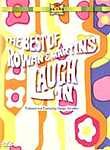
 Rowan & Martin's Laugh-In and The Smothers Brothers Comedy Hour
Thanks to Netflix, we're reprising the 1960's. Just a little. Contrary to popular, romantic belief, the 60's and 70's were a difficult and painful time for our country, and while there was some progress made in important arenas, I see those times as watershed years, in which our society turned rapidly for the worse in many ways. I never did like Forrestt Gump; it cuts too close to the bone. Nonetheless, while searching for some clean comic relief, I chose to look backwards, at some "best of" takes on two shows that made me laugh in my high school days.
My memory was confirmed that of the two the Smothers Brothers show was by far the better. I've removed from our queue the remaining Laugh-In disks in the series, but kept two more of the Smothers Brothers. They make me laugh still. Only now, I cry as well.
It's hard to imagine calling anything from the 1960's "innocent," but in comparison to today's show, that's the proper adjective. Yet the seeds of today's hard-edged, cynical depravity were clearly there for those with eyes to see. Even now it stings to realize that the cautionary words of our old-fashioned elders were right, and our insistence that it was all harmless fun was wrong.
Don't misunderstand me: there was a lot of harmless fun in the shows, and even some important social commentary. But in attitude and innuendo there was the beginning of a darker trend, a crack in the foundation as it were, which has now widened into a breach.
One thing I like about the Smothers Brothers show is all the music, especially when Tom plays his acoustic guitar and Dick his string bass. They both had beautiful singing voices, and frequently sang lovely old folk songs. Also interesting is seeing the beginnings of later-famous groups, such as future country star Kenny Rogers singing psychedelic rock with the First Edition. Less amusing was an early performance by the Who, who smashed not only their own instruments but (unexpectedly) Tommy's guitar as well. Tommy did an amazing job of staying cool about it, though that may have been because all were reeling from the explosion of a cannon in the drum set. It had unintentionally been loaded with a triple charge and literally blew the set apart, injuring the drummer with shrapnel and causing permanent hearing loss in one of the guitarists. In the spirit of "the show must go on," it's not obvious to the viewer that all didn't go as planned.
I'm not sure exactly where I'm going with this resolution, and I really have no business adding another when I haven't made much progress on the others yet. But it's the 8th of the month, and this one intrigues me.
Fear and worst-case-scenario thinking has too much influence in our lives. It's natural: One phone call with really bad news can make one jumpy every time the telephone rings, even though the ratio of bad to good (or at least neutral) calls is very small. It's natural, but it's not right.
I haven't thought much beyond that yet, but I know that two passages are going to play a large role in the outworking of this resolution. The first is three lines from one of my favorite choir anthems, And the Father Will Dance* by Mark Hayes:
Cast away fear for you have been restored!
Put on the garment of praise as on a festival day.
Join with the Father in glorious, jubilant song.
The second is one of my favorite Bible verses, Philippians 4:4-7.
Rejoice in the Lord always. I will say it again: Rejoice! Let your gentleness be evident to all. The Lord is near. Do not be anxious about anything, but in everything, by prayer and petition, with thanksgiving, present your requests to God. And the peace of God, which transcends all understanding, will guard your hearts and your minds in Christ Jesus.
It remains to be seen how this all plays out, and whether it merits its own number or should be considered part of Resolution #3 (Learn to Relax). But this is a beginning.
And now, the part of the post wherein I am forced to admit my lack of progress:
#1 Read More Books Yech. Only two books read in May, and one ridiculously short. That's partly due to still plowing my way through the The History of the Ancient World and The Chronological Guide to the Bible, and partly to having more distractions in May than usual, but mostly I must admit I haven't been making reading a priority, which is exactly where I was when I made this resolution in the first place.
#2 Rediscover Feasting Nothing much to report, although we have been consistent in keeping Wednesday as a weekly fast day, which both of us have found beneficial, mentally and physically.
#3 Learn to Relax I haven't made any more effort to find an Alexander Technique teacher here, though I am hoping to have some time with Janet's teacher when I go to Switzerland. My doctor told me that I am hard-wired as a "hot reactor," which merits a blog post of its own at some point. I find most of the symptoms way off base for me, but some are spot-on. In any case, I'm determined to prove him wrong about the hard-wired part (being convinced of my own neuroplasticity), so I need to give this higher priority.
#4 Like More Things Spinach: I've liked it raw, in salads, for along time, but spinach is actually better for you if it's cooked a bit, and I've detested cooked spinach ever since I discovered that—contrary to what I saw in the Popeye cartoons of the early 1960's—it was green, not black, and didn't give me super strength. I still don't care for spinach plain, but now I love mixing a handful of spinach leaves with other vegetables on pizza, or in an omelet or quesadilla. So that's a victory. On the other hand, I bought a can of sardines planning to force myself to eat a small bit: they're so good for you, but the thought and smell turn my stomach. I backed out at the last minute and let Porter enjoy all of them.
#5 Pay Attention At least I can say that I've been paying attention to paying attention, and trying—albeit with limited success—to bring my mind to focus on the moment instead of always being in three places at once.
Permalink | Comments
Category Everyday Life
What could be more American than hot dogs?
Lawsuits, apparently.
I bought a package of hot dogs yesterday. I'm probably a little behind the times—we don't eat hot dogs very often—but since when did they come with warning labels? Not the kind of warning I might expect, e.g. "this product is full of fat and dangerous additives, and is made from parts of the animal you don't want to know about," but the following:
CHOKING WARNING
For children under age 6, cut hot dogs lengthwise and crosswise into small bite-sized pieces. Children should always be seated and supervised while eating.
Come again? You must be six years old to eat a hot dog? I remember the day when hot dog-shaped meat sticks were a staple toddler "first finger food" in the baby food section of the grocery store. Not that we ever bought them: they were disgusting. But there they were. Clearly, somebody sued somebody over a hot dog incident, and now we get warning labels.
The chief problem with such inanities is that they lead to a cavalier attitude towards all warning labels. In between "children under six must have their hot dogs cut into tiny pieces" and "remove plastic from pizza before putting into oven," someone's going to miss "poison—do not drink."
Permalink | Comments
Category Everyday Life Food
Check out our* Steph Shaw on a very early morning TV gig in New York today. The guy out front who keeps hogging the camera? That's Swedish singer Anders ("the Sting of Stockholm") Holst. Okay, so he's the star and she's the backup. Some folks need to get their priorities straight.
Here's the link. (I can't embed the video.)
Permalink | Comments
Category Everyday Life
Meet Feudal Effort, the latest addition to the comics list on my Sursum Corda page:

I find it fun. Sometimes there's a bit of mildly objectionable language, but nothing the nephews can't handle, and I don't think the grandkids are reading my comic list yet. :)
You can get to know the characters here.
Permalink | Comments
Category Just for Fun
Mutton dressed as lamb.
I can and do text, finding it quite useful at times, mostly because not all phones send and receive e-mails, and because our overseas friends can receive texts for free...
...but I just don't get why anyone who knows how to type would prefer texting. And although in extremity I will do it, I have a deep aversion to abbreviating words, omitting capitalization, and leaving out punctuation.
You will often see me with headphones on and mp3 player in my pocket...
...but today's Zits is me!

Permalink | Comments
Category Everyday Life

Our Memorial Day celebration concluded with a lovely dinner at at a friend's house, to which we brought wine and dessert. This friend is one of those on whom I am not hesitatant to inflict culinary experiments, and this cake was one. I began with a simple vanilla cake base from my Boston Cream Pie recipe (credit my friend LCS). It is a single-layer cake, which I sliced in two horizontally with a serrated bread knife. I heated passionfruit jam a bit to make it thinner, and mixed it well to make it smooth. This I spread generously on the first layer. After adding the second layer, I used a pastry brush to glaze it and the sides with the thinned jam. Then I added the fruit: fresh strawberry halves and whole blueberries, canned apricot halves and peach slices. Using the brush again, I glazed the fruit with the jam.
I must say we were all very happy with it! Apricot or currant jams are more traditional for this sort of dessert, but I think the passion fruit flavor made this cake the success it was.
What I plan to do differently next time (and there will be a next time):
- Use a higher percentage of whole wheat flour in the cake. (This time I used a 50/50 mixture of white whole wheat and all-purpose flours).
- Use less sugar in the cake (the recipe calls for 1 cup, but I think less would work well—the jam makes it sweet enough).
- Possibly make the inner layer of jam thinner.
- Use fresh fruit exclusively if I can't find firmer canned fruit; the apricots and peaches were rather mushy—though that did make cutting the cake easier than firm fruit would have.
Permalink | Comments
Category Everyday Life Food

