
Being an avid reader of science fiction, I was sure that the big technological change to mark our time would be space travel. But it’s apparently an idea whose time has not yet come, because it never took off (yes, I meant to say that) the way the science fiction writers prognosticated.
Personal computing and the Internet, on the other hand, took me—along with most of the S-F writers—by surprise, even though they were part of my world from the era of room-sized machines and paper-tape input. I never imagined how drastically they would change our lives. Instead of exploring outer space, we have opened the inner spaces of our world.
Time, space, and grandchildren do not permit me to cover the vast scope of changes, but here are a few for which I’m grateful, even though there’s often a negative side as well.
Information I guess that goes without saying in the information age, but I think people who came of age in the post-Google era cannot imagine how rare information was. Questions often required a trip to the library, on the chance that there might be a book on the subject (no online card catalogues), then wading through the book hoping for an answer. One could go to progressively larger (and more distant) libraries searching for more, all of which took time, time, and more time. I love sitting in a library doing research—somehow I doubt the Internet will ever replace the smell and feel of old books—but I’m gratefully amazed at how much information is readily at hand now. Information is power, and the Internet has distributed this power to the masses.
Memory Are you, like me, perennially tortured by something that you almost remember? A quotation you need to source? A fragment of a quotation you’d love to know in full? A snatch of music from some song you can’t recall? A word that would be perfect for a sentence you’re writing but it just won’t come to mind? In the past I mostly just had to wait and hope that eventually the missing information would appear from my subconscious; often the question was never answered. Even I sometimes find it difficult to believe what life was like before Google.
Connection We have friends and family all over the world. I wrote earlier how thankful I am for the radical changes in communication and transportation speed and affordability. Moreover, e-mail, blogs, and social networking sites have kept me in contact—or renewed contact—with people who would otherwise have faded from my life. We are among that disappearing breed, the Christmas-card senders, and I can't imagine ever giving that up, but the connections that more frequent and instantaneous communication builds are even better.
Opportunity I love to write. Unfortunately, I did not discover this strange state of affairs until after I graduated from college with a math degree and went to work as an assembly language programmer, so the opportunities for this form of expression were few. I wrote letters to the editors of newspapers and magazines, created a family newsletter, and kept a journal. But it wasn’t until I discovered blogging (thanks, Jon!) that I started writing a lot. It takes an unreasonable amount of time, it doesn’t bring in any money, and I regret that it has for the most part crowded out the above-mentioned outlets for my writing impulse. I’d love to be able to do it all. Still, I now have my own corner of the world in which to write, a small but loyal following, and a large number of people who have found something useful here. That’s a good feeling.
Independence I’ve written before about the way the Internet facilitates the work of amateurs, and how I believe this is for the most part a good thing. We need professionals who will devote to their fields the time that amateurs do not have and the effort they do not want to make. Yet for two reasons I believe the rise of amateur work is an important benefit of 21st century life.
First, so much information is now available that even the professionals cannot keep up with it, as everyone knows who has by his own minor research discovered important medical information that his doctor has missed. This is not, in my observation, a rare occurrence.
Second, there is a tyranny of professionalism, under which professionals—and more so, their guild-like organizations—have encouraged a “leave it to us” attitude that most of us have bought into. Professionals raise our food, bake our bread, make our clothes, take care of our lawns, attend to our health, teach our children, provide our music, and play our games for us. Thanks to the Internet, computer software, and even television, tools and information once limited to professionals are now available to everyone, and many people are rediscovering the joy and freedom of doing things for themselves. Someday we may even return to the neighborhood kickball game and singing around the piano at home, though this will take more than the Internet to recover.
I’m not unaware of the irony of trading dependence on a few professionals for dependence on technology and a vast, faceless “community.” There’s a lot to be said for having local doctors, teachers, musicians, and bakers who know and are known in a true, small, physical community. But few of us have that choice, and even then I’d like to have the best of both worlds. In the meantime, I’m encouraged to see families and individuals discovering and rediscovering the basic skills of life.
This is the final post in November’s Thanksgiving series. I doubt it’s the end of the Good New Days series, as there’s more to say there, but I’m thankful to leave behind the pressure to post something every day. 
Permalink | Comments
Category Computing The Good New Days
For all I gripe about the short shrift given to public transportation in the United States, I need to take a moment to be thankful for our highways. Vacation travel in my younger years was more picturesque, as we wandered through small towns and back roads. But if I-95 is boring, it makes the drive between Pennsylvania and Florida immeasurably more pleasant.
Even with the inevitable traffic jam around Washington, D.C., when your objective is to get from Point A to Point B, travelling 70 mph on a multi-lane road beats without question poking along at 30 mph on a two-lane road, behind a mile-long army convoy, through a construction zone. The only thing the latter has going for it is that it’s easier to find relief when the kids have to use the bathroom.
(If you travelled on New England’s highways yesterday, you may have a hard time believing that automobile travel could have been worse, and you might be right. I don’t think we ever experienced anything as bad as Massachusetts/Connecticut traffic on the Sunday after Thanksgiving—or just about any Friday night, for that matter. I refer you to my previous complaints about our lack of good public transit.)
Permalink | Comments
Category The Good New Days
It’s such a brilliant idea to have one, easily-remembered number to call for all forms of emergency, anywhere in the country. (Cell phones and Voice Over IP phones have outpaced the 911 system and diminished its power a bit, but it is catching up again.)
I used to have nightmares in which I needed to call the police, or ambulance, or fire department, and kept fumbling through the phone book and not finding the number. If I finally succeeded, then d-i-a-l-i-n-g the number took so long and my finger always slipped at about the next-to-last digit and I’d have to start over again and by that time the phone book had fallen shut and I had lost the number….
I don’t have those nightmares anymore.
Permalink | Comments
Category The Good New Days
For a normal, healthy person dealing only with minor illnesses—including diseases like measles and chicken pox, which were no big deal for most people—in many ways it was better to be living 50 years ago than now.
(An exception would be for normal childbirth, which had been taken over by hospitals and doctors. Mothers reclaimed their [ahem] birthright in the late 1970s, only to lose it again, and then to partially regain it—it’s the only branch of medicine that I know to be so cyclical.)
I remember doctors making house calls, and doctors who treating the whole family as a unit, which I believe is healthier for all. They trusted parents to describe symptoms accurately and as often as not the doctors gave advice over the telephone and saved many a trip—even when they were no longer making house calls. They still had time to talk with their patients; none of this in-and-out-in-15-minutes assembly line stuff.
However—and it’s a big caveat—for serious illnesses and for emergency medicine, now is a much better time to need medical care. When I was born, polio was still devastating the country and organ transplants were unheard of. CAT scans didn’t appear until twenty years later. From babies to bones, from tumors to head trauma—I hope never to need it, but if I do, I’ll take today’s medical technology with gratitude.
It’s just a pity we can’t have the house calls, too.
Permalink | Comments
Category Health The Good New Days
I grew up in a monoculture, which was not unusual 50 years ago. People of other races and cultures were a topic to studied, not friends and neighbors. I’m thankful today’s American children experience racial and cultural diversity naturally, as part of their daily, normal lives. To our grandson, a “black lady” is a woman of any race wearing a black dress.
Permalink | Comments
Category The Good New Days
On this Thanksgiving Day, as we prepare for a very traditional American feast, I’ll take time to be thankful for the tremendous variety of food now available from other countries and cultures all over the world.
I’m a great fan of the locavore movement; I know from my childhood that nothing tastes as good as food that not only comes straight from a nearby farm, but also has a distinctive local flavor. But there is also something to be said for being able to enjoy fresh fruits and vegetables in the middle of winter.
Even better is the opportunity to enjoy fruits, vegetables, spices, and prepared foods that were unheard of when I was growing up: sushi, satay, tandoori chicken, naan, fajitas, egg rolls, mango lassi, bok choi, passion fruit, kung pao chicken … the list is long of now-common foods that were unavailable to most Americans 50 years ago. I’d never even had a bagel till I went to college with a large crowd from New York City.
What a multicultural feast our table has become!
Permalink | Comments
Category Food The Good New Days
I can’t quite bring myself to say directly that I’m thankful for television, because I believe it has done great harm in our society, but it would be wrong to ignore the enormous educational and cultural benefits this technology has conferred. As strong a proponent as I am of the written word, some second-hand experiences are much better approached in a video format. From African safaris to Wagnerian opera, video provides formerly elite experiences to the hoi polloi. It’s not the real thing—but even the very rich cannot experience everything directly.
Thus I am also thankful for the technology that has enabled us to be masters of this medium. In my early days we had no television at all, but it didn’t take long to become enslaved. Life was planned around when favorite shows were on, because if you weren’t watching at that very hour, you missed it. I remember (to my shame) being reduced to tearful anger because our babysitter wouldn’t change the channel from her favorite show to mine.
It's true that we are, as a society, still enthralled. But we don’t need to be. We have the tools to use the medium for good purposes and ignore all the rest.
Permalink | Comments
Category Education The Good New Days
When I give thanks for modern dentistry, I’m not referring to the practice of some dentists, which is to do any dental work that might involve pain using some form of anesthesia. It is good for children to learn how to handle pain in small doses. Life is not pain-free, and the habit of seeking medication for every ill is a dangerous one. Personally, I’d much rather deal with the temporary, minor pain of the dentist’s drill than the risk and after-effects of anesthesia. Moreover, when the patient is aware of where the dentist is probing, the dentist is more likely to notice if he’s gone too far or found a trouble spot.
That said, the improvements in dentistry since I was a child have been vast. The drills back then were slow, and much more painful. (Porter’s dentist even used a foot pedal powered drill for a while!) Today’s high-speed drills are almost a pleasure (I said almost) in comparison.
Thanks to fluoride (however controversial it is when put in public water supplies), to dental sealants, and to better attention given to tooth and gum care, even before a baby gets its first tooth, children have many fewer cavities today. Orthodontia has made badly crooked teeth a thing of the past. Onlays, crowns, bridges, and dental implants have greatly extended the life of our natural teeth and delayed the need for dentures.
The need to repair dental caries is so low these days that dentists have taken to whitening teeth to stay in business. What they’ll do if we ever kick our tremendous sugar habit, I don’t know.
Permalink | Comments
Category Health The Good New Days
How I love the smell of clothes dried outside in the sunshine and a soft breeze! Especially bed linens; no perfume exists that can beat that scent on a pillow. It’s a pleasure most American children have never experienced, but it was many years before my mother had the luxury of an automatic clothes dryer.
Dryers are not a necessity, even in highly-developed countries, as our visits to Japan and Europe have shown me. And yet when the weather is grey and drizzly, when children come in from playing in the snow with their winter clothing dripping with icy water, if one has better things to do with one’s time than iron clothes, or when one would simply like to have clean clothes available in fewer than twenty-four hours, to be able to toss the wet items into a machine and have them warm and dry in an hour is a great blessing.
Permalink | Comments
Category The Good New Days
You’re surprised I waited so long for this one, right? I value home education so highly that my gratitude for that privilege almost goes without saying. (But gratitude should never go without saying.) Because my joyous thanksgiving for the legal protection that homeschoolers now enjoy cannot be overstated, I will understate it here.
Educational opportunities have expanded for everyone, not just homeschoolers, over the last 50 years.
When I was a child living in upstate New York, educational choices for most families were simple: Your children went to the local public school after they turned five years old. If you were Catholic, you had one more choice: parochial school.
Later we moved to the Philadelphia Main Line, where there were several well-established private schools to choose from—if you were wealthy and willing to commute.
Today? There still isn’t as much choice as I would like, as the system is heavily weighted in favor of public schools and against parents who choose another path. But tremendous improvements have been made.
- Education is now provided for all children; in the past, “all children are to be provided a free, public education” often did not apply to children with handicaps.
- Homeschooling is legal in every state, albeit with varying degrees of governmental interference.
- Within the home education realm itself, materials and support (and with them, options) have exploded over the last 20 years.
- Private school options have multiplied: non-Catholic Christian schools, Muslim schools, Montessori schools, unschools, specialty academic schools—if there’s an idea, someone has turned it into a school.
- Public school options have also multiplied, with magnet schools, charter schools, and in some (too few) places even the right to choose which regular public school to attend. Even limited competition has encouraged public schools to be less complacent.
Would I call the system great? No. In some ways schooling is worse now than when I was a child, although to be fair that’s mostly due to sociological changes. But overall the system is much better than it was 50, or even 25 years ago, because we have choices. Whether in the end we choose public, private, or home education—or a combination thereof—we (and our children) are better off for having the opportunity to make these decisions, rather than passively accepting the status quo.
Permalink | Comments
Category Education Children & Family Issues The Good New Days
I’m thankful for push-button phones, cordless phones, cell phones, answering machines, voice mail, Voice over IP, and video calling.
I didn't mind dialing a number—numbers were shorter back then—but phone buttons are used for a lot more than dialing these days, and that became possible when the clicks were replaced by tones. (Can anyone besides me remember phones that converted button presses into clicks?)
Once upon a time the 25-foot phone cord was the great new technology that let one actually get some work done while talking on the telephone. It was almost always in the kitchen, where it may have caused a child to trip or become entangled, but was overall much safer than using a cell phone while driving.* Still, cordless phones are much more fun, enabling work to be done in other parts of the house … and poolside relaxation without fear of missed calls.
Not that missed calls are so much of a problem anymore. Various answering devices have all but eliminated the slavery induced by the fear that this call is the all-important, critical one from your boss, or from a family member in trouble, and therefore it has the right to interrupt any and all other activities—even though nine times out of ten it turns out to be a sales call and 999 out of 1000 is something that could have waited. Call forwarding technology performs a similar liberating function, especially the kind that allows one to forward only calls from specific numbers.
Call waiting, annoying as it sometimes is, is a boon to those who like to have long telephone conversations—and to those who share a phone line with them.
Cell phones? Yes, they have in one sense tethered us. (What do you mean I can’t reach you on vacation? Don’t you have a cell phone?) But the freedom they have bestowed is even greater, especially on women and children. Think about driving (or letting your child drive!) alone late at night without a cell phone, and you’ll see what I mean.**
I won’t get into Blackberries, iPhones, and other amazing devices here, because I don’t own one. Yet. It’s really hard to think about giving up my $100/year cell phone plan. But they have liberated many people from the need to lug their computers around with them, which I can appreciate.
Voice over IP and video calling? One word: Grandchildren.
*Ahem. Like the driver who would have hit me and my bicycle recently if I had not been extra cautious crossing the road, as she cheerfully continued her phone conversation while turning right on red without stopping, or even pausing, and certainly without looking, as I was spang in the middle of the intersection when she began the turn. Harrumph.
**No guarantees, though. The likelihood that your car will break down in an area without cell service is diminishing, but I remember well a particular time in the mountains of Western Pennsylvania….
Permalink | Comments
Category The Good New Days
By now you’re tired of hearing me say this, but you won’t believe…
…the things one couldn’t do without a Y chromosome when I was growing up.
My own parents were great—and a bit ahead of their time—at encouraging me not to be fenced in by my sex. I had backhoes and construction sets as well as dolls for toys. I was encouraged to climb trees—and mountains. But society at large was still severely restrictive.
In sixth grade I expressed the wish to be an astronaut, and was emphatically told by my (male) teacher that girls could never be astronauts, because all astronauts had to be test pilots, and test pilots were only men. (Take that, Sally Ride!)
Those were the days when girls took home economics classes and boys took shop. Period. End of story.
There’s no point in detailing all the restrictions—there are too many, and this is about thanksgiving, not griping—but here’s one I just learned: Until the late 1960s no woman could run officially in the Boston Marathon. My running friend says women were told they would damage their bodies if they tried to run such a long distance. (Now some of the best ultramarathon runners are women.)
I rode the crest of the wave of change, with doors opening all around me. I was the first (and only) girl in my high school’s jazz band, the only girl in my Boy Scout Explorer post, the only girl in many of my physics classes.
It’s true that in our enthusiasm we’ve allowed the pendulum to swing too far, forcing women to face a different kind of restriction: While a myriad other opportunities were becoming available, women were finding it more and more difficult to choose the noble career of homemaking that had for millenia been taken for granted as their birthright (and duty).
A course correction is necessary to fix this injustice, but let’s not lose sight of what we have gained, nor be tempted to push the pendulum back too far. These may be perilous times, but if you’re a woman, you don’t really want to go back to the 1950s.
I’m thankful that today’s girls can dream about becoming astronauts.* Or whatever else they might want to be and to do.
*The uncertain future of our space program notwithstanding.
Permalink | Comments
Category Children & Family Issues The Good New Days
I am of the last generation to know what life was like before pocket calculators. Even that name is revealing; who calls them that anymore? Who remembers when “adding machines” were big, clunky things like typewriters? (Have you seen a typewriter outside of a museum or an old movie?)
I remember my parents doing their taxes with a nifty little plastic device with a set of numbered dials like a telephone. (Uh, who remembers dial phones?) There was a 1’s dial, a 10’s dial, a 100’s dial, etc. and you used a stylus to turn them to the correct numbers. You could add and subtract by turning the dials clockwise or counterclockwise. The device was handy for checking all those tax numbers, and lots of fun for me when I could get my hands on it.
As a science major in college, I had many tedious calculations to do, and often found it worthwhile to make a trek through the cold and snowy winter night to use one of the half dozen Wang calculators made available to students by the physics department.
When I graduated from college, I received a thrilling (and expensive) gift: A Texas Instruments SR-10 calculator! It was especially cool because it handled scientific notation. Take a look at the keyboard and note that it did a whole lot less than the calculators you can buy today for $10 at your friendly neighborhood Walmart. The last time I visited the Smithsonian Institution in Washington, I found my wonderful graduation present on display amongst the other relics.
I firmly believe that everyone should know how to do basic arithmetic functions easily and quickly, and think it’s deplorable that we have cashiers who can’t make change without a register to do the calculations. I’ve never forgotten Isaac Asimov’s prescient story, The Feeling of Power (1958).
I also believe that everyone should know how to make bread, but that doesn’t stop me from being thankful to be able to buy bread at the store.
Thus, without apology, I am thankful for the handy, portable, convenient, powerful, inexpensive, labor-saving pocket calculator.
Permalink | Comments
Category Computing The Good New Days
When I was young there was no such thing as recycling, per se. We still produced a whole lot less trash than the average family today, because we had a whole lot less stuff, and what we had was often reused (e.g. milk bottles). Food scraps went, not into the trash or down the sink, but into a compost pile in the back yard, where hardworking worms and bugs and microbes recycled it their own way into fertile soil.
Times changed. Almost without being aware of it we had become a disposable society, and our piles of trash grew. And grew. Newspapers could be recycled—indeed, one could make good money by collecting people’s old papers and taking them to the paper plant. But metal, glass, and the ubiquitous varieties of plastic went straight to the landfill.
Finally, cans and bottles began to be recycled, but one had to be committed to the cause to drive one’s accumulation to a place that would accept it.
Today we have two recycling bins in our garage, one for newspapers, magazines, and cardboard; the other for steel cans, aluminum cans, glass, and all forms of plastic with a recycling number. Once a week a special truck comes right to our driveway and empties them. At the grocery store I can easily recycle plastic bags and Styrofoam. Other cities collect office paper. Auto parts stores will accept used motor oil.
Recycling is no longer a money-making proposition, at least not for most individual citizens, but curbside collection has greatly improved community involvement. We may never reach the remarkable Swiss compliance rate (81% for PETE plastic, 91% for aluminum cans, 60-80% for other forms of aluminum, 94.6% for glass bottles and containers) but it’s certainly better than it was 40 years ago.
We’ve always recycled whenever we could (and try to reuse, and use less, as well), but I’m thankful for community-based recycling, both for the convenience and for the way it encourages widespread participation.
Permalink | Comments
Category Conservationist Living The Good New Days
Think “reproductive freedom” and what comes to mind? Birth control? Abortion-on-demand? The freedom, in short, not to reproduce while indulging in the activity specifically designed for reproduction?
What I’m thankful for is the inverse.
My generation grew up in the days of Ehrlich’s The Population Bomb and fears that the world would outgrow its food supply by the mid-1980s. It was seriously suggested that giving aid to distressed peoples was morally wrong, on the grounds that helping them now would only enable them to reproduce and then more people would starve to death later.
(It was also seriously suggested that we spread dirt on the polar ice cap to help counteract the global cooling that was threatening our environment, but that’s a different issue.)
I think today’s generation will not believe the societal pressure there was back then to have no more than two children. If you’ve read Ender’s Game, think what it was like to be a “Third” in that society: Having a third child was nearly as bad here. I remember a friend who hoped for twins her second pregnancy, on the grounds that that was the only way she could have more than two children without having scorn heaped upon her. Families with “extra” kids were clearly irresponsible and incompetent at birth control.
Nowadays many have decided that they like the one to one parent/child ratio—so many, in fact, that the birth rate in some countries has fallen below the replacement level—but there’s a lot more choice going into that decision than there was in our day. That’s a good thing.
An even better thing? That some families now feel free to enjoy three, four, or even many more children.
The best thing? In my case, more grandchildren!
For them, I’m especially thankful.
Permalink | Comments
Category Children & Family Issues The Good New Days
Overall, society has become much ruder, cruder, and lewder than it was 50, or even 25, years ago. But sexual harassment, if hardly a thing of the past, is at least—like smoking—generally disapproved of, and the woman on the receiving end of a “friendly” pat on the rear from her boss or suggestive remarks from her co-workers now has legal recourse. In the past, enduring such treatment was often considered as much a part of the job as making coffee. (On a personal note, I worked with great people and did not have this kind of problem myself. I didn’t make the coffee, either.)
Maybe we’ve gone too far in enforcing the new rules—suspending a kindergartener for kissing a classmate comes to mind—but for the most part they are in place because they are necessary. I’m thankful for this civility.
Permalink | Comments
Category The Good New Days
It’s okay—it’s good—to be thankful for small things, too. It may not be an earthshaking improvement, but I’m thankful for digital cameras. One key to taking good photographs is taking lots of photographs, and in times past only the professional could afford to do so. Now anyone can.
Digital cameras are also great for children. Instant feedback is so much more satisfying than waiting to finish the roll of film so it could be developed—and not wanting to waste any pictures because film + developing = a lot of money. Now there are cameras that let the youngest learn to take good photographs.
What’s more, good cameras—even video cameras—are small enough to carry in a purse. A small purse! Our first video camera was a huge monster that took full-sized VHS tapes.
Organizing photos into albums has never been easier, and there are so many more wonderful things you can do to present them. On the other hand, having so many more pictures and options makes more work, even if the work is easier.
But that’s a minor quibble. I love my tiny, handy, good-quality digital camera!
Permalink | Comments
Category The Good New Days
There’s no doubt the sociological upheavals caused by the so-called Women’s Liberation Movement have done much harm, but one great thing to come out of that time is a greater closeness between fathers and their children.
My father was always actively involved with his children—unusually so for that generation, I believe—even before my mother’s early death forced him to take on double parenting duty. And yet in his journals of our early years he always refers to the times my mother was not at home as times when he was “babysitting the children.” No one I know with young children in this century would even think such a thought, much less express it. How can one “babysit” one’s own child?
My own generation was at the cusp, I think. Most fathers I knew still thought of their time alone with the kids as babysitting duty, at least when the children were very young, but overall they were beginning to be more involved in their care. That happened most as the children grew older, however—and dirty diapers were still the mother’s domain.
Now—with the notable exception of breastfeeding—fathers seem to be doing everything. Some even specialize in dirty diapers! If the father is the family breadwinner and the mother the homemaker,* then there is necessarily a difference in the quantity of time each has with their children, but functionally dads have taken on parenting in a way that only mothers had enjoyed. It’s not that they’ve become mothers—watch a father playing with an infant and you’ll say vive la difference! once your heart rate returns to normal. They’ve become better fathers.
Today I’m thankful for fathers, past and present, who learned the awesome truth that no selfish pleasure brings as much delight as nurturing a family.
*“Homemaker” has positive connotations for me—there can’t be many professions nobler than making a home—and the term “stay-at-home-mom” sets my teeth on edge.
Permalink | Comments
Category Children & Family Issues The Good New Days
It’s quite possible that the environment we live in is in worse shape now than 50 years ago, especially in places like China and Africa. But here, now, it looks, tastes, and smells a lot better. And not just because fewer people are smoking.
I remember when the Cuyahoga River caught on fire, and when it was said you could develop film in the Genesee downstream from the Kodak factory. My father worked for General Electric in Schenectady, and used to say that they returned the water to the Mohawk cleaner than it was when they took it out, which was no doubt true but should not be taken as an endorsement of the effluent.
The air in Pittsburgh was so full of smoke and particulates that when the Church of the Ascension expanded, they used black stone in order to match the soot-darkened original.
Automobile exhaust was something awful. It’s not nice even now to walk or bike along a road full of cars, but nothing like what it was before pollution controls.
I even remember when the Freihofer bread delivery truck was horse-drawn, and you can guess what that did to the streets. (But I loved to sit on our porch and watch it pass by!)
Environmentally, this is not a secure time to be living. What’s more, I know that the improvements to our air and water quality are only partly because of pollution control laws. Pittsburgh is a clean, breathable city because they no longer make steel in the home of the Steelers. We have outsourced and off-shored our pollution as well as our jobs.
But when it comes to breathing and drinking, I’m thankful for today.
This post could also be viewed as a mere excuse for sharing my favorite Tom Lehrer song of that era.
Permalink | Comments
Category Conservationist Living The Good New Days
 Into the Silent Land: A Guide to the Christian Practice of Contemplation , by Martin Laird (Oxford University Press, 2006)
The physical benefits of meditative techniques are well established, and I’d like to be able to take advantage of them. What has hindered me is that many—though not all—of the studies have focused on Transcendental Meditation (TM), the Eastern religious aspects of which have led me to keep meditation in general at arm’s length since I first learned of it some 40 years ago. It will not do to gain a physical benefit at a spiritual loss—I can’t help thinking of The Magician’s Nephew, in which Digory was tempted to steal an apple that would have cured his dying mother, but if he had done so, both he and his mother would have later “looked back and said it would have been better to die in that illness.”
Yet Digory, having passed the test, was eventually given another apple, one that healed his mother in the right way.
Despite all the attention given to TM during my formative years, it turns out that Christian meditation is an ancient and respected practice. Many of the techniques turn out to be similar, though not identical and of course the focus and intent are quite different.
You don’t hear much about Christian contemplative practice today, at least not outside of the more liturgical traditions—and not much in them, either. Our cranked-up, frenetic, yammering world is not comfortable with either external or internal silence.
Nor does it help that those who have written about meditation are generally describing the indescribable, which makes them incomprehensible, as far as I’m concerned. I plowed about halfway through Thomas Dubay’s Fire Within: St. Teresa of Avila, St. John of the Cross, and the Gospel on Prayer before giving it up as being 'way too far over my head.
Into the Silent Land covers much of the same material in a shorter and simpler form, but it still leaves my head spinning—and this was my second reading. So I cannot, at this point, give it an accurate evaluation. I will say it’s worth a third attempt at some point. For now, I’ve found a few ideas that I can hang onto and begin to put into practice, which may help illuminate a re-rereading.
Spiritual and physical benefits remain to be seen, but even what little I’ve been able to glean thus far has been of some help with no fewer than three of my New Year’s Resolutions: Learn to Relax, Pay Attention, and Cast Away Fear. (See the Progress section of New Year’s Resolution #11.)
Side note: Do you, like me, assume contemplatives must generally be introverted people? Perhaps it's true; those who choose to be monks would be those who are comfortable with silence and solitude—not that all contemplatives are monks. But having read recently that introverts have more activity constantly going on in their brains—more internal dialogue, measurable in neurological studies—I suspect that we are drawn to meditation because we need it more. We need techniques and much practice to be able to still the chattering mind and achieve inner silence.
What would today be without being thankful for our veterans, and all who work and sacrifice to protect the rest of us?
In the spirit of the Good New Days, I’m also thankful for our all-volunteer military. The military draft cast a long, difficult, and painful shadow on life in the 1960s and 70s. In that respect it is much better to be young today. A career in the armed services can be a very good choice—but it should be just that, a choice. It’s better for families, for society, and for the military as well.
Permalink | Comments
Category The Good New Days
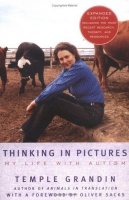 Thinking in Pictures: And Other Reports from My Life with Autism, by Temple Grandin (Vintage, 2006) (Expanded from the original 1995 version)
I’ve already written about Temple Grandin, the movie, which was the inspiration for getting this book from the library. It’s well worth reading, and the only reason I’m sending back unread the two other books of hers I picked up at the same time is that I realized I must put the brakes on my reading for a while. At the very least I need to substitute books I won’t be tempted to review.
Thinking in Pictures would have convinced me, if Grandin’s own commentary on the DVD had not, that the movie is an accurate, if not perfect, portrayal of her life. It’s fascinating to read about autism from the inside out, as it were, and also interesting to note her opinion that for all the advances we have made in understanding autism and Asperger’s syndrome, as a child in the 1950’s she had a few advantages over today’s children. School classrooms were well-ordered and quiet; the noise and chaos often seen classrooms now would have been impossible for her to handle. Parents, teachers, and other adults worked hard to instill good manners and polite behavior into children; these are difficult but essential skills for autistic children to learn, but they are sadly neglected today. Finally, there were no video games then, which encourage solitary activity; she was forced to interact directly with other children through board games, outdoor play, and other normal, 1950’s-era activities.
Of even more interest to me is her theory that whatever causes autism spectrum disorders, it is closely linked to brilliant, creative thinking. Too much of whatever it is deprives a person of the ability to function in this world, but a little bit makes for the kind of folks we cannot do without. Not only are our potential Einsteins being shunted into special education classes instead of the gifted classes where they belong, but if genetic testing someday allows us to screen for risk of autism, we may never see another Bill Gates.
On the sensory sensitivities of someone with autism spectrum disorder:
Washing my hair and dressing to go to church were two things I hated as a child…. [S]hampooing actually hurt my scalp…. Scratchy petticoats were like sandpaper scraping away at raw nerve endings.
I can relate to that!
When I was a child, I was expected to sit through formal Sunday dinners and behave. Most of the time I did. Rudeness was not tolerated and I was taught to say please and thank you. Normal family activities provided structured opportunities to learn social skills. Sit-down meals and activities such as playing cards and board games like Chinese checkers taught turn-taking and patience. …Today many children lack this structure. Video games and time on the computer are spent solo. Many of my favorite childhood activities required participation with another child. … Even the normal children today are growing up with more social problems. Later on they do not know how to behave at work.
I can drive because the operation of the car, steering and braking, has become a fully automatic skill. Research has shown that when a motor skill is first being learned, one has to consciously think about it. When the skill becomes fully learned, the frontal cortex is no longer activated and only the motor parts of the brain are turned on. I learned to drive on ranch roads in Arizona and I did not drive on the freeway or in heavy traffic for a full year. This avoided the multitasking issue because when I finally started driving in traffic, my frontal cortex was able to devote all its processor space to watching traffic. I recommend that people on the [autism] spectrum who are learning to drive spend up to a year driving on easy roads until steering, braking, and other car operations can be done without conscious thought.
That might have saved me the debilitating car-phobia I had for many years. It took me much longer than most people to reach the “automatic” point, and until then, every second behind the wheel was torture.
In an ideal world the scientist should find a method to prevent the most severe forms of autism but allow the milder forms to survive. After all, the really social people did not invent the first stone spear. It was probably invented by an Aspie who chipped away at rocks while the other people socialized around the campfire. Without autism traits we might still be living in caves.
It is likely that genius is an abnormality. If the genes that cause autism and other disorders such as manic-depression were eliminated, the world might be left to boring conformists with few creative ideas.
Three things that occur more frequently in people with high mathematical ability than in the population at large are left-handedness, allergies, and nearsightedness. Both learning disability in mathematics and math talent are associated with left-handedness. Young children who show very high ability in verbal reasoning and mathematics are twice as likely to have allergies as the rest of the population. Students with extremely high ability are also more likely to be nearsighted. The old stereotype of a little genius with thick glasses may be true.
During my career, I have met many brilliant visual thinkers working in the maintenance departments of meat plants. Some of these people are great designers and invent all kinds of innovative equipment, but they were disillusioned and frustrated at school. Our educational system weeds these people out of the system instead of turning them into world-class scientists.
On her vocation in the livestock industry:
I do not believe that my profession is morally wrong. Slaughtering is not wrong, but I do feel very strongly about treating animals humanely and with respect. I’ve devoted my life to reforming and improving the livestock industry. Still, it’s a sobering experience to have designed one of the world’s most efficient killing machines. Most people don’t realize that the slaughter plant is much gentler than nature. Animals in the wild die from starvation, predators, or exposure. If I had a choice, I would rather go through a slaughter system than have my guts ripped out by coyotes or lions while I was still conscious. Unfortunately, most people never observe the natural cycle of birth and death.
A couple of generations ago, overseas travel for pleasure was only for the rich. Even business travel was uncommon, unless one was a missionary or in the military. Today we visit our family in Switzerland more frequently, with less effort, and possibly even with less relative expense than my family travelled from New York to Florida to visit my grandparents when I was young.
Telephone service was once so expensive that long distance calls (remember long distance?) had to be kept brief—as in just a few minutes. Overseas calls were out of the question most of the time. Today our grandchildren have long conversations with us on the phone, and we can call Switzerland at six cents a minute. Skype costs even less (less as in free); the quality may not be as good as I'd like, but it allows us to see each other. The long-dreamed-of video phone is here!
You think sending a letter via the Post Office is snail mail? Letters used to travel by truck, not airplane, and on slow roads at that. Overseas mail went by boat and could take months to reach its destination. Imagine seeing your spouse, parents, children, grandchildren, siblings, or friends go off as soldiers or missionaries to the other side of the world and having to wait weeks before knowing they arrived safely. Now mail flies and e-mail is nearly instantaneous.
When I was in college, communication was by mostly by letter, and that not very often. It wasn’t expensive, but you know how college students are about writing. Perhaps I would have written more had I not been blessed with parents who didn’t mind footing the substantial bill for weekly phone calls; most of my friends did not have that privilege. But with today’s instant, varied, and frequent communication—phone, e-mail, SMS, Facebook, blogs—the sudden and unnatural break from loved ones can be a thing of the past.
If one has far-flung family and friends, this is a good time to be living. Do I wish our grandchildren lived where they could walk to Grandma’s house for breakfast? You bet! But with today’s easier and less expensive travel and communication choices, we’re a lot better off than my own grandparents were. So I’m thankful!
Permalink | Comments
Category Children & Family Issues The Good New Days
I've removed the Feedjit live traffic feed from the panel on the right because of the ads that are now there. I didn't mind the ads for Feedjit itself, but I have no control over the others they are now showing. I have, however, retained the link (under Links/Other) so you can see the feed there if you, like me, find it interesting to see where people come here from and (sometimes) why.
Nobody likes to be sick, and especially nobody likes children to be sick. But if you are a child, today is a much better time than 50 years ago to face a mild illness. I don’t mean because of all the new vaccines—I actually look back with some fondness on the days of chicken pox, measles, and German measles. (I missed out on that other great disease of early childhood, mumps, despite repeated visits to my friend when she was afflicted.) Nor do I mean the obvious improvements in the treatment of many diseases, and in emergency medicine, not that I’m not grateful for them.
What I’m thankful for is that we have outgrown the sick-children-must-stay-in-bed philosophy. Bed is fine when you’re too miserable to do anything else, but in the 50’s and 60’s bed rest was still considered an important part of the cure, and often imposed long after the child would have been much better off up and about.
I don’t remember my own confinements lasting overly long, perhaps because I enjoyed the opportunity to be the center of attention, to be served meals in bed, to read as much as I wanted to, to have my parents sit with me and play games—I particularly remember a car/plane/boat race across the U.S. game on a tray that I never tired of—and to have my mother at my beck and call, at the sound of a bell, a buzzer, or a flashing light—whatever fun device my dad and I had concocted to get her attention.
But I’m not certain Porter’s relationship with his mother every completely recovered from the well-meant instructions from their doctor to keep him in bed for half his kindergarten year because he had been diagnosed with mononucleosis.
I am grateful that doctors today seem happy to assume that if a child feels like staying in bed, that’s probably what he needs, and if he feels like getting up, that’s a good sign he’s ready for more activity.
But I have very fond memories of that race game.
Permalink | Comments
Category Health Children & Family Issues The Good New Days
The older I get, the easier it is to give in to the habit of grumbling. It's not easy to watch the world go to hell in a handbasket without complaint, and it’s part of the necessary wisdom of the elders to make the younger generations aware of what they are in danger of losing. But too much of that attitude is unhealthy. It’s bad for society and worse for the individual. What, then, could be a better choice for my November New Year’s resolution than to cultivate a habit of thanksgiving?
Some of my favorite Bible verses are related to an attitude of thanksgiving.
Do not be anxious about anything, but in everything, by prayer and petition, with thanksgiving, present your requests to God. (Philippians 4:6)
Rejoice always, pray continually, give thanks in all circumstances; for this is God’s will for you in Christ Jesus. (1 Thessalonians 5: 16-18)
For everything God created is good, and nothing is to be rejected if it is received with thanksgiving. (1 Timothy 4:4)
The Bible also warns against grumbling, it being one of Israel’s troublesome sins.
Do not grumble, as some of them did—and were killed by the destroying angel. (1 Corinthians 10:10)
Most of my resolutions have come to me well in advance of my 8th of the month deadline, but this one, despite the clarity of the choice once it was made, did not. It was especially interesting, therefore, to see how quickly after I made the decision I started seeing confirmation everywhere. Not that I should have been surprised—‘tis the season of Thanksgiving!
The latest Christianity Today includes an essay on gratitude by Mollie Ziegler Hemingway; unfortunately it is not yet available online. Hemingway makes the point, quoting Cicero, that “Gratitude is not only the greatest of virtues, but the parent of all the others.” She also provides a serious antidote to my statement above that it's not easy to watch the world go to hell in a handbasket without complaint.
Consider German pastor Martin Rinckart, who served a town that became a refuge for political and military fugitives during the Thirty Years War. The situation in Eilenburg was bad even before the Black Plague arrived in 1637. One pastor fled. Rinckart buried another two on the same day. The only pastor remaining, he conducted funeral services for as many as 50 people a day and 4,490 within one year.
Yet Rinckart is best known for writing, in the midst of the war, the great hymn that triumphantly proclaims this:
Now thank we all our God,
with heart and hands and voices
Who wonderous things has done,
in whom this world rejoices;
Who from our mothers’ arms
has blessed us on our way
With countless gifts of love,
and still is ours today.
We sang that powerful hymn—in both English and the original German—at Janet and Stephan’s wedding, and I’ve long appreciated it, but I did not until now know its history. You can learn more about it, hear the traditional tune to which it is sung, and view the words in German, at NetHymnal.
On the lighter side, Hemingway’s essay also alerted me to this video on grumbling in the midst of plenty. Apparently it has been viral online for over a year, but if I’d never seen it, probably some of my readers haven’t either. As modern comedy goes, it’s not terribly offensive, but neither is it grandchild safe. It does, however, fit well with this resolution, and perfectly wtih my Good New Days series.
Developing an attitude of thanksgiving will take much practice, hence the title of this resolution.
Progress Report
I've taken to reading my list of resolutions out loud at the start of every day. It does help keep me thinking about them.
#1 Read More Books I'm doing even better here than I expected. I've already met my year's goal of one book per week, and am only three books short of meeting the outside-chance, five-per-month (on average) goal that I thought was very unlikely even a month ago. Next year I plan to revisit and analyze each resolution, but here's a preview for this one: I'm convinced that the reason I've been so successful here is largely due to the fact that it is the only one of my resolutions that is easily quantifiable and measurable.
#2 Rediscover Feasting I'll say one thing for Fasting Wednesdays—they certainly make me appreciate the other days of the week! That said, I'm finally getting to the point where I can do without food for a day without thinking much about not eating. That's a big step forward for me.
#3 Learn to Relax I've been reading Into the Silent Land: A Guide to the Christian Practice of COntemplation (that will be a link once I post my review) and while it's a difficult book, it has already helped me some here.
#4 Like More Things Last month I reported learning to enjoy running. This still needs some work before it's really "mine." On the other hand, I think I'm solidly a fan of honey now. There are still some forms I'm not that fond of—unfortunately, they tend to be the most common ones, like clover, which accounts for my heretofore lifelong averson—but our local beekeepers, Winter Park Honey, have taught me that I like far more varieties than I dislike: raspberry (my hands-down favorite), blackberry, tupelo, Florida wildflower, avocado, fireweed ... who'd have thought varieties of honey could be so different, and so good?
On the non-food front, I'm learning to apply my Swiss laundry lesson to other chores: Don't resent the time they take, don't rush to get them over and done with, don't even try to make them into a game, or to use the time for other purposes (composing essays, listening to books on tape). Cultivate instead an appreciation for the task itself: the dance-like rhythms of housecleaning, the feel of a baby's soft skin when changing diapers, the pleasure of physical exertion while shoveling snow, the satisfaction of watching words arrange themselves into a coherent paragraph, the deep forest scent on one's hands after pulling weeds.
#5 Pay Attention Techniques from Into the Silent Land have thus far helped more here than with #3. The idea of calmly, patiently, consistently and without self-reproach bringing the mind back to its proper focus of attention has been particularly useful. It reminds me of a loving mother, helping her child learn to resist the temptation to grab a forbidden object by gently, but persistently, moving the child's hand back to where it belongs.
#6 Cast Away Fear Believe it or not, Into the Silent Land seems to have applicability here, too. I wish it were an easier book to understand!
#7 Talk Less, Listen More It's funny, but when Porter is away I find myself taking over some of "his" regular conversations, such as with the folks who sit next to us at concerts, and certain people at church. This involves both talking and listening more.
#8 Enjoy Spontaneity I haven't written my planned GTD update yet, because I'm not nearly as far along in the process as I would like. But in October I discovered that I've made more progress than I thought. Thanks to having clearly spelled out for me what needed to be done before we could leave, and what could wait, I was able to enjoy our nearly spontaneous trip to Miami. That's quite a change for me.
#9 End with the Beginning in Mind Not much to report here, because of falling behind with GTD, but when I do manage to set things up for the morrow before going to bed, the next day always goes better.
#10 Care More about Other People—and Less about What They Think I'm working on this—but as I said in #1, it's easier to report (and to make) progress when it's more quantifiable.
Permalink | Comments
Category Everyday Life The Good New Days
Among all the changes in the lives of females over the last 50 years, I rate the improvement in clothing options as one of the best. It may be my autism spectrum tendencies coming out, but to me the comfort factor in what I wear is of utmost importance.
Until my senior year in high school, girls were required to wear dresses or skirts to school. Even after the hard-won change, jeans were still out of the question. Because I have loathed wearing dresses since my earliest memories, this did nothing to make my school years more enjoyable, even though my mother, God bless her, did her best to make my dresses from comfortable material.
By the time our girls were of school age, the situation had improved dramatically. Pants, and even shorts, were acceptible school attire—so much more practical, especially for active elementary school students living in Florida.
I do know families who insist, even today, that their girls wear dresses. I would never do that to my children, but I'll admit that if such dresses as they generally wear had been an option in my day, perhaps I wouldn’t have minded so much. In addition to accepting pants appropriate apparel for women, we seem to have become much more tolerant of a wide variety of dress styles and lengths. When I was very young, dresses for little girls were stiff, scratchy and frilly—a nightmare for a touch-sensitive girl—and by my teen years skirts were uncomfortably short and getting shorter. Practical dresses of a decent length and comfortable material might have won me over, but they were nowhere to be seen.
Even so, pants are the very best for climbing trees, and I never wanted to wear clothing that tied me to the ground.
I’m very thankful that today’s girls—and women—have more choices.
Permalink | Comments
Category The Good New Days
Taking a slight diversion from my Good New Days series, today I am thankful for cooler weather. Fall has been terribly late in coming this year. In our early years in Florida we sometimes turned the furnace on at the end of September—those were the days when Climate Change meant the series of unusually cold winters that destroyed the citrus industry in Central Florida—but this year we needed the air conditioning right through the end of October.
But for the last few days I have been able to enjoy wearing jeans again. I have put a blanket on the bed and dug out my winter pajamas. Lows in the mid-40’s and highs in the mid-60’s, with bright sunshine and a pleasant reduction in the humidity: that’s my kind of weather. It makes me feel alive, and happy for no particular reason at all.
This morning when I woke up, the inside temperature was 60 degrees. Normally that's cause to turn on the furnace, but by Wednesday we’re supposed to be back up into the 80’s. So for now I’m thankful for the joy of wrapping cold fingers around a hot cup of tea. I may even break out the oatmeal for breakfast, and enjoy a steaming hot cup of cocoa!
Permalink | Comments
Category Hurricanes and Such Everyday Life The Good New Days
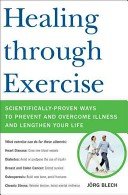 Healing through Exercise: Scientifically-Proven Ways to Prevent and Overcome Illness and Lengthen Your Life, by Jörg Blech (Da Capo Press, 2009) Originally published as Heilen mit Bewergung (S. Fischer Verlag, 2009)
We all know exercise is good for us, right? So who needs yet another book telling us so?
Knowing what we should be doing is one thing, but actually doing it is another, and Healing through Exercise provides motivation in spades.
Beware the cure that is marketed as a panacea, we are told: if it claims to fix all ills, it’s probably a fraud. That’s sound advice, but Jörg Blech makes a convincing case that simple, regular exercise is as close to a cure-all as we’ll ever find. Whether the issue is heart disease, diabetes, osteoporosis, cholesterol, hypertension, Alzheimer’s disease, back pain, cancer, impotence, ADHD, depression, brain development, immune system health, stress overload, or “old age,” moderate, regular exercise is essential—and in some cases even sufficient—for preventing illness and restoring health. We’re more familiar with the preventative side, but Blech cites study after study showing how exercise can even reverse existing damage. It’s never too late to take advantage of the benefits of exercise. (Note to self: this should be incentive to get started at any age, but never an excuse for procrastination.)
The specific studies and amazing results showing the power of exercise to heal are too numerous to detail, although as usual I’ve provided some teasers below. I highly recommend that everyone find and read a copy of this book, especially if you are young, old, middle-aged, or have children.
The bottom line? Get moving! It’s critically important, the best thing you can do for your physical and mental health. Get your children moving! It’s essential for the development of their brains as well as their bodies. It doesn’t need to be onerous. Thirty minutes of moderate exercise (such as brisk walking, jogging, or bicycling) five times per week seems to be the threshold at which all sorts of wonderful effects begin. Make that 60 minutes, and throw in some light strength training a couple of days per week, and you will be giving your body and mind a real treat. Furthermore, the effect is cumulative, so every little bit of action you add to your day will make a difference.
According to the evolutionary biologists, we have to rethink the old view of exercise: movement is by no means just a useful added way to improve our health. In fact, it is absolutely necessary for the human body to work normally.
You can debate all day about the value of an evolutionary perspective, but whether you say “evolved” or “designed,” we surely weren’t meant to spend most of our days sitting.
In the United States, children grow up in a world that leaves no time and no room for physical activities. For most of the baby boomers, it was common either to walk or to ride a bicycle to school. In these days, kids are moved around in minivans, and teachers have a hard time advocating walking days. Once in school, students will rarely be challenged physically because many school systems struggle to finance a physical education program worthy of the name. At recess, video games and other gadgets have taken the role balls and skipping ropes used to occupy. The idle members of generation XXL spend their youths indoors, and they would rather travel online than by foot. Granted that some ten-year-olds design impressive Web pages, but many have difficulties climbing, jumping, or pitching a ball.
The abandonment of exercise is a global trend affecting not only kids growing up in American suburbia but also youngsters living in walkable areas of Europe. Wilhelm Nieblung has a doctor’s office in the idyllic Black Forest. As he puts it: “Many children in our town are not able to balance backwards.”
In [the] early years, while the brain downsizes and develops at the same time, it is extremely important that a child has sufficient physical exercise. Good coordination of the body helps to preserve nerve cells in the brain and promotes their wiring to each other. Evidence indicates children need a certain minimum amount of exercise to develop a brain malleable or plastic enough to adapt to ever-changing environments.
Children can develop their mental abilities properly only if they do enough running, jumping, and physical playing as well. Motor and cognitive skills develop in unison and stimulate each other within the brain. Researchers in the field of neuroanatomy at the University of Bielefeld sum up what that means for parents, children, and teachers: “Learning needs movement.”
If we train our motor abilities by exercising, at the same time we strengthen regions of the brain that are important for paying attention and other cognitive capabilities. Playing sports makes us smarter, and all children can benefit from this effect.
Physical activity not only enriches chemistry in the gray matter; it also alters the structure of the brain. First, exercise promotes the production of new nerve cells in the hippocampus…. Second, exercise creates new synapses, thereby establishing and maintaining the vast network of connected nerve cells in the brain.
The brain of an active creature produces especially high numbers of nerve cells that can be used to process … new stimuli. The new cells mature into fully functioning neurons when they are challenged with new tasks. In the absence of such challenges, it is thought, a big portion of the new nerve cells die before long. And in the absence of physical activity, the production of new nerve cells largely ceases.
Alzheimer’s is a disease that strikes with age…. Besides age, there are other risk factors. It may not be a good omen when family members have suffered from Alzheimer’s because that suggests a genetic predisposition to it..... These factors are hard to change … but there is another way to postpone the onset of the disease or to prevent it altogether: activities such as brisk walking or bicycle riding…. Older men aged 71 to 93 who walk at least two miles every day cut the risk of Alzheimer’s in half, compared to people the same age who walk only a quarter of a mile per day.
William E. Kraus at the Duke University Medical Center has found that a certain type of exercise is especially good at keeping lipoproteins in check: longer spells of moderate exercise seem to be more beneficial than shorter, more intensive workouts.
Exercise is … a proven and reliable remedy for people with hypertension, although this is not widely appreciated. [F]requently the treating doctors are to blame, says Hans-Georg Predel of the Sports University in Cologne, Germany. He has made the sobering observation that physicians “often don’t consider the effectiveness of an intervention without drugs and that they lack a sufficient expertise in prescribing lifestyle changes.”
If you, like me, have been subjected to regular bone-density (DEXA) scans since reaching a certain age, you will be interested to note that some countries—Germany is one—no longer pay for the procedure on the grounds that bone density measurements have been shown to be useless for preventing broken bones in the elderly. So have drugs prescribed for osteoporosis. What does help? Exercise.
Time and again, trials of menopausal women have confirmed that moderate aerobic and strength training make the spine stronger. And in order to reduce hip fractures, walking seems to be the best medicine.
Although exercise is one of the most potent and effective remedies in existence, it plays only a small role in medical-school training. For this reason, American doctors rarely recommend exercise. Even though some doctors do prescribe exercise, physicians can make a much greater profit with drugs and operations. Faith in the power of medicine is another reason why people tend to underestimate the value of exercise. The number of back surgeries has increased dramatically in recent years, while pills for high blood pressure and drugs to lower cholesterol have sales in the billions of dollars. This fuels the medical industry and might meet the expectations of many patients, but it still amounts to nothing more than tinkering with the symptoms.
Even when doctors are willing to use the new science of healing through exercise, they often find that patients would prefer an invasive procedure and drug regimen, rather than the supposedly silly advice of bicycling 30 minutes a day.
The sun is shining, the air is cool, and I need to go for a walk. See ya!
When I was a child restaurant meals were very rare, the stuff of vacation travel and anniversary dinners. My father carried a homemade lunch to work, just as we children carried ours to school. When we did eat out, the food was rather ordinary—though I'll admit I thought a Howard Johnsons hot dog followed by their special peppermint stick ice cream was the highlight of many a vacation.
I wouldn't trade our homemade meals and family dinners for any five-star restaurant, but what I love about eating in the 21st century is the great variety of food now available from cultures and traditions all over the world. From Indian to Korean, Ethiopian to Moroccan, Thai to Lebanese—this is a great time to be eating!
Permalink | Comments
Category Food The Good New Days
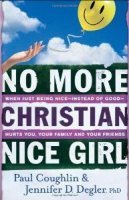 No More Christian Nice Girl, by Paul Coughlin and Jennifer D. Degler (Bethany House, 2010)
No More Christian Nice Girl? Yuck.
Don’t judge a book by its cover—or title—I told myself; there must have been a reason why I accepted this book from the publisher for review.
Flip to a random chapter. Yeech. If the title made me gag, this chapter nearly made me lose my dinner. Well, accepting the book is a promise to review it, which implies I must read it.
I didn’t care much for the beginning, either, but fortunately, it got better. I don’t like the authors’ style, so it helped to separate that from the content. They do have some good points to make.
Foremost is the idea that even in the 21st century too many women have bought into the idea that they must be “sugar and spice and everything nice”—and for Christian women, this is often exacerbated by the messages they receive from their churches. However, being “nice,” as opposed to being good, turns us into unhappy, frustrated doormats who try to please everyone, do other people’s work for them, injure our own families by never being able to say “no” to others, and generally end up doing more harm than good in the process. What’s more, we lose rather than gain respect and appreciation for all our efforts.
The authors make the point that “gentle Jesus, meek and mild” is not precisely the Jesus presented in the Bible, and that by glossing over passages that show his righteous anger, hard words, and assertive actions, we give ourselves an inaccurate model to follow when considering, “What would Jesus do?”
Even though I, myself, have some of the problems the authors delineate, I was not inspired by this book. I’d like to see the same topic dealt with in a way that feels less condescending. But that may be just me; I’m sure there are many “Christian Nice Girls” whose fractured and stressful lives could benefit from the wisdom the authors present.
Here are some things I did like:
Before looking at how God created most women, a quick caveat: The research findings presented are for the majority of women. Some women’s brains are wired more like the typical man’s brain, and the reverse is true of men as well. Having “majority wiring” is not better or more pleasing to God than “minority wiring.” Both types of wiring are valuable and useful to God, whether they are found in women or men.
I appreciated this. I’m tired of books that say “women are like this,” or “women want that”—such as the Eldredges’ Wild at Heart and Captivating—when as far as I’m concerned they miss the boat completely.
The sugar-and-spice expectations start in infancy when baby girls are dressed in ruffles, pastels, and bows while boys are dressed in brighter colors and sports-oriented clothing. Adults treat girl babies more gently than boy babies, even though girl babies are physiologically heartier and stronger. Parents provide dolls to daughters and trucks and sports toys to sons, and reward play behavior that is gender stereotyped. Across the world, girls spend more time doing household chores and helping with child care, while boys spend more time in unsupervised play. It’s true that girls may prefer to play “relationally” with toys, and may want to be helpful given their empathetic wiring, but when Christian parents, often unknowingly, send solely the message “girls should be nice and helpful and boys should be active and independent,” they are hemming in their children and making it more difficult for girls and boys to grow into the full 360-degree image of Christ.
Still? After all these years? Apparently so.
Some churches don’t allow women to be involved in any form of leadership, unless it’s singing on the worship team or teaching children. This means that the important insights and contributions available from women’s god-given, intuitive, empathetic minds are undervalued, unheard, and unheeded. In other churches, where women are encouraged to be more assertive and expressive, it’s often highly compartmentalized. Being animated and spirited is okay—but only during worship. It’s good to be courageous—when sharing the gospel. It’s right to be firm—when disciplining your children. … And when women are allowed to lead, some are trained that when it comes to a disagreement, men win by virtue of gender, not accuracy.
Christian Nice Girls tend to minimize their negative experiences by saying, “What happened to me wasn’t that bad. Other people have had it worse.” Yes, perhaps other people have had it worse, but that doesn’t mean that what happened to you should be ignored or judged as unworthy of examination. You have to look for what’s perpetuating a problem before you can fix it.
What are people learning from their relationship experiences with you? Firmly speaking the truth in love and maintaining healthy boundaries in relationships will teach most people to treat you respectfully. However, not everyone is teachable, and ultimately, you aren’t responsible for how people accept your truth spoken with love and grace. ... If someone is not teachable, you will completely waste your time and energy if you try to teach them what they aren’t interested in learning or changing. … [P]ray for them, get out of the way, and let God get to them. He will orchestrate life lessons that will teach them what they need to know.
Most people grow up watching mothers pick up after their children, finish the last of the dishes, etc. Women like to help, and it is hard to stop this rescuing behavior in the workplace. But it’s a big mistake to rescue incompetent co-workers by doing their work for them. Everyone needs a helping hand now and again, but there is a difference between giving someone a helping hand and enabling them to be a perpetual slacker.
Women bond by sharing the intimate details of their lives…. Because of their strong need for approval, Christian Nice Girls share more than is necessary or wise to connect with others. This can come back to haunt them….
You have to set limits with [some] people, or they will tend to take increasingly large amounts of the energy, time, money, and talent God gave you to accomplish his purposes.
For Christian Nice Girls with anxious parents, the message transmitted was “Life is to be feared.” This type of caretaker hovers like a search-and-rescue helicopter, transmitting fear and overprotecting children by:
- Not allowing them to regularly go outside and play in a reasonably safe neighborhood, but watching them like a hawk when they are allowed outside, which thwarts their play.
- Setting limits that would only be appropriate for a much younger child on how far they can ride their bikes or walk with friends.
- Overreacting to and overanalyzing normal childhood developmental challenges or minor injuries.
- Painting a verbally frightening picture of the world by continually pointing out any possible dangers, however remote or unlikely.
- Performing tasks that they could do themselves … which reinforces beliefs of inferiority and powerlessness.
- Intruding into and trying to control all aspects of their children’s free time, relationships, and jobs.
- Constantly calling them on their cell phone … just to “see how they’re doing.”
- Making all of their children’s decisions.
- Rescuing their children from any mistakes and not allowing them to suffer any negative consequences.
Needless to say, this is as important for boys as for girls. It could have come straight out of Free-Range Kids.
God takes the sin of cowardice very seriously. Revelation 21:8 states, “The cowardly, the unbelieving, the vile, the murderers, the sexually immoral, those who practice magic arts, the idolaters and all liars—their place will be in the fiery lake of burning sulfur.” Cowardice is included among the worst temptations you can give in to.
Ouch.
I’m thankful for the progress we have made in welcoming people with handicaps into the mainstream of society.
If you’re a baby as yet unborn this is not a good time to be handicapped, as you have a good chance of not surviving till birth. But if you get that far, it’s better to be here and now than in an earlier time. Here are just a few of the improvements I’ve witnessed:
- Major advances in neonatal medicine
- Amazing prosthetics
- Braille signs in elevators and other public places
- Acceptance and promotion of American Sign Language for the Deaf
- Wheelchair cuts in curbs—which are also a great help with bicycles and strollers
- Ramp access to buildings
- Handicapped parking spaces
- Specially equipped restrooms
- Integration of handicapped students in regular school classrooms
- Special Olympics and similar events that encourage sports participation for the handicapped
- Greater understanding of and openness about mental illness
- Computers, with their ability to open the world to people with many different forms of disability
- Laws against unfair discrimination
If progress remains to be made, and it does, it's good to remember how far we've come, and to be aware that gains achieved can subsequently be lost. I've seen hints of a disturbing backlash against handicapped children, on the grounds that "they should never have been born."
Permalink | Comments
Category The Good New Days
I am thankful for the baby formula that is available today.
I know. Me, the Notorious Despiser of Artificial Baby Feeding, thankful for infant formula. But it’s true.
If I believe that formula is vastly overused and overrated as a baby-feeding alternative, and I do, nonetheless I still recognize that there are times and conditions under which babies simply cannot be fed in the normal way by their mothers. In the very old days, the available choices were (1) find a wet nurse, or (2) die.
As time went on, various substitutes for mother’s milk were tried, but by the mid-20th century we had only gotten as far as evaporated cow’s milk + water + corn syrup. It must have worked, at least sort of—that’s what I was fed as an infant. Perhaps there’s a good reason they started month-old babies on solid food back then. Can I blame many of my problems on inadequate nutrition during a critical time of brain growth? That and growing up in a haze of tobacco smoke must cover a multitude of sins—or at least personality quirks. 
If today’s infant formula still can’t meet the high standards of breast milk, it sure comes a whale of a lot closer than what was available 50 years ago. And if baby formula is overused, that’s all the more reason to be thankful that it has become so much better for babies.
Moms are happier. Babies are happier and healthier. That's a lot to be thankful for.
Permalink | Comments
Category Health Children & Family Issues Food The Good New Days
On the day after Election Day* I felt some commentary to be necessary, so I struggled to find something about our political system that is better now than in the past.
I considered the 19th Amendment: that’s a significant improvement. But I’m not so old that I was ever disenfranchised because of my sex, so it doesn’t really count.
The 26th Amendment did make a difference in my life, but I have mixed feelings about that one, seeing as extending the voting age downward corresponded with an upward movement of the age of responsible maturity.
Much about our political system has taken a turn for the worse during my lifetime. (I’m not saying it was always better—we’re not longer literally tar-and-feathering our opponents.) But one positive change I am thankful for on this third day of November is openness.
I hate the in-your-face media and constant coverage that have produced campaigning-by-sound bite and taken away any vestige of private life for those seeking to enter political service. But recent years have also brought—through media coverage and through legislation—more light and transparency to government and to the people who run it, and that is a very good thing.
Laws, like sausages, cease to inspire respect in proportion as we know how they are made — John Godfrey Saxe
True. But both sausages and laws are good things, and the call of people like Michael Pollan and Temple Grandin for slaughterhouses to have glass walls finds its parallel in political Sunshine Laws, the Freedom of Information Act, and other efforts to bring government out of the shadows of the smoke-filled room.** Transparency and openness bring some difficulties and inefficiencies, but do much to prevent, detect, and excise rottenness, be it in our food supply or in our government.
That’s something that’s better now than in the not-so-distant past, and I’m thankful.
I’m also thankful this morning that Daniel Webster is going to the House of Representatives from Florida—and with an overwhelming victory. I was not able to vote for him, as we are not in his district. But I’ve respected him for many, many years even though there we certainly have our areas of disagreement. Quoting from the Orlando Sentinel, which despite their liberal inclinations endorsed conservative Webster,
Mr. Webster was a Republican state legislator for nearly three decades whose civility and statesmanship earned him the admiration of Democrats. He wasn't just a nice guy; he was effective. He played a leading role in raising education standards, reforming welfare and opening lawmaking to more public scrutiny.
Webster credited the results to his grass-roots support and his decision to run a positive campaign.
"Most of the time, negative campaigning works, and a lot of people cringed when I said I would run a positive campaign. We just felt like it was the right thing to do," Webster said. "I'm not going there to change places with the Democrats. We've got to do things differently. We've got to change the process."
It’s refreshing to see good character and a positive outlook win over bombast, negativity, and lots of money.
On a more personal note, Daniel Webster was also largely responsible for the legal protection home education enjoys in Florida, and for that I will always be very, very thankful!
*Yes, despite the push for early and absentee voting, I walked into my local polling place and cast my ballot on Election Day. I also like to enter our church through the traditional red doors instead of the new glass doors.
**Is “smoke-filled room” a political anachronism in these relatively smoke-free days?
Permalink | Comments
Category Politics The Good New Days
Continuing with the Thanksgiving/Good New Days series, today (and every day) I am thankful for smoke-free restaurants, homes, airplanes, offices, grocery stores, and even bowling alleys! This is a societal sea-change that is most definitely for the better.
You youngsters simply cannot imagine what it was like.
Smoking was everywhere. Not that you would have noticed, because you probably would have grown up with one or both parents smoking in your home. Even the rare families with no smokers owned ashtrays and allowed visiting friends to smoke; the social pressure to do so must have been tremendous.
At work, at play, in the theater, at a restaurant, on a bus, on a plane, in the hospital. There was no escape.
Outdoors was the best place for breathing, if there weren't too many other people around. School was relatively safe, if you stayed away from the teachers’ lounge and could get through the day without needing to use the bathroom.
Even our doctor smoked.
Go to college? Your roommate was likely to be a smoker, and that was not considered grounds for requesting a switch.
Get a job? Smoke polluted your air space, unless you were one of the lucky few who shared a room with one of them new-fangled computin’ machines. They were too valuable to be subjected to damaging smoke particles.
Who knows? Maybe it was the increasing use of computers which began to tip the balance in favor of non-smokers. The events did parallel one another. But smoke-free living didn’t just happen: much work, money, and lobbying were poured into this personal environmental cleanup action.
When it comes to tobacco smoke, now is a much better time to be living than 50 or even 25 years ago.
Permalink | Comments
Category Health The Good New Days
Liz at Smithical has issued a challenge to honor Thanksgiving by blogging about something we're thankful for each day of November. It will be a bit of a trick to accomplish, as I already have more posts in the pipeline than time to work on them, and I hope to liberate myself from my computer for several days this month. But it's a grand idea, so I'm going to plunge in. She didn't say the posts must be long, or profound.
The concept fits nicely with an idea for a post I was in the middle of constructing: The Good New Days.
After more than half a century of observation, it's very easy to be aware of (and complain about) how much society has changed for the worse over the years. I mention examples from time to time (some would say frequently), and it's not just the mutterings of an old curmudgeon: it's true that in many ways we are in bad shape and getting worse.
However, it is equally true that we have made significant gains, and some things are much, much better than they were. I'll attempt to mention one of these for each day of November, both to encourage myself and to warn the next generations not to take the improvements for granted. Without vigilance, what has been won can often be lost.
To begin: I'm thankful to be living now. I've often expressed the opinion that I was born too late, that I belong in an earlier era. But truthfully, if I belong then, I would have been living then. This is the day that the Lord hath made for me.
Besides, I've seen the toilet facilities in those medieval castles.
Permalink | Comments
Category The Good New Days
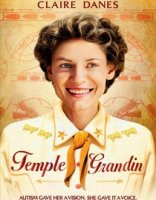 Temple Grandin (HBO, NR)
Why are you reading this post when you could be rushing to your nearest video store (is that phrase as passé as "dialing a phone number"?) and grabbing a copy of Temple Grandin? It would be trite to say that this is one of the most amazing and inspiring movies I have ever seen, though it is. It would be understatement to say that Temple Grandin is an incredibly amazing and inspiring person.
"Highly functioning autistic" doesn't begin to describe this brilliant visual thinker—and university professor—whose humane designs have revolutionized livestock handling. My introduction to Temple Grandin was through her TED lecture, The World Needs All Kinds of Minds. That's a good place to start, but don't miss the movie. (As far as I can recall it is completely grandchild safe.)
Normally I don't care for the DVD special features that make you watch the entire movie again to hear the commentary; I love learning about how the movie was made, but prefer it in condensed form. Here it's well worthwhile taking the extra time, because unlike many DVD commentaries, there's very little inanity—and most of all because one of the commentators is Temple Grandin herself.
It was a little disconcerting to note how well I understood some of her problems; enough so that I took this autism spectrum self-test I found in Wired. The results were as I suspected: I'm not close to the diagnostic level, but well above average.
I'm looking forward to reading some of Grandin's books, having ordered The Way I See It: A Personal Look at Autism and Asperger's, and Animals Make Us Human: Creating the Best Life for Animals from our library.
Permalink | Comments
Category Reviews Health Conservationist Living

