
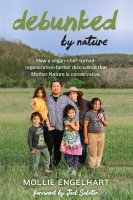
 Debunked by Nature: How a Vegan-Chef-Turned-Regenerative-Farmer Discovered that Mother Nature Is a Conservative by Mollie Engelhart (Acres U.S.A., Inc., 2025)
When and where I first heard about Mollie Engelhart I no longer remember, but it is enough to realize that the foreword of this book is written by Joel Salatin, whose agricultural revolution I've admired for years.
I've been enjoying Engelhart's well-written columns for a long time, and have occasionally quoted from them here. So I decided it was high time that I read the book in which she documents her journey from celebrated vegan chef to regenerative farmer, which is well-written, informative, and inspirational. Once again I grew impatient waiting for either our library to acquire it, or Amazon to offer a good Kindle deal, and decided to support an author I admire by paying full price. The Kindle version at this moment is $10, the paperback twice that—and if you have Kindle Unlimited you can read it for free. I highly recommend it for anyone who cares about food: its quality, its availability, where it comes from, animal welfare, and healing our land.
Quotations can't do the story justice, but here they are anyway. You can expect more posts pointing to Mollie Englehart's work in the future, as I become more and more impressed with her life and thoughts.
I came to Fillmore expecting a fight. What I found were Christian homeschool moms ordering from Azure Standard like I did, families raising their own food, people committed to health and freedom. There were Trump signs, sure—but the people weren’t villains. They were kind. They were showing up for their land, their kids, and their neighbors. The story I’d believed about who these people were just didn’t hold. (pp 8-9)
The deeper I got into the land, the more the noise fell away. Mimi’s death cracked me open. The soil kept me grounded. And the community I once feared became a family I didn’t know I needed. I thought I’d lost everything. But that loss was actually the beginning of the life I was always meant to live. (p 10)
Then we moved to the farm, and everything flipped. That city idea—men as optional—fell apart the second we stepped into real work. Fillmore wasn’t a place for theories; it was dirt, sweat, and survival. My husband’s hands started shaping the land—planting orchards, installing irrigation, turning rocky soil into something alive. I’d design the layout of where everything would go—from animals to compost piles to gardens and greenhouses—and he’d dig the trenches, haul the pipes, and make it happen. I could plan, nurture, and hustle, but when it came to raw strength—to holding the line against nature’s chaos—I saw what he brought. It wasn’t optional—it was the backbone. (p 25)
Nature doesn’t mess around. When it hits, you don’t debate. You need strength, action, someone who’ll step up. My husband did, and does—every day, not just in floods. He’d butcher a sheep when dogs tore through it and process it for the community, while I’d just freeze up. He’d fix things when they break and haul hay when the animals needed it. I’d plan the feed, but he moved it. I’d birth kids at home, nurture them, keep the rhythm; he’d plant the orchards that fed us.
Back in LA, I’d have bristled at this—at 36, I’d have said, “I don’t need that.” But at 46, on the farm, I’m grateful. Grateful for my marriage, for my four kids, for serving my husband and family in ways I once didn’t understand. Suffering doesn’t come from embracing womanhood—it comes from fighting it. We’ve got to stop outsourcing masculinity, pretending it’s optional just because we can order groceries online. It’s not toxic—it’s essential—a balance to femininity.
If you think men don’t matter, ask yourself: in a disaster, would you want only women and kids around? If no, you already know the truth. We need men—strong men—not just one, but a whole society of them. Without that, we can’t stand. (pp 25-26)
Standing in the field with my cow, I know she belongs here. And I belong here—we belong together. She’s not a pollutant; she’s a partner. ... My cow’s cycle is clean; an electric car’s is a shell game. We don’t need more tech—we need less arrogance and more scaling up of regenerative agriculture. We need more mimicking of what nature already does. Grazing cattle mimic bison herds, cover crops shield the soil, and microbes do their work. It’s not sexy, but it’s real, small-scale energy. ... With my cow I feel it—we’re part of this, not above it. Farmers who swap Big Ag for living soil aren’t just feeding us—they’re healing what we broke. It’s hard work, not a get-rich scheme—that’s why it’s sidelined. My cow and I will return to the earth. The wind turbines will rust in heaps. The real fix isn’t coming out of some factory—it’s under our feet, in the living soil. (p 41)
That radical faith, trusting the path, is what’s missing today. We don’t trust each other, ourselves, or God, so the government steps in—telling us how to eat, raise kids, run businesses. Have we let this happen because we’re disconnected from the sacred, from nature? If we could quiet the noise and hear God’s whispers, maybe we’d finally know what to do.(p 47)
It’s time to reconnect—with nature, with our food, with each other. Start small: herbs on your stoop, a market haul, a meal with no factory fingerprints. Ask where it’s from. Grow something—anything. Link up with neighbors; swap what you’ve got. We must start somewhere—plant a garden or a small orchard, get a flock of chickens, have a couple of milk goats, and trade with your neighbors. We must start depending on local food. We must start creating local food. This is a national security imperative. (pp 57-58)
In today’s society, discomfort is treated like a plague—something to dodge, medicate, or banish. We’ve convinced ourselves that unease is a danger signal, a threat to our peace, rather than what it really is: a spark for growth, a rite of passage, a sacred call to rise. This comfort fixation has wormed its way into everything—parenting, work, relationships—and it’s left us fragile, cracking under the lightest load. We’ve forgotten how to see discomfort as a guide, not a foe. (p 59)
Real life doesn’t coddle either. Farm life is blunt. The cows don’t care if you’re spent—they need feed. The beans don’t wait for your mood—they need water. Parenting’s no different. I’ve breastfed for ten years straight, my body a lifeline for my kids. I’ve changed diapers daily for a decade—thousands. I’ve been pregnant six times in twelve years: four births that remade me, two losses that tore me open. There’s no pause, no “self-discovery” jaunt to Bali. It’s relentless, holy service—raw, draining, radiant. I wouldn’t trade it. (p 60)
We’ve conditioned young women to see their bodies as tools for personal gain—sex, power, looks. But nothing prepared me for the gorgeous, total annihilation of self that motherhood demands. It’s not easy—nights of tears, mornings of doubt—but it’s the richest reward I’ve known. We need to train our girls for that, to be comfortable with discomfort, because those holy moments—birth, nurturing, sacrifice—demand it. I want my daughters—my two-year-old with her muddy boots and my seven-year-old with her sharp mind—to get this. Their bodies are sacred, not just because they’re theirs, but because they tie them to something bigger: their families, their babies, their communities, their husbands. That’s not oppression—it’s a gift, a sacrifice, a blessing all at once. (p 63)
Discomfort is how we grow. Trauma’s real, but it doesn’t have to rule us. Animals show us—after a predator scare, a goat will shake, shedding the fear, then graze like it’s nothing. We humans cling. We replay the hurt, weaving stories around it. I’ve had trauma—sexual assault in my music industry days. Men with money and power wanted access to my body, and so they took it by force. It was wrong. It cut deep. It left marks. But I chose not to carry it forever. I understand what it is to have compassion for young men filled with testosterone, lacking wisdom, trying to find their way in the world. I did dumb things when I was young as well. It doesn’t take away what they did, but it gives me the power to shake it off. I felt it, faced it, let it go—not because it was small, but because I wouldn’t let it define me.
I know folks wrecked by less. A hand grazing their bottom at a bar, a crude remark—they’ve turned those into lifelong weights. They carry more trauma from that than I do from being violated. Why? They were never taught to sit with discomfort, to process and release. They were told every unease is a wound, every slight a scar. I’m not dismissing their pain—their pain is real. But I’m reclaiming our power. What happens to us isn’t who we are. How we respond is. (pp 63-64).
Embracing traditional ways of living—hands in the dirt, food from the field, life close to nature—led me to a truth that hit like a thunderclap: we belong here. Not as intruders, not as a blight, but as part of this earth, woven into its fabric.
Yet there’s this creeping idea out there, whispered in classrooms and shouted through policies, that it’s fine for us to be poisoned—that it’s no big deal if male sperm counts have crashed 50 percent in forty years or if fertility struggles shadow every developed nation. The modern green movement often runs on a quiet engine: humans are the problem, a species to be culled or contained. They don’t say it outright—not usually—but the vibe seeps through: we’re a plague, a stain on the planet, better off walled away from nature so it can limp back to health without us.
That’s the ugliest lie I’ve ever heard.
We belong here. We’re not separate from the whole—we’re in it, of it. Sure, we’ve messed up. We’ve scarred the soil, fouled the water, choked the air—I won’t pretend otherwise. But the fix isn’t to shrink back, to abandon nature like it’s a museum exhibit we’re banned from touching. The real power, the truest union, comes when we step into nature with respect, with understanding—using our brains, our hands, our science to amplify the beauty in God’s design.
We’re not helpless—we’re potent, brimming with potential. But when we buy the lie that we’re a plague, that there’s too many of us, we crumple. Fear takes over, apathy sets in, and we stop doing what’s right. We let the poison flow unchecked. (p 65)
[R]eal diversity isn’t just tolerating difference; it’s wrestling with it. It’s sitting across from someone who sees the world upside-down from you and choosing to listen anyway. In a culture that’s quick to cancel, that’s radical. It’s taught me patience, sharpened my arguments, and kept me humble. ... And that’s the real test—can you stay close with people as your life changes, as your views change, and as you see the world differently?
The importance of loving people we don’t agree with is immeasurable. We must be able to separate the being—the expression of God in front of us—from the ideas that being holds true. We are not our ideas. I’m the same person I always was, and yet this entire book is about how my ideas shifted drastically over the years. (p 103)
Unfortunately, much of the equity conversation is pushing us further apart rather than closer together. The ever-moving goalposts should always be a warning. When I was younger, equality meant fair treatment—same rules, same chances. Then it became equity: different rules to level the playing field. Now it’s something else entirely—reparations, dismantling systems, rewriting history. Every time we think we’re close, the goalposts move again. It’s like chasing a mirage in the desert: the closer you get, the farther it slips away. (p 104)
I’ve come to understand this: Nature allows for movement within the limits of structure. The birds don’t migrate in chaos. They follow patterns—routes that are shaped by weather, food, season, and survival. And when a food source is threatened, animals defend it. When a species is vulnerable, it retreats inward to protect itself. This is not cruelty. It’s wisdom. It’s instinct. It’s order. ...[A] secure border isn’t unnatural. In fact, it may be one of the most natural things a nation can do. (p 109)
Here’s the hard truth: the southern border is not secured by the United States government. It’s secured by the cartels. Every person crossing is paying $10,000 to $13,000—often more—to make the trip. They are pre-scheduled to be robbed en route, and often extorted again once they arrive. The cartels run a billion-dollar operation, and we fund it every time we eat inexpensive produce picked by someone who had to cross illegally to get that job. And we do need that labor. Desperately. Anyone who tells you otherwise hasn’t run a restaurant, harvested a field, or worked in a meat packing plant. We’ve raised a generation of weak-bodied, weak-minded young people who believe hard work is beneath them and discomfort is a trauma. Our economy is addicted to the labor of immigrants—but our policies pretend we’re not. And that dishonesty is killing people. (p 110)
Here’s the truth we have to face: we need the labor. A border is not racist. A wall is not racist. I have a fence around my property—not because I hate my neighbors’ cows, but because I don’t want them eating my grass. And yet, this is a constant issue. My neighbor’s cows get through my fence. They eat my grass. I fix the fence. It’s not because I dislike their cows. Their cows are beautiful, majestic beings, just like mine. But I don’t want to feed them—unless, ultimately, they are going to contribute to my family’s life at the end of their own. In the same way, we want people in this country who want to contribute to this country. And we must create a pathway for those who want to come, work, and then go home to their families.
That's why I've proposed a ten-year low-skill work visa. It would allow people to work, pay taxes, visit home, and live in dignity. It would protect women from rape, children from trafficking, and all migrants from murder and extortion. It would give people a legal alternative to risking their lives and their bodies. Applicants would need a clean criminal record. They’d be required to stay employed. The visa could be renewed once, but would never lead to citizenship—not even through marriage. The best case might be a green card. The goal is contribution, not permanent relocation. There would be a fee of $10,000 per person—meaning that same amount of money people currently pay the cartels would go to the US government instead. The grip of those cartels on society would be weakened. Unlike our current system, it would allow people to keep connection with their home—so they’re not forced into a forever exile from the people who raised them. It would dismantle the business model of the cartels overnight. It would allow people to fly directly into the cities where work is needed—no more desert crossings, no more smugglers, no more horror stories. Just honest labor for honest pay. (pp 111-112)
We’re not all called to be regenerative farmers, though I’ll admit I sometimes wish everyone could feel the dirt under their nails the way I do now. I feel happier (and, I think, even look happier!) as a cattle rancher than I ever did as a vegan chef. We’re not all meant to leave our lives behind, abandon the cities, and go live off-grid in the wilderness with nothing but a tent and a prayer. That’s not the point. But we are all here, at this specific moment in time, for a reason. Modern life pulls us away from that reason—distracting us with the endless chase for money, status, fleeting recognition, the next promotion, the next shiny thing. It’s a treadmill we can’t step off, a noise so loud it drowns out the quiet voice inside. Yet, in those rare moments when we do step away—when the phone’s off, the screens are dark, and the world hushes—we sense it. A stirring. A knowing. Something calling us back to what’s real.
For some, that calling might be to tend the soil, to grow food, to provide nourishment for others. I felt that pull when I left Sage Vegan Bistro behind and sank my hands into the rocky earth of Fillmore. For others, it might be to nurture something else—a marriage through the hard seasons, a family through the chaos of raising kids, a community through the small, unglamorous acts of showing up. It could be as simple as growing herbs on a windowsill in a cramped apartment, watching those green shoots defy the concrete jungle outside.
These acts matter. They’re not trivial. They tether us back to what has always sustained human life: food, family, faith, and community. They’re threads in a tapestry we’ve let fray, but they’re still there, waiting to be picked up. (pp 122-123)
[E]ven if your path doesn’t lead you to a farm, you’re still being called to tend to something. That’s the universal thread—we’re all stewards of something, whether we recognize it or not. ... [H]ow do we reconnect? It’s not about grand gestures—it’s about small, deliberate steps. (pp 124, 126)

