
Once again I'm piggy-backing on something Jon posted in Google Reader, but I haven't figured out how to comment on any of the "shared items" in Google Reader yet, and of course I have an opinion that I want to express! I'm not going to take time to quote the article, called Understanding Generation Y, since my point is more about the principle than the content, but clicking the link will take you to the pdf itself. It is somewhat interesting, but not, I think, particularly revealing.
When our church invested in a Korg electronic keyboard, everyone was amazed at the quality of the instruments sounds, and how much they sounded like the real instruments—everyone, that is, except those who were most familiar with those instruments. The pianists hated the piano sound, but thought the flute was great. The flute players thought the flute sound anemic, but the harp beautiful. The more you knew about a particular instrument, the less you were satisified with the attempt to distill its sound into something electronic.
So here, I suspect. I read the supposed characteristics of the Baby Boomer generation and found it only partially true in general and certainly not true of us, yet caught myself accepting the truth of the depictions of other generations. Finding characteristics of myself and those I know in all of the generational descriptions, I'm not convinced these stereotypes are any more accurate or helpful than the horoscopes on the placemats in certain Chinese restaurants. Like the placemats, they can be fun—but dangerous to put much faith in when making real life decisions.
Permalink | Comments | Edit
Category Random Musings
As I try to steer a course between providing too much information and too little, let me attempt to explain what I plan to institute as a general policy with regard to links in my posts. I provide links to other sites for various purposes: to give credit where it is due, to provide resources for further exploration of a subject, and/or because I think I can't do justice to the source with a few excerpts. At the request of several of my readers, what I will try to do is provide enough information within my own post to make it informative and perhaps interesting, providing links for the above-mentioned purposes but not expecting the majority of my readers to follow them. When I do think a link is particuarly important, I'll make that clear.
I've been thinking about the subject recently, as the amount of information that comes my way continues to expand exponentially. I like to think of myself as an aggregator for my friends and family, passing on important ideas, worrisome trends, and interesting stories that others might not find; I know that I am grateful to people who provide that service for me. But I also know that merely being sent a link is no longer particularly helpful. If I don't know something about the subject, and what's more important, what the sender himself thinks about the link he has sent, I find I'm less and less likely to check it out. Too much information, too little time. Since many of my readers have less time than I do, I'll try to provide better service here.Permalink | Comments | Edit
Category Computing Random Musings
I am reproducing John C. Wright's latest post in its entirety because I desperately want my liberal readers to tell me why he is wrong, and many of you don't bother to click through when I merely provide links. Three things keep me from utter despair over the course we are following: (1) denial; (2) knowing that God—not the President, not the media, and not the corporate CEOs—is ultimately in charge, and will bring good out of even our most boneheaded mistakes; and (3) our children, and young people in general, are still enthusiastic and optimistic. Maybe they're in denial, too, but as long as they don't give up we will make it through.
Adding more to the debt than all previous presidents combined
In The Wall Street Journal, Michael Boskin writes:
Mr. Obama's $3.6 trillion budget blueprint, by his own admission, redefines the role of government in our economy and society. The budget more than doubles the national debt held by the public, adding more to the debt than all previous presidents—from George Washington to George W. Bush — combined. It reduces defense spending to a level not sustained since the dangerous days before World War II, while increasing nondefense spending (relative to GDP) to the highest level in U.S. history. And it would raise taxes to historically high levels (again, relative to GDP). And all of this before addressing the impending explosion in Social Security and Medicare costs.
Mark Steyn makes this comment on Boskin:
What emerges from such a blueprint will not be America. The United States will survive as a geographical designation, a collection of zip codes, but what goes on within them will be a Euro-Canadian form of societal arrangement
My comment: With this amount of money, NASA could have built an Arthur C Clarkian space elevator. Out of one hundred dollar bills.
What astonishes me is the sheer economic illiteracy of this course and its defenders. During FDR's disastrous New Deal (which made the depression from a one-season market correction into a decades-long nightmare. Dow levels did not return to their 1920's figures until the late 1950's, a years after FDR was dead and WWII was over) at least FDR had two excuses: first, Keynes talked such charming goobledegook that anyone might get confused; and (2) a depression of this magnitude had never happened before, so experience was no clear guide.
The supporters of the current administration do not have those excuses. First, the current spending makes no sense even from a Keynesian point of view. Second, the lesson learned from the Great Depression is clear enough with anyone who has eyes to see.
Keynes suggested that massive public works projects would tax savings and increase borrowing, lowering the interest rate. This is a bone-headed idea, but it is not insane. It is wrong, but not evil. The current administration suggests that massive transfer payment from the most productive to the least productive sector of society, with moneys spend on consumption goods rather than investment, will somehow stimulate .... something. The rhetoric is a little vague on the intended consequences. The consumption goods in this case include socialized retirement savings (known as social security), socialized medicine, socialized education to the college level, socialization of the banking and lending industry (thanks, Bush!) and pork projects whose wastefulness beggars exaggeration.
In the Wall Street Journal, Reason Foundation Founder Robert Poole’s op-ed lists just some of the pork our children and grandchildren, for the rest of their lives, will be making interest payments on.A wish list that is 11,391 projects strong! What vital infrastructure projects would cash-strapped taxpayers get for their $73 billion? Here's a sampling: - Hercules, Calif., wants $2.5 million in hard-earned taxpayer money for a "Waterfront Duck Pond Park," and another $200,000 for a dog park.
- Euless, Texas, wants $15 million for the Midway Park Family Life Center, which, you'll be glad to note, includes both a senior center and aquatic facility.
- Natchez, Miss., "needs" a new $9.5 million sports complex "which would allow our city to host major regional and national sports tournaments."
- Henderson, Nev., is asking for $20 million to help "develop a 60 acre multi-use sports field complex."
- Brigham City, Utah, wants $15 million for a sports park.
- Arlington, Texas, needs $4 million to expand its tennis center.
- Miami, Fla., needs $15 million for a "Moore Park Community Center, Tennis Center and Day Care" facility. The city is also desperate for $3.6 million to build a covered basketball court and a new tennis court at Robert King High Park. Then there's the $94 million Orange Bowl parking garage you are being asked to pay for.
- La Porte, Texas, wants $7.6 million for a "Life Style Center." And Oakland, Calif., needs $1 million for Fruitvale Latino Cultural and Performing Arts Center.
At some point, this degree of economic irrationality tips over from good-hearted-but-wrong-headed eurosocialist nonsense, into corrupt-headed Soviet-style totalitarianism. After a certain point, a certain degree of negligence when it comes to how the world actually works is not longer excusible; and it is not negligence, but depravity.
In my judgment, we have reached that level of depravity.
This is not the normal back-and-forth of partisan politics. This is damage to the Republic which could spell the end of it. Nations do not survive as nations once they are bankrupt and addicted to government power. Oh, will no doubt continue to call ourselves the United States of America, with the same sincerity that Spanish and German princes were called The Holy Roman Emperor, long after the Fall of Rome.
Meanwhile, bank stocks bottom out, the Dow continues to plummet, unemployment in all sectors EXCEPT GOVERNMENT continues to rise (Big Brother is hiring), and the Conservative movement's main concern seems to be a name-calling match between Rush Limbaugh and David Frum. (For those of you who did not notice, President Obama used his vampire hypnosis powers learned from the Secret Masters of Tibet to declare Rush the leader of the Republican Party, and, for some reason not clear to me, Republicans scurried to agree with him.)
The sheer triviality of the media coverage of this is beyond belief and without parallel in history. Meanwhile we are at war with a ruthless, well funded, and highly motivated enemy, who operates from a decentralized power structure, difficult or impossible to locate and destroy. Meanwhile our defense budget is being slashed to levels (as percent of GDP) as low as it was between the Great War and World War Two. Those with long memories recall the sequel to that.
Instead of drilling here and drilling now, the new administration's energy policy ignores the three viable sources of energy on planet earth, coal, petrol, and nuclear. Instead the government will be replacing storm windows in all government buildings, on the taxpayer's tab.
While I support free trade as an economic matter, as a military matter, it is unwise to by oil from Middle Eastern regimes who fund our enemies. As a miltiary matter, it is unwise to borrow money from Red China. Whenever Peking decides it would be expedient politically to bankrupt their own rising (and unruly) middle class, they can sever trade relations with us, and call in their debts. Certainly they would suffer from this. But their Party elite would not suffer. We would suffer more. Again, our elite would not suffer.
Meanwhile, our European allies, far from being delighted to return to American alliance once the dreaded Darth Bush term expired, discover that protectionism is the order of the day. The collapse of our economy -- due in large part, perhaps entirely, to the Democrat party's socialist experiments in the housing market -- collapses their economy. The economically sane thing to do at such times is to lower trade barriers. A depression is the worst time for protectionism. But the new adminitration has rushed through protectionist schemes, tarriffs, and so on, in the name of the emergency, so our European allies are being left to fend for themselves.
Meanwhile, Iran is working on a nuke, and the Iranian leader promises to destroy Israel, a nation whom the new administration has no interest in supporting.
Meanwhile, in other topics, the corruption and degeneration of art, of literature, of morals, of notions of truth and beauty, vice and virtue, continue to degrade. Ignorance is rampant; the public school system has failed; the aesthetes praise only mind-jarringly grotesque and talentless rubbish; the nuclear family decays; and the California Supreme Court seriously debates whether to overrule the voter's sovereignty regarding Prop 8 in California. The only thing sacred to the Left is sexual perversion. Whatever is abnormal, sterile, morally empty and self-destructive, to them, looks fine and fair.
Meanwhile, the administration plans to make any and all state restrictions on infanticide unlawful. The administration seeks to appoint the most abortion-friendly candidate imaginable to the leadership of the department of health and human services. The billions of infants slain so far is not enough: Moloch is not pleased because the pyramid of tiny skulls is not piled high enough.
Call your Congressman. For each call they receive, the politicians calculate that a certain number of other voters feel the same, but did not call. In other words, if you make the effort to complain, the complaint is amplified in their ears.
Permalink | Comments | Edit
Category Politics Random Musings
Suspects arrested in baby formula theft ring. That was the headline for an article in today's Orlando Sentinel.
I understand black markets for avoiding high taxes (cigarettes and booze), for copyright infringement (pirated DVDs), for illegal items (cocaine), and in situations where price-fixing rules distort the market. But baby formula? Who could possibly sell baby formula for a price that would make it worthwhile risking jail and/or deportation? Who would buy black market baby formula when it's plentiful in every grocery store? What am I missing here?A total of 21 men and women in Orange, Osceola and Polk counties face charges of stealing hundreds of cans of baby formula from local shops....[T]he men and women facing charges are undocumented immigrants from Honduras and Mexico. Immigration and Customs Enforcement officials have been alerted and immigration holds have been placed on the suspects....Investigators said the suspects walked into local supermarkets, grabbed cans of baby food, stuffed them into large plastic bags and left the store without paying for the merchandise. Nearly 2,000 stolen cans of baby formula were then stashed in a storage unit....Reports show the suspects would ship the baby formula out-of-state for sale on the black market.
Permalink | Comments | Edit
Category Random Musings
"What is VPK?" asks an article in our city's magazine.
Pre-math, pre-reading and social skills. How do I teach my child all this information before she enters kindergarten? Many parents used to ask themselves that precise question not too long ago. However, for the past four years, concerned parents have decided to enroll their children in what is called VPK, or voluntary pre-kindergarten education....VPK is free [that is, tax-funded]...regardless of family income.
Since the program was implemented, the results have been remarkable. First, the program gives the child the opportunity to interact with teachers, that is, people other than their parents, in whose company they've been for most of their lives. Their social skills improve as they learn to share, respect and communicate their feelings to adults and other children. Second, it gives children the freedom to express their creativity, emotion and innovation: They create cities from building blocks, show their feelings through paper and crayons and learn new ways to use everyday objects—a paper plate becomes a hat, a pipe cleaner becomes a coiled snake. VPK also brings joy, happiness and excitement to the child's family—as well as the community—when our youngsters are seen developing their intellectual side and growing as individuals at an early age.
Precisely the skills and experiences which from time immemorial children have learned...at home.
I can accept that there may be a few aberrant families in which the children interact with no one other than their parents, have neither sibling nor playmate with whom to learn to share, and have no access to crayons, blocks, paper plates, pots and pans, rocks, sticks, furniture, blankets, and all the other paraphernalia with which children "express their creativity," i.e. play. These children do, indeed, deserve all the outside assistance we can give them. But if such families are not exceedingly rare, we are in bigger trouble than an extra year in school can begin to fix. VPK is not a program for the extremely deprived; it is billed and funded as an important pre-kindergarten activity for every child. It is presently voluntary, but kindergarten was once voluntary, too. Technically kindergarten is still optional in Florida...unless you want your child to attend first grade, for which kindergarten is a prerequisite.
How much the world has changed in my memory! Some for the better, some for the worse...but the trend away from home seems to me an evil one. Our clothes are made in China and our meals in a restaurant; someone else mows our lawns and teaches our children how to play with blocks. Is home no more than a place to sleep?Permalink | Comments | Edit
Category Education Children & Family Issues Random Musings
Two of my favorite bloggers have written recently about the perils of allowing ourselves to be too busy.
Surely You Can Work a Little Harder, from John Stackhouse
Some of us need to work harder than we do. Students fool themselves, thinking they are “studying” when they are just hanging out with their friends with open books in front of them. Professors think they are working when they are merely chatting with colleagues or fussing about some minor matter of campus politics....Many of us, however, work harder than we should. For whatever reason, and there are a lot of possible reasons, we are pushing ourselves beyond the limits of our mental, emotional, physical, and spiritual health.....So let us hear some wisdom from a very hard-working Christian brother who flourished four centuries ago. His name is Vincent de Paul, and he was an astonishing minister for good in the church....Be careful to preserve your health. It is a trick of the devil, which he employs to deceive good souls, to incite them to do more than they are able, in order that they may no longer be able to do anything.
Many of us, and I count myself chief of sinners, need to heed both warnings: do less and work harder. Jennifer at Conversion Diary talks about natural limits and making choices in Thoughts on Letting Yourself Get Overbooked.
Make wise choices and live within your limits, or your world will come crashing down. Sound advice for time or money. It doesn't guarantee financial security—as we have so dramatically seen, the wise and prudent can be hurt badly by other people's foolish choices—and it won't fix all our time problems, either. But it's the right path, and the most sane.[A] good way to figure out how much God expects you to get done in a week is to attempt to do no more work than you could get done in a six-day week, during daylight hours only, allowing ample time throughout the days for prayer breaks and calm, nourishing meals.
I've been thinking about how much I use modern technology (mainly artificial light) to push myself way past these natural limits—how I abuse the fact that I can add more hours to a day or week simply by keeping the all lights on until midnight or blowing off Sunday as a day of rest—and I realize that I do it to keep myself from having to make painful choices about what I can and cannot realistically commit to.
When you live your life within the constraints [of the] natural, God-given work/rest rhythms of the days and weeks, you have buffer. There's some wiggle room in your schedule when urgent, unexpected situations arise. ....[T]he amount of work that I attempt to do in a week spills far over those natural borders of how much one should work, but it all turns out fine and I can maintain the illusion of control...as long as nothing goes wrong. As long as everyone is healthy and there are no emergencies, I can get it all done without too much stress. But...when the slightest thing does go wrong, like a juggler who's barely able to handle all the balls he has in the air, it all comes crashing down.
Permalink | Comments | Edit
Category Health Random Musings
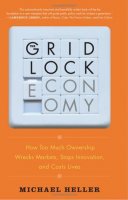 The Gridlock Economy, by Michael Heller (Basic Books, New York, 2008)
Peter V.—who now keeps most of his insightful commentary behind the Facebook wall, so I can't provide a link—alerted me to The Gridlock Economy, which I touched on in the first Casting the Net. Since then I obtained the book through Interlibrary Loan, and thanks to my Lenten disciplines, finished reading it last night. Now I can get the library monkey off my back and return this long-overdue book. (To be fair to them, the library has not been nagging me about it. But I was brought up to view an overdue library book as an unpaid debt, and my own conscience does quite enough nagging. In maturity—I think once I passed the half-century mark—I came to realize that keeping a book a little longer and paying a fine was an acceptable strategy and more reasonable than returning it unfinished. But I still imagine that I'm keeping hoards of folks in durance vile by limiting their access to the book.)
The Gridlock Economy, like many modern books, could have used a better editor. The author suffers from Presbyterian Preacher Syndrome—the habit of saying something three times when once would have done better; we gave up reading it aloud because that made the repetition more painfully obvious. Nonetheless, it's worth making the effort. If you don't read the book, at least check out the website. For those without the time to do even that, consider this.
In the discussion that followed my post on Chinese piracy, I wondered how patent and copyright law could stifle the creativity and innovation they were designed to encourage. Gridlock Economy provides an answer: ownership has splintered out of control. So many people (more likely, organizations) own rights to small parts of a creative endeavor that securing permission to use them all is unreasonably expensive, if not outright impossible. From the arts to medicine to telecommunication and hundreds if not thousands of other fields, when division of ownership meets our litigious society, it slams the brakes on progress. Here is an example that hit home to me, because we recently watched a PBS rebroadcast of Eyes on the Prize.
For millions of Americans, Dr. [Martin Luther] King came alive through the Emmy Award-winning public television documentary Eyes on the Prize....To make this fourteen-hour documentary, filmmaker Henry Hampton talked with hundreds of people who knew Dr. King—fellow activists, family members, journalists, and friends—and drew from many sources in a variety of media: video footage from 82 archives, almost 275 still photographs from 93 archives, and some 120 songs.
To put these materials into the film, Hampton had to secure licenses from their copyright owners. Otherwise he faced possible lawsuits. Many of these licenses expired in 1987 after the film was first broadcast. Over time, rights to these video clips, images, and songs changed hands. Often, the original permission did not include rights to a television rebroadcast or use in new media such as DVDs. Because the Eyes on the Prize filmmakers lacked broad permission to use the underlying sources, the film could not be shown again. It sat unwatched for years.
[The film] could not easily be made today. Licensing all the pieces of intellectual property would be too daunting. Along with the film's other creators, [Dr. Clayborne Carson] has spent many frustrating years trying to bring Eyes on the Prize out of the vault. The Ford Foundation donated six hundred thousand dollars to help buy licenses; other donors gave hundreds of thousands more. Even with these contributions, and a lot of volunteer efforts, the negotiations took nearly twenty years.
What caused the gridlock? Suppose the filmmakers used a film clip of an interview. People who were honored to appear in the original documentary can now demand payment for inclusion in the DVD. Owners of copyrighted songs sung in the background as Dr. King marched can demand compensation. So can the interviewer or narrator. And Dr. King's estate can request compensation for use of his likeness in the film.
To re-release the film, the producers had to jump through a thousand hoops, a process called "clearing rights" in the trade. Clearing rights is not cheap or fast....Bringing the film to DVD meant identifying and locating each of the partial owners or their heirs, then negotiating payment to, or a release from, every single one of them.
Clearing rights is especially complex for music. When the Eyes on the Prize team could not get the rights to a song, the music had to be removed and replaced without "damaging the integrity of the sequence," according to Rena Koserasky, music supervisor for the project. "We're not talking about digital formats, we're talking about actual reels of material. It's difficult and very time-consuming."
In 2006, the team effort finally succeeded in clearing the rights to (or replacing) each element of the film. Eyes on the Prize was re-released.
Michael Heller calls his theory of gridlock "the tragedy of the anti-commons." "Commons" is property available to all, such as the village land where our New England ancestors grazed their livestock, or the rivers, back when anyone with a net could gather food for his family. The trouble with property held in common is that incentive to protect and improve it is reduced. Rivers become over-fished because one person's decision to limit his catch is undone by his neighbor, who sees this as an opportunity to get more fish for himself. Short-term thinking is rewarded, and everyone loses in the long term. Wars are fought over such things: one reason Iraq was interested in taking over Kuwait was that both countries were pulling oil from the same field.
The concept of private property is a very effective means of encouraging responsible use of a resource, and even innovation. Alas, I no longer remember the source, but we read, or watched, something just recently about the agricultural progress that was made when common land was enclosed, thus giving farmers both incentive and ability to improve their breeds and conserve their land. (Land enclosure movements have negative consequences as well, but that's another issue.) However, when property—or more precisely, control of property—is fragmented into too many pieces the problem can turn from overuse to underuse.
I don't agree that underuse is always a problem. If a big company wants to build a shopping center and is stymied by a few holdouts who don't want to sell their family homes, that's just fine with me, even if the shopping center increases the market value of the property a thousand fold. Occasionally Michael Heller puts me in mind of my father's uncle, who couldn't see a tall, straight tree without thinking of its logging value. Nonetheless, Heller has convinced me that fragmented ownership, the anti-commons, frequently leads to situations that do nobody any good.
In 1887, John Brown bought eight acres of land in Rankin County, Mississippi. He was part of the great wave of freed slaves who invested their life savings in farmland. John lived a long life, and when he died in 1835, he did not leave a will. So ownership of his land split among his wife and children. In time they all also died without wills, so the land passed to their children and grandchildren. One of these children, Willie Brown, began consolidating ownership in the land by buying the interests of five of John's nine children: Frances, Minnie, Adda, Joe, and Lizzie. By the time Willie passed away, he had accumulated a 41/72 share in the family farm, which he left to his wife, Ruth.
In 1978, Ruth asked a court to divide the farm so that she would own her share of the land outright. The other sixty-six Brown heirs would then own the balance, in shares ranging from 1/178 of the farm down to 1/19,440. The court refused to partition the parcel by drawing a line on the land; it was too complicated. Instead, the judge ordered the land sold and the money divided among the heirs. As often happens in such forced sales, a single outside company was the only bidder. In this case it was a local white-owned lumber company that wanted to cut the timber.
Even though the family collectively valued the farm far above its auction price, no Brown heir placed a bid. Why? Partly because U.S. law often requires cash paid in full at such auction sales, a rule that makes bidding impossible for most ordinary owners. No single Brown heir could top the lumber company's lowball bid. There was no simple mechanism through which the heirs could quickly organize a joint family bid—a missing legal tool that commonly affects scattered heir owners. Ruth got a little cash from the sale—not nearly enough to replace the farm and nothing like enough to compensate her family for losing the locus of its cohesion and tradition.
Had Ruth known the outcome, she would never have gone to court. But many times there is no choice. Opportunists prey on owners of splintered property by convincing one small shareholder to sell his interest, and then forcing the sale—which even the smallest shareholder can do—thus acquiring the entire property at a fire-sale price. Opportunists are in every field, and to my mind a great deal of the problem is the separation of patents and copyrights not only into pieces and parts, but away from those whose ingenuity brought them forth in the first place. Patent and copyright "trolls," whose only business is to search out and buy up pieces of intellectual property for the purpose of squeezing money out of someone who wants to put them to use, strike me as little better than blackmailers.
Anti-commons tragedies are rampant on the leading edge of discovery, where legal rights are not only splintered but also still in flux. Research laboratories abandon promising lines of inquiry because the cost of finding and assembling all the necessary rights is so high—and even higher if you miss one, no matter how minor, and find yourself hauled into court. Academic researchers become scofflaws, ignoring patents in hopes that the owners will not bother to sue them, at least not until the efforts produce something profitable. Commercial labs cannot afford to take that chance. Underuse is hard to quantify; who can say what has not been created, what medical discoveries have not been made?
Another question The Gridlock Economy answered for me was why the government was interested in forcing the conversion of broadcast television from analog to digital, and why some folks want to stop broadcast TV altogether. It turns out that the low-frequency spectrum it uses is very prime real estate indeed, and currently very inefficiently used. This is one reason why our cell phone and wireless broadband services are far behind places like Japan and Europe. One cell tower at 700MHz can provide the same coverage as ten towers at 2400 MHz.
This book was published in early 2008, and offers this example of a Tragedy of the Anti-Commons from a year ago:
Not long ago, mortgage bankers sized up borrowers before making loans; lenders were a phone call away if home owners had trouble repaying. Not anymore. Investment banks engineered new mortgage instruments that gave larger loans on riskier terms to people with weaker credit. Banks pooled these new mortgages together, then split the pools into bonds with varying risk levels. The details were complex, but the results were magical: financial engineering seemed to transform dodgy mortgages into safe bonds. So long as interest rates stayed low and house values high, everyone made money.
But not for long. Fragmenting mortgage ownership broke the link between borrower and lender. When rates rose and prices dropped, the gridlock features of the new financial instruments came to the fore. There were so many partial owners of pooled mortgages that no one cared to act like an old-fashioned mortgage banker with careful underwriting and loan servicing. Until recently, foreclosure had been the banker's last resort because it's costly for everyone, including the lender. But in the new world of too many owners, widespread foreclosures became inevitable. Scattered owners of pooled mortgages could not easily reach agreement to restructure troubled loans. Today, there's no one for a borrower to talk to at the other end of the phone.
There's a regulatory gridlock story here as well. Mortgage regulation is still based on the old one-mortgage, one-banker model....New financial instruments fall between multiple federal and state regulators. No single agency can protect the integrity of the financial system as a whole, but each is powerful enough to block the others from stepping on its bureaucratic turf. Regulatory gridlock meant that no one checked as hundreds of billions in dangerous mortgage bonds were created and sold.
To his great credit, Michael Heller offers up no stock villains, and proposes no one solution to the problem. He sees the answer in (1) awareness of the problem, and (2) willingness to explore a variety of solutions public and private, legislated and informal. The Gridlock Economy is an eye- and mind-opening new perspective.
I hope this doesn't violate blog etiquette, but I'm going to repeat a conversation an anonymous Canadian and I have been having over at East of Eden, on the post I mentioned in Casting the Net, Vol. 6. I'm hoping she'll continue the discussion here, because (1) the blog owner is taking a break for Lent and I don't want to overwhelm her post while she is gone, and (2) I think several of my readers would enjoy the conversation and have something to contribute to it. If the best part of overseas travel is being with family and friends, the second best is the opportunity to meet other points of view. I'd welcome a Canadian viewpoint around here.
The original post is here, and I've excerpted below our conversation so far.
CA:
As a Canadian who's been online for 11 years (talking to Americans, watching America, visiting America) I'd like to make a few comments about what I see as the causes and effects of the current economic situation.
1. A major cause of the economic troubles now is a corporate culture that rewards short term thinking - bonuses based on quarterly returns for example - an action with a large short term benefit may not be in the company's best long term interests. Rev'ing an engine makes a really cool noise and makes you go fast for a while, but it burns out the engine. The economic engine is burnt out.
2. I realise that watching America through the Internet selects for a certain level of affluence, but "your" idea of comfort is very different than most of the rest of the world's - even a Canadian's! - idea of comfort! When a blogger posts, "We're struggling financially" then posts a picture of her house and neighbourhood, or talks about the great decorating find at the Pottery Barn or wherever, well, it's hard to be sympathetic. It's hard not to think that you don't actually understand what struggling is, and this inability to understand just how "rich" you are has led you into this mess.
3. The affluence gap. A "rich" Canadian may not be as "rich" as an American, but our "poor" aren't as poor either. I have traveled in the States, as has my dh on business and the evidence is very easy to spot from the window of a plane or the side of the highway. The gap between rich and poor in the US is extremely disturbing. Again, I think a great many Americans just don't understand and appreciate just how "rich" you are.
4. And may I say? This rev'ing of the economic engine to get more and have more, taking out mortgages for more than the house is worth in the expectation that you can sell it for more later, credit ratios of 30:1, and so on? Yes, this is what America did, and yes, you're taking the rest of the world down with you. I think that should be as much, if not more, of a moral concern as the workers in your company (I applaud your concern for them BTW) and your pondering the "deep dark hole that America has binged herself into"
Obviously, I'm going to post this as Anonymous, but I look forward to the comments on my comment.
LW:
It's a little odd, leaving a comment that the writer of the original article won't read for over a month, but since the Anonymous Canadian invited comments, I can't resist:
1. You are 100% right. It's not the only cause of the problems, but certainly a major factor. Rewarding short-term thinking is...well, short-term thinking. Rather than the engine analogy, though, I'd compare it to over-fishing the oyster beds, and hope we haven't taken the last oyster.
2. I agree that we are all, even the poorest American, much richer than we think. And we have, indeed, become accustomed to a ridiculous level of luxury. But in defense of the examples you mention, it is not impossible to have a large, beautiful house and struggle financially, even if you didn't overextend yourself in buying it. Very few people can buy any house and not be dependent on a job to provide income to pay the taxes, let alone a mortgage. You might say they could sell the house, but probably not without a tremendous loss, and maybe not even then in this market. And you can buy "great decorating" items at places like the Pottery Barn for less than a meal at McDonalds.
3. True again -- about problems with the large gap, I mean; I don't know enough about Canada, unfortunately, to compare. But I think there are too many causal factors to make a country-to-country comparison particularly meaningful.
4. Yes, there was a lot of stupidity and crime to go around, and I'm glad to see someone blaming the folks who knowingly bought more house than they could afford as well as the banks that financed them. But I don't buy the idea that "we" are bringing the whole world down. A former Canadian Prime Minister (sorry I don't remember which one, but I think the quote is reasonably close to what he said) once said that bordering the United States was like sleeping with an elephant: when the elephant rolls over, the whole bed shakes. With the world as interconnected as it is, Canada isn't the only country affected, and the U.S. economy -- whether up or down -- makes waves that are felt worldwide. But we have no monopoly on greed and stupidity -- even the careful Swiss were taken in by Bernie Madoff, and the desire to improve one's lot is a universal trait.
What strikes me most about the whole situation -- and here I'll show my age -- is that once upon a time we knew the value of frugality, thrift, savings, and living within our means. Many people still do, but clearly not enough. How did we fail to pass this on? I think it all goes back to point #1 -- the rewards for short-term thinking, not just corporately, but all over.
CA:
Yes, perhaps a little odd, but the first blog that I've come across that had a topic that seemed appropriate for the comments that I've wanted to make somewhere for a very long time. And blog-visitors can always have a conversation while blog-host is away.
PM Pierre Trudeau said that sharing a continent with the US is like living with an elephant, when the US sneezes, we get a cold. Perhaps I am generalizing, or single-cause blaming just a bit too much, but I think the US's prominence in the world (deserved or not) confers more responsibility than privilege, and a large part of the responsibility for this mess is US spending habits: governmental, corporate and personal.
It's hard to 'see' an acceptance of that global responsibility in stimulus bills requiring US-only purchasing (for example).
As for your example of a purchase from Pottery Barn costing less than a meal at MacDonald's - what is the cost of a meal at MacDonald's? What are you doing eating there anyway? when a sandwich from home takes as much time and costs so much less for more nutritional value?! (Just as an aside)
DH and I are self-employed,and have not yet financially recovered from the dot.com crash of 2001. There was some light at the end of that tunnel though, until this fall...it's all a little hard to take.
I'll show my age too - I was raised in the era when saving, frugality and living within our means meant something. When a budget meant 'not now', instead of 'we'll get it on credit.'
LW:
Sorry, Canadian Anonymous, I didn't mean to give the impression that we eat at McDonald's. I did eat a chicken sandwich there about a year ago when I had a coupon for a free one, and I was surprised that it was a pretty decent sandwich. But, as you point out, I can (and do) make better, cheaper, sandwiches at home. Why, I'm so old that our kids and my husband always took homemade lunches to school/work! I used McDonald's to make my point because, as far as I can tell, no one in the U.S. considers himself too poor to eat there. But my point may have been wrong, anyway, since I confused the Pottery Barn, which I do not know, with Old Time Pottery, which I think of as a place to buy cheap, though sometimes useful, junk.
Thanks for identifying, and correcting, the Trudeau quote. I was sure it had something to do with the elephant rolling over...but having already admitted my age I can admit a sometimes faulty memory. :)
You say this is "the first blog that I've come across that had a topic that seemed appropriate for the comments that I've wanted to make somewhere for a very long time." If it's not rude to hijack you, I'd love for you to come over to my blog and continue the conversation. My readership is not large (okay, it's very small), but includes differing nationalities as well as a range of ages, life situations, and political opinions. One thing they nearly all have in common, however, is that they value saving, frugality and living within their means, and agree that a budget means "not now" instead of "we'll get it on credit."
The floor is open. :)
Update: Please note that the comment section has spilled over onto a second page (hooray!), so to see the most recent comment you'll need to click the "Next" button.
Permalink | Comments | Edit
Category Random Musings
It's time once again to clean up my "blog about this" list with a shovel rather than a spoon. Here are some treasures scooped up from various places.
Comments on the economic crisis by a small business owner, at East of Eden.
It’s all about the banks. We have business acquaintances that’ve had their banks call in loans that are not currently due, we have ridiculously qualified clients that can’t get financing, we get nothing but smoke and mirrors from the banks we deal with. “Oh, yes, we have money to loan,” they say, but the money never materializes for these client’s loans.
Growing problems with the Consumer Product Safety Improvement Act, reported at Studeo, via Percival Blakeney Academy. Illegal books?
No, they're not illegal to own, but a new law that many people haven't heard about yet has recently made it illegal to buy, sell or barter books published before 1985 for children ages 12 and under, because of concerns about lead content in the ink.
In spite of what Snopes.com says (which is uncharacteristically myopic about a very far-reaching law - and doesn't even get into the consequences for used children's books), it is quite clear that children's books published before 1985 are in danger. I've heard reliable reports that some used book stores are trashing all of their pre-1985 children's books.
We don't need yet another excuse for bookstores and libraries to trash good books. Contrary to what I believe should be one of the primary purposes for the existence of libraries, many such institutions deliberately cull their shelves of older books to make room for whatever is currently popular.
Here's a fun site from the U.S. Census Bureau, in which you can find out what kinds of questions the government was interested in asking of its people, and how they have changed over the years. For example:
1820 - Not much besides a breakdown by age range, color, slave/free/citizenship status, and whether in agriculture, commerce, or manufacturing.
1830 - Was anyone in the household blind?
1850 - A big year for genealogists—the first time everyone was listed by name, rather than merely by head-of-household. Place of birth was also added. Other questions concerned value of real estate owned, school attendance, literacy, and whether or not the person was "deaf, dumb, blind, insane, idiotic, pauper, or convict?"
1870 - Were the person's parents of foreign birth?
1880 - Another good one for genealogists, as they started asking where the person's parents were born, and also marital status. The sick/disabled status was expanded and broken down instead of being lumped together.
1890 - Lots of great data for genealogists here; unfortunately all but a very small number of these records were destroyed in a fire. The racial breakdown for this census was "White, Black, Mulatto, Quadroon, Octoroon, Chinese, Japanese, or Indian."
1900 - How many years married, how many children born to mothers, how many of those still living—through this census I found my grandfather's sister. Lots of questions about employment and living situations. Also year of immigration, and naturalization status.
1910 - Mother tongue of person and his parents; number of years of present marriage, and whether the marriage is first or subsequent. Is the person an employee, employer, or self-employed?
1930 - The race question gets more specific: Enumerators were to enter "W" for white, "Neg" for black, "Mex" for Mexican, "In" for American Indian, "Ch" for Chinese, "Jp" for Japanese, "Fil" for Filipino, "Hin" for Hindu, and "Kor" for Korean. All other races were to be written out in full.
1940 - April 1, 2012 is the date genealogists are waiting for: the 1940 census data will finally be released. (There's a 72-year wait for reasons of privacy.) It should be fascinating, as it includes many detailed questions about the family's housing situation, including lighting, sanitary facilities, heating, number of rooms, and much more. Unfortunately, these detailed questions were only asked of five percent of the population.
1950 - This is getting closer to home, but we won't see it till 2022. I wonder what they had to say about our house, if we were lucky enough to win the 5% sample lottery.
1960 - I'll be in this one! I hope I live to see it. Alas, for most of us this will be a really dull census, as most households were only asked for age, sex, race, and marital status data. B-O-R-I-N-G!Permalink | Comments | Edit
Category Random Musings
As with most First Things articles, David B. Hart's 2004 essay Freedom and Decency is intellectual, dense, long, and not easy going. But—again like most First Things articles—it is well worth the effort. (Hat tip to John C. Wright. Who says science fiction writers can't be deep thinkers?) What earns the article its own post rather than a brief mention in my "Casting the Net" series is the following extraordinary paragraph, which leaps from the somewhat dry erudition with the shock of a striking panther.
I am not convinced that we are in any very meaningful sense in the midst of a “culture war”; I think it might at best be described as a fracas. I do not say that such a war would not be worth waging. Yet most of us have already unconsciously surrendered to the more insidious aspects of modernity long before we even contemplate drawing our swords from their scabbards and inspecting them for rust. This is not to say that there are no practical measures for those who wish in earnest for the battle to be joined: homeschooling or private “trivium” academies; the disposal or locking away of televisions; prohibitions on video games and popular music; Greek and Latin; great books; remote places; archaic enthusiasms. It is generally wise to seek to be separate, to be in the world but not of it, to be no more engaged with modernity than were the ancient Christians with the culture of pagan antiquity; and wise also to cultivate in our hearts a generous hatred toward the secular order, and a charitable contempt. Probably the most subversive and effective strategy we might undertake would be one of militant fecundity: abundant, relentless, exuberant, and defiant childbearing. Given the reluctance of modern men and women to be fruitful and multiply, it would not be difficult, surely, for the devout to accomplish — in no more than a generation or two — a demographic revolution. Such a course is quite radical, admittedly, and contrary to the spirit of the age, but that is rather the point, after all. It would mean often forgoing certain material advantages, and forfeiting a great deal of our leisure; it would often prove difficult to sustain a two-career family or to be certain of a lavish retirement. But if it is a war we want, we should not recoil from sacrifice.
Permalink | Comments | Edit
Category Children & Family Issues Random Musings
Jon shared Controlling Our Food on Facebook, but as that leaves out most of my readers, I'll post it here. I almost didn't, because whoever put it up on Google Video is some sort of anti-Semitic conspiracy theorist. That doesn't negate the importance of what this French documentary has to say, however, so in the spirit of "the wise man recognizes truth in the words of his enemies," I recommend taking the time to watch this video, because it raises some critical issues about the environment and the future of our food supply. (It's nearly two hours long, but it not content-dense, so you can do something else while listening or be liberal with the fast-forward button.)
Controlling Our Food is primarily about the Monsanto Corporation. To bolster the claim that Monsanto will do anything to increase profits, including lie and cover up and put people at grave risk of illness and death, the first part of the documentary is old news about PCBs and dioxin and industrial/agricultural pollution. True enough, but old, and overly long, so that even in two hours there is not enough time given to the main points.
My main points, anyway. Perhaps the creators of the video intended it to be primarily an anti-Monsanto slam. To confess my own biases, I prefer organic, locally-grown, heirloom products produced on small farms as naturally as possible, but this does not make me anti-technology, anti-agribusiness, or even anti-GMO food (in principle), any more than being strongly in favor of educational choice, and homeschooling in particular, makes me blind to the benefits of public education. Mankind has been "engineering" his crops and livestock from prehistoric times, and in most cases this has been a good thing. There is a place for insecticides, herbicides, antibiotics, and other chemical interferences with nature. We take for granted the abundance of inexpensive food produced by our "factory farming," and those who would destroy the system need to consider the impact of that destruction, especially on the poor.
It's the long-range impact and unintended consequences of our technological innovations that concern me, and that's what I took away from Controlling Our Food. Perhaps Monsanto is evil incarnate and its executives are conspiring to poison us all and take over the world—but I doubt it. I distrust them, because I distrust any large organization that dominates a field, whether it's Monsanto, Microsoft, Google, the Teamsters Union, or the national government. But one doesn't need to have bad intentions to provoke evil consequences, and here are a few that should concern us:
- Monsanto's "Round-Up Ready" soybeans have been genetically engineered to resist Monsanto's popular herbicide, Round-Up. Farmers who plant this seed variety can drench their fields with herbicide to keep them weed-free while allowing the soybean plants to grow. It doesn't take much thinking to realize this means Round-Up will be used extensively rather than judiciously.
- Injudicious use of herbicides threatens the non-GMO crops of neighboring farmers.
- And what about the effect of those herbicides on farm workers and their families?
- And on those of us who subsequently eat those Round-Up laced soybeans?
- Because GMO seeds are patented, farmers are forbidden to save seed for next year's planting, and Monsanto aggressively pursues lawsuits against anyone they think is violating this agreement.
- This is especially disconcerting because the modified genes are distributed by natural forces beyond the boundaries of the originally-planted field.
- Which is concerning in itself, and threatens all non-GMO varieties, especially heirloom and native strains.
- More and more farmers are planting GMO crops, in order to remain competitive, and because non-GMO seeds are becoming increasingly unavailable.
- Poor farmers are especially hard-hit, because the natural strains of a crop that their families could subsist on—replanting the "seed corn" from year to year—are being lost; often high-cost GMO seeds are the only choice available.
- Anything that threatens our biodiversity is potentially a major, long-term problem. Not only does the lack of variety give us a bland sameness—all store-bought orange juice tastes the same—but any disease or pest threat to the one remaining strain endangers the entire food supply.
- When we reach the point where we cannot get seed for the future from our current crop, we are standing on top of a house of cards far more serious than the one that collapsed in our current financial crisis.
As I wrote in my review of Barbara Kingsolver's Animal, Vegetable, Miracle:
Our food supply is no longer self-sustainable. Plants and animals have for years been bred for many characteristics, but those which encourage reproduction, by seed or by sex, are not among them. Those who sell seeds have little interest in plants that will allow the farmer to save seeds from his current crop rather than purchasing new seeds for the next year. Characteristics that make animals successful reproducers are not generally compatible with the technique of keeping animals in close confinement, and besides, artificial insemination is more reliable and predictable, so that’s the way our agricultural animals are reproduced. I find the idea of a food supply that can’t last beyond the current generation without artificial intervention to be very, very scary. Closely related is the way we have bred variety out of our food plants and animals. Ninety-nine percent of the turkeys we eat, for example, are of a single breed, the Broad-Breasted White. All I can think of when I hear numbers like that is the Irish Potato Famine. We may end up owing our lives to heritage and heirloom plant and animal breeders like our friend at the Claude Moore Colonial Farm.
P.S. To the makers of the video: You do not inspire confidence in your findings by showing us that most of your research was apparently done via Google searches. Perhaps it was intended to assure us that the information is readily available, but I find it to be like a college student submitting a research paper in which all his sources are cited from Wikipedia. If you do a search for "dangers of epidurals" you will (currently) see this on the first page (click on the image for a larger view):

Permalink | Comments | Edit
Category Health Random Musings
Jon provided the name; now all I have to do is figure out what "Classical Unschooling" is. It could be confused with unschooling as it was practiced "in the good ol' days"—but for a great article on the "unschooling" label see Pat Farenga's post What's going on with unschooling? (There's no permalink that I could find, so if you come to this post later you may have to search in his archives.) What I mean for Classical Unschooling to be, however, is an approach to homeschooling—better yet, all of life—that combines the best of what I've gleaned from authors as divergent as John Holt and Susan Wise Bauer, a flexible plan that is low-stress yet high-expectation, creative yet disciplined, supportive yet challenging.
Liz at smithically schooled began the discussion, but it's a little hard to keep up with because if there's an an easy way to know when comments have been added there I can't find it. (The Recent Comments feature is another reason I like LifeType on Lime Daley for this blog.) It would be great if my highly intelligent and experienced blog readers would read and add to her discussion, which is why I'm making this post and sending you there. I'll also post a comment here if I note that the discussion has progressed there (and hope others will do the same) so you can know more easily if there's been an update.
Permalink | Comments | Edit
Category Education Random Musings
I briefly reviewed the wonderful Claude Moore Colonial Farm back in 2005. It's time for an update, because there's a great article about the place and its people on Slate. Don't miss the video, which I can't figure out how to imbed here since it's not YouTube or a similar site.
The usual disclaimers, I don't usually do "memes," etc. But when it's books, it's hard to resist. I found this one over at Percival Blakeney Academy. The instructions are:
- Look at the list and bold those you have read—films don't count.
- Italicize those you intend to read. ("Intend" may be a little strong. How about "Would like to read someday, sometime.)
- Tag somebody if you like. (I don’t like to tag people. But I’d love to see other people’s lists and comments.)
I don't know who chose the books on the list, nor why. It seems varied enough, with books old and new, and several I've never heard of. And any book list that includes Swallows and Amazons gets big points as far as I'm concerned. It could only have done better by including George MacDonald. :) My comments follow in parentheses.
- Pride and Prejudice - Jane Austen
- The Lord of the Rings - JRR Tolkien (Absolutely one of the best series of books I’ve ever read. I have read them, and The Hobbit, see #16, innumerable times and get something more out of them every time. The movie misses nearly all that is wonderful about them.)
- Jane Eyre - Charlotte Bronte
- Harry Potter series - JK Rowling
- To Kill a Mockingbird - Harper Lee
- The Bible
- Wuthering Heights - Emily Bronte (I no longer remember anything about it, however, except a couple of house and moor images in my mind.)
- 1984 - George Orwell
- His Dark Materials - Philip Pullman
- Great Expectations - Charles Dickens
- Little Women - Louisa M Alcott
- Tess of the D'Urbervilles - Thomas Hardy (Again, I don’t remember a thing about it.)
- Catch 22 - Joseph Heller (What is it about books we’re forced to read in school? I remember nothing about this book either, only my anger in 8th grade that my class read The Caine Mutiny while the other was reading Catch 22, then the teacher made us read Catch 22 but let the other skip The Caine Mutiny. As a consequence, perhaps, I remember absolutely nothing about this one and little more about the other.)
- Complete Works of Shakespeare (I’ve read some, but hardly all.)
- Rebecca - Daphne Du Maurier
- The Hobbit - JRR Tolkien (See #2 above.)
- Birdsong - Sebastian Faulks
- Catcher in the Rye - JD Salinger (Unlike many folks, I wasn’t forced to read this in school, but I read it anyway because it is set in one of my home towns. If you’re not from Wayne, Pennsylvania, don’t bother; there’s nothing else redeeming about it.)
- The Time Traveller's Wife - Audrey Niffenegger
- Middlemarch - George Eliot
- Gone With the Wind - Margaret Mitchell (I passed this up at a time when it was a big fad amongst my friends; I’ve seen the movie twice but it hasn’t given me any reason yet to want to read the book. Still, I think I might find it interesting for historical reasons.)
- The Great Gatsby - F Scott Fitzgerald (Saw the movie, can’t remember if I read the book or not.)
- Bleak House - Charles Dickens
- War and Peace - Leo Tolstoy
- The Hitchhiker's Guide to the Galaxy - Douglas Adams (Worth reading, if only to know where “So long, and thanks for all the fish” comes from.)
- Brideshead Revisited - Evelyn Waugh
- Crime and Punishment - Fyodor Dostoyevsky
- Grapes of Wrath - John Steinbeck (Probably worth reading for cultural literacy reasons, but I don’t want to pollute my mind with its historical inaccuracies – the same reason I sometimes wish I hadn’t seen the movies Braveheart and Amadeus.)
- Alice in Wonderland - Lewis Carroll (Don’t miss this.)
- The Wind in the Willows - Kenneth Grahame (Ditto.)
- Anna Karenina - Leo Tolstoy
- David Copperfield - Charles Dickens
- Chronicles of Narnia - CS Lewis (What I said about the movie version under #2, The Lord of the Rings, applies here as well. Read the books first for their own delightful sake, then read Michael Ward’s Planet Narnia for some amazing insights.)
- Emma - Jane Austen
- Persuasion - Jane Austen
- The Lion, The Witch and The Wardrobe - CS Lewis (I answered this one already, see #33.)
- The Kite Runner - Khaled Hosseini
- Corelli's Mandolin - Louis De Bernieres
- Memoirs of a Geisha - Arthur Golden (It’s on my list because Janet read it in Japan.)
- Winnie the Pooh - AA Milne
- Animal Farm - George Orwell
- The Da Vinci Code - Dan Brown
- One Hundred Years of Solitude - Gabriel Garcia Marquez
- A Prayer for Owen Meaney - John Irving (On the recommendation of Janet’s English teacher; okay, but I wouldn’t recommend it myself.)
- The Woman in White - Wilkie Collins
- Anne of Green Gables - LM Montgomery (And all the others in the series as well.)
- Far From The Madding Crowd - Thomas Hardy
- The Handmaid's Tale - Margaret Atwood
- Lord of the Flies - William Golding (I definitely don’t recommend this. Get the Cliff Notes version, so you can understand all the cultural references to it, but otherwise don’t subject yourself to it.)
- Atonement - Ian McEwan
- Life of Pi - Yann Martel
- Dune - Frank Herbert
- Cold Comfort Farm - Stella Gibbons
- Sense and Sensibility - Jane Austen
- A Suitable Boy - Vikram Seth
- The Shadow of the Wind - Carlos Ruiz Zafon
- A Tale Of Two Cities - Charles Dickens
- Brave New World - Aldous Huxley (I had to read it in school. I might like it more if I read it again.)
- The Curious Incident of the Dog in the Night-time - Mark Haddon
- Love In The Time Of Cholera - Gabriel Garcia Marquez
- Of Mice and Men - John Steinbeck
- Lolita - Vladimir Nabokov
- The Secret History - Donna Tartt
- The Lovely Bones - Alice Sebold
- Count of Monte Cristo - Alexandre Dumas
- On The Road - Jack Kerouac
- Jude the Obscure - Thomas Hardy
- Bridget Jones's Diary - Helen Fielding
- Midnight's Children - Salman Rushdie
- Moby Dick - Herman Melville
- Oliver Twist - Charles Dickens
- Dracula - Bram Stoker
- The Secret Garden - Frances Hodgson Burnett (And many more of her books.)
- Notes From A Small Island - Bill Bryson (I don’t know anything about the book, bad Dad liked Bill Bryson, so that’s reason enough for me to italicize it.)
- Ulysses - James Joyce (I suppose I should want to read this, for cultural literacy reasons, but I never got past the first page. I read Portrait of the Artist as a Young Man in school, and that was bad enough.)
- The Bell Jar - Sylvia Plath
- Swallows and Amazons - Arthur Ransome (I love this series! It’s much too neglected these days. One reviewer dismissed it as being too unbelievable, because the siblings don’t fight. It gets worse – they love and respect their parents. What a shock. I’ve seen no better portrayal of competent, confident, independent children in which the adults are also competent, reasonable people. Besides, these are great stories. Warning 1: the stories are old, and there are one or two instances of words that were once acceptable in polite society which are no longer. Warning 2: reading these stories may give you an irresistible desire do go out and buy a sailboat.)
- Germinal - Emile Zola
- Vanity Fair - William Makepeace Thackeray
- Possession - AS Byatt
- A Christmas Carol - Charles Dickens
- Cloud Atlas - David Mitchell
- The Color Purple - Alice Walker (I read it when Heather was in high school. Don’t bother.)
- The Remains of the Day - Kazuo Ishiguro
- Madame Bovary - Gustave Flaubert
- A Fine Balance - Rohinton Mistry
- Charlotte's Web - EB White
- The Five People You Meet In Heaven - Mitch Albom
- Adventures of Sherlock Holmes - Sir Arthur Conan Doyle
- The Faraway Tree Collection - Enid Blyton
- Heart of Darkness - Joseph Conrad
- The Little Prince - Antoine De Saint-Exupery (First in French, then in English.)
- The Wasp Factory - Iain Banks
- Watership Down - Richard Adams (You’ll never look at a rabbit the same way again.)
- A Confederacy of Dunces - John Kennedy Toole
- A Town Like Alice - Nevil Shute
- The Three Musketeers - Alexandre Dumas
- Hamlet - Shakespeare
- Charlie and the Chocolate Factory - Roald Dahl
- Les Miserables - Victor Hugo (Mostly. The only version I was able to get at the time was slightly abridged; it was still plenty long, however.)
Some of the ones that are neither bolded nor italicized I have no intention of reading, but most are that way because I don't know anything about them. If there's one you recommend, please say so. And I'd love to see other people's lists. You can put one in a comment here, if you wish; if you make it a post in your own blog, please leave a link to it here.
Permalink | Comments | Edit
Category Reviews Education Random Musings Just for Fun
Why do I like our church? Well, for one thing, during yesterday's service there was not one mention of the Super Bowl. :)
I did afterwards, in the form of a friend who is a florist commenting that she had the day off because no one schedules a wedding during the Super Bowl, which led Porter to comment that Super Bowl Sunday may be the only holiday truly observed and respected in America.
Although we watched only about 30 seconds of the game, that half-minute included the game-winning touchdown. Porter feels towards the Steelers only slightly better than he does towards the Yankees, but I send congratulations to all of our Pittsburgh-area, and Pittsburgh ex-pat, friends.
With a hat-tip to Bill H., another Steeler fan, here's the Super Bowl ad you didn't see. I believe NBC should have the right to choose the ads it shows, but I like this one, so you can see it here. No ad revenues generated. :) It's safer to watch it right from here; if you go to the YouTube site itself, I recommend avoiding the viewer comments, and I don't vouch for any other videos that might be suggested.
Permalink | Comments | Edit
Category Random Musings Everyday Life

