
John Stackhouse has another perspicacious post, this time on the homogenization of music in contemporary churches. I know nothing about the "white gospel" style he laments in Disappearing (Musical) Languages but his experience strikes a sympathetic chord, since my musical "mother tongue" for worship is equally endangered.
That's much more encouraging than being told to get over it and learn to like the new languages. It's helps to realize that when it comes to church worship music I am a Native American child forced to speak only English in school, a deaf child forbidden to sign, or a Scot required to use the language of his conquerors. Prudence tells me the value of learning the dominant tongue, but a higher wisdom calls me to preserve that which is in danger of perishing. Call it the genealogical impulse.[T]he Welsh, among others, would tell us to keep alive the languages we love. Those who still speak them must take them up as sacred causes, maintaining these vital ways of perceiving and articulating the world without which humanity is diminished.
Permalink | Comments | Edit
Category Random Musings
It's been harder than I thought to write the "why I blog" post that's been on my backlog for ages. So I'm just going to do it.
I suppose my blog can most charitably be called "eclectic." Some blogs are political, some personal journals, some accumulate interesting articles and news stories, some keep far-flung families in contact, some are formed around a specific cause or issue. I aim to be jack-of-all-trades, and if that means being master of none, I see nothing wrong with that. It depends on your audience. Five-star restaurants require highly-trained and gifted chefs, but I'd take my mother's home cooking and the family dinner table any day. Fine. But why? Why do I put so much time and effort into blogging? What do I hope to accomplish?I post first of all because I can't stop my mind from writing, and it's helpful to give concrete expression to the phrases, paragraphs, and essays that are constantly churning within my brain. See the story of Li'l Writer Guy. The blog is a particularly satisfactory way of getting my thoughts into print: the primary audience may be small, but they're loyal readers, and occasionally people stop by from all over the world and find something useful. I can write what I want, when I want, with no pesky editors, stockholders or advertisers to interfere.
Because I write primarily for family members and friends who actually enjoy hearing about the details of our lives, there are a number of posts that are personal and of no interest to the general public, whoever that may be. I make no apology. You don't like it? Don't read it. This is not high school English class. There will be no homework grade and no final exam.
Then there are the random posts of odd bits of news, posts from other blogs, and anything else good or ill that has struck me as worth sharing. There's a lot of data, and a very poor signal-to-noise ratio, out there. If I find something good, important, or thought-provoking, I want to increase its visibility.
Years ago I overheard one woman speaking derisively of another, saying, "She's the kind of person who gives books to other people." This puzzled me at first, since I find books to be among the best possible of gifts. What I eventually learned was that the complainer felt the gift books were being used as weapons, a means for pointing out the recipient's faults. Perhaps that was true, but as one who loves to give books at least as much as to receive them, I suspect the giver was misjudged.
It is obvious to me that most of the best ideas I've had, and the good decisions I've made, especially in the areas of childrearing and education, came because someone else was willing to share them. I take some credit for implementing and expanding ideas, and for having a few of my own, but I'm keenly aware that most of what I've done right I owe to someone's book, someone's conversation, someone's example. What's more, there have been many, many ideas about which I've thought, "Why didn't I know this years ago, before it was too late? Why didn't someone tell me?" For this reason I have not hesitated to pass on good ideas when I think the recipient might be receptive, or at least interested. I love to give books that I've found helpful, though I almost always add the caveat that I don't necessarily approve of everything the author has to say. Sometimes there's much I don't like, but always there's at least something I find so valuable I want to share it. Do I expect everyone to appreciate what I find valuable? Of course not. Am I offended if they ignore what I find important? No. Do I direct certain books or articles at specific people because I think they "need" them? Believe it or not, I don't. I share what I find good, useful, enlightening, or helpful. I want to make information available, in hopes that fewer people will look back and say, "I wish someone had told me about that before."
Blogging provides many more opportunities than giving away a few books, and that's another reason I write. This is the one area where I think of a wider audience; someone, somewhere out there may care about what I have learned about xylitol, or epidurals, or math curricula. Again, I don't apologize for writing what some may not find interesting; if you don't like it, skip it. But if you find something valuable in it, and especially if you have something to add to the discussion, I greatly appreciate comments. From the beginning I had hoped this blog would be "a forum for spirited—but polite—discussion and the exchange of ideas," and I still mean that.
One thing all my posts have in common is commentary. You get my opinion on politics, education, and health; on books and movies; on bike trails and genealogy. More often you get my opinion-in-progress, as writing is as much my way of forming thoughts as of expressing them. What you won't get is something directed as a weapon against you—certain public persons excepted, although even then I prefer to challenge ideas, not people. I write from my own accumulated knowledge and experience; whether you agree or disagree, your own experiences are more than welcome. My best work still comes from those who are willing to share.Permalink | Comments | Edit
Category Random Musings
That's what I wrote in a comment on a previous post. Now I've learned that I'm not the only one to notice the half-generational difference. Apparently those born between 1954 and 1965 are now being differentiated from the rest of us Baby Boomers by their own designation: Generation Jones. I don't set much store by this idea of naming generations; as with many attempts to classify people, I believe individual characteristics are more important than mere demographics. Still, patterns are interesting, especially when they relate to something I've observed myself.I've often noted that there is a significant generation gap between my siblings and me; even seven years makes a big difference. Not that it keeps us from being a closely-knit and loving family, but it's noticeable. Although for a number of reasons my upbringing was somewhat different from theirs, that's not what I'm talking about, but rather changes in the surrounding culture and "conventional wisdom" between my formative years and theirs. Perhaps change always happens this way, and I only noticed it because there is that half-generation gap between us. It does serve as an interesting bridge between our generation and that of our children. It was a bit of a shock when I realized that certain customs...that our children thought of as "the way it's done" were those of my siblings' era, and quite different from my own views of "normal."
Permalink | Comments | Edit
Category Random Musings
I shouldn't be surprised when what is said in comic strips mirrors opinions expressed by essayists in more serious venues. After all, both get their inspiration from the same human condition, and humor is an efficient and effective way to make a point. Nonetheless, I always take note when I hear the same message from widely divergent sources, as happened when I read in close succession Francis Schaeffer's The God Who Is There and John Taylor Gatto's The Underground History of American Education. When an evangelical Protestant theologian living in Switzerland and a self-described lapsed Catholic schoolteacher from Pittsburgh, writing on issues that apparently differ markedly, make the same historical and philosophical point, perhaps I had better listen.
The conjunction of Mallard Fillmore and Mike Thomas, about which I wrote yesterday, is less portentous, perhaps, but today's has signficant social and philosophical implications.Safe Havens is one of the quirkier comic strips I like to read, but if the following strip is incomprehensible to you, it's not because you don't understand about the mermaid, the grandmother's ghost, the genetically-altered animals now serving as roadies. I follow all that and was still confused.
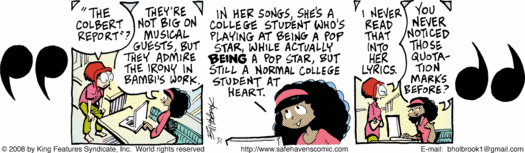
Yesterday's mail brought a letter from Ken Myers, whose Mars Hill Audio Journal I enjoy greatly. The purpose of the letter was an appeal for support, but the content shed light on the Safe Havens strip.
With my children grown, I have been blessedly even more clueless of pop kid culture than I was when they were young, but I did hear the name Hannah Montana thanks to a friend of Heather's who blogged about the effort she went through to secure concert tickets for her Hannah Montana-crazy daughter. That's all I knew though—she sings, and she's enormously popular with the younger set. Thanks to Myers' letter, however, I know—and worry—more.
So that's the Safe Havens strip, complete with "ironizing quotation marks."
- Miley Cyrus (now 15) plays the lead character on Hannah Montana, a character named Miley Stewart. Stewart has migrated west from her humble Tennessee origins to live in Malibu, to pursue her dreams as a superstar singer known to the public as Hannah Montana. Hannah Montana is thus a persona, an alternate identity assumed by Miley Stewart. Miley Stewart is also a character, performed by Miley Cyrus. What makes it even more reflexive is that Miley Cyrus performs in concert as Hannah Montana, bypassing Ms. Stewart entirely. One might ask if Miley Cyrus is really a celebrity pop sensation, or whether she just pretends to be a pop sensation when she’s in character.
- The image in Vanity Fair of Miley Cyrus [apparently nude, though provocatively draped in a sheet]…has evoked intense media scrutiny and widespread parental anxiety over the apparently important question: Has this wholesome role model been stained by this arguably provocative photo.
- The question moms (and dads) need to be asking is not whether Miley/Miley/Hannah is going to go all Britney on them, but whether their six- and seven-year-old daughters really benefit from having as a guide to growing up a performer playing a performer playing a performer. Just as the most important lesson taught by Sesame Street is that learning must be fun, so the most important lesson taught by Hannah Montana may be that growing up is about learning how to perform one’s life, how to define your identity as a desirable commodity, how to assemble and project the brand called Me.
- The culture of celebrity and personal performance which permeates our society is profoundly destructive. It’s not simply that being well-known for simply being well-known (in Daniel Boorstin’s classic formulation) is a thin and vapid achievement. More fundamentally disordering is the way in which the deeply sensed notion of “identity as performance” promoted in the culture of celebrity undercuts the very idea of reality or real life; more than the work of nihilistic philosophers, the prominence of performers in our society nudges us toward referring to “reality” (with the ironizing quotation marks) rather than to Reality.
Permalink | Comments | Edit
Category Children & Family Issues Random Musings
As I wrote earlier, one important idea I took from Marcus Buckingham's The One Thing You Need to Know is the value of expending more energy in our areas of strength than in where we are weak. Self-evident? Maybe, but in practice we often tend to do the opposite.
John Stackhouse's review of another Buckingham book, Go Put Your Strengths to Work, inspired me to reserve it at our library. Although the "I gotta be me" philosophy taken to extremes can lead to unwholesome, selfish attitudes and dereliction of duty, we err in the other direction by not recognizing that God made us who we are and not someone else for a reason. To ignore that design is not only to insult our Creator, but also to risk missing out on the good he would do to and through us.
Buckingham’s counsel—available in this book, on his website, and via other media—coincides powerfully with the counsel of the apostle Paul, who told the early Christians under his care to recognize their inherent particularity, to rejoice in it, to honour each other’s differences, and to work together for mutual benefit. In fact, Paul provides for us an image so apt that it is surprising Buckingham never makes use of it: the parts of the human body working in all of their particularity for each other’s good: eye, ear, hand, foot, and so on (I Corinthians 12).
Life is short, distractions and demands are many, and we can misspend ‘way too much of our time and effort on matters that don’t matter, or in work to which we are neither inclined nor suited. Buckingham’s book is, like all wisdom, deceptively simple and clear, and I’ve found it to be effective. It has helped me move away from activities that I am not good at, or even some that I am, but don’t have much heart for, toward those through which I can do the most good for others and enjoy myself best while doing them.
Permalink | Comments | Edit
Category Random Musings
In an earlier post on the Lisbon Treaty, I stated
I"m watching, and here's an example I saw today. The U. S. Supreme Court has nullified a Louisiana law allowing for a sentence of the death penalty following conviction for the rape of a child under 12.[I]n the U.S. we have seen state laws gradually subsumed more and more by national regulation, so that fleeing to Pennsylvania from a repressive law in New York is not as easy as it once was. I'm not saying this is always bad, but it can be, and bears watching.
However devastating the crime to children, Justice Anthony Kennedy wrote in his majority opinion, "the death penalty is not a proportional punishment for the rape of a child." His four liberal colleagues joined him, while the four more conservative justices dissented.
There has not been an execution in the United States for a crime that did not also involve the death of the victim in 44 years, a factor that weighed in Kennedy's decision.... Kennedy said the absence of any recent executions for rape and the small number of states that allow it demonstrate "there is a national consensus against capital punishment for the crime of child rape."
What's wrong here? Why are the judges debating the heinousness of the crime, and why are they judging by perceived national consensus? Shouldn't the question before the Court be, "Is there anything in the Constitution of the United States that prohibits the State of Louisiana from imposing this sentence?"
That, as they say, is why we pay them the big bucks. Questions of the legitimacy of the death penalty and what might be suitable punishment for a man who repeatedly rapes a five-year-old girl can be debated by the voters and their representatives in each state. The purview of those nine experts in Constitutional Law is the Constitution itself.Permalink | Comments | Edit
Category Politics Random Musings
The role of joking in the way we deal with one another is a concern of mine, as I've said before. Thanks to Groshlink I've found another excellent essay on the topic, The Gospel and Humor by Tim Keller, pastor of Redeemer Presbyterian Church in New York City. Unfortunately, the article is in PDF format, and you have to weave amongst some other articles to read it, but it's worthwhile. To get you started—and to give those who won't follow the link a taste of what he says—here are some excerpts.
- Your humor has a lot to do with how you regard yourself. Many people use humor to put down others, keep themselves in the driver’s seat in a conversation and setting, and to remind the hearers of their superior vantage point. They use humor not to defuse tension and put people at ease, but to deliberately belittle the opposing view. Rather than showing respect and doing the hard work of true disagreement, they mock others’ points of view and dismiss them without actually engaging the argument.
- There are [also] some people who constantly, bitterly, mock themselves. At first it looks like a form of humility, or realism, but really it is just as self-absorbed as the other version. It is a sign of an inner dis-ease with one’s self, a profound spiritual restlessness.
- There is another kind of self-righteousness...that produces a person with little or no sense of humor. Moralistic persons often have no sense of irony because they take themselves too seriously, or because they are too self-conscious and self-absorbed in their own struggles to be habitually joyful.
- The gospel, however, creates a gentle sense of irony. Our doctrine of sin keeps us from being over-awed by anyone (especially ourselves) or shocked, shocked by any behavior. We find a lot to laugh at, starting with our own weaknesses. They don’t threaten us any more because our ultimate worth is not based on our record or performance. Our doctrine of grace and redemption also keeps us from seeing any situation as hopeless. This groundnote of joy and peace makes humor spontaneous and natural.
- In gospel-shaped humor we don’t only poke fun at ourselves, we also can gently poke fun at others, especially our friends. But it is always humor that takes the other seriously and ultimately builds them up as a show of affection. “We are not to be perpetually solemn. We must play. But our merriment must be of that kind (and it is, in fact, the merriest kind) which exists between people who have, from the outset, taken each other seriously—no flippancy, no superiority, no presumption.” (C.S. Lewis, “The Weight of Glory”)
Permalink | Comments | Edit
Category Random Musings
I've never heard the American Public Media program Speaking of Faith, but somehow (I've forgotten whom to credit) came upon this transcript of Quarks and Creation, an interview with the physicist/priest John Polkinghorne. If you can ignore the annoyances of a word-for-word transcript of an audio program, it's a fascinating interview. (For those who prefer an audio format, that's also available.) Polkinghorne touches on subjects as diverse as beauty, truth, quantum physics, prayer, free will, and the dangerous brilliance of creating a world that creates itself.
In 1997, he was knighted by Queen Elizabeth, though, as tradition dictates, Polkinghorne does not take the honorific title "Sir" because, as an ordained minister, he would not be expected to wield a sword.
And we're expecting Sir Elton John to use a sword? Hmmm.
[B]eauty is a very interesting thing, and a form of beauty that is important to me is mathematical beauty. That's a rather austere form of aesthetic pleasure, but those of us who work in that area and speak that language can recognize it and agree about it. And we've found in theoretical physics that the fundamental laws of nature are always mathematically beautiful. In fact, if you've got some ugly equations, almost certainly you haven't got it right and you should think again. So beauty is the key to unlocking the secrets of the physical world.
[I]t's very hard, of course, to describe any form of beauty....In some sense you have to perceive it. And it's more difficult with mathematics because you have to be able to speak the language. It's a bit like saying, "This is a wonderful Icelandic poem," but if I don't understand Icelandic, I won't get the gist of it. So mathematical beauty is connected, first of all, with things being elegant and economic. You don't write a great sprawling equation that takes half a page to write down. It's very concise, just perhaps a line with only a few symbols in it. But it turns out that it's also very deep, so that when you explore its consequences, you find this very simple-looking thing. It implies this, it implies that, all sorts of surprising and unexpected things. And if it's a successful part of mathematical physics, of course, it will imply all sorts of phenomena happening in the world. And that's what we mean by mathematical beauty.
Permalink | Comments | Edit
Category Random Musings
I did place an order on Amazon.com this morning...but somehow I doubt that's what brought down the system. Whatever; it has been unavailable for a few hours now: "Http/1.1 Service Unavailable." Just another reminder that we are too dependent on infrastructure over which we have little or no control: water, sanitary services, electrical power, grocery deliveries, police protection, mail, phone, and Internet services. Our ancestors had plenty of worries that we don't, but they dug their own wells, buried their own sewage, grew and/or hunted their own food, and protected their families with their own weapons, and lived among neighbors who could help out when needed.
Communities still share what they can during times of trouble, but for the most part, if we lose one or more of the basic services, so do our neighbors.Permalink | Comments | Edit
Category Random Musings
As I said before, I'm not always curmudgeonly. Here, for your morning's delight, is an inspiring story from the blog, "Et tu?" What happens when an introverted mother of three children under four, whose only much-needed time for solitude comes when all three kids are napping simultaneously, finds this time interrupted again and again by neighborhood pranksters who repeatedly ring her doorbell and run? No, this is not a sordid tale of mass murder; I said it was a happy story.
Read the What first, then the How (with further details).
The curmudgeonly protective part of my nature wants to warn her to keep her eyes open, and let the girls help around the house but never leave them alone with her children; I've heard too many horror stories of irreparable damage done to innocent children by street-wise kids from troubled homes. With that caveat, it's a wonderful story, and a glimpse of what neighborhoods used to be like, back in the day when "that house" was "those houses."
Though it's hardly the main point of the story, I love this paragraph:
I've quoted many times the statement that both extroverts and introverts like people and enjoy their company, but for the latter, interacting with a crowd (even a small one) is usually a net loss of energy, while for the former it is generally a net gain. We introverts like being with people, but it drains us, and we need time alone to recover. When challenged on a source for that idea, I couldn't come up with a source, but here's evidence that it wasn't just my own invention.A while back I took a Birkman test, a personality inventory renowned for its accuracy, and on a scale of 1 - 100 with 100 being most extroverted, I was a 1. One. Uno. It doesn't mean that I don't like people, but that being around others is exhausting for me. As the test administrator put it, "You need introvert time where you don't have to be 'on' like normal people need air."
Permalink | Comments | Edit
Category Random Musings
Here's a scary article for you: Emily Gould's Exposed, from the May 25, 2008 New York Times Magazine. Andrew Keen (The Cult of the Amateur) would definitely appreciate this story of one woman's venture into a world of publishing unfettered by editorial oversight and subsequent free-fall into the Dark Side of Blogging.
I slumped to the kitchen floor and lay there in the fetal position. I didn’t want to exist. I had made my existence so public in such a strange way, and I wanted to take it all back, but in order to do that I’d have to destroy the entire Internet. If only I could! Google, YouTube, Gawker, Facebook, WordPress, all gone. I squeezed my eyes shut and prayed for an electromagnetic storm that would cancel out every mistake I’d ever made.
Another sad story about a naïve teenaged girl molested by someone she met on MySpace? Not at all. Just an imprudent adult woman seduced by the delights of seeing her thoughts in print. Scary.
Permalink | Comments | Edit
Category Computing Random Musings
In a previous post, which was primarily about something else so I won't link to it here, I said:
Having experienced the higher-level coinage of Canada, New Zealand, Australia, Switzerland, and the European Union, I wish the United States had the sense to supplant (not just supplement) the dollar bill with dollar coins. (And maybe the $2 and $5 bills while we're at it.) But the mountain of paper used to print dollar bills comes from Massachusetts, where the Crane Paper Company has a stranglehold monopoly on the business. The $1 bill has a lifespan of under two years and represents about 45% of the U. S. currency production, so it's no surprise that Massachusetts politicians don't like dollar coins.
I've mentioned the idea of getting rid of the lower-denomination bills in favor of coins, and while women generally don't seem to mind, I am likely to get a negative reaction from men. I think this is because women's wallets almost always have a place for change, but men's wallets rarely do. Porter carries his change in a small coin purse (something like this) which keeps the coins handy and protects his pocket. But most men I've talked with tend to keep their change loose in their pockets and then dump them in a jar or on a dresser at the end of the day. This system works because our coins are worth so little.
(Back when I was little and our coins were worth a lot more, this system was a boon to children, who would comb couches and chairs for change that had fallen out of men's pockets.)
Needless to say, these men are less than happy with the thought of heavy coins jangling in their pockets instead of light, thin bills in their wallets. I can see their point. However, I know that Europeans, Canadians, Australians and New Zealanders (and no doubt people from other countries) manage quite well with higher denomination coinage instead of bills. So my question is, What's your secret? How do you handle change?
(I'll admit I only know of one European male who regularly reads this blog and can be counted on to be generous enough to comment, but there are others who occasionally stop by, and I figure the women probably know something about it, too.)
Then again, eveyone else seems to have been able to adjust to the metric system and we still haven't managed that, so maybe I shouldn't hold out too much hope....
Permalink | Comments | Edit
Category Random Musings
My feminism tends to be of the on-again-off-again sort. As a child—thanks to parents who encouraged me—I never considered any good character trait, activity, or occupation to be off limits because of my sex. I didn't think much about feminism back then; I just acted, becoming the first girl to break the sex barrier in my high school's stage band, and the only or one of just a few girls in some of my science classes. This sounds tame and silly from a 21st century perspective, but it was a big deal back then.
When Feminism became a movement, however, I soon had to distance myself from it, largely because it distanced itself from me. I was (and am) all for equality of opportunity—as much as is physically possible; I don't ever want to see men getting pregnant—but when Feminism veered into being anti-man and pro-abortion, when it denigrated the role of homemaker and made the two-income family first common and then in some cases necessary, and when it invoked "political correctness" over the very words we speak and even started calling God "Our Mother," that's when I turned away. Not from my beliefs, which hadn't changed, but from the movement and the label. Women were now included, and succeeding, in nearly every possible opportunity; it was time, I believed, to give feminism a rest.
Until I found myself for a few years in the company of some people (mostly men) whose view of women was more oppressive than anything I'd known growing up nearly half a century earlier. Then I realized that even a necessary correction to the movement's faults and excesses (great though they were and are) could send us back too far. I actually worry less about those men now than I do about the Princess infatuation that little girls are embracing as they did Barbie dolls. (And still do? I've been out of the scene for a while.) We're still encouraging our boys to be smart and strong and our girls to be...pretty.
How does one raise boys to be men and girls to be women and all to be intelligent, strong, and competent people? The impetus for this post was an article I read yesterday in a church bulletin insert, which included this paragraph.
A godly father has a profoundly positive influence on the life of his son or daughter. He teaches his son the importance of self-control, respect for women, the value of work, and healthy risk taking. He affirms his daughter's femininity by expressing his appreciation for her as a woman. Dads, keep these thoughts in mind as you nurture healthy gender identity in your children.
Excuse me? The best a father can do for his daughter is to appreciate her as a woman? I thank God my father did a lot more for me than that! Self-control, respect, the value of work, and healthy risk taking are things we all need to learn—not just half of us.
I do believe boys need to be taught how to be good men, and girls to be good women, and that these roles are not identical. But could we please find a way to make boys into men without putting down girls? It must be possible to nurture in boys fatherly and protective characteristics without appealing to pride, which generates worse problems.
Any ideas?
Permalink | Comments | Edit
Category Children & Family Issues Random Musings
I like academia. I love college campuses, chem labs, and the smell of libraries with old books. Places and institutions dedicated to the advancement of knowledge, to study, investigation, and discussion. In an odd way, I feel more at home on a college campus than in most places. They feel exciting, challenging, and yet as comfortable as a pair of well-worn shoes. That my own college experience differed significantly from my theoretical ideal did not do much to diminish my belief that a college professor had a near-perfect job in a near-perfect setting.
Pausing to let my professor friends recover from their choking fits....Thirty plus years away from the university experience—if you don't count paying tuition bills—along with a fair amount of reading, and discussions with friends who are college professors themselves, have revealed not only that an academic job is not the halcyon experience I had imagined, but that my view of academia as the ideal of intellectual inquiry is also seriously flawed. A recent article at Inside Higher Ed, entitled Does Academe Hinder Parenthood?, confirms both illusion-shattering discoveries. (Thanks to GroshLink for alerting me to this.)
The comments following the article are as revealing as the article itself, which notes that an academic career significantly reduces one's (statistical) chances of having children.
Controlling for such factors as age, weekly hours worked, and race or ethnicity, male faculty members are 21 percent less likely than male physicians to have recently had a birth in their households. Controlling the same factors for women, those who are academics are 41 percent less likely than physicians to have recently had children.
I was pleased to note that the comments were for the most part several steps more civilized than the usual playground taunts I see in comments to online news articles. However, I also noted a disturbing tendency—which may in itself reveal something about academia's view of children. "I was 36 when I felt free to start procreating," "Not once in non-academic circles have I ever heard mothers referred to as 'breeders'—but I hear it from academics all the time," "fulfilling a biological function," "women have family caretaking pressures IN ADDITION TO reproduction," "the male/female binary couple"—perhaps the writers are merely being academic and precise, but terms like "procreating," "breeders," "biological function," "reproduction," and the redundant "binary couple" all sound cold in this context, and distant from the reality of children and families. When doctors talk about an unborn baby at a certain stage of development as a "fetus," they are being technically correct, but an abortion-rights advocate uses the same term to put distance between that being and the idea of a living, human child. I find it quite likely that the very language with which those in academia are speaking about having children would have a negative effect on their own childbearing decisions.
So too, would the attitude of the commenter who calls himself "ScienceProf."
Of course academia hinders parenthood — it’s hard to be a parent when you work 80-100 hours a week. The question, however, is not whether it hinders parenthood, but whether anything should be done about it.
My answer is a flat out No! We cannot and should not coddle to those who make the decision to have children. When a woman has a child it is her problem, and no one else’s. Why should her colleagues pay the cost of her decision with their time? Why should the department be dragged down by having a member is not producing research? Why should a university be expected lower its standards of excellence?
When I serve on a hiring committee or select graduate students to work in my lab, I don’t want any with children. I know that they will be unable to commit the 80-100 hour weeks that is the standard workload of my department. As a supervisor for tenure-track faculty and graduate students, I refuse to accept lesser productivity due to someone’s choice to have a child. Anyone who has a child must accept the responsibility for their actions.
For those who do choose to have children, it is wholly unfair to expect your colleagues and department to share the burden of your personal decision. Their child is their problem, not mine, nor the department’s.
Even with my less-idealized view of the academy, I trust that attitude is not widespread—though I fear it might be. If it is, the problem goes far beyond whether or not college professors must jeopardize their careers to have families. Such a system would require them to jeopardize their careers to have a life. Even the medical establishment is beginning to learn that one cannot require that kind of work load for any more than a short time period and expect decent, let alone creative, work.
I still love libraries, old books, research, and college campuses, and know that there are schools that come much closer to my ideal than most. I'd love to hear about them!Permalink | Comments | Edit
Category Children & Family Issues Random Musings
I recently finished reading a book called The Marketing of Evil: How Radicals, Elitists, and Pseudo-Experts Sell Us Corruption Disguised as Freedom. That's not what this post is about, because while the author, David Kupelian, does have some important insights into how our culture got to be the way it is, his tone is too strident to allow me to recommend the book with particular enthusiasm. However, he cites his sources well, and thus I am able to give full credit for what is perhaps my favorite part of the whole book, the following great quote from G. K. Chesterton.
Sex is an instinct that produces an institution; and it is positive and not negative, noble and not base, creative and not destructive, because it produces this institution. That institution is the family; a small state or commonwealth which has hundreds of aspects, when it is once started, that are not sexual at all. It includes worship, justice, festivity, decoration, instruction, comradeship, repose. Sex is the gate of that house; and romantic and imaginative people naturally like looking through a gateway. But the house is very much larger than the gate. There are indeed a certain number of people who like to hang about the gate and never get any further.
— G.K.'s Weekly, January 29, 1928
It is a great tragedy of our day that we have been all but convinced that the gate is all there is, that the house and fields beyond it are, and have always been, no more than a romantic, imaginative dream—at best. Perhaps we need a Puddleglum to stamp on the enchanted fire and clear our heads.
Perhaps the strident tone of Kupelian's book is, after all, just the un-enchanting smell of burnt marsh-wiggle.
Permalink | Comments | Edit
Category Children & Family Issues Random Musings

