
On Monday, Vivienne received the blessing of the Swiss government; today we travelled to the American Embassy in Bern for a simlar benediction from the United States. As I did when Joseph was born, I came along to hold diaper bags and other items not allowed in the embassy, which includes purses (or bags of any sort) and cell phones (or electronics of any sort). Fortunately, winter coats were acceptable, as were a couple of diapers stuffed in the pockets.
Really, it's a very un-welcoming experience, a visit to this little bit of American soil in Switzerland. Embarrassing, when you think of the impression we are making on others. (Okay, so Hollywood does a worse job, but at least they're not official.) There is no waiting room, unless you count the small antechamber outside, where those waiting in line are subjected to the summer's heat or winter's cold—though a roof provides some protection from rain, if it isn't too windy.
But we were prepared. Joseph and I were well-dressed, and had the stroller with us. As soon as Vivienne and her parents passed through the security check, he and I started out on our adventure.
Last year I was alone, and spent most of the waiting time in a cafe, drinking tea and writing, because that was more fun than exploring the city in a downpour. With the temperature in the mid-teens (Fahrenheit) there was no risk of rain today—though we did have light snow, so Joseph and I headed up the hill to the more famous parts of Bern, including the Bundeshaus (Swiss equivalent of our White House and Capitol Building) and the Zytglogge (medieval clock tower).
The shops of Marktgasse were much as I remembered them: hideously expensive and filled with things I wouldn't want to buy anyway. But we did stop a Coop City to look at t-shirts, buying nothing because they were a third more expensive than similar shirts in Luzern. Joseph, on the other hand, thought Marktgasse was great, because of the heavy tram traffic. He never uttered a word of complaint about the bitter cold, but any time I turned the stroller away from a passing tram, I heard about it!
Did I mention that it was c-o-l-d? Here's the fountain at which we refilled our water bottles. (As usual, click on the pictures for a larger view.)

After we had been gone over an hour, I thought it time to wend our way back to the Embassy. Here's a park we passed through—and the same park a year and a half ago, in the summer.


When we arrived back at the Embassy, I stopped on the street, hesitating to bring the stroller up into the (semi-) sheltered area, because we had no official business there. But one of the security guards recognized us, and told us to come on up, because it was too cold to wait on the street. Of course, it would have been really nice if he had invited us inside, but that was beyond his power, and I was grateful enough to be sheltered from the wind.
Less than 10 minutes later, the new American citizen was back on Swiss soil, and our adventure ended, seven hours after it began, with some very welcome hot cocoa at home.
I've enjoyed all my visits to Bern, but may I suggest that the next baby be born in the spring or in the fall?
Permalink | Comments | Edit
Category Travels Everyday Life
I'll never convince a credit-card wielding American, but shopping with cash in a country like Switzerland is great! I'll admit that I love the convenience of credit cards, mostly for online purchases, buying gas (drive in, swipe the card, pump, go), and the neatly organized monthly statements. And, of course, never worrying about having enough cash at the grocery store.
That last is part of the problem. With cash, I see the exact cost of what I'm buying. There's something visceral about handing over the bills and coins. The money I had, I no longer have. And if I don't have enough, I have to put something back on the shelves and buy it later, or never. I have no statistics to back up my assertion, but I'm absolutely certain that I spend more money, more freely, since we moved away from making most of our purchases with cash.
What's especially nice about using cash in Switzerland, however, is their system of coins and currency. The smallest bill is the 10-franc note; coins come in 5-, 2-, 1 and 1/2-franc denominations, plus 20-, 10- and 5-rappen (cents). Note that there is no 1-rappen coin. This makes calculations very easy, especially since any taxes are hidden in the price of the item. What you see is what you pay. With only multiples of five to worry about, it's very easy to keep a running total of the cost of what's in my cart. Therefore, before the checkout clerk has finished scanning my items, I know what the total is going to be, and with what combination of bills and coins I plan to pay. And I know exactly how much change I should receive.
I find that extremely satisfying. I'm not good enough with mental arithmetic to bother with it at home. Let's see: 14.88 plus 5.54; that's uh, um, oh something more than $20. Hmmm, should I buy orange juice at $3.99 or grapefruit at $3.85? How much are tomatoes per pound today? Do we need mayonnaise? Oh, bother, I've forgotten the total. And even if I remember it, I know that when the clerk is done ringing up my order, she's going to add an awkward 7% sales tax, but only to certain items, and I'm never sure just which ones. So I meekly hand over my credit card and hope every part of the system is honest, accurate, and not broken down.
Cash - multples of five - clear pricing. What an empowering combination!
Permalink | Comments | Edit
Category Travels Everyday Life
There's some debate just what Emmen is. Stephan says it's a suburb of Luzern, and I suppose it is, Luzern being a 15-minute bus ride, or an even shorter train ride, away, which we proved today when Vivienne acquired her Swiss passport. But it hardly has a "suburban" feel, at least as I know suburbs. For one thing, there's decent public transportation—but that's no doubt because it's Swiss. For another, most people live in apartments, which says "city" to me, though Janet says that is also a Swiss characteristic, city or no. There's traffic. There's industry. There are plenty of stores, but no strip malls (though there is a mall or two). Everything is close together, and what yards there are, are tiny. Children walk to school. Janet walks to the grocery store (actually, several grocery stores), the train station, the above-mentioned malls, the swimming pool complex, and church. That feels like a city to me.
And yet.... Emmen certainly isn't a city like Basel, or Luzern, with a lively city center, and centuries of history and culture. And it has a rural feel, as well. Also within easy walking distance is a long hiking trail along the river (pedestrian, bike, and also equestrian in most places). The trail runs through wooded areas where trees are still being harvested by loggers.
(Switzerland is a great place for hiking trails. There's one that leads all the way into the city of Luzern; we had planned to hike it today, but the -9 degree Celsius temperature was a deterrent. Perhaps we should have taken advantage of such balmy weather, though: tomorrow's high is supposed to be -10, with a wind chill of -16 (that's 3 degrees Fahrenheit).
There are also several small farms nearby. One of Joseph's favorite walks is to the see the cows and goats at the nearest dairy farm, where for a single franc we pick up a liter of fresh, delicious, raw milk. (Click on the pictures to enlarge.)


So, what is Emmen? Whatever it is, it's like nothing in the United States that I know of.
Joseph has two different words for "spin." One, pronounced "pin," refers to when he, himself, is spinning. The other I haven't yet figured out how to transcribe, but it has two syllables and refers to spinning an object, like a top, a ball, a block, a coin. Whether it's supposed to be one word, or a two-word command, the meaning is clear when he hands you an object: "Spin it!" You'd be surprised at how many items that are not tops can be made to spin.
"Pin," on the other hand, can refer to being spun in someone's arms, or twirling himself around till he staggers with dizziness, or being spun on Mommy's office chair. When he does the last sitting backwards and holding on to the seat back, it can be very fast, and produces an impressive postrotatory nystagmus.
He also likes this, sitting in his space capsule (backpack) and training for NASA. The position makes up for the reduced rotational velocity. At the end he is saying and signing, "more."
Permalink | Comments | Edit
Category Travels Children & Family Issues Everyday Life
This was the first video, taken nearly two weeks ago to let Dad-o know that Joseph is thinking about him even though he isn't here with us.
We love you, Dad-o!
Permalink | Comments | Edit
Category Travels Children & Family Issues Everyday Life
The real question is not, How Smart Is Your Baby? but How can you help your baby avoid losing his extraordiary powers as he grows up? As the book of that name acknowledges, every normal baby is a born genius. If you don't think so, take three years and try to become fluent in a foreign language. Then remember that most babies can do that with ease. For multiple languages. Simultaneously. And while learning the very concept of language itself.
Joseph and I try to take at least one walk each day. Most of the time I'm the one doing the walking, and comes along passively in the stroller, because I don't get much exercise going at his pace, and that's half the point of the walk. (The other half is giving his parents a break.) Until recently, we'd go where I wanted to go. But two days ago, Joseph started expressing his opinions in the matter.
He's usually pretty complacent and quiet as we trundle along, so I was shocked when he suddenly started fussing as we passed through an intersection on our way home. I stopped, and he pointed in the cross direction, clearly indicating that he wanted to turn. "Aha!" I thought. "I know where that road leads."
"Do you want to go see the goats?" I asked. Joseph quickly signed, "Please." I made the turn toward the dairy farm, and he was his happy self again.
I found that astonishing enough—that he was able to recognize the intersection. But it was a straight line from that point on to the goats, and he'd been there many times before.
Then yesterday, when I had planned to walk to the nearby mall, Joseph once again fussed and pointed in another direction. I decided to forgo shopping and give him his head.
At each intersection I stopped the stroller and asked, "Shall we go this way, or that way?" with appropriate gestures. Even though I deliberately changed up the way I asked the question (so as not to give him any hints), he led me unerringly, without hesitation, and through many turns to one of his favorite places: the swimming center, where there are also goats (chickens, peacocks, rabbits, etc.) to see.
But that's not where we stopped. At the final turn, when I knew for certain that he knew where he was—because he could see the animals from the intersection—he chose to go left instead of right. So left we went, and this time he led me—perfectly, and over a route that had changed recently due to construction, so he'd only been on it a few times—to the library.
I'd been that far before, but after the library I was in new territory. I explored, following his directions, until we came to a main street, at which point he decided he didn't like that and asked to go turn around. We explored a bit more, then I decided we'd had enough and headed back towards the library. At that point Joseph fell asleep, so it's a good thing I knew how to get home. But if we ever get lost, I'm asking him for directions.
My brother was like that as a child, though at an older age. He might run off (as he did in Yellowstone National Park when he was six) but we could count on him to find his way back. Unfortunately, he says, he lost much of that ability as he grew up.
So how can that loss be prevented? Is such skill like a muscle that must be exercised regularly? Use it or lose it? It should be easy to devise "navigation games" and create increasingly difficult puzzles through the years, to keep the skill sharp. But it would take a conscious effort to make that happen: no one seems to care about leaving no children behind navigationally.
Permalink | Comments | Edit
Category Travels Children & Family Issues Everyday Life
Joseph's language abilities are growing steadily; it's amazing to see how much he has learned in the short time I've been here. And that's just in English! It is so strange to hear Swiss German words coming from his mouth, and to see that he obviously understands when Stephan speaks to him. The latest game is for him to hand Janet one of his number puzzle pieces, whereupon she says (for example): Mommy and Grandma say nine. The Germans say neun. Daddy says nüün." (The last two sentences are said not in English, but in German and Swiss German, respectively.) Then Joseph gets her another number and asks, "more." This is as close to formal language teaching as he gets—because he asks for it. Mostly he just hears people speaking and figures it out, as all babies do.
Of course a 19-month-old does not speak clearly in any language. Joseph has a few words that anyone can understand, but mostly it takes a parent, or a grandparent who has been living with him for a while, to make out what he is saying. For example, it took me some time to realize that he knows the number "0," because the word he uses doesn't sound at all like "zero" to me. But it is consistent and always associated with that number. (And, no, it's not the German or Swiss German word; Joseph says "null" clearly.)
It's especially helpful that Janet has taught him many ASL signs. It's too cute, really. Please, thank you, help, water, sleep, milk, down, play, Mommy, Daddy, Grandma, airplane, train, and more, including the very useful toilet. Joseph will often speak and sign at the same time, which helps me understand his speech, be it English, German, Swiss German, or Josephese. I know I'm going to be helpless on the phone, though.
Note: I love American Sign Language, but what sadist designed the sign for "please" to involve rubbing the hand on the chest? No one who had to do the laundry after a toddler's spaghetti dinner or yoghurt-and-muesli breakfast, that's for sure.
And Vivienne? Janet's beginning to learn the difference between the cry that means, "I'm hungry" and the cry that means, "I need to go to the bathroom." But I'll let her write the post about Elimination Communication. :)
Permalink | Comments | Edit
Category Travels Children & Family Issues Everyday Life
Every day, after the noon meal, we follow the Episcopal Book of Common Prayer "Daily Devotions for Individuals and Families" noontime liturgy. Joseph loves the time and is an active participant, as they use hand motions for many of the prayers. (Some, at least, are a legacy of Janet's American Sign Language minor.) For example, at "Give praise, you servants of the LORD" we raise our hands high in the air; at "in quietness and trust shall be our strength" we flex our biceps.
Then comes time for the reading, and Joseph jumps up to get the Bible for Daddy. After that we pray. Before Vivienne was born, Joseph would put his hand on Janet's belly to "pray for the baby." Now he puts his hand out, says "baby" and looks a little confused. :) After the Collect, he will often join in with a hearty, "Amen!"
That's it: short but sweet and powerful. It's especially delightful to watch Joseph's enthusiasm for "praise the Lord time."
Permalink | Comments | Edit
Category Travels Children & Family Issues Everyday Life
As you might have guessed by the blog silence, we've been a little busy around here. We have Baby News at last!
Vivienne Linda Stücklin
Born at home in Emmen, Switzerland
Saturday, January 21, 2012 at 12:26 p.m.
Length: 53cm (21in)
Weight: 3840g (8lbs 7oz)
I would never say that anyone's labor was easy, and this certainly wasn't, but it was a WHOLE lot better than with Joseph. Consequently, Janet is recovering quickly and enjoying little Vivienne immensely. So, you might observe, is Grandma.

(Click photo to enlarge.)
Vivienne was only a few days late, but the wait seemed long because Joseph had been a week early. Once Janet was sure she was in labor, Stephan's parents joined us to keep Joseph entertained. He did get to see his sister's birth, though I'm sure he won't remember it in years to come.
Ten years ago, I had no idea why anyone would want a home birth. Now it's glaringly obvious. That could be a whole nother post. For now, suffice it to say that hospitals and doctors are great when it comes to emergencies and high-risk circumstances, but haven't a clue when it comes to normal childbirth. What a difference an experienced midwife makes—and how wonderful to give birth in (and to be born into) one's own, familiar nest.
Joseph had a rough first day (and night—hence so did the parents), bursting into heart-rending tears every time Vivienne cried. But Janet learned to calm him by enlisting his help in calming his sister, such as patting her gently. By the next day he seemed to have accepted the idea that her cries were a form of communication. He loves to give her kisses, and sometimes even suggests to Janet that "Baby" needs mommy milk.
Some of the old anxiety returned today when the doctor came and Vivienne cried more than usual (more accurately, her cry was a bit different from usual). I think tomorrow she is getting her first heel stick; remembering how his cousin Jonathan curled up in a ball and sobbed, "I didn't want them to cut my baby's heel," I think we may try to distract him in another room when that happens.
Vivienne herself is doing great, working on advanced degrees in eating, sleeping, eliminating, and charming the world.
But for the rest of us, sleep is still a bit on the short side, and I am up 'way too late working on this post. So, enough for now.
Welcome to our world, Vivienne! Congratulations to the family, and good night to all!
Permalink | Comments | Edit
Category Travels Children & Family Issues Everyday Life
Breakfast
An international child, Joseph might start his day with leftover pizza, or rice, or bread and peanut butter, or a tortilla with "spices" (more on that later). But for the most part his breakfast is "no no bissi" a.k.a. yoghurt and muesli. Unsweetened muesli and plain yoghurt—and he loves it. His drink for all meals is water. He feeds himself with a spoon quite competently, although as you can imagine some cleanup is required.

For breakfast I might have yoghurt and muesli, or cooked oatmeal, or good Swiss bread, or yummy, fresh Swiss eggs (with golden yolks).
Dinner
The noontime meal is the primary one here, because Daddy comes home from work to join us. To the Swiss, the idea of a cold lunch is strange. I must say that cooking makes the morning seem short, but it's very nice to have an easy meal in the evening.
We've been eating very well. Janet is a good cook, and has been experimenting with new meals that supposedly freeze well, doubling them to have a supply for ATB (after the baby is born). The salutary habit of American churches of supplying families with post-childbirth meals seems to be unknown here. We've had meatloaf, orange chicken, curried shrimp and rice, pizza, fondue, raclette, sausage dishes, and other good things I can't list because I can't remember, and only this week's menu is post on the refrigerator door. :)
Joseph eats pretty much whatever the rest of us are having, feeding himself competently with some combination of fork and fingers. The exception is sweets, which are mostly excluded from his diet, just as coffee, tea, beer, and wine are. He is, however, beginning to realize that the adult "crackers" (cookies) taste better than his....
Supper
This is a lighter meal, often leftovers, or bread and cheese. The Swiss do eat sandwiches, but it doesn't seem very common. Again, Joseph eats bits and pieces of whatever the adults have.
Snacks
In Switzerland, it seems expected that children will eat more often than at mealtimes. "znüüni" (at 9 a.m.) and "zvieri" (at 4 p.m.) are planned snacks, although Joseph gets his at varying times depending on our schedule. He might have banana and peanut butter, or cheese, or bread, or "no no bissi," or almost anything else that is reasonably healthy. One of his favorite snacks is "ti" with "pie-h'n" (spices)—tortilla sprinkled with something from the spice rack, from garlic powder to cinnamon. Joseph would put spices on almost everything if allowed. (Peanut butter toast with cinnamon, anyone?) The only time he objected was when I gave him some of my pizza, which I had sprinkled with "pie-h'n" of my own—red pepper flakes.
Drinks
Joseph's drink at all meals, and in between, is water. Occasionally he will have a small cup of milk, and once, when we squeezed some blood oranges, he had a few sips of the juice. The fresh-squeezed juice was a real treat, especially for Janet and me, because no Floridian can be really happy with less than fresh-squeezed juice. For breakfast, we usually drink "orange juice-like liquid" (orange juice from concentrate) from the store, as not-from-concentrate juice here isn't even as good as it is in the U.S., and it's expensive.
Unfortunately, I'm here in the wrong season to get the delicious unpasteurized cider from the farm down the road. (The farmer expressed astonishment that cider must be pasteurized in the U.S.)
Janet's been drinking boring, store-bought milk since getting close to her due date, but the other day we walked to the diary farm and bought a liter of raw milk. For dinner and supper we mostly drink water, but lately I've been indulging in the milk. Unpasteurized milk really is a different sort of beast. Normally I drink only skim milk, and can't abide even 1%, let alone whole milk. But in its natural state, whole milk is delicious.
That's about it for this edition of Life with Joseph. It's taken me three days to get this far, and those-who-can't-be-here are anxious for news. Of course, the news they're most anxious for is a birth announcement, but I give what I can....
Permalink | Comments | Edit
Category Travels Children & Family Issues Everyday Life Food
It's hard being a long-distance grandmother, whether the distance is 1000 miles or 4800. Certainly I'd rather our grandchildren live just down the street! But one compensation for the loss of frequent interaction is the joy of seeing how much the children change between visits. As we await the time when I'll have baby news to announce, I'll share a few stories of life with Joseph, 18 months old and soon to assume the important role of big brother.
John Ciardi said that a child should be allowed to learn, "at the rate determined by her own happy hunger." Joseph's current "happy hunger" is for letters and numbers. He has a wooden puzzle of the upper case alphabet that is the first toy he takes out in the morning, and again after his nap. This was supplemented at Christmas by the nicest number puzzle I've seen, which includes the numbers from 0 through 20 and arithmetic operators as well.

First, he toddles over to the shelf for his alphabet, and then—because it is more difficult to reach—points to the number puzzle and commands, "Hum!" ["Numbers!"] After naming the numbers and letters to himself and/or asking for them to be named, taking them out of the puzzle frame, putting them back in, and yes, throwing them with glee across the room—he is a little boy—he will get paper and a pencil and ask for various numbers and letters to be written, often adding his own scribbles, which, of course, look nothing like the models—yet.
Joseph knows all the letters, most by letter name (e.g. "bee," "ess," "tee"), some by "is for" (e.g. "cow" for C, "ha(wk)" for H. He knows the numbers 0 - 10, 12, and 20. Some are clear ("two, "ten") and some, such as seven and twenty, you have to know what he's saying, but it's consistent.
Not only does he know the pieces, and where they go, but he's also cognizent of what's missing, and worries until it is found. Before dinner, and again at night, we help Joseph pick up the toys. The other day he and I were working on the number puzzle, and Stephan the alphabet. Stephan remarked to himself, "where's the Z?", finally found it (did I mention that the pieces get thrown around the room?), and put the puzzle where it belongs without announcing his success. After Joseph and I finished the number puzzle, he went to Stephan and asked, "Zee?", content only when shown that it was in its proper place in the puzzle.
Just this morning Janet discovered that he also knows how to count, at least to six: she was fixing dinner (which happens at noon here, because Daddy bikes home from work to join us), and Joseph was helping by handing her potatoes to weigh. He handed her the first one, and announced, "one." Then the second, followed by "two." Then "three, four, five, six." At the seventh and last potato, he hesitated, having forgotten; seven is one of his newest number words. Our apologies to Glenn Doman and to the Right Start Math folks, who want children to lean quantities before they learn counting, but it was his idea. We had no idea he could do it. Then again, maybe he knows more quantities than we think. He loves his daddy's Dots book.

Joseph is also very good at putting the pieces in their places on the puzzle board. I remarked that he went very quickly from the "large knob puzzles" to being able to do this much harder variety, and Janet said, "Oh, he still can't do the large knob puzzles! He gets frustrated quickly and gives up." Which only confirms that children will work patiently and persistently to learn what they really love!
Oh, I suppose I should mention that he's learning the letters and numbers in three languages.... I think he's more fluent with English at this point, though really, how would I know?
Joy for a grandmother's heart, especially a grandmother whose college major was math. :)
Joseph is SO much fun.  His two favorite toys are his wooden alphabet puzzle, and his new-for-Christmas wooden number puzzle (0 - 20, with +, -, x, {division), < (works flipped for >) and =).  He's passionate about them; first thing in the morning, and again after his nap, he goes immediately for them.  He knows all the letters, most by letter name (e.b. "bee," "ess," "tee"), some by "is for" (e.g. "cow" for C, "ha(wk)" for H.  He knows the numbers 1 - 10, 12, and 20, and sometimes gets 0 but not consistently.  Some of numbers are clear ("two, three") and some, such as seven and twenty, you have to know what he's saying, but it's consistent.  And he's very good at putting the pieces in their places on the puzzle board.  I remarked that he went very quickly from the "large knob puzzles" to being able to do this much harder version, and Janet said, "Oh, he still can't do the large knob puzzles!  He gets frustrated quickly and gives up."  But he's so obsessive about the letters and numbers that he worked persistently enough to get good at them.  One of his favorite activities is to give me a piece of paper and a pencil and ask me to write letters and numbers.

He's also a very good-natured and calm child.  We shall see how that plays out when there is another little one in the house!
Permalink | Comments | Edit
Category Education Travels Children & Family Issues Everyday Life
If I weren't eating so well at the famous Swiss Zum Stücklin, I might be sad at missing the Outstanding in the Field event held at our favorite egg (and more) farm, Lake Meadow Naturals. Not that I'm in the habit of spending $180/person on meals, not even in Switzerland, not even when we ate at the incomparable restaurant at Les Trois Rois in Basel. But I'm happy for our local farm to get such national recognition.
We went to Naples a couple of weekends ago.
No, not that Naples, although there are some superficial similarities, such as a location on the southwest coast of similarly-shaped peninsulas, a warm climate, and inhabitants who speak both English and a Romance language.

We were nearing the expiration of the hotel voucher we'd earned by listening to a timeshare presentation in Hawaii, and chose to use it at the Naples Grande Beach Resort, a Waldorf Astoria hotel in Naples, Florida. You see, it was a $200 voucher, but good only for the hotel room, and only for one night. Hence the pricy hotel.
It’s a four-hour trip—about like driving from Florence if you’re thinking of the other peninsula—and we made it longer by stopping in Lake Wales for several hours. That’s where the lovely Bok Tower Gardens are. (As usual, click on a picture for a larger image.)


One of my favorite places in the Gardens is the Window on the Pond, where we can observe the wildlife from inside a duck blind style shelter. Corn kernels are scattered on some large tree stumps to encourage the birds to come close. But as with any bird feeder....
The next day we headed for nearby Marco Island, where we enjoyed a walk at Tigertail Beach Park. Much of the flora was identified, but not this gorgeous purple grass:

These Aqua-Cycles, suitable for sand and water exploration, were available for rent. We did not try them out, but immediately thought, “Wouldn’t that be fun at the Maggie P!”

But lest any nephews or grandchildren (or uncles) get too excited, when we later investigated we learned that it would take over $3000 to make that dream come true! Not this Christmas, folks.
After an ice cream treat at the beach café, we turned our GPS toward home and drew the curtain on a much-needed weekend of R&R.
This was just posted on Free-Range Kids, and deserves to go viral. So I'm doing my part. The author, Darreby Ambler, is a writer and mother of three from Bath, Maine.
These were the travel rules we used with our kids when they were smaller. They are now 15, 19, and 21, and travel independently and joyfully around the world. (You can tell from the rules that it wasn’t always this way! Hang in there, parents!)
Ambler Family Travel Rules and Responsibilities
- It’s good to talk to strangers. The outside world is full of them. The place you don’t have to deal with them is at home, which is where people who can’t cope with strangers will stay next time.
- Each traveler is responsible for finding things to be excited about, and sharing that enthusiasm.
- If the enthusiasm of others embarrasses you, pretend otherwise. Being cool is dull, except in a sports car.
- Unusual foods are part of the point.
- Staying home is usually more comfortable than traveling, but traveling is more interesting. Prioritize well.
- Travel disruptions are normal and a good way to show your readiness for more challenging adventures.
- Remember that your dislikes do not make interesting conversation.
- Wash your hands. You have no immunity to foreign germs. Throwing up is not interesting.
- You have travel in your future that you can not even imagine. Adhering to these guidelines makes you eligible for such travel.
Permalink | Comments | Edit
Category Travels Children & Family Issues
(Continued from Day 6)
This was our final day in Hawaii, and we checked out of the lovely Hilton Waikoloa Village after enjoying its amenities a bit more. I don’t think I mentioned that they have quite an impressive collection of artwork.
Our plane did not leave until nearly 9 o’clock at night, however, so we once again ventured south, to catch some sights we passed by on our return from Volcanoes National Park.
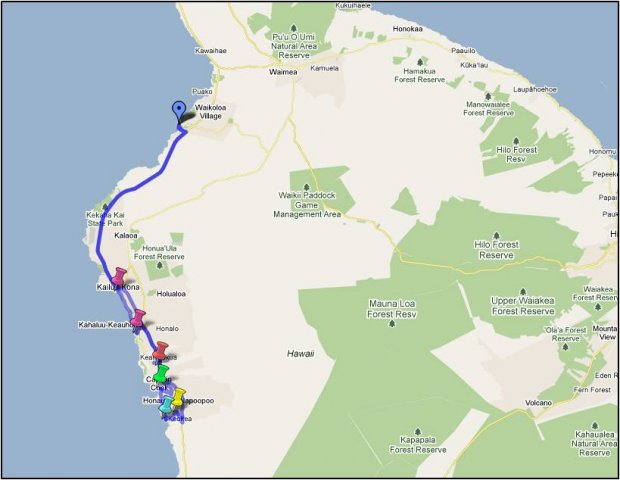
Click on the map for more detail. You will be able to zoom in and out, and move around.
At Kailua Kona (where the Walmart is) we diverted from Route 11 to take in the sights along Ali’I Drive, which hugs the coast (between the pink pins on the map). From there we found our way to Kealakekua Bay State Historical Park (green pin). There we explored another heiau, not that we were seeking out places of human sacrifice, you understand. Both heiaus had this puzzling warning sign:
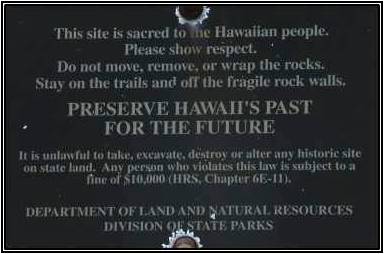
I mean, I get the part about not damaging the structure, or stealing rocks for souvenirs. But don’t wrap the rocks? What’s with that?
We live in a new era: Twenty years ago I would have puzzled over the problem for a few minutes and moved on, but today I’ve become accustomed to finding answers, even when they don’t really matter, because they're usually only a few clicks (not klicks) away. Sure enough, I learned that tourists have been wrapping heiau rocks in ti leaves (not tea leaves) for good luck, a custom offensive to the Hawaiians and apparently with no historical basis older than a bad surfer movie from the 80s.
Across Kealakekua Bay is a monument to Captain James Cook, near the spot where he was killed by the Hawaiians in 1779. In keeping with the tradition of making tourist access difficult, it is accessible only by a steep and difficult climb or an hour-long swim. Or, you can contribute to the thriving local kayak-rental business and get there in 30 minutes. We chose to take advantage of the camera’s zoom feature.

To reach our next stop, Pu’uhonua o Honaunau (aqua pin), we travelled down Highway 160. Well, perhaps “highway” is a bit of an exaggeration, but it got us there, and was a huge improvement over yesterday’s dirt trail. It looks desolate, but once or twice we had the opportunity to appreciate the recent widening that you can see in the photo, which made it a 1½-lane road and much more comfortable when meeting another vehicle head-on.

Pu’uhonua o Honaunau was a Place of Refuge. The early Hawaiians lived under an oppressive set of regulations—the kapu system—that governed every detail of life. Not that the laws could compete in sheer number with our legal system today, but the penalty for even the smallest infraction was often death. Catch a woman eating a coconut, or a banana? Men and women eating together? A commoner who allowed the shadow of one of the elite to fall on him? Death. Shark bait. Human sacrifice. Torture-of-the-month. Death by clubbing, strangling, drowning, or being burnt alive.
Or you could be fast. Outrun your pursuers and get to a Place of Refuge, perform certain rituals under the auspices of the local priest—and you could go home: forgiven, safe, and free. A bit hard on the women and children, but it saved the strong and agile men for more days of work and fighting.
Statues of the gods.

Today Pu’uhonua o Honaunau is a refuge of a different sort.


Before heading back north, we took a brief detour to St. Benedict’s Catholic Church (yellow pin), known as the Painted Church, thanks to the efforts of its priest at the turn of the 20th century. It didn’t feel right to take pictures, so we bought a postcard instead.

It was a rather remarkable week in that the only rain we experienced fell on this day. Hilo, after all, gets rained on some 275 days each year. But the only consequence for us was spending rather more time than we had planned at Discovery Antiques (red pin) while waiting for a respite sufficient to let us dash for the car with some hope of not having to change clothes before boarding the plane. We’d only gone in for another sampling of Tropical Dreams ice cream, and that’s all we bought, but the assortment of old and odd items kept us entertained during the wait. Uncle Jay would have loved it.
Finding ourselves back at Kona much too early to go to the airport, we passed the time exploring the King’s Trail back at Waikoloa, looking for petroglyphs.

Finally, having stretched the glorious week as far as we thought reasonable, we returned to the tiny Kona airport, where we had a snack and waited. And waited. And finally read, in a local newspaper, about the discovery and killing of Osama bin Laden. And bought honey made from the blossoms of the ohia tree, after being assured it wouldn’t be confiscated before we boarded the plane.
In addition to the regular security line, Kona also has an agricultural inspection. This did not surprise me, as I’ve become accustomed to such concerns when re-entering the United States. Not that we had ever left the U.S. on this trip, though at times I wondered. I could not stop myself from mentally adding up the cost of our souvenirs for the Customs form….
The flight from Kona was pleasant and uneventful, and we landed in Los Angeles in plenty of time to negotiate the long walk through construction to our connecting flight. That, too, was fine, and with plenty of time in Minneapolis before our final leg, we relaxed at Ike's, enjoying their fine shrimp. It's fun to travel with someone who knows the airports and the best places to eat!
Did I say we had plenty of time? We were to have more than we'd bargained for, though we didn't get any more shrimp out of it. We had boarded our flight to Orlando and appeared to be on our way when the pilot announced that a leak had been spotted in the hydraulic system. The good news was that it could be fixed right at the gate, and there was no need to cancel the flight. But it would take time, and did we want to stay on the plane or return to the terminal? That's the first time I've ever been on a flight where democracy ruled: the passengers could all get off, or all stay on, but nothing in between, so we voted. Back to the terminal it was.
We waited. And waited. And waited, not wanting to get too far from the gate area. I struck up a conversation with a woman whose husband was chasing their young daughter around, talking with her, soothing her, reassuring her. It was a good lesson in reserving judgement on other people’s parenting: this little child, who appeared to be mildly spoiled, was in reality autistic, and had done exceedingly well up to the point where we got off the plane. If flight disruptions upset ordinary, adult passengers, what must they do to a child for whom any change from the expected is traumatic? I’ve seen adult passengers behave worse, actually.
I lost track of the little girl and missed how she reacted to what happened next.
Flashing lights. Very loud European-style siren. And the following announcement, also at full volume:
May I have your attention please. May I have your attention please. A fire alarm has been detected in this area of the airport. The fire department is investigating this alarm. Please be alert for signs of fire and evacuate the terminal if necessary. The fire department will provide additional direction over this paging system as required.
Repeat. And repeat. (“Pete and Repeat were sitting in a boat. Pete jumped out. Who was left?” “Repeat.” “Pete and Repeat were in a boat….”)

Eventually we were shooed back into the plane. I’m convinced the exasperated pilot finally spluttered, “Get those people back onto the plane before someone makes them evacuate the airport!” Good decision.
Our friendly neighbors were waiting for us when at last we arrived in Orlando, and the final leg of our journey was pleasant and timely. Our luggage (and its contents) made it in good shape, albeit with the “TSA was here” note inside that I’ve come to expect. Back in the days when the people we would visit smoked, I’d wash even our clean clothes upon returning home. Now I’m back to doing it again. Sure, the TSA folks wear gloves, but they don’t change them between suitcases. Call me paranoid, but it makes me feel better, like washing new clothes straight from the store.
As always, it was good to get home, and back to the business of life. Someone asked me if our vacation was restful, and I replied, "Restful? Of course not. Vacations are never restful." But this one was enjoyable, fulfilling, and delightful.
For one who never cared much for travel of any sort, much less overseas—Hawaii may not be out of the country, but it's clearly "overseas"—I'm coming to see that it can be worthwhile, fun, and more affordable than I thought. I'm also getting better at it, as I get more practice. I'm a long way from putting in 10,000 hours, but if that's what it takes to become an expert, maybe I can become reasonably competent on a lesser course of study.
Aloha, Hawaii, and mahalo for your hospitality!

