
(Continued from Day 5)
This morning we arose early, broke out our snorkeling gear, and headed for the resort’s lagoon. The lagoon is manmade, but open to the sea, so if you get there before there’s a lot of splashing around you can see some interesting fish and sea turtles.
That done, we were on the road again, this time going to the Kohala area, the northwestern tip of the island.
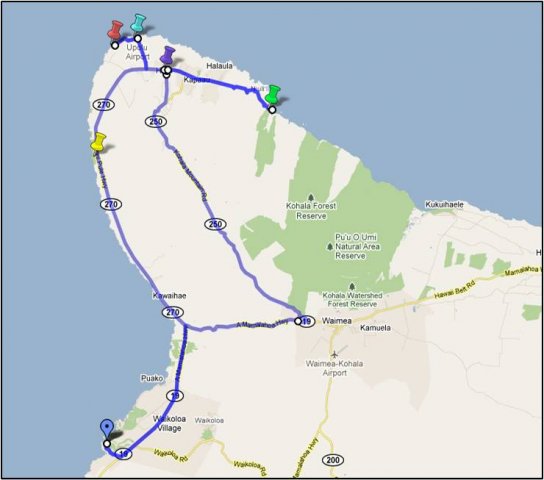
Click on the map for more detail. You will be able to zoom in and out, and move around.
Polulu Beach (green marker on the map) is reached by foot, via a steep trail that begins with these warning signs.
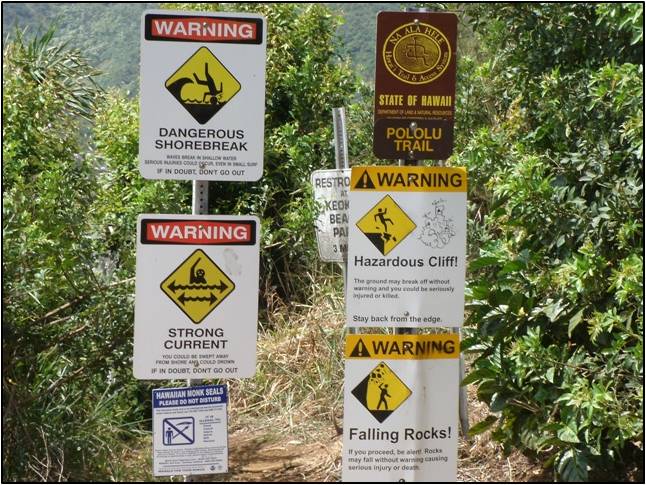
It was a nice trek, though we didn’t go much more than halfway. The view was good enough.

Back in the car again, we made our way in a leisurely manner back towards Hawi (purple marker), stopping at various sites along the way.
The Kalahikiola Church was founded in 1855, one of the first on the island. New England has a long reach: it is a Congregational church.

In Kapaau we paused to see the statue of King Kamehameha the Great. The famous version of this statue, in Honolulu, was a replacement for this one, which was lost in a shipwreck on its way from Europe. It was later recovered, and now rests here.

We parked across the street, and walked over for a closer look, and to use the restrooms. Porter found some nice old ladies on the porch to talk with, and one of those gentle, sweet souls gave him his Great and Terrifying Idea. More on that later.
Feeling it would be rude to use their parking lot without stopping in, we visited the Ackerman Galleries gift shop. It was like a magnet: we kept returning as we thought of more and more things to buy there. It was the first shop we tried, in this area famous for its resident artists, and it turned out to be the best by far.
(Further down the road is the original Ackerman Galleries, featuring the work of Gary Ackerman himself. It was like a museum, but with price tags. Entirely unaffordable price tags, so we enjoyed it as a museum. You can see some of Ackerman’s very impressive work on his website.)
We never found the divine confections promised here, but I like the street sign.

Back in Hawi, we stopped for lunch and some Tropical Dreams ice cream at the Kohala Coffee Mill. We had some interesting dining companions.

I’ve said before that Hawaii doesn’t make it easy for tourists. Two important historical sites, the Mo’okini Heiau and the birthplace of Kamehameha the Great, are not far from Hawi, but you’d never guess it. To get there one must know to turn at the sign for the tiny Upolu airport (aqua marker on the map). At the airport, turn left onto a dirt road—and I use the term “road” loosely. There are no signs at all. I quote from the guidebook:
The county does a terrible job maintaining the unpaved portion. If it’s dry, you may make it the 1½ miles to the heiau…. Otherwise, it’s 4WD on at least part of the unpaved section and the last part might even scare 4-wheelers. Puddles last a long time here, and some of them are large enough to have nearly spawned their own ecosystem. Even during bad weather we’ve seen rental cars back here, giving legitimacy to the question: What’s the difference between a rental car and a 4WD? A rental car can go anywhere…
Apparently Porter took that last line—though none of the rest of the paragraph—to heart. Either that or his success at South Point went to his head. Or perhaps he thought, “How bad can a road recommended by a little old lady be?”
Bravely he made the left turn and plunged down the dirt road. Weaving, swerving, dodging to avoid deep holes and large, jagged rocks, we bounced and jerked and tilted our way to … where? We were driving by faith—in the guidebook? the little old lady?—and not by sight; remember, there were no signs to indicate we were on the right road. Only—there was no other road, so we pressed on. Did I say we tilted? Several times I thought we were at risk of flipping the car, though Porter denies this. He’s probably right, but I recognized the feeling from several exciting sailing trips, and kept throwing my weight as far as I could to the side of safety.
Porter later wondered why I didn’t use my camera during the drive. When I replied that I don’t take good photographs with my eyes closed, he was astounded. I guess that when he gleefully crowed, “Isn’t this fun?” he must have taken my stunned silence for assent. I thought I did pretty well to bite my lip and let him have his wild ride.
At last, the longed-for reassurance that we were on the right road—at the wide spot that passes for a parking lot, with room for a car or two (red marker). Clearlly, they knew better than to expect a crowd. We made the rest of the journey on foot.

Mo’okini Heiau was a place of human sacrifice; tens of thousands of Hawaiians lost their lives at this holehole stone. It is a desolate place, full of history and nearly untouched by the tourist industry.

Porter asked me, “Are you glad we came?” to which I replied, “Not yet. After we’re safely out of here I will be glad that we made the trip.” He was quite confident in his ability to get us safely back to the main road; I, however, was eyeing the approaching storm and thinking how impossible it would be to navigate the rocks and ruts with the road covered by water.

But Porter was right; we beat the storm and I did then say I was glad we had come.
Our next, much more accessible, stop was the old Hawaiian village ruins at Lapakahi State Historical Park (yellow marker). We had just enough time for a quick tour before it closed.

I love the contrast between the black and white stones.

We capped our penultimate day in Hawaii with a swim in the fancy pool complex back at the resort.
(Continued from Day 4, Part 2)
At 8:00 this morning we had the mandatory timeshare presentation that made the whole trip possible. Despite having many, many opportunities in Florida to earn stuff by wasting time in this way, we had never taken advantage of them, and this was our first.
Based on the experiences of others, we expected a boring group presentation and a high-pressure sales pitch. I even brought a book to read, as I was told that is the best way of getting through the presentation.
Not here. First, the presentation was personal, just the agent and us. Surprisingly, that was not boring at all. I survived very well the insistent personal questions—designed to help her tailor her presentation to our personalities—by reminding myself that there was a person behind that sales front, and countering every question with one back at her. “How many children do you have?” she’d ask; “Two; how about you?” I’d respond. We actually had an interesting conversation, instead of me just resenting being asked questions I didn’t want to answer.
The presentation was followed by a tour of the Hilton timeshare properties at Waikoloa Village. (We were staying in their hotel, not a timeshare.) Again, it was just the two of us and our guide.
At the end, we were given the opportunity to buy into the program, and—as we had expected—some incentives to “do it now.” But really, there was little pressure; they expect the program to sell itself.
And if we had been different people, it would have. Timeshares aren’t the burdens they were many years ago, at least not these. If our travelling tastes ran to staying in major cities and tourist destinations, this would be an excellent resource. Hilton has a vast array of properties, from small apartments to major hotels, available for their community members to use on “points” generated by their timeshare properties. Some are more luxurious than others, but all are backed by Hilton quality. The system could save someone who vacations like that a lot of money over time.
But that’s not us. True, we’ve learned to enjoy a nice hotel on the company’s dime dollar. We also stopped patronizing cheap motels when the clientele went from frugal to sleazy, at least along I-95. I’m talking bedbug / appalling personal hygiene / meth residue on the walls kind of sleazy. We like good quality accommodations. But our travel largely revolves around family and friends—the sales rep reluctantly informed us that they have as yet no properties in the Gambia—and we’d rather not have HD TV in the room and a golf course and tennis courts nearby.
So, they didn’t make a sale, but succeeded in proving to us that timeshare programs are like I-95 hotels: you can find a good one if you’re careful.
All in all, considering the value we received, I call it two and a half hours well spent.
It was our fifth day in Hawaii, and we hadn’t yet been swimming. So we headed just a bit north, to Hapuna Beach State Park, which has won numerous accolades for its white-sand beach.
The sand was nice, the water was nice—albeit a bit too calm for my taste—and we spent a pleasant couple of hours there—but it is hard not to be a Florida snob when it comes to sand, surf, and sun.
Back at the resort, we prepared for the evening’s big event, the Legends of the Pacific luau. Big, all-you-can-eat spread of Hawaiian food. Entertainment featuring Polynesian music and dance. Not something that would have drawn us with its $100/person price tag, but for what we paid (it was part of our package), it was fun, and good eating.
This short YouTube video by Westjet gives you a view of the Hilton Waikoloa resort, and you’ll see part of the luau production in the middle. I know some grandkids who would have enjoyed the fire dancer.
Historical note: One of our table-neighbors was playing with his iPad while waiting for dinner to be ready, while his wife nagged him to get rid of it. I sympathized with him, but he put it away and did not share with us what he had been reading—that halfway across the world, Osama bin Laden had been killed.
(Continued from Day 4, Part 1)
After climbing up out of the Kilauea Iki crater, our next adventure was at the Thurston Lava Tube.
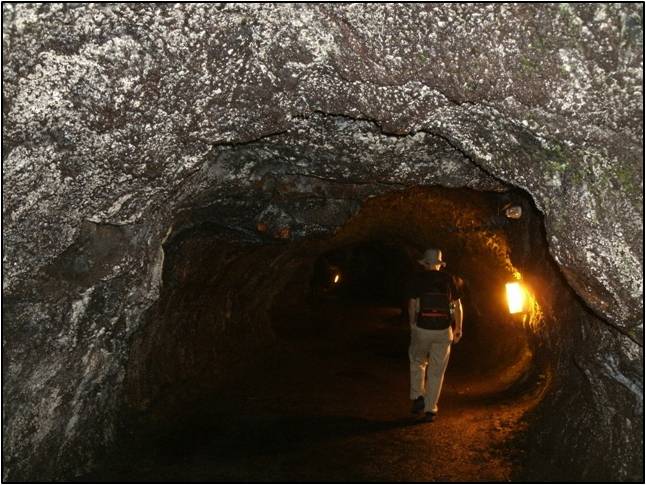
Walking inside a cave made by flowing lava was impressive enough, but the real fun began after this sign:
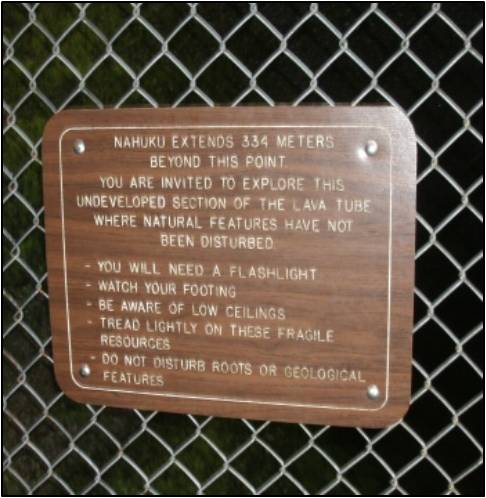
Hawaii, even in the National Park, lets you be as foolish as you like. They put up the warning signs, and you make the decision. Actually, this was quite safe, but I was a lot happier knowing we had not one, but two flashlights. My favorite part came after we had walked far enough that there was not the faintest hint of a glow of light from the entrance, no matter how long we kept our lights off to let our eyes adjust. It was dark. D-A-R-K. Thrillingly and palpably dark. The second best thing was that most tourists were scared off by the sign—or unprepared with lights. We had turned around and were nearly back at the surface before seeing another person. Having that experience all to ourselves was awesome indeed.
Our next walk was above ground once again. Devastation Trail is a pretty accurate name, but it has a great view of the path across Kilauea Iki.

Cinder fields from the 1959 eruption.

After that we took the Pu'u Huluhulu / Mauna Ulu trail, but on the advice of a ranger did not walk its entire length. The sights were interesting, but with time passing rapidly, we couldn’t afford another two- to three-hour hike (or maybe four at our pace), and really, after a while all that lava starts to look alike.
Or not. This is a wall of a'a', a handy Boggle word, since the game doesn’t insist on the apostrophes.

And this is pahoehoe, which is described as “smooth”—but those soft-looking striations feel like parallel razor blades.

We continued down Chain of Craters Road for a while. Our intent had been to take it to the end, but that was still a long way away, and it became clear that many of the stops were more interesting to those who had not bothered to take the Kilauea Iki hike. So we headed back to the Visitor Center for one more, short trail: Sulphur Banks. The name pretty much says it all.

Soon we were back on Route 11, leaving Volcanoes National Park behind, taking with us lots of pictures and a memorable experience.

Click on the map for more detail. You will be able to zoom in and out, and move around.
Our next stop was South Point, the southernmost spot in the United States. A quarter of a century earlier, we had stood at the southernmost point in the continental U.S.

Here’s the southernmost point without qualification.

Tourism, as might be expected, is a big industry for Hawaii, but that doesn’t mean they make it easy for strangers. In stark contrast with Florida’s Key West, South Point makes no effort to attract tourists: it is poorly marked, and the road, though recently made much more automobile-friendly, is single-lane and rather desolate. Getting down to the parking area was, shall we say, interesting—and we couldn’t help noticing that anyone who knew anything about the area had come in a four-wheel drive vehicle. I’ll save the suspense and let you know that Porter rose to the occasion, making it up the steep, rutted, and rocky grade on the first try.
That was not sufficient challenge for him, however. He deeply regretted not having brought his bathing suit, as some enthusiastic local teens (the term “Hawaiian” is properly given only to those with native Hawaiian blood) were jumping off the cliff at the end of the road and climbing back up a blow hole. Porter would love to have had me take a video of him doing likewise. Me? I’m very glad he had no suit. He made me nervous enough by standing near the very edge, with a stiff and unpredictably gusty wind threatening to blow him in, bathing suit or no.
Oh, and the guidebook, which doesn’t hesitate to suggest risky adventures, recommends not swimming unless you know what you are doing, because the currents there take you directly to Antarctica with no stopovers.
Did I mention it was windy?

After that adventure we made a beeline for home, saving the remaining sights for another day. We would like to have visited the green sand beach, but it is only accessible by 4WD from South Point, unless you're up for a five mile hike, which we weren't.
It was well after dark when we elected to make one more stop: at Walmart, for water shoes to replace the ones we had neglected to bring from home. Why I bothered to get some for myself when my Vibrams would have worked just as well, I’ll never know—but at least they were inexpensive, even in mainland terms.
It had been an exhausting and exhilarating two-day tour of the island’s perimeter, and I don’t think I’d change a thing—including the part about Porter not having his bathing suit.
We crawled into bed, anticipating a lighter day the morrow.
(Continued from Day 3 - Part 2)
There was nothing about its beginning to presage a day spent amidst reminders of nature’s primordial (and very present) violence.
We awakened early. I grabbed my Bible and a cup of tea, and slipped out to breathe in the morning from our porch. Rarely have I experience such uplifting peace. I bathed in the natural beauty before me—okay, technically it was a golf course, but there were birds, and wind stirring the trees, and no sign of golfers. Best of all was the delight for my ears: I could hear the trilling of unknown Hawaiian birds, the crow of a rooster, and the lowing of a cow. I could hear the breeze, and the soft sounds of Porter puttering in the cottage behind me. More remarkable was what I could not hear: no lawn mowers, no chain saws, no air conditioning compressors, no pool pumps, no airplanes, no construction work, and no road noise—not even a single car. I was awed at how much more conducive to meditation is such a setting.
Somewhat reluctantly, we packed up and headed for breakfast (included with the room) at the Kilauea Lodge restaurant. The feature was French toast: three pieces of Portuguese sweet bread (note: not sweetbreads), each different—plain, taro, and guava—all delicious. It was served with two syrups, maple and coconut. This being Hawaii, not Vermont, the “maple” syrup was not the genuine article, but Porter liked the coconut, and I found the French toast sweet, flavorful, and delicious just as it was.
If forced to name the high point of our trip, I would have to say the helicopter ride on Day 2. No pun intended. Really. But Volcanoes National Park was a close second. Florida has resorts. Florida has botanical gardens. Florida has beaches. Very nice beaches, with surfing, and snorkeling. Florida even has cattle ranches. But Florida has no volcanoes. Not one. Walking across a crater is one amazing experience. Not at all like walking across a Florida parking lot in August. Well, only a little like that.
You can take a look at the park with this cool, interactive map from the National Park Service. Our first stop at the park was—surprise!—the Visitor Center. There, some friendly rangers helped us tailor our visit to our time limitations and personal preferences. We began by taking the Crater Rim Drive to the Jaggar Museum. Those who know how much we like museums may wonder at this, but we spent very little time in the museum itself. It’s full of interesting information, and if we’d had a week we would have enjoyed it. Information can be found elsewhere; not so the view!
This is the Kilauea caldera.

This is my Florida guy in Hawaii, wearing his hat from Thailand and his shirt from Tanzania. With the Kilauea caldera. Not at all the same as the grandsons' request for a picture of "Dad-o standing dangerously close to the lava," but the best we could do.

Porter’s favorite Hawaiian flora, the ohia tree. If you have five minutes to spare, enjoy this story of the ohia from HGTV.

The 11-mile Crater Rim Drive circles Kilauea, but for us this was the end of the line. Much of the park is closed due to dangerous emissions from recent volcanic activity.

No worries. There was more than enough still open to make us wish we had more than three quarters of a day to spend at the park.
This steamy trail reminded me of New Zealand, where we watched Maoris cooking food over similar steam vents.

After that warm-up we were ready for the main hike, the highlight of the day: the Kilauea Iki Trail. Kilauea Iki is a smaller crater on the east side of the main Kilauea caldera. The hike took us through rain forest along the crater rim, a pleasant enough walk as it was, but—this is where I reveal my bad tourism skills, having not read the brochure beforehand—I really became excited when I realized we were gradually descending to the frozen lava lake itself! The trail, now marked with piles of stacked rocks, known as ahu, ran more or less straight across the still-steaming lakebed before returning steeply to the top of the crater. If you want to follow where we trod, so to speak, you can read the brochure that was our guide.
View from the rim: You can see steam from the Kilauea caldera in the background, and part of the tourist-foot-worn path along the Kilauea Iki floor. That's the faint, white, straight, diagonal line that crosses from sun to shadow in the middle of the picture. We walked across from upper right to lower left.

Good thing I don’t mind looking like a tourist: Thai hat (gift from Porter); Carnegie Mellon shirt (gift from Heather); Swiss backpack (gift from Janet). The belt pack kept my camera handy, and the jeans protected my legs, which were still sore and oozing from the day before, when I foolishly climbed around on razor-sharp lava rock in shorts. Not that climbing was the problem; falling was.
But the pièce de résistance was the shoes. My Vibram Five Fingers. Walking barefoot across the lava was out of the question (see above comment about asphalt, Florida, and August), but I knew I had to let my Happy Feet make the journey. They make hiking more personal, more connected and responsive to the land. It was a sublime experience.
Eventually, and reluctantly, I switched back to my sneakers. Walking in my Vibrams may be more fun, but over such rough terrain it was also slower. Because we like to look around a lot while we hike, it was already clear that we would be exceeding the park’s hiking time estimate of two to three hours. More than that—did I mention that the lava rock is sharp? I decided I’d rather ruin a $35 pair of shoes than ones that cost twice that. (As it turned out, the Five Fingers probably would have been fine, as they showed no damage at all from the trek. I’m quite impressed.)

Beauty from ashes: the ohia tree is one of the first signs of life returning to the barren land.

It’s good to know part of all that money went to something more satisfying than repaving highways.

To be continued in Part 2.
(Continued from Day 3 - Part 1, which was continued from Day 2, which was continued from Day 1.)
Leaving behind the Waipi`o Valley, we retraced our path and rejoined the Hawaii Belt Road (Route 19), continuing westward before turning south.
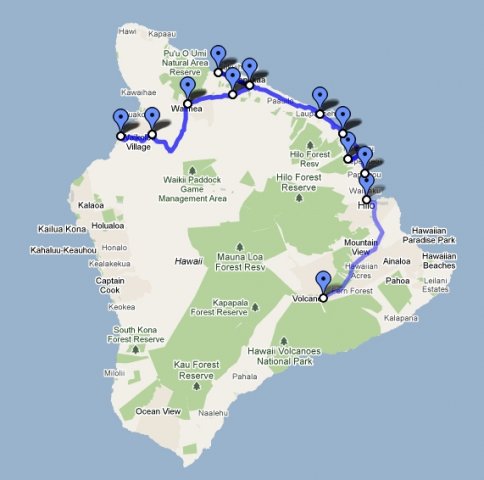
Click on the map for more detail. You will be able to zoom in and out, and move around.
Laupahoehoe Point was a seaside village, but in 1946, twenty-one children and three adults died in a tsunami, and the town was moved to higher ground.
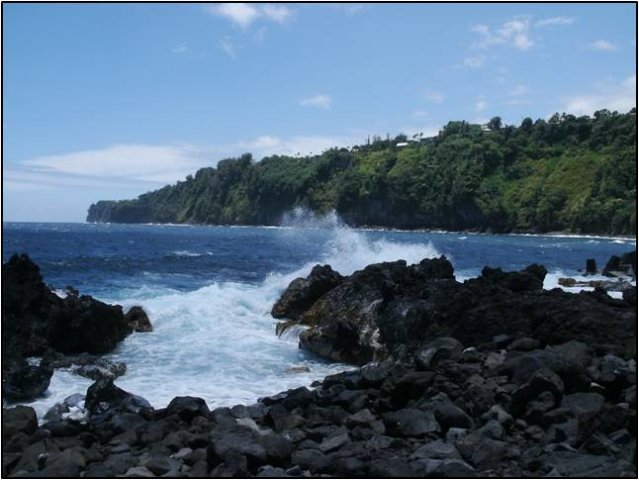
It is now a beautiful park, with a memorial and you-won’t-see-this-on-the-mainland warning signs.
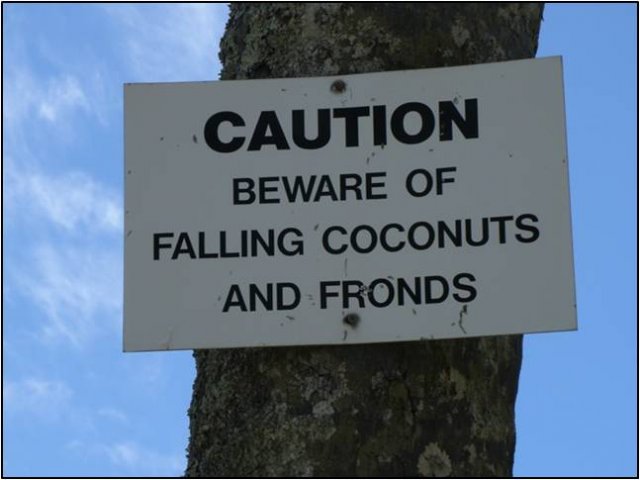
Sugar once dominated Hawaii—and there’s a case to be made that it was as bad for Hawaii as it is for our teeth.* But the only signs remaining are ruins, and an occasional sugarcane plant left to grow wild. We drove through some of this old sugar land on our way to ’Akaka Falls State Park for a nice hike and some good-looking water.

On our way back to Route 19, we stopped at the Woodshop Gallery and Café; the wood products were interesting, but not as interesting as the homemade ice cream.
Soon we deviated once again from the main road, on for a four-mile “scenic route.” Trust me, it’s all scenic here, but this road also led to the Hawaii Tropical Botanical Garden.
The story began in 1977, when fifty-six year old Dan Lutkenhouse looked at a dump—a property “so overgrown that a machete was needed to walk only a few feet through it, and filled with old cars, machinery, appliances and trash of all kinds” —and dreamed a garden for the world to enjoy.
We did, very much indeed.
Behive ginger
Mule's foot fern
Persian shield
I don't know what it is, but I love the two purples.
What's Hawaii without a warning sign?
Don't you think the cannonball tree is more deserving of a danger sign?


Perhaps we lingered overlong in the Garden. We had no promises to keep, but miles to go before we could sleep. Plan A had been to spend the night in Hilo, but we had not reckoned on the Merrie Monarch Festival, a popular hula celebration and contest. Extremely popular. There was not a hotel room to be had.
Plan B took us all the way to Volcano, and the Kilauea Lodge, which would give us a good start on the next day’s exploration of Volcanoes National Park. Even there, the only “room” available was the Pi’i Mauna House, with capacity for six (or several more) and a price tag to match. We had reservations, and therefore no worries about arriving late, but if you’re spending that kind of money, it’s nice to do more than crash into bed.
So we quickened our pace, driving through Hilo without stopping at any of the tempting museums. There always has to be a reason to return, right?
Not that Hilo was without adventure.
Let me tell you something about the Hawaiian language. It is expressed using a mere 12 letters (plus a left single quote, which represents a glottal stop). This extreme efficiency plays havoc with my brain, especially while navigating.
Navigating through Hilo went fine until we found ourselves at an unclear intersection and guessed wrong. The development went something like this: I catch a glimpse of a street sign as we pass by, noting that it begins with K. I look down at the map. Great. Half the streets in Hilo begin with K. Porter calls out another name while I’m scanning the map, but his guess at the pronunciation doesn’t eliminate much. I decide on a route to take, but by the time I’m done struggling through the syllables we’ve passed it. Waianuenue, Komohana, Ponahawai, Punahele, Kapiolani, Kinoole, Kilauea, Kukuau, Hualalai, Panaewa, Kaiulani, Kekaulike, Wailuku ... under pressure, they all look alike.
We have friends who keep telling us we would be perfect contestants on The Amazing Race. I say, we’ve been married for 36 years, and I’d like to keep it that way, thank you.
But we were soon safely on the way to Volcano, reluctantly sticking to Route 11 without diverting down 130 to Hawaii’s newest land, created as lava flows into the sea. But we had seen that from the helicopter. You might think that some compensation for having your home overcome by lava would be gaining acreage, but the State claims all new land. I wonder how they write homeowner’s insurance policies in Hawaii. What if your house is untouched, but cut off from the rest of the world? See the roads to nowhere?

We checked into Pi’i Mauna House and set off to find Thai food for dinner (successful) and a view of the glowing lava flowing into the ocean (unsuccessful). I’m not certain we were looking in exactly the right place, anyway, but apparently we were able to see lava flow in the crater because its path to the sea had been blocked. You get one or the other, or neither, but not both. Unless it's a massive eruption of the kind no one but someone whose home is safely elsewhere wants to see.
The obvious solution was to return to our house and enjoy the hot tub before retiring.
I know you're all—one or two of you, anyway—waiting with bated breath for the next installment of the Hawaiian Adventure. I'm working on it. But it's not going to happen tonight, so instead you get a quick story of today's enjoyable shopping trip.
Yes. I did just use "enjoyable" and "shopping" in the same sentence.
Thirty-plus years ago we visited Brazil. One of the delights of foreign travel is the opportunity to expand one's taste in food, and that trip introduced us to, among other treasures, jabuticaba jelly, Antarctica Guaraná, and suco de maracujá sem açúcar. The last is passion fruit juice, without sugar, and was my staple breakfast drink every day I could get it.
It is hard to find passion fruit juice here, and when I do, it's always sweetened. Our local Albertsons did start stocking plain, frozen passion fruit purée a few years ago, so when, in my new-found enthusiasm for smoothies, I decided that passion fruit flavor was just what I needed, I turned to them.
Alas, they no longer carry it. But the willing-to-be-helpful clerk suggested we try a Bravo Supermarket. We have several nearby food stores, but Bravo is not one of them. Research, however, revealed one not far from our church, so this morning we ventured in.
Success! We came home with not one but three different brands of passion fruit purée: one from Colombia, one from Ecuador, and one from the Dominican Republic. Mmmm—smoothies tomorrow!
Finding a long-lost love is enough in itself to take the sting out of shopping, but Bravo did us one better by being such an interesting store. Even if it were closer, it wouldn't do for everyday use, because it's a small store with not much general selection. But it abounds in what I'd call, for lack of better information. Hispanic foods. The produce section was amazing, with half a dozen different kinds of bananas, and dozens of fruits and vegetables I know not of.
I look forward to other after-church excursions in the future.
Our concierge had informed us of Waikoloa Village Market, where the locals buy groceries, so yesterday we picked up a few supplies, such as SPF50 sunscreen, a pineapple, a knife with which to cut the pineapple, and breakfast materials. It was nice not to pay resort prices, but overall it must be admitted that Hawaii makes Swiss price tags seem reasonable. Lower-48 Americans can stop complaining about the cost of a fill-up now: gasoline is about a dollar more per gallon in Hawaii. We even paid more for the pineapple than we do at home in Florida.
We began our day with breakfast on the balcony: Raspberry Ginger Clusters & Flakes. It was good stuff, although the ginger overwhelmed the raspberry. Obliterated, really. Think of it as Blenheim-in-a-box.
The Hilton Waikoloa Village is a super resort. You could have a bank-breaking fabulous vacation without ever leaving the property. So, having spent but one night there, we left. We kept the room, for we intended to return the next day. (And we did.) But what care we for super resorts? We can have those for a lot less money without leaving Florida. Beaches, swimming, and snorkeling? Ditto. But volcanoes? Florida is remarkably short of that particular natural beauty. So we hopped in our rental car, and hit the road.
If we’d been smart, we would have bought Hawaii: The Big Island Revealed (aka “the blue book”) before we left home and not paid island prices; even so, it was a great investment. Along with the map our concierge had given us (more useful than the AAA map we had brought), this became our most important guide for the rest of the trip—even though I felt I was navigating standing on my head, since much of our journey went in the opposite direction from that described in the book.
When we had picked up the car, we had been asked if we wanted to upgrade the vehicle—to either a convertible or a Jeep. “A Jeep?” I queried Porter in amazement, when he reported the option. “I can see a convertible as an upgrade, but a Jeep? No way.” I was to learn my mistake later. For this trip, however, we had no worries in our Ford Fusion.
Click on the map for more detail. You will be able to zoom in and out, and move around.
We first returned to Waikoloa Village, the continued on Waikoloa Road to the Hawaii Belt Road (Route 190 at that point), and thence to the town of Waimea.
Does “Polynesian cow town” sound like an oxymoron?
Of all the images I had associated with Hawaii, “cattle country” was not one. Yet the Parker Ranch—which traces its origins to a gift of longhorns given to King Kamehameha the Great in 1793—is one of the largest in the United States. (Our helicopter pilot said it is the largest, but then you have to quibble about “contiguous” and “privately-owned” and other details; suffice it to say, the Parker Ranch is big.)

From Waimea, we continued on the Belt Road (now Route 19), deviating from it for a drive along the (even more) scenic Old Mamalahoa Highway. This is the only time I wished we had had a GPS, because we were looking for a particular cave to explore, and the only instructions, besides a rough indication on the map, were latitude and longitude numbers. We never found the bigger cave we were looking for, but settled for this small version, and went on.

Back on the main road, we made sure to stop at Honoka`a. What’s in Honoka`a, you ask? Nothing less than the Tex Drive In, famous for its malasadas (a type of doughnut introduced by the Portuguese). Yum! Er, make that Yum! Yum! We each had two. Not that they were really anything special as fried dough goes, but fried dough does go rather far in that direction.

That’s also where I took a pictures of this tree.

So far I’ve been unsuccessful in my efforts to learn its identity, but I doubt it’s true name is more evocative than Porter’s nickname: “African-American hairdresser tree.”
Our next stop required a side trip, to the end of Route 240. From there we looked out over the beautiful Waipi`o Valley.

Here is where having taken the helicopter ride saved us: we knew there was no need to find a way down into the valley itself, as we would never get a view as good as yesterday's helicopter tour. As the blue book says,
Don’t even think about driving a regular car down Waipi`o Valley Road. The paved one-lane road down into the valley has a ridiculously steep 25% grade. Vehicles with 4WD and low gears (so you don’t burn up your brakes) can make it down the 900-foot descent (in less than a mile). Regular cars simply can’t. (There is a wad of metal that was once a two-wheel drive truck below one of the turns left by someone who thought otherwise. He miraculously survived by jumping from the vehicle just as it started tumbling down the almost vertical plunge.)
I was no longer laughing at the idea of a Jeep being a rental car upgrade.
We slept well until 4:30 a.m. That sounds early, but it’s not unusual for us to start the day ony an hour later. Not bad at all, considering Hawaiian clocks—in the summertime—are six hours skewed from Florida’s.
(My current approach to combatting jet lag is to sleep as much as possible on the plane, but not to make an effort to sleep. Once upon a time I acted as if I could get a full night’s sleep on an overnight flight: brushing my teeth, wearing eye covers, and settling down as much as is possible in a coach-class set, with a pillow and a blanket. After several flights with marginal success at best, I decided to ignore my watch altogether. After boarding, I settle down to enjoy myself, usually with a book or my World of Puzzles magazine. I’m at the stage of life where it’s easy to doze—actually, I’ve been at that stage for at least 40 years—so when I feel sleepy, I set the book down and allow myself to snooze. I rarely even bother to take off my glasses; I just lean back and sleep. When I wake, I pick up where I left off and begin the cycle again. I find this much more satisfactory, because I’m no longer annoyed by announcements, food carts, or neighbors who must get out of their seats. If they wake me up, they’ve only disturbed a short nap, not my “night’s rest.” I no longer worry that I’m “supposed” to be sleeping. I enjoy the flight more, and adjustment to the new time schedule comes more easily.)
We would have liked to make a faster start to the day, but had a morning appointment with our “personal concierge,” who would help us plan our week, including the mandatory timeshare presentation. She was actually very helpful, with useful suggestions for places to stop on our around-the-island tour. She was also able to reschedule our presentation, which had originally been placed in the middle of the day, a most annoying and wasteful time.
The first meeting accomplished, we headed out of the Hilton property to the shopping/restaurant area at the entrance to the resort. (The resort is more than the Hilton sites, although they constitute a large part of it.) There we made a breakfast of “Japanese Tempura Style Fish and Chips” (and shrimp). Delicious!

Unless you consider fish & chips for breakfast a bit odd, there was nothing about its onset to indicate how incredible this day would be.
Other people may not have this problem, but I quail at the thought of spending more than $1000 on an activity that lasts only two hours. Even grocery shopping isn’t that expensive. The two of us can fly to Pittsburgh and back for half that. Or one of us to Switzerland (though not back). However….
If you’re going to go all the way to Hawaii, I recommend in the strongest terms that you invest in a Blue Hawaiian helicopter tour. We decided to go all out, choosing the two-hour tour and the fancy Eco-Star helicopter, and are so glad we did. What an amazing experience!
On the practical side, it was a fantastic introduction to the island, giving us a much better idea of what we wanted to do with the rest of our days there. (I know, I know. We should have had all that figured out ahead of time. But we didn’t, and I don’t know how we could have done better than what transpired, no matter how much we had planned. Hmm.... We might have saved a bit on the Volcano hotel; more on that later. But that’s about it.) We learned a lot about which treks were worth taking, and which were a lot of effort for a view much less interesting than the one we had from the air.
The view. The views! It would have been rewarding enough merely flying all over the island. On the first leg of the trip we flew across to Hilo: from the desert,

over ranch land,

to rain forest.

But that’s not what you’re waiting to see.
We flew right over the top of Kilauea!

At the arrow, the red-hot lava is pouring forth, turning grey as it cools but still flowing. This is not the spectacular effect our grandkids were hoping to see, preferably with Grandma and Dad-o standing perilously close, but this is God’s creation, not Walt Disney’s, and not to be activated on demand. We were lucky to see lava flow at all, as until recently it had been flowing through underground lava tubes rather than into the caldera. And it was truly amazing to see Creation ongoing.
After the volcano tour, we stopped briefly in Hilo for refueling, and then it was on to the waterfalls! The Waipi‘o Valley is best seen by helicopter, unless you have a four-wheel drive vehicle and a death wish.

Hawaii’s falls are not broad, but very tall and beautiful.

An expensive ride? Yes. Worth the cost? Absolutely.
Did I mention that flying in a helicopter feels like flying? Or what I imagine flying would be like, were I actually able to do so.
After a lunch/dinner of pulled pork—which is big in Hawaii as well as South Carolina—we went back to the room, intending to put on our swim suits and check out the resort’s saltwater lagoon and freshwater pools. But I made the mistake of lying down, “just for a few minutes,” and quickly lost consciousness. Porter spent the time reading our guidebooks, occasionally making a half-hearted, and thoroughly unsuccessful, attempt at awakening me. Our early arising, bright sunshine—which always makes me sleepy—and exciting adventures had wiped me out … until 4:30 a.m. of the new day.
I'm still working on Hawaii, Day 2, so today you get to see the souvenir we brought home—for the worms.

It's billed as a compostable cup, and was of excellent quailty for drinking. According the the manufacturer,
Please note that composting is required for biodegradation. These cups will biodegrade within 180 days in a commercial composting facility but can take up to a year or more to biodegrade in a home composting system.
We will see what the worms make of it. I suspect it will take quite a while for them to have an impact on the cup: they prefer their food in small pieces, preferably soft. They will eat the mushier parts first, leaving harder pieces until bugs and microbes have degraded them somewhat—see the piece of corn cob to the right of the cup.
Permalink | Comments | Edit
Category Travels Conservationist Living
If a good neighbor is one who watches out for your home while you are gone, and a great neighbor takes care of your mail and pets (even if there are 10,000 of them), what can you say about a neighbor who will take you to the airport at 4:30 in the morning? That was the first leg of our trip to Hawaii. (Technically, “Hawai‘i,” with the left single quote, but I’m going with the simplified spelling.)
Hawaii? What were we doing there? That’s what I asked myself.
Ever since my class in elementary school debated the relative merits of our new states, Alaska and Hawaii, I’d preferred the former. What a pernicious influence our early experiences can have! My mind later realized that outside of the debate context, this is not a choice—one can, and should, like both—but my prejudices from that forced decision remained.
Thus I was not as excited as some might be when Porter announced that he had made a commitment to go to Hawaii. I wasn’t upset; I knew he wanted to get there sometime, and I find vacations a lot more fun if someone else makes the arrangements. Not upset, but surprised, because we usually debate such plans for months before acting.
As it turned out, he had debated for months, until he was worn down by a Hilton Vacation Club salesman at the hotel where he had stayed while working in New York City. So our great deal came at the cost of a 2 ½-hour timeshare presentation. (It was well worth the price, but more on that in a later post.) The deal included three days at the Hilton Waikoloa Village resort on the Big Island, a rental car, a luau, and a $200 voucher to use sometime in the next six months at another Hilton property of our choice. We added a fair amount of our own money to extend the stay to six days, but used frequent flier points for our plane tickets, so I guess Porter earned this dream trip in several ways!

We travelled relatively light—it’s easier when you don’t have friends and family on the other end—but still ended up with one checked bag and three small carry-ons. It didn’t seem as if we were bringing that much, but snorkelling equipment, a video camera, extra shoes, and clothes for both hot and cold weather do take up space. Not to mention a computer, though we only brought one this time.
The flight from Orlando to Atlanta was fine, although we were disappointed to learn that apparently flying on points disqualifies you for upgrades, which we had been looking forward to thanks to Porter’s super-elite status. Ah, well. First class doesn’t get to the runway any sooner than coach. Later, actually!
It was in Atlanta that things appeared to go wrong. I missed the part where we had signed up for the Delta Fitness Plan, but the inevitable gate change didn’t surprise me. We began to suspect more than a simple gate change when boarding time came and went. Then we were told there was an equipment problem, but Maintenance was working on it. And working on it. “You don’t want to fly all the way to Los Angeles with non-functional bathrooms, do you?” Given that we had a connection to make, I would have been willing to take my chances, but Delta wasn’t.
Finally, we decided to investigate other options, as the odds of making our Kona flight were diminishing rapidly. As it happened, we were right at the entrance to the Delta Customer Service area when the cancellation of our Atlanta – L.A. flight was announced; thus we found ourselves at the head of what soon became a very. long. line.
Platinum status may not have gained us a first class upgrade, but it did shove us to the front of the next line, inside Customer Service itself. There, the kind and very efficient agent booked us on a flight directly from Atlanta to Honolulu, and a puddle jumper thence to Kona. Level II of the fitness program: this gate change required racing to the most distant wing of the airport. We made it—but if we had not been where we were when the cancellation was made, or if we had had to wait in the non-status line, we would have had plenty of time to use the generous $16 worth of food vouchers we had been given.
The new arrangements turned out to be much nicer than the originals. We skipped L.A., added an additional island to our tour (albeit for less than an hour), and landed in Kona not much later than originally scheduled. The hardest part was believing we were still in America after having flown so far. Door-to-door travel time was about 19 hours; after all that, shouldn’t we have been in Switzerland?

The Kona airport is tiny. About a dozen gates, and none of those enclosed jetways: You walk down the stairs from the plane, and through the weather. Fortunately, Kona is on the dry side of the island.
First impression: Hawaii is bilingual. Much as Florida’s signs are in English and Spanish, the signs at the airport, rental car agency, and resort are in English and Japanese. Seventy years after the attack on Pearl Harbor, the Japanese invasion of Hawaii is going strong—in the form of tourists, dropping yen instead of bombs. It was great to hear Japanese once again, and brush up on important skills, like recognizing the Japanese characters for “exit.” (As it turns out, we saw more Hawaiian than Japanese once we left the resort area. More on the Hawaiian language later.)
After check-in, we took an evening walk around the huge resort, and ate what turned out to be our one-and-only resort restaurant meal. I had a moderately outrageously priced teriyaki chicken sandwich that was quite good, and Porter had a $25 “lobster burger” that was not.

The view from our window
The night was breezy and not too hot, the sunset-and-ocean view was soothing, and dolphins were playing in the nearby lagoon. We were in Hawaii!
We were in Hawaii: jet-lagged, and with a busy day scheduled for tomorrow. Grateful for the day’s many blessings, we collapsed into bed.

Waikoloa sunset
 Stephan's thoughtful parents gave Porter a jar of Speculoos à Tartiner for Christmas, and I can't wait to try it. It's made by Lotus, the same folks who make the incredibly delicious Biscoff cookies Porter occasionally brings home from a plane flight.
I don't have as much quarrel with the TSA as many people do, but I am tired of having my luggage singled out for hand inspection nearly every time I fly. On my most recent trip to Switzerland, I wasn't particularly surprised to find the tell-tale TSA notice in my checked bag when it and I were finally reunited (that's another story), because I was carrying a large, metal cylinder filled with dangerous ... candy canes. The can did a great job of protecting the fragile candy, but must have looked intimidating on the x-ray. There is no packing job so good that the TSA can't make a hash of it, but the only victim of their efforts was one crushed chocolate truffle. We promptly destroyed the evidence.
On the way home I thought I had a chance of escaping. I had a few bizarre encounters with airport security—none of which involved pat-downs, I'm glad to say—but it wasn't until I landed in Charlotte that my checked bag became a problem.
First, I was singled out for special treatment at Customs, because I'd answered honestly the question, "Are you bringing any food into the country?" That always gets me into trouble, although normally as soon as I explain that the food is chocolate, cookies, and similar items, they lose interest.
Not this time. Everything, including my purse, went through a scanner. "What's in the jar?" I was asked. "It's kind of like peanut butter," was the best I could do, but it was sufficient. The pleasant Customs officials released me, and I thought I was home free.
Not too surprisingly, however, Customs and the TSA don't share all their information. When I retrieved my bag in Orlando, it was not the unscathed piece of equipment I had re-checked in Charlotte. That my special Towers-Perrin strap was ripped was clearly the fault of some mechanical demon, but what accounted for the odd shape of the bag? When I opened the bag to check for damage, it was clear that someone had gone through the contents. No way would I have left fragile items on the very top, unprotected by several layers of clothing! Amazingly, all appeared to be well, despite the mangling. But who had done the inspection? It must have been done in Europe, I reasoned, because I could see no TSA slip. It wasn't until a few days later, when I removed the Speculoos jar from its protective wrapping, that I found the notice from the TSA, carefully wrapped around the jar.... To give them credit, they did return the glass jar to its bubble wrap, and no damage was done.
I'm really looking forward to tasting that which caused so much concern. If it's as good as I hear, I may be braving TSA and Customs inspections on subsequent trips.
That's all I was going to say. But in researching Speculoos à Tartiner for this post, I came upon this post by pastry chef David Lebowitz. While drooling wandering around his site I also discovered a post about his visit to Lausanne, Switzerland. At least one of my readers will not want to miss it.
It is fitting to end my November Thanksgivings with gratitude for a wonderful visit with family and a safe journey home. Despite Heather’s prediction that I would post more about our activities than she would, you’re not likely to hear much about them. I was too busy living the adventure to write about it.1 Of yesterday’s voyage from Pittsburgh to Orlando I have much to say, and the illusion of time to say it.
It was a long day—nearly 16 hours door-to-door—but I can’t complain as Porter still had some 13 more hours to travel after I was safe in our own house. If it weren’t for the final blow from JetBlue, I wouldn’t have minded at all.
Perhaps the beginning of the trip was a portent, as we began by brushing the first, wet snow of the season off the car.2 Traffic was bad but the driving fine on the way to the airport, and there was no line at either of our check-in counters, so we had plenty of time. The security line was by far the longest I’ve experienced in Pittsburgh, but short by Orlando standards, and neither of us had to make the body scanner/pat down choice.
All too soon we had to go to our separate gates, but kept in touch by SMS:
many flights out of nyc canceled3
mine ok so far
delayed to 10:40
our plane just landed. praying for your connections
ours not here yet
on plane
me too
Remind me not to schedule non-direct flights during the winter if possible. I was flying through New York City instead of directly home to Orlando because I was taking a free trip Porter had earned by being bumped from a JetBlue flight earlier in the year. If it weren’t for the most important part—I got to my destination and home again safely—I might be tempted to say the flights were worth the cost.4
Flights out of JFK airport were delayed and cancelled left and right…but not the one flight I wanted to be delayed: my 12:30 New York – Orlando leg. I must say that JetBlue got me to New York in time to catch the flight, had we not been so far above the airport at boarding time.
When we finally were allowed to land, I remarked that if I had wanted a thrill ride I could have stayed at home in Orlando. One of the airport employees later described the weather as a monsoon and a tornado combined. In Florida we’d call that a hurricane, but whatever it was, that’s what it looked (and felt) like from the airplane, too.
Safe on the ground—not without a cheer and a communal sigh of relief from the passengers—I sped out of the plane hoping that my connecting flight had been delayed at least as much as we had, but it was no longer on the display board. I noted that the next flight to Orlando was currently boarding, so I sprinted from Gate 6 to Gate 17 to pant for a seat. No go. Well, no go for me. As it turned out, they had room for my luggage, though I would later learn that the price it paid for the privilege was not one I would be willing to pay for myself.
I almost didn’t mind the delay, however, because I received one more SMS from Porter:
just made the narita flight, got my first jog in in 2 weeks
Better him than me, by far. If he’d missed that connection, his next chance wouldn’t have been until the following day.
Another sprint—or rather, a fast walk, as there was plenty of time before the next Orlando flight—brought me to the “Just Ask” desk, where the friendly and apparently helpful agent listened to my story and quickly printed me a new boarding pass. I walked away, very impressed with JetBlue’s service.5
That good feeling lasted just long enough for me to get to the gate and be told that my boarding pass was not a ticket, just a placeholder on the standby list for a completely full flight. Still, the gate agent was fairly encouraging, as if he expected several of the “already checked in” passengers to disappear at the last moment.
Being on standby pretty much tied me to the gate area, as I wanted to be available at a moment’s notice. In fact, everyone was told to stay in the gate area, since flight statuses were changing with a fairly regular randomness. Not that this kept me from getting my exercise: the gate changed from 14 to 5, pretty much as far as you can go in the JetBlue area. Presumably this was because the plane we were to take to Orlando was now coming into Gate 5 instead of Gate 14, so we were hopeful that we6 might soon be on our way.
Just kidding. I dutifully re-told my story to the new gate agent and settled in with the crowd, but after much more waiting and wondering, we were informed that “our” plane had been diverted to Atlantic City. Fitting, I suppose. Air travel in winter is always a gamble.
I had asked the agent at Gate 5 if it wouldn’t be better to get a confirmed seat on a later flight than to take my chances with a sold-out flight that piled delay upon delay, but she told me to stick with the standby. The Atlantic City diversion sent me back to Just Ask for a second opinion. The agent there confirmed that the later flight was also full—but that a few seats had opened up on my standby flight, and he would confirm me on it. Hallelujah! I wish the gate agent had been willing to do the same, but in all fairness she was mighty busy, and it did take 10 minutes and a phone call or two to make it happen.
But happen it did, and clutching my confirmed boarding pass I pulled up a square of carpet near an electrical outlet and sat down for the first time in hours.7 I finally felt secure enough to relax and pull out my computer, but alas, those waiting for posted updates did not get any, as for reasons still unknown I could make neither the gate-area wi-fi nor our air card work. I soon repacked the computer and resumed standing—the floor was cold and hard.
At last our plane escaped from New Jersey, and even managed to land without another gate change. We boarded and were soon in the air and on our way home.
Flights to Orlando are unique in that the pre-boarding line, which includes those travelling with young children, can fill up much of the plane before anyone else gets on board. Amazingly, although a baby or two cried occasionally, and one two-year-old with a high-pitched scream was set off ‘way too many times, the children were incredibly well-behaved for having been cooped up in an airport for most of the day. Not that this stopped one nearby passenger from complaining, loudly and rudely. I would guess he was in his mid-20’s, but even the two-year-old with the nails-on-blackboard screech was more mature than he.
Even more amazingly, he was the only rude and immature person I encountered. The camaraderie of shared difficulty mostly seemed to make people friendlier. We talked, we joked, we helped one another. I’ve had less fun at parties!8
Three hours later, the plane touched down at good ol’ MCO. We cheered, we packed up our belongings, we retrieved our luggage from the overhead bins. We waited patiently for the exit line to start moving. And waited. And waited. The jetway at our gate was broken, and all other gates were occupied. After much effort and failure, the proper mechanic was sent for, but his efforts were equally fruitless. At last another gate opened. Thanks no doubt to the same regulations that require us to learn on every flight how to fasten and unfasten a seat belt, we couldn’t moved until all the luggage was restowed in the overhead bins, and all the passengers back—and belted—in their seats. Thus protected, we made our way—at an altitude of 0 feet above the ground and at a speed slower than I can run—around the corner to our new gate, and deplaned at last. Even so, everyone but the aforementioned rude young man was cheerful and patient. My neighbor did refer to this delay as the final blow, and I told her to wait to say that until she had her luggage in her hand. Sometimes my prescience astonishes me.
Cheerfully I hauled my heavy backpack and heavier duffle bag across the airport to baggage claim, where I searched in vain for my suitcase. It should have been easy to spot, with its 1992 Sunshine State Pow-wow patches and bright red Towers-Perrin strap, but bag after bag went by, and I reluctantly had to admit mine was not among them. At the JetBlue baggage desk I was astonished to find that they could not tell me if it had made it onto the plane.9 I did, however, find it myself, in a small group of orphaned bags from previous flights.
My rejoicing was short-lived. The bag was canted at an odd angle, and refused to come along when I pulled. The cause of this recalcitrance was not hard to discern: the wheels—both of them—had been Snapped. Clean. Off.


Back to the baggage desk line I went, only to be told, “They don’t cover wheels and handles.” I ask you, does the above look like normal wear and tear? Having had my bag badly mangled on a previous trip, I took especial care to pack this one completely full and in a way calculated to minimize problems. And it worked—the body of the bag came through in fine shape. Perhaps I shouldn’t have been so diligent, as if they’d bashed the body they would have acknowledged the claim. But then the contents might have been damaged, and so far all looks well in that department. The bag, however—our one remaining of that size not damaged beyond usefulness—is a total loss. The clerk said I could file a “courtesy claim,” but when pressed admitted that it would make no difference whatsoever. Mindful of the hour and my kind neighbors who had been waiting a long time for me, I said good night. But for the record, whatever JetBlue claims for its successful baggage handling, their statistics are off by at least one bag.
Did I mention kind neighbors? We have the best! My original plan had been to take the bus home from the airport and walk the mile and a half home. When I ended up bringing home the extra 48-pound bag, my revised plan was to ask our neighbors to pick me up at the bus stop and save me the half-hour walk with heavy luggage. However, as my chances of getting into Orlando at a decent hour grew slimmer and slimmer—and the odds of my getting to the bus stop after midnight greater and greater—I went for Plan C and asked for a ride from the airport. This is no small favor, the airport being 45 minutes away, but as I said, they are great neighbors and came to my rescue. Given the baggage situation, it was a much greater rescue than any of us knew—dragging the wheel-less bag the 50 feet to their car was difficult enough. I think we owe them Outback dinners for the rest of the year.
On the way home, after I told my baggage story, they—seasoned travelers themselves—remarked that these days you almost have to look on luggage as a disposable item. Perhaps they’re right: We reuse plastic cutlery, zip-lock bags, and yoghurt containers until they give out, but don’t mourn overmuch when they do. I’m pretty sure some of our yoghurt containers have lasted longer than the dearly departed suitcase, but then again, they never had to go through the airline baggage system.
Adventures or misadventures, all in all it was a great trip. I’m glad to be home, and thankful for all the wonderful people who made it enjoyable from beginning to end.
1I know I posted something every day in November, but that’s because all but one of the posts were written before I left home, so all I had to do was activate the posts.
2 We had to borrow a brush from Heather, as our car did not have one. I maintain that all cars rented during snow season should come equipped with a brush and scraper, even if they do have Florida plates.
3 I generally prefer the British spelling, with the doubled letters—“cancelled”—despite the objections of most spell checkers, but I am so slow a texter I take shortcuts, as you can tell by the lack of capital letters. SMS is ruining the language.
4 But really, 16 hours from Pennsylvania to Florida would have been considered extraordinarily fast even when I was a child, to say nothing of what the trip was like for my ancestors. I was warm and dry the whole time, too.
5 Though not nearly as impressed as I was with USAirways when Eyjafjallajoukull caused us to miss our connecting flight home from Switzerland.
6 Note that by this time the crowd of passengers had become “we,” a community. On an individual level, I was still in standby limbo.
7 There were nearly as many passengers on the floor as in seats, and I felt very privileged to find a space within reach of an outlet. As Ma Ingalls always said in the Little House on the Prairie books, “There’s no great loss without some small gain”—the nearby massage/facial/manicure store was doing a booming business.
8 Except for the food. Parties usually have good things to eat and drink, and JetBlue never even came through with a meal voucher.
9 On our first trip to Switzerland, the French baggage clerk in Basel/Mulhouse was able to tell us within seconds that Porter’s bag had missed the American Airlines flight out of Miami, and would be delivered to us between 10 and 11 the following morning.
Permalink | Comments | Edit
Category Travels Everyday Life
This is a short post, because I don't have a lot to say about electricity in Switzerland, but I like their home outlets. I'd rather the world adopt our 110 volt system, for safety reasons, but if I could I'd change our plugs to the Swiss type. See how sturdy the prongs are? No worries about accidentally bending them when you stretch the cord too much, straining to get the vacuum cleaner to reach to the far corner. Some outlets are combined with light switches, and many are recessed—a neat safety device that makes it impossible for the prongs to be connected to the electricity and touching your fingers at the same time.


Permalink | Comments | Edit
Category Travels Everyday Life
Maybe this post should be "readjustments," since I'm now home and experiencing reverse culture shock, but it's still worth talking about transportation.
Basel is a city, albeit one of the nicest cities I know. It's the third largest in Switzerland, a little smaller in population than Providence, Rhode Island or Tallahassee, Florida, but a lot more dense. I'm not fond of cities, in general, but if you wanted to design a situation that is perfect for public transit, walking, and biking, you could hardly do better—and Basel made a conscious choice, back in the 1970's, to encourage those modes of transport.
 Trams and buses The best I've ever experienced. Clean, quiet, frequent, dependable, on time. You can count on the schedule—for a tram to be late by three minutes is shocking—and at most times, if you miss a tram, there's another coming in just a few minutes. I love their innovative approach to ticketing, too. You must have a ticket—which you can buy and punch at the tram stop if you don't have a pass—but don't expect someone to collect it. You simply hop on the tram or bus, ride it to your destination, and hop off. (I only wish you could by your ticket on the tram. It's frustrating to miss your ride because you're still fighting with the ticket machine.)
Do some people ride without buying a ticket? Sure. But the penalty, if you're caught, is stiff enough to encourage good behavior. Rarely—but you never know when—the tram police (in plain clothes, so you get no warning) block all the exits and ask to see everyone's tickets. If you don't have one, the fine is 80 francs (about $80), and it goes to 100 francs if you don't pay right then and there. The system works because it is consistently enforced—and not sabotaged by lawsuits, which is what I suspect would happen in this country.
 Biking Trams are great, especially in inclement weather or if you're carrying bulky packages, but they're not as fast as biking from A to B. Bikers are everywhere, and are accommodated with ramps like the one to the left, and plenty of parking places. This is one reason backpacks are so popular. One of my favorite memories is of a nattily-attired man biking along in a business suit, with proper tie—and bright orange backpack. In the U.S., bikes and backpacks for anything other than recreational purposes are too often associated with children—or losers who have had their drivers licenses revoked. Switzerland wins this one big time in my book.
(That said, the only way businessmen could reasonably bike to work here in Florida would be if their place of employment provided showers—and in that case, they wouldn't be wearing their suits.)
Bikers are second only to trams and pedestrians when it comes to right-of-way on the road, and drivers are much more aware of their presence than in America. Still, I wish more of them would wear helmets. (Kudos to our son-in-law for setting a good example.)
Walking I walked nearly everywhere I wanted to go in Basel during my visit: to the grocery store(s), the post office, the train station, the organic farm delivery stop, school, church, the park, and a lot more. I thought I was getting a lot of exercise tramping all over the city, but a few calculations showed the shocking truth. Walking distances from home to:
- the corner store: about 350 feet
- the tram stop: 0.2 miles
- the train station: 0.3 miles
- the big grocery store: 0.5 miles
- the Basel Hilton: 0.5 miles
- Barfüsserplatz: 1.0 miles
- Marktplatz: 1.1 miles
- church: 1.5 miles
- all the way across the Rhine to Claraplatz: 1.7 miles
By contrast, back in Florida, it takes 0.8 miles just to get out of our neighborhood, which is nothing fancy at all, I would say a pretty average middle class neighborhood with comparatively small lots. We also live in a city, though a small one—the population is a quarter that of Basel. Walking distances from our house to:
- the bike trail: 0.8 miles
- the playground: 0.8 miles
- Best Buy: 1.3 miles
- the bus stop: 1.4 miles
- the post office: 1.5 miles
- the park: 1.6 miles
- the grocery story: 1.6 miles
- Office Max: 1.7 miles
- the mall: 2.7 miles
- the library: 5.5 miles
Claraplatz seems far away from Janet's home, because it's clear on the other side of the city. Office Max I consider very close, "just down the street." Yet they are the same distance. Blows my mind. The effect is probably because I go by Office Max more often by car than on foot.
What really makes walking nice in Basel is the traffic lights. First of all, if there is no light, a pedestrian in any crosswalk has the right of way over anything except a tram. (That doesn't mean it isn't sometimes necessary to stare down the approaching cars, and it's always important to look before stepping into the intersection, as non-resident drivers do not always know they are expected to stop if they see you at the curb.) If there is a light, the pedestrian must stop, but the great thing is that the wait is always short. The cycles are designed to keep pedestrian traffic flowing, unlike the walk lights here, at which a five-minute wait is not unheard of.
Car sharing By car is not the nicest way to get around Basel—parking is a big problem, for one thing—but there are times when you need one. For this you can take advantage of a car sharing system, sort of like a short-term rental. It works quite well, at least if you don't mind driving a stick.
I'd love to import Basel's transit system here, but—as I keep telling European friends who think the only reason the U.S. doesn't have such a system is that we're all a bunch of lazy SUV-lovers—it's not that simple. What I think could and should be imported is the farsightedness and strength of will that made Basel decide, some 35 years ago, to turn away from the more cars / more and bigger roads transit model, and commit to a cleaner and friendlier path.
Permalink | Comments | Edit
Category Travels Everyday Life Conservationist Living
Permalink | Comments | Edit
Category Travels Everyday Life

