
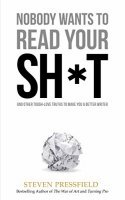
 Nobody Wants to Read Your Sh*t: Why That Is and What You Can Do about It by Steven Pressfield (Black Irish Entertainment, 2016) (This subtitle is for the Kindle version. The paperback subtitle is And Other Tough-Love Truths to Make You a Better Writer. Don't ask me why.)
I hate this book. That's why I'm considering buying my own copy.
Our grandson received a Kindle for his birthday, a rite of passage in his family. Fortunately, he didn't mind in the least that it was a used Kindle by the time it was placed in his hands. I took full advantage of the temporary access to his father's library of e-books during the weeks it was in my possession, devouring six books, one of which was this title. Thus I read it quickly, and do not have access to the notes and quotes I would normally have for writing a review. But here's what I remember:
- The language doesn't get any better than the title, and lacks the courtesy of the asterisk. This shouts unprofessionalism as well as rudeness.
- There are 119 chapters in this 208-page book. You can guess the length of most of the chapters, which read more like Facebook posts than book chapters. This was actually handy for reading in the few spare minutes I could snatch during our recent cruise from Budapest to Amsterdam, but it made the book—not the boat ride—choppy and disorienting.
- Pressfield has very definite ideas about how a story must be written, and reading his prescription my immediate reaction was, "If this is the way books are supposed to be written these days, it's no wonder I find very few that I like."
- He sees little to no difference in how to tell a story, whether writing fiction or non-fiction, books, TV, movies or advertising copy. That's another reason for me not to like modern books. There's a reason I far prefer the written word to film.
- Pressfield sprinkles his book liberally with movie references, which of course leaves me completely at a loss as to the point of the illustration he is using.
- He has a style reminiscent of Ann Voskamp, which I know recommends him to many people, but not to me. I find her writing disorienting and not particularly helpful.
- Basically, the book was annoying to read, often confusing, and seemed to speak of a world totally foreign to my own.
So why on earth am I considered purchasing Nobody Wants to Read your Sh*t?
Because I think it has something to say to me. I think I can learn from it.
One place I agree with Pressfield is that all writing is storytelling. Much of speaking is also storytelling. It's a skill everyone should learn, and while I've picked up some experience flying by the seat of my pants, I'm a babe in the woods when it comes to the art itself. Pressfield, who is a successful writer of fiction, history, and self-help books as well as movie and television scripts, clearly knows much that I'm not even aware that I don't know.
- At the most trivial level, learning the art of storytelling will give me a new and fun way to look at books and movies, trying to puzzle out the patterns and techniques used to create the story line.
- Since all writing is storytelling, knowing the techniques—even if I reject some of them—should help me make my own writing more interesting.
- It might even help my speaking, since I've been told more than once that when I try to tell a story without writing it down first, I put in too much unnecessary and confusing detail and background, leaving listeners just wishing that I would get to the point. It's not good storytelling to bore the audience.
Well, I've pretty much convinced myself. Now if Amazon would just run one of their special $1.99 sales....

