
Breakfast
An international child, Joseph might start his day with leftover pizza, or rice, or bread and peanut butter, or a tortilla with "spices" (more on that later). But for the most part his breakfast is "no no bissi" a.k.a. yoghurt and muesli. Unsweetened muesli and plain yoghurt—and he loves it. His drink for all meals is water. He feeds himself with a spoon quite competently, although as you can imagine some cleanup is required.

For breakfast I might have yoghurt and muesli, or cooked oatmeal, or good Swiss bread, or yummy, fresh Swiss eggs (with golden yolks).
Dinner
The noontime meal is the primary one here, because Daddy comes home from work to join us. To the Swiss, the idea of a cold lunch is strange. I must say that cooking makes the morning seem short, but it's very nice to have an easy meal in the evening.
We've been eating very well. Janet is a good cook, and has been experimenting with new meals that supposedly freeze well, doubling them to have a supply for ATB (after the baby is born). The salutary habit of American churches of supplying families with post-childbirth meals seems to be unknown here. We've had meatloaf, orange chicken, curried shrimp and rice, pizza, fondue, raclette, sausage dishes, and other good things I can't list because I can't remember, and only this week's menu is post on the refrigerator door. :)
Joseph eats pretty much whatever the rest of us are having, feeding himself competently with some combination of fork and fingers. The exception is sweets, which are mostly excluded from his diet, just as coffee, tea, beer, and wine are. He is, however, beginning to realize that the adult "crackers" (cookies) taste better than his....
Supper
This is a lighter meal, often leftovers, or bread and cheese. The Swiss do eat sandwiches, but it doesn't seem very common. Again, Joseph eats bits and pieces of whatever the adults have.
Snacks
In Switzerland, it seems expected that children will eat more often than at mealtimes. "znüüni" (at 9 a.m.) and "zvieri" (at 4 p.m.) are planned snacks, although Joseph gets his at varying times depending on our schedule. He might have banana and peanut butter, or cheese, or bread, or "no no bissi," or almost anything else that is reasonably healthy. One of his favorite snacks is "ti" with "pie-h'n" (spices)—tortilla sprinkled with something from the spice rack, from garlic powder to cinnamon. Joseph would put spices on almost everything if allowed. (Peanut butter toast with cinnamon, anyone?) The only time he objected was when I gave him some of my pizza, which I had sprinkled with "pie-h'n" of my own—red pepper flakes.
Drinks
Joseph's drink at all meals, and in between, is water. Occasionally he will have a small cup of milk, and once, when we squeezed some blood oranges, he had a few sips of the juice. The fresh-squeezed juice was a real treat, especially for Janet and me, because no Floridian can be really happy with less than fresh-squeezed juice. For breakfast, we usually drink "orange juice-like liquid" (orange juice from concentrate) from the store, as not-from-concentrate juice here isn't even as good as it is in the U.S., and it's expensive.
Unfortunately, I'm here in the wrong season to get the delicious unpasteurized cider from the farm down the road. (The farmer expressed astonishment that cider must be pasteurized in the U.S.)
Janet's been drinking boring, store-bought milk since getting close to her due date, but the other day we walked to the diary farm and bought a liter of raw milk. For dinner and supper we mostly drink water, but lately I've been indulging in the milk. Unpasteurized milk really is a different sort of beast. Normally I drink only skim milk, and can't abide even 1%, let alone whole milk. But in its natural state, whole milk is delicious.
That's about it for this edition of Life with Joseph. It's taken me three days to get this far, and those-who-can't-be-here are anxious for news. Of course, the news they're most anxious for is a birth announcement, but I give what I can....
Permalink | Comments
Category Travels Children & Family Issues Everyday Life Food
Do e-mail, SMS, Facebook, Skype, and other quick-and-easy forms of communication, in an increasingly non-literate society, spell doom for the U.S. Postal Service? We'd better hope not, especially those of us who like to send and receive packages. If you think mailing a package overseas is outrageously expensive—and I do, except for the great Priority Mail Large Video Box—try using one of the other parcel services.
I never thought I'd be saying this, but I think one problem the U.S. Postal Service has is that the prices are too low. It costs our daughter twice as much to send a letter from Switzerland as it costs us to write back. (Though they do get to design and print their own stamps for no additional charge! There's nothing like getting a letter with a picture of your grandchild on it.) And this is what one Canadian eBay seller has to say:
Although I live in Canada, in Winnipeg, I make the 150 mile round-trip to Neche, North Dakota, to mail most parcels ... this allows me to pass on the savings in postage from USPS, which is a lot cheaper than Canada Post (and faster). In fact, it is even cheaper to ship books back to Canada from the USA, [than] it is to ship them in Canada, unless they are very thin!
I don't like the upcoming postal increase any more than the next person, but I'll happily pay more if that reflects the true cost of the service. Let's continue to expect the best from our postal service, and give them the resources needed to do the job right.
Permalink | Comments
Category Random Musings
When Moses received the Ten Commandments, when Hatshepsut ruled Egypt, when the Phoenicians were developing their alphabet, The Senator was a young tree. When Jesus was born, it was nearly 1500 years old.
It was the largest pond cypress in the United States, the largest native tree in Florida, and possibly the largest tree of any sort east of the Mississippi. The oldest of its species in the United States, and one of the oldest trees in the world, it had stood for some 3500 years in what is now a small park near our home. It was even older than Te Matua Ngahere, which we travelled to the ends of the earth to see.
We enjoyed visiting The Senator, and would have done so more often had the park not had a reputation for some nefarious goings-on at the time our children were young. I can't access our own pictures at the moment, but there's picture in the Wikipedia article that looks much like ours, only with different people standing in front of the tree. (You might have to wait till the blackout is over to see it.)
But the tree that was 2500 years old at the time of the Norman Conquest is no more. The Senator was destroyed by fire yesterday, January 16, 2012. Officially, arson has been ruled out, but I agree with Beth Kassab's call for a more serious investigation. It is too easy to attribute the death of the elderly to natural causes. Such a venerable being deserves better.
Permalink | Comments
Category Everyday Life
It's hard being a long-distance grandmother, whether the distance is 1000 miles or 4800. Certainly I'd rather our grandchildren live just down the street! But one compensation for the loss of frequent interaction is the joy of seeing how much the children change between visits. As we await the time when I'll have baby news to announce, I'll share a few stories of life with Joseph, 18 months old and soon to assume the important role of big brother.
John Ciardi said that a child should be allowed to learn, "at the rate determined by her own happy hunger." Joseph's current "happy hunger" is for letters and numbers. He has a wooden puzzle of the upper case alphabet that is the first toy he takes out in the morning, and again after his nap. This was supplemented at Christmas by the nicest number puzzle I've seen, which includes the numbers from 0 through 20 and arithmetic operators as well.

First, he toddles over to the shelf for his alphabet, and then—because it is more difficult to reach—points to the number puzzle and commands, "Hum!" ["Numbers!"] After naming the numbers and letters to himself and/or asking for them to be named, taking them out of the puzzle frame, putting them back in, and yes, throwing them with glee across the room—he is a little boy—he will get paper and a pencil and ask for various numbers and letters to be written, often adding his own scribbles, which, of course, look nothing like the models—yet.
Joseph knows all the letters, most by letter name (e.g. "bee," "ess," "tee"), some by "is for" (e.g. "cow" for C, "ha(wk)" for H. He knows the numbers 0 - 10, 12, and 20. Some are clear ("two, "ten") and some, such as seven and twenty, you have to know what he's saying, but it's consistent.
Not only does he know the pieces, and where they go, but he's also cognizent of what's missing, and worries until it is found. Before dinner, and again at night, we help Joseph pick up the toys. The other day he and I were working on the number puzzle, and Stephan the alphabet. Stephan remarked to himself, "where's the Z?", finally found it (did I mention that the pieces get thrown around the room?), and put the puzzle where it belongs without announcing his success. After Joseph and I finished the number puzzle, he went to Stephan and asked, "Zee?", content only when shown that it was in its proper place in the puzzle.
Just this morning Janet discovered that he also knows how to count, at least to six: she was fixing dinner (which happens at noon here, because Daddy bikes home from work to join us), and Joseph was helping by handing her potatoes to weigh. He handed her the first one, and announced, "one." Then the second, followed by "two." Then "three, four, five, six." At the seventh and last potato, he hesitated, having forgotten; seven is one of his newest number words. Our apologies to Glenn Doman and to the Right Start Math folks, who want children to lean quantities before they learn counting, but it was his idea. We had no idea he could do it. Then again, maybe he knows more quantities than we think. He loves his daddy's Dots book.

Joseph is also very good at putting the pieces in their places on the puzzle board. I remarked that he went very quickly from the "large knob puzzles" to being able to do this much harder variety, and Janet said, "Oh, he still can't do the large knob puzzles! He gets frustrated quickly and gives up." Which only confirms that children will work patiently and persistently to learn what they really love!
Oh, I suppose I should mention that he's learning the letters and numbers in three languages.... I think he's more fluent with English at this point, though really, how would I know?
Joy for a grandmother's heart, especially a grandmother whose college major was math. :)
Joseph is SO much fun.  His two favorite toys are his wooden alphabet puzzle, and his new-for-Christmas wooden number puzzle (0 - 20, with +, -, x, {division), < (works flipped for >) and =).  He's passionate about them; first thing in the morning, and again after his nap, he goes immediately for them.  He knows all the letters, most by letter name (e.b. "bee," "ess," "tee"), some by "is for" (e.g. "cow" for C, "ha(wk)" for H.  He knows the numbers 1 - 10, 12, and 20, and sometimes gets 0 but not consistently.  Some of numbers are clear ("two, three") and some, such as seven and twenty, you have to know what he's saying, but it's consistent.  And he's very good at putting the pieces in their places on the puzzle board.  I remarked that he went very quickly from the "large knob puzzles" to being able to do this much harder version, and Janet said, "Oh, he still can't do the large knob puzzles!  He gets frustrated quickly and gives up."  But he's so obsessive about the letters and numbers that he worked persistently enough to get good at them.  One of his favorite activities is to give me a piece of paper and a pencil and ask me to write letters and numbers.

He's also a very good-natured and calm child.  We shall see how that plays out when there is another little one in the house!
Permalink | Comments
Category Education Travels Children & Family Issues Everyday Life
[I know most of you are waiting for Baby News, but as that has not yet been forthcoming, I have to improvise.]
A series of experiments at Notre Dame sheds light on on the perennial "Why did I come into this room?" question. Here are some excerpts from the Scientific American article, Why Walking through a Doorway Makes You Forget. Most of the experiments were done in a video-game context, but the same effect was seen in real-life versions as well.
[Participants played a video game in which] they would walk up to a table with a colored geometric solid sitting on it. Their task was to pick up the object and take it to another table, where they would put the object down and pick up a new one. Whichever object they were currently carrying was invisible to them, as if it were in a virtual backpack. Sometimes, to get to the next object the participant simply walked across the room. Other times, they had to walk the same distance, but through a door into a new room. From time to time, the researchers gave them a pop quiz, asking which object was currently in their backpack. The quiz was timed so that when they walked through a doorway, they were tested right afterwards. Their responses were both slower and less accurate when they'd walked through a doorway into a new room than when they'd walked the same distance within the same room.
Usually, returning to the room I started from will remind me of why I left in the first place. But the researchers did not find that to be the case in their experiments.
[P]articipants sometimes picked up an object, walked through a door, and then walked through a second door that brought them either to a new room or back to the first room. If matching the context is what counts, then walking back to the old room should boost recall. It did not.
The doorway effect suggests that there's more to the remembering than just what you paid attention to, when it happened, and how hard you tried. Instead, some forms of memory seem to be optimized to keep information ready-to-hand until its shelf life expires, and then purge that information in favor of new stuff. ... [W]alking through a doorway is a good time to purge your event models because whatever happened in the old room is likely to become less relevant now that you have changed venues. ... Other changes may induce a purge as well: A friend knocks on the door, you finish the task you were working on, or your computer battery runs down and you have to plug in to recharge.
Why would we have a memory system set up to forget things as soon as we finish one thing and move on to another? Because we can’t keep everything ready-to-hand, and most of the time the system functions beautifully.
Take heart, distracted mothers! That which frustrates you so badly was apparently designed to help with the rapid context-switching essential to your vocation.
Permalink | Comments
Category Random Musings
If I weren't eating so well at the famous Swiss Zum Stücklin, I might be sad at missing the Outstanding in the Field event held at our favorite egg (and more) farm, Lake Meadow Naturals. Not that I'm in the habit of spending $180/person on meals, not even in Switzerland, not even when we ate at the incomparable restaurant at Les Trois Rois in Basel. But I'm happy for our local farm to get such national recognition.
Permalink | Comments
Category Travels Everyday Life Food
We're stocking up on meals, pre-birth, and today made a double batch of our favorite stew. The recipe calls for a hefty helping of paprika. Spices should not necessarily be increased in direct proportion, but I like paprika, so I doubled the quantity—and then, as I usually do, threw in a bit more.
Some of Janet's spices are labelled in English, but most in the Swiss triumvirate of German, French, and Italian. This jar had but a one-word label: "paprica." Perhaps paprika is the same in every language.
Or not. The spice in that jar was decidedly not paprika as I have always known it. Picture a pot of stew seasoned with a heaping tablespoon of red pepper....
The stew was delicious. Even Joseph liked it. (Then again, he asks for "spices" on almost everything.) Hot pepper worked. But it's a good lesson in taking care when cooking in another country. What if "paprica" had actually meant "ginger"?
Permalink | Comments
Category Everyday Life Food
At this time last year I reflected on the results of my 2010 January resolution: Read More Books. It was an unqualified success: In 2010 I had read 65 books of great variety: print and audio, fiction and non-fiction, from children's lit to an 800-page survey of ancient history. I felt quite good about it.
I'm not feeling so encouraged now. For 2011, my total of 33 books was but half the previous year's. Without doubt, even an avid bookworm like me needs to be vigilant and deliberate in making time for reading.
What happened? I can think of a few factors, none negative in itself.
Instead of listening to audio books when I take my (quasi-) daily walks, I've been using the occasions for prayer, and for the introvert's essential "processing time." There are no audio books on my 2011 reading tally.
In 2010 I spent much more time as a guest in the homes of avid readers, where other people used their free time to read books, and where my normal household activities could not distract or nag at me.
Last year my husband worked from home almost exclusively, whereas in the previous year he primarily had out-of-town, and even out-of-the-country, assignments. I'm not saying he's an unwelcome distraction.... :)
Well, ganbarimasu! Perhaps in 2012 I'll do better, knowing I have to work at it. My goal is to average one book per week.
Here's the list for 2011, sorted alphabetically. A chronological listing, with links, is here.
- At Home by Franz Hohler
- Bad Science: Quacks, Hacks, and Big Pharma Flacks by Ben Goldacre
- The Caves of Fear: A Rick Brant Science-Adventure Story by John Blaine
- Christmas at Fairacre by Miss Read
- Confessions and Reflections of a Traveler by Brett R. McLean
- The Corpse Walker by Liao Yiwu
- The Crime of the Century by Kingsley Amis
- Eats, Shoots and Leaves by Lynne Truss
- The Electronic Mind Reader: A Rick Brant Science-Adventure Story by John Blaine
- Ender's Shadow by Orson Scott Card
- The Flaming Mountain: A Rick Brant Science-Adventure Story by John Blaine
- The Flying Stingaree: A Rick Brant Science-Adventure Story by John Blaine
- How to Be a High School Superstar by Cal Newport
- Introverts in the Church by Adam S. McHugh
- The Longevity Project by Howard S. Friedman and Leslie R. Martin
- The Lord of the Rings: The Return of the King by J. R. R. Tolkien
- The Mother Tongue by Bill Bryson
- The Mystery of the Timber Giant: A Tom Quest Adventure by Fran Striker
- North to Freedom by Anne Holm
- Outliers by Malcolm Gladwell
- The Pirates of Shan: A Rick Brant Science-Adventure Story by John Blaine
- The Raw Milk Revolution by David E. Gumpert
- The Rocket's Shadow: A Rick Brant Science-Adventure Story by John Blaine
- Sabbath by Dan B. Allender
- The Scarlet Lake Mystery: A Rick Brant Science-Adventure Story by John Blaine
- Sea Gold: A Rick Brant Science-Adventure Story by John Blaine
- Secret Water by Arthur Ransome
- Shakespeare by Bill Bryson
- Tom Swift and the Visitor from Planet X by Victor Appleton II
- Troublesome Words by Bill Bryson
- Village Affairs by Miss Read
- The Vintage Bradbury: Ray Bradbury's Own Selection of His Best Stories by Ray Bradbury
- The Zen of Fish by Trevor Corson
The Vintage Bradbury: Ray Bradbury's Own Selection of His Best Stories by Ray Bradbury
Confessions and Reflections of a Traveler by Brett R. McLean
The Lord of the Rings: The Return of the King by J. R. R. Tolkien
Bad Science: Quacks, Hacks, and Big Pharma Flacks by Ben Goldacre
Ender's Shadow by Orson Scott Card
How to Be a High School Superstar by Cal Newport
The Mother Tongue by Bill Bryson
Troublesome Words by Bill Bryson
Sabbath by Dan B. Allender
Outliers by Malcolm Gladwell
The Raw Milk Revolution by David E. Gumpert
Eats, Shoots and Leaves by Lynne Truss
North to Freedom by Anne Holm
The Longevity Project by Howard S. Friedman and Leslie R. Martin
At Home by Franz Hohler
Introverts in the Church by Adam S. McHugh
Shakespeare by Bill Bryson
The Rocket's Shadow: A Rick Brant Science-Adventure Story by John Blaine
Sea Gold: A Rick Brant Science-Adventure Story by John Blaine
The Caves of Fear: A Rick Brant Science-Adventure Story by John Blaine
The Electronic Mind Reader: A Rick Brant Science-Adventure Story by John Blaine
The Scarlet Lake Mystery: A Rick Brant Science-Adventure Story by John Blaine
The Pirates of Shan: A Rick Brant Science-Adventure Story by John Blaine
The Flaming Mountain: A Rick Brant Science-Adventure Story by John Blaine
The Flying Stingaree: A Rick Brant Science-Adventure Story by John Blaine
Tom Swift and the Visitor from Planet X by Victor Appleton II
The Mystery of the Timber Giant: A Tom Quest Adventure by Fran Striker
Secret Water by Arthur Ransome
The Crime of the Century by Kingsley Amis
The Corpse Walker by Liao Yiwu
The Zen of Fish by Trevor Corson
Christmas at Fairacre by Miss Read
Village Affairs by Miss Read
Summer at Fairacre by Miss ReadPermalink | Comments
Category Everyday Life
So, Orlando finally gets a Wawa! Nowhere near us yet, but there's hope.
I'm still waiting for a Trader Joe's....
Permalink | Comments
Category Everyday Life Food
 Several months ago, Porter signed us up for a pre-anniversary present of tickets to the Orlando performance of The Screwtape Letters. I tucked them carefully away in my Tickler file, and last week they popped up. I'm very grateful for the Tickler and for Google Calendar—when you book things so far in advance it's all too easy to forget, especially in a season of other big events. It was a delightful post-Christmas outing.
The location, the Plaza Live theater, was initially disappointing, as it looks—and smells—like the converted movie theater it is. But that was easy to forget once the show started.
Not so easy to ignore was the excessive volume of the music and sound effects. I did not want to resort to my earplugs, because the speaking part was of a reasonable volume, but after several assaults I gave up, and was still able to hear the monologue. Yes, it's a monologue, though not a one-man show. But the other character, Screwtape's secretary, Toadpipe, is a mime. And played by a woman, so maybe it is a one-man show after all.
How do you adapt a book, consisting entirely of a series of letters, to the stage? With difficulty, but they did a commendable job. The stage setting is in Hell, where Screwtape is dictating his letters. Toadpipe's acrobatics and the sound effects provide enough action to keep the show moving. For what it is, the show is very well done, and should have large audience appeal. It received a very positive review from the Orlando Sentinel. Even I enjoyed it, no doubt because the script was so faithful to the original. I know the book well enough to recognize that large sections were performed verbatim. Much was, of necessity, left out—I had wondered how they would handle the part where Screwtape turns into a cockroach; they didn't—and there were one or two places where I thought there might have been just a little modernization. But it's hard to beat C.S. Lewis for writing, so I'm glad they didn't try. Best of all, the show stays true to the character of the book.
No show could replace the book itself. But for an introduction to the book, it's a good performance. If only they had turned the volume down!

A Boy's War by David Michell (OMF International, 1988)
In 2010, revelations of unspeakable abuse of missionary children at not one but two West African boarding schools only confirmed my intense belief that missions organizations sinned greatly against the very families that gave everything to serve with them, by expecting—often requiring—parents to send their children away to boarding school at a very young age. After all, isn't one of the (multiple) lessons of the Old Testament story of Abraham's willingness to sacrifice his son Isaac, the counter-cultural message that God does not ask parents to sacrifice their children, but himself provides the sacrifice? How did the organizations dare preach Jesus Christ while demanding sacrifices to Moloch? I'm not talking about high school-aged children who chose to go to boarding school for the sake of a better education and preparation for college, but little ones, as young as six, whose education would have been better accomplished at home with their parents. I daresay the parents' missionary work would have benefitted as well, as the native peoples would have more easily accepted them as fellow human beings as they watched them interacting as families.
Granted, there are many excellent boarding schools. My quarrel is not with families who choose this as the best educational option for their children, but with the missions that mandated the practice. Why did the organizations rip children away from their parents in the name of God, and why did their parents put up with it? It was a long time before I came up with a theory: it may be because so many missions organizations have their roots in England, and other countries where sending small children off to boarding school was standard practice, a historical and cultural given.
God can redeem even the worst situation, and for a moving example, read A Candle in the Darkness, an article by Wess Stafford, president of Compassion International, who transformed his boarding school tortures into a life-long determination to stand up for children who cannot speak for themselves.
But A Boy's War is not about that kind of boarding school. It's about the amazing resilience of children, who can thrive and even have a great deal of fun under very difficult circumstances if they are supported by those who provide love and a semblance of stability. David Michell was the son of Australian missionaries to China, one of many children sent off at the age of six to the far-away Chefoo School of the China Inland Mission. A few years later, Japanese invaders had taken the entire school captive, and eventually the students, teachers, and staff ended up at the infamous Weihsien Concentration Camp, where Olympic champion Eric Liddell died and is buried.
This is the story of heroic teachers and other school personnel, who managed to create for the children in their care something remarkably resembling normal life—including a good education—under circumstances of incarceration, overcrowding, filth, hunger, and ever-present fear, disease, and death. Told from the boys' point of view, the loving sacrifices of the adults are more implicit than graphic, and there's nothing inappropriate for children to read. The book is short, under 200 pages, and the vocabulary unchallenging. Unfortunately, however, it seems that the author was primarily writing for adults: the story is not told in a way calculated to grab the interest of a child. Otherwise, my copy would already be on its way to our eight-year-old adventure-story reader. We'll see how he does with God's Smuggler, first.
Why do Jehovah's Witnesses bring out the worst in me? They're only doing what they think is best.
I'm not good with any form of un-asked-for solicitation, be it door-to-door, phone, e-mail, blog comment, junk mail, or any other form of spam. I don't like being rude, but I've found that a quick, "No, thank you; I'm not interested," followed immediately by hanging up the phone or closing the door, to be the solution that wastes the least amount of time—not only mine, but theirs. Why let them go on and on when I know I'm not going to give in to whatever they're selling? I did know someone who would, on occasion, invite them in, and let them go on and on, thinking they were about to make a sale, until the whole evening was used up. He figured he was saving several dozen other folks from having their evenings interrupted, and he found it somewhat amusing. (Reality TV hadn't been invented yet.) But that's not me.
When it comes to JWs, I also know people who will invite them in, serve them coffee, and spend the evening preaching the gospel to them. I admire those who can do that, but it's definitely not me.
Porter, having been a door-to-door salesman himself, is much more understanding and will often take a few minutes to answer questions and ask some of his own. He still doesn't buy anything—unless it's Girl Scouts selling cookies or Lake Brantley band members selling apples; even I am happy to welcome that kind of solicitor with a smile and a sale—and if anything has come from a discussion with a Jehovah's Witness, we won't know it till Heaven. But at least he's friendly.
I, on the other hand, get Really. Ticked. Off. Especially on a Saturday, when I have a thousand more pleasant things to do, like scrubbing the kitchen floor. On my hands and knees. With a toothbrush. Or defrosting the freezer, which is why the garage door was open. I opened the door from the house to find two JWs in the garage, keeping Porter from his work of replacing our kitchen light fixtures. He was gracious, and polite, engaging them in conversation.
Me? I panicked, turning tail immediately and skedaddling back into the house, with an inarticulate growl and an "if looks could kill" expression.
Sigh. Do we learn humility from humiliation? I hope so.
Permalink | Comments
Category Everyday Life
It's not polite to think about items you didn't get for Christmas while we're still in the Christmas season. But hey—at least no one thinks I'm hinting for a gift as I ponder things.
Those who know me will be shocked at what I am about to reveal, almost as shocked as when I admitted that I might actually want to own a Wii. Oops, I haven't actually confessed that here yet. But I had such a blast with the Wii Fit over Thanksgiving....
I am a book-lover. That is, a lover of real, paper, take-'em anywhere, you-own-it-and-Amazon (or whoever)-can't take it away kinds of books. Books that smell like books. I dislike reading on a computer screen. Back in the Dark Ages of last century, I tried reading a book on my then-leading-edge Palm handheld device. Yuck.
However, the thought of owning an e-reader (Kindle, Nook, etc.) is slowly breaching my event horizon. For one thing, the price is coming down. I had dismissed Kindle early on, at the mere thought of holding a $300 "book" that would likely to break if dropped. But $100 is a little less scary. More than 2/3 less scary, for some reason.
Then this morning I was struck by two prods in the e-book direction. First, an e-mail from Janet inquiring about a certain book, which opened my eyes to the idea that one can give e-reader books instantly, without worrying about delivery time or overseas shipping charges.
Shortly thereafter I read Conversion Diary's 7 Quick Takes Friday, from which I quote:
My husband got me a Kindle for Christmas. “I guess I might use it for the occasional fiction book,” I thought. “But I’ll never do regular reading on an electronic device.” To put it bluntly: I COULD NOT HAVE BEEN MORE WRONG. This thing has become like an appendage of my body. It’s my favorite gadget I’ve ever owned. Here’s what’s great about it:
- You can create highlights and make notes — and they’re available online. First of all, I was delighted to discover that you can highlight sections and make notes with e-readers. Then, when I logged into my Kindle account on Amazon and saw all my highlights and notes right there, I almost passed out from the awesomeness. (It has been pointed out to me that you can only do this with books you buy through the Kindle store. Which is definitely a downside. But whatever! Because then there’s this:)
- It lies flat. The other day the baby was unusually fussy and insisted on being held all day, and in the moments when she’d finally doze off I was able to get a lot of reading done. I had to use both hands for the ninja techniques required to keep her happy, and so it would have been hard to hold a paper book open. Being able to just glance down at my Kindle, then press a button to turn the page, made hands-free reading a breeze.
- It doesn’t require a monthly data plan. I was under the mistaken impression that you had to buy a monthly data plan in order to download books on e-readers. I was delighted to find that I can use my Kindle on my home wireless network to get my purchases.
- The screen is like reading on paper. I’m amazed at how similar the look of the screen is to a regular book: It doesn’t glow, it’s not glossy, and it’s easier to read the more light you shine on it.
I will still buy some books in paper form, but count me in as e-reading’s newest convert.
So now you’re convinced. You’re sitting in front of your computer saying, “Jen, you’re right. I thought my life was complete, but now I see that it is a mere shell of an existence compared to what it could be if I owned an e-reader. I am going to purchase a Kindle as soon as I finish reading your astoundingly insightful Quick Takes. However, I am going to go all out and get a Kindle Fire!” No. Do not do this. Go with the low-end version. Here’s why:
One of the reasons I thought I wasn’t an e-reader kind of gal is because my mom has an iPad, and I could never get into reading books on it when I’d borrow it. First of all, I don’t like reading a lot of text on glowing screens. Second, there were too many distractions: I’d sit down with the intention of getting into Scott Hahn’s latest title, but would somehow end up in a heated debate about nuts in desserts on Twitter. It was just too tempting to do something interactive like surf the web or check my email and social media accounts. What’s wonderful about the basic-model Kindle (and presumably the basic models of other e-readers as well) is that there’s no temptation to do anything other than read a book.
So, I think I was right that I don’t like reading on electronic devices; what I was missing is that the basic Kindle is more like a book than an electronic device.
So ... it's not like reading on a computer screen after all. And it seems there are lots of cool features not available with print books. It might be just the thing for books I want to read once, but which aren't good enough to merit any of our already over-taxed and precious bookshelf space. (Well ... erm ... out of curiosity I did a quick calculation of how much bookshelf space we have: Over 200 feet. That's 2/3 of a football field of books lined up along their narrowest dimension. No wonder an e-reader is beginning to sound attractive.)
What's more, you can store pictures and Word docs and text files and pdfs and mp3s. Think of all the cute grandkid photos I could take along with me.
I'm leery, however, of committing to a proprietary format. And unhappier still that the companies can apparently yank a book off your own device without your permission.
I realize I'm coming very late to the table here. After all, the Occasional CEO told me nearly three years ago that I should get one. (Actually, he told me nearly three years ago that someone else should get me one, but I digress.) So I'm throwing the question out to my more up-to-date, tech-savvy readers. What do you think? Do you own an e-reader? Why or why not? Which do you think is best?
Permalink | Comments
Category Computing Everyday Life
(Continued from Pre-Christmas Fun.)

You wouldn't think that with just the two of us it would still take all day to open presents, but it very nearly did.
We slept a little late, due to yesterday's exhaustion, but we can never sleep in much, even without the pleasure of being awakened to Christmas carols on the clarinet. (Yes, that is a pleasure! We missed that this year.) I finished the few preparations that I'd negelected last night, and we sat down to open our stockings.
Mothers—sometimes fathers, but more commonly mothers—often develop the bad habit of filling their own stockings. For one thing, and this is unavoidable, if you have a gift that everyone gets (in our house this includes Toblerone, Mentos, citrus fruit, a coin) it makes sense to drop one into each stocking. It would look very strange for one person to be left out. But beyond that, it's just a bad habit. One parent takes on the role of chief stocking-filler, and the other is content to let that stand. In our case, when we had guests, this was almost a necessity, as so many moms were contributing to stockings that they overflowed without the dads having a chance. But this year, I resisted. There were only two of us, and why should I deprive Porter of the joy of finally having a chance to be Santa Claus with more than his traditional dollar coin? So when I picked up a set of combs for each of us, I wrapped Porter's but put mine in the drawer. When I bought tape, I wrapped some for Porter's stocking, but did not put any in my own. Etc.
What a good decision! Porter is a great Santa Claus! So here is a word to all moms caught in my trap: Share the joy! Even if it means prodding your man a bit to get him started. Why should moms do all the work have all the fun?
On to breakfast! As usual for Christmas day, the clementines from the toes of our stockings were the only part of breakfast we could consider healthful. But mmmmm! Raspberry kringle (thanks, NMKB!), Dutch banket (pastry filled with almond paste), almond raisin bread ... you get the picture. When our children were young Christmas breakfast was primarily Lucky Charms, as Christmas and birthdays were the only occasions sugary cereals were allowed in the house. We adults prefer our sugar in different forms, but Christmas morning at our house is traditionally overwhelmingly sweet. Traditional for our family, that is. Growing up in my own family, I don't remember any particular Christmas breakfast traditions besides a stocking tangerine, and an "eat faster so we can get to the Christmas tree!" attitude. My parents graciously, but with a show of reluctance, conceded to drink their after-breakfast coffee in the living room.
Neither of us drinks coffee, but I would have brought my tea into the living room if we had had time. But it was then time to get ready for church.
Having done yeoman's duty Christmas Eve, our choir had the day off. So we eschewed the long drive to our usual church and attended the Christmas service at All Saints Episcopal in Winter Park. I'd been there once, maybe twice before, but never for a regular service. Not that you can tell much about a church by what you see on Christmas Day, either. Their choir also had the day off, but the service was still glorious, and filled with music. It's an old, beautiful church with a huge pipe organ. And imagine: the full, resplendent sound of a pipe organ—once the loudest man-made sound on earth—and we never once needed to seek recourse in our earplugs. At our own church, and many churches we have visited, the services are physically painful (and, I'm convinced, ear-damaging) because of the volume of the electronic instruments, even in a more traditional service where the only instrument is an electronic keyboard. I'd forgotten how lovely it is to be able to pay more attention to worshipping God than to the agony of my ears. For the sake of our future hearing, we wear earplugs in church—and in many other places, such as movie theaters and skating rinks—but it's distracting, and makes me feel distant from the rest of the worshippers. Not to mention that it makes singing well very difficult.
I'm not sure if it was a good or a bad thing to be so powerfully reminded of what worship can be.
Be that as it may, we had no regrets for leaving our present-opening to consider together the greatest gift of all.
Not that we weren't excited about coming home to the Christmas tree, where we opened gifts from each other and from distant family members. There's never a lack of gifts when you emphasize the practical, though there was no underwear this year. There were several un-practical, but particularly appropriate and delightful gifts to be opened as well.
Then reality hit: It's 2:30 and I haven't begun to work on Christmas dinner! Our guests weren't coming until 6:00, but beef roasts take time to cook, and bread takes time to rise. Plus quite other items on the day's agenda.
So this is the Christmas I learned that I could let some plans go and still have a wonderful evening. I reduced by three the number of dishes I had planned for dinner—and the dinner was probably better without them. (I'd mention them, but one of our guests will eventually read this and know what he missed.) It was certainly good enough, and we were still too stuffed for dessert. I also (re)learned that letting other people help can be much better than doing everything yourself. Our guests brought a gorgeous salad, much more beautiful than the one I would have made. Porter set the table, and had both more time and more interest than I for making it look nice—and in lighting candles around the house.
I concentrated on the rest of the dinner: beef rib roast, mashed potatoes, gravy, steamed broccoli, and homemade rolls. The roast was tricky, because I cook them so rarely, and the directions from two cookbooks and numerous Internet sources were mutually contradictory. I ended up gonig mostly with my brother's advice—he was cooking a beef roast for their dinner, too—which was pretty much, "I usually just put it in the oven and see what happens." What happened this time turned out to be really good, so I guess it was great advice.
The potatoes weren't supposed to be mashed. When I serve roast beef, I like to boil potato chuncks to the not-quite-done stage, then put them, with a little of their cooking water, alongside the roast near the end of its cooking time. That way they take on a lovely brown color and absorb some of the delicious beef drippings. But that, too, can be tricky, so I decided that mashing the potatoes would be good enough and a lot quicker. Everyone seemed happy with the results.
I cheated a bit with the rolls, picking an easy bread machine recipe so the machine could take care of the kneading and rising for me. I even used (mostly) the white bread flour called for in the recipe, not having time to take a chance on experimentation. Well, okay, I did substitute whole wheat for about a third of it, in the name of flavor. It worked well, but next time I'm going to roll the dough thinner than the recipe called for and make crescent rolls that are not so huge. But if they weren't the prettiest, they sure tasted good.
The gravy I'm particularly proud of. Because I did not cook the potatoes in the roasting pan, I had pure drippings to work with after Porter and his carving knife took away the roast. It was lovely, dark, and deep, because I have learned The Secret: the roast had rested on a layer of chopped onions, which happily caramelized while it cooked. To the drippings I added sufficient flour to make a good roux, then about a cup of white wine, and then most of the leftover potato water. This wasn't just any potato water: I had added some beef bouillon to the boiling potatoes, so what was left was essentially beef stock. With the addition of some more beef bouillon and a generous dose of pepper, it was awesome, if I do say so myself. (Any cook will realize that I've left out a few important actions, notably "stirred and cooked for a while" between most of the steps.)
The best part of the whole meal, however, was being together with our neighbors. They shared some of their Christmas traditions, we shared some of ours, and we all shared some great conversation. Just as wonderful as the morning's reminder that it is possible to worship without high decibels, was the evening's confirmation that even in these polemic days it is possible to have—nay, to enjoy—a lively discussion among people whose views differ substantially, without anyone getting hot under the collar. Isn't it amazing what respect, consideration, and good manners can accomplish?
For the second day in a row we went to bed too late, and exhausted. But what a good kind of exhaustion it was!
On the Second Day of Christmas, my true love gave to me ... Christmas Rest! The busy-ness has been for the most part wonderful, but there's a reason "the Sabbath was made for man." We need days of rest. When we felt hungry (which, after Christmas dinner, wasn't often) we snacked on leftovers. When we didn't, we concentrated on a new Sudoku puzzle book (Porter) and a new Miss Read book (Linda).
All the while being very grateful that we were not throwing up, an affliction besetting this day an appalling number of friends and family on both coasts of the United States (as well as the middle) and on both sides of the Atlantic (but not in the middle).
On the Third Day of Christmas, my true love gave to me ... returning health to our loved ones, and a gentle return to work for us, along with continued rest. (Finished the book. Started another one.)
On the Fourth Day of Christmas, my true love gave to me ... a determination to prepare a collection of Advent music to enjoy during most of December next year. It's only the Fourth Day, and even I am tired of Christmas music. We're still enjoying the tree, the lights, and all the other decorations, however.
A cold front came through last night, so we are enjoying a crisp, clear, cool (55 degrees) sunny day. It's time to close this post and get on with life.
Permalink | Comments
Category Everyday Life
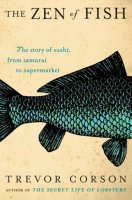
The Zen of Fish: The Story of Sushi, from Samurai to Supermarket by Trevor Corson (HarperCollins, 2007)
Eating sushi is like rearing children: there's always someone happy to point out that you're doing it all wrong.
Not that I care much. So what if many of the rolls I love are American inventions? If the Japanese consider them to be inside-out rolls? If adding more seasoning to your roll is an insult to the chef? (Well, I suppose I care a bit more about the last. I don't like insulting people, especially not those who are providing my dinner. Then again, I'm the one eating it.) I like Japanese sushi; I like American sushi; and I don't mind being too unsophisticated to enjoy the sea urchin and raw quail egg combo that Porter ordered in Boston.
However, I was happy to learn that sushi is meant to be eaten with the fingers, not chopsticks. And eaten in one bite—though I'm not sure how. Do the Japanese have larger mouths than Americans? Seems unlikely.
The Zen of Fish weaves the history, science, and culture of America's unexpected food craze together with the adventures of students at the California Sushi Academy. It's well-written, highly informative, fun to read, and will make you very hungry—when it's not causing you to rethink consuming fish in any form. My only complaint is that the author apparently considered his target audience to be largely made up of adolescent boys. I could have done without most of the sexual references and innuendo—although it was quite cool to learn about the shrimp that start out male, then after a few years become female. The timing of the change assures a gender-balanced population, suggesting perhaps that shrimp are smarter than people.
Okay, even writing about sushi makes me hungry.

