
This post was going to include Christmas Day, but it turned out to be pretty long, so I've divided it into two parts.
Last Sunday we enjoyed the Festival of Nine Christmas Lessons and Carols at the Cathedral Church of St. Luke, featuring the Boy Choir and Girls Choir. I'm tired of hearing that today's kids only want to sing pop songs! If that's all they hear, of course that's what they'll want to sing. But these boys and girls sing excellent music from several centuries, and with beautiful, pure voices. The singers included a couple of friends of ours: one boy man, now a college graduate (alumni are invited to sing with the choirs), whom we knew as a very young Suzuki violinist, and a second-generation Girl's Choir singer whose mother we knew when she was in high school. Perhaps my favorite part of the service, however, was the instructions, printed in the bulletin, to the congregation. No slackers allowed: "Please stand and sing the entire hymn in harmony." (Emphasis mine.) That and seeing several long-time friends (I've reached the age when "old friends" is not the preferred term) at the excellent reception afterwards.
Friday night we took a break and returned to the Morse Museum for our third time in a month: they showcase music as well as art during this season. We didn't stay long, however, and spent most of the time talking to some friends we unexpectedly met. We would like to have returned Saturday, when the Raintree Chamber Players were to be featured, but that was Christmas Eve, and we had a few other plans....
On the 24th, Porter decided to join the throngs of procrastinating shoppers, and found the crowds suprisingly sparse. Given the state of the stores and highways leading up to the day, however, I conclude it has little to do with the economy. Perhaps beginning the Christmas shopping season in early October was sufficient inspiration for most people to be fully prepared (or at least out of money) with no need for a last-minute rush.
Not me, though. My shopping was done, but I had plenty of other last-minute things to do. While Porter was out I finished the wrapping, and frosted our Christmas Cutout cookies. I had planned to be lazy this year and not bother with the frosting, but I'd used 100% white whole wheat flour (see the discussion in the comments here) and it made the already-not-very-sweet dough into something not quite right for Christmas. So I whipped up our traditional egg white and confectioner's sugar frosting with a healthy glug of Penzeys double-strength vanilla and it did the trick perfectly with the cookies, which, incidentally, I had spiced this year with last year's gift of Speckulatius-gewürz. I was still lazy, frosting them in single colors with a knife rather than painting them artistically with tiny brushes, but I'm sure they didn't taste the worst for that.

After my early, experimental batch of Variations on a Dream cookies, I made two more, plus two of Christmas Cutouts, two batches of Almond Butter Crunch, and one each of Dark Chocolate Cherry and Dark Chocolate Orange fudge. Sounds a bit over-indulgent for two people, doesn't it? Fortunately, Christmas goodies serve well as gifts for choir members, neighbors, and assorted other folks. But yes, we did save some for ourselves....
All too soon it was time to leave for church, and our two Christmas Eve services. (Actually, there are three, but the choir was not needed at the earliest one.) We had a brief rehearsal, and began the first service at 7:00. I thought the evening might be a marathon, but hadn't realized it would be a sprint as well. Episcopalians make up for not singing Christmas carols during Advent by singing them all on Christmas Eve! With thirteen hymns and four anthems, along with the rest of the service, I was exhausted and hoarse when the service ended an hour and a half later. The choir has a tradition of eating together between the early and the late services, but it has grown to include the entire performing arts ministry and their families—some sixty people—which was more than this introvert could face between two exhausting services. Fortunately, a fellow choir member felt the same way, and he took us to his home, where his wife had waiting a meal of bread and soothing hot soup. Restored, we were back at church by 10:30 for the final service. It was just as crazy, but this time I was prepared and knew when I could fit in essential sips of water.
My favorite part of the evening? Singing the Hallelujah Chorus. TWICE.
My second-favorite part? Not burning the church down.
In the later part of each service, as the congregation returned from receiving Communion, each person was given a candle. The choir sang one verse of Stille Nacht, then everyone sang Silent Night as the choir dispersed into the congregation to light the candles. Of course, for the proper candlelight effect, the lights must be turned down. As I made my way along the darkened, narrow aisle to my assigned rows, I tripped over what I later determined to be someone's folded-up walker leaning against the wall. I recovered, and offered the lady on the end of the aisle my candle, from which to light her own. That was when I realized she didn't have a candle. The lady whose lap I had nearly fallen into didn't have a candle because she had a nasal cannula. Attached to an oxygen bottle. I gingerly reached w-a-a-a-y over her to light the candle of the person sitting beside her.
We made it home by about 12:30 Christmas morning. I broke with tradition and did not listen to Mannheim Steamroller while finishing up Christmas preparations, but went to bed at the same time as everyone else. With "everyone else" being no one but Porter, all but filling the stockings and placing the remaining gifts under the tree could wait for morning. Later morning, that is.
Permalink | Comments
Category Everyday Life
Here's one reason why it's more fun to be Episcopalian/Anglican/Catholic/Orthodox or anyone else for whom Christmas lasts a full twelve days.

Permalink | Comments
Category Just for Fun
Don't forget NORAD Tracks Santa! (I see they have some new videos this year.) As I write this, Santa is at the International Space Station. I'd love to see what a reindeer wears for a space suit.
This is for our children, who never considered themselves Disney fans as the world knows Disney, but who grew up in Mickey's backyard. Happy memories! (H/T Richard S. and the GGGAMB)
Happy Christmas to all, and to all a Good Night!
Permalink | Comments
Category Random Musings

This will be my last 7 Quick Takes Friday, at least on a regular basis. It's been fun thinking in this way, and I have enjoyed reading other people's Quick Takes. But it takes a lot of time (it's not "quick" for the writer, at least not for me), and if I spread the work out over the week, well, why not publish immediately rather than wait till Friday? I think getting seven posts all at once overwhelms some of my readers, too. Perhaps I'll do more 7 Quick Thanks posts, or gradually collect short posts around a theme for an occasional 7 Quick Takes.
It's probably due more to the season than to my joining the 7 Quick Takes gang, but I've been overwhelmed with spam comments since commencing. I wonder if it will drop off now (whether due to my dropping out or to the end of the infamous Shopping Season), or if that door has been opened never to close.
Any real, human readers who stopped by via the 7 Quick Takes program are welcome to come here directly. :)
Requiem Aeternam Dona Ei, Domine. One of my strongest memories from 1968 is the feeling of desolation as Soviet tanks rolled into Czechoslovakia. RIP Václav Havel.
"Truth and love must prevail over lies and hate."
— 3 —
Steven E. Landsburg was a math classmate of mine at the University of Rochester. I remember him chiefly for his brilliance and for his decision to forgo a bachelor's degree in favor of a master's because the master's program had no physical education and language requirements. (The link in his name takes you to the Wikipedia article on Steve, which has, as far as I can tell, at least one error—I believe it was his bachelor's degree, not his master's, that he received after becoming a professor of economics at the U of R. The University of Chicago would hardly have accepted him into its PhD program with no degree at all.) Steve appeared in the Wall Street Journal last month with this article: A Short Econ Quiz for the Super Committee. Here's how it ends:
The government's chief asset—in fact, pretty much its only asset—is its ability to tax people, now and in the future. The taxpayers are the government's ATM. Make a withdrawal today, and there's less available tomorrow.
Now the ability to tax is a pretty huge asset and the government has not (yet!) come close to depleting it. In that sense, there's a lot of money in the bank. But no matter how much you've got in the bank, a policy of ever-increasing withdrawals is nothing at all like a decision to earn more income. It's important to get the analogy right. And it's clear from the blogs and the op-ed pages that not everybody gets this.
Instead, the notion persists that an extra trillion in federal spending can be converted from "irresponsible" to "responsible" as long as it's accompanied by an extra trillion in tax hikes. That's like saying a $500 haircut can be converted from "irresponsible'' to "responsible'' as long as you withdraw the $500 from your bank account. If the super committee loses sight of this fundamental truth, it is doomed to fail.
Once upon a time, the United States had huge assets independent of its ability to tax people. We had the better part of a whole continent, in fact. Sometimes I wonder if we were any wiser than Napoleon in disposing of our riches.
 Too Much of a Good Thing? I love Christmas music, and we have a huge collection thereof: over 500 songs at last count, from Medieval chant to Mannheim Steamroller. I'm not complaining! But I do wonder, occasionally, if I might have been richer as a young child, with three or four 33 1/3 rpm vinyl records of Christmas music that I loved dearly, knowing nearly every word, note, and album cover by heart.
 Brad Smith. Brad who? That's what I said. Our Christmas collection has been enriched by the fact that Janet's massive CD collection largely resides with us, and this year I added her Christmas music to the playlist on the mp3 player that pours out random Christmas treats as we go about our work. With all the new music, I often found myself thinking, "That's a wonderful arrangement; what's it from?" Time and time again the answer turned out to be Brad Smith's The Gift: A Christmas Celebration. (Click on the link to hear samples.) A little research revealed that Brad Smith is a master craftsman—a woodworker. But he is also an artist of a different sort, a musician—a master of the oboe and English horn, as a matter of fact, which explains both his presence in Janet's collection and my captivation with his music.
 Variations on a Dream (Cookie). Dream Cookies were a favorite with my family growing up, and equally so with our family now. I don't know where the original recipe came from; as far as I'm concerned, it's my mother's. :) It came a bit later in my life than the other cookie recipes I consider essential for a traditional Christmas, but I'll bet my siblings don't remember a time without Dream Cookies. Here is the original recipe:
Dream Cookies
- 1 cup butter, softened (Actually, we often used margarine, back in the days when it was considered healthier. The taste was still good, though different.)
- 1 cup sugar
- 1 teaspoon vanilla
- 2 cups flour
- 1 pinch salt
- 1 teaspoon baking powder
Preheat oven to 300°F. Cream butter; add sugar, and beat until light. Mix in vanilla. Sift dry ingredients together. Add and mix well. Form into small balls; dip in colored sugar crystals and place on ungreased cookie sheet. Bake for about 18 minutes until done but not browned. Alternatively, instead of dipping dough in sugar crystals, try dipping warm, baked cookies in a mixture of ¼ cup confectioner's sugar and 1 teaspoon nutmeg.
And here's the new version I created recently. It was a huge hit.
Variations on a Dream
- 1 cup butter, softened
- 1 cup sugar
- 3/4 teaspoon Penzeys double-strength vanilla (Regular vanilla would probably do.)
- 1 tablespoon Penzeys almond extract (I'm a Penzeys snob, but you could use another brand.)
- 2 cups King Arthur white whole wheat flour (Does anyone else make white whole wheat flour?)
- 1 pinch salt
- 1 teaspoon baking powder
Preheat oven to 300°F. Cream butter; add sugar, and beat until light. Mix in vanilla and almond flavorings. Stir dry ingredients together. Add and mix well. Form into small balls (we always did this by hand, but I find my new cookie scoop works very well, too); dip in colored sugar crystals and place on ungreased cookie sheet. Bake for about 18 minutes until done but not browned. I suspect the powdered sugar/nutmeg version would not work well with the almond flavor, but who knows?
— 7 —
Thoughts on the Incarnation. For years I unthinkingly accepted the admonition that Easter should be a more important holiday for Christians than Christmas. After all, the resurrection of Christ is the one spectacular event on which Christianity stands or falls.
Or is it? If it is unique and astonishing that a man so clearly dead should in three days be so clearly alive, and alive in such a new way that he has a physical body (that can be touched, and fed) and yet comes and goes through space in a manner more befitting science fiction—is it any less unique and astonishing that God, the creator of all that is, seen and unseen, should become a human being, not in the shape-shifting ways of the Greek gods, but through physical birth, with human limitations?
Debating which holiday is more significant for a Christian is like asking whether my left or my right leg is more important for running.

A very Merry Christmas to all !
God bless us, every one.
For more Quick Takes, visit Conversion Diary!
Permalink | Comments
Category Random Musings

The Corpse Walker: Real Life Stories, China from the Bottom Up by Liao Yiwu, translated by Wen Huang (Pantheon, 2008)
With a title like The Corpse Walker, you might expect this to be a frightening book. And you would be correct. But there's not a zombie in sight.
We are so Euro-centric. We repeatedly hold up Adolf Hitler and Nazi Germany as the epitome of evil. If pressed, we might acknowledge Joseph Stalin, but Russia is more distant, foreign, and unknown than Germany. Compared with Mao Zedong's China, however ... well, you can read more about that in this article on democide.
The Lord of the Flies meets 1984. Liao Yiwu's book is must reading for anyone who still hangs on to the idea that unfettered human nature is basically good, or that the acquisition of power is not one of the most deadly, corrupting circumstances ever.
Although Liao Yiwu is still an outlawed writer on the run from the Chinese government, you won't find many complaints about present-day China in this collection of interviews; it may not be safe to criticize the Communist government of the past, but it's a whole lot safer than criticizing the Communist government of the present. However, the view of Chinese history through the eyes of the survivors of the past sixty years may be crucial to understanding the Chinese of today.
Take a puppy, abuse him, kick him, mistreat him—he'll revert to feral carnivore. Take his litter brother, pet him, talk to him, let him sleep with you, but train him—he's a happy, well-behaved house pet. Take another from that same litter, pet him on even days and kick him on odd days. You'll have him so confused that he'll be ruined for either role; he can't survive as a wild animal and he doesn't understand what is expected of a pet. Pretty soon he won't eat, he won't sleep, he can't control his functions; he just cowers and shivers. — Robert Heinlein
Humans aren't puppies, and the Chinese people aren't cowering and shivering. But without a doubt they have had too much of being petted on even days and kicked on odd days. But kicked a whole lot more than petted. Perhaps this (almost certainly apocryphal) story of Stalin is more appropriate:
On his deathbed, Stalin summoned two likely successors to his side, to test which one of the two had a better knack for ruling the country. He ordered two birds to be brought in, and presented one bird to each of the two candidates. He then instructed each of them to make sure that the bird did not fly away. The first candidate, terrified that the bird would fly free, squeezed the poor creature so tightly that when he opened his palm, the bird was dead. Seeing the disapproving look on Stalin's face and being afraid to repeat his rival's mistake, the second candidate loosened his grip so much that the bird freed himself and flew away.
Stalin looked at both of them scornfully. "Bring me a bird!' he thundered. They did. Stalin took the bird by its legs and slowly, one by one, he plucked each feather of this poor creature from its tiny little body. Then he opened his palm. The bird lay there naked, helpless, and shivering. Stalin looked up, smiled gently, and said, "You see, this little bird is thankful for the human warmth of my palm."
I fear that those who prescribe free-market capitalism as the secret to democratizing China are as wrong as those who believe a severely abused child can be healed merely by placing him in a loving home. China has a lot of healing to do. To be fair, many of the injuries were inflicted before Mao came to power; he only made them infinitely worse by taking away what little stability the country had. If the life of a peasant had been grinding misery, it was not improved by mass starvation. If the country had been controlled by rival gangs of thugs, it was not made safer by a government of thugs. If the traditions that ruled Chinese society had been onerous and discriminatory, destroying those traditions left the Chinese with no history, no foundation, no moral compass.
We joined the Communist revolution so we could live a better life, have enough to eat, marry a beautiful woman, and raise a family. This basic concept was totally distorted in the Mao era. All we talked about were the abstract ideas such as the Party and the People. Private lives were considered something disgraceful. You can't marry the Party or the People, can you? We used to hear phony stuff like "So-and-so has been nurtured by the Party and the People." What do the Party's breasts look like?
But I am giving you the entirely false impression that The Corpse Walker is about politics. It's not. It's about people. Ordinary people, who have had extraordinary things happen to them. Some are uniquely Chinese; some could be from anywhere. Meet the Human Trafficker, whose entry into the trade began with selling his own daughters—"What do they know about happiness? My daughters are the children of a poor peasant. As long as their husbands have dicks, that's all I care." The next time you eat vegetables, think about the Public Restroom Manager and how Chinese fields are fertilized. Fear the unrepentant Former Red Guard—"Ï was born into a family of blue-collar workers. The Cultural Revolution offered me the opportunity to finally trample on those elite. It was glorious. I couldn't get enough of it." See the 20th century through the eyes of a 103-year-old Buddhist abbot. Meet survivors who endured unthinkable tortures. Marvel at how resilient is the human spirit, and tremble at how quickly ordinary people learn to commit extraordinary evil.
A book's impact depends heavily on its translator, and Wen Huang is clearly fluent in English. Perhaps too fluent, or at least too familiar with slang and other informal language, which gives the dialogue an occasional jarring note. Profanity from the mouth of the human trafficker is unpleasant to read, but he is an unpleasant person and his words less shocking than his attitudes. But for higher-class, otherwise articulate, elders to use phrases like "an old fart," "making the big bucks," and "I was so grossed out" is incongruous and detracts somewhat from the stories.
You're still wondering about the title, aren't you? It comes from the practice of returning the dead to their hometowns by literally walking them from place to place. It is by no means the most macabre of the stories. I could have said, "The Lord of the Flies meets 1984 meets the Donner Party."
This is for my Carngie Mellon MechE grad daughter, who loves gears. Check out the rest of this Celebrating a Simple Life post for more fascinating videos and a TED lecture by kinetic sculptor David Roy.
One of my favorite lost causes. Just when the Republicans have about convinced me to vote for Barack Obama in the coming election, along comes Joe Biden to shove me in the other direction. The Obama administration has given up on the dollar coin. "Nobody wants them," Biden said. One would think a politician would know better than to call any voter a "nobody." I want the dollar coins, very much, and make a point of spending them when I get the opportunity. I'd like to see two- and five-dollar coins, as well. What I don't want are 1-, 5-, and maybe even 10-cent coins. and yet "the Mint says it is committed to producing the one-cent pieces." My Favorite Economist says that is technically an incorrect statement: The Mint has nothing to say about what gets minted—that is completely up to Congress. Which is why the dollar coins will still be minted in limited quantities. It's also a specious argument to say that eliminating the coin will save $50 million per year, without mentioning how much would be saved by eliminating the dollar bill. I've seen estimates ranging from $183 million to $500 million per year, depending on whether or not we bite the bullet and close down the secondary branch of the Bureau of Engraving and Printing. Here's more from My Favorite Economist:
Getting rid of the bill makes more sense. Did we have 10-cent bills when we were kids? A dime from then (pre-65) is worth over $2.30 in silver now. Even using the government's own inflation numbers a dollar is down to 13.7 cents from 1964.
Politically, however, the powerful states Massachusetts and Texas are both against the idea. Massachusetts is where the paper for our currency is made, and the second Bureau of Engraving and Printing—which could be eliminated if the $1 bill were no longer printed—is in Texas. In this season of "payroll tax holidays" and other stupid PR moves to give the public bread and circuses, reasoned argument does not prevail.
Americans are wedded to the $1 bill because they think if it exists it will still be worth something. Getting rid of it is a psychological admission that the currency has gone to junk. Same thing about the utterly useless cent. Now there is a coin the Congress should eliminate.
You can read more about the benefits of replacing small-denomination bills with coins from the Dollar Coin Alliance. The EU, Switzerland, the UK, Australia, New Zealand, Canada, and Japan are among the major countries where the change in your pocket has real value. If we can't muster the political will to make this change, what hope do we ever have of adopting the metric system? That switch was predicted to be "imminent" when I was a child ... half a century ago.
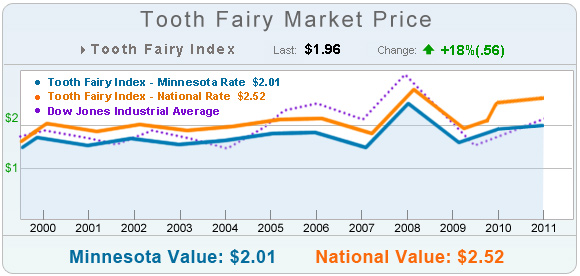
The Tooth Fairy Economy. It's all well and good to talk about inflation-adjusted dollar values, but what does it all mean? When I was losing my primary teeth 50+ years ago, the Tooth Fairy routinely left a dime under my pillow (molars earned a quarter, presumably because of their size). In 2011, according to the Official Tooth Fairy Poll, the average American child received $2.52 per tooth. (I think the Tooth Fairy should leave coins, not bills, which is a bit awkward when your largest widely-circulating coin is the quarter.)
Do you want to know how the American economy is doing? Forget Dow Jones and the NASDAQ—check out the Tooth Fairy Market Price:
My Political Statement. This year we ended our Christmas newsletter with the following: I’ve spared you the mundane as well as the bad, the ugly, and a lot more of the good than you see here. You don’t need to know about work frustrations (but still employed), computer problems (but still functioning), or health issues (but much to be thankful for); no doubt you have plenty of your own. And you certainly don’t want to hear any comments about the current political or economic situation! I'm sure that's true of most people, but one friend responded, "I would be very interested in your comments about the current political situation!." So this is for you, Jamie. (Not that I have any assurance that he ever reads this blog.....)
- We have a Democratic president, many of whose policies I think are disastrous. I pray for him daily.
- We have a Republican state governor, many of whose policies I think are disastrous. I pray for him daily.
- In our most recent election I voted—with pleasure—in our non-partisan city mayoral race for someone with whom I have many areas of disagreement but who I believe has done a good job in the past. I pray for her daily.
- I wish I could make more political decisions as in #3. I am not holding my breath. But I'm still praying.
A Plug for Penzeys. Is is possible to have a political disagreement over spices? Bill Penzey frequently writes essays in their catalogue that have political implications with which I disagree strongly. (I've tried to engage in conversation, but for some reason he's too busy—providing the seasonings I love—to write back.) That doesn't change a bit what I've said before:
Penzeys can be considered the Cadillac of spices. You can certainly find herbs and spices for less money elsewhere. But there are times when it's worth paying a little extra for quality, and quality is where Penzeys excels. Variety, too—they have exotic herbs and spices I'd never heard of, plus a stunning variety of their own excellent blends. They even excel in quantity, from tiny jars for the spices you use rarely, to large bags (at a commensurately lower per-ounce price) for greater needs.
My recent Penzeys experience deserves a public accolade, so here it is.
I was seeking a small gift that would say "thank you" to some people whose kindness I had particularly felt recently, and was having a hard time finding something that would be (1) appreciated, (2) healthful, (3) consumable, and (4) a little different. Then my Penzeys catalogue arrived.
Their latest promotion, the Kind Heart gift box, is billed as "the perfect gift for those whose little acts of kindness have brightened your life." Voilà! I picked up the telephone. When the representative told me the total price, I said, "That can't be right." She replied, "Oh, if you think it's important to thank these people, it's important to us, too. All you pay is the shipping charges." That wasn't advertised! It sure brightened my day, not so much for the savings, though they were appreciated, but for the delightful surprise and the attitude. Of course you can't stay in business for long that way, and Penzeys is a good business. What's particularly encouraging is they don't find any contradiction in being simultaneously committed to good quality, good business, and good deeds.
Oatmeal Season. Our weather has been warm again for a while—in that lovely range when the HVAC blows neither hot nor cold—but the first cold snap of the year was sufficient to reset my breakfast habits. In the hot months I eat (homemade) granola, and in the cold, oatmeal (steel-cut Irish, or "old fashioned" rolled oats; not <shudder> the flavored, instant variety). I really like oatmeal cooked in milk, but I use water to make clean-up easier, and add dry milk powder at the very end. To me, oatmeal requires raisins. The other flavorings I use include maple syrup, honey, brown sugar, cinnamon sugar, Penzeys Cake Spice sugar, various jams—or nothing at all (the steel-cut oats have a wonderful taste by themselves). It's great to have a food that I love to eat and is good for me! I'm not sure why oatmeal has such bad press, unless it's because of those packets of over-sweetened, over-processed mush that bear the same name on the grocery shelves....
— 7 —
Thanks to the Occasional CEO, I now understand more about the new generation gap in communications. Previous communication gaps had more to do with content than method, but this one is fundamental.

E-mail is a wonderful means of communication for those of us who love language and communicate better when we have time to think. It has most of the advantages of postal mail but is much faster.
Our nephews (and their parents) text all the time. I'll agree that texting has its place, but in my world that place is small and limited. Since my cell phone doesn't do e-mail, I like texts when I'm away from home because you can send a message without (needing to) interrupt the recipient. (It's even better when communicating with Switzerland, where texts are free for the recipient and for the sender cost a whole lot less than calls to a foreign cell phone.) But even with a full keyboard (which my phone doesn't have), you still have to peck out a message one letter at a time, leading to incomplete sentences, lack of punctuation, and abbreviations, which are like fingernails on a blackboard to me. U C?
Using the word "blackboard" reveals my age also, neh?
For more Quick Takes, visit Conversion Diary!
Permalink | Comments
Category Random Musings
A Facebook discussion set me to pondering what I have learned through the years about necessary and unnecessary stress at Christmastime. Yes, I think there is such a thing as necessary stress. The discussion was prompted by this quotation from Ann Voskamp: Whenever Christmas begins to burden, it’s a sign that I’ve taken on something of the world and not of Christ. Any weight in Christmas has to be of this world.
I appreciate the point, but I beg to differ, slightly.
The Christmas season, like all other seasons, has its own burdens and blessings. The work that goes into it, like the work that goes into life, can be delightful and can be stressful. I don't think it's a sign that we're doing something not of Christ just because it's stressful or burdensome. Good things take work. Labor, as in the birth of a baby. The more effortless a work of art looks, and the more joy it brings to others (inspiring musical performance; smoothly-running household; creative, confident, well-behaved children), the more labor you can assume went into it. Yet there's no denying that we can get so caught up in the effort that we miss the point, be it Christmas, or a wedding, or life itself.
Here are some things we've done, or not done, over the years, that made a difference to our Christmas stress level. Your mileage may vary.
 Media exposure. One of the best decisions we ever made was to severely limit the presence of television in our home. This included—for good reason—videos and public television, but it was the lack of commercial TV that made the greatest difference at Christmastime. Our children didn't beg for toys they didn't know existed and certainly didn't know they "needed." That wasn't our motivation for banishing children's television programs from our lives, but it was an especially helpful benefit.
Santa Claus. I grew up with the excitement of the jolly ol' guy, but we decided to tell our children from the beginning that honoring the real St. Nicholas had evolved into a fun, but fictional, Christmas story. I won't say that Santa never delivered gifts to our house—there were grandparents' wishes to consider—but we never, ever, stood in a long line, or paid ridiculous prices, or fought over the last Tickle Me Elmo just because our children had asked Santa, and Santa was expected to deliver. (That line never worked in my childhood, but somehow expectations have grown over the years.)
 Loss of anticipation. Despite the absence of a too-generous Santa, our children did not lack for presents and other reasons for looking forward to Christmas. But they never experienced the long period of anticipation I remember. In my childhood, the weeks between Thanksgiving and Chistmas j-u-s-t d-r-a-g-g-e-d. Life is busier now, and children feel time flying in a way that was once only an adult curse. Holiday stress has no age limits.
Christmas parties. Every organization or activity we or our children were involved in felt it necessary to have a Christmas party, complete with gift exchange, during the busiest and most expensive season of the year. I don't know why: the secular organizations had no need to celebrate Christmas, and the churches should have realized that Advent / Christmas Eve / Christmas / Epiphany worship services are a much better excuse for a celebration than "we have to have parties because everyone else does." I realize that some people are energized by such events, but I could have drastically reduced my stress level by declining at least half of the Christmas events we were invited to. I would much, much rather have baked and decorated cookies at home than attended parties, yet more often than not the latter squeezed out the better.
Christmas traditions. Frankly, I don't have any answers here. I still grieve over not having established our own family's holiday traditions, and for letting some treasures from my past fall by the wayside. For years we celebrated Thanksgiving with my in-laws; after that, we joined my family's gathering at my sister's house. Our children have wonderful memories of time spent with our extended families, which is of infinite value ... but no memories of Thanksgiving at home. Christmastime was usually spent at our house, but always with company, usually my in-laws. This was a great treasure, and I wouldn't trade it. But it was also stressful, as we accommodated their desires (e.g. Santa Claus), and in the time crunch I dropped some of my own cherished Christmas traditions. Why stress ourselves with making and decorating cookies (precious memories from my childhood) when we knew Grandma would bring piles of wonderful food with her? This was one of the "if only I were more organized" stresses: couldn't I have fit it all in, somehow? Without a doubt, family is far more important (and fun) than a particular cookie tradition. But there's still a loss, and a stress to deal with.
We've been part of our church's Christmas services for nearly as long as our kids have been alive, in some combination of childen's choir, adult choir, Christmas musicals, Scripture reading, and/or setup and takedown. Overall this is a great thing, and I find it hard to "do congregation," especially in churches where congregations don't do all that much. Active involvement is both educational and inspirational. But it also has its losses and stresses, from missing the neighborhood Santa drive-by (small loss, I think, but the kids loved getting the candy he tosses); to staying up into the wee hours of Christmas morning finishing tasks, having returned from church well after midnight; to burdening our guests with the choice of (1) be at church with us for a long time, sometimes attending multiple services, (2) providing their own transportation (difficult when the church was a complicated 40-minute drive from home), or (3) staying home without us, whom they had come long distances to be with. On the plus side, what with the exhuastion and staying up late, we rarely had to deal with early-rising children on Christmas morn.
Gift giving. This deserves a post to itself, but I'll try to keep it short. A gift, whether inexpensive or costly, can be a precious expression of love, or at least appreciation. But there's no question gift giving can be a problem, even without Santa in the picture.
- For a long time I was embarrased about the number of gifts under our tree, but I've gotten over that. Even though we had only two children, we always had visitors for Christmas to swell the present pile, and we have many generous relatives. We also made a point of wrapping as gifts things most families probably just buy as a matter of course, such as clothing (yes, even underwear), educational materials, and other necessities of life, just because it's so much fun to watch people unwrap presents—and they were never ungrateful, not even for the underwear. Most of the generous relatives were good about sending useful presents, too.
- The number of presents wasn't the only reason it took us all morning and most of the afternoon to open our gifts. It was important to us to treasure each gift (even the underwear), so we opened gifts slowly, and two gifts were never opened at the same time, no matter how many people were in the room. All attention was focused on one person, one gift. I can't say strongly enough how wonderful this custom was for us. Every gift was treasured, every giver thanked in person (or the gift carefully noted down if the giver was not present). The ungrateful do not deserve gifts. Thankfully, we never had to enforce this.
- Unfortunately, we were pretty bad about thank-you notes. We almost always got them out, but much later than we should have. I don't know why it was so difficult. The children were truly thankful, but getting them (or, to be honest, myself) to put pen to paper was a battle. But, really, how hard can it be? If I were doing it over, I'd include under the tree a special box of notecards for each child, and make a point of sitting down at the beginning of each subsequent day and writing one thank-you note. Even with our generous family, they'd have been finished before Epiphany. Let me add that, in these days of multiple means of communication, I wouldn't insist on hand-written, need-a-stamp notes, although those are always lovely to get. But whether expressed through letter, e-mail, phone, Skype, SMS, IM, or Facebook, what the giver wants to know is: Did the gift arrive? Was it broken or defective in any way? What do you like about it? What don't you like about it? Here is a great opportunity for a lesson in basic courtesy: how to thank someone for his thoughtfulness and generosity while letting him know that at age 12 you really don't want any more pink elephant slippers. Trust me, the giver has better things to do with his money than to give you presents you don't want. And please, mention gifts individually. "Thank you for the presents" meets the bare minimum requirements, but does not satisfy a loving and generous heart.
- If I were doing it again, I'd fret less about some of the gifts our children received that didn't fit well with our priorities and values. There was never anything truly awful—though in my opinion, a Barbie doll comes close—but I don't think they were scarred for life by being given stick-on plastic earrings and play nail polish. Relatives are good for expanding one's horizons.
- Charity gift catalogues (e.g. World Vision, Compassion, Heifer Project) are a gimmick, I know, but nonetheless a very effective and educational way to involve children in contributing to those in need. And I think the donation of a goat, or a bicycle, or an anti-malaria bed net would be just perfect for those otherwise meaningless Christmas party gift exchanges. I wouldn't go as far as this family (the same Ann Voskamp mentioned above) and have no gifts at all under the tree: receiving gifts is not only a joy for children but also a lesson in thankfulness. And anyway, what would we do without underwear? But the basic concept is worth working into our gift-giving, one way or another. Buy a few extra items to keep on hand during the year, too. They won't spoil (you get a card; the gift has already been given) and you'll have an easy present to pull out when needed.
- When I read, years ago, about a woman who had all her Christmas shopping done before Thanksgiving, I knew I could never be so efficient. Deadlines inspire me, but they must be real deadlines: I'm no good at mentally determining to be done by a certain time if my gut knows I really have another two weeks. But for the past several years, Thanksgiving has been a real deadline, because that's when our family gets together, and we all like to save on postage. True, it's a soft deadline—I can and do still shop in December—but it's solid enough to spur me into action a month early. It's an awesome feeling to go into December (and Advent) with much of the labor completed!
- What I really want to do is gather Christmas gifts slowly, all year 'round. This is harder to do for children of a certain age, whose interest in a particular item may not be sustained from February to December, or for things that people might buy for themeselves in the interim. But that still leaves a number of possibilities, from consumables (food, sandpaper, crayons) to items you know someone would love but would not treat himself to.
- We need to get over our embarrassment about homemade gifts. Few things say love like something that takes time and effort rather than a credit card. Homemade jam and hand-knit sweaters were always big hits at our house. Just don't take anything homemade to a Christmas party gift exchange, where for reasons I still don't understand, mockery is frequently mistaken for humor.
What has helped—or hindered—your celebration of Christmas?
A phrase from George McDonald sums up how I'd like to approach this season of blessing and stressing. Labor without perturbation, readiness without hurry, no haste and no hesitation. For the visual thinkers and chart-minded among us, I've created a graph that I find helpful in determining whether or not a particular Christmas activity is worthwhile for me.

The y-axis, Duty, represents the importance of a project or activity, whether in my own mind or imposed by others; the x-axis, Delight, is a measure of the joy received as a result of my participation. There is nothing mathematical about the placement of the adjectives within a quadrant; they are merely suggestive.
A given type of event may fit into any of the four quadrants. For example, the Christmas party.
The first quadrant is all positive; this is where you want to be. For me, it would be a small gathering of good friends, where we take our voices and various instruments on a carolling tour of the neighborhood, preferably on a still, quiet night with a few snowflakes falling. Then we'd repatriate and warm up by a cheerful fire with cups of steaming cocoa and an assortment of snacks and cookies. (Yes, I'm aware that I live in Florida.)
Quadrant Two might be your office Christmas party, which you dread, but you know that if you don't show up—with a smile and a gag gift—your boss will consign you to the "not a team player" abyss. Grit your teeth, take a good attitude with you, and please try to stay out of trouble.
The third quadrant is bad all around: no fun and no good reason to be there. Perhaps it's your church's production of The Young Messiah, served with Crystal Light lemonade and peanut butter cookies, which you know will distress your ears, your brain, your stomach, and your musical sensibilities. You like to support church activities, but they're expecting an enthusiastic crowd of three hundred and you will not be missed. Cross this one off your list with gratitude and a sigh of relief.
Quadrant Four is where you'll find the chocolate cake of life: Not good for you, but not harmful in limited quantities. Perhaps your neighbors are staging a back-to-back showing of your favorite Christmas television specials. No one will be offended if you stay home, and you don't anticipate any benefit, not even a chance for conversation—no one but you appreciates pausing a show to discuss the philosophical implications of the Ghost of Christmas Present, or the symbolic significance of the Island of Misfit Toys—but you would love to see A Charlie Brown Christmas again. The greatest danger with activities from this quadrant is that it is too easy to let them accumulate until they've multiplied stress by crowding out Quadrants One and Two.
I see the Ann Voskamp quotation as unrealistically one-dimensional: Anything that is not in Quadrant One must be in Quadrant Three. I suggest that the Christmas season, like life, cannot be reduced so neatly—not even to my two-dimensional analysis. But in any case, a reasoned consideration of what contributes to a joyful celebration and what detracts should lead us in the direction of a
Merry Christmas!
Which is an appropriate activity for Advent.
Permalink | Comments
Category Children & Family Issues Random Musings
Thanksgiving is one of my favorite holidays, but I wish we celebrated it in October, like the Canadians. For one thing, winter weather would be much less likely to interfere with "over the river and through the woods to Grandmother's house we go." Okay, in this case, it's Grandmother who does the travelling, but you get the point. October is a better time to have a harvest festival, anyway. And since the commercial interests have already declared that the entire last quarter of the year is the Christmas shopping season, they could kick it off with Thanksgiving the way they used to.
It's almost impossible to celebrate the succession of Advent, Christmas, and Epiphany in modern America. Another benefit of moving Thanksgiving to October would be that it it would no longer step on Advent. We almost always miss the solemn and lovely First Sunday in Advent because of our Thanksgiving travels. Worse, it's difficult to concentrate on reflection, self-examination, repentence, and anticipation of Christ's return when everything around you—including most churches—is shouting, "Christmas!" It's also unneighborly to be fasting when others invite you to a feast.
Then, when the anticipation has reached its height, and Christmas has been welcomed with bells on the midnight between December 24 and 25, and you are ready for a twelve-day-long celebration, the rest of the country stops caring. Abruptly. Around noon of the 25th. The atmosphere becomes positively Grinchy. Christmas trees, many having been decorated since before December began, are back in the attic, if not the trash, before Epiphany. Epiphany? What's that? Perhaps one benefit of our growing Hispanic population will be a rebirth of the Three Kings holiday.
So, we compromise. I'm thankful to be in a church that celebrates Advent, Christmas, and Epiphany. But I do try not to be Grinchy myself, and to go along with this peculiar admixture of Advent and Christmas. Unless we live in a cloistered community, it's unfriendly, not to mention quite against the spirit of the season—especially Epiphany—to shut ourselves off from our neighbors' joy. Besides, we'd miss some of the best music of the year!
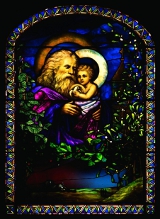 Christmas in the Park. Every year on the first Thursday of December, the Morse Museum brings some of its beautiful Tiffany stained glass windows, along with the Bach Festival Choir, to nearby Central Park to celebrate Christmas. For Morse members, this was preceded by a reception at the museum. The food was good, but we recognized no one, not even the musicians. Nonetheless, a woman came up to me and asked, "Do I know you?" I couldn't place her at all, not that that means much, given my memory for names and faces. But it was my brown and white sweatshirt she knew. "Did you go to Westtown? I graduated from Westtown, and so did my husband." I explained that it was my nephews that went there, and I got the sweatshirt. Amazing, I said, that we were talking about the same Westtown. Drawing herself up, she replied, "There is only one Westtown." Then she laughed, and added, "Only one brown-and-white, Quaker Westtown, anyway!"
After the reception we walked to the park, and met up with some friends we hadn't seen in a while. It's a good thing we had cell phones, because the park was so packed with people we couldn't even get a good look at the famous windows, let alone find someone in the crowd. The window depicted to the left is Christmas Eve, ca. 1902. If God the Father looks a bit like Santa Claus, that's no coincidence: the window was designed by the son of Thomas Nast. There's some debate over who that figure is meant to be—it may be St. Nicholas—but I'm siding with those who call it a depiction of the Father, to complete the Trinity; it's hard to tell in this small view, but the Christ Child is holding a dove.)
It was a great concert, as outdoor performances go, beginning with standard carols and then branching into more interesting and lesser-known songs. The audience was invited to sing along, and the four of us had a blast singing all the verses of our favorites. We even did pretty well with the Hallelujah Chorus, although it's hard to keep track of the parts without music. (We made a quartet: soprano, alto, tenor, bass.)
Winter Park is as close to a European city as you can find around here. Walking along, we were reminded of last year's Christmas adventure in Strasbourg, France—only more crowded and without the chance of slipping on the ice and sliding into a frigid river.
Advent Lessons and Carols. Three days later, we were back in Advent, at the Cathedral Church of St. Luke. Sadly, there are reasons we can't make that our home church, but it has the best music in town. We sang not one contemporary "praise song," but instead: Come, Thou Redeemer of the Earth; Creator of the Stars of Night; Hark! A Thrilling Voice Is Sounding; On Jordan's Bank the Baptist's Cry (second time that day); Sleepers Wake! and O Come, O Come, Emmanuel. All verses, even of the last. Interspersed with these were Scripture lessons and offerings from the choir that included works by Bach (Lord Christ, the Only Son of God), Palestrina (Advent Matins Responsory), Heinrich Biber (thee of his Rosary Sonatas), John Rutter (Nativity Carol), Javier Busto (Ave Maria), Peter Mathews (Pray for the Peace of Jerusalem), and Benjamin Lane (Advent Vespers Responsory), plus a spiritual (My Lord, What a Mornin'), a Medieval English Carol (There is No Rose), and more!
As an unplanned bonus, we met and sat with our favorite elementary school music teacher. It was good to catch up with her.
Speaking of elementary school music, here's a version of Handel's Hallelujah Chorus from some fifth graders in Quinhagak, Alaska. Since it was a computer project done by students, I can forgive the misplaced apostrophes, usually a pet peeve of mine. (The teacher commented, "I now have a very teachable moment once we start school again.") I wonder, however, what was the source of their text. Can you spot the two interesting errors I found?
UPDATE 8/15/19: At some point over time, the end of #6 and the beginning of #7 went missing. I have no idea why.
For more Quick Takes, visit Conversion Diary!
Permalink | Comments
Category Random Musings
We will never forget.
A day that will live in infamy.
Forever is a long time. How long will it be, I wonder, before the most recent unprovoked, surprise attack on American soil is as distant a memory as the one before?
I usually judge society's remembrance of an event by how often it is mentioned in the comic strips. Back in 2006, BC and Mallard Fillmore were among the few that commemorated the day. Today, I found none at all.
But a 70 year anniversary deserves recognition: Today is, and will always be, Pearl Harbor Day.
Permalink | Comments
Category Random Musings
(In)Security. Here's another of the TED talks I accumulate from various places; unfortunately I no longer remember who to credit for the tip. Security expert Bruce Schneier speaks on our models of security, our feelings of security, and why these often differ from the reality of our security. I wish he had given more concrete examples, but it's still a good talk, especially at the beginning when he makes the point that all security decisions are tradeoffs, and the proper question to ask is not so much, "Does this make us safer?" as "Is it worth the cost?" He's probably thinking about national and computer security, but the application that immediately jumps to my mind is parenthood. Whether it's airport body scanners, tamper-proof bottles, or removing tall slides from playgrounds, it's important to realize that security—or even the illusion of security—comes at a cost.
UPDATE 8/15/19: At some point over time, a large chunck of this post—numbers 2-7—went missing. I have no idea why. The video below obviously went with one of the missing posts.
For more Quick Takes, visit Conversion Diary!
Permalink | Comments
Category Random Musings
No time for Seven Quick Takes, so here are Seven Quick Thanks:
- Extended family who love getting together and enjoying our similarities and differences,
- All of our grandchildren, with their unique personalities,
- Home-grown potatoes,
- Home-grown music!
- Our eight-year-old grandson, whose birthday is today!
- Watching that same grandson with his nose in a book that I loved as a child,
- That all of our children, grandchildren, and nephews love to read or to be read to.
Permalink | Comments
Category Random Musings
The Duggar Family is just about the only reason I might wish, a little bit, that we had cable television. Not really; Netflix has spoiled me for watching anything I can't control. But Netflix has also failed me, not offering any but the first two seasons of their show. As a result, I'm 'way behind on their story, other than the little snippets I can see on Hulu. So I can't write the (long) post I want to. Instead, I'll summarize everything I'd hoped to say this way:
- There are many things I like about their lives and the way they are raising their children.
- There are many things I don't like about their lives and the way they are raising their children.
- I don't understand the extreme reactions the family has provoked:
- Not those who treat them like rock stars, standing worshipfully in line for hours just to see them at a book signing.
- Even less those who treat them as if they were evil incarnate, responding with vicious, hateful, ignorant comments.
- No one can ever adequately judge a family while it is still a work "in process." But I will note three things:
- They have been under an intense media spotlight for years; major politicians get less scrutiny. They've been interviewed, filmed, followed, and written about by journalists from all over the world. If they were hiding some dirty little secret, it would be known by now.
- The children (ranging in age from one to 23) are clearly well-behaved, pleasant, active, helpful, and happy.
- The parents are incredibly gracious in their responses to, and understanding of, those who question or misunderstand them.
I say, more power to them, and congratulations on expecting #20! Netflix, are you listening?
Here's a video from the Today Show that considers why the Duggar Family might elicit such strong reactions.
Permalink | Comments
Category Reviews Children & Family Issues
Ahem.
Our nephew is playing in the 2011 Quidditch World Cup in New York City. He's a Seeker, and he just caught the Snitch.
I thought the world should know. :)
Permalink | Comments
Category Everyday Life
What were you doing at 11-11-11 11:11:11?
I was washing dishes. I noticed the clock at 11:13.
Permalink | Comments
Category Children & Family Issues
Cultural differences. We're still reading the Sunday New York Times we picked up in Naples. The Sunday Times may cost a whopping $5, but there's a book's work of matierial to read.
From Russia with Lies should be read by anyone doing business with—or dating—someone from another culture. Author Elena Corokhova, a child of Communist Russia, explains vranyo, a culture of lies that everyone knows, but no one admits, are lies. Everyone except the naive foreigner, that is—and Russians born after perestroika.
Putin was lying to us, we knew he was lying, he knew we knew he was lying, but he kept lying anyway, and we pretended to believe him. ... While I envy this uncommunist generation, I do see one deficiency: They have lost the ability to detect a lie.
My husband works with people from many different cultures: north, south, east, west, and midwest in the U.S., and countries as different as China, India, Italy, Nigeria, and Australia. One of his Chinese colleagues told him candidly something everyone needs to know when dealing with China: culturally, it is not only acceptable, but admirable, to best a competitor by cheating and deception. If the victim is not Chinese, so much the better.
My in-laws lived and worked in Brazil some 30 years ago. Perhaps the culture has changed, but back then what we would call "taking bribes" was simply the way business was done. If you did not participate, not only did you not get your business accomplished, but you were considered ignorant and rude.
My point is not to be disrespectful of other cultures, and certainly not to imply that every Russian is a liar, every Chinese a cheat, and every Brazilian corrupt, but to ask two questions.
- How can we be "wise as serpents and harmless as doves" when interacting with foreign cultures? Acknowledge the risks in dealing with people whose mores differ from ours without being (or becoming) racist? Maintain our own integrity while adapting to life and work in a foreign land?
- What are the aspects of American culture that trip up foreigners? What makes it difficult to deal with Americans? What do we take for granted as "normal" that others consider bizarre, rude, or even immoral?
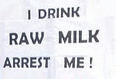 A Rally I Can Believe In. I can't ever see myself participating in a Tea Party rally, much less the more chaotic and uncivil "Occupy" events. But if I'd been in the area, I'd have gladly taken part in the Raw Milk Freedom Riders' Caravan and Farm Food Freedom Rally on November 1st. I'd have made my first public act of civil disobedience, too, joining the mothers who bought raw milk (legally) in Pennsylvania and transported it (illegally) to Maryland, where they drank it in front of the Food and Drug Administration headquarters in Silver Spring. Speakers at the rally included Joel Salatin, David Gumpert, and other heroes of the battle for liberty as it touches what we eat, where it comes from, and how it is produced.
The mission of the Farm Food Freedom Coalition is, "to inspire, empower and facilitate consumers into action until everyone can procure the foods of their choice from the producer of their choice." Here are some links for further information on the FFFC and the rally.
A good summary of the event from The Compleat Patient.
A pre-event post from the New England Cheesemaking Supply Company, with videos of some of the speakers (not from the rally).
Pictures from the rally (again at NECSC).
The Farm Food Freedom Coalition.
Is this a good place to point out that I am apparently incapable of understanding the Quick part of 7 Quick Takes Friday?
Okay, here's a quick one. Not many e-mail forwards are worth passing on, but I couldn't resist this. To understand its appeal, first you have to know something about my family tree. My grandfather, my father, and two of my siblings are engineers. So is one of our daughters, and both of our sons-in-law (who themselves come from engineering families). Most of the rest of us are mathematicians.

Election Day fun. I don't talk about politics all that often, and when I do, it may or may not tell you something about how I cast my ballots. For one thing, I try to elect the best person for the particular job, which may mean voting for someone who is not my first choice, or someone with whom I seriously disagree on matters that only tangentially impact his capacity for filling the office in question. For another, I really believe in the importance of the secret ballot. But today I'm making an exception.
I am a conservative Democrat (which is not quite an oxymoron). As such, I find myself more often than not these days voting against my own party. So it was with a peculiar kind of glee that this week I cast my ballot in our mayoral election for a LIBERAL DEMOCRAT. At least, that's what her opponent called her, in a blitzkrieg campaign that annoyed me enough I'd have voted against him in any case. But in actuality, I voted for the incumbent rather than against her opponent—and believe me, it's quite a pleasure to be able to cast a positive vote for a change. Ours is one of the nicest, most beautiful cities in the area, our taxes are low, and the city is debt-free. If it ain't broke, don't fix it seems like a pretty good conservative attitude to me.
Ten is the new two. That's how Free-Range Kids advocate Lenore Skenazy describes Amtrak's decision to raise the age at which a person can ride the train without an adult babysitter from eight to twelve. And 13- to 15-year-olds have severe restrictions as well. I can't help remembering our trip to Liechtenstein a few years ago, when we saw schoolchildren who were probably in the five to eight range travelling on public transportation—knowing where to get off, and more importantly, where not to get off—completely unaccompanied. Granted, that's not the same as a long train trip, but Amtrak's restrictions seem ridiculous to me.
What are your experiences with train travel and children? Somehow I can't picture the Europeans requiring a 15-year-old to wear a special wristband marking him as an unaccompanied minor—but I may be wrong.
Fighting ICD (Internet Compulsive Disorder). CNNHeath asks, Does life online give you "popcorn brain"? and answers, alas, in the affirmative. It's of particular concern to me because most of the work I do requires using the computer. (Not that people did not, for example, do genealogy research before computers were invented, but it would be silly not to use this most helpful of tools now that we have it.) I imagine there's a difference between what happens to the brain when you use the computer for research and when you use it for Facebook or to play an interactive multiplayer game, but that's not clear.
[S]tudies show multitasking on the Internet can make you forget how to read human emotions. ... "Human interaction is a learned skill, and they don't get to practice it enough."
The human brain is wired to crave the instant gratification, fast pace, and unpredictability of technology. ... "I never know what the next tweet is going to be. ... But I know what's waiting for me in my garden." [Who needs the Internet for this? All you need is a few children around the house.]
"We can't just sit quietly and wait for a bus, and that's too bad, because our brains need that down time to rest, to process things." [Not me, despite all my computer use. I'm more than happy to sit quietly and process things. But with music and, increasingly, video blaring everywhere (even on buses), it's not easy to do.]
Over time, and with enough Internet usage, the structure of our brains can actually physically change. ... Researchers in China did MRIs on the brains of 18 college students who spent about 10 hours a day online. Compared with a control group who spent less than two hours a day online, these students had less gray matter, the thinking part of the brain.
Not that any of this is the reason I'm announcing a blogging slowdown. The next three months will be extremely busy for me, so my "7 Quick Takes" may not happen every Friday for a while. I may have to adopt IrishOboe's "7 Quick Thanks." :) I'm not disappearing entirely—writing is actually one of my most important vehicles for the above-mentioned processing time. But for anything involving an online presence (blogging, Facebook, e-mail) I'll be more than usually unpredictable for a while.
It's time to rebuild some of that grey matter, as well as real-life relationships.
And here's a bonus. How fitting for a special day to fall on a special date. For veterans of all wars, all current and past members of our armed forces, and all whose calling is to stand between others and harm, including those among our friends and family who serve as fire, ambulance, and police First Responders, I offer my favorite verse of our national anthem.
Oh! thus be it ever, when free men shall stand
Between their loved home and the war's desolation!
Blest with vict'ry and peace, may the heav'n-rescued land
Praise the Pow'r that hath made and preserved us a nation.
Then conquer we must, when our cause it is just,
And this be our motto: "In God is our trust."
And the star-spangled banner in triumph shall wave
O'er the land of the free and the home of the brave!
For more Quick Takes, visit Conversion Diary!
Permalink | Comments
Category Random Musings

