
Mom knows best: if you want to learn, you need to sleep.
A new study shows that dreaming is an important part of that process.
Robert Stickgold, the director of the Center for Sleep and Cognition at Beth Israel Deaconess Medical Center, in Boston, Massachusetts ... and his colleagues asked 99 college students to memorize a complex maze on a computer. The researchers then placed the students inside a virtual, 3-D version of the maze and asked them to navigate to another spot within it. After doing this several times, half of the participants took a 90-minute nap while the other half stayed awake and watched videos.
When the students were given the maze test again five hours later, the nappers did better than the students who had stayed awake, even those who had reviewed the maze in their heads. However, the nappers who dreamed about the maze — one described being lost in a bat cave — performed 10 times better than the nappers who didn't.
The students who dreamed about the maze did poorly on the test the first time around — which may not be a coincidence, the researchers say. If a task is difficult for you, your brain seems to know it, and you may be more likely to dream about it than if the task were easier.
It doesn't even need to be a deep sleep, as the researchers found when they monitored the brain activity of the students while they slept. Although the deep slumber known as rapid eye movement (REM) is most closely associated with dreaming, the students' dreaming and learning occurred after as little as one minute of non-REM sleep.
Porter's immediate and excellent suggestion was that the researchers use as a control group, not students who watched videos, but students who stayed awake but otherwise were not allowed to do anything distracting. The sleeper's minds were free to continue to work on the problem, whereas watching videos would not only divert attention from the task, but would actively drive out the newly-learned information. Porter suggested the control group be required simply to sit and do nothing for that time, but you can't ask a chronically sleep-deprived college student to sit still for 90 minutes without falling asleep. Perhaps they could go for a walk instead, or do some other activity that lets the brain free-wheel.
Since the nappers had better results than students who mentally reviewed the maze (apparently before or after the videos, though the article doesn't say), the free-wheeling part is probably important. I know my own brain continues to work on problems if I set them aside for a while and do tasks that don't require much high-level brain power.
But what I was learning last night that involved secret agents, super powers, and shredded carrots?
What amazing natural phenomenon is this?

Looks to me like a NASA photo of some far-off nebula, but it's a lot closer to home. You can find this and other photos of the erupting Icelandic volcano in this RoadRunner collection.
Permalink | Comments
Category Everyday Life
There's a radio show in Basel called The English Show, for English-speaking ex-pats, and last night Janet was interviewed about her upcoming recital, A Guided Evening of Medieval Music. Stephan wrote about it, with links, and I cannot improve on what he said, so I'll quote him:
Yesterday, Janet was interviewed on the English Show at Radio X and got to explain some of what she does to the radio-listening expat community. The entire show can be downloaded from the English Show link above or directly here.
It’s pretty large - 82 MB - but will give you a couple of on-the-air mentions of Janet’s name in various pronounciations. At 2:15 she’s referred to as a “Gothic harpist,” which could be somewhat misleading, since she doesn’t dress in black and sport piercings, skull rings, and bullet casing belts; the brief mention after the news at about 34:00 is a little more precise. The actual interview begins after the Tracy Chapman song at the 38:50 mark, and culminates in Janet playing a Trotto from 14th century Italy with her baby harp (”Arpa Doble”). Her concert gets a fair bit of publicity and is mentioned again at about 55:00 in their calendar of events, alongside the Jazzfestival Basel and the Mamma Mia musical (and it’s the only free event). I’m curious to see if extra people show up for the concert because of this interview!
I have, however, taken the liberty of extracting the parts more interesting to my particular audience. :)

Trotto from a 14th century Italian manuscript, Janet playing the double-stringed harp in the picture (mp3, about 4MB)
(That's our newest grandchild in the picture, too. For all I know, he/she was contributing a few kicks to the performance.)
Permalink | Comments
Category Everyday Life
Welcome home, Discovery. It's always a thrill; what a pity this was your penultimate flight.
Permalink | Comments
Category Everyday Life
Permalink | Comments
Category Everyday Life
Our local story of the disappearance and rescue of 11-year-old Nadia Bloom didn't stay local for long.
Mostly, I ignored it as much as possible, other than getting the occasional update for prayer purposes. The media was going nuts. And so were the nay-sayers, the gossips, and the fear-mongers.
To be sure, they had reason. We've had at least two recent, high-profile cases here of "missing" children where at least one of the tearful, pleading relatives was most likely the perpetrator of a horrendous crime. That's enough to cause a little cynicism. But cynicism and suspicion don't accomplish much, and in the end, Nadia was rescued after four days in Florida swampland by an ordinary man of faith: faith in God, and faith that Nadia's disappearance was exactly what it appeared to be—a beloved child who adventured a little too far and needed help.
I'm not taking anything away from the professionals involved in the rescue attempt; I'm sure they follwed the right procedures and worked diligently and desperately to find her. If you are wondering how hard can it be to find a child in "the woods," you need to re-read the story of Ponce de Leon's adventures in Florida.
Was James King—who set out because his wife reminded him that whenever they lose things, they always pray and God provides the answers, and wasn't Nadia lost?—was he hailed as a hero? Eventually, but not until after questioning and a background check. What a fishy story it was! How could he have found her like that if he hadn't been complicit in her disappearance? And how weird is it that he claims God led him to Nadia? Fortunately, King was cleared quickly.
There several things that annoyed me as the story played out, more than enough reason to minimize my media exposure. The suspicion and cynicism, as I said. And more: playing up Nadia's Asperger's condition as if she were a totally helpless child whose parents should have known better than ever to let her get out of their sight; latching on to the fact that she'd been reading a book about a girl who has an adventure, with the hint that such books are dangerous because they might lead a child to think adventures might be fun; even the fact that Nadia, who apparently could walk and was suffering from no more than bug bites and dehydration, was carried out of the woods by a rescue team, then given IV fluids and antibiotics and hospitalized for a few days. It's hard not to wonder if in a less litigious era she would have been allowed to go home to her joyful family and told to rest and drink a lot.
But, whatever—the story has a happy ending, and if there's a dark side, no one has found it, although you can be sure they've tried. Thus I was encouraged—encouraged enough to write about it—by Scott Maxwell's positive essay in today's Orlando Sentinel. It's worth reading in its entirety, but here's an excerpt, since I know many of my readers won't bother....
Many of us struggle to believe that part of King's faith involves God actually speaking to him.
But perhaps we can believe this: If King didn't have faith, he wouldn't have been out there to find Nadia in the first place.
In fact, in the hours and days that followed the climax of this drama about a little girl found after four days, I couldn't help but think that perhaps the whole lesson was really about faith — not just in a higher power, but perhaps restoring our collective faith that bad stories truly can have happy endings.
Because, tell the truth: You were probably skeptical.
I know I was.
I was curious to talk with [King] himself. Because I, too, can admit that I don't always get those who hear directly from God and talk back in tongues.
Maybe that's partly because I was raised Presbyterian in the South, where describing our worship style as "low-key" is like saying a string quartet is a little lower-key than Def Leppard.
[H]ow did [God] tell you? Did you actually hear a voice? Out loud? In your head? Did you see a sign?
"Sometimes, for me," he said, "it's just a very strong thought."
I see, I responded.
"We spend so much of our time listening to all the noise in the world, we don't hear the voice of God because our senses have become dulled," he continued. "That's part of why I haven't watched TV since 1989."
So said the man who did seven TV interviews before he spoke with me.
"Yeah," he laughed, "I didn't recognize a single person I did an interview with."
I'm still not sure King's expressions of faith match my own.
And I know I'm not alone. Even Nadia's grateful mother chose her words very carefully, saying that King was, well, "a little more evangelical than us."
But that's OK, isn't it?
I mean, we all know that religion has been used in heinous ways to justify some of history's most evil acts. Isn't it OK to stop and appreciate a man whose own faith practices might seem different, but who has at least used those beliefs for good?
I can't get inside the head of this 44-year-old father of five. But I did listen to the 911 call in which King can be heard talking with Nadia in the background, telling her that he brought along some chocolate milk. ("Yay!" she exclaimed.) And that she was a very brave girl. ("Thank you very much.")
And though I don't have all the answers, until someone has evidence to the contrary, I think Nadia's story can inspire us all.
It's a story of faith. And survival. And not always expecting the worst.
Permalink | Comments
Category Random Musings
Rimsky-Korsakov: Russian Easter Overture, op. 36
Respighi: Church Windows
Debussy: Sunken Cathedral
Sung: The Circle Closes
This, the last of our subscription concerts for the season, promised to be a great one. I love the Russian Easter Overture, and the Orlando Phil did a nice job with its glorious, solemn, joyful, and triumphant Resurrection Day music. The next two works were new to me, but I like Respighi a lot, and Debussy well enough, and they did not disappoint. This concert was a bit different, having extra lights that projecting a lotus blossom-like image of changing colors behind the orchestra during this, the first half of the performance. It was hardly necessary, but was simple enough not to detract from the music, and may even have enhanced it a little.
The second half of the show was another story. This is where I was truly disappointed, because for it my expectations had been highest. I'd loved every Stella Sung composition I'd heard, beginning with the suite she wrote for the Florida Symphony Youth Orchestra back in the 1990's. As I said before, I've never yet met a Stella Sung work I didn't like.
Until now. I hadn't anticipated having to struggle with my New Year's Resolution #4 - Like More Things. The Circle Closes began well enough; I even managed to appreciate parts of the light show, though I found it a bit over the top. There was enough dry ice to make one think the auditorium was on fire, and the musicians' feet—not to mention their instruments—must have been uncomfortably cold. I will say I was impressed with the harp, however. It was positioned in the light just right to make it look as if it had been carved out of tiger's eye, and the pins glowed with color that changed with the lights.
The music was, broadly, in two parts without a break. Sung has stated that the work has no "program," but rather is purely abstract. Nonetheless, I would have called the first part angry and aggressive, and the look of Carl the Timpanist rising up out of the cold fog gave the impression of some Nordic version of hell. The second part was more serene and meditative, or so it seemed at first.
Porter described The Circle Closes as "one part Horizons [a ride at Disney World's EPCOT park], one part Blue Man Group, and one part 2001: A Space Odyssey. I, too, felt the EPCOT influence right away, and indeed the first half could make a good soundtrack to some wild theme park ride. The movie that came to my mind, however, was Disney's Fantasia—the first one, in which A Night on Bald Mountain, with its angry devils and spouting flames, gives way to the Schubert Ave Maria and the monks' candlelit processional. Only in this case it is as if the devils suddenly break into the procession and shatter the serenity forever. I haven't quite yet forgiven Carl for what his tympani blast did to my heart in the middle of the meditation.
After that it was all downhill. The second half of the work features four "crystal bowls." This, too, I was looking forward to, because I've heard music using crystal goblets, and they make a lovely, ringing sound. But this was something else. According to the program, crystal bowls are sometimes used "for meditation and healing." I agree with Porter that they could better be used for interrogation. After two hours of that sound, he declared, he'd spill any state secret you want. It took considerably less than two hours to have me cringing in my seat and eager for the concert to end. The tone of the bowls was not, at first, unpleasant, but repeated endlessly, with no break, no discernable variation, just over and over and over and over, and at an increasingly loud volume, it was torture. It took most of the ride home before my ears stopped ringing, and longer than that before my mind stopped ringing.
This was a first for me. I've never not applauded at the end of a concert. But I was that miserable. I'm glad I showed my enthusiasm vigorously at the end of the first half, because I know the musicians did a good job. And I'm not giving up on Stella Sung; no one can bat 1000 with anyone else's taste, and to be honest, most of the audience seemed to like The Circle Closes. But not me, New Year's resolution notwithstanding.
But don't take my word for it. The concert was streamed live online, and you can hear it yourself: Orlando Philharmonic Orchestra, Color Cathedral. You must register, but registration is free. At the moment at least, it's not in a finished form—there are several versions, and the first one I watched ended in the middle of the piece. And you may not get the same impression we did. We were amazed to hear how much different it sounds in the recording. The bowls are much softer and not nearly so oppressive, so it's possible that our negative experience was due to the acoustic peculiarities of our middle-front balcony position, though that's normally a very good spot.
Permalink | Comments
Category Reviews Everyday Life
 Can Trader Joe's be far behind?
Central Florida now has its very own Penzeys store, in the lovely Park Avenue area of Winter Park. It opened unofficially for a few hours yesterday, and today for real; we walked through the doors an hour after opening. I am so excited.
I know, Penzeys can be considered the Cadillac of spices, as befits the Park Avenue location. You can certainly find herbs and spices for less money elsewhere. But there are times when it's worth paying a little extra for quality, and quality is where Penzeys excels. Variety, too—they have exotic herbs and spices I'd never heard of, plus a stunning variety of their own excellent blends. They even excel in quantity, from tiny jars for the spices you use rarely, to large bags (at a commensurately lower per-ounce price) for greater needs.
It was particularly fun shopping today, as I bought only what I wanted, and in smaller quantities than usual. Herbs and spices lose their potency after a while, but I've been accustomed to ending a Penzeys visit with a large armload, since I either (1) didn't know when I'd have another chance to get to a store, or (2) wanted to make the most of my shipping charges for an online order. Now I can buy small amounts, and when I run out, plan a spicy date: get to Winter Park early enough to find a good parking space, visit Winter Park Honey and other friends at the Farmer's Market, then eat breakfast at Croissant Gourmet while waiting for Penzeys to open. Works for me.
Permalink | Comments
Category Everyday Life Food
 Ever since our visit to Rio de Janiero, where we began each morning with suco de maracujá sem açúcar, out-of-this-world unsweetened passion fruit juice, I have been on the alert for passionfruit flavors. Alas, nearly every version of passionfruit juice sold here is sweetened, which does a serious disservice to the noble fruit.
However, if you're going to adulterate the passionfruit, the Feodora Grand'Or Maracuja 75% Cacao chocolate bar is a good way to go. Porter found this German delight for me in New York City. At 75% cacao, the chocolate loses a little too much of its "mouthfeel" to be perfect, but the maracuja flavor is heavenly. Don't pass this up if you get the opportunity to taste some.
In “All Religions Are the Same…” (except Where They’re Not), John Stackhouse takes on the fallacy that all religions, at heart, are basically the same and of equal value.
What needs to be argued and not just asserted is that each of the major religions really does reduce down to moralism or mysticism without a loss to its essential character. And, in my view, most religions do not so reduce. Devotional (bhakti) Hinduism (the most popular form of Hinduism) doesn’t; Mahayana Buddhism (the most popular form of Buddhism) doesn’t; Judaism doesn’t; and Christianity and Islam, the most popular religions in the world, certainly don’t. (I recognize that there are moralistic and mystical varieties of each of the Abrahamic religions, but the majority of believers and of those religions’ formal traditions do not, I maintain, reduce to mere moralism or mysticism.)
[A]s politically useful and personally pleasant a belief as it would be—that all religions are basically the same—I continue to aver what most of the religions of the world actually do say: They’re not basically the same and one does have to choose.
We’ll have to keep investigating and thinking about what Map of Reality (which is what religions and all other forms of life-philosophy purport to offer) is the best one. We don’t have to conclude that all religions are wrong except one. More than one map can depict at least some of the territory at least somewhat correctly. But we can’t blithely suggest that they’re all equally, or even fundamentally, right, either. That would have to be shown, and I haven’t seen a good argument yet for that (unlikely) hypothesis.
Permalink | Comments
Category Random Musings
The Obamas' Federal income tax return for 2009 is now media fodder. (Another reason not to run for president.) They made a lot of money, though it didn't come primarily from your pocket unless you bought one of his books. But here's what I want to know: Does our president support his words with his actions?
One of my complaints about politicians is their penchant for enhancing their reputation for generosity by being charitable with other people's money. (See the Daley Ponderings discussion about Davy Crockett.) Oddly enough, the more a politician is known for wanting to spend tax money on charitable causes, the less willing he seems to spend his own money in a similar fashion—a lesson not easily forgotten if one has lived in Massachusetts. As I reported in How Much Should the Rich Pay in Taxes?,
- In 2007, President George W. Bush and his wife had an adjusted gross income of $923,807...and donated $165,660 to charity—or 18 percent of their income.
- Barack Obama and his wife, Michelle, earned between $200,000 and $300,000 a year between 2000 and 2004, and they donated less than 1 percent to charity. When their income soared to $4.2 million in 2007, their charitable contributions went up to 5 percent.
Here's the question: In 2009, were the Obamas as generous with their own money as they want to be with ours?
First take, the simple answer, from their 65-page long tax return. Adjusted gross income: $5,505,509. Charitable contributions: $329,100. That's a paltry 6%. Not very impressive, considering that the Christian minimum is 10% with more expected of those who have more to give. Not that we all live up to that, but it is nonetheless the standard. Surely one should be able to expect more from the nation's #1 political role model.
Take two, digging deeper. Neither the AGI nor the charitable deduction reflects President Obama's Nobel Prize winnings of $1.4 million, which he gave away entirely. (One of the recipients, by the way, was Greg Mortenson's Central Asia Institute.) This changes the figures dramatically: income $6,905,509, charitable giving $1,729,100, a much more impressive 25%.
So—are they generous folk with their own money? You can call it either way. Perhaps it would be better to judge by next year's filing, as it's arguable that the Nobel Prize introduced an anomaly into the system.
But the biggest lesson here is not a judgement on the Obamas' personal versus public charity, but how easy it is to grab either the 6% or the 25% and run with it much further than it deserves to be taken.
I try not to say too much about our current Federal administration, even though much of what they are doing scares me. (Yes, this is restraint. Believe me.) So when they say something I actually like, it's fun to be able to acknowledge it. (HT Margaret Gorodetzer via Facebook, and Joan Lowy/the Huffington Post.)
With the caveat that I haven't investigated the story at all, Transportation Secretary Ray LaHood is my current hero for his recognition that walking, biking, and public transit are important ways of getting from one place to another in daily life, not just recreation or the last refuge of losers who have lost their drivers' licenses Talk is not action, but it's a beginning.
LaHood says the government is going to give bicycling – and walking, too – the same importance as automobiles in transportation planning and the selection of projects for federal money. The former Republican congressman quietly announced the "sea change" in transportation policy last month. "This is the end of favoring motorized transportation at the expense of non-motorized," he wrote in his government blog.
LaHood's blog was accompanied by a [Department of Transportation] policy statement urging states and transportation agencies to treat "walking and bicycling as equals with other transportation modes." It recommends, among other things, including biking and walking lanes on bridges and clearing snow from bike paths.
The new policy is an extension of the Obama administration's livability initiative, which regards the creation of alternatives to driving – buses, streetcars, trolleys and trains, as well as biking and walking – as central to solving the nation's transportation woes.
Alas, this is just a recommendation, but it's an attitude that needs supporting. A sane transportation policy is long overdue that sees beyond "more roads and bigger."
Permalink | Comments
Category Politics Conservationist Living
The alarm going off at 6:15 wasn't exactly my idea of the ideal way to begin a Saturday, but it was worth it.
The occasion was as close to a trip to Europe as we get without actually getting on an airplane: a visit to Winter Park. Winter Park is not far from here, but has an ambiance few Central Florida cities attain. True, Park Avenue has sadly become home to more upscale chain stores than independent businesses, but it's still a lovely place to walk on a cool, sunny morning after a visit to the farmer's market. (By "cool," I mean temperatures in the low 70's.)
The market was the excuse for our trip, to replenish our supply of Winter Park Honey. We came home with six bottles: two of our favorite Blackberry Twist, one of Avocado (said to be especially good for women, but whatever, we both liked the flavor), and three of our soon-to-be-new favorite, Raspberry. I didn't think honey could get any better than Blackberry Twist, but you've never tasted honey like this!
On the way out we picked up some almost-local (Plant City) strawberries for tonight's dinner, and a half gallon of fresh-from-the-tree, raw orange juice. (They tried to sell us their grapefruit juice, but we like what we get from our own tree even more.)
Before leaving we walked up Park Avenue to check out construction on the Penzey's that will soon be open. I can't wait! And having not had breakfast yet, we decided not to resist the allure of Croissant Gourmet, sharing a strawberry crêpe at an outdoor table.
What a lovely Saturday morning! All that accomplished, and when we arrived home it was only a little after nine o'clock. Now we're working on the more mundane chores, like shopping and cleaning the thick blanket of green snow (aka oak pollen) off the roof and walkways.
Then we have company to look forward to at dinnertime!
Permalink | Comments
Category Everyday Life
This started as a comment to the Sockdolager post on Daley Ponderings, but it turned out to be long and off-topic, so I migrated it here. The article in question is a thought-provoking one, but it had one unintended consequence.
I've been having an ongoing conversation with our rector, who insists on frequent use of simple "praise choruses" at all our services, even the most traditional, so that they will stick in our heads and we'll have them handy in times of need. I understand the motivation: this is why I memorize Scripture, hymns, liturgy, poetry, anthems, and other useful and helpful works.
But because I know he does not set out to torture his congregation, I know his brain processes music in a different way from mine. By this I don't mean that he likes different music from me, although that is certainly true. The issue is not a matter of style or taste, but of processing.
Music sticks in my brain. I wish it were only the best music that sticks in my brain, but it's not. The simpler and more banal it is, the more it sticks. And it won't go away. Round and round and round it plays like a track on eternal "repeat," until I manage to kick it out—often by substituting something else—or go crazy. So far I've managed not to reach the latter point...quite.
This can be a useful affliction, as it does help with learning choir pieces. But it doesn't stop after we're done with the anthem. A little of that can be enjoyable, but even my favorite anthems can get stuck, and I have to work actively to stop the process so I don't end up loathing them. And if I don't like a song from the beginning, you can imagine what I think of it by the 455th repetition.
The more complicated the work, the less likely it is to annoy me, which is why the simple praise choruses are more than usually troublesome. But complex music is not exempt: the other day I had part of Mozart's g minor symphony stuck on "repeat" and it was driving me nuts, even though I really like the piece. Fortunately, I know enough of that one that I was able, by effort of will, to kick it over into the next section.
It's not only music that does this to me, but words—though usually only if I'm writing them. I tend to compose paragraphs while walking—often they later become letters or blog posts. That can be an efficient way to think, but sometimes I'll get stuck going round and round with the same phrases and thoughts, and that's when I know it's time to pull out the mp3 player and let someone else's words into my brain.
Does anyone else share this blessing/affliction?
But the point of all this is what happened after I read the article, which is about Davy Crockett and the Constitution. So far, writing this post has been the only thing able to stop my endless mental repetitions of The Ballad of Davy Crockett. I never saw the movie, nor the television show, but as a child I had a record of Disney songs, of which that was one. Despite 50 years or so having passed since I last heard that record, I could still sing it to you.
I won't, though. You can watch this instead.
Permalink | Comments
Category Random Musings
A friend of mine likes to clean out her files periodically, and when she does I know to expect an envelope in the mail. She's very much into recycling.
Some of the articles she sends are from years back, so when there's one I'd like to share it's not always possible to locate it online. Thanks to Google News archives, however, you too can read this Lori Borgman column from 2002.
Maybe when all's said and done, the greatest perk of staying for the duration is knowing and being known.
Lori is both wise and funny, a healthy combination in any era.
Permalink | Comments
Category Children & Family Issues
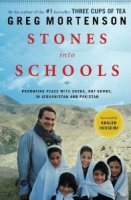 Stones into Schools: Promoting Peace with Books, not Bombs, in Afghanistan and Pakistan, by Greg Mortenson
(Viking Penguin, New York, 2009)
I knew before finishing Three Cups of Tea that I wanted to read the sequel. Stones into Schools is even more wonderful. For one thing, Mortenson has found better help with the writing, so the story is crafted in a riveting, compelling fashion.
Most of all, though, the story itself is riveting and compelling. While autobiography was a necessary and interesting part of the first book, this one is more about the work of the Central Asia Institute than about Mortenson himself. In an inversion of the usual approach taken in books about institutions, here the pyramid of emphasis gives the most prominence to the people at the bottom of the organizational structure. Perhaps the greatest strength of the Central Asia Institute is the extent to which the principle of subsidiarity is honored: the work is handled at the lowest competent level, which means most of it is in the hands of the Afghanis and Pakistanis themselves. The Americans handle the overall organization and fundraising, at which it must be admitted we are much better than at dealing with the intricacies of getting things done in a culture that is completely foreign to us.
The Russian invasion of Afghanistan; the rise and fall and rise of the Taliban; the devastating earthquake in Kashmir; the tensions (and war) between India and Pakistan; the unselfish goodness and the tragic, pig-headed stupidity of American intervention—see these from the inside, and never look at a map of that part of the world in the same way again. Learn what unbelievable sacrifices the "backwoods," tribal peoples will make to gain an education for their daughters, and how much they appreciate schooling for their sons that does not include militant, Taliban-backed, Saudi-funded, extremist indoctrination.
What pleases me most about Stones into Schools is the clear fairness of it all. In the acknowledgments section, there are as many D's after the politicians names as there are R's. Mortenson excoriates and praises American policy with an even hand, according to the results he sees. And while he is careful never to take any funding from the U. S. government for fear of jeopardizing the credibility of his organization, he is happy to work with the military to promote peace and understanding.
Prior to those meetings [with military personal, from service academies to high-level officials], my judgment of the American military's conduct in Afghanistan was harsh and rather uncompromising—and even after these encounters, I still have my objections. Between June and November 2006, for example, the U.S. Air Force ... dropped roughly 987 bombs on Afghanistan.... The resulting civilian casualties generated deep revulsion among the Afghan people.
Nevertheless, as I experienced the equivalent of sharing three cups of tea with the U.S. military, my perspective began to change. In a way, each side had something to teach the other, and we both wound up emerging wiser and enriched by the encounter. In the end, I also came away with the conclusion that the military is probably doing a better job than any other institution in the United States government—including the State Department, Congress, and the White House—of developing a meaningful understanding of the complex dynamics on the ground in Pakistan and Afghanistan.
The progress that the military has made began under President Bush, and continues under President Obama. The Central Asia Institute's supporters are as "red" as they are "blue." They are school children collecting Pennies for Peace, and high-ranking military leaders. Is there something here that can unite our sorely divided country?
I often recommend books, but I rarely say, "everyone should read this book."
Everyone should read this book.
Most of all, every American should read Stones into Schools.
There's nothing like establishing a pattern of making a new resolution on the 8th of every month to make one aware of how quickly time passes, and how slowly progress is made. Nonetheless, I press on with April.
One of the joys of this venture is the resolutions themselves. For the most part they've been new and unexpected: had I made a list of resolutions on January 1st it would have been quite different. Even when I'm thinking ahead to what next month's might be, by the time it comes to write it up, something new and different, but to my mind perfect, has appeared out of the blue to supplant it.
Like More Things was like that, a resolution that I don't believe had crossed my mind in over half a century. After all, what we like and dislike is part of what defines us as individuals, and the ability to distinguish between good quality and bad marks us as mature, educated human beings. So here is what I don't mean.
I don't mean giving up individual preferences like preferring broccoli to asparagus or Wagner to Mozart.
I don't mean pretending the ugly is beautiful, shoddy work is as good as high-quality craftsmanship, or that war is peace, slavery freedom, and ignorance strength.
Above all I don't mean accepting that all lifestyles, all philosophies, all behaviors, all theories, and all actions are equally valuable.
But not liking things is a great waste of energy, and an insult to God who gave them to us as good gifts. If a thing isn't out-and-out sinful, why should I not enjoy it? Only if circumstances would make it wrong for me—a qualification covering everything from sex outside of lawful marriage to eating that chocolate-covered doughnut while having given up sweets for Lent. The array of good things presented for us to enjoy vastly outnumbers the bad, yet we voluntarily close ourselves off from many of them.
If I don't like beets (they make me gag), not only am I not enjoying a good, healthy gift from God, but I'm putting myself in the position of worrying, when we eat at someone else's house, that the hostess will serve beets, and I will somehow have to choke them down with a smile. And I'm depriving my husband, who loves beets, because I rarely think to serve them.
If I don't like contemporary church "praise songs" (most of them make me gag), I'm cutting myself off from a community experience with those who do, and hindering my ability to worship God in a "contemporary-style" service.
Those are two really tough ones for me, so I'm not starting there. But I know that what we like and dislike is changeable, and to at least some extent subject to our wills. Over the years my husband and I have each trained ourselves to relish foods we had previously rejected, or eaten only "because they're good for us," and have made some progress in at least tolerating music that is not to our taste. Very small changes, I know, but recognizing the possibility of change is a good start.
I don't ever expect to prefer Christian (or any other variety) rock music to Bach-harmonized hymns, and that's not my goal. But I can take actions to help reduce negative reactions, such as using earplugs (such music is almost always presented at a painful volume), and concentrating on what good I can find, be it a particular line of text or the skill of the guitarist.
When something is not wrong, why torture ourselves by not liking it?
"[I]f a body was never to do anything but what he knew to be good, he would have to live half his time doing nothing."
"There you are much mistaken. ... How little you must have thought! Why, you don't seem even to know the good of the things you are constantly doing. Now don't mistake me. I don't mean you are good for doing them. It is a good thing to eat your breakfast, but you don't fancy it's very good of you to do it. The thing is good, not you. ... There are a great many more good things than bad things to do."
(George MacDonald, The Princess and Curdie)
Progress report:
#1 Read More Books Nine more books in March, including one audiobook. Making progress on The History of the Ancient World mentioned in my last update, but interspersing it with shorter books.
#2 Rediscover Feasting Some progress; not a lot, but steady. Having wonderful dinner guests a couple of times made for some great feasts by my standards. Fasting one day each week during Lent turned out to be much more fun than I had thought; maybe I'll keep it up. It's really nice to have a whole day with no time spent preparing and eating meals. I've also been learning from British chef and gadfly Jamie Oliver as well as Michael Pollan; their celebration of good food is contagious.
#3 Learn to Relax Alas, almost no progress here, and with travel on the horizon I don't anticipate much this month, either. I enjoy vacations and travel, but for an introvert like me, even the best come with elevated stress levels. Come to think of it, maybe that will provide an excellent opportunity to practice relaxing under stress!
Permalink | Comments
Category Everyday Life
Our greatest involvement in our children's public schools came during the heyday of the self-esteem movement, and I recall the frustrations of being a lone voice crying out that easy success is as much an inhibitor of learning as repeated failure. Those who sail through their early educational encounters with too much ease are often surpassed by their supposedly less able compatriots later in life, because they've missed the important lessons taught by failure.
With a hat top to Free-Range Kids, here's a Wall Street Journal article on why that college rejection letter, that teacher's put-down, and even our own weaknesses can be agents that propel us to success.
Warren Buffett was devastated when Harvard Business School rejected his application. Buoyed by his father's "unconditional love...an unconditional belief in me," he looked for Plan B, squeaked in under Columbia University's application deadline, and was accepted, later donating some twelve million dollars to the institution whose investment in Buffett turned out to be as savvy as Buffett himself.
"The truth is, everything that has happened in my life...that I thought was a crushing event at the time, has turned out for the better," Mr. Buffett says.
Columbia's current president, Lee Bollinger, grew up in a small town with limited educational opportunities. He, too, was rejected by Harvard, and the shock taught him to take responsibility for his own education, to realize that "it was up to him alone to define his talents and potential."
His advice: Don't let rejections control your life. To "allow other people's assessment of you to determine your own self-assessment is a very big mistake," says Mr. Bollinger, a First Amendment author and scholar. "The question really is, who at the end of the day is going to make the determination about what your talents are, and what your interests are? That has to be you."
Success has many lessons to teach, too, and frankly I prefer that classroom. But for grit, determination, perseverance, responsibility, and hard work, failure may be the better teacher.
Permalink | Comments
Category Education Random Musings
Christ is risen!
He is risen, indeed! Alleluia!
We do know the proper first words of Easter morning. They are not,
"What the heck was that?!?"
"Mmmm, a very large branch that fell but didn't hit the roof?"
But sometimes, when awakened unexpectedly from a deep sleep, proper words are not what first comes to mind. We don't yet know what it was, as it's dark out and will still be so when we leave for church in a few minutes. But when we return after two services of singing and rejoicing, a little investigation will be in order.
Happy Easter, All!
Permalink | Comments
Category Everyday Life
Is there anything worse than excruciating physical, mental, emotional, and spiritual torture and death?
It takes nothing from the sufferings of Christ commemorated this Holy Week to pause and consider a couple of other important persons in the drama.
I find the following hymn to be one of the most powerful and moving of the season. For obvious reasons, it is usually sung on Palm Sunday, but the verses reach all the way through to Easter.
Ride on! ride on in majesty!
Hark! all the tribes hosanna cry;
Thy humble beast pursues his road
with palms and scattered garments strowed.
Ride on! ride on in majesty!
In lowly pomp ride on to die;
O Christ, thy triumphs now begin
o'er captive death and conquered sin.
Ride on! ride on in majesty!
The angel armies of the sky
look down with sad and wond'ring eyes
to see the approaching sacrifice.
Ride on! ride on in majesty!
Thy last and fiercest strife is nigh;
the Father on his sapphire throne
expects his own anointed Son.
Ride on! ride on in majesty!
In lowly pomp ride on to die;
bow thy meek head to mortal pain,
then take, O God, thy power, and reign.
"The Father on his sapphire throne expects his own anointed Son." For millennia, good fathers have encouraged, led, or forced their children into suffering, from primitive coming-of-age rites to chemotherapy. Even when they know it is for the best, and that all will be well in the end, the terrible suffering of the fathers is imaginable only by someone who has been in that position himself.
And mothers?
The Protestant Church doesn't talk much about Mary. The ostensible reason is to avoid what they see as the idolatry of the Catholic Church, though given the adoration heaped upon male saints and church notables by many Protestants, I'm inclined to suspect a little sexism, too. In any case, Mary is generally ignored, except for a little bit around Christmas, where she is unavoidable.
On Wednesday I attended, for the second time in my life, a Stations of the Cross service. Besides being a very moving service as a whole, it brought my attention to the agony of Mary. Did she recall then the prophetic word of Simeon, "a sword shall pierce through your own soul also"? Did she find the image of being impaled by a sword far too mild to do justice to the searing, tearing torture of watching her firstborn son wrongly convicted, whipped, beaten, mocked, crucified, in an agony of pain and thirst, and finally abandoned to death? Did she find a tiny bit of comfort in the thought that death had at least ended the ordeal? Did she cling to the hope of what she knew in her heart about her most unusual son, that even then the story was not over? Whatever she may have believed, she could not have had the Father's knowledge, and even if she had, would that have penetrated the blinding agony of the moment?
In my head I know that the sufferings of Christ, in taking on the sins of the world, were unimaginably greater than the physical pain of injustice and crucifixion, which, awful as they are, were shared by many others in those days. But in my heart, it's the sufferings of God his Father and Mary his mother that hit home most strongly this Holy Week.
Permalink | Comments
Category Everyday Life
 The Gobblestone School: A Tale Inspired by the German Criminalization of Homeschooling, by Jacob Schriftman (aka Jokim Schnoebbe)
(Moonrise/CreateSpace, Scotts Valley, California, 2009)
I wanted to like this book.
First, I wanted to read it, and for that I had to buy it, as it was not available in the library. It languished in my Amazon "save for later" cart for a while, but I recently decided to indulge myself. I'm glad I read it, but as indulgence goes, I'd rather have dark chocolate.
I don't remember where I first heard of The Gobblestone School; it was probably because of my deep concern (and daily prayers) for Germany, where homeschooling is sufficient grounds for forcibly removing children from their homes and placing them in governmental care. Many homeschoolers have left their homes and jobs, families and friends to be able to give their children the education they believe is best, and the author of The Gobblestone School (now living in Ireland) is one of them. So I really wanted to like his book.
But even extreme sympathy, identification, and concern won't make me say I like a book if I don't.
The Gobblestone School has three problems, as far as I am concerned. First, it's aimed at modern adolescents, and I like very little that is focused on this narrow demographic. I do give the author kudos for not filling his book with profanities and sexual themes, as many of that genre do. It's also about school and magic, and let's be honest: when it comes to modern adolescents, school, and magic, J. K. Rowling has set the bar rather high.
Second, I don't have to be able to write a better story to be qualified to say this one is not well written. I can stand a poorly-written book if the story captivates me sufficiently, and I can stand a less interesting story if the craft is superlative. But two strikes and I'm not happy.
Finally, I had hoped that the book would be a good introduction to the benefits of homeschooling and to the particular problems in Germany, an easily-read explanation I could lend to others. It turns out to be a book that the homeschooling cognoscenti and children who are miserable in school might appreciate, but I doubt it would contribute anything to a reasoned dialogue. Even though the heavy-handed stereotyping is admittedly important to the plot, and the unhappy German school experience has clearly autobiographical elements (and therefore can't be entirely dismissed as false), the extreme negativity about school (and German school authorities) disqualifies the book from the outreach role I had hoped for it. Not that the author doesn't have reason enough to feel strong negative emotions about the German school system!
My own hopes for it aside, The Gobblestone School was actually a fun, quick, and easy read, much better than most in its genre, though that's not exactly high praise.
Permalink | Comments
Category Reviews Education Children & Family Issues

