
Our choir anthem for Sunday, September 22, 2013: For the Lord Our God Reigns (Craig Smith, Davit T. Clydesdale; Word Music, 0 80689 25027 9)
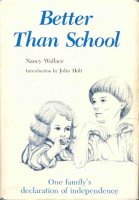
Better Than School by Nancy Wallace (Larson Publications, 1983)
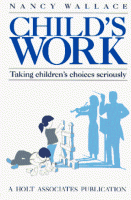
Child's Work: Taking Children's Choices Seriously by Nancy Wallace (Holt Associates, 1990)
These stories of the education of Ishmael and Vita Wallace have been high on my list of favorite books since our own homeschooling days. Recently I re-read them both, confirming my suspicions that the Wallaces—flying by the seat of their pants in an era when homeschooling was almost unheard of, and often illegal—discovered many of the principles now refined in Project-Based Homeschooling.
The last time I read about the Wallaces' struggles with onerous regulations and imperious school boards, I noted how blessedly out of date it was, for although there are still those in the United States who would make homeschooling illegal again if they could, for the most part homeschoolers here can rest in the knowledge that the right to direct the education of our own children is recognized in all fifty states. This time, however, I read those parts of the books with renewed interest, since Switzerland, while much more advanced than the U.S. in some areas, is woefully behind us in this. Some of the Wallaces' experiences and arguments may turn out to be relevant, or at least to give inspiration.
Don't you just hate it when you read an inspiring story from the past and have no idea what happened to the characters in subsequent years? With Vita and Ishmael, at least, that question can be answered by visiting their Orpheo Duo website.
Here are a few, somewhat random, quotations. You really need to read the books to get a good sense of the story, however.
Walking into the meeting knowing that we had a majority [of the school board] on our side was a lot better than not knowing what to expect, but I guess I really wanted more than that. I wanted the whole board to admit that we were doing a terrific job with our kids and to be interested in our approach to education. After all, there was a lot the public schools could have learned from us. What disturbed me the most was that not only were two of the board members completely uninterested in what we were doing but they seemed to want the kids to go to school no matter what. When I wrote about this to John Holt, he responded with some very insightful remarks that I'll never forget. "One of the saddest things I've learned in my life," he said, "one of the things I least wanted to believe and resisted believing for as long as I could, was that people in chains don't want to get them off, but want to get them on everyone else. 'Where are your chains?' they want to know. 'How come you're not wearing chains? Do you think you are too good to wear them? What makes you think you're so special?'" (BTS, 114-115)
It always puts me on edge when people talk about Ishmael as being "gifted." I get even more uptight when they politely inquire whether Vita is "the same" as her brother. No, Vita isn't the same. Her personality is quite different and so are her interests and ways of learning. But most important, neither child is an aberration—a creature born from a normal set of parents but with an extra set of wrinkles on its brain.
True, even I am struck when I see Vita, who is five, happily typing away at a story on the living room floor, or hear Ishmael, at age nine, alluding to Hamlet or Macbeth; but at the same time I know that Bob and I had a lot to do with the way the kids are—they weren't born that way. ... Now if Ishmael had become a math whiz while growing up in this house, which was almost barren of numbers before we took him out of school, I'd seriously begin thinking about "giftedness" or brain wrinkles, but that never happened. Instead, we are raising two normal kids who happen to enjoy reading and writing. (BTS, 135-136)
Neither Ishmael nor Vita slept through the night until they were about three or four years old. Not only did they liven up around midnight, but they always insisted on company. ... Finally, we managed to hit upon a fairly satisfactory compromise. Ishmael first, and later Vita, would sit in bed and listen as Bob and I took turns reading to them. We read thick books with few pictures in the hopes of boring them to sleep. ... The big trouble, though, was that the kids didn't bore easily. Often we had to read for hours at a stretch—but at least Bob and I insisted on reading the books that we liked. (BTS, 136)
It was a really scary thing to face up to the fact that we might risk being labeled criminals or child abusers by moving casually into a state which might, for all we knew, prohibit homeschooling or have such stringent regulations that we couldn't possibly meet them. As I anxiously researched New York State's education laws and court precedents, I had visions of Peter and Brigitta Van Daam, home-schoolers in Rhode Island. Thanks to the TV screen at a neighbor's house, I had watched them bravely waving good-bye to their children as a policeman drove them off to jail for failing to comply with the state's compulsory attendance law. I thought, too, of the Sessions family in Iowa, in and out of court for years while fighting to keep their boys out of school, and of John Singer, the father of seven children in Utah, whose battle with school authorities ended tragically when he was shot to death in a battle with some sheriff's deputies. (BTS, 238)
[A]s musicians usually judge the talent of young beginners, these children were not at the start unusually talented. I know some of the tests by which musicians try (to no useful purpose) to measure and judge musical talent in young children, and by these tests and measures I don't think either of the Wallace children would have been called more than average. They have gone as far as they have not because they began with unusual talents but because they have the good luck to have parents who love and make music, because their mother is herself a very sensitive, understanding, patient, and skillful teacher, because they have been much encouraged without being in the least pressured, and because—since they don't go to school—they have time to work on music as much as they like. (BTS, Introduction by John Holt)
Vita and Ishmael are impressively competent at their chosen work, so much so that some readers may think this is a story about prodigies and consider it irrelevant to their own children or children they know. Child's Work is, indeed, about Vita's and Ishmael's skill at music, composition, art, and writing. Yet if this were all that Nancy had to tell, the book would not be as useful as it in fact is. For Nancy, the most interesting question about Vita and Ishmael is not, "What can they do?" but "Why have they been able to do so much; what conditions have allowed them to flourish?" If we think of Vita and Ishmael as prodigies, we avoid having to think about what helped them become as competent as they are. What if all children had the time to experiment, to pursue their own work, to draw on the resources around them? Might we then discover that children's capacities, and their ability to find work they love and pursue it wholeheartedly, are greater than we ever dreamed? (CW, Forward by Susannah Sheffer)
When we first took Ishmael out of school nobody had yet had enough experience to tell us what was "normal," what was possible. In the beginning, at least, we had to discover it all for ourselves. Eventually, what came to seem to us the most normal was, in fact, our biggest discovery, and one that in many ways led to all the possibilities that homeschooling has since opened up for us. It was this: that when Vita and Ishmael are busy, they are simply busy. Despite the ways and attitudes of the rest of the world, they refuse to see a distinction between schoolwork and everything else they do. They are genuinely baffled when people ask, "But what do you do just for fun?" as if to imply that doing anything of real value and importance couldn't by definition be classified as giving light-hearted pleasure, and that after a hard day's work, we all need a change. "But why?" I see Vita and Ishmael wonder.
Once, when a reporter came to interview Ishmael, he was so amazed by Ishmael's bemused attitude that he said, "Oh, come on now, isn't there anything you have to do that you don't like?"
Ishmael thought and thought, his chin resting in the cup of his hand. Finally, to save time, and almost certainly because I was feeling desperate to appear at least somewhat conventional, I said, "Well, you don't really like math that much, do you, Ishmael?"
"Yes, I do," he said. "Algebra is really beautiful—at least when it works."
"What about taking out the trash, then," the reporter persisted.
"Well," Ishmael said thoughtfully, "I haven't done much of that. I'll have to try it." (CW, 5-6)
"Always do your own work. Never copy other people's." This lesson haunts most of us throughout our school years. It is one that, until Vita and Ishmael managed to teach me otherwise, I accepted without question. Yet now it seems to be one of the major misconceptions about learning that the schools perpetuate.
When we take it for granted that there is a clear distinction between knowing and not knowing ("Vita can't yet read"), we tend to become so sure of "right" answers that we don't realize the importance of allowing children to discover for themselves what is right and to develop their own solutions and their own methods for arriving at those solutions. Out of impatience with our children's tentativeness, as John [Holt] puts it, and a suspicion of their chosen methods, we all too often threaten their ability as scientists and separate them from their own curiosity. Once humiliated by my second grade teacher, I lost all sense of the meaning of multiplication. It took me years to rediscover it. (CW, 54)
As writers ... Vita and Ishmael used us the way Bob and I use each other, as colleagues rather than simply as teachers. Vita didn't want unasked-for help with spelling, but she certainly wanted help with style and clarity, even at four or five. (CW, 61)
I remember John Holt on one of his visits to us, pacing the kitchen floor and saying with some agitation, "Some people just don't understand! Tennis would be no fun at all if we simply hit the ball whenever we liked. It's the court, the net, and even the rules of scoring that make the game worth playing at all." As if inspired by the very limitations ... that [literary] forms establish, Vita and Ishmael have always experimented in their own writing with different literary styles, imitating (or more accurately, intuiting the rules of) the grammatical structures that the specific form demands. (CW, 63-64)
John Holt wrote, "We do not ask or expect a child to invent the wheel starting from scratch. He doesn't have to. The wheel has been invented. It is out there, in front of him. ... A child does not need to be told what wheels are and what they are for in order to know. He can figure that out for himself, in his own way, in his own good time. ... The whole culture is out there. What I urge is that a child be free to explore and make sense of that culture in his own way." (CW, 96)
[S]o often our expectations lead to disappointment and sorrow. Yet if we were absolutely detached from the world—even if we had no sorrows—that would be terrible. I'm convinced that we were born into the world in order to live in it and be attached to it, and if attachment to other people and things gives us sorrow, all that means is that happiness is not the absolutely most important thing in life. (CW, 96; Ishmael Wallace, age 14)
Permalink | Comments
Category Reviews Education Children & Family Issues
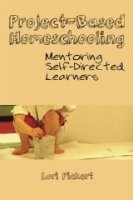 Project-Based Homeschooling: Mentoring Self-Directed Learners by Lori Pickert (independently published at CreateSpace, 2012)
Janet's enthusiasm over Project-Based Homeschooling led me to be sure I read the book while I had access to it in Switzerland. I had to get over some misconceptions, and I found the ideas intimidating, but I agree: it's a must-read for homeschoolers, and in truth important for all parents. Maybe for everybody.
The Misconception Way back when, in our homeschooling days, a popular approach was called Unit Studies. Here's an essay on unit studies as they relate to what's now called Classical Education; it give a pretty good idea of what they are about. Basically, you pick a topic you hope your child will be interested in, and integrate the teaching of all subjects into a study of that topic. At the time, I found the method too structured, too school-at-home, and too much work. I assumed project-based homeschooling was a re-working of unit studies.
I was wrong. There are similarities: a child working on a project is integrating many disciplines and skills together. But project-based homeschooling is an excellent example of why unschooling, well done, is absolutely not the "let the kid play video games all day" approach its detractors think it is.
Projects of this sort are the child's idea and the child's responsibility. That doesn't mean, however, that the parents are off the hook. It seems to me that the work involved in observing and coaching a project is much harder than following a curriculum. Which leads me to ...
The Intimidation I love the ideas. I really do. But even as a do-it-yourself, lone wolf kind of homeschooler, this is out-of-my-comfort-zone thinking. Probably because if Earth is my comfort zone, art projects are somewhere around Neptune, and so much of the examples here involve using art materials. The author seems to think it natural to work through one's ideas by making a painting or modelling in clay. I don't believe I've ever in my life even thought about doing that—and I've live a lot of years—so the idea of coaching a child to do so leaves me queasy. Fortunately, Lori Pickert was kind enough to explain, in a comment on Janet's review, that "if drawing and painting make you nervous, there’s still building, writing, designing t-shirts and websites, putting on skits, making brochures and posters, etc. etc. etc.—it’s more about helping kids figure out a way to help others learn and along the way that reinforces what they know/don’t know and how you collaborate, share, etc."
Also, she's careful to give the neophyte a break:
Surprisingly often, people will champion self-directed learning for children but not allow those children's parents the same freedom and respect. It's their way or the highway, and you had better start doing it the right way (their way) right away. Your kids should learn at their own pace, follow their interests, and you should trust that they'll eventually learn everything they need to know. You, on the other hand, should get with the program, right now, 100%, or else. You don't need to have your own opinions or ideas; ours will suffice. There's no time to experiment and see if these ideas work for you; take it on faith or you're part of the problem.
If your child deserves to learn at his own pace and have his own ideas, so do you. Whatever you champion for your child, make sure you also give to yourself: the right to follow your own path, work at your own pace, follow your own interests, make mistakes, and try again. Whatever you want for your children, you are far more likely to help them achieve it if you live it yourself.
It's hard to do justice to the project-based homeschooling concept without taking a lot more time and effort than I'm willing to put forth at the moment—not to mention that I'd need the book, which presently is some 4500 miles away. However, I do have some excerpts, which I copied down before relinquishing the book.
The quotes
Helping your child direct and manage his own learning does not mean immediately giving him complete control of his entire curriculum. You can balance assigned work with self-chosen work. We are talking about that essential portion of your child's learning life that you will devote to helping him do his own self-chosen work—you get to decide how big that portion will be.
There are many things you can do to help your child direct and manage her own learning, but perhaps the most important one is choosing how and where to put your attention. ... Think about what you value most, because that's what deserves your attention. Your child will respond by doing more of whatever earns your focus.
Creative work requires big chunks of unscheduled time. It requires freedom to explore, to try different things, to just think and imagine—and it requires a relaxed mindset. It is impossible to take your time and explore an idea in many different ways if you feel pressured by a lack of time or someone else's expectations.
I agree that this is the ideal, though I can't help thinking of all the really great creative work throughout history that developed under intense pressures of time, patrons' expectations, and even hunger.
Better-quality art supplies make for more beautiful representations and encourage your child to put more care into their making. ... High-quality materials arranged beautifully send a message to your child that his work is important and valued. ... They say, "Your work matters. You deserve the best." ... Quality materials inspire quality work.
If you have more than one child doing project work together, they may need to learn to trust the abundance of materials in the art studio or workspace. They may want to glue thirty buttons to a single piece of paper—they would rather use up all the materials than risk having them used up by someone else. Rather than setting limiting rules like "three buttons per person per day," you might want to ride it out and let them see that when they use things up, they'll be replaced. (It can help to start by offering cheaper materials first. Popsicle sticks come to mind.)
A child who draws, designs, creates, and builds every day is more likely to feel confident and optimistic about his skills. The more practice he has, the more fluent he will become. The more it's a part of your ordinary routine, the more likely he is to be able to articulate his ideas the way he envisions them.
Giving your child a lot of isolated, one-off experiences (say, with weekly themes or random field trips) is like giving her one plastic brick, one wooden block, one gear, etc. She has a handful of things to construct with, but what can she make? The pieces don't fit together. Your child can't combine them to make something meaningful. ... Having a series of isolated, stand-alone experiences—at trip to the orchard, a visit to the planetarium, a day at the zoo—lets your child learn a little bit about several different things. ... Moving from one opportunity to the next, she never gets the chance to dig below the surface. Having a series of experiences that connect meaningfully to one another allows her to begin to do more challenging intellectual work. A trip to the orchard, a visit to a local farm, interviewing the produce manager at the grocery store, back to the orchard, talking to the local extension officer, dissecting and sketching apples, planting an apple tree, going to the nursery, visiting a different orchard at the university—all of these experiences connect to one another.
I can appreciate the need to go into depth—without believing any less in the importance of having many, varied experiences. It's the breadth of experience that leads to further interest that leads to the desire for depth. I guess it's one of those profound truths for which the opposite is also a profound truth. (I learned this concept from Gretchen Rubin, but apparently Niels Bohr was there before her.)
Remember to let your child's ideas take precedence. ... Don't take over. Don't flood him with your own ideas; write them in your journal and save them for later. ... Keeping track of your own ideas can help you stay alert to possibilities, but make sure your child is focused on his ideas, not yours. ... If you have a particular thing in mind—an answer, an idea, a plan—then you may miss your child's idea, question, or plan. He'll figure out quickly that you're thinking of or fishing for a particular answer or response, and he will either stop driving the project and focus on pleasing you or shut down rather than offer up something he suspects may be wrong or not what you want.
When she's working, it's inevitable that she'll become stuck, make a mistake, or become confused. Help her by modeling how to work through it rather than just giving her a solution. Don't straighten out her thinking for her—let her tease the knots apart by herself.
If you see your child headed off in the wrong direction, don't jump in to correct him. Wrong turns can lead to great discoveries, and self-caught, self-corrected mistakes are more likely to be understood and remembered.
When he's frustrated or angry about something that went wrong, don't cheerlead and don't become upset yourself. Project calm acceptance (things will go wrong; it's inevitable) and optimism (you can always find another way; there's a solution somewhere). Suggest to your child that he can put his work away and look at it again tomorrow if he's not ready to try something else right away.
Avoid empty, nonspecific praise: "Great job." "Beautiful drawing." "Good work." Make statements that describe your child as a powerful learner. ... "That was frustrating when the wheels fell off, but you didn't give up and you fixed it." ...
Let your child talk about his work. Rather than praising him with words, show him with your actions how much you value what he's doing. Listen, pay attention, and always follow through when you make a promise. ...
Instead of praise, focus on building a family culture that appreciates, celebrates, and cultivates meaningful work through daily conversation, sharing, dedicating time to it, and giving it a place of honor in your home.
You help her reflect on and assess her work, so she can judge whether she has made her best effort and reached her goals. But she gets to be the judge.
Reflecting is crucial for transforming a simple learning experience into a larger experience about learning how to learn. In project-based homeschooling, we build reflection into the learning process. Rather than stopping with a finished product, we invoke that slow learning and build in an extra step, which sends us back to consider, refine, and revise our ideas and the work.
In project work, you can't just keep taking things in—you have to put something out. You have to create, you have to build, you have to interpret. You have to share.
Ouch. This is why I can't keep taking photographs without organizing and editing them for others to enjoy. This is why I mustn't continue to indulge in the pleasure of doing genealogy research without taking the time to present the data in a way that others can understand and appreciate it.
If you want to help your child learn how to finish—and it might be the most important lesson in this book—you must become a person who finishes.
Keys for finishing:
- Show up. Commit to making the time and using the time.
- Use small goals to accomplish big goals.
- Set yourself up to succeed: put a system in place.
- Aim for learned competence. ["Value effort over end results. Accept that people who do challenging work are always going to make mistakes along the way. Focus on nurturing the habits and attitudes that support strong thinking and learning."]
Your core values must align with your goals, which must align in turn with your everyday choices.
Really listen to what adults around you say about children—not their own children, but children in general. Many adults think very little of children and their abilities and motives—possibly because they think very little of themselves and their own abilities and motives. They transfer their negative beliefs onto children. If adults thought of themselves as strong, capable learners who enjoy challenges and want to contribute, presumably they would see children the same way.
The Follow-Up There's much more information on the Project-Based Homeschooling website. Here's a quote I like from an article on boredom.
We want [our children] to choose intellectual, creative activities—in general, we want them to choose higher-value ways to spend their time. But how do we support that?
Parents bemoan the fact that all their kid wants to do is watch TV and play Xbox. Yet the heart of their home is set up to look like a shrine devoted to exactly those two things. There’s a TV the size of a twin bed and every chair in the room—the most comfortable chairs in the house, by the way—[is] arrayed around it in rapt devotion. The Xbox is nestled alongside.
When you compare that shrine to screen-based entertainment to the area of the house devoted to their child’s other interests.... Oh, wait. There is no area like that.
The Connection? I think it's no coincidence that Project-Based Homeschooling reminded me of the early days of unschooling. Recently I re-read Nancy Wallace's Better than School and Child's Work and was struck by how much the education of Ishmael and Vita Wallace was very much an embryonic form of this concept.
The Conclusion As I said, I'm indimidated, because this approach appears to have a steep learning curve. But I'm sure it could be of value in my own projects, so I plan to look into it further. I'll end with one more quotation, one that epitomizes the unschooling philosophy as I remember it, and shows how much the term has morphed over time, at least in the minds of the news media and the general public.
Children, even when very young, have the capacity for inventive thought and decisive action. They have worthwhile ideas. ... They want to be a part of things. It's up to us to give them the opportunity to express their creativity, explore widely, and connect with their own meaningful work.
Many parents and teachers agree readily that children have these abilities, but they want to believe they can (and perhaps should) blossom naturally with no interference from adults. Traditional educators think this will happen in the child's free time—presumably sometime between the school bell ringing in the afternoon and bedtime, in and amongst homework, extracurricular activities, team practices, and play dates. Many parents want to believe it will happen if their child has adequate free time. They hope their child will drift naturally away from the TV set and the video game console toward literature, nature, and science. They know that their child is intelligent and creative, and they expect—or hope—that deep thinking, rich exploration, and a strong work ethic will follow.
We can do better than that.
Rather than expecting children to seek out a balanced life all on their own, we can help them live it. We can create an everyday life that prioritizes what we value most. We can help our children grow up experiencing creativity, inquiry, and making ideas happen as part of their normal, everyday life, from their earliest days.
We can help them live a life based on learning and doing.
Our choir anthems for:
August 8, 2013 And the Father Will Dance (Mark Hayes). Always one of my favorites. You know how I often remind you that these are videos I found on YouTube, not our own choir? Well, this one isn't of our church choir, and it isn't the best recording, but it's a special recording for some of us. Ignore the extraneous frames at the end. I didn't notice that Windows Movie Maker had added them until it was already uploaded. For this purpose, GEIBTP*. Bonus points if you can guess the identity of the baby.
UPDATE 10/30/19. It's pretty consistent that the automated conversion of Flash in old posts to iframe excised a chunck of the post wherever there was more than one video. I can't recover the text, which at least gave the date for when we sang the anthem in the second video (now appearing first), but here's the missing first video, which goes after "guess the identity of the baby."
Many thanks to our friend RW, who alerted us to this Wall Street Journal article about a wine-tasting bicycle journey through the Wallis in Switzerland. The timing was perfect, because that's the part of Switzerland we had the privilege of visiting while waiting for Daniel to make his entrance. Janet wrote some about the trip here, and I hope to post my own memories soon—before I forget more than I already have. In the meantime you can get some of the flavor of the canton (though, not, alas, the wines) through the article.
I have a correction to make, however.
And the Matterhorn delivers—as long as you don't mind seeing it with the crowds through the clouds.
And this is what Switzerland should say to New Zealand:
In a letter to his son, J.R.R. Tolkien claimed that a visit to the Upper Valais [Wallis in French] and neighboring Lauterbrunnen Valley inspired the Elven outpost of Rivendell in his books.
Having visited both the Wallis and Lauterbrunnen, I can now claim to have been not only to Middle Earth, but to Rivendell itself. The Shire, however, I expect I'll have to find on a trip to England.
For most of his journey, the author rode what's called an e-bike: not, as I originally thought, some sort of virtual tour, but a modestly-powered bicycle that "helps me on the climbs yet is easy enough to carry on the train." That sounds like a brilliant invention for climbs that even Steven Perezluha might find daunting, or maybe even for weary, out-of-shape mothers who would appreciate a little help trying to keep up on family bike trips.
This journey was about wine, and ours was not, but the article captures the feel of the area so well it was pure delight to read. You might enjoy it, too, for a little glimpse of what we saw this summer. Of course, the article neglects to mention the mountain pass with frequent, hair-raising switchbacks, driving rain and hail, two carsick kids, and a woman threatening to go into labor. For that, you'll have to wait for my version.
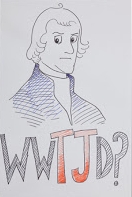 The Occasional CEO has an interesting take this morning on our obsession with the "original intent" of the Founding Fathers when the Constitution was crafted. It confirms my long-held belief that the most amazing thing about the Constitution is that it has worked as well as it has for all these years. Imperfect as it may be, a compromise that no one was happy with, it serves well as an anchor to restrain the human tendency to be "tossed to and fro, and carried about with every wind of doctrine, by the sleight of men, and cunning craftiness."
(I would have written about this even if I couldn't have used Eric Schultz's cool image above, which is originally from uvamagazine.org, but I think it captures the obsession neatly.)
The founders, Wood concludes, succeeded so well in promoting democracy and equality among ordinary people that that’s precisely what they got. Neither Washington, who led the common man in battle, nor Adams, who represented him in court, had any illusions about human nature, preferring a strong national government (led by a wise elite). Jefferson, the great champion of the common man, could not have tripped over more than a few common men in all his years in Paris and on his great plantation, so when he finally understood late in life [who] they were and what they were like, he was dumbfounded. (That's why, when we quote him, we use the early stuff.)
By 1820, the great experiment had spun wildly out of control, far beyond the vision or comfort of its creators.
[T]here was one Founder who would today be fundamentally comfortable and happy with the results of the great American experiment. Alexander Hamilton, Jefferson’s lifelong enemy, was an immigrant, an opponent of slavery, a proponent of a large standing army, and (like Adams and Washington) had serious doubts about democracy. He was the only Founding Father who understood finance, banking, capital creation and fundamental economics, the only one who truly comprehended the Industrial Revolution. He believed America in time would become more urban and industrial, more hierarchical and unequal. ... Hamilton was the true genius of Republic 1.0—and, as sometimes happens, almost none of his coFounders understood what he was doing.
It's well worth reading, and makes me want to read Gordon Wood's Revolutionary Characters, which was the article's inspiration.
It was in 2002, barely a year after it was written, that I first heard of Blessed Be Your Name by Matt and Beth Redman.
(Dir gehört mein Lob, wenn der Segen in Strömen fließt,
du mir mehr als genügend gibst, dir gehört mein Lob.
Und dir gehöert mein Lob, auch wenn ich mich verloren fühl
in der Wüste und ohne Ziel, dir gehört mein Lob.
Jeder Segen, den du schenkst, wird zum Lob für dich,
und selbst wenn ich im Dunkeln steh, Herr, gilt das für mich.
Jesus, dir gehört all mein Lob, dir gehört mein Lob.
Jesus, dir gehört all mein Lob, deinen Namen preise ich, Herr.
Dir gehört mein Lob, wenn die Sonne am Himmel scheint.,
es "das Leben gut mit mir meint", dir gehört mein Lob.
Und dir gehört mein Lob, wenn der Weg auch nicht einfach ist,
sich mein Lobpreis mit Leiden mischt, dir gehört mein Lob.
Jeder Segen, den du schenkst, wird zum Lob für dich,
und selbst wenn ich im Dunkeln steh, Herr, gilt das für mich.
Jesus, dir gehört all mein Lob, dir gehört mein Lob.
Jesus, dir gehört all mein Lob, deinen Namen preise ich, Herr.
Egal, was du mir gibst, egal, was du mir nimmst,
du bist und bleibst mein Gott, nur dir gehört mein Lob.
Egal, was du mir gibst, egal, was du mir nimmst,
du bist und bleibst mein Gott, nur dir gehört mein Lob.
Jesus, dir gehört all mein Lob, dir gehört mein Lob.
Jesus, dir gehört all mein Lob, deinen Namen preise ich, Herr.
Jesus, dir gehört all mein Lob, dir gehört mein Lob.
Jesus, dir gehört all mein Lob, deinen Namen preise ich, Herr.)
What brings all this to a post, besides the fact that I recently had the opportunity to sing the German version at Janet and Stephan's church in Switzerland, was that at choir reheasal Wednesday (9/11/13), I learned the story behind the song. You can read about it here. Matt and Beth Redman flew to the U.S. on September 15, 2001 for a sabbatical, and found themselves immersed in the reaction of the country, the churches, and the people to the shock of the terrorist attacks. They wrote Blessed Be Your Name a few weeks later, after realizing that the church (especially, I would say, the modern church) has far too few songs to sing in times of deep sorrow.
[N]early everywhere we visited, a worrying question began to arise: Where were the songwriters at such a time as this? Where were the musical poets and prophets to help the people of God find a voice in worship at this tragic time? The truth was, in most places we visited (or led worship in), there was a distinct lack of songs appropriate for this time. As songwriters and lead worshipers, we had a few expressions of hope at our [disposal]; but when it came to expressions of pain and lament, we had very little vocabulary to give voice to our heart cries.... The truth is, the Church of God needs her songs of lament just as much as she needs her songs of victory.
Blessed Be Your Name does an effective job of putting that lament in the context of faith and hope.
UPDATE 10/30/19. As has happened before, something was excised from this post when Flash was converted to iframe. I'm not sure what, but I know at least that there was a German version of the song embedded above the German words. Here it is—not what I originally had, but good enough.
Every kid knows how wonderful it is to bounce on the bed.
I'm certain the world would be a saner and happier place if we all had access to jumping pillows. Not to mention healthier—what a fun form of exercise!
Permalink | Comments
Category Health Just for Fun
I need to ponder this a lot more. I think I've just been struck by lightning.
From Jen at Conversion Diary: "The Mental Neat Freak."
When Joe came home that evening, I was at my wits’ end. I was mentally fatigued to the point that I felt like I was on the brink of a breakdown, and could barely restrain myself from yelling at everyone about everything. When Joe asked what was wrong, I snapped, “I’ve been doing nothing but working ALL DAY. I JUST NEED A BREAK.”
It was kind of awkward when he reminded me, “Didn’t you spend half the afternoon at that nice salon?”
Oh.
I stopped whining immediately, per that law of the universe that states that you’re not allowed to complain about anything for at least six hours after you’ve had an aromatherapy scalp massage. Yet I still felt miserable. No matter how many times I admonished myself to FEEL GRATITUDE NOW, I still walked around in that red-zone state where I desired a break like a drowning man desires oxygen.
...
The big moment occurred when I was trying to explain to my friend why I did not find the salon trip relaxing. “What would you have rather been doing?” she asked.
I knew the answer immediately: “Writing.”
...
[F]inally, after digging my way through piles and piles of words, I hit the core of the issue: “It brings order to my brain. It’s like…there are all these things that happen in my days that make my mind feel — I don’t know how else to describe it — messy. Like I’m surrounded by chaos, but on the inside. And it keeps piling up and piling up, to the point where sometimes I feel like I’m drowning.
...
Just like with physical space, it is possible for your mental space to get “messy.”
Again like with physical space, it is critical to your sense of peace and wellbeing to regularly clean up your mental space....
I think the biggest insight, though, was this:
Just because an activity is relaxing doesn’t mean it’s good for helping me regain a sense of internal order.
There's a lot more to the article, so if this resonates at all with you—or if you know someone who seems inexplicably stressed by a life filled with activities that you think should be relaxing—do take the time to read the whole thing. I suspect this is a major reason why programs such as Mind Organization for Moms and Getting Things Done are so popular: they recognize the debilitation caused by mental chaos. What "Mental Neat Freak" adds is recognition of the need to identify and deliberately choose activities that promote clearing of mental clutter, which may or may not be connected to organizational activities. Jen, for example, has so far discovered the following activities to be very helpful:
Writing
Jogging while listening to music (oddly, it has to be both — one or the other doesn’t do it)
Reading a well-written book
Nearly everyone could be helped by MOM and GTD, but mind-chaos-taming activities are clearly many, varied, and personal.
Permalink | Comments
Category Health Children & Family Issues
For three weeks our tiny a cappella choir struggled to learn the parts to the Ralph Vaughan Williams (King's Weston) version of At the Name of Jesus. (You can hear it here, if you click on the MIDI link. I tried to find a YouTube version, but none features the hymnal harmony.) It's a great harmony, if difficult, and would have been even better (and perhaps easier) if Porter had been there to provide the tenor.
I was looking forward to singing it at church sometime, but yesterday when I checked out the Episcopal Hymnal (1982) I discovered that it has only the melody! Tragedy! Travesty!
Maybe someday we'll sing the real version as an anthem, or in an ensemble ... or whenever we next manage to get the whole family together again. I want to sing it with all four parts!


