
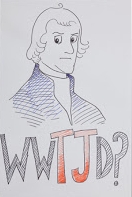
 The Occasional CEO has an interesting take this morning on our obsession with the "original intent" of the Founding Fathers when the Constitution was crafted. It confirms my long-held belief that the most amazing thing about the Constitution is that it has worked as well as it has for all these years. Imperfect as it may be, a compromise that no one was happy with, it serves well as an anchor to restrain the human tendency to be "tossed to and fro, and carried about with every wind of doctrine, by the sleight of men, and cunning craftiness."
(I would have written about this even if I couldn't have used Eric Schultz's cool image above, which is originally from uvamagazine.org, but I think it captures the obsession neatly.)
The founders, Wood concludes, succeeded so well in promoting democracy and equality among ordinary people that that’s precisely what they got. Neither Washington, who led the common man in battle, nor Adams, who represented him in court, had any illusions about human nature, preferring a strong national government (led by a wise elite). Jefferson, the great champion of the common man, could not have tripped over more than a few common men in all his years in Paris and on his great plantation, so when he finally understood late in life [who] they were and what they were like, he was dumbfounded. (That's why, when we quote him, we use the early stuff.)
By 1820, the great experiment had spun wildly out of control, far beyond the vision or comfort of its creators.
[T]here was one Founder who would today be fundamentally comfortable and happy with the results of the great American experiment. Alexander Hamilton, Jefferson’s lifelong enemy, was an immigrant, an opponent of slavery, a proponent of a large standing army, and (like Adams and Washington) had serious doubts about democracy. He was the only Founding Father who understood finance, banking, capital creation and fundamental economics, the only one who truly comprehended the Industrial Revolution. He believed America in time would become more urban and industrial, more hierarchical and unequal. ... Hamilton was the true genius of Republic 1.0—and, as sometimes happens, almost none of his coFounders understood what he was doing.
It's well worth reading, and makes me want to read Gordon Wood's Revolutionary Characters, which was the article's inspiration.

