
Gabriel Kron. Of all the amazing people who have intersected with my life, he is probably the safest to write about, since he died more than 40 years ago. So I will; he deserves to be better known.
I knew him as my father's friend and mountain climbing partner; my father knew him from their days together at the General Electric Company in Schenectady, New York. Dad, a Tau Beta Pi engineer (like his father, two of his children, and a grandchild), was no intellectual slouch, but he never pretended to understand anything of Gabe's work.
It didn't matter. I myself joined the Kron Klimbing Klub at age seven, and was mighty annoyed when I later learned that some other organization had usurped the acronym, "KKK."
One firm rule of the Klub I remember distinctly: No eating until you reach the top.
Unfortunately, I don't remember much about this brilliant and unusual man, other than that I enjoyed climbing with him. Here is one memory from Dad's own Remembrances Along the Way.
Beginning in August 1959 Linda went with me on nearly all my climbing trips, her first climb being Buck Mountain on Lake George. There were three trips in 1960 and 1961 up Hunter Mountain, a 4000+-foot peak in the Catskills.
We climbed as members of the Kron Klimbing Klub. Gabe Kron was a mathematician of considerable note who worked for General Electric and who liked to climb mountains that were close enough at hand that he could leave Schenectady at 8 o’clock, drive to the mountain, climb it, and return by 5:00 p.m. Hunter was one of his favorites but such things as inspiring views meant nothing to him. He would get to the top, get out his lunch, sit on a rock and eat lunch and read the New York Times. Then he would go down and home. Ted Dietze and his son Rick also went on these trips and Gabe was infinitely patient with the children.
They were very enjoyable trips. Everyone who climbed with Gabe was a member of the Kron Klimbing Klub. One day we planned to climb Snowy Mountain. We left Schenectady with decent weather that turned to rain before we arrived in the town of Speculator. The children were not shod for wet weather so we bought them overshoes in Speculator. As we started to climb the weather turned cold and the rain turned to snow. The snow began to build up, the trail became slippery, and the climbing became very difficult because of the slipperiness. We turned around and headed back down well below the summit. Linda was so cold that all she wanted to do was to sit down and rest. Of course I would not allow that and I practically dragged her down the trail for several minutes until she warmed up and all was well for the rest of the way down.
The trip up Snowy Mountain I remember for three things: (1) my new boots may have kept my feet dry, but they did nothing to stop them from getting very, very cold; (2) I was determined not to give up before Ricky Dietze did, as he was older, stronger, male, and thought he could beat me in everything; and (3) my chief fear in turning around before reaching the top lay in believing I would then not be entitled to lunch!
For much more about this remarkable person, read The Evolution of an Engineering Scientist, by Philip Langdon Alger (no relation, that I know of). You must scroll down a bit to find the beginning. I'll add some tempting excerpts below.
[T]he youngest child in a family of eight children, [Gabe] was born on July 23, 1901, in ... a town of about 10,000 people in a remote region of the Carpathian Mountains of Hungary. ... A boyhood friend described Gabe in elementary school as plump, always lively, always joyous, always having something to tell. [P]eople who knew him well understood quite clearly that for him the environment of his home town was too confined and that a day would come when he would act to broaden his horizons."
Before he could escape, however, he needed to learn English.
"Being subjected during my life time to several inoculations with a new language, I gradually developed a technique of my own; that proved to be quite practical for acquiring a reading knowledge of a new language in a place which offered no contact with people speaking it. As young children we had been instructed in Hebrew ... In the Gymnasium we were taught Latin for eight years, German for six, and Greek for four years, each with the aid of the most elaborate grammar the human mind could devise. Under the guise of classical education the professors crammed our heads with an infinite variety of useless rules, exceptions to the rules, and exceptions to the exceptions, so that languages were the most lugubrious subjects taught...."
"Realizing that the manner in which languages were taught was one of the hundred possible ways that should not be employed, I started out to use just the opposite tactics. Instead of memorizing grammar, I memorized the German dictionary. Our school dictionary had about twenty thousand words in it, a hundred words on a page; so, I tore out a page a day and committed it to memory. Then the page was thrown away. When there was no dictionary left, I considered myself an expert in the language. I could sit down, open up a French or German book anywhere, and proceed. Slowly and painfully at first, but nevertheless I could make headway in understanding the text....."
"[Finding no suitable English dictionary available, what] I did was to borrow an English book, which happened to be H.G. Wells' The Food of the Gods, and beginning with the first page I wrote out a hundred words each day and committed them to memory. After eight or ten pages the text began to assume more human form, and past the first chapter the content even became enjoyable."
In 1921, Kron and his brother came to the United States, ending up at the University of Michigan, a school which met their criteria: "an engineering school that would cost no more than $150 for tuition, located far enough inland to be away from the flood of immigrants." Gabe graduated in three years despite working to support himself. He wasn't a typical UM student. In his words,
"As always happens when a free spirit is obliged to undergo a prescribed routine, I wanted to study everything except what the curriculum called for. How to find time to study what one wishes, and not what the teacher thinks best for one's own good, must be a perennial problem to many an anxious pupil. Finally, I hit on the idea of arranging my schedules so that by Friday noon the classes would be all over. Three full days then each week from Friday noon to Monday morning I was free to pursue my own private schedule of study without the interruptions of regular classwork. The rest of the week I considered as a sacrifice on the altar of mechanized education."
After securing American citizenship in 1926, he rode a tanker from California to Tahiti.
He lived as a guest in the family of a native in Tahiti for some weeks, then sailed to the Fiji Islands. He walked through the back country, shared native hospitality, swam rivers, and admired the tropical forest. ... In all his travels, his custom was to spend the usual siesta hours under a tree, studying mathematics.
Then he took ship to Sydney, where his money ran out.... After working long enough to clear £35, be bought [another math book] and took to the road again ... On the way he spent many nights in the company of the "sundowners," the Australian tramps who lived without working, with the aid of free food tickets handed out in police stations to anyone who needed them.
Kron sailed from Townsville to Borneo, and thence to Manila, Hongkong, and Saigon. Here, he started out on foot to Angkor Vat, and walked on to Aranha, where he took a train for Bangkok, then joined a caravan that followed the ancient trade route to Cockrake in Burma. He walked to Rangoon, took a boat to Calcutta, walked on to Agra, where he admired the Taj Mahal. He crossed the Indian desert to Karachi by train, took a boat across the Persian Gulf and went on by train to Baghdad, stopping to see the ruins of Ur on the way. He spent $5 for a truck ride across the Arabian desert to Damascus, then set out on foot again to Gaza. He hastened on to Cairo by train, saw the Pyramids, sailed from Alexandria to Constantinople and went by train to Bucharest, arriving at midnight at the home of a friend, with just small change left in his pockets. After an all-night talk, the friend financed his ticket to Baja Mare, where his parents welcomed him. The neighbors wanted to know why he had come home from America with his toes sticking out of his shoes, while every one else came home rich. No one asked about his travels.
Eventually he ended up, as stated above, working for General Electric in Schenectady.
Kron was a puzzle to the company executives who were responsible for his assignments. They wanted to tell him what to do, and to put him in a place where his talents would yield immediate, commercially useful results, and to adjust his salary accordingly. This was difficult, because Kron's value was largely in the inspiration he gave to others and in distant objectives that seemed to business managers to be merely dreams. As they tried to make the best use of him, he was shifted hither and yon. ... Kron had to pursue his own ideas outside of office hours.
This was no real hardship, however, as the company did give Kron complete freedom to publish his ideas, and to maintain contacts with a wide circle of interested men, outside as well as inside the company. Some commercial men, who did not like the engineers to talk about new developments, said that it would do no harm for Kron to write, as no competitor would understand him anyway.
What a dinner guest he must have been!
Permalink | Comments | Edit
Category Education Random Musings Everyday Life
...while I indulge in a bit of nostalgia.
We moved to Central Florida not long after Disney's EPCOT Center opened. Our children were four and not-quite-two, so that first year we bought special Florida resident annual passes to the Disney World parks (all two of them). This was a brilliant investment that enabled us to explore at our leisure and allow the kids to determine when it was time to go home. We wanted to avoid the all too common scene of childish meltdown, caused by parents determined to squeeze every last minute out of their very expensive vacation.
(Very expensive? Well, it was, though no one will believe that if I mention that I remember when the price of a one-day ticket went up to $17 for an adult.)
Actually, the girls usually held out better than I did, and we frequently stayed to enjoy the closing fireworks. Their favorite park by far was EPCOT, perhaps because Disney characters and movies took up very little space in our lives, so the Magic Kingdom did not have the appeal it otherwise would have. Had we not lived in Central Florida, I doubt we would ever have bothered with that all-American dream, a Disney vacation. But living here has its perks, and between good deals for Florida residents and many opportunities to earn free tickets, Disney World, and especially EPCOT, played a significant role in shaping our children's memories.
So, for them, I present, Walt Dated World! I found this site, dedicated to Disney World features that are no more, while searching for the original script for the Spaceship Earth ride. The first ride that greets you as you walk into the park, it was once sponsored by AT&T, and Porter's AT&T ID card sent us to the front of the line, so we enjoyed it frequently, and watched it change over the years. I think the best version was narrated by Walter Cronkite (1986-1994), but my personal favorite was the original, as I found its language less prosaic.
Where have we come from, where are we going? The answers begin in our past. In the dust from which we were formed, answers recorded on the walls of time. So let us journey into that past, to seek those walls, to know ourselves and to probe the destiny of our Spaceship Earth.
On fine Phoenician ships, we take our scrolls to sea.
North, south, east, and west, all roads lead from Rome, a mighty network reaching across the land, welding far-flung garrisons into a growing empire. Glorious Rome, until consumed by the flames of excess. Imperial Rome, lost in the ashes of darkness! [To this day I cannot smell lapsang souchong tea without recalling this part of the ride.]
In western abbeys, monks toil endlessly transcribing ancient wisdom into hand-penned books of revelation.
Behold, the majesty of the Sistine ceiling!
Poised on the threshold of infinity, we see our world as it truly is: small, silent, fragile, alive, a drifting island in the midnight sky. It is our spaceship. Our Spaceship Earth.
Stop by Walt Dated World and see what other treasures you can find. I'll throw in a dash of childish delight!
Permalink | Comments | Edit
Category Everyday Life
With all the fuss lately about illness caused by salmonella in eggs from factory farms with highly dubious practices, it was especially delightful to take a trip—farther than the grocery store, but closer than our church—to Lake Meadow Naturals farm. They have a pick-your-own program on Saturday mornings, and we did just that, reaching under the hens to retrieve a dozen warm-from-the-hen eggs, at a price of $3.50.
Unlike many of that designation, these hens really are free-range: they were ranging all over the yard when we arrived, along with several other types of fowl, including guinea hens, which are the pest control service, being voracious eaters of ticks and other nasty bugs.
I really liked the look of the place, and the friendliness, and hope to return many times for wonderful, fresh eggs. I'm a little disappointed that the yolks are not the deep orange color of the eggs Heather gets from her farming friends, and of the eggs we ate at the bed and breakfast in the Ticino part of Switzerland. But there's no doubt these chickens are healthy, free-range, and lovingly cared for, so I'll be happy with that. Maybe when their less-common breeds are laying I'll notice more of a difference.
We also bought two duck eggs, which were good, but not sufficiently discernable from chicken eggs to encourage a wholesale switch, since we paid $1 each for them. Maybe next time we'll try the guinea hen eggs. :)
Permalink | Comments | Edit
Category Everyday Life Food Conservationist Living
The Caller ID number was local; in fact, it was from the town where our church is located, so I answered the phone, fully expecting a recorded message about upcoming parish events.
Instead, it was a live person. Because she asked to speak with a family member who is currently nearly 5000 miles away, I asked if I could take a message.
"There ain't no message," the caller responded. "I'll call back."
Well. There ain't none of our friends who talk like that, so I figured this was a solicitation call of some sort and hung up. (I'm tempted to tell the next caller that I'm voting in the upcoming election for anyone who does not call to solicit my vote.) But I wonder. Who would entrust his message to someone who talked like that to potential customers/voters?
Then again, I shouldn't be so hard on her. She was probably a minimum-wage hireling, and I've seen worse from official business documents, major newspapers, and professional websites. I know that language evolves, but "anything goes" cannot be the mark of a higher civilization.
Permalink | Comments | Edit
Category Everyday Life
New Year's Resolution #8—in which I detail my renewed attempts at organizing my life—notwithstanding, my dear friend, whose birthday it is today, knows well that it will be a long time before I am half as organized as she was 30 years ago, if not from birth.
Thus it will be a disappointment, perhaps, but no surprise, that my new scheme is not well enough in place for a real, physical birthday card to be arriving at her lovely home in today's mail. There's hope for next year, but in the meantime, since she is a Faithful Reader and can be counted on to see this post, if not on the day, at least close to it, I offer this substitute:
Happy Birthday, my friend!
You have been an organizational inspiration to me ever since you taught me that laziness is the best motivator. (And yes, it is easier to have the spices in alphabetical order!)
Permalink | Comments | Edit
Category Everyday Life
Just as with #2 Rediscover Feasting, there's a lot more to this resolution than meets the eye. But if I called this resolution "Get Organized," it would sound boring and not a few of my readers would laugh.
I'm not naturally an organized person, and I've made many attempts to "get my life together." Some have been more successful than others, but none has stood the Stress Test: Nearly any system can work when conditions are right, but the only one worth implementing is one that won't fall apart when the floodwaters of life start to rise. In my case, "floodwaters" is loosely defined to include any disruption in my schedule, bad or good: from hurricanes and illnesses to vacations and visitors.
That's why I'm so excited about Getting Things Done: I saw how well Janet's implementation (and she's still tuning it) worked as she made the transition from teacher/graduate student to full-time, first-time mother, a definite stress test, and definitely successful. I've only just begun to try to implement some of the GTD ideas in my life, and I'm not Janet, but there are promising signs. If I can avoid any significant stress tests before I get it securely in place, I have great hope.
What does this have to do with enjoying spontaneity? To paraphrase Winston Churchill: Organization is not the end. It is not even the beginning of the end. But it is, perhaps, the end of the beginning. It's very difficult for me to relax (see Resolution #3) and enjoy spontaneous activities—or planned activities for that matter—when the thousand-and-one items on my personal to-do list are whispering, nagging, or screaming at me from my subconscious mind. Whether or not other people would agree with me on the importance or urgency of the items on this list is not the point.
In order to hang out with friends or take a long, aimless walk and truly have nothing on your mind, you’ve got to know where all your actionable items are located, what they are, and that they will wait. And you need to be able to do that in a few seconds, not days. (GTD)
GTD is not, first and foremost, about getting things done. It's a consolidation loan for the disorganized: all your activity debts—everything you must do, should do, or might want to do—are gathered into one system, with a plan for paying them off in small, easy, but consistent steps. In the process, mental health improves, creativity is unleashed, and ... Things Get Done. That's the theory: we'll see if I will soon be able to say, as Janet did:
[GTD] turned my life around from always feeling overwhelmed and behind to feeling like I knew where I stood and how to get where I wanted to go. This freed my mind up to enjoy time relaxing with people rather than always worrying about the known and unknown things I had to do.
Then I will have a chance of being able to enjoy spontaneity.
Progress Report
#1 Read More Books Now that's more like it! I'm back on track with six books in July. I was partly inspired by knowing I had only one month to enjoy Janet and Stephan's library, and partly because it's easy do what the people around you are doing, and Janet and Stephan are often to be found book-in-hand. Even when they are also baby-in-hand.
#2 Rediscover Feasting In the land of fabulous bread, cheese, and chocolate, how can you not feast? The trick is in returning to "ordinary time" at home. I'm still working on it.
#3 Learn to Relax I bought a book on Alexander Technique from Janet's teacher, though I only read half of it this month—when I remembered that I would be taking it home with me, I switched my attention to books I would be leaving behind. I've been trying to increase my awareness of my muscles and trying to learn to relax them. I also hope to learn something from observing Stephan's way of reacting slowly and calmly to situations, instead of with my normal adrenaline surge....
#4 Like More Things For progress on this resolution I highly recommend spending six weeks in a foreign country. Make that living six weeks in a foreign country. There's something about living daily life that transforms the new from strange to comfortable—or even delightful.
#5 Pay Attention I keep forgetting about this one. I got distracted during a critical turn on a walk in Bern and didn't realize what I had missed until I was required to retrace my steps on my own—but I eventually figured it out. In other areas of life—such as my inveterate multi-tasking—I need to work harder even to think about this resolution, let alone make progress.
#6 Cast Away Fear Solo travel, living in a foreign country, and childbirth provide good opportunities for practicing Philippians 4:6. If my victories are baby steps, they are steps nonetheless, and I'm happy about them.
#7 Talk Less, Listen More Whether or not it was visible to those around me, I made some progress here. It's easier when the conversation is in a foreign language. :)
Permalink | Comments | Edit
Category Everyday Life
... When you're doing a crossword puzzle, the clue is "big name in chips," and you immediately think "Intel."
The answer was "Wise."
Permalink | Comments | Edit
Category Everyday Life
I've mentioned Steph Shaw before, when I wrote about Kevin Michael Johnson's Kickstarter campaign (successfully completed; The Raid is moving forward).
Now Steph has her own Kickstarter project: creating a full-length album of her new songs.

I've teamed up with producer Sean McClowry here in NYC & we've narrowed down our fav songs for my record. I'm excited to be bringing you all some new music.
The songs are all written.
Producer is on board.
What next?Well, the cool thing about this project is that, since I'm an independent artist, I basically have total creative freedom -- no record label peeking over my shoulder. However, that also means that it's up to me to come up with the funds to take this on.
Go Steph!
Permalink | Comments | Edit
Category Everyday Life
Catching up a bit, since I missed July 4:
Happy Independence Day
to my country, and
Happy Schweizer Bundesfeier
(Fête nationale Suisse, Festa nazionale svizzera, and Fiasta naziunala Svizra)
to my country-in-law!

Permalink | Comments | Edit
Category Everyday Life
Permalink | Comments | Edit
Category Travels Everyday Life
One of the fun things about spending foreign money is that it doesn't feel like real spending. It feels like play money, Monopoly money. I don't know at what point I crossed the line, but I'm definitely past that. Swiss francs are now real money, and I look at the green American paper in my wallet and think, "What is this? Do people actually accept this as payment?" No doubt that will not last long, once I am home, but it's a weird feeling.
I've long been in favor of following the lead of the many countries that have replaced their lower-denomination bills with coins. Now that I've worked with such a system for over a month, here are some observations:
- The lowest Swiss bill is the 10-franc note. There are 5-, 2-, 1-, and 1/2-franc coins. Practically speaking, this means I can no longer ignore coins. In America, when I get change back from a purchase, I usually dump the coins in my wallet without checking them, as no error can cost me more than a dollar. Here, where the change might be worth nearly ten dollars, it's worth at least a quick glance. I was quite proud of myself when I noted in one transaction that the cashier had mistakenly given me a 2-franc coin instead of a 5-franc coin.
- I had to train myself to make a point of using coins. Using bills all the time results in a heavy wallet; once I discovered I had over Fr. 40- in change! Once you get used to the idea of not ignoring change, however, it's not a problem to keep the quantity down to something reasonable.
- The lowest denomination coin is the 5-rappen piece. This is a good practice; I see no need for the U. S. to continue to mint cents, other than to feed those fun machines at tourist sites that make elongates. The existence of those machines is to my mind the only compelling reason for keeping the cent.
- I've gotten quite good at paying with change, but still have trouble distinguishing the 1-franc coin from the 20-rappen piece, and the 1/2-franc coin from the 10-rappen piece, when they are jumbled up in my wallet. I have to look at the number on the coin to be certain, and I find that annoying.
- Swiss merchants don't blink when you hand them a 100-franc bill; in the U. S. I don't like carrying $100 bills because clerks suspect them of being counterfeit, and even if convinced a bill is real, will grumble if your purchase is small.
- Paying with cash is much more common in Switzerland than in the U. S. Debit cards are handy, though, when buying train tickets; trying to convince the automatic ticket machine to accept your bills (or coins) can sometimes be a problem.
- A common debit card is the Post-Finance card. Once you get over the shock of thinking of a bank and the post office being the same organization, you begin to wonder if the system works because the former subsidizes the latter. (I have no idea if it does; the thought just occurred to me as a possible explanation for the mysterious combination of banking and postal services. I know that combination is not just in Switzerland, but I haven't researched how it might have come about.)
- Nearly all shopping is done with Swiss francs, but I've noticed that in shops catering specifically to tourists they will sometimes give the price in Euros as well.
Shopping here is as fun as shopping gets because (1) I can walk where I need to go, (2) it's usually not urgent, but part of the process of exploring the city, (3) there's still a challenge in paying with the right change instead of merely handing over a large bill, and (4) there's always the thrill of trying to get by without English. The last is much easier than I had imagined. Knowing a few words of German—notably "please," "thank you," "where is?" and "I'm sorry, but I don't understand German"—goes a long way. It's also a great help that the cash registers display the total price, so I don't have to try to understand rapid-fire cashier language. I'm happy to report that I have managed totally in a combination of German, Swiss German, and gestures—except for one of my trips to the tea shop, where the clerk spoke in English because I had filled out a form with my U.S. address. My proudest moment was asking, "Wo sind die Stilleinlagen?" and making myself understood with no need for repetition or gestures (the latter being a very good thing).
Permalink | Comments | Edit
Category Travels Everyday Life
While Joseph was undergoing a secular baptism of sorts at the American Embassy in Bern, Grandma had no official business other than to receive the diaper bag when it was rejected at the door for possible terrorist connections.*

After a little exploration, the weather—along with the uncertainty of when the party might be over—turned the waiting time over to Li'l Writer Guy, who discovered that a Swiss café is a delightful place to work.

Fr. 4.- may seem high for a cup of tea, but I figure it as: cup of tea with cookie, Fr. 2-; quiet place to work, Fr. 2-; shelter from the pouring rain, Priceless. A great bargain.

Permalink | Comments | Edit
Category Travels Everyday Life
Living with other people for several weeks is a good way to experience new foods and new food combinations. If those other people happen to live in another country, the opportunities multiply. And if they also subscribe to a local organic farm's weekly vegetable delivery, well...you get to try Swiss chard. Verdict? Not bad, though I think I'll like it better mixed with other things, such as in an omelet or on a pizza. It's related to beets, but I find the taste more like spinach. As it was with Heather and Jon's Community-Supported Agriculture farm in Pittsburgh, the weekly vegetable lottery is fun to play, and Stephan (like Jon) is particularly good at figuring out how to make good use of fennel, fresh tarragon, and eggplant as well as potatoes, lettuce, and zucchini.
What's a visit to Switzerland without trying a new variety of chocolate? When Stephan brought home a bar of dark Ovomaltine, I was at first skeptical.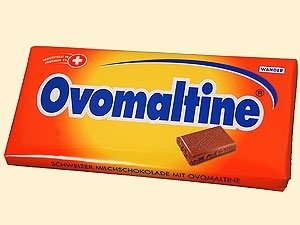
I remember the Ovaltine drink (name changed in the English-speaking world thanks to a typo) from my childhood, and not pleasantly. It was touted as a healthy alternative to chocolate milk; perhaps that was the reason we viewed it with suspicion.
This is not your father's Ovaltine. Well, maybe it is, and maybe I would actually have liked it as a child had I not thought of it in the same category as spinach and beets while expecting it to taste like chocolate milk. I don't know. Whatever. This is a delightful form of chocolate, which the Swiss do very, very well: smooth, a little bit crunchy, a little bit malty, a lot yummy.
The good news, for those who support the Nestlé boycott because of the company's aggressive marketing of infant formula in third world countries, is that Ovomaltine, still made here in Switzerland, is Nestlé-free. The bad news is that if you want to try this delicious chocolate, you need to ask me to bring some back for you, as Nestlé owns the rights in the United States. So place your orders now.
There's no adjustment needed when it comes to Swiss bread, the only difficulty being deciding which of the dozens of tempting breads to buy. Butter, on the other hand, is unsalted here. At home I've always found unsalted butter unpalatable, and I'm not sure what to make of the fact that I happily eat it on my good Swiss bread every morning. Either my tastes have changed, or Swiss bread is saltier than I'm used to.
Speaking of unpalatable, that's how I usually find any milk with cream content greater than skim, which I believe is 0.5%. Raw milk is an exception, but I can rarely get that. Here, unless one is willing to drink the ultra high temperature pasteurized milk, the lowest fat content is 2.5%. Needless to say, I haven't been drinking much milk here, except when the temperatures were cold enough to warrant fixing some hot cocoa, which is improved by higher-fat milk. I do find, however, that the 2.5% here tastes better than 1% back home. Sadly, we should be able to get great raw milk straight from the cow here—or at least straight from the dairy farm on the hill, which is close enough to smell when the wind is in the right direction—but we can't. It's legal to sell raw milk in Switzerland; the problem has something to do with the price-support system, under which the farm is not allowed to sell directly to the public. :(
Eggs, on the other hand, are amazing here. Fresh, free-range, organic if that's your desire—with the most lovely, inviting, delicious bright-orange yolks, a sign that the eggs are from chickens that really did range freely enough to eat grass and bugs—which is not true of many eggs that claim that label in the U. S. And here's a surprise: eggs are not refrigerated here. Not in the store, and not at home. They sit out on the shelves or on the counter, even in our recent heat wave with temperatures rivaling Florida's. So far, we're all alive and well.
I love the kefir that is sold in American grocery stores, both the sweetened fruit version and the plain. What I've found here, however, has a slightly different taste, and a texture like a cross between yoghurt and cottage cheese. It will be interesting to see what the product will be like when I make my own from the kefir grains waiting patiently in our freezer.
If Switzerland is known for any food more than chocolate, it is cheese, and cheese shopping is even more complicated than buying bread. I have a lot to learn here, and I haven't been adventuresome. Prices here tend to be high in general, but good cheese is an exception. Gruyère is a staple, rather than the luxury I'm accustomed to. On the other hand, if you can find cheddar at all, the price is outlandish for a rather mediocre product. Asiago, too, is vastly different from at home: it's good, but a rather bland, mild cheese, instead of the sharp, flavorful variety I love.
Grocery shopping is a different experience. European refrigerators (and cupboards, and kitchens) seem to be generally smaller than Amrican ones; Janet and Stephan's refrigerator is not that unusual in being the same size as the dorm fridge I had in college. This promotes a "shop frequently, buy fresh, use it quickly" philosophy that I can learn from. I don't know how onerous this might be if we were not in the city, but as it is, it is easy to pick up a few things at the store on the way home from work, or when doing other errands. Since I like to take a walk every day anyway, I often stop by Migros or Coop then. A grocery trip isn't such a big, scary deal if it's not an hour-long, major provisioning expedition. On the other hand, this practice contributes to inefficiency, greater use of packaging materials, and higher prices, since one routinely buys a liter of milk instead of a gallon, and a kilo of flour instead of five pounds.
I think the grocery cart system in Basel is great: In order to extract your cart from the lineup, you deposit a two-franc piece (about $2); it is returned to you when you return the cart. In the end it costs nothing, but effectively promotes responsible cart use.
Restaurants are a lot more fun here now that smoking is banned. Not perfect, since it is still allowed in bars, and in our favorite place for Rösti, zum alten Stöckli, smoke from the bar rises to the the restaurant, which is upstairs. Nonetheless, it's a great improvement. Another improvement to restaurant meals is knowing how to order something to drink. I can order schwarzer Tee (black tea)—though not iced tea, which would have been lovely when the temperature hit 36 (98). (Iced anything is hard to come by; I still find the sight of a large Coke with no ice odd.) I can order Apfelsaft (apple juice). But the greatest improvement is being able to order my usual American restaurant drink: plain tap water. Order water here, and you'll probably get fizzy mineral water. Order plain water, and it will be the same, only not fizzy. The magic word is Hahnewasser (Swiss German; in high German, Hahnenwasser). I find the regular Swiss tap water—the kind that pours freely from fountains throughout the city—superior to anything I've bought in a bottle. The trick to avoiding dirty looks from the waiter is to spend sufficient money on the rest of the meal.
We interrupt the writing of my review of Ender's Game to alert you to the fact that Janet has now posted Joseph's birth story. I'll add some comments later.
Permalink | Comments | Edit
Category Travels Everyday Life
Temperatures in the mid-90's do not surprise me in July: I live in Florida. I'll confess I was hoping for something more reasonable in Switzerland, however. Somehow calling the temperatures "mid-30's" doesn't improve the situation as much as I would hope. I miss air conditioning; I miss ceiling fans. Even when we lived without air conditioning in Boston I could find relief at the grocery store. Not so, here.
But there are compensations. The apartment is wonderfully designed for cross-ventilation, and the lack of screens means we make the most of every breeze. We have two fans, and the temperatures cool off enough at night to make sleeping reasonable. Still, there's not much incentive to be very ambitious, and Janet is really wishing she could take advantage of her membership in the pool that's only a five-minute walk away.
How about you? I gather it's been hot for a lot of folks.
Baby update: Doing fine, eating lots, filling out, doesn't like the heat but still likes to be held. Has perfected the knack of filling a clean diaper within 15 seconds of the change.
Permalink | Comments | Edit
Category Travels Everyday Life

