
Living with other people for several weeks is a good way to experience new foods and new food combinations. If those other people happen to live in another country, the opportunities multiply. And if they also subscribe to a local organic farm's weekly vegetable delivery, well...you get to try Swiss chard. Verdict? Not bad, though I think I'll like it better mixed with other things, such as in an omelet or on a pizza. It's related to beets, but I find the taste more like spinach. As it was with Heather and Jon's Community-Supported Agriculture farm in Pittsburgh, the weekly vegetable lottery is fun to play, and Stephan (like Jon) is particularly good at figuring out how to make good use of fennel, fresh tarragon, and eggplant as well as potatoes, lettuce, and zucchini.
What's a visit to Switzerland without trying a new variety of chocolate? When Stephan brought home a bar of dark Ovomaltine, I was at first skeptical.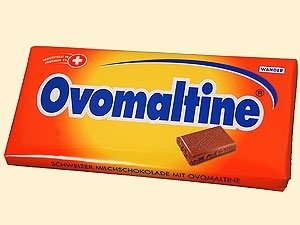
I remember the Ovaltine drink (name changed in the English-speaking world thanks to a typo) from my childhood, and not pleasantly. It was touted as a healthy alternative to chocolate milk; perhaps that was the reason we viewed it with suspicion.
This is not your father's Ovaltine. Well, maybe it is, and maybe I would actually have liked it as a child had I not thought of it in the same category as spinach and beets while expecting it to taste like chocolate milk. I don't know. Whatever. This is a delightful form of chocolate, which the Swiss do very, very well: smooth, a little bit crunchy, a little bit malty, a lot yummy.
The good news, for those who support the Nestlé boycott because of the company's aggressive marketing of infant formula in third world countries, is that Ovomaltine, still made here in Switzerland, is Nestlé-free. The bad news is that if you want to try this delicious chocolate, you need to ask me to bring some back for you, as Nestlé owns the rights in the United States. So place your orders now.
There's no adjustment needed when it comes to Swiss bread, the only difficulty being deciding which of the dozens of tempting breads to buy. Butter, on the other hand, is unsalted here. At home I've always found unsalted butter unpalatable, and I'm not sure what to make of the fact that I happily eat it on my good Swiss bread every morning. Either my tastes have changed, or Swiss bread is saltier than I'm used to.
Speaking of unpalatable, that's how I usually find any milk with cream content greater than skim, which I believe is 0.5%. Raw milk is an exception, but I can rarely get that. Here, unless one is willing to drink the ultra high temperature pasteurized milk, the lowest fat content is 2.5%. Needless to say, I haven't been drinking much milk here, except when the temperatures were cold enough to warrant fixing some hot cocoa, which is improved by higher-fat milk. I do find, however, that the 2.5% here tastes better than 1% back home. Sadly, we should be able to get great raw milk straight from the cow here—or at least straight from the dairy farm on the hill, which is close enough to smell when the wind is in the right direction—but we can't. It's legal to sell raw milk in Switzerland; the problem has something to do with the price-support system, under which the farm is not allowed to sell directly to the public. :(
Eggs, on the other hand, are amazing here. Fresh, free-range, organic if that's your desire—with the most lovely, inviting, delicious bright-orange yolks, a sign that the eggs are from chickens that really did range freely enough to eat grass and bugs—which is not true of many eggs that claim that label in the U. S. And here's a surprise: eggs are not refrigerated here. Not in the store, and not at home. They sit out on the shelves or on the counter, even in our recent heat wave with temperatures rivaling Florida's. So far, we're all alive and well.
I love the kefir that is sold in American grocery stores, both the sweetened fruit version and the plain. What I've found here, however, has a slightly different taste, and a texture like a cross between yoghurt and cottage cheese. It will be interesting to see what the product will be like when I make my own from the kefir grains waiting patiently in our freezer.
If Switzerland is known for any food more than chocolate, it is cheese, and cheese shopping is even more complicated than buying bread. I have a lot to learn here, and I haven't been adventuresome. Prices here tend to be high in general, but good cheese is an exception. Gruyère is a staple, rather than the luxury I'm accustomed to. On the other hand, if you can find cheddar at all, the price is outlandish for a rather mediocre product. Asiago, too, is vastly different from at home: it's good, but a rather bland, mild cheese, instead of the sharp, flavorful variety I love.
Grocery shopping is a different experience. European refrigerators (and cupboards, and kitchens) seem to be generally smaller than Amrican ones; Janet and Stephan's refrigerator is not that unusual in being the same size as the dorm fridge I had in college. This promotes a "shop frequently, buy fresh, use it quickly" philosophy that I can learn from. I don't know how onerous this might be if we were not in the city, but as it is, it is easy to pick up a few things at the store on the way home from work, or when doing other errands. Since I like to take a walk every day anyway, I often stop by Migros or Coop then. A grocery trip isn't such a big, scary deal if it's not an hour-long, major provisioning expedition. On the other hand, this practice contributes to inefficiency, greater use of packaging materials, and higher prices, since one routinely buys a liter of milk instead of a gallon, and a kilo of flour instead of five pounds.
I think the grocery cart system in Basel is great: In order to extract your cart from the lineup, you deposit a two-franc piece (about $2); it is returned to you when you return the cart. In the end it costs nothing, but effectively promotes responsible cart use.
Restaurants are a lot more fun here now that smoking is banned. Not perfect, since it is still allowed in bars, and in our favorite place for Rösti, zum alten Stöckli, smoke from the bar rises to the the restaurant, which is upstairs. Nonetheless, it's a great improvement. Another improvement to restaurant meals is knowing how to order something to drink. I can order schwarzer Tee (black tea)—though not iced tea, which would have been lovely when the temperature hit 36 (98). (Iced anything is hard to come by; I still find the sight of a large Coke with no ice odd.) I can order Apfelsaft (apple juice). But the greatest improvement is being able to order my usual American restaurant drink: plain tap water. Order water here, and you'll probably get fizzy mineral water. Order plain water, and it will be the same, only not fizzy. The magic word is Hahnewasser (Swiss German; in high German, Hahnenwasser). I find the regular Swiss tap water—the kind that pours freely from fountains throughout the city—superior to anything I've bought in a bottle. The trick to avoiding dirty looks from the waiter is to spend sufficient money on the rest of the meal.
Permalink
Category Travels Everyday Life Food

