
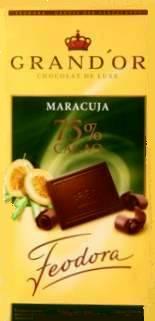
 Ever since our visit to Rio de Janiero, where we began each morning with suco de maracujá sem açúcar, out-of-this-world unsweetened passion fruit juice, I have been on the alert for passionfruit flavors. Alas, nearly every version of passionfruit juice sold here is sweetened, which does a serious disservice to the noble fruit.
However, if you're going to adulterate the passionfruit, the Feodora Grand'Or Maracuja 75% Cacao chocolate bar is a good way to go. Porter found this German delight for me in New York City. At 75% cacao, the chocolate loses a little too much of its "mouthfeel" to be perfect, but the maracuja flavor is heavenly. Don't pass this up if you get the opportunity to taste some.
CNN Health reported a study in which rats, allowed unlimited access to bacon, sausage, cheesecake, frosting, and other high-calorie foods, developed brain changes similar to those in rats given free access to cocaine or heroin. People are not rats, the scientists are quick to point out, but the findings are suggestive. I'm not so happy that their goal seems to be developing a pharmaceutical approach to both drug addiction and obesity, but I found the following thought-provoking:
So...Coca-Cola originally had cocaine as one of its ingredients...now it has high fructose corn syrup. No wonder it's so popular. :)The fact that junk food could provoke this response isn't entirely surprising, says Dr.Gene-Jack Wang, M.D., the chair of the medical department at the U.S. Department of Energy's Brookhaven National Laboratory, in Upton, New York.
"We make our food very similar to cocaine now," he says.
Coca leaves have been used since ancient times, he points out, but people learned to purify or alter cocaine to deliver it more efficiently to their brains (by injecting or smoking it, for instance). This made the drug more addictive.
According to Wang, food has evolved in a similar way. "We purify our food," he says. "Our ancestors ate whole grains, but we're eating white bread. American Indians ate corn; we eat corn syrup."
The ingredients in purified modern food cause people to "eat unconsciously and unnecessarily," and will also prompt an animal to "eat like a drug abuser [uses drugs]," says Wang.
Janet alerted me to Jamie Oliver; DSTB followed up with what is apparently a new show on ABC. It starts next Friday, but the pilot was shown last night; fortunately it's available both at the show site and Hulu, so I was able to watch it. Jamie's attempt to get the people of Huntington, West Virginia to take a healthier approach to eating has the faults of American commercial television (just as does Who Do You Think You Are?), but it's not bad and (so far) is not as over the top as what I've seen of his British shows. If his personality is a little too dramatic for my taste, there's no doubting the sincerity of his preaching and his mission. His gospel is good, fresh food, and in this episode he takes on school lunches.
[Excuse me, school meals. The only meal these children eat at home is dinner. In Oliver's unfeigned horror at the meals served at our public schools, he misses what strikes me as the more important point: Why are all these children eating school food? Why aren't they bringing lunches from home, and why, for Pete's sake, don't they eat breakfast before going to school? If the schools are going to offer food, certainly it should be healthy food, but where are the parents? There's absolutely no need to subject one's children to American public school food, good or bad. The school lunch (and now breakfast) program does serve a useful purpose, making sure children whose parents can't provide meals for them aren't trying to learn on empty stomachs. That's a good thing. But somehow the whole system got skewed; I know that the goal of the school lunch program at our kids' school was to have everyone participate. (We didn't.) I saw not one lunchbox in the show. I hope that while he teaches the adults how easy it is to put together healthy meals, he also teaches the kids how easy it is to make their own healthy lunches. But that's another issue; I know I'm taking on a Great American Icon by dissing the school lunch program.]
My favorite character in the show was one of the school lunch ladies, appropriately named Alice. She wasn't the one in charge, but as Oliver said, "It's obvious that the real boss is Alice," and "Alice is a force to be reckoned with." There are some delightfully obvious similarities—but the real Boss, Alice Davis Porter Wightman, would have agreed with Jamie about the food.
One place I disagree with him is his incomprehensible aversion to pizza for breakfast. Granted, the pizza the children were being served didn't look good for any meal, but I'll stake my recent breakfast pizza against anyone's milk-and-cereal or bacon-and-eggs: Homemade crust; homemade "tomato sauce" which was not only tomato but a whole bunch of other veggies cooked so it still looked and tasted like tomato sauce (only better); green, red, and hot peppers; mushrooms; onions; garlic; and spinach. Yes, it also had cheese and, yes pepperoni—but so what? The balance was great...and so was the pizza. Far more veggies than most American breakfasts—or British either, I'll bet.
As long as I can watch it on my computer, with a pause button and while doing other things, I think I'll enjoy checking out Jamie Oliver's progress in upcoming episodes.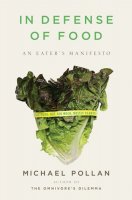 In Defense of Food: An Eater's Manifesto, by Michael Pollan (Penguin, New York, 2008)
I'm in the middle (okay, the beginning) of two rather hefty books at the moment, Susan Wise Bauer's The History of the Ancient World, and my latest review book from Thomas Nelson, The Chronological Guide to the Bible. It's great to be reading the two of them together, though that means it will be a long time before I can review either one.
And now longer still, as the library e-mailed to let me know that I'd made it to the top of the waiting list for In Defense of Food. Michael Pollan is shaping up to be the next John Taylor Gatto for me: a modern author whose books I simply can't resist and can't put down. Reading was the easy part; reviewing without quoting from every page is the difficulty. The book is bristling with my neon green and pink sticky notes.
C. S. Lewis, writing more than half a century ago about the unhealthy state of our sexual appetites, made this comparison with our approach to food:
The biological purpose of sex is children, just as the biological purpose of eating is to repair the body. Now if we eat whenever we feel inclined and just as much as we want, it is quite true most of us will eat too much: but not terrifically too much. One man may eat enough for two, but he does not eat enough for ten. The appetite goes a little beyond its biological purpose, but not enormously. But if a healthy young man indulged his sexual appetite whenever he felt inclined, and if each act produced a baby, then in ten years he might easily populate a small village. This appetite is in ludicrous and preposterous excess of its function.
Or take it another way. You can get a large audience together for a striptease act—that is, to watch a girl undress on the stage. Now suppose you come to a country where you could fill a theatre by simply bringing a covered plate on to the stage and then slowly lifting the cover so as to let every one see, just before the lights went out, that it contained a mutton chop or a bit of bacon, would you not think that in that country something had gone wrong with the appetite for food?
And indeed it has. Americans are obsessed with food, simultaneously overweight and undernourished, eating more and enjoying it less. Although the causes of our unhealthy relationship with food are many and complex, much is explained by the simple idea that we have abdicated our responsibility for what and how we eat in favor of the expert opinion of professionals. Never mind that the experts change their minds dramatically with alarming and almost predictable frequency. Reading In Defense of Food, I was struck by a feeling of same song, next verse. It's a strikingly familiar story to anyone who has considered the arenas of childbirth, medical care, education and even entertainment, in which we have ceded our rights and responsibilities to others.
The good news? Our eating disorders are not our fault, but the cumulative effect of bad science, bad advice, and the biases of a whole lot of people in government, academia, and the food and medical industries who realize that there is much more profit in a Twinkie than a carrot. The better news? We can change. We can take back the responsibility for our own food choices.
Eat food. Not too much. Mostly plants. Pollan begins with this succinct expression of how to eat right. In the final section he fleshes out these thoughts with some practical suggestions, and in between he covers the dangers of nutritionism—regarding food as nothing more than a delivery system for nutrients—and why the Western diet appears largely responsible for what he calls the diseases of civilization.
I'm going to ignore most of my colorful sticky notes, but here are some favorites:
USDA figures show a decline in the nutrient content of the forty-three crops it has tracked since the 1950s. In one recent analysis, vitamin C declined by 20 percent, iron by 15 percent, riboflavin by 38 percent, calcium by 16 percent....To put this in concrete terms, you now have to eat three apples to get the same amount of iron as you would have gotten from a single 1940 apple, and you'd have to eat several more slices of bread to get your recommended daily allowance of zinc than you would have a century ago.
Paul Rozin is a psychologist at the University of Pennsylvania who has dreamed up some of the more imaginative survey questions ever asked of American eaters; the answers he's collected offer a pretty good index to our current befuddlement and anxiety about eating.... In one experiment, he showed the words "chocolate cake" to a group of Americans and recorded their word associations. "Guilt" was the top response. If that strikes you as unexceptional, consider the response of the French eaters to the same prompt: "celebration."
A few years ago, Rozin presented a group of Americans with the following sentence: "Assume you are alone on a desert island for one year and you can have water and one other food. Pick the food that you think would be best for your health." The choices were corn, alfalfa sprouts, hot dogs, spinach, peaches, bananas, and milk chocolate. The most popular choice was bananas (42 percent), followed by spinach (27 percent), corn (12 percent), alfalfa sprouts (7 percent), peaches (5 percent), hot dogs (4 percent), and milk chocolate (3 percent). Only 7 percent of the participants chose one of the two foods that would in fact best support survival: hot dogs and milk chocolate.
Pollan's Omnivore's Dilemma is a book well worth reading, but In Defense of Food is well worth buying, if only to be able to lend it out. It's in my Amazon shopping cart even now.
Jamie Oliver, a British chef, is apparently a big hit in Europe. (Perhaps here, too; that I had never heard of him doesn't mean a lot.) He has cooking shows, a Tupperware-style home party business, and has taken on school meals in England and the eating habits of an entire West Virginia city. I find his flamboyant style annoying, and some of his information dated or controversial (e.g. demonizing saturated fat without mentioning the more problematic trans fats), but there is still plenty worth watching. (H/T Janet)
Grandchild warning. Forty-five years ago, my British-born Girl Scout leader explained to us some of the differences between the US and the UK when it comes to acceptable and unacceptable language. Some words considered normal here were horribly offensive there, while certain words for bodily functions were unacceptable here but commonplace there. She tried to clean up her language in deference to her adopted country, but sometimes slipped—hence the explanation. Oliver's videos are best watched without grandchildren in the room.
Oliver's TED lecture on teaching children about food and good eating habits. He's not a great speaker in this context, but I like the format better than the other videos. He's a little too inclined to look into non-personal (i.e. government and business) solutions, but an important message nonetheless. If nothing else, this one's worth it for the clip at 11:16 where he asks schoolchildren to identify foods in their natural state—and they are baffled by tomatoes and potatoes.
Having made my first New Year's resolution on January 8, it is fitting that I add my second today.
At first glance, resolving to rediscover feasting sounds about as painful as resolving to read more books, but bear with me a moment.
There's a lot of wisdom in the church liturgical year, with its fasts (e.g. Advent and Lent), its feasts (the grandest of which are, of course, Christmas and Easter), and its large swaths of so-called Ordinary Time. For most of our modern, American society, however, it is Christmas Every Day. To paraphrase one of my favorite lines from The Incredibles, If every day is special, no day is.
The material and dietary excess to which we have pushed our festive occasions is the natural consequence of possessions and everyday meals that rival the greatest feasts of our ancestors. In order to rediscover feasting without surfeit, we must first rediscover fasting, and more importantly, normality. Without Ordinary Time, there can be no special times.
So, how am I going to accomplish this resolution? I don't even know how I'm going to begin it, other than making it public as a spur to action. Stay tuned—and feel free to share your suggestions and experiences.
It's appropriate today, also, to look back at New Year's Resolution #1: Read More Books, and ask, How am I doing?
Better than I ever imagined. I've read eight books so far this year, and we're not even halfway through the second month. I didn't keep a record last year, but as an educated guess, based on the books I reviewed, with a handful of non-reviewed books thrown in, I'd say it took me at least half of last year to get to that total.
It's true that I don't expect to be able to keep up this pace: Two of this year's books were read during vacation time. Vacation is more often recreation than rest, and thus not conducive to reading, but in this case I had a few days with a good bit of reading time in them. What's more, February saw the confluence of cold, dreary, wet weather with four days of an involuntary computer fast, which made curling up next to the heater with a book, a cup of tea, and my Kevin blanket seem like a reasonable use of time. Plus I let my Ancestry.com subscription lapse in January when they doubled the price, which had a depressing effect on time spent doing genealogy research.
Nonetheless, although those factors certainly helped, I think most important was the application of "what gets measured gets done." More significantly, perhaps, is that what gets measured in a way visible to the public eye gets done. I don't want it to be obvious that I'm ignoring my resolution! But don't let that panic you; I'm not about to publish all my goals (and progress, or lack thereof) here!Permalink | Comments | Edit
Category Everyday Life Food
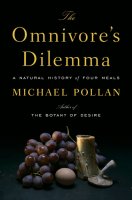 The Omnivore's Dilemma: A Natural History of Four Meals, by Michael Pollan (Penguin, New York, 2006)
My limited knowledge of Michael Pollan prior to devouring this book was primarily his mantra for healthy eating: Eat food. Not too much. Mostly plants. There's a lot of wisdom there — not that I'm very good at following it — but that phrase itself is not found in The Omnivore's Dilemma. It is the beginning, however, of an excellent Pollan article in the New York Times, Unhappy Meals.
I'll admit I was expecting a diatribe, a full-force blast against agri-business and the factory farm, more along the lines of what we hear from the more strident vegans and animal rights activists. Pollan, however, is much too skilled as a journalist and writer for that. If his journeys lead him to both Food Hell and Food Heaven, they also show him that there is no clear, simple, and easy path to salvation when it comes to eating.
The Omnivore's Dilemma is Pollan's attempt to answer some important questions about the food we eat, which I have unfairly boiled down to: Where does the food that we eat come from, and how did it get from there to us? His quest takes him through the horrifying house of cards that is industrial farming, ranching, and food processing, a vision that will either open your eyes or make you screw them tightly shut, because most of us don't have a lot of choice when it comes, for example, to eschewing the monoculture corn that finds its way into most of what we eat and much of what we don't. The first of the four meals in the subtitle is of McDonald's fast food, eaten with his family but hardly "shared," as they each consumed a different choice of foods, all the while driving along the highway, as many fast food meals are eaten in America today.
Skipping ahead, the fourth and final meal was as personal and local as Pollan could make it: meat from the wild pig he shot himself, bread made with wild yeasts, produce from his garden, mushrooms gathered by his own hands, and more, all crafted into a gourmet feast that he shared at the table with friends, family, and good conversation. With apparently honest and transparent struggles, he experiences both the attraction of vegetarianism and the joy of the hunt in preparation for what he called his Perfect Meal. Not a meal for everyone, nor for every day, but a meal of grace, embodying the ultimate answer to his questions.
In between is Organic, what Pollan calls "pastoral food," in contrast to "industrial." This required two meals, because "organic" isn't what it used to be. "Big organic," symbolized by the Whole Foods Market, has hit the big time. It is proof that we do, after all, have some choice about where our food comes from. That we can now buy organic food at Wal-Mart says a lot for the power of the consumer. But this victory came at a price: our 1960's-bred image of the small, family, organic farm remains only on the patently misleading pictures on the food packages. In order to become a mass-market commodity, organic food has taken on many of the harmful practices of the industrial system, from migrant labor to "free range" chickens that never see the outdoors. It's still a good thing — organic farming is much better for the land and produces food that is at least somewhat more nutritious — but has it lost its soul?
Joel Salatin would say it has. The section on Salatin's Polyface Farm in Virginia is worth the price of the book all by itself. This is Food Heaven on earth. If you've seen the movie, Food, Inc., you've seen Joel and the wonder that is Polyface. The Salatin family, beginning with Joel's parents, took an abused and exhausted plot of land and healed it ("We are in the redemption business"), turning it into a showpiece of truly sustainable agriculture. It's all I ever dreamed of for the Ideal Farm, and more, one that produces a great deal of food while enriching, rather than depleting the land, and where the people, the animals, the plants, the smaller creatures, and the soil play out their interdependence to the advantage of all. To add to my delight, the Salatins are also homeschoolers.
As many of us who have chosen to homeschool our children are in defending our educational way of life, Joel Salatin is perhaps a little too strident in his enthusiasm for his way of farming, not showing much concern for those of us who have no access to locally-grown food but still want to eat. I know from experience that such is a common, though unhelpful, reaction when the rest of the world — and especially the government — seems determined to stop you from doing what you know is good, right, and healing for yourself, your family, and your community. That is the position that small farmers are in today, much as homeschoolers were 30 years ago in the United States, and still are in many parts of the world.
Putting that defensiveness aside, however: in all the areas in which I care so much for the local and the personal — homes, families, education, childbirth, businesses, farms, and more — no one path is right for everyone, and in diversity is our strength.
Deciding whether [the future of food] should more closely resemble Joel's radically local vision or Whole Foods' industrial organic matters less than assuring that thriving alternatives exist; feeding the cities may require a different sort of food chain than feeding the countryside. We may need a great many different alternative food chains, organic and local, biodynamic and slow, and others yet undreamed of. As in the fields, nature provides the best model for the marketplaces, and nature never puts all her eggs in one basket. The great virtue of a diversified food economy, like a diverse pasture or farm, is its ability to withstand any shock. The important thing is that there be multiple food chains, so that when any one of them fails — when the oil runs out, when mad cow or other food-borne diseases become epidemic, when the pesticides no longer work, when drought strikes and plagues come and soils blow away — we'll still have a way to feed ourselves.
Michael Pollan is a superb writer, making The Omnivore's Dilemma a very welcome change from much that resides between book covers these days. I doubt I'll ever get used to seeing certain four-letter words in print, but here they are context-appropriate, and best of all, rare. There's no need for a grandchild or nephew warning, as by the time they are old enough to read this book (or, more to the point, old enough to want to read it), they will, alas, have already seen and heard things much more shocking.
Much of the content is, in itself, more shocking than a few Anglo-Saxon words could ever be. But far from being the jeremiad I had expected, Pollan's careful investigations and respectful reporting make The Omnivore's Dilemma a book that everyone who eats should read.Ah, a glass of red wine, bruschetta (made with homemade bread), and a Porter-made salad with spring greens, scallions, artichoke hearts, kalamata olives, and rosemary and sea salt focaccia sticks with sun-dried tomato spread, dressed with a dressing concocted from balsamic vinegar and a marvellous lemon-olive oil from Italy that was a gift from Stephan's parents.

Permalink | Comments | Edit
Category Everyday Life Food
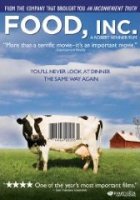 Food, Inc. (2008, Magnolia Home Entertainment, directed by Robert Kenner, PG )
I first heard about Food, Inc. seven months ago, and at that time posted the trailer, a couple of links, and my determination to see the movie when it became available on Netflix. Just before Christmas the disk arrived in our mailbox, so we packed it in our luggage and were able to enjoy it with my brother and his family, which was only fitting, as they are the ones who alerted us to the movie in the first place.
Everyone who eats should see this film. Alas, it only touches the surface of the problems in our food industry and doesn't have time to say much about solutions—but it's quite enough to inspire further research. The film's website might be a good place to begin.
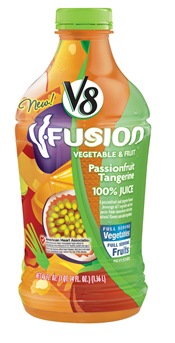 This actually seemed like a good idea at the grocery store.
V-Fusion, by the same folks who brought you, "I could have had a V-8."
I should have had something else.
It's a good idea. I love passionfruit juice (at least when I can get it without sugar, as we did in Brazil), and I love tangerine juice. It's 100% juice, and not just fruit juices: there's enough carrot and sweet potato juice in there to allow them to claim that an eight-ounce glass provides a full serving of vegetables as well as a full serving of fruits. Should be good, and good for you.
But oh my, how sweet it is. Sickeningly sweet. Not even the passionfruit and tangerine flavors could redeem the taste. There's no "sugar" added, but sweet juices (apple and grape) in abundance.
It's just as well. At $4.99/bottle it cost too much anyway. And that's not sour grapes, though sour grapes would improve the juice.
I cogitated upon this video all day before finally deciding to post it. I'm hiding it behind the "more" tag because it's replete with highly offensive words. So much so that it's almost not offensive: nothing is said with anger, or malice; it's as if the man is one of those poor unfortunates who can't speak without using "um" or "like" every other word—only those aren't his filler words of choice.
The reason I decided to bear with the profanity is that this comedy routine is perhaps the neatest expression I've yet seen of Purple Ketchup Syndrome. When Heinz came out with purple ketchup, I knew the mental disconnect between what we eat and where it comes from was complete.(If you watch the video, do it here rather than clicking through to the YouTube site; the comments there are worse than the video.)
Permalink | Comments | Edit
Category Random Musings Food
I made cheese today, my first effort since succumbing to the lure of Ricki Carroll and her New England Cheesemaking Supply Company. It was not, perhaps, an auspicious beginning, since the never-fail, easy-enough-for-a-seven-year-old mozzarella recipe...failed. Maybe I need a grandchild or two to help.
On the other hand, what I did manage to produce is a great, lower-fat substitute for cream cheese, and if I knew what it was I did wrong, I could replicate it. My biggest mistake was clearly to ignore Ricki's instructions to keep a cheese journal, logging everything from ingredients to procedures to the ambient temperature and humidity. Cheesemaking is an art, and at some point you're bound to create something you'd like to be able to make again; keeping a log doesn't guarantee that you'll be able to, but it greatly increases the odds.
For now, I'l enjoy my "cream cheese," and try again with the mozzarella another day.Permalink | Comments | Edit
Category Everyday Life Food
 Chocolate Unwrapped: The Surprising Health Benefits of America's Favorite Passion, by Rowan Jacobsen (Invisible Cities Press, Montpelier, Vermont, 2003)
Like chocolate, this delicious book goes down easily, and the facts about chocolate's health benefits are not hard to swallow. At a mere 126 pages from introduction through references, it's a quick and easy read—I read most of it on the way to and from church today—and yet manages to cover the history and production of chocolate, a good deal of detail on why chocolate—which begins as a fruit, after all—should be considered a health food, environmental and labor issues in the production of chocolate, unusual chocolate recipes, and list of great chocolate sources. It is necessary to ignore a few insults to Columbus, the Puritans, and anyone who likes milk chocolate, but on the whole these are minor annoyances.
Did you know that there are three types of cacao plant? The criollo beans of Mesoamerica have the best flavor; but the forastero beans of South America (transplanted to Africa) have taken over 90% of the market, because their trees are hardier and more productive. Trinitario, a hybrid of the two, was developed in Trinidad and though it supposedly carries the best characteristics of each, it runs a far-distant second. It is a familiar story, this choice of quantity over quality: think instant coffee, Velveeta cheese, cheap wine, Wonder Bread, and red-rock tomatoes. But as more and more people join the taste revolution, choosing to enjoy whole grains, local vegetables, and espresso, so also are the more flavorful varieties of cacao becoming popular. And as with wine and cheese, where chocolate comes from—the soil, the climate, the environment—makes a difference in the flavor.
It's not too surprising that the darker the chocolate, the more beneficial components it retains. The author recommends 70% cacao, as beyond that the melt-in-your-mouth effect is lost. I figure I'm close enough with my Ghirardelli 60% cacao chocolate chips. :)
And what are those beneficial components? Legion. Anti-oxidants galore—it blows away the competition, including blueberries, red wine, and green tea. "[O]ne good-quality dark chocolate bar can have more polyphenols than two whole days' worth of fruits and vegetables." You know how some doctors prescribe daily 81-milligram doses of aspirin for its clot-prevention effects? Turns out a couple of squares of dark chocolate have the same effect. Hmmm...I know what my choice would be.
Chocolate also contains a whole slew of low-dose, mood-altering chemicals, including anadamide, which is nearly identical to the THC found in marijuana. Seems those marijuana brownies of our college days did more than just disguise the illegal drug. (And no, I didn't partake, didn't even have the opportunity. But I can't follow President Clinton in saying I didn't inhale, because second-hand smoke of more than one kind was unavoidable back then.) There's a reason eating chocolate makes us feel better.
The section on environmental and labor issues is balanced, pointing out that the issues are complicated. In attempting to combat child labor on cacao plantations in Côte d'Ivoire, for example, one must take care not to do more harm than good.
For these cacao laborers, a poor-paying job is still better than none. And preteens working in agriculture alongside their parents has been part of African culture for centuries, if not longer. Of the one million cacao farms in West Africa, the vast majority are tiny (less than five acres) family affairs. The child labor abuses reported were confined to the few large plantations, but boycotting cacao from Ivory Coast would affect the family farms even more severely than the plantations.
Jacobson supports the Fair Trade program, which has grown beyond coffee to include cacao, and has two sets of standards, one for small farmers and another for plantations and factories. He also recommends buying organic chocolate, which is grown in a more environmentally-sustainable fashion—and also is more likely to contain the better-tasting criollo beans.
There's one more delightful side effect of Chocolate Unwrapped: last night I read a section of it out loud after dinner, and Porter immediately brought me a bowl of Publix Chocolate Trinity ice cream and a glass of red wine. :)
Making vegetables grow in our nutrient-poor, nematode-rich sand soil is always a challenge. After the initial shock of moving here from a world where one puts the seeds in the ground and stands back, we pretty much gave up on gardens until a couple of years ago. We do a little better each year, but at least financially the balance sheet is still dismal.
One plant that is still thriving, even in the oppressive Florida summer heat, is our lemon balm. We planted it this year for no other reason than that it was available at Lowes (or Home Depot, I forget which) and I remembered that Porter had remarked on how good it smelled when we encountered it at Leu Gardens. We let it grow untouched for a long time, mostly because I didn't know what to do with it, but when a friend mentioned making lemon balm tea, I had my answer.
Now I brew a pot of tea with one regular PG Tips tea bag and a handful of bruised, fresh lemon balm leaves. I don't know how it tastes hot, as we're not in that season, but I can attest that it makes a wonderful iced tea. I generally prefer my tea unflavored, but at least for now I can't get enough of this delicious combination.
Permalink | Comments | Edit
Category Food Conservationist Living
On June 12—tomorrow—Food, Inc. opens. As usual, we'll probably wait for the DVD, but it's definitely one I want to see. Do I really want to hear more about the dangers of our factory farming system? Unfortunately, yes. True, it produces plenteous, apparenly low-cost food—we spend less of our paychecks on food than in any time in our history—but the true costs are hidden, and high. Did you know that 90% of the items in our grocery stores contain some form of corn or soy? That our supply of beef, chicken, potatoes, and many other foods is driven by the fast-food industry? One reason I'm looking forward to the movie is that supposedly it is not entirely a doom and gloom horror flick, but also celebrates the power of the individual to make a difference. We shall see. Thanks to DSTB for the alert.
Here's the official Food, Inc. website, where you can see the trailer.
And a PBS show about the movie.

