
One of the fun things about spending foreign money is that it doesn't feel like real spending. It feels like play money, Monopoly money. I don't know at what point I crossed the line, but I'm definitely past that. Swiss francs are now real money, and I look at the green American paper in my wallet and think, "What is this? Do people actually accept this as payment?" No doubt that will not last long, once I am home, but it's a weird feeling.
I've long been in favor of following the lead of the many countries that have replaced their lower-denomination bills with coins. Now that I've worked with such a system for over a month, here are some observations:
- The lowest Swiss bill is the 10-franc note. There are 5-, 2-, 1-, and 1/2-franc coins. Practically speaking, this means I can no longer ignore coins. In America, when I get change back from a purchase, I usually dump the coins in my wallet without checking them, as no error can cost me more than a dollar. Here, where the change might be worth nearly ten dollars, it's worth at least a quick glance. I was quite proud of myself when I noted in one transaction that the cashier had mistakenly given me a 2-franc coin instead of a 5-franc coin.
- I had to train myself to make a point of using coins. Using bills all the time results in a heavy wallet; once I discovered I had over Fr. 40- in change! Once you get used to the idea of not ignoring change, however, it's not a problem to keep the quantity down to something reasonable.
- The lowest denomination coin is the 5-rappen piece. This is a good practice; I see no need for the U. S. to continue to mint cents, other than to feed those fun machines at tourist sites that make elongates. The existence of those machines is to my mind the only compelling reason for keeping the cent.
- I've gotten quite good at paying with change, but still have trouble distinguishing the 1-franc coin from the 20-rappen piece, and the 1/2-franc coin from the 10-rappen piece, when they are jumbled up in my wallet. I have to look at the number on the coin to be certain, and I find that annoying.
- Swiss merchants don't blink when you hand them a 100-franc bill; in the U. S. I don't like carrying $100 bills because clerks suspect them of being counterfeit, and even if convinced a bill is real, will grumble if your purchase is small.
- Paying with cash is much more common in Switzerland than in the U. S. Debit cards are handy, though, when buying train tickets; trying to convince the automatic ticket machine to accept your bills (or coins) can sometimes be a problem.
- A common debit card is the Post-Finance card. Once you get over the shock of thinking of a bank and the post office being the same organization, you begin to wonder if the system works because the former subsidizes the latter. (I have no idea if it does; the thought just occurred to me as a possible explanation for the mysterious combination of banking and postal services. I know that combination is not just in Switzerland, but I haven't researched how it might have come about.)
- Nearly all shopping is done with Swiss francs, but I've noticed that in shops catering specifically to tourists they will sometimes give the price in Euros as well.
Shopping here is as fun as shopping gets because (1) I can walk where I need to go, (2) it's usually not urgent, but part of the process of exploring the city, (3) there's still a challenge in paying with the right change instead of merely handing over a large bill, and (4) there's always the thrill of trying to get by without English. The last is much easier than I had imagined. Knowing a few words of German—notably "please," "thank you," "where is?" and "I'm sorry, but I don't understand German"—goes a long way. It's also a great help that the cash registers display the total price, so I don't have to try to understand rapid-fire cashier language. I'm happy to report that I have managed totally in a combination of German, Swiss German, and gestures—except for one of my trips to the tea shop, where the clerk spoke in English because I had filled out a form with my U.S. address. My proudest moment was asking, "Wo sind die Stilleinlagen?" and making myself understood with no need for repetition or gestures (the latter being a very good thing).
Permalink | Comments | Edit
Category Travels Everyday Life
While Joseph was undergoing a secular baptism of sorts at the American Embassy in Bern, Grandma had no official business other than to receive the diaper bag when it was rejected at the door for possible terrorist connections.*

After a little exploration, the weather—along with the uncertainty of when the party might be over—turned the waiting time over to Li'l Writer Guy, who discovered that a Swiss café is a delightful place to work.

Fr. 4.- may seem high for a cup of tea, but I figure it as: cup of tea with cookie, Fr. 2-; quiet place to work, Fr. 2-; shelter from the pouring rain, Priceless. A great bargain.

Permalink | Comments | Edit
Category Travels Everyday Life
Living with other people for several weeks is a good way to experience new foods and new food combinations. If those other people happen to live in another country, the opportunities multiply. And if they also subscribe to a local organic farm's weekly vegetable delivery, well...you get to try Swiss chard. Verdict? Not bad, though I think I'll like it better mixed with other things, such as in an omelet or on a pizza. It's related to beets, but I find the taste more like spinach. As it was with Heather and Jon's Community-Supported Agriculture farm in Pittsburgh, the weekly vegetable lottery is fun to play, and Stephan (like Jon) is particularly good at figuring out how to make good use of fennel, fresh tarragon, and eggplant as well as potatoes, lettuce, and zucchini.
What's a visit to Switzerland without trying a new variety of chocolate? When Stephan brought home a bar of dark Ovomaltine, I was at first skeptical.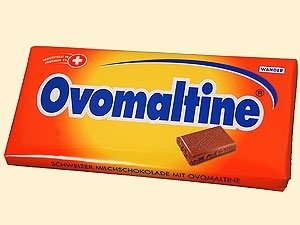
I remember the Ovaltine drink (name changed in the English-speaking world thanks to a typo) from my childhood, and not pleasantly. It was touted as a healthy alternative to chocolate milk; perhaps that was the reason we viewed it with suspicion.
This is not your father's Ovaltine. Well, maybe it is, and maybe I would actually have liked it as a child had I not thought of it in the same category as spinach and beets while expecting it to taste like chocolate milk. I don't know. Whatever. This is a delightful form of chocolate, which the Swiss do very, very well: smooth, a little bit crunchy, a little bit malty, a lot yummy.
The good news, for those who support the Nestlé boycott because of the company's aggressive marketing of infant formula in third world countries, is that Ovomaltine, still made here in Switzerland, is Nestlé-free. The bad news is that if you want to try this delicious chocolate, you need to ask me to bring some back for you, as Nestlé owns the rights in the United States. So place your orders now.
There's no adjustment needed when it comes to Swiss bread, the only difficulty being deciding which of the dozens of tempting breads to buy. Butter, on the other hand, is unsalted here. At home I've always found unsalted butter unpalatable, and I'm not sure what to make of the fact that I happily eat it on my good Swiss bread every morning. Either my tastes have changed, or Swiss bread is saltier than I'm used to.
Speaking of unpalatable, that's how I usually find any milk with cream content greater than skim, which I believe is 0.5%. Raw milk is an exception, but I can rarely get that. Here, unless one is willing to drink the ultra high temperature pasteurized milk, the lowest fat content is 2.5%. Needless to say, I haven't been drinking much milk here, except when the temperatures were cold enough to warrant fixing some hot cocoa, which is improved by higher-fat milk. I do find, however, that the 2.5% here tastes better than 1% back home. Sadly, we should be able to get great raw milk straight from the cow here—or at least straight from the dairy farm on the hill, which is close enough to smell when the wind is in the right direction—but we can't. It's legal to sell raw milk in Switzerland; the problem has something to do with the price-support system, under which the farm is not allowed to sell directly to the public. :(
Eggs, on the other hand, are amazing here. Fresh, free-range, organic if that's your desire—with the most lovely, inviting, delicious bright-orange yolks, a sign that the eggs are from chickens that really did range freely enough to eat grass and bugs—which is not true of many eggs that claim that label in the U. S. And here's a surprise: eggs are not refrigerated here. Not in the store, and not at home. They sit out on the shelves or on the counter, even in our recent heat wave with temperatures rivaling Florida's. So far, we're all alive and well.
I love the kefir that is sold in American grocery stores, both the sweetened fruit version and the plain. What I've found here, however, has a slightly different taste, and a texture like a cross between yoghurt and cottage cheese. It will be interesting to see what the product will be like when I make my own from the kefir grains waiting patiently in our freezer.
If Switzerland is known for any food more than chocolate, it is cheese, and cheese shopping is even more complicated than buying bread. I have a lot to learn here, and I haven't been adventuresome. Prices here tend to be high in general, but good cheese is an exception. Gruyère is a staple, rather than the luxury I'm accustomed to. On the other hand, if you can find cheddar at all, the price is outlandish for a rather mediocre product. Asiago, too, is vastly different from at home: it's good, but a rather bland, mild cheese, instead of the sharp, flavorful variety I love.
Grocery shopping is a different experience. European refrigerators (and cupboards, and kitchens) seem to be generally smaller than Amrican ones; Janet and Stephan's refrigerator is not that unusual in being the same size as the dorm fridge I had in college. This promotes a "shop frequently, buy fresh, use it quickly" philosophy that I can learn from. I don't know how onerous this might be if we were not in the city, but as it is, it is easy to pick up a few things at the store on the way home from work, or when doing other errands. Since I like to take a walk every day anyway, I often stop by Migros or Coop then. A grocery trip isn't such a big, scary deal if it's not an hour-long, major provisioning expedition. On the other hand, this practice contributes to inefficiency, greater use of packaging materials, and higher prices, since one routinely buys a liter of milk instead of a gallon, and a kilo of flour instead of five pounds.
I think the grocery cart system in Basel is great: In order to extract your cart from the lineup, you deposit a two-franc piece (about $2); it is returned to you when you return the cart. In the end it costs nothing, but effectively promotes responsible cart use.
Restaurants are a lot more fun here now that smoking is banned. Not perfect, since it is still allowed in bars, and in our favorite place for Rösti, zum alten Stöckli, smoke from the bar rises to the the restaurant, which is upstairs. Nonetheless, it's a great improvement. Another improvement to restaurant meals is knowing how to order something to drink. I can order schwarzer Tee (black tea)—though not iced tea, which would have been lovely when the temperature hit 36 (98). (Iced anything is hard to come by; I still find the sight of a large Coke with no ice odd.) I can order Apfelsaft (apple juice). But the greatest improvement is being able to order my usual American restaurant drink: plain tap water. Order water here, and you'll probably get fizzy mineral water. Order plain water, and it will be the same, only not fizzy. The magic word is Hahnewasser (Swiss German; in high German, Hahnenwasser). I find the regular Swiss tap water—the kind that pours freely from fountains throughout the city—superior to anything I've bought in a bottle. The trick to avoiding dirty looks from the waiter is to spend sufficient money on the rest of the meal.
We interrupt the writing of my review of Ender's Game to alert you to the fact that Janet has now posted Joseph's birth story. I'll add some comments later.
Permalink | Comments | Edit
Category Travels Everyday Life
I like the trash collection system here in Basel: You buy special blue garbage bags, each 35 liters in size (about 9 gallons), which is considerably smaller than an American "large kitchen trash bag." They are, however, much tougher, and can be well-stuffed without ripping. You pack your trash as efficiently as possible into as many bags as you need, and put them out in the street at the appropriate time for collection.
That's it. The cost of trash collection is included in the cost of the bags, and thus you pay proportionately for the amount of trash you produce. There is significant incentive to minimize your waste, yet the capacity to dispose of more is there if you need it. Ideally, you would pay by weight rather than volume, but the system is so easy, it is a worthwhile compromise. I think of a friend's complaint that she can't help feeling annoyed at seeing her neighbor's routine weekly pile of 10 or more large bags as she makes her own family's one-small-bag contribution to the landfill collection; she would welcome such a system in her town. As would I.
Recycling is different here, too, though I haven't decided if it's better or worse. Plastics and metals must be taken to a recycling station instead of being picked up at the curb as I'm accustomed to, but such stations are only an easy walk away. Only one type of plastic is recycled ("PET," known in the U.S. as PETE or #1); our county recycles any type of plastic as long as it has a number code. On the other hand, paper is picked up at the curb, and they recycle all sorts of paper, including office paper, which our county excludes. Not worse, not better, just different—and not any more different than the variability from community to community in the U.S., as we discovered in moving among New York, Pennsylvania, Massachusetts, and Florida.
Permalink | Comments | Edit
Category Travels Conservationist Living
Temperatures in the mid-90's do not surprise me in July: I live in Florida. I'll confess I was hoping for something more reasonable in Switzerland, however. Somehow calling the temperatures "mid-30's" doesn't improve the situation as much as I would hope. I miss air conditioning; I miss ceiling fans. Even when we lived without air conditioning in Boston I could find relief at the grocery store. Not so, here.
But there are compensations. The apartment is wonderfully designed for cross-ventilation, and the lack of screens means we make the most of every breeze. We have two fans, and the temperatures cool off enough at night to make sleeping reasonable. Still, there's not much incentive to be very ambitious, and Janet is really wishing she could take advantage of her membership in the pool that's only a five-minute walk away.
How about you? I gather it's been hot for a lot of folks.
Baby update: Doing fine, eating lots, filling out, doesn't like the heat but still likes to be held. Has perfected the knack of filling a clean diaper within 15 seconds of the change.
Permalink | Comments | Edit
Category Travels Everyday Life
My original impression of Basel as a quiet place has been irrevocably shattered now that I'm here in the summer instead of the winter. In this season construction projects are in full swing, and the noise of machinery is nearly incessant during the work day—including some sort of saw that reminds me of a high-volume dentist's drill and sets my teeth on edge worse than the World Cup horns.
That unavoidable annoyance notwithstanding, I realized this morning that in some ways Janet and Stephan's city apartment is closer to nature than our own suburban house. (And our back yard, for its size, is an especially wildlife-friendly area.) Light and air stream through the many windows, and when I look up from my computer I rest my eyes on a view of the blue sky, the trees of a nearby park, and a window box garden of herbs and wildflowers.
When I look up from my computer at home, I see a wall. Well, I also see pictures of our grandkids, which is a delightful view itself, but here there is something restful to the eyes in focussing on the distant trees, and soothing to the spirit in watching the birds soar and the wildflowers move in the breeze.
Who'd have thought one could feel so close to nature in the middle of the city? The peace it brings almost cancels out the noise.
Permalink | Comments | Edit
Category Travels Everyday Life
I left the new family to their own devices on Saturday morning, when Stephan's mom whisked me away for an adventure. There is a small farm in nearby Riehen which, as I understand it, specializes in biodiversity/heritage breed conservation of berry plants. On this day, they opened their farm to the public for tasting! We could take nothing away, not even by purchase, but were welcome to taste and enjoy all we wanted.
(Somewhere therein is a metaphor for life, I'm certain.)
There were tiny strawberries with the sweet, strong flavor I remember from my childhood, from the wild plants that once grew profusely in the field near our house in New York. My mother would make the most delightful strawberry jam imaginable from what berries escaped immediate consumption.

The raspberries had clearly been the most popular among those who had come before us, but there were still plenty left for tasting, including a white variety.


Even more to my delight, though less popular in general, were the tiny black raspberries, again from my childhood; we called them "black caps."

And one more childhood memory; this one will be shared by my younger siblings, whose memories are more solid of our time in Pennsylvania.


Some fruits were new to me. A former neighbor had black and red currant bushes, but she moved soon after we became acquainted, and the bushes were cut down. This was probably my first taste of fresh currants in over 30 years. The black were my least favorite of all the tastes there, but the red and the white were exquisite.

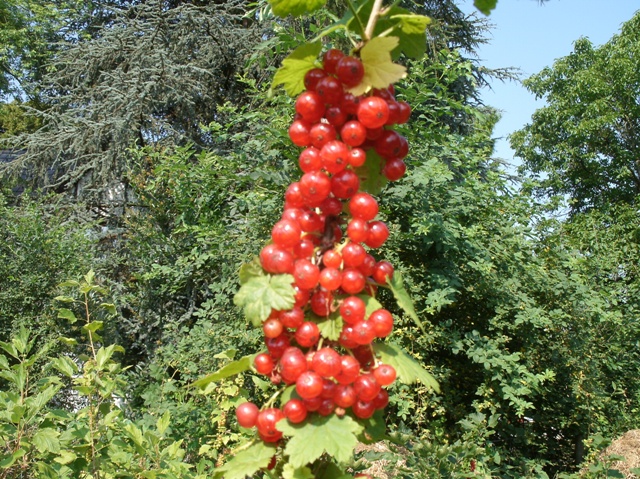
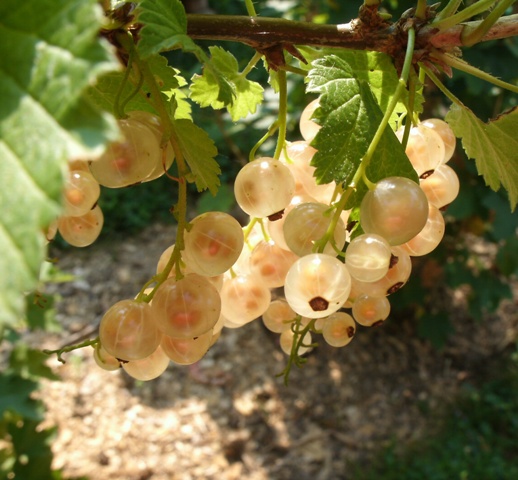
Finally, there were the gooseberries (green) and the jostaberries (purple). Having cut my teeth on (and learned spelling from) English novels, I'd heard of gooseberries, but had never, to my knowledge, tasted one. They are delicious. The jostaberries—a somewhat complex mixture of gooseberry and black currant—tasted strange at first, but that impression soon evolved into a nice, tart flavor.


(As usual, you can click on the images to see the full version.)
Not everything was ready for tasting.

As might be expected from a farm specializing in diversity, there was no such flavor as, say, "raspberry," any more than "orange" can cover the vast spectrum of Citrus sinensis. Half the fun was moving from one bush to another apparently the same, and being surprised by the change in taste.
Over half a century I have watched our choices for food (and much else) expand astronomically, and yet at the same time contract. We can eat food from all over the world at nearly any time of the year, and appreciate ethnic recipes of which our ancestors knew nothing. Yet at the same time our choices within a particular food are narrowing, perhaps dangerously. Milk is milk, orange juice is orange juice, tomatoes are tomatoes (or red tomato-like substances in the grocery stores), hamburger is hamburger, and we know nothing of the rich variability within a single food.
My gratitude is great to the Creator who wove such diversity into his work, to the gardeners who lovingly, carefully work to nurture and extend that diversity, and the heritage breed preservationists whose efforts may allow us once again to recover the flavors that delighted our ancestors.
Permalink | Comments | Edit
Category Travels Everyday Life Food Conservationist Living
The day I arrived in Basel on this trip, I felt in need of some "chill-out" reading that wouldn't tax my jet-lagged brain cells. Fortunately, Janet and Stephan's bookshelves are well stocked, even after eliminating the books in German, French, and Japanese.
For much of my life, Isaac Asimov was one of my very favorite authors, first for his science fiction, and later for his non-fiction. (I had the pleasure of astonishing him once at a science fiction convention by presenting to him one of his American history books for autographing.) Asimov kept writing—surely he must hold some record for the quantity and scope of his works—but life took me in different directions and I neglected him for many years, except for re-reading his delightful Black Widowers mystery stories.
But there on the bookshelf was Gold, a collection of some of his last short stories and essays, and it was just what I wanted.
So far, I'm still impressed with Asimov's writing, though his own opinions and philosophies intrude somewhat annoyingly into the stories. I suspect that was always the case, but I was less aware, both because of my lack of experience and because his prejudices did not then conflict in any significant way with mine. In any case, his worldview is part of what makes an author who he is, so I don't mind much.
In the essay on women in science fiction, however, Asimov's sharp wits seem to have deserted him. How else to fathom his casting blame on puritanical attitudes toward sex for the fact that early science fiction stories were all about men?
In most cases, non-recognition of the existence of sex was treated as though it was the law. ... But if there's no sex, what do you do with female characters? They can't have passions and feelings. They can't participate on equal terms with male characters because that would introduce too many complications where some sort of sex might creep in. The best thing to do was to keep them around in the background, allowing them to scream in terror, to be caught and then rescued, and, at the end, to smile prettily at the hero.
Excuse me? Female characters are good for nothing but sex? If they can't have sex, they can't do anything? And you can't have male and female characters together in the same story without having them jump into bed?
What makes this statement all the more absurd is that Asimov himself succeeded many times over in doing what he just said was impossible. As he stated in a later essay, "I use no gutter language or sex in my juvenile books, but then I use no gutter language and very little sex in my adult books."
Robert Heinlein, another of my once-favorite SF authors, was also adept at writing stories with strong—i.e. normal—female characters and no sex scenes, although to be sure he also wrote plenty of books that were objectionable and even bizarre in that department.
Asimov clearly knew better, and wrote better. Why he would say something so irrational escapes me completely. He's right that science fiction, along with most stories of adventure, daring, and heroism, failed their female readers miserably. I know, because as one of them in my impressionable childhood, I couldn't help noticing that, with few exceptions, the only characters worth admiring or emulating were male.
But it wasn't the censors' fault. It may, in many ways, have been society's fault. I'll easily believe that the problem reflected a poor general attitude towards women and girls—but to imply that a story with female characters must have a romantic interest, let along a sex scene, is the more offensive error.
To repeat, from Part 1, lest I forget:
DiapersThe first principle is that nobody should be ashamed of thinking a thing funny because it is foreign; the second is that he should be ashamed of thinking it wrong because it is funny. The reaction of his senses and superficial habits of mind against something new, and to him abnormal, is a perfectly healthy reaction. But the mind which imagines that mere unfamiliarity can possibly prove anything about inferiority is a very inadequate mind. — G. K. Chesterton, writing on foreign travel in What Is America?
I thought the diapering world was divided neatly between cloth and disposibles, with elimination communication thrown in as an added wrinkle—which only shows how limited and parochial my world has been. Of course, the whole diaper situation here was planned to be well under control by now, but it has become an issue thanks to a miscommunication with the "diaper lady" reminiscent of my last-minute struggles with Lufthansa's baggage policy. "No, I don't actually sell diapers; I only have samples you can experiment with to help you decide what you like. You can't actually buy them here in Switzerland, and no, I don't have any overseas suppliers to recommend...."
This was a Boston Rubbermaid moment for me. At home I would zip off to Babies R Us, Target, or Walmart, all within walking distance, and grab several packages of birdseye prefolds. Here I was prepared to pay Swiss prices, but I was not prepared for diapers to be unavailable!
But of course, I'm wrong. Diapers are available here. Swiss diapers. Which are decidedly not birdseye cotton prefolds. I spent half an hour looking for a good picture of one for this post, without success, although in the process I found out more about diaper choices and technology than I ever imagined existed. (Type "diaper folding" into YouTube for just a glimpse at the possibilities.) But imagine large, thin, square cloths in all sorts of colors and designs, sold individually. If you ask the sales clerk at the baby store how to fold them, fasten them on the baby, or how to cover them so they don't leak, she has no idea. They don't sell diaper fasteners and they don't sell diaper covers. Cloth diapers, it appears, are popular baby items, but no one in his right mind actually diapers a baby with them. That's what disposables are for. Real diapers are bought to be used as burp cloths.
Unless, of course, you go to the "organic" store here. Except that she would gag on the prices, I kept thinking that our all-natural, organic, earth-friendly friend Serina would be in heaven there. At that store, the clerk was very competent indeed; if she hasn't diapered a thousand babies herself, she at least must have given the demonstration a thousand times. They sell not so much diapers as diapering systems, all in an eye-pleasing, natural, ecru shade—you couldn't bleach it, but stains would be less obvious than with white. The diapers themselves are still the thin sqares of cloth, but these folks have obviously thought about their practical use as a diapering medium.
Watching the clerk fold a diaper was like watching Johnny Montroll fold an origami animal. Faster than I could follow, she created a very clever diaper from the square, thick and thin in all the proper places. I didn't follow the rest of the procedure, either, as she was demonstrating two different systems, with explanation in rapid-fire German. In addition to the diaper there are inserts of various kinds, covers to hold it all together, and a few other things I'm sure I've forgotten. It was, no doubt, a lovely system for an all-natural, earth-friendly, baby. In many ways it was quite attractive and appealing. But SO complicated! It's one thing to accept, and even embrace, inefficiencies in laundry, and quite another when one is attempting to diaper a squirming baby, or promoting awareness of potty needs.
This problem is still in search of a solution. Despite the imminent arrival of the baby, it's not an urgent situation because of what Janet already has in place, but it's definitely a puzzlement. We've been looking around online for what we might order. Alas, most of the American companies I depend on won't ship overseas. My brief investigation into European online stores yielded Heather's favorite diaper cover and a whole array of previously-unknown (to me) cloth diapering options, none of which is either the kind of diaper I'm used to back home or what is common in the stores here! Who'd have thought diapering could be so complicated?
Maybe it's a very good thing that Janet has been folding John Montroll models since she was six years old.
Permalink | Comments | Edit
Category Travels Children & Family Issues Everyday Life
The first principle is that nobody should be ashamed of thinking a thing funny because it is foreign; the second is that he should be ashamed of thinking it wrong because it is funny. The reaction of his senses and superficial habits of mind against something new, and to him abnormal, is a perfectly healthy reaction. But the mind which imagines that mere unfamiliarity can possibly prove anything about inferiority is a very inadequate mind. — G. K. Chesterton, writing on foreign travel in What Is America?
Visiting another country or culture is one thing; living there, even for a few weeks, is another. As a sightseer, it is easy to find something funny and respect it inspite of, or even because of, its apparent oddity. A good attitude can be more difficult when it frustrates the efforts of daily life.
I didn't need to live in a foreign country to experience those frustrations. Soon after arriving in Switzerland, I found myself spinning in a disorientation that had nothing to do with language differences, and at the same time, puzzling over the familiarity of the feeling. Then I remembered the first few weeks after our move from Florida to the Boston area. Boston is a great city, and there's much about Massachusetts that I now miss—a lot, even. Nonetheless, as I was trying to set up housekeeping in our small apartment, searching store after store and making telephone call after telephone call trying to find a source of Rubbermaid storage bins, I was very nearly reduced to tears and a heartfelt cry of, "A Wal-Mart! A Wal-Mart! My kingdom for a Wal-Mart!" Although I eventually came to appreciate what Boston had that Orlando didn't, what was lacking (or apparently lacking) was uppermost in my mind in those days. (I never did find out where Bostonians purchase Rubbermaid storage bins, or even if they use such things at all, but I did eventually find a Wal-Mart.)
Freely admitting that differences are not an indication of inferiority, but with Chesterton's permission to find them peculiar, I will be sharing some of the disorientations and adjustments of my time here.*
Laundry
Europeans have a reputation for being more laid-back and relaxed than Americans. I am now suspecting that the reason is the Laundry Zen Experience. One can either scream,
- "This is one of the most civilized, organized, efficient, and technologically advanced countries in the world. Why does it take three hours to do a load of laundry in the best of circumstances?" ("Best of circumstances" = there's actually a clothes dryer available. In many cases all laundry must be hung on a clothesline in the basement, in which case don't count on having clean clothes in less than a day.)
- "Why do manufacturers still make ordinary clothing, even underwear—we're not talking silk ties and fancy dresses here—that can't go in the dryer?" Each item as it comes out of the wash must be examined for a laundry tag with its mysterious hieroglyphics and sorted into what can go into the dryer and what must be hung on the line.
- Most of all, "What company in its right mind would make baby clothes that must be line dried? That's baby clothes, as in the kind that get spit up, drooled, peed, and pooped on! What are they thinking, to make them of materials that need special care?"
Granted, there are Americans who take more care with their laundry than I do. With rare exceptions, I do not coddle our clothes. If they can't survive a normal trip through the washer and dryer, they don't get in the door.
Laundry routine, at home:
- Determine whether or not the items need washing.
- Throw them into the washer, normal cycle, warm wash/cold rinse.
- When done, throw all clothes into the dryer, normal cycle, medium heat.
- Fold and put away.
Laundry routine, here:
- Sort laundry by color and by washing temperature. (Fortunately, Janet does this part, not only to be helpful, but because she rightly doesn't trust me.)
- Put laundry in washer.
- Choose correct water temperature. (In our case, it's either 30 or 60 degrees—86/140 Fahrenheit—but there's an option of 90, practically boiling!)
- When done, about an hour and a half later, examine each article of clothing as it comes from the washer for either the cryptic sign or the blessed "tumble dry low." Throw the favored few into the dryer; hang the rest. Again, to be fair, Janet does this part much faster than I do, since she pretty much knows which of their clothes can and cannot be dried. It's not at all obvious from the fabric.
- Start dryer (low heat), which again takes about an hour and a half to complete. The dryer is a bit disconcerting at first, because it keeps stopping and restarting. Perhaps that's one reason it takes so long. But when it stops, it reverses direction, which I'm certain is better for the clothes and helps keep them from getting tangled together.
- Fold and put away. (At least this part is the same!)
- Return to the basement the next day to retrieve the remaining laundry hanging on the line.
As I said, one can either scream, or one can take a deep breath, relax, and s-l-o-w d-o-w-n. After all, what, really, is lost if the washing machine takes twice as long as it "should," or hanging clothes take 18 hours to dry? Mostly just the ability to act at the last minute, in a hurry. It's not as if you can't do other things while waiting, and if Janet is any indication, after a while the sorting process becomes second nature. In the meantime, when I do the laundry, there's no need for me to be in a hurry. And I make the dryer/clothes line sorting into a game: "Cute little new outfit? Probably needs to be hung." "Hand-me-down from Heather? I don't even need to look; into the dryer it goes!" And if the item happens to be one of my own, I fling it into the dryer with a defiant grin.
Permalink | Comments | Edit
Category Travels Everyday Life
The trouble with having a handicap not shared by most people is that no one appreciates it when you have a major victory. If they care about you, they may try, but it's difficult to avoid a "well, duh!" inflection when faced with an accomplishment that is, to you, incomprehensibly easy.
Take Porter along an unknown pathway once, and chances are he will be able to reproduce it. Take me along the same route 10 times, and if I am talking, listening, thinking, or otherwise not paying deliberate, close attention to landmarks and directions—which I find very difficult to do—and I will still have no clue how to get from A to B. Basel is not a large city, but despite several visits I couldn't tell you how to get from Barfüsserplatz to Theaterplatz.
I am not, however, as incompetent as I appear, though it took the writings of John Holt to convince me. His How Children Fail and How Children Learn opened my eyes to both the negative effects of fear and pressure on learning, and to the importance of allowing learners sufficient time to "play around" with a puzzle, be it a Rubik's Cube or a mathematical concept or navigating a city. The need for that exploration, unhindered by expectation, pressure, or "help" varies from person to person and from problem to problem.
For my first solo walk through Basel I began slowly, marking my turns and frequently looking behind me for familiar landmarks. Much to my surprise and pleasure, I had no trouble finding the Basel Hilton, and from there was able to retrace part of a walk we had taken on a previous trip. I was inexpressibly delighted to find myself at Barfüsserplatz—though as yet I had no idea how close I was to Theaterplatz.
(The only time I felt lost in the least was in the train station Migros store, which was jammed with Sunday shoppers—most stores are closed on Sundays here—and from which there appeared to be no exit at all for one who had nothing at all to purchase and who did not want to wait in a very long check-out line for nothing. The trick, it turned out, was to screw up the courage to ask the security guard for help, for no sooner did I approach than he regally swung open the "no exit" gate and waved me through.)
I found my way home with no problem whatsoever, and was ridiculously proud of myself!
Emboldened by this success (and an emergency map and cell phone), on my next walk I abandonned the constant checking backward for a retreat path and decided to trust my feet. I wandered the city for nearly three hours, finding myself variously at the Musik-Akademie, the University, the Predigerkirche (considerably warmer than when I was there two Januaries ago), walking along the Rhine (which was flowing swiftly and glittering in the sun), buying fresh rhubarb from a farmer at at Marktplatz, and puzzling over diapers and baby clothes at Coop City.
There's a lovely park very close to home here, and I intend to investigate it soon. There are trails that will be much more beautiful and relaxing than a city walk. But I find myself continually drawn into Basel. I know that my navigational successes must be frequently reinforced or I will lose them; I'm still very much in the "playing" stage.
More than that, I treasure the thrill of victory. It more than makes up for the knowledge that few people will ever understand why it is an accomplishment at all.
Permalink | Comments | Edit
Category Travels Everyday Life
Stephan returned from a business trip, and graciously spent what few minutes he had free to install a new system that not only includes more reliable Internet, but wireless connection! Whoo-hoo! Now I am home away from home! I think it's a good thing—one day without Internet was a nice break, but I'm not ready for a steady diet.
Among many people I know, IKEA seems to be almost a cult store, like Trader Joe's, Whole Foods, and Penzey's. I've come to understand people's devotion to the last three, but had to travel to Switzerland to have the IKEA experience. Part of the fascination here is the reasonable prices: pretty normal by U. S. standards, but worth a special trip here. Or maybe it was the restaurant special: a huge plate of Swedish meatballs, with gravy and lingonberry sauce, plus a mountain of French fries with unlimited ketchup, all for CHF 5. I could have done without the gravy, but the meatballs were very good, the lingonberry sauce terrific, and I hadn't had French fries in ages. Even the shopping was fun, even for this non-shopper, though I suppose I'll have to go to Orlando's IKEA to discover what was the overall IKEA experience and what was due to the local flavor. The meal was my favorite, though—mostly because it was a good time to chat and renew acquaintance with a Swiss friend. Actually, she's not Swiss—she's an American living in Germany—but I meant a friend we only see when visiting Switzerland.
Father's Day is not celebrated in Switzerland (although they do have Mother's Day), but it at least gets a mention (and a large, yummy, soft pretzel for the men) when your church is an international one.
Settling in was not as difficult as it might have been, thanks to Janet and Stephan's patience and their creativity in finding a mother/mother-in-law nook in an apartment that was already crowded. We've been busy, with laundry and shopping and errands and even a party, but Janet's need to study for a major, intense, German certification exam coming up (if the baby doesn't come first) leaves me with time to write blog posts and take much-needed long walks. That will change, of course, but I'm grateful for the time to adjust.
I'm also grateful for inexpensive international phone calls, for e-mail, instant messaging, and other forms of communication with my other life. I don't think I would have made a very good traveller in the old days.
I certainly can't complain about the weather. Having left behind record-setting highs in Orlando, being able to wear jeans and a sweatshirt again is bliss.
Permalink | Comments | Edit
Category Travels Everyday Life
I know, I know, I have many more adventures to write up, but I'm starting with this one, as I think it will be more interesting to most of those for whom I write.
The first adventure of the adventure occurred the day before I left. I suppose I should have discoverd the problem earlier, but I didn't.
Because I was bringing quantities of food, books, and educational materials with me, and knew I would be pushing the weight/size limit on my luggage allowance, I did my packing early. That was good. That was smart.
That wasn't enough.
Even though I knew my flight was on Lufthansa, I had carefully followed the baggage rules of USAirways, as my reservations were through them. And anyway, aren't the rules all pretty much the same?
No.
The day before my flight, I dutifully typed the flight number into the USAirways Flight Status box, and was momentarily encouraged. The from Charlotte, North Carolina to San Francisco, California was expected to be on time, which would have been good news had I not been expecting to fly from Orlando, Florida to Basel, Switzerland. A bit disconcerted, I called USAirways and was informed that they had nothing to do with the flight except for making the reservations, and I'd have to talk with Lufthansa about flight status.
Uh oh. Being the obsessive-compulsive person I am, I decided I'd better check Lufthansa's luggage rules, just to be sure. Everyone said I'd be fine.
Everyone but Lufthansa, that is.
The USAirways weight limit for the carry-on bag is 40 pounds, or 18 kilograms. I was feeling good about my packing, which at 38 pounds gave me a little leeway. But the Lufthansa website said their limit was 8 kg. Hoping that was a misprint that left off the ten's digit, I called—and they confirmed the lower number. :(
My plans for the final day had not included repacking. And re-repacking. And re-re-re-packing. But I did it! The weight allowance for the checked bag was 23kg, and at the airport the next day it weighed in at 22.8! Both my carry-on and my personal item were slightly over 8kg; I had a Plan B if that had been a problem, but it wasn't. True, I didn't bring all that I wanted to with me, but I brought all that was most important, and I have to admit that it was nicer to carry 8kg than 18 on the long hike through the Frankfort airport.
The Day came. Let me say this at the outset: Weight restrictions aside, flying to Basel with only one change is a lot nicer than having two. What's more, leaving at 8pm sure beats leaving in the morning. It was great to have most of the day for last-minute chores, and in theory leaving at that hour would make it easy to sleep on the plane. But I'm getting ahead of myself.
Porter was able to take me to the airport, which was a real blessing. All went smoothly with checking baggage and going through security. Our plane was a little late taking off, but we more than made up the time in flight. I had an aisle seat, which normally would have been fantastic. Not that it was bad, but if I'd known how things were going to go, I'd have asked the girl next to me if she wanted to change places.
She was a lovely child, perhaps 10 years old: friendly, talkative, polite, and interesting. But she was up and out of her seat a lot—I had told her not to worry about waking me up if she had to use the bathroom—which meant I was up and down as well, and I don't think she slept all night. Consequently, my own total was less than three hours, probably more like two due to the interruptions. Still, overall there was little to complain about, and nine hours in the plane sure beats the 14 of my last flight.
The plane landed in the wing of the airport from which my next flight was scheduled to depart, so getting from one to the other ought to have been easy. But Frankfort is a big airport, and despite the apparent closeness, the two gates were a very long walk and a security checkpoint apart. The latter caused an unexpected delay as well, as both I and my luggage were searched. They didn't find anything because there was nothing to find; I have no idea what caused their suspicions. (Later I learned that my checked luggage had been examined by the TSA, so I guess it was old-lady-with-more-books-than-clothes profiling day.)
Despite that, I made it to the Basel flight in plenty of time. By now, the EuroAirport is looking quite familiar, so I grabbed my luggage, exchanged Swiss German greetings with the customs agent as I breezed by, and walked out the door to three generations of waiting relatives, one very pregnant. :)
Jet lag turned out to be no problem at all. The bigger adjustment was to a 10 p.m. sunset, hence a totally discombobulated sense of time. But it's great for long evening walks.
Lesson one learned from my first solo transatlantic flight: If I speak English, I can get along just fine. If I try to speak German, I provoke a stream of German in response, of which I understand not one word, and my own brain, struggling with German, forgets to be competent in English. Note to self: leave playing with other languages to non-critical situations.
Permalink | Comments | Edit
Category Travels Everyday Life
We recently returned from a lovely two weeks in Switzerland (with brief side trips to France, Germany, and Italy). I hope eventually to post more pictures and stories, but here's a start.
Just over a week before our scheduled departure from the U.S., the Icelandic volcano, Eyjafjallajokull, threw a spanner into the works for European flights. Porter wrestled for a while with changing our itinerary to go through airports less risky than Amsterdam's Schiphol, but with the ash cloud as unpredictable as it was, decided the best course was to hand on to what we had. We did what we always do when there's nothing else we can do (and even when there is): we prayed a lot. Unlike that of our friend who needed to get to her brother's funeral (she made it), this was not a critical flight, but the primary purpose of the trip was to attend Janet's end-of-school recital, and we would have been very sad to miss it, having not yet heard any of her grad school performances.
The airports gradually opened, and we had no problems on the flight over. (Side note: Schiphol is a lovely airport, and very friendly to English-speakers. I believe there is more English in Amsterdam's airport than in Miami's, and the announcements are much clearer and more easily understandable than in several American airports of my experience.)
The flight home two weeks later was another story. Getting from Basel to Amsterdam was uneventful, and all appeared normal as we boarded the flight to Philadelphia. We were upgraded to better seats, and soon learned why: Porter's Preferred status with Star Alliance, plus the fact that we were on a different plane from that which had been scheduled.
That was the hint that not all was well.
We were using a different plane because Eyjafjallajokull's ash cloud was forcing the planes to take less direct routes, and unlike the 757 originally assigned to our flight, the 767 could make the journey without a refueling stop. The difference in planes turned out to have even more significance later on.
We had a new plane, but we were still waiting. And waiting. The 767 has a different set of kitchen equipment, and the caterer had to take back the old and bring in the new. From somewhere off-site. And got snarled in a long security line for getting back onto airport grounds. Finally, we were stocked and ready to go.
Except that while we were waiting, the entire North Atlantic airspace had been closed, and all flight plans cancelled. Ours was to take us north of the ash cloud, and thus was still a good plan—except that everything had to be re-filed and re-evaluated, I'm guessing because the controllers had to give priority to dealing with planes that were already in the air when the airspace was closed.
However, our alert and savvy pilot re-filed his plan immediately, and thus we were the first transatlantic flight given permission to leave Schiphol when the time came. The three hours on the tarmac in Amsterdam, plus the longer flight time and further delay because we missed our connection in Philadelphia, were more than compensated for by the view afforded by our new flight path, which took us spang over the middle of Iceland. There are much better photos of the volcano available, but nothing beats the personal experience. The picture came out better than I thought it would, but you'll need to click on it and look at the bigger picture to discern much of anything.

Here's a video Porter took that shows things a bit better.
I was, by the way, more than impressed with USAirways. The entire crew was cheerful, helpful, patient, and gracious through the delay and uncertainty, and the pilot particularly savvy and helpful. He was definitely on the ball when it came to getting us off the ground; he made a point of helping us find the ash cloud; and before we even left Amsterdam had the reservations desk working on rescheduling connecting flights, so that our new boarding passes were waiting for us, along with meal vouchers as we deplaned in Philadelphia. For those who were unable to get flights that day, USAirways not only provided hotel vouchers, but made all the hotel arrangements. True, for no discernable reason and without warning they downgraded our seats on the Philadelphia-Orlando flight as we were boarding, so that we were many rows apart, and also mangled one of our suitcases (note to self: fly with full suitcases and don't try packing one inside another). But overall, I think they did a commendable and above-and-beyond job in difficult circumstances.

