
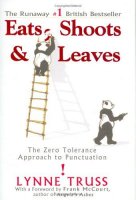
 Eats, Shoots & Leaves: The Zero Tolerance Approach to Punctuation, by Lynne Truss (Gotham Books, New York, 2003)
A panda walks into a café. He orders a sandwich, eats it, then draws a gun and fires two shots in the air.
“Why?” asks the confused waiter, as the panda makes towards the exit. The panda produces a badly punctuated wildlife manual and tosses it over his shoulder.
I’m a panda,” he says, at the door. “Look it up.”
The waiter turns to the relevant entry and, sure enough, finds an explanation.
“Panda. Large black-and-white bear-like mammal, native to China. Eats, shoots and leaves.”
Many thanks to DSTB for giving me this book, and thereby redeeming a past mistake on my part, made in response to a mistake on the part of our library.
I’d heard that Eats, Shoots & Leaves was a good book—though I knew little about it, as you will see—and so one day when I found it on tape at our library, I checked it out. I obviously was not paying attention when I put the cassette in our player, because apparently the wrong tape had been returned to the Eats, Shoots & Leaves packaging. What I heard was so uninteresting to me that I didn’t even finish the book, and don’t remember it now; it certainly wasn’t about punctuation.
“What?” you ask. “There’s something more boring than punctuation?”
Read Eats, Shoots & Leaves. You’ll never call punctuation boring again. You’ll laugh, and you’ll also learn.
One thing I learned is something I’ve suspected for a while now: the rules change when you cross the Atlantic. It’s not just the spelling (and pronunciation) of that metal out of which we make soda cans and “tin” foil. Truss encourages us to be sticklers for proper punctuation (hear, hear!)—a difficult enough task when bad examples surround us—but also cautions that sometimes what looks incorrect may be merely a cultural difference.
Be that as it may, the only thing that annoyed me about this short and pleasant book—and only as much as fingernails on a blackboard—was this British author’s persistent use of the British way of combining punctuation and quotation marks.
Many words require hyphens to avoid ambiguity: words such as “co-respondent”, “re-formed”, “re-mark”.
I would have called that plain wrong, but it turns out that putting the punctuation inside the quotation marks (<ahem> where it belongs!) is an Americanism.
Many words require hyphens to avoid ambiguity: words such as “co-respondent,” “re-formed,” “re-mark.”
I see the logic of the British system, but it still grates.
I also learned that there’s a reason for another annoyance ; this one is found in my beloved collection of George MacDonald books : What ? Colons, semicolons, question marks, and exclamation points ! find themselves preceded as well as followed by spaces. Truss provided the answer to my puzzlement: these books are facsimile editions, and that now strange punctuation procedure was at one time the Way Things Are Done.
Are you confused by the Way Things Are (or Should Be) Done Now? Check out Eats, Shoots & Leaves for some seriously amusing enlightenment.
A headline recently provided by my Google News feed illustrates the importance of correct punctuation.
Ratko Mladic arrested, Hillary Clinton in Pakistan
Imagine it now, without the comma:
Ratko Mladic arrested Hillary Clinton in Pakistan
Punctuation matters. So read, mark, learn, and inwardly digest—and enjoy!

