
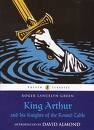
 King Arthur and His Knights of the Round Table, by Roger Lancelyn Green (Puffin Books, 2008)
I bought this book for my grandson, who so enjoyed Roger Lancelyn Green's The Adventures of Robin Hood. His mother reported that the Robin Hood book was "perfect" for him, but I wish I had read it myself, first, so I could compare it with King Arthur, since I'm having second thoughts. King Arthur has been read by and to children for half a century, and there's nothing at all inappropriate about it, but there are not a few battles in which people's heads get lopped off, and a few babies conceived under less than ideal circumstances (Arthur in a scenario not unlike Solomon's), and—perhaps more disturbing for a child—a couple of examples of children raised by others instead of their own families.
In other words, the stories are real, no matter how fantastic and mythical. They have not been cleaned up, Disney style. Which I say is all to the good, and makes this book great for adults as well as children. The Knights of the Round Table are not born saints, but learn chivalry through trial, error, sin, and forgiveness. Although the characters are shown to be complex, doing both good and bad, there is no question that sin is sin, and has terrible consequences, even though sometimes God brings good out of evil actions. The Church is central throughout, and miracles and magic abound, not surprising for a collection of Medieval (and earlier) romances.
Everyone should read Green's book who is past the age of being overly disturbed by fears of being taken from his parents and given to someone else to raise. Which brings me to the Digression: How did I get through 17 years of education, and more than three times that many years of life, knowing so little about the King Arthur stories? They make everything from the stories of C. S. Lewis and J. R. R. Tolkien to the operas of Wagner more understandable and enjoyable. They are clearly part of the foundational education that such writers assumed every one of their audience would have. They are a basic part of the heritage of Western Civilization. So why were they lacking in my education?
There's enough blame to go around: to me, for not seeking out the classics on my own; to my parents, for not seeing to this part of my education themselves; but mostly I am once again astonished that school should have devoured so many years of my life and not given back even the rudiments of this and other classic literature. Have we traded our birthright for a mess of...Disney?
I'm tempted to keep King Arthur for myself, but would I then be any better than my schools? :)

