
It's not a topic I'd intended to blog about, even though I'd read the AP article, Top home-school texts dismiss Darwin, evolution. But I wrote so much in a comment to a friend's Facebook post (thanks, Liz!), I figure it's a shame not to make a second use of the effort.
Our own homeschooling experience left me not particularly impressed with the efforts of specifically Christian publishers, beginning with the discovery that the A Beka kindergarten book I'd bought taught that winter is a time of snow, with no mention of the large part of the world where
that isn't true. I suspect most books at the kindergarten level are about
as bad, but A Beka is based in Pensacola, Florida, and should have
known better.
Nonetheless, I can't get very excited about the evolutionary shortcomings of some homeschooling textbooks. I'm more upset that mainstream publishers often won't sell to homeschoolers. Standard textbooks have plenty of problems as well, whether in science or history or literature, and the only hope of getting a reasonably clear story is to have plenty of resources, along with some training in logic. I well remember the astonishment I felt in college upon discovering that most of my (public) high school classes had lied to me. Not on purpose, perhaps, but by vast simplification they had left out most of the complexity, uncertainty, and beauty of the subjects.
Textbooks can sometimes be helpful, especially at the higher level, and most especially in subjects like math, but at best they are an introduction, or a supplement, and should be accompanied by other resources and experience as much as possible. Whatever your source of materials, if you don't include some dissenting voices, you're doing your students a disfavor. So why the fuss about these particular books?
I'm also one to cheer the underdog, because, having seen from inside how scientific publishing works, I know that Truth is pretty far down on the list when it comes to deciding what goes into the much-vaunted "peer-reviewed journals." There's a long history of established opinion being wrong, too.
But most of all, I'm in favor of the choice of what to teach and what materials to use being left up to the PARENTS and at some point the STUDENTS. If the kids grow up not knowing anything about evolution, that's bad—but in my mind no worse than if they grow up not knowing that there are serious disagreements and questions even among evolutionists, or not reading Shakespeare, or reading Judy Blume, or watching Saturday morning cartoons on television, or not learning to play the piano, or eating junk food, or a thousand other areas in which parents don't want ME making their childrearing decisions for them.
It's risky to leave the nurture and education of the next generation in the hands of their parents, but it's the safest risk we'll ever run, and necessary. If civilization is to survive, we need diversity—as every good evolutionist should agree.Permalink | Comments | Edit
Category Education Children & Family Issues
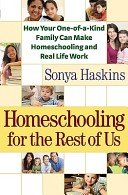 Homeschooling for the Rest of Us: How Your One-of-a-Kind Family Can Make Homeschooling and Real Life Work, by Sonya Haskins
(Bethany House, Minneapolis, 2010)
Sonya Haskins is a calm and reasonable voice speaking to the homeschooler—and potential homeschooler—who is overwhelmed and intimidated by the image of the "perfect" homeschooling experience: "Matching outfits, polite toddlers, award-winning students, fifteen-passenger vans, and family Web sites." (Raymond and Dorothy Moore did the same thing in the 1980s with Homeschool Burnout, which was updated and revised in the 1990s as The Successful Homeschool Family Handbook.) There's a lot of hype, confusion, and contradictory information out there, and Haskins' practical, back-to-basics approach and helpful suggestions will reassure timid beginners that they can, indeed, safely navigate the homeschooling waters.
It's a pity, then, that she "narrowcasts" her message to a small branch of Christian homeschoolers. Most of her suggestions are excellent and appropriate for anyone, but the evangelistic message and the assumptions of a young-earth Creationism are bound to make the general audience uneasy about the rest of the book. If its focus were broadened, this could become a classic introduction to homeschooling. But perhaps the author (or publisher) is not looking for "classic": the annoying sidebars and references to websites give it the feel of a magazine or "disposable book." As I said, a pity, because there's much good here.
A book of under 200 pages cannot hope to be both broad and detailed; Haskins elects for broad—one reason why it's good introductory material—but still manages to provide helpful lists and examples.
Rather than propounding one method of homeschooling, Homeschooling for the Rest of Us generally presents suggestions appropriate for many approaches. If she has an overarching philosophy, it is that character building is of primary importance.
Several years ago a mom came to me and asked how she should start homeschooling her children, then ages six and four. I suggested three things: reading to them frequently, training them to obey, and spending the first year or two focusing on relationships. In my opinion, it is that third step that isn't emphasized enough in homeschool households. We forget how important it is to teach our children how to get along, respect one another, and love others. Parents have plenty of time to introduce academics, field trips, and outside activities, but if children don't learn how to develop positive relationships while they are young, it is difficult for them to attain this ability later.
I meet parents all the time who are so proud that their two-year-old can recite the alphabet, but when the parent tells the child not to do something, she does it anyway. You can teach an obedient child new things, but it is very difficult to teach a disobedient child anything!
She is quite right, and I always say that the most important factor in determining the potential success of a homeschool situation is how well the parent and child get along. Emphasizing academic excellence while allowing character to slide is setting a child up for ultimate failure. Unfortunately, Haskins swings the pendulum too far the other way. Her lackadaisical approach to academics is likely to be taken by those who are already too lax academically as an excuse to do even less. Young children can learn obedience and the alphabet as well.
A basic belief among Christian homeschoolers is that the education of children is at heart a parental responsibility, not a governmental responsibility. Homeschooling for the Rest of Us goes an important step further, making the critical point that, ultimately, education is the responsibility of the student. (Unschoolers and secular writers such as John Holt and John Taylor Gatto would agree.)
Before the mid-1800s, the burden of education was not on the government. Nor was it on the parents.... Students knew that the burden of education was on their shoulders. If they wanted to learn something, they borrowed books or found someone who could teach them what they wanted to know. Education was considered a privilege.
When your child takes control of his or her education, this doesn't mean you throw discipline, structure, and guidance out the window. It simply means that you allow your child to be the one responsible for his education.... You may choose to continue with a schedule.... You might even choose to have a structured curriculum. But do not waste time every day arguing with a child about doing his schoolwork.
Here are a few more of my favorite quotes:
Over the years, I've discovered that the problem usually is not that [naysayers] disagree with the concept of homeschooling, but they think you disapprove of their choice to send their child to public or private school. Each of you surely loves your child, and opinions differ on many parenting issues, including discipline, eating habits, and clothing choices. But strangely, while friends can politely disagree on many things, it's often education choices that cause relationship problems.
[W]e parents should treat our children fairly, but there is a huge difference between fair and equal.
If you're still feeling pressure because experts or others tell you to "do it this way" or "if you'd only follow my plan, your life will be perfect, your children will obey, and they will love learning" or any other "just do it my way" kinds of statements, my advice is simple: Find different experts!
I'm not convinced that Homeschooling for the Rest of Us is a book worth buying, though at $10 it's hard to complain much. In any case, if you're new to homeschooling, frustrated in your own homeschooling efforts, or merely curious, and if you can appreciate—or at least ignore—the narrowness of its theological focus, it's a book well worth reading. But please don't let her minimalist approach to academics deprive your children of the educational excellence they can and should achieve.
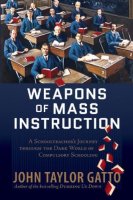 Weapons of Mass Instruction: A Schoolteacher's Journey through the Dark World of Compulsory Schooling, by John Taylor Gatto
(New Society Publishers, Gabriola Island, BC, Canada, 2009)
A pastor I know was fond of quoting Martin Luther, who, when asked why he preached on justification by faith every week, responded, "Because you forget it every week." John Taylor Gatto has no love for Martin Luther, but I can imagine him giving a similar response when asked why his books, articles, and lectures include so much that he has said before. He has a critically important message to deliver, and is clearly compelled to repeat it as many times and in as many ways as he can.
In his desperation to make people understand what he has learned, from his research and 30 years on the front lines of teaching, Gatto has become more pointed, strident and radical as time goes on. It's an understandable reaction—I remember noting the same effect in John Holt's writings, and I fall prey to it all too often myself—but for this reason I hesitate a little to recommend Weapons of Mass Instruction to anyone who is not already convinced of the dangers inherent in our pubic school system. And yet...I do recommend it, highly. Why? Let me digress.
Back in the 1980's, we attended a Christian Educators Association conference at which one of the speakers warned of the horrors being perpetrated against children in the public schools, largely under the guise of "affective education," "values clarification," "guidance classes," and the like. I was appalled, not at the reported abuses, but at the nature of the presentation, which was inflammatory, not particularly helpful, and seemingly intended to induce panic in susceptible parents. What was being reported was so much at odds with our own experiences—as public-schooled children ourselves, and as the parents of children in public elementary school at the time—to be believable.
But here's the thing: It was true. Even though I reacted badly to the presentation, the information stayed in the back of my mind and kept me alert to the problem. Coming across information from my brother's elementary school days, I learned that he had been involved in some of the harmful programs. (One notorious discussion was of the form, "You are in a lifeboat with seven other people: a teacher, a doctor, a priest, etc....there isn't enough food for everyone to survive...whom do you throw overboard?") I waded through pages of transcripts of U. S. Department of Education hearings, and heard parents testify over and over again about the abusive nature of the discussions their children were forced to participate in, and the intrusive questions they were asked. Then I knew enough to examine the materials used in our children's school, and found one of the by now well-familiar programs. Why hadn't I noticed the problems before? Two reasons: one, I didn't know to look, and two, their intelligent guidance counsellor had modified the program to eliminate the worse of the offenses. I had been right: what they had experienced was (thanks to that particular guidance counsellor) not all that bad. But being alerted to the potential risk enabled me to forestall future problems.
This particular issue is not mentioned as part of Gatto's "dark world of compulsory schooling." I present it as a cautionary tale, hoping that even the most enthusiastic supporter of modern American education will read, contemplate, and remember the information in Weapons of Mass Instruction. Not to change your mind, but to raise your awareness, to forewarn and forearm you. If you read this, or any of his other books, such as Dumbing Us Down, A Different Kind of Teacher, or The Underground History of American Education, you will be better prepared to navigate the course of your children's education, and may find some light shed on your own.
Weapons of Mass Instruction contains much of the shocking story of how we got our present educational system, in a shorter and more easily readable form than The Underground History of American Education, though the latter (available online in its entirety) has more details, examples, and references. Follow the twisted path of compulsory education from militaristic Prussia to the industrial United States; check out its dark relationship with the eugenics movement; face the question of whether great philanthropists like Andrew Carnegie and John D. Rockefeller were helping people or preparing an easily-exploitable labor force; and wonder why a self-described lapsed Catholic, libertarian New York State Teacher of the Year (Gatto, born 1935, writing about education), tells much the same story of that era as a distributist, English, Catholic convert journalist (G. K. Chesterton, 1874-1936, writing about eugenics), and a conservative, Evangelical Protestant theologian living in Switzerland (Francis Schaeffer, 1912-1984, writing about philosophy). When people that diverse agree on something, I say it's worth listening.
If you have a couple of hours to spare, you can listen to many of the ideas and stories from Weapons of Mass Instruction on this C-Span program from last March.
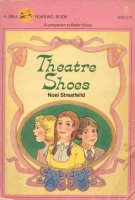 Theatre Shoes, by Noel Streatfeild (Dell, New York, 1983)
This wasn't on my reading list at this time, but the combination of (1) hearing a Teaching Company lecture about The Tempest and remembering the part it plays in this book, and (2) a dreary, chilly, rainy day in which the computer, the dryer, and the telephone all suddenly stopped working, led me to feel that what I needed was a bit of curling up by the heater with a blanket, a cup of tea, and an easy-to-read, uplifting book.
Written in 1945, Theatre Shoes is a delightful story set in World War II era England, and puts into perspective the problem of a few recalcitrant appliances. It's a children's book, but quite suitable for adults looking for comfort. I've said many times that you never outgrow good books.
We also have Streatfeild's Dancing Shoes and Ballet Shoes, but I think this is my favorite. It's better written, more realistic, and less sappy than A Little Princess, but contains a similar theme of responding to bad times with good attitudes. In this day of whining, fault-finding, and the victim mentality, such a reminder is a good encouragement. It reminds me of a passage from Arthur Ransome's Swallowdale. (Perhaps one of the reasons I like Theatre Shoes is that it mentions the Ransome books.)
"They look happy enough," said Captain Flint, watching the Amazon slapping across the ripples on her way to Horseshoe Cove.
"They aren't," said Captain John.
"Ï know they aren't, but the next best thing to being happy is to look it."
Permalink | Comments | Edit
Category Reviews Children & Family Issues
Jennifer at Conversion Diary is turning 33, and asked her readers what they would say to their 33-year-old selves if they could. That's the kind of challenge I can't resist, and neither can I resist recycling what I wrote as a blog post. It's pretty much just off the top of my head, and in no particular order, but here are a few of the things I wish I could have told myself.
- Have more kids. There were some good reasons why we didn't, but a very bad reason was buying into the "you can't afford it and neither can the world" mentality. If you haven't lived through it, I don't think you can fathom how much pressure there was in those days to have no more than two children.
- Expect much more from your children than society does, on every level. From the day they are born, your children can learn more, do more, and behave better than you will be told is possible. Don't limit them with your low expectations.
- Homeschool. Homeschool. Homeschool. From the beginning, and never look back. This is one of the best decisions we ever made, and I wish we had never subjected our children to the "school mindset." But when I was 33, school was "the way things are done," and I never questioned it till years later.
- "Bloom where you are planted." Make the most of your present situation, because you never know when it will change.
- Keep a journal, take pictures (and label them!), make recordings. Concentrate on people and places dear to you—there are plenty of professionals documenting the rest of the scenery.
- When you videotape your children's performances, be sure to include their friends as well. You may not care, but your children will!
- Talk with older family members about their childhoods and their life stories, and get everything you can from them about your ancestors and family history. Make sure their pictures are labelled!
- Take care of yourself. When you have young children at home, it's very easy (and seems virtuous) to shortchange yourself when it comes to sleep, exercise, education, and the care of your soul. Make yourself make time for these things. Enlist the aid of your spouse—I don't mean to tell you what to do, but to make sure you get the time to do it. Your children will thank you later.
- If you are too busy to get organized, you are too busy not to get organized. Make the time (and again, get your spouse to help). There is no moment better than now; that mythical time "when I have time" will never come. Never give up; experiment with different systems till you find one that works for you. Be prepared to alter it as needed, however, when your circumstances alter.
Permalink | Comments | Edit
Category Children & Family Issues Random Musings
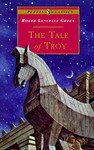 Tales of the Greek Heroes by Roger Lancelyn Green (Puffin Books, London, 2002) and The Tale of Troy by Roger Lancelyn Green (Puffin Books, London, 1994)
These two books are meant to be read together, with the story of Troy second.
After my very positive experiences with Green's books on Robin Hood, King Arthur, and ancient Egyptian stories, I expected too much of these two. I still recommend them; they are worth reading, and I found that within a week something I read there helped me understand a story I heard later. Nonetheless, there are drawbacks.First, they are ambitious, especially Tales of the Greek Heroes. Green's scrupulous attention to historical and literary accuracy is commendable, as is his desire to present the stories in a manner that demonstrates their logical and chronological connections. However, although I consider myself moderately familiar with Greek and Roman mythology, I soon found out how little I really know. These books are written for children—for example, he gives a clear, age-appropriate explanation of why the Immortals had so many wives, not pressing the distinction among wives, lovers, and victims of assault—but with children I wouldn't begin here. Perhaps the D'Aulaires' Book of Greek Myths would be a better introduction. I found all the names of the Greek Heroes, Immortals, and mortal men (and women) to be terribly confusing—I, who had no trouble whatsoever keeping track of all the characters in The Lord of the Rings. Pronunciation would be a read-aloud nightmare, too.
Then there's the matter of content. I am reminded of why I never made it through The Iliad, getting heartily sick of all the battle scenes early in the poem. And why G. A. Henty's With Lee in Virginia left me groaning, "Not another eight paragraphs on battle strategy!" even though I've like most of the Henty books I've read. Those who enjoyed the endless battles in the movie version of The Lord of the Rings may do fine with this, but there's only so much swaggering pride, battle lust, and vengeance I can take.
One surprising effect it all had one me: I came through it with a better appreciation for spectator sports. By all means, let the screaming, foaming-at-the-mouth Gator fans swear vengeance on the equally insane Seminole fans. As the history of man goes, it wasn't all that long ago they were tossing boulders instead of basketballs, swinging clubs instead of baseball bats, throwing spears instead of footballs, and sacrificing daughters instead of holding tailgate-party barbecues.
In some ways, however, things haven't changed much.
The ancient Greek stories, like the Bible, Shakespeare, and much of what is called classic literature, are important to know because of the insight they give into human nature, history, and culture, whether or not one appreciates the content. And like all great literature, they won't be mastered through one book, nor in a single reading. Green's books may not be the best introduction to the topic, but they'd be a great second or third step.[Heracles] wandered far and wide until at length he came to another cave in which he found a mysterious creature. [He asked,]
"Strange maiden, have you seen my horses?"
"Yes," she replied, "it was I who took them in when they strayed this way. But I will never give them up to you, unless you wed me, according to the custom of this country. Here we are married when we have kissed thrice; and the marriage lasts only for as long as we both wish it."
Permalink | Comments | Edit
Category Reviews Children & Family Issues
My recent visit with our grandchildren reminded me of why I don't like video/computer games. I don't mean I don't like to play them; I know all too well how addicted I can get if I allow myself to get started.
It began, of course, with television. When the technological wonder entered my home when I was seven, I was already familiar with its delights, thanks to the generosity of our neighbors. We matured together, television and I, and with such a sibling it's no wonder we bonded strongly as the years passed. It was not a healthy bond, and I'm thankful that I went to college before televisions were ubiquitous in the dormitories, because those four years of abstention were the beginning of my liberation. It would be many years and much struggle before I could declare myself free, but never again would the glowing opium box control my life.Well, not that glowing opium box, anyway.
It was Marie Winn's The Plug-In Drug—confirmed by my own experience—that showed me the greatest problem with television, as a medium, and it's not the content. Certainly, content is important: it's better to eat nutritious food than junk food, and better to eat either than poison. But as many of us can attest, even good food, in quantity, becomes poison to our bodies. Television, at its best, is an unparalleled tool for learning and cultural enrichment. But it has a terrible tendency to become addictive, fostering increasing demand and decreasing quality. There is a version of Gresham's Law for television viewing, apparently.
Eschewing broadcast and cable television for carefully selected DVDs, while certainly a good thing, often misses the main point. The question ought always be asked, "Is this a better use of my (or my children's) time than the alternatives, e.g. reading, making Lego creations, or playing outside?" One of television's very unfortunate effects is to make itself more attractive than other, more valuable activities, just as lesser shows are almost inevitably more attractive than the better ones. Why this is true is a mystery. Some have posited physical changes made to the brain by the medium itself, which would also explain the similar addictive properties of video/computer games and computers in general.
As a mother and homeschooler I learned that children have a marvellous capacity to entertain and educate themselves, and can be trusted to make good use of every waking moment—and to accept sleep when that is the best use of their time. The more I observe, however, the more I realize that what has been true for millennia is no longer. Children who have been crippled by television and other video screen experiences have lost this capacity. Even in our grandson I saw the terrible tendrils of whatever it is that sucks the life from us: although his family owns no television, and only occasionally watches DVDs; although the computer games he sometimes plays with his dad are of the older, less flashy variety; although he has a wonderful, vivid imagination and can entertain himself (and his siblings) for hours; nonetheless, when I was in charge for a day, pretty much the only thing he wanted to do was play video games—at least until Grandma hardened her heart and proved she wasn't quite the soft touch he had hoped.
Who has not known college buddies who will spend every free moment (and many that are not, technically, free) with online, multi-player games? Whose Second Life is more important than their first? Teenagers retreating to their iPods/iPhones and choosing games over real-life interaction? Young children in cars with the wonders of the countryside flowing past them but their eyes unmoving from their flickering portable DVD players? Middle-aged wanna-be writers and amateur genealogists who spend so much time at the computer that OSHA would crack down if it were a workplace scenario?
Computers, video games, and television are wonderful, useful additions to our collection of tools for living and learning. Even for loving; if e-mail, Skype, and blogging will never replace physical interaction, anyone who has family in faraway places knows how valuable they are for nurturing human relations. The price exacted may be terribly high, however, if we cannot be the masters of our tools rather than their slaves.
Abstention, if difficult, is always easier than control, as any Alcoholics Anonymous member knows, but when the thing is good, control is the better path. Sometimes, as with eating, it's a necessary path. These days, computer use is nearly in the category of necessity, and therein lies my problem. Nearly everything I do involves sitting down at the computer. Writing, reading, researching, communicating, paying bills, organizing photos, staying informed, shopping, creating educational materials, keeping track of finances, organizing addresses and other information—all these and much more are now done, and often done better, with the use of a computer. No doubt this tool saves us time, but as with most so-called time-saving devices, it may give us minutes with one hand only to take away hours with the other.
As I once asked when contemplating allowing our children to watch Mr. Rogers' Neighborhood on a daily basis, "What is not being done during the time dedicated to this activity?" There is an opportunity cost in time as well as in money, a far more serious cost, because if time can be saved, it cannot be banked, and moments wasted are lost forever. The time we spend in front of the television, playing video games, and working on the computer was, not that long ago, available for other projects. What have we gained? What have we lost?Permalink | Comments | Edit
Category Computing Children & Family Issues Everyday Life
School at the Daley household could hardly have been called normal, since Grandma was there as a distraction and Mommy was sick for the first part of my visit. Nonetheless, I enjoyed my glimpse into the official, sit-at-the-table side of their 24/7 educational process.
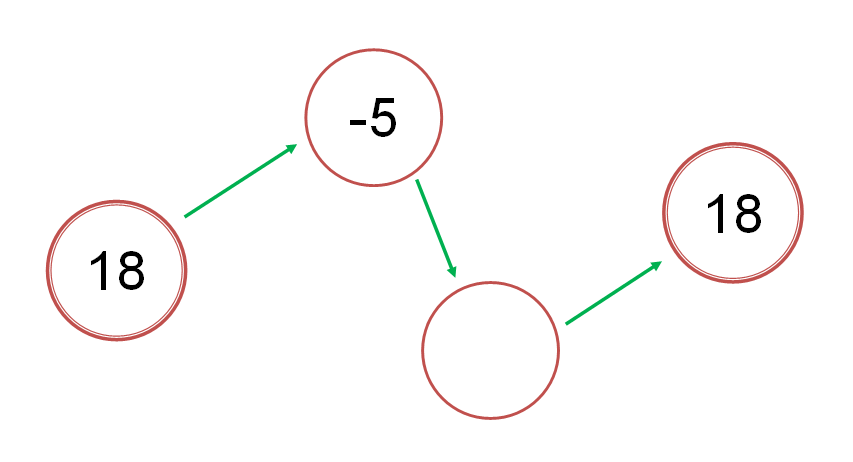
Jonathan is not at the moment as excited about math as he is about reading—unlike his Aunt Janet at that age, for whom reading was all right but math was a bowl full of candy. He's doing well, though, with basic addition and subtraction (and even some simple multiplication and division), and enjoys the "math paths" that Grandma sends him in the mail, problems like this one:
Permalink | Comments | Edit
Category Education Children & Family Issues Everyday Life
If there's an advantage to Mommy being sick, it's that Grandma got to supervise, i.e. watch, Noah doing his chores. His is not a difficult regimen, but still pretty impressive for a three-year old, particularly the enthusiasm with which he demonstrated his skills.
- Clear his own breakfast dishes off the table and put them in the dishwasher.
- Brush his teeth.
- Make his bed.
- Sweep under the table, which is only fitting, since most of the crumbs seem to be his.
- "Help Mommy," which on this particular day meant cleaning the tub in the bathroom.
If you were to suspect that a tub cleaned by a three-year-old does not get quite as clean as it might, you would be right, particularly since his cleaning agents are baking soda and water. But the result is good enough, and the investment in future "help Mommy" assistance priceless.
I did not watch Jonathan doing his chores, so I can't chronicle them, but he did proudly show me his sparkling clean bathroom sink.
The boys also do laundry, taking the clothes downstairs, putting them in the washer, adding the detergent, and making sure all the settings are correct. (Some strategically placed stickers help with the last.) Later, they do similar honors for the dryer stage. A rug covering the basement floor in the laundry area mitigates any problems when articles of clothing get dropped in the transfer process.
If they are not so good at remembering to subsequently retrieve the dry clothes and bring them upstairs...well, neither is Grandma.Permalink | Comments | Edit
Category Children & Family Issues Everyday Life
The future may belong to the Indians, or perhaps the Africans—or anyone who grows up in a multilingual environment. Adding to the evidence of the benefits to the brain of speaking multiple languages is the research of Lera Boroditsky at Stanford University. (Newsweek article by Sharon Begley.)
When the world's tallest vehicular bridge,* the Viaduc de Millau, opened,
German newspapers described how it "floated above the clouds" with "elegance and lightness" and "breathtaking" beauty. In France, papers praised the "immense" "concrete giant." Was it mere coincidence that the Germans saw beauty where the French saw heft and power?
Not coincidental, and also not conforming to my stereotypes, in which Germans focus on strength and organization while the French are concerned with beauty and grace. However,
In German, the noun for bridge, Brücke, is feminine. In French, pont is masculine. German speakers saw prototypically female features; French speakers, masculine ones.
Nor is this an isolated phenomenon.
Germans describe keys (Schlüssel) with words such as hard, heavy, jagged, and metal, while to Spaniards keys (llaves) are golden, intricate, little, and lovely. Guess which language construes key as masculine and which as feminine?
Our language shapes not only our thoughts but our very ability to see. People whose language has more precise words discern differences faster and better. Russian, for example, has separate words for what English calls different shades of blue; experimenters found native Russian speakers to be faster than English speakers at distinguishing the differences.
Similarly, Korean uses one word for "in" when one object is in another snugly (a letter in an envelope), and a different one when an object is in something loosely (an apple in a bowl). Sure enough, Korean adults are better than English speakers at distinguishing tight fit from loose fit.
In Australia, the Aboriginal Kuuk Thaayorre use compass directions for every spatial cue rather than right or left, leading to locutions such as "there is an ant on your southeast leg." The Kuuk Thaayorre are also much more skillful than English speakers at dead reckoning, even in unfamiliar surroundings or strange buildings.
There's more to this than the obvious thought that knowing multiple languages opens the mind to more ways of thinking and perceiving. The most potent statement in the article is this:
Having a name for something allows you to perceive it more sharply.
People have wondered why I am so interested in the idea of sharing "encyclopedic knowledge" (sometimes derided as "baby flash cards") with very young children. (I've written a small bit about it at Jonathan's Happy Hunger.) This connection between naming and perception underscores one of the primary reasons: the more one knows, the more one sees...and generally, the more one enjoys, as well. Whether it's birds or automobiles or paintings or constellations, knowledge increases both observation and enjoyment, which in turn increase appreciation, respect, and the desire for more knowledge.
Maybe if Adam had taught Eve the names he gave to all those animals, her thirst for knowledge wouldn't have led her in the wrong direction.
Permalink | Comments | Edit
Category Education Children & Family Issues
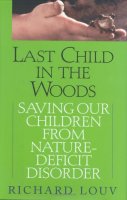 Last Child in the Woods: Saving Our Children from Nature-Deficit Disorder, by Richard Louv (Algonquin Books, Chapel Hill, North Carolina, 2005)
I'm sorry to say I gave this book short shrift, but reading time has been scarce lately, and I must return it to the library today. I can say, however, that it is a must-read for anyone who is not already convinced that children need, as one of life's basic necessities, plenty of time in the natural world: hiking, camping, and learning with their families, building forts and tree houses, exploring on their own, and just being in the world of bugs and fish, stars and sand dunes, trees and caverns. If for you this kind of exhortation is preaching to the choir, it's probably still worth at least skimming it as much as I did, if only for the shock value of learning that today's children are even more cut off from such activities than you had imagined.
I grew up on the edge of a new housing development; unlike the projects I see today, this one was slow to develop, and so we enjoyed many years of free exploration in woods and field: climbing trees, building tree houses, following streams, skating on frozen ponds, and observing wildlife. Nowadays such activity is often illegal.
The cumulative impact of overdevelopment, multiplying park rules...environmental regulations, building regulations, community covenants, and fear of litigation sends a chilling message to our children that their free-range play is unwelcome, that organized sports on manicured playing fields is the only officially sanctioned form of outdoor recreation.
Children's play has become boxed in, tied up, neatly organized, and often commercial. Parks favor sports fields—often used more by adults than children—rather than space for free play.
[V]acant lots are vanishing, and the nature of suburban development is changing. Suburban fields that might have been left open in earlier decades are being erased, replaced by denser, planned developments with manicured green areas maintained through strict covenants.
It takes time—loose, unstructured dreamtime—to experience nature in a meaningful way. Unless parents are vigilant, such time becomes a scarce resource, not because they intend it to shrink, but because time is consumed by multiple, invisible forces; because our culture currently places so little value on natural play.
Fear is the most potent force that prevents parents from allowing their children the freedom they themselves enjoyed when they were young. Fear is the emotion that separates a developing child from the full, essential benefits of nature. Fear of traffic, of crime, of stranger-danger—and of nature itself.
The author deals well with this fear, debunking some myths, and more importantly encouraging parents to help ther children avoid and handle genuine dangers, teaching them specific skills and offering "controlled risk" situations for growth.
"Every year since 1950, the number of American children gunned down has doubled." So goes a widely quoted statement, which originated in a Children's Defense Fund report in the mid-1990s.
I like that one. Do the math.
Some of our most prominent and revered conservationists developed their love of nature through direct childhood experiences, including such now-distained activities as hunting, fishing, and pinging seagulls with a BB gun. Today's environmentalists predominantly trace their activism to their own unstructured play in natural habitats. Many of these same environmentalists, however, are curiously uninterested in reaching the next generation, or providing for them the same experiences that nurtured their own love of nature—perhaps, the author suggests, because children, overpopulation, and environmental degradation are solidly linked in their minds. If so, they—and the environment they love—may suffer the same fate as the Shakers. Even the national parks are in danger of losing support, as fewer families visit them for camping and wilderness hiking.
As [national park] officials work to make parks safer and more accessible, the outdoors often ends up feeling more like Disneyland than wilderness. Some kids end up disappointed that the parks aren't more Disneyesque. When middle school students sent me their reflections on nature, one boy reported visiting Utah's Rainbow Bridge National Monument, the world's largest natural bridge, which was carved out of the cliffs above modern-day Lake Powell over thousands of years. "The bridge was somewhat disappointing. It was not as perfect as in the brochure," the boy wrote. His parents enhanced the family vacation by renting Jet Skis.
Even when I was young, the Girl Scouts were far inferior to the Boy Scouts when it came to wilderness skills and experiences, but the situation for girls has gotten far worse. Madhu Narayan and Karyl T. O'Brien are executives with the Girl Scouts in the San Diego, California area.
[The] overwhelming majority of Girl Scout programs are unconcerned with nature. Included (along with selling cookies) are such offerings as Teaching Tolerance, Tobacco Prevention, Golf Clinic, Self-Improvement, Science Festival, EZ Defense, and Financial Literacy. Soon, Camp CEO will bring businesswomen to a natural setting to mentor girls in job interviewing, product development, and marketing. The divide between past and future is seen best at the Girl Scout camps in mountains east of the city: one is billed as traditional, with open-air cabins and tents hidden in the trees; the newer camp looks like a little suburbia with street lights. "I flipped when I learned that girls weren't allowed to climb trees at our camps," says O'Brien. Liability is an increasing concern. "When I was a kid, you fell down, you got up, so what; you learned to deal with consequences. I broke this arm twice," says Narayan. "Today, if a parent sends a kid to you without a scratch, they better come back that way."
There's more book, but no more time.
Permalink | Comments | Edit
Category Reviews Children & Family Issues Conservationist Living
A common theme over at the Front Porch Republic is a respect for place: for home and community, for not only eating locally but being locally, staying in (or returning to) one's hometown rather than venturing off to "better" places. The article Root Hog or Die is where I chose to ask a question that has been bothering me about this approach to life, much as I like some of the ideas.
I’ve moved enough times in my life to know I hate it. (The only time I didn’t was when moving from an apartment to our first house, just a few blocks away.) I grieve that my present grandchildren live an 18-hour drive away, and some future grandchildren are likely to grow up where I can’t visit them without a passport. Our extended family makes a point of getting together at least twice a year—but that’s not the same as being able to drop by my nephew’s house for an impromptu cello concert, or to comfort my grandson when he is sick.
That said, I want to ask a question that has bothered me ever since I first encountered the stay-home ideas here at the FPR. Having done extensive genealogical research, I know that the best thing my maternal great-grandparents did for me was to get out of their West Virginia town. Among those who remained, the incidence of “father unknown” on the birth records is depressingly high.
Moreover, I noticed that each of my hated moving experiences provoked growth in my life and that of others. In my own (highly-rated) high school the brightest, most interesting students were almost always those who had come from elsewhere, not because of any deficiencies in the local population, but because the non-locals had a wider range of experience from which to draw. I like to think our different perspectives brought enrichment to our fellow-students as well.
I wish we could have it both ways. Home, as my friends and family will assure you, sometimes with exasperation, is my favorite place to be—wherever home happens to be at the moment. I wish my entire family were no more than an hour’s drive away instead of spread across the country and the globe. But living, at least for a while, in Japan, and Costa Rica, and Switzerland, and Italy, and yes, Pennsylvania, Florida, Washington, Massachusetts, and many other states, in small towns and suburbs, in cities and on farms, has brought such richness to our family that I wouldn’t have it otherwise.
How does the philosophy I see here at the FPR allow for such enrichment, such growth, such joys?
If there's a good response I'll include it here in the comments.
What is my home? Eastern upstate New York, where I grew up? Eastern Pennsylvania, where I also grew up? Western New York, where our children were born? Florida, our home for most of the last quarter-century? My two parents and four grandparents were born in New York, Washington, West Virginia, Missouri, Pennsylvania, and Florida—representing the middle and three of the four corners of this continental United States. How far back do I go to find my "family" home? Do I go back to England, Ireland, Scotland, Wales, Germany, France, or the Netherlands?
These ruminations were sparked in part by what I learned recently about the Swiss system of citizenship, which perhaps reflects, at least in principle, the rootedness extolled at the FPR. Swiss people are not citizens of Switzerland, per se, but of their family’s home town, which may be neither the place they were born nor a place they have ever lived. Children and wives take on the citizenship of the father/husband, which probably would make me a citizen of Quidnessett, Rhode Island, if not of somewhere in England. Mindboggling.
Ancestral lands or no, "home" to me would ideally have all family members (children parents, grandparents, uncles, aunts, cousins, siblings, in-laws) living close enough together for casual visits, mutual support, and tremendous Memorial Day picnics, while at the same time providing for all the enrichment of life that comes from extended immersion in other cultures, both the cultures of foreign lands and the alien cultures in our own country. (If you doubt we have alien cultures in our own country, you've never experienced the contrast between New England and the South, let alone Middle America and California.) So it's impossible: but what kinds of attitudes and actions could bring us closer to the ideal?Permalink | Comments | Edit
Category Genealogy Children & Family Issues Random Musings
A friend alerted me to an article on midwives from the May 20, 2009 Orlando Sentinel. It's about a recently-developed program of the Orange County Health Department that provides hospital-based midwife services for low-income women in the Orlando area, and told me some things I didn't know about midwives and Florida law.
Knowing from experience that links to Sentinel articles break after a while, I'll provide a few relevant excerpts below.
The program came about after health officials took notice of the positive birth outcomes of women who were working with local lay midwives. Florida is one of only four states in the country where women with little medical training can be state certified as midwives....Legal practice of [lay] midwifery in Florida—one of 25 states that regulate midwifery—is done by Certified Professional Midwives, who must complete training and meet clinical requirements.
"We were seeing low cesarean rates and very low percentage of low birth weight babies," said Dr. Kevin Sherin, Orange County Health Department director. "It was sort of a natural to bring together their successful practice and our resources."
For those of you following the trial of Judy Wilson, Judy is a Certified Professional Midwife. According to this state-by-state chart from the Midwives' Alliance of North America, the statement that Florida is one of only four states to license lay midwives is incomplete; many other states have licensing procedures in a different form.
But instead of lay midwives, the county hired five certified nurse midwives to work with women at the Lila Mitchell Health Center in west Orlando, where about half the patients are uninsured and the other half are on Medicaid. The clinic also serves a largely black and Hispanic clientele....Certified nurse midwives, like doctors, can use some medical intervention including electronic fetal monitoring, labor-inducing drugs, pain medications and episiotomies.
I'm all in favor of Certified Nurse Midwives—especially the one that delivered Faith  —though it should be clear from all the medical interventions listed that they're operating from a different model of care from the midwife in Amish country who delivered Jonathan and Noah. "Electronic fetal monitoring, labor-inducing drugs, pain medications and episiotomies" are, in my experience, what people who employ the services of midwives are seeking to escape. This route is not for everyone, however, and Orange County's hospital-based choice appeals to many of the women they hope to reach.
Like a lot of women, Tiana Marrero thought having a midwife meant giving birth at home. "I was kind of scared," said the west Orlando resident. "Once they broke it down for me, I learned it was a good program that gave you a lot of good information about having a healthy baby.....They give you personalized service. They make you feel comfortable."
"In Hispanic countries, women know all about midwifery. When we tell them about it, they say, ‘Oh, yeah, partera," said Alyn McGee, a certified nurse midwife, referring to the Spanish word for midwife. McGee said women from the Caribbean islands are also well-versed in the practice. Other women, like Marerro, get on board once stereotypes about midwives are debunked.
"There's a lot of education that goes on," said Stacey Gruka, a certified nurse midwife. "When they find out a midwife isn't someone wearing hoop skirts and lighting candles, they feel better about participating."
I don't remember any hoop skirts, nor can I imagine a midwife wearing one—it would get in the way, horribly. I don't remember candles, either, but they may have been an option. I wonder how wide-spread that stereotype is.
It seems to me that hospital-based midwifery is providing the care that obstetricians gave in the 70s and 80s, back when our children were being born. The practice of obstetrics has changed radically since then, as I wrote in Options in Childbirth. All women should have legal access to home birth, free-standing birth centers, and midwives for whom medical intervention is a last resort rather than a first response, but Orange County's program is a good middle ground.
So far, the program, under way since last October, has had a cesarean rate of less than 10 percent and low percentage of low birth weight babies. The average cesarean rate is 30 percent for pregnant women who don't have pre-existing conditions such as high blood pressure or HIV infection.
Permalink | Comments | Edit
Category Health Children & Family Issues
Daniel Hauser, a 13-year-old boy with cancer, is being forced to receive treatment that both he and his parents have refused.
I often find myself in the minority when I argue for parental rights. Doctors, teachers, social workers, and "concerned citizens" fret over the idea that parents should be allowed to make decisions that they believe are not in the bests interests of their children. In one sense it's hard to blame them, as these are often people who are in a position to see better than most the consequences of physical, emotional, and educational neglect and abuse."It is imperative that Daniel receive the attention of an oncologist as soon as possible," wrote Brown County District Judge John R. Rodenberg in an order to "apprehend and detain....His best interests require it."
However, I insist that, other than in exceptional and egregious cases of insanity or malicious, criminal intent on the part of the parents, we cannot afford to entrust the care of children to anyone else, least of all a bureaucracy. There's a quote from Rabindranath Tagore that I like: He alone may chastise who loves. I would also say, "He alone may decide who loves." No one else, ultimately, can be trusted. The judge in this case may be right, he may even be wise, but in no way can we pretend he loves Daniel.
Do I think parents make stupid mistakes? Yes, yes, yes! I've made enough myself. This is where the community comes in, providing education, encouragement, and role models—but never, unless in cases of proven criminality, legal coercion.
Medical ethicists say parents generally have a legal right to make decisions for their children, but there is a limit. "You have a right, but not an open-ended right," Arthur Caplan, director of the center for bioethics at the University of Pennsylvania, said last week. "You can't compromise the life of your child."
Sounds noble, but consider what it could lead do. Forced Caesarean sections if a doctor thinks childbirth might be risky? Forced sterilizations of "unfit parents"? Court-ordered immunization of children using controversial vaccines? Jehovah's Witnesses are already being court-ordered to compromise their children's souls through blood transfusions. (For the record, I don't agree that blood transfusions are a spiritual danger, though they may be a physical one. But choose your own belief—what if a court ordered you to do something you knew would harm your child?) It means very little to me that the overwhelming majority of medical opinion be against the parents; at one point in time, the overwhelming majority of medical opinion was in favor of bloodletting as a treatment, and many patients died because of it.
If the rights and responsibilities for children are not to rest securely with the parents, where shall they lie? Whom do you trust more than yourself to make decisions for your family? I trust (and rely on) many sources for advice, example, and support, but none—least of all a bureaucracy—for the final decision. Parents can and will be wrong, but they are still the best hope for children. The argument is often made that "if one child is saved" through bureaucratic intervention, that is sufficient justification. What this logic misses is how many children are irreparably damaged by such intervention. First, do no harm.Permalink | Comments | Edit
Category Health Children & Family Issues
It seems appropriate that Katherine Dalton's The Immoral Life of Children should appear on the Front Porch Republic just after a conversation I had with Heather about children's art books. A friend of hers uses a particular homeschooling curriculum that she likes, but finds herself censoring certain illustrations in the art history sections that she deems inappropriate for elementary-age children.
I happen to disagree with this mother's approach. Not that there isn't plenty of so-called art that I wouldn't want our grandchildren to see—pretty much the same art that I don't want to see, myself—but I have no objection to art nudes, per se, even for young children. It may be that the Supreme Court will soon be unable to tell the difference between Michelangelo's David (picture alert) and something indecent, but I can. :) However, I don't understand the publisher of that curriculum. If I think (as I do) that there are works of art which everyone should be able to recognize and appreciate, and if the list happens to include nudes (as it does), nonetheless I can't think of any potentially offensive work that is critical for an elementary-aged child to view. Any introduction to art necessarily excludes vastly more than it includes; one ought to be able to put together quite an impressive elementary-age art curriculum without tempting mothers to deface the pages of the books. What bothers me more is that this mother's over-protectiveness seemingly precludes taking her child to an art museum, an omission I think of much graver consequence.But I hail and commend this woman as a contrast to most of us, who, perhaps for fear of being thought overprotective ourselves, close our eyes to the onslaught of evil our little ones cannot avoid without our help—if at all. Dalton's article is at the very least a reminder that not being able to do everything is no excuse for not doing what we can.
A few weeks ago a friend’s ten-year-old daughter came home from school, turned to her mother with a frown, and speaking low, so as to stay out of earshot of a younger sibling, asked, “Mom, what does the word ‘contraception’ mean, and what does a sponge have to do with it?” You would think she’d been talking to a classmate, but no; as it happened she had read this in a book on Ancient Rome....[T]he information came from an Usborne book. In other words, it came from a book written and designed for children.
[My own fourth-grade daughter] and her father tackle the Jumble word puzzle which lies opposite the comics page in our increasingly thin Louisville Courier-Journal. This is a new game for them, and it took a day or two for my husband and I to notice that right above ATCATK and YLROLWD lies the “Annie’s Mailbox” column, with its sad parade of grief, trouble and abuse. We cut or fold the page now....I have to scan the covers of the political/literary magazines I take; I ran a permanent marker through a cover headline in the Atlantic the other month, in order to be able to keep the magazine around the house till I’d read it....Women’s and health magazines are typically so indecent that on the rare occasions I have one around I hide it.
[W]ith the exception of certain slurs there is no limit on what is deemed appropriate public language, and that what is appropriate language for adults is assumed to be appropriate for the children who follow in their wake. News is reported in a way that takes for granted children either aren’t listening or don’t matter.
The definition of adult-appropriate language and topics has changed in the last three or four decades to include words and speculations no one would have discussed before, outside a law court or an exceedingly frank one-gender get-together. These words leap out from everywhere—the TV, radio, newsstand, book store display, and conversations overheard on the sidewalk....If there is any outlet in our media-saturated culture that isn’t actively working to turn ten-year-olds into case-hardened 22-year-olds, I would like to know what it is. Around here, Louisville’s classical music station WUOL is the only thing that comes to mind.
I don’t need to listen to news radio when the children are around, and I can bowdlerize the paper, and my children don’t surf the Internet yet. But books—we all love books, and since my children love to read it has become impossible for me, without becoming a high-octane helicopter parent, to vet all their reading. The Usborne book is a good example of many grammar school-age books that are unexceptionable except for one or two little ticking bombs of age-inappropriate information, buried on page X. These clues to adult life show up in fiction, historical fiction, “fun facts” books and history. I’m aware of some of them, but have missed many others. As we ascend to the pre-teen and teen list, they will become Legion.
[E]verything can be handled well with good communication—everything except a ten-year-old’s concerned astonishment about what these strangely intimate details of adulthood can possibly mean. We can try to comfort, but any further explanation at this age will only make things weirder. There is plenty that even the most curious ten-year-old doesn’t want to know. Not really, and not yet. Unfortunately, we live in a world of people who are dying to tell her. We have to counter their words with our own, when what we really want on certain topics is silence.
Thinking back to the issue of the art nudes reminds me of another time, and another situation, in which children learned about sex, death, and other hard issues of life at an early age, yet which I consider good, not bad: on the farm. Context matters. There is a crucial difference between observing pigs mate and watching a steamy sex scene on television. To paraphrase Potter Stewart, I may not be able to define the difference adequately, but I know it when I see it. Sadly, the chances of a modern child seeing the former are about as slim as his chances of avoiding the latter.Whatever my children may or may not be reading, I can see that they must grow up....We will have to talk about moral behavior with a directness my own mother never used with me—because the culture we live in is making all kinds of arguments on the other side, all the time, explicitly, in a way it didn’t when my mother was young. I can’t protect my children from the ugliness of a lot of history, if they’re going to learn any, or from all the horrors of our current wars and other countries’ conflicts. I have no illusions I can protect them from pain, death or the knowledge of evil. I don’t even desire to protect them from everything, since they must learn to stand up and fight on their own, and love the good on their own. But it is a heck of a thing, to live in a culture that works so actively and in so many thousands of ways, big and small, to undermine every possible standard–even the chastity of children.
Permalink | Comments | Edit
Category Children & Family Issues


