
I've covered my three main uses of Facebook: relationships, writing platform, and news source. But there are several other minor uses, including:
- As a memory aid, a record of events. I use my own blog for this, but tend to use Facebook for more minor events.
Is Facebook the best or only tool for this use?
I could put them on my blog, or just not talk about them at all. For the primary purpose, a far more generally useful record of events can be found in my phone camera's time and location stamps.
- For making short comments on current events—individual, family, community, national, worldwide.
Is Facebook the best or only tool for this use?
Longer comments already go on my blog, but these are more conversation-style, the kind of thing I might say to Porter, or to friends over lunch. Facebook seems like a logical place for such tidbits ... but maybe not. When we talk with family and friends, we know with whom we are speaking and tailor our conversation accordingly. We have a pretty good idea when our comments will elicit support and agreement, and when they will poke the bear. Facebook, even when limited to our own friends list, covers a very wide variety of people, backgrounds, and opinions. I can get just about everyone in happy agreement by posting pictures of our grandchildren, or of my nephew's Boston Marathon race, but that's about it. Spontaneous, unguarded commentary posted on Facebook very often does not end well.
- Daily encounter with different points of view. My friends are nothing if not diverse in background, experience, and opinion. It's not that I need so much to hear their points of view, which are generally widely (if too loudly) available. What I value is the reminder that behind these worldviews, opinions, and attitudes are real human beings, fellow citizens of the world, men and women made in the image of God. People with parents, siblings, children, jobs, goals, dreams. No matter how ill-informed, twisted, and even evil I might find their opinions to be, these are people more like me than not, people of infinite value, and people I am actually commanded to love. And I try to present to Facebook a similar reminder to others that behind those whose opinions they consider ill-informed, twisted, and even evil there are also real human beings more alike them than not.
Is Facebook the best or only tool for this use?
It's hardly the best. Absolutely nothing replaces working together on a common project for opening one's eyes to the humanity of those with whom we disagree. I think the jury's still out on whether or not Facebook can do what I hope in this. It's risky—it's easy to do a lot of harm even with the best of intentions. But more and more as a society we are shutting ourselves into our own worlds of like-minded people and convincing ourselves of the "otherness" of those who disagree. The pandemic has only magnified the problem.
It may be too great a risk. I treasure stories of the lives and families of my Facebook friends. But these days I'm much more likely to hear political comments, usually negative and far too often painfully rude. I know what it's doing to my own mental health.
- Interesting and sometimes important bits of random information. My son-in-law finds a new product that he recommends. Shutterfly sends me a photo book offer. I've found Facebook often to be the best way to contact a company or organization, getting a rapid response from a Facebook message after several e-mails have gone unanswered. I often get church and choir information through Facebook that I don't get elsewhere. Friends send out everything from new baby announcements to urgent prayer requests through Facebook because it is a quick way to reach many people. Even the advertisers have learned that the best way to catch my attention is to offer a new recipe; I still curse the ads but I'm enjoying them more. Facebook also has saved me a few times by reminding me of birthdays.
Is Facebook the best or only tool for this use?
For some things, no. I can be reminded of birthdays through other ways. Companies like Shutterfly usually send e-mail offers as well as posting them on Facebook. There are more recipes on YouTube than I can handle anyway. However, there is no doubt that I will miss important information—such as the prayer requests—if I drop Facebook altogether. On the other hand, it seems that more and more people are moving to other social media sites, and it's going to take a very strong incentive to get me involved in another one—especially since they're not all going to the same places.
After weeks of pondering, I'm beginning to take action. But that will be for another post.
I wish any veterans reading this a blessed Veterans Day.
Permalink | Read 1638 times | Comments (0)
Category Social Media: [first] [previous] [next] [newest]
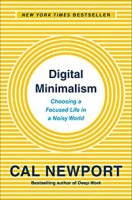 Digital Minimalism: Choosing a Focused Life in a Noisy World by Cal Newport (Portfolio/Penguin 2019)
Janet recommended this one to me, and after checking out Newport's TED talk, "Why You Should Quit Social Media," I decided to reserve it at the library. I had to wait in line; maybe more than a few people are rethinking Facebook, Twitter, Instagram, Old Uncle Tom Cobleigh and all.
Digital Minimalism is divided into two parts: Foundations, and Practices. I read through Foundations easily, able to enjoy the book without pasting sticky tabs all over it. For me, this is like going somewhere and not taking pictures. Those sticky notes represent text that I will later laboriously transcribe for my reviews. As with the photos, something is gained but something is lost. I was enjoying the book and anticipating an easy review.
Then I hit Practices. Or Practices hit me.
The first chapter of that section, "Spend Time Alone," is about solitude deprivation. I could have sticky-noted the whole chapter. Here is me, restraining myself:
Everyone benefits from regular doses of solitude, and, equally important, anyone who avoids this state for an extended period of time will ... suffer. ... Regardless of how you decide to shape your digital ecosystem, you should give your brain the regular doses of quiet it requires to support a monumental life. (pp. 91-92).
[Raymond] Kethledge is a respected judge serving on the United States Court of Appeals for the Sixth Circuit, and [Michael] Erwin is a former army officer who served in both Iraq and Afghanistan. ... [Their book on the topic of solitude], Lead Yourself First ... summarizes, with the tight logic you expect from a federal judge and former military officer, [their] case for the importance of being alone with your thoughts. Before outlining their case, however, the authors start with what is arguably one of their most valuable contributions, a precise definition of solitude. Many people mistakenly associate this term with physical separation—requiring, perhaps, that you hike to a remote cabin miles from another human being. This flawed definition introduces a standard of isolation that can be impractical for most to satisfy on any sort of a regular basis. As Kethledge and Erwin explain, however, solitude is about what’s happening in your brain, not the environment around you. Accordingly, they define it to be a subjective state in which your mind is free from input from other minds. (pp. 92-93)
You can enjoy solitude in a crowded coffee shop, on a subway car, or, as President Lincoln discovered at his cottage, while sharing your lawn with two companies of Union soldiers, so long as your mind is left to grapple only with its own thoughts. On the other hand, solitude can be banished in even the quietest setting if you allow input from other minds to intrude. In addition to direct conversation with another person, these inputs can also take the form of reading a book, listening to a podcast, watching TV, or performing just about any activity that might draw your attention to a smartphone screen. Solitude requires you to move past reacting to information created by other people and focus instead on your own thoughts and experiences—wherever you happen to be. (pp. 93-94).
Regular doses of solitude, mixed in with our default mode of sociality, are necessary to flourish as a human being. It’s more urgent now than ever that we recognize this fact, because ... for the first time in human history solitude is starting to fade away altogether. (p. 99)
The concern that modernity is at odds with solitude is not new. ... The question before us, then, is whether our current moment offers a new threat to solitude that is somehow more pressing than those that commentators have bemoaned for decades. ... To understand my concern, the right place to start is the iPod revolution that occurred in the first years of the twenty-first century. We had portable music before the iPod ... but these devices played only a restricted role in most people’s lives—something you used to entertain yourself while exercising, or in the back seat of a car on a long family road trip. If you stood on a busy city street corner in the early 1990s, you would not see too many people sporting black foam Sony earphones on their way to work. By the early 2000s, however, if you stood on that same street corner, white earbuds would be near ubiquitous. The iPod succeeded not just by selling lots of units, but also by changing the culture surrounding portable music. It became common, especially among younger generations, to allow your iPod to provide a musical backdrop to your entire day—putting the earbuds in as you walk out the door and taking them off only when you couldn’t avoid having to talk to another human. (pp. 99-100).
This transformation started by the iPod, however, didn’t reach its full potential until the release of its successor, the iPhone.... Even though iPods became ubiquitous, there were still moments in which it was either too much trouble to slip in the earbuds (think: waiting to be called into a meeting), or it might be socially awkward to do so (think: sitting bored during a slow hymn at a church service). The smartphone provided a new technique to banish these remaining slivers of solitude: the quick glance. (p. 101)
When you avoid solitude, you miss out on the positive things it brings you: the ability to clarify hard problems, to regulate your emotions, to build moral courage, and to strengthen relationships. (p. 104)
Eliminating solitude also introduces new negative repercussions that we’re only now beginning to understand. A good way to investigate a behavior’s effect is to study a population that pushes the behavior to an extreme. When it comes to constant connectivity, these extremes are readily apparent among young people born after 1995—the first group to enter their preteen years with access to smartphones, tablets, and persistent internet connectivity. ... If persistent solitude deprivation causes problems, we should see them show up here first. ...
The head of mental health services at a well-known university ... told me that she had begun seeing major shifts in student mental health. ... Seemingly overnight the number of students seeking mental health counseling massively expanded, and the standard mix of teenage issues was dominated by something that used to be relatively rare: anxiety. ... The sudden rise in anxiety-related problems coincided with the first incoming classes of students that were raised on smartphones and social media. She noticed that these new students were constantly and frantically processing and sending messages. ...
[San Diego State University psychology professor Jean Twenge observed that] young people born between 1995 and 2012 are ... on the brink of the worst mental-health crisis in decades. ... [She] made it clear that she didn’t set out to implicate the smartphone: “It seemed like too easy an explanation for negative mental-health outcomes in teens,” but it ended up the only explanation that fit the timing. Lots of potential culprits, from stressful current events to increased academic pressure, existed before the spike in anxiety.... The only factor that dramatically increased right around the same time as teenage anxiety was the number of young people owning their own smartphones. ...
When journalist Benoit Denizet-Lewis investigated this teen anxiety epidemic in the New York Times Magazine, he also discovered that the smartphone kept emerging as a persistent signal among the noise of plausible hypotheses. “Anxious kids certainly existed before Instagram,” he writes, “but many of the parents I spoke to worried that their kids’ digital habits—round-the-clock responding to texts, posting to social media, obsessively following the filtered exploits of peers—were partly to blame for their children’s struggles.” Denizet-Lewis assumed that the teenagers themselves would dismiss this theory as standard parental grumbling, but this is not what happened. “To my surprise, anxious teenagers tended to agree.” A college student he interviewed at a residential anxiety treatment center put it well: “Social media is a tool, but it’s become this thing that we can’t live without that’s making us crazy.” (pp. 104-107)
The pianist Glenn Gould once proposed a mathematical formula for this cycle, telling a journalist: “I’ve always had a sort of intuition that for every hour you spend with other human beings you need X number of hours alone. Now what that X represents I don’t really know . . . but it’s a substantial ratio.” (p. 111)
The past two decades ... are characterized by the rapid spread of digital communication tools—my name for apps, services, or sites that enable people to interact through digital networks—which have pushed people’s social networks to be much larger and much less local, while encouraging interactions through short, text-based messages and approval clicks that are orders of magnitude less information laden than what we have evolved to expect. ... Much in the same way that the “innovation” of highly processed foods in the mid-twentieth century led to a global health crisis, the unintended side effects of digital communication tools—a sort of social fast food—are proving to be similarly worrisome.(p. 136).
After winning me over with the chapter on solitude deprivation, Newport lost me somewhat with his approach to taming the beasts. The basic problem is that, for a guy who has written several books and has his own blog, he seems to have very little respect for the written word.
Many people think about conversation and connection as two different strategies for accomplishing the same goal of maintaining their social life. This mind-set believes that there are many different ways to tend important relationships in your life, and in our current modern moment, you should use all tools available—spanning from old-fashioned face-to-face talking, to tapping the heart icon on a friend’s Instagram post.
The philosophy of conversation-centric communication takes a harder stance. It argues that conversation is the only form of interaction that in some sense counts toward maintaining a relationship. This conversation can take the form of a face-to-face meeting, or it can be a video chat or a phone call—so long as it matches Sherry Turkle’s criteria of involving nuanced analog cues, such as the tone of your voice or facial expressions. Anything textual or non-interactive—basically, all social media, email, text, and instant messaging—doesn’t count as conversation and should instead be categorized as mere connection. (p. 147)
I heartily disagree with his lumping e-mail in with "all social media, text, and instant messaging." I will grant that most social media, texts, WhatsApp, IM, and the like are severely limited by the difficulty of creating the message. Phones simply are not designed for high-speed typing, and I don't know about other people's experiences, but for me voice-to-text makes so many errors I spend almost as much time correcting as I would have laboriously pecking out a message on the tiny keyboard. (That's why I much prefer WhatsApp, where I can type my messages on the computer keyboard, to texting, where I can't.) So messages tend to be short, of restricted vocabulary and complexity, and full of nasty abbreviations. But e-mails are simply typed letters that get delivered with much more speed than the mail can achieve. I will grant that you miss the tone-of-voice cues that can be heard over the phone, but I think that's often more than made up for by the ability to both speak and listen without interruption. On the phone, if I turn all my attention to what the other person is saying, there's a long silence when it's my turn to talk while I think of how I want to respond. But if I try to figure that out while the other person is speaking, I'm likely to miss, or mis-interpret what is said. And when I'm speaking, it's more than likely that I will get interrupted before getting out my entire thought, and the conversation will veer off in another direction, leaving my response incomplete and likely mis-understood. E-mail leaves plenty of time for listening, thinking, and responding.
Newport has serious problems with Facebook's "Like" button. I can see his point in some respects.
The “Like” feature evolved to become the foundation on which Facebook rebuilt itself from a fun amusement that people occasionally checked, to a digital slot machine that began to dominate its users’ time and attention. This button introduced a rich new stream of social approval indicators that arrive in an unpredictable fashion—creating an almost impossibly appealing impulse to keep checking your account. It also provided Facebook much more detailed information on your preferences, allowing their machine-learning algorithms to digest your humanity into statistical slivers that could then be mined to push you toward targeted ads and stickier content. (p. 192)
I do get the slot-machine analogy. We all crave (positive) feedback for whatever of ourselves we have put "out there." And the temptation to keep checking is real. It reminds me of the joke from 'way back in the America Online days, in which the person sitting at the computer (no smart phones back then) checks his mail, sees that there is none waiting for him—and immediately checks again. It was funny because that's what so many people did. But I think Newport misunderstands how many of us use the Like button.
In the context of this chapter, however, I don’t want to focus on the boon the “Like” button proved to be for social media companies. I want to instead focus on the harm it inflicted to our human need for real conversation. To click “Like,” within the precise definitions of information theory, is literally the least informative type of nontrivial communication, providing only a minimal one bit of information about the state of the sender (the person clicking the icon on a post) to the receiver (the person who published the post). Earlier, I cited extensive research that supports the claim that the human brain has evolved to process the flood of information generated by face-to-face interactions. To replace this rich flow with a single bit is the ultimate insult to our social processing machinery. (p. 153)
But here's the thing. I don't know anyone who pretends that clicking "Like" or "Love" or "I care" is conversation. However, it is the digital equivalent of one part of a successful conversation: the nod, the smile, the grunt, the frown, the short interjection, which in face-to-face conversation we used as an important lubricant to keep a conversation running smoothly. It hardly communicates any more information than the Facebook buttons; maybe it's little more than a bit—but it's an important bit. It says, "I'm listening, I hear you, I agree, keep talking," or "Wait, what you said confuses me, or angers me," or "I'm sorry, I sympathize."
As soon as easier communication technologies were introduced—text messages, emails—people seemed eager to abandon this time-tested method of conversation for lower-quality connections (Sherry Turkle calls this effect “phone phobia”). (p. 160)
Guilty as charged, but there's no need for Newport (or Turkle) to be snarky about it. I'm hardly alone, and there's ample evidence that phone phobia is attached to the same set of genes that makes me like mathematics. I love the (true) story a colleague told of a bunch of math grad students who decided to order pizza. Every one of them hemmed and hawed and delayed making the order, until the wife of one of the mathematicians, herself a grad student in philosophy, sighed, "For Pete's sake!" and called the restaurant. Text-based communication is a real boon to people like us. Call it a disability if you like—and then remember that you shouldn't mock or discriminate against people with disabilities.
Fortunately, there’s a simple practice that can help you sidestep these inconveniences and make it much easier to regularly enjoy rich phone conversations. I learned it from a technology executive in Silicon Valley who innovated a novel strategy for supporting high-quality interaction with friends and family: he tells them that he’s always available to talk on the phone at 5:30 p.m. on weekdays. There’s no need to schedule a conversation or let him know when you plan to call—just dial him up. As it turns out, 5:30 is when he begins his traffic-clogged commute home in the Bay Area. He decided at some point that he wanted to put this daily period of car confinement to good use, so he invented the 5:30 rule. The logistical simplicity of this system enables this executive to easily shift time-consuming, low-quality connections into higher-quality conversation. If you write him with a somewhat complicated question, he can reply, “I’d love to get into that. Call me at 5:30 any day you want.” Similarly, when I was visiting San Francisco a few years back and wanted to arrange a get-together, he replied that I could catch him on the phone any day at 5:30, and we could work out a plan. When he wants to catch up with someone he hasn’t spoken to in a while, he can send them a quick note saying, “I’d love to get up to speed on what’s going on in your life, call me at 5:30 sometime.” ... He hacked his schedule in such a way that eliminated most of the overhead related to conversation and therefore allowed him to easily serve his human need for rich interaction. (pp. 161-162)
I have to say, that strikes me as more selfish than clever. It's saying to everyone else that he will only communicate with them through his own preferred medium. Granted, it's his right to do so, and maybe he's learned that that's the best way he can get the most accomplished. But I'd have to be pretty desperate to call someone who I knew was going to be driving while he is talking with me. Either he's not going to be giving me his full attention, or he's not going to be giving the other cars on the road his full attention, neither one of which strikes me as ideal. And if I have a complicated question, I definitely want the response to be by written word, where there's a record of what was said, and more chance of getting a well thought out response.
I’ve seen several variations of this practice work well. Using a commute for phone conversations, like the executive introduced above, is a good idea if you follow a regular commuting schedule. It also transforms a potentially wasted part of your day into something meaningful. Coffee shop hours are also popular. In this variation, you pick some time each week during which you settle into a table at your favorite coffee shop with the newspaper or a good book. The reading, however, is just the backup activity. You spread the word among people you know that you’re always at the shop during these hours with the hope that you soon cultivate a rotating group of regulars that come hang out. ... You can also consider running these office hours once a week during happy hour at a favored bar. (pp. 162-163)
<Shudder> Really? I'm supposed to go to the expense, inconvenience, and annoyance of sitting around at a coffee shop or bar on spec, just hoping a friend shows up? And expect my friends to be willing to pay an insane amount for a cup of coffee just to talk with me? Here, and in many other places in Digital Minimalism, you can tell that Newport is an extrovert—with plenty of spare cash—and friends who are the same.
And anyway, whatever happened to visiting people in their homes? One friend of ours decided to quit Facebook, and in her final message invited anyone in town to drop by her house for tea. I could get into that. If you're willing to get out and drive to a restaurant, come instead and knock at our door. You'll be more than welcome and none one of us will have to buy an expensive drink. (This pandemic won't last forever.)
[In the early 20th century, Arnold Bennett, author of How to Live on 24 Hours a Day, speaking of leisure activities] argues that these hours should instead be put to use for demanding and virtuous leisure activities. Bennett, being an early twentieth-century British snob, suggests activities that center on reading difficult literature and rigorous self-reflection. In a representative passage, Bennett dismisses novels because they “never demand any appreciable mental application.” A good leisure pursuit, in Bennett’s calculus, should require more “mental strain” to enjoy (he recommends difficult poetry). (p. 175)
Newport approves of the idea that "the value you receive from a pursuit is often proportional to the energy invested." But then he adds,
For our twenty-first-century purposes, we can ignore the specific activities Bennett suggests. (p. 175)
And what, pray tell, is snobbish or unreasonable about literature and poetry?
Newport has a lot to say about the value of craft: of woodworking, or renovating a bathroom, or repairing a motorcycle, or knitting a sweater. He includes musical performances as well. But—and I find this odd for an author—he seems to have little respect for creating books. Would it be a more noble activity if they were typed on an old Remington, or handwritten? He similarly discounts composing music using a computer as less worthwhile than playing a guitar. I don't buy it.
The following story is for our two oldest grandsons, who have a way of picking up and enjoying construction skills.
[Pete's] welding odyssey began in 2005. At the time, he was building a custom home. ... The house was modern so Pete integrated some custom metalwork into his design plan, including a beautiful custom steel railing on the stairs.
The design seemed like a great idea until Pete received a quote from his metal contractor for the work: it was for $15,800, and Pete had budgeted only $4,000. “If this guy is billing out his metalworking time at $75.00 an hour, that’s a sign that I need to finally learn the craft myself,” Pete recalls thinking at the time. “How hard can it be?” In Pete’s hands, the answer turned out to be: not that hard.
Pete bought a grinder, a metal chop saw, a visor, heavy-duty gloves, and a 120-volt wire-feed flux core welder—which, as Pete explains, is by far the easiest welding device to learn. He then picked some simple projects, loaded up some YouTube videos, and got to work. Before long, Pete became a competent welder—not a master craftsman, but skilled enough to save himself tens of thousands of dollars in labor and parts. (As Pete explains it, he can’t craft a “curvaceous supercar,” but he could certainly weld up a “nice Mad-Max-style dune buggy.”) In addition to completing the railing for his custom home project (for much less than the $15,800 he was quoted), Pete went on to build a similar railing for a rooftop patio on a nearby home. He then started creating steel garden gates and unusual plant holders. He built a custom lumber rack for his pickup truck and fabricated a series of structural parts for straightening up old foundations and floors in the historic homes in his neighborhood. As Pete was writing his post on welding, a metal attachment bracket for his garage door opener broke. He easily fixed it. (pp. 194-195)
If you're wondering where to learn skills needed for simple projects ... the answer is easy. Almost every modern-day handyperson I've spoken to recommends the exact same source for quick how-to lessons: YouTube. (pp. 197-198, emphasis mine)
In the middle of a busy workday, or after a particularly trying morning of childcare, it’s tempting to crave the release of having nothing to do—whole blocks of time with no schedule, no expectations, and no activity beyond whatever seems to catch your attention in the moment. These decompression sessions have their place, but their rewards are muted, as they tend to devolve toward low-quality activities like mindless phone swiping and half-hearted binge-watching. ... Investing energy into something hard but worthwhile almost always returns much richer rewards. (p. 212)
Finally, I can't resist his description of former Kickstarter project called the Light Phone.
Here’s how it works. Let’s say you have a Light Phone, which is an elegant slab of white plastic about the size of two or three stacked credit cards. This phone has a keypad and a small number display. And that’s it. All it can do is receive and make telephone calls—about as far as you can get from a modern smartphone while still technically counting as a communication device.
Assume you’re leaving the house to run some errands, and you want freedom from constant attacks on your attention. You activate your Light Phone through a few taps on your normal smartphone. At this point, any calls to your normal phone number will be forwarded to your Light Phone. If you call someone from it, the call will show up as coming from your normal smartphone number as well. When you’re ready to put the Light Phone away, a few more taps turns off the forwarding. This is not a replacement for your smartphone, but instead an escape hatch that allows you to take long breaks from it. (p. 245).
Despite our areas of disagreement, there's only one really, really annoying section of the book. He spends seven pages on the ideas of someone named Jennifer who "prefers the pronoun 'they/their' to 'she/her'." The ideas are not worth the ensuing confusion between singular and plural. I found myself constantly re-reading trying to figure out who was being referenced in the text.
But I do recommend reading Digital Minimalism. The concept of solitude deprivation alone would make it worthwhile, and the rest of the book is pretty good, too—especially if you're not a phone-phobic, introverted author.
Permalink | Read 2503 times | Comments (6)
Category Reviews: [first] [previous] [next] [newest] Education: [first] [previous] [next] [newest] Health: [first] [previous] [next] [newest] Computing: [first] [previous] [next] [newest] Children & Family Issues: [first] [previous] [next] [newest] Social Media: [first] [previous] [next] [newest]
I mentioned before that Facebook rejected my September 11 tribute post for "violating their community standards."
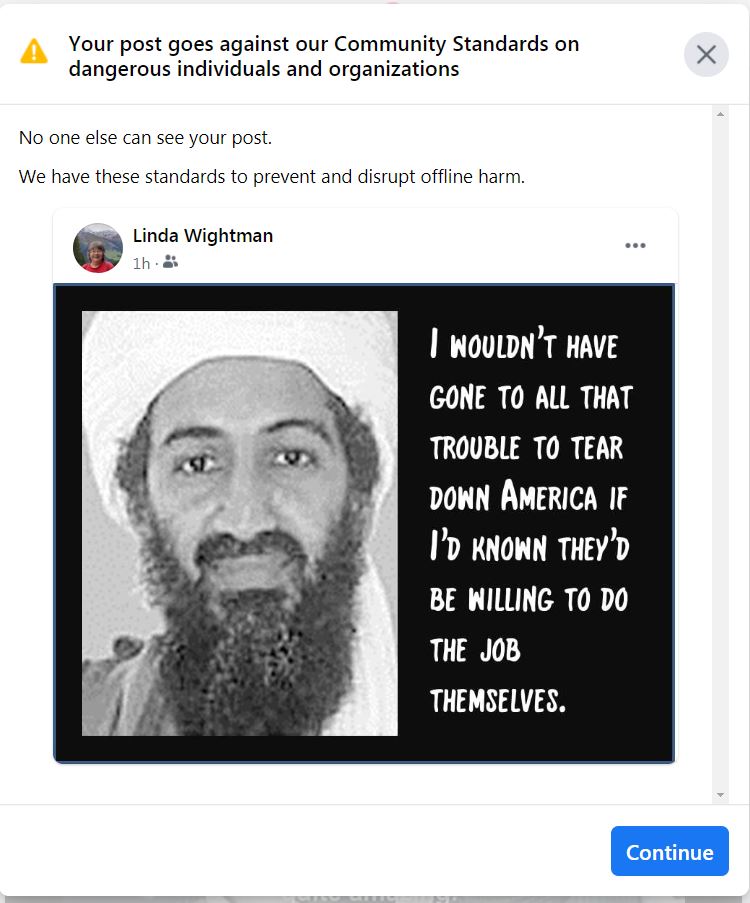
My first reaction was that I didn't want to be part of any community that would object to such a post. That dovetailed pretty nicely with the thoughts I had been having about how to tame the Facebook dragon in my life. (See my Social Media category.)
While poking around another part of Facebook this morning, I found this:
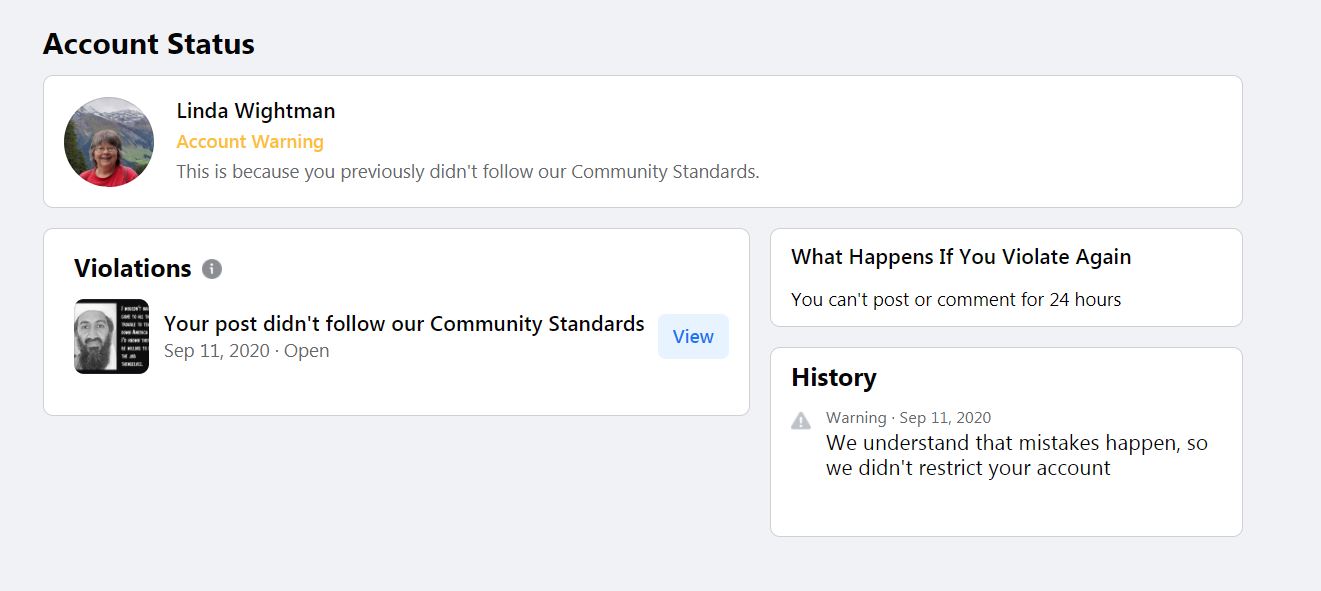
You'd think they'd make such things a little more obvious. Then again, there was a big "Continue" button on their original rejection that I completely missed until today.... Following that, I discovered that I could request a review of their rejection.
I wasn't going to bother, but then decided it was only fair to give them another chance. I requested the review, though I was given no opportunity to ask or explain anything. At that point I received a notice saying that they would review my post, but "as a reminder" I would not be able to post or comment for 30 days. I wasn't expecting that, since they had said they would not restrict my account (see above), because "we understand that mistakes happen." (They may have meant that I made an inadvertent mistake, in which case I was going to be annoyed, but I choose to assume they were admitting that THEY may have made a mistake.)
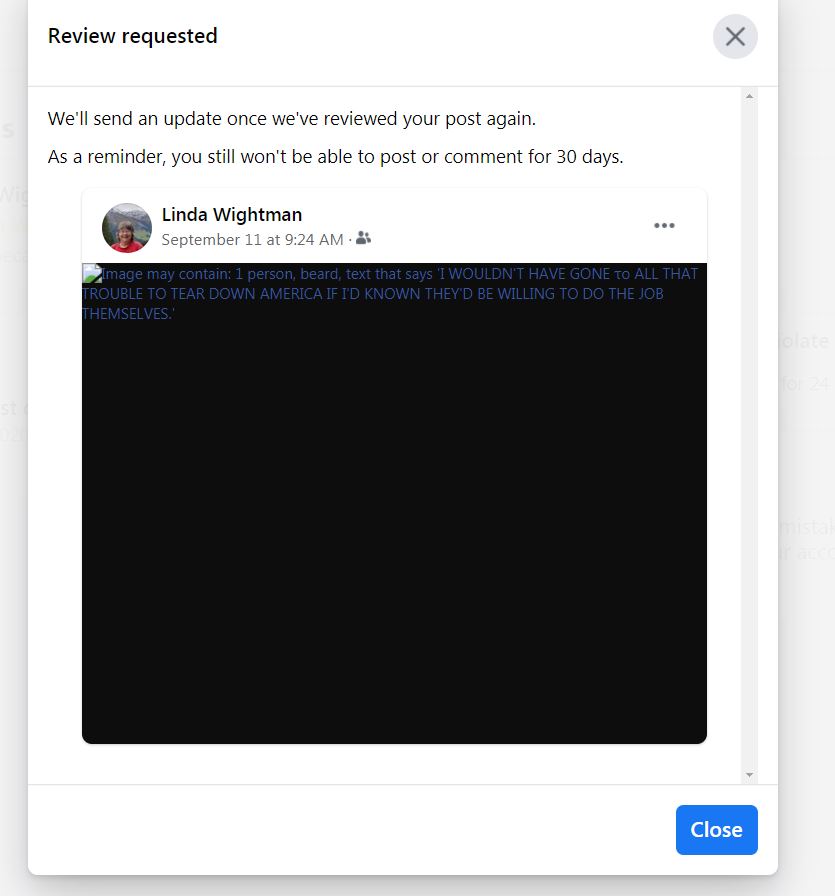
I then made a test post was to see if they really meant what they said, or if it was just a boilerplate response, and it was not rejected, at least not yet. For a moment there I thought my decision about restricting my Facebook use had been taken out of my hands. :)
I'll update when I hear from the Facebook review team. Assuming I get to humans this time and not the automaton that I think rejected my post in the first place.
In the meantime, I'm enjoying my newfound status among friends who can't believe I could write something that would offend community standards. I had no idea I had a reputation of being mild-mannered and harmless.
Permalink | Read 1590 times | Comments (2)
Category Social Media: [first] [previous] [next] [newest]
I use Facebook to support relationships and as a writing platform. What else?
I suppose I should be ashamed to admit this, but for me Facebook is also a major source of news. But I do not apologize for that, because I have a few friends who can be counted on to post on Facebook whenever something important is happening in the world. I know from life-long experience that mainlining the news is bad for my mental health.
Is Facebook the best or only tool for this use?
These particular friends can usually be counted on for two very important benefits: (1) each brings a different background and point of view to the table; (2) in addition to the news that makes headlines, they often alert me to news that would be lucky to make two inches on page 32 but which is of interest to me; and (3) they present the news with far less stress-inducing drama than most mainstream media. I know of no other site that does such an excellent job of curating my news.
Many years ago, when I lived in Rochester, a good friend would call me on the phone nearly every day, and we'd chat for ages. (Those were the days when the phone was on the wall in the kitchen, and we invested in a 25-foot phone cord so that I could work and talk at the same time.) At the same time, we were trying to drastically reduce the time we spent watching television. To the concern that we would miss something important by not watching the evening news, I would reply, "If it's really important, I'll learn about it from Pam tomorrow."
If I were to give up my Facebook news sources, what could substitute? Given that all news reporting is biased, as newscaster Peter Jennings famously warned more than 15 years ago, that means—as it does with all history studies—a single source is never sufficient. And consulting multiple sources with the same bias doesn't count.
I'm sorry to say that our local newspaper is out. I want to be able to support local, physical papers, but it was decades ago that ours started giving less for more: the space devoted to text steadily shrank, replaced by pictures that definintely were not worth a thousand words. The stories themselves veered away from meat toward fluff. Editing and proofreading efforts declined drastically, perhaps through costcutting measures and/or the need to beat the Internet with a news story. Worst of all was the blurring of the line between news and editorials. We cancelled our subscription when the Orlando Sentinel started to look like USA Today, and haven't been back since, except for responding a couple of times to "an offer you can't refuse"—which never succeeded in convincing us to keep the subscription when it ran out.
Television news has gone all out in the Adrenalin Wars: presenting the news at fever pitch to maximize excitement, fear, and even panic, for the purpose of keeping customers glued to their shows and money pouring in. "Public" television is very nearly as bad—they, too, have customers and sponsors. And all the while each network strongly promotes its own point of view. For the sake of my mental health I don't want the hype; for the sake of my spiritual health I don't want the bias. Watching news shows on more than one network may somewhat balance the bias, but it doubles the hype.
One site that was suggested to me is allsides.com, which attempts to bring together news stories from the Left, from the Right, and from the Center, using criteria it has set up for determining the bias of a news organization. I've bookmarked the site as potentially quite useful. It is frustrating to come across an interesting story and feel that I can't share it, because if the source is a left-leaning site half my friends won't trust it, and if it's a right-leaning site the other half will reject it unread. Allsides.com might at least help me find the same story in different places.
But Allsides is still too much in-your-face with the news for frequent use. The same is true of Google News, which used to be helpful but is much less so since they stopped letting me specify what kinds of stories interest me and now enforce Google Knows Best. In my case, Google Is Usually Wrong. I need to do more research here.
Porter subscribes to the BBC News feed, which seems to do a pretty good job of covering the world. It takes up a lot of his time, however, so I'm just as happy to take it second-hand.
Some well-known and intelligent person once said that he never paid attention to daily, or even weekly news. Only if something was still newsworthy after a month did he bother about it. I think it was Peter Drucker, or someone he wrote about, in Adventures of a Bystander, but I'm still trying to hunt down the exact story and attribution. For all but a few news items (e.g. an approaching hurricane), that sounds like a sane and sustainable philosophy. Being inundated with news—usually tragic—from every corner of the country and the world is exhausting and debilitating. I don't want to stick my head in the sand, but the value of receiving bad news lies in being moved to good and useful action. Otherwise it just cripples us.
My friend Pam and I once lived across a small hallway from each other. Now we are more than 2000 miles apart. But she is still one of my reliable news sources, and Facebook is now that 25-foot long telephone cord. Hour-long phone conversations no longer work for either of us. Facebook really is a good way to reach many people in a very short time. The question is how to maximize benefits and minimize costs.
I have some ideas to try out. Stay tuned.
Permalink | Read 1531 times | Comments (2)
Category Social Media: [first] [previous] [next] [newest]
What else do I use Facebook for, besides communication with friends and family?
Right up there near the top must surely be this: as a writing platform. Writing is to a large extent the way I think, and I like getting my thoughts out of my head and onto some external medium. Moreover, I'm enough of a writer, or perhaps "performer," that I want my words to be seen. My writing is also my brain's equivalent of an external hard drive: a place to store wildly eclectic information for later retrieval—made possible in large measure, I must grudgingly admit, to Google's excellent search capabilities.
Searching is why Facebook is not a good place for writing: retrieving what I have once written is difficult to impossible. Finding what someone else has written is even harder. Facebook's place in my writing habit is primarily threefold:
- What someone else has written will often stimulate thoughts, which I often publish in the form of a comment. The danger of this is that it can all too easily be much too long for the medium, and it's all too easy to hijack someone else's post for my own ideas. (A little of that is good, but I tend to take it too far. One reason I never got hooked on Twitter is that I can't say anything in fewer than 140 words, let alone characters. I tried for a while....) But sometimes the seeds planted develop into posts of my own.
Is Facebook the best or only tool for this use?
Certainly not. Inspiration for writing is everywhere, and there are far more thoughts stimulating my brain than will ever make their way into print.
- Linking to my blog posts from Facebook has opened my work to a greater audience, despite the fact that my blog is public and my Facebook limited to a relatively small circle of friends. Years ago, Facebook had a facility for cross-posting that didn't work well for me, but for a long time now I have been posting to Facebook links to individual blog posts, with maybe a short comment (because I hate it when people just post links without a few words of introduction to tell me why they think the link is valuable).
Is Facebook the best or only tool for this use?
I already know that it can't replace my own blog: I have Faithful Readers who do not use Facebook. And if that weren't enough, I would be thoroughly convinced that I need my own platform by a recent incident in which Facebook deleted my 9/11 tribute, saying it violated their community standards. Is that a community I should remain part of?
Certainly anyone who clicks to my blog through Facebook could get there directly. But it would remove some of the convenience, and eliminate the readers who might be intrigued by a particular post title here and there, but not enough to visit my blog itself with any frequency. It's still an easy way to make my words available to more people.
It also provides more feedback. Those "Like" buttons make it easy to let someone know you've read what they've written, and there's no way to do that on my blog except by leaving a comment, which many people don't like to do. Plus, even of comments I usually get more on Facebook. But that can be part of the problem, too. I'm human: I like to hear when my words have been well received. Not so much when they haven't—I'm not getting paid so I can't be like the columnist who insisted he didn't mind getting hate mail, because it meant his column was being read, which was all that mattered to his employers. But after I've posted a link on Facebook I do find myself checking the app more frequently, to see who has read and reacted to my post. I like those little dopamine hits as much as anyone. But it's probably not a good thing.
Conclusion? If I were to abandon Facebook altogether, I could manage without this. My blog was never about getting widespread publicity anyway. I like for my words to be a blessing to people—as some have said they are—but flying under the radar is more my ambition than going viral. If my decision is to keep Facebook but greatly reduce its hold on me, howere, I think this is something I would keep. If, that is, I can convince myself that I don't need to know now when someone has reacted to my post—a day or even a week later will do.
- Finally, Facebook provides a place for the small, off-the-cuff comments that are fun but don't seem worthy of a blog post: "Hi, everyone! We're enjoying the Food & Wine Festival at EPCOT!" "Here's an inspiring quote I found." "The president said WHAT?" More chit-chat than conversation. I don't mean to belittle it; there's a place for chit-chat in the glue that holds relationships together.
Is Facebook the best or only tool for this use?
I have to admit that it's a good one, and I would miss it. With family I could (and often do) substitute WhatsApp, since we have a lively group there. But when deprived of personal contact, by distance or pandemic, there's some value here that I don't know how to replace. For many, even most, of my Facebook friends it probably doesn't matter a bit, but there is a subset for which I think it does. Maybe not enough benefit for the cost, however. And of course there's always the possiblity certainty that some such comments (e.g. the political ones) do more harm than good....
Permalink | Read 1589 times | Comments (2)
Category Social Media: [first] [previous] [next] [newest]
It was our younger daughter who started it, asking me why I spend time on Facebook. Really, the nerve of our children! Doesn't she remember that she was the one who induced me to join, and who made the first comment on what was then called my "wall"? Back in 2007 that was, and I was entranced by the ease with which I could keep in touch with famiy and friends, and by the ability to find and be found by people who would otherwise have faded out of our lives, or at best become once-a-year-at-Christmas contacts.
But nearly thirteen years have passed since I took those first steps into the world of social media, and I've accepted her challenge to re-evaluate. It came in response to my admiration of our eldest grandson, who had recently made a clean break with a couple of time-consuming activities. They were fun, but the pandemic shutdown revealed to him that he was no longer growing through them. Facebook provided many new opportunities when I first joined, but perhaps there are better uses of my time. "Good" can hardly be considered good enough if it keeps "better" at bay.
Back when we gave up television, there wasn't a lot said about the dangerous nature of the medium; if people complained it was generally about poor content: the "vast wasteland." Marie Winn was one of only a handful who saw the problem as systemic. One day, I wandered with my bibliophile father into a small bookstore in Wayne, Pennsylvania, and in my browsing happened upon her book, The Plug-In Drug, which changed our lives forever. There's no need for such a chance encounter now: googling "Facebook addiction" or "why you should quit social media" will flood you with more information than you can handle.
But I'll leave all that serious stuff about how the intrusiveness of social media, and even something as old-school as e-mail, literally changes our brains, making it very difficult for us to focus on tasks that require sustained attention and hard work. And I'll skip the disturbing part about how all media, from Facebook to news shows to plain ol' TV have been consciously altered to make them as addictive as casino gambling. As I said, you can find out more than you want to know about that with some simple online queries. To my embarrassment, I can see those frightening effects clearly in my own life, but it's enough at the moment to ask, Why do I use Facebook? What do I get out of it? How do I give to others through it? Am I accomplishing anything worthwhile, or just being entertained? What activities in my life are being displaced by social media? Are there other, more helpful and/or less harmful, activities that could be used to accomplish whatever good I see in Facebook?
Not everyone uses Facebook for the same reasons, or in the same way. As they say, your mileage may vary—by a lot.
Facebook began for me as a means of communication with family and friends. Many years ago, when we first moved to Florida, I started sending a more frequent version of a Christmas letter to keep in touch with those we had left behind. First the typewriter, then later the word processor, made it possible to write more content, more frequently, and to more people than I ever did when all my notes were hand-written. Facebook was simply a logical extension of that move.
And for a while it worked well. I could see photos of family and friends, and hear about what our grandchildren were up to. (For the latter, our children's blogs were actually more useful, but eventually those updates stopped and Facebook became more important.) But guess what? Our children have all dropped out of Facebook. None of our grandchildren have social media accounts of any sort, nor do I expect them to. Our nephews still have Facebook accounts, but rarely use them. A few other family members use Facebook occasionally, and there are a couple for whom Facebook is our primary means of communication. But nearly all of the sharing of photos and activities is now done via WhatsApp. Yes, I'm aware that WhatsApp is owned by Facebook, but that's a separate issue. For most, though not 100%, of our family, I think I could disregard Facebook and do as well or better. The same is true for closer friends, those with whom we would keep in touch, even if just once a year, no matter what.
But I have developed a whole new level of friendship on Facebook: something greater than mere acquaintance, though far from what we introverts call real friends. In fact, it's quite an odd form of friendship, in which we learn details about each others' lives that real friends might take years to reveal in person—yet these are people we haven't seen in decades, or maybe have never met at all. One of my first Facebook friends was a (now very much grown up) little girl I haven't seen since the 1980's. To this day she will, every once in a while, "like" one of my Facebook posts.
There are others who became Facebook friends long before we ever met, usually because they were a friend of a friend and we found something in common through our comments on that friend's posts. I suppose it's like going to a party at a friend's house and meeting a new friend there—but for me, much more fun than a party.
When I met a first cousin once removed for the first time at a memorial service, it was especially helpful to have already become acquainted with her and her family via Facebook. When our church called a new priest, I felt almost instantly comfortable with him after he arrived, because I had already gotten to know him some on Facebook. It's still the case that Facebook provides more interaction than I've ever had before with a pastor. It's casual, can be accomplished at times convenient to all, and is done in writing, which is always my preferred form of expression.
That's more than enough ruminating for now, though there are many more aspects of my relationship with Facebook to consider. One thing has become clear: When it comes to some relationships and communication, I would do no worse, and maybe better, if I drop Facebook and put my energy into other areas. And certainly these are the people who deserve the greater share of my time and attention. Yet I'm not willing at this point to drop the new friends and the casual friends, who expand my horizons and provide much-needed encouragement, as I hope I do for them.
The question then, becomes this: Can I radically reduce my Facebook time and attention and not lose those connections? It there something less than total abandonment of social media that will enable me to concentrate on my highest priorities? Is this an "if your right hand causes you to sin..." issue?
Still thinking about that one. There is still much more to consider.
Permalink | Read 1531 times | Comments (2)
Category Social Media: [first] [next] [newest]
We gave up television in the early 1980's, when we began noticing its negative effects on our toddler. That was a struggle, but to this day I hold it as one of our best parenting decisions ever.
Television had sneaked into our lives in a frog-and-kettle way. My family didn't even own a TV set until I was seven years old, and it received a grand total of four stations: three VHF and one UHF. All was black and white, of course. The influence of the medium in our lives grew only gradually, but by the time my much younger sister was in middle school, she had her own TV in her bedroom.
My television addiction—that's not too strong a word—was effectively broken in college, when the only way to see a show was halfway across campus in the student lounge; it simply was not worth the effort. My husband was deprived of this cold-turkey blessing, since one of his roommates owned a set. Thus after we were married it took the kick-in-the-pants of parenting to get us to make the break.
Television has since become quite a different beast, both for better and for worse, and I acknowledge that the medium has its usefulness. Still, I'm 100% certain that our grandchildren are far better off for growing up in television-free homes.
However, "television" as I once knew it has evolved into audio-visual media of incredible variety, now far more useful and far more dangerous. Our grandchildren may not have television sets, and their "media time" may be restricted, but computers, Kindles, and tablets are still important in their lives.
The use of computers and other "screens" has sneaked up on subsequent generations the way television did on mine. Many parents are as concerned about it all as I was with television, but the option of giving it up completely just isn't there, unless you can live self-sufficiently somewhere in the back of beyond. The new media are even more addictive, and much more time-consuming, than good ol' broadcast TV ever was. But they are too useful to give up completely.
Which leaves us with control as the only practical option, and control is always harder than abstention.
Despite the lengthy introduction, the issue for this post is not how to control media for children, for whom I no longer have any direct responsibility, but for myself.
I'm certain I spend too much time sitting at the computer, but that is where my work is. Not that I'm being paid to work in an office, staring at a screen. But my writing, my genealogical research, my archivists' work, and much of the nitty-gritty of everyday life takes place using the computer/phone. I'm not ready to give up so much of what I consider to be valuable work. And when your children and grandchildren live far away, electronic media is an incalculable blessing.
But something has to give. I'm at the time of life when I need to make sure I'm using my allotted span wisely. Really, that should be all the times of our lives; it just hits home harder when you must face the certainty that you are not going to live another 50 years.
What's the best use of my time? Too big a question. What's the best use of my time on the computer? Better, but still too big to start with. What's the best use for me of social media? Now that's something I might be able to sink my teeth into.
Stay tuned for Facebook: The Challenge.
Permalink | Read 1979 times | Comments (2)
Category Social Media: [next] [newest]

