
If you were reading Lift Up Your Hearts! regularly back in 2020, thank you. The following may consequently sound familiar, but it's worth reprising. C. S. Lewis is well-known, and classic. George MacDonald is much less so, though he has enjoyed somewhat of a revival thanks to renewed availability of his writings. What is worth bearing in mind is that he was Lewis's mentor, though they never met; it was his writings—and the character they revealed—that influenced Lewis so greatly. Lewis put it clearly and boldly:
I have never concealed the fact that I regarded him as my master; indeed I fancy I have never written a book in which I did not quote from him.... I dare not say that he is never in error; but to speak plainly I know hardly any other writer who seems to be closer, or more continually close, to the Spirit of Christ Himself.
C. S. Lewis showed me a God who made sense of the world; George MacDonald showed me a God I could wholeheartedly love.
As I neared the end of my C. S. Lewis retrospective—reading (mostly re-reading) all the books we own by or about the prolific author—I was challenged by my friend, The Occasional CEO, to relate a few of the most significant things I have learned from Lewis. I began with the idea of trying to distill a Top Five from his many areas of influence in my life.
It soon became clear that of everything I have learned from Lewis—from faith to literature to history to the changing meaning of words to the critical importance of one's model of the universe—two stood out, orders of magnitude greater than the rest.
All is gift. I am Oyarsa not by His gift alone but by our foster mother’s, not by hers alone but by yours, not by yours alone but my wife’s—nay, in some sort, by gift of the very beasts and birds. Through many hands, enriched with many different kinds of love and labor, the gift comes to me. It is the Law. The best fruits are plucked for each by some hand that is not his own. [from Perelandra]
The first gift I received from C. S. Lewis was his Narnia stories. I was introduced to them in mid-elementary school: The Lion, the Witch, and the Wardrobe was a gift from my mother, who brought it to me in a stack of books from the library when I was sick in bed. The remainder of the series came about two years later, a gift from a neighbor, who owned all seven and shared them around our group of friends. I was delighted, enthralled. However, my attempt to find similar delight in his other fiction was at the time unsuccessful. I tried the first of his Space Trilogy, but I was a hard-core science fiction fan—Asimov, Heinlein, Clarke—and Out of the Silent Planet was not sufficiently science-based for me. One of Lewis's earliest books, it lacks the beauty and enchantment of the Narnia stories, and was intended for an adult audience. I have since come to enjoy it, but I wasn't ready then.
I rediscovered Narnia in college, thanks to the University of Rochester's Education Library, which was well-stocked with children's books. There I also first encountered Mere Christianity: the gift of my roommate, and my introduction to Lewis's nonfiction. To my shock, there I discovered that all the delight—the goodness, truth, and beauty—that I had encountered in Narnia was for Lewis an expression of reality, a reality far greater than he could depict, even in fantasy. I came later to respect the background in Christianity I had received in my childhood, but it was through Lewis and Narnia that the reality of God began to make sense to me.
This is the first and great gift, and the second is like unto it.
I went on to read more of Lewis's non-fiction, and to gain from it, but his next pivotal gift came many years later, through a friend—all is gift—who shared with me Lewis's George MacDonald: An Anthology.
If Narnia had shown me a God who made sense of the world, MacDonald showed me a God I could love.
George MacDonald is another author I had met before—as a child through his Curdie books and At the Back of the North Wind—but I'd never followed through to find what else he might have written. To be fair to myself, his other books weren't easy to find back then.
Of MacDonald, Lewis wrote,
In making these extracts I have been concerned with MacDonald not as a writer but as a Christian teacher. If I were to deal with him as a writer, a man of letters, I should be faced with a difficult critical problem. If we define Literature as an art whose medium is words, then certainly MacDonald has no place in its first rank—perhaps not even in its second. There are indeed passages, many of them in this collection, where the wisdom and (I would dare to call it) the holiness that are in him triumph over and even burn away the baser elements in his style: the expression becomes precise, weighty, economic; acquires a cutting edge. But he does not maintain this level for long. The texture of his writing as a whole is undistinguished, at times fumbling. Bad pulpit traditions cling to it; there is sometimes a nonconformist verbosity, sometimes an old Scotch weakness for florid ornament (it runs right through them from Dunbar to the Waverly Novels), sometimes an oversweetness picked up from Novalis. But this does not quite dispose of him even for the literary critic. What he does best is fantasy—fantasy that hovers between the allegorical and the mythopoeic. And this, in my opinion, he does better than any man.
(Unless otherwise noted, all quotations are from Lewis's preface to George MacDonald, An Anthology.}
MacDonald's works can be divided roughly into three parts, though they overlap: the fantasy that so impressed Lewis; books of sermons; and his many adult novels—the craft of which left Lewis so unimpressed—which served both to feed his family of thirteen and as vehicles for reaching a wider audience with his preaching. The last sounds dreary, but in reality the preaching is what makes his novels shine. (Those who know my lack of appreciation for most sermons will recognize the peculiarity of such a statement coming from me.)
Having been reawakened to MacDonald by Lewis's Anthology, I looked around for more, and the best I could find were modern re-workings of his novels, some by Michael R. Phillips and some by Dan Hamilton. I give credit to both authors for their obvious respect for MacDonald, and their faithfulness to his ideas, even though in their efforts they exaggerated the parts I like least from the originals (the Romantic elements) and reduced the best (the preaching). The library had most of them, and I wolfed them down.
Most of my extracts are taken from the three volumes of Unspoken Sermons. My own debt to this book is almost as great as one man can owe to another.
The next contributor to my journey was a church secretary who had obtained photocopies of all three Unspoken Sermons books, which she graciously shared. I wonder if the generations who grew up with easy access to a universe of electronic resources can even imagine how valuable bound photocopies could be. Or what an incredible gift it was to the world when, in the 1990's, Johannesen began republishing all of MacDonald's works, in beautifully-crafted sets. All of these treasures were given to me, over several years of birthdays and Christmases, by my father. He himself had no particular appreciation of MacDonald—I doubt he read any of the books—but a great deal of love for his children and grandchildren, for whom I consider the collection a legacy. Now, Kindle versions of almost all of MacDonald's works are available at no or very little cost.
I have never concealed the fact that I regarded him as my master; indeed I fancy I have never written a book in which I did not quote from him.
Lewis is not exaggerating the frequency of MacDonald's influence on his own works. Having tackled my MacDonald retrospective first, I easily recognized his ideas and often his words when I encountered them in Lewis.
I know nothing that gives me such a feeling of spiritual healing, of being washed, as to read George MacDonald. (from a letter of Lewis to Arthur Greeves)
I dare not say that he is never in error; but to speak plainly I know hardly any other writer who seems to be closer, or more continually close, to the Spirit of Christ Himself.
What greater endorsement could there be?
Lewis was puzzled as to how people could idolize him and ignore MacDonald. I have some ideas. MacDonald's books were old, even then—he had died before Lewis turned seven—and our society's "chronological snobbery" was well established. Although full of gold, many of his books are difficult to read, even those not laden with Scottish dialect. I can now say that it's well worth the effort, and the reading and understanding get much easier with practice. But I can't forget that I had actually encountered MacDonald's novels years before, deep in the stacks of our main college library. But apparently this, too, had to wait to be a gift rather than my own choice: to my everlasting embarrassment, I turned aside from those unattractive, ancient, brown, and dusty tomes. Perhaps it was the library's revenge that I later became a genealogist, whose blood now quickens at the mere scent of such books.
Then, too, from the beginning MacDonald was plagued by charges of heresy and branded "Universalist" for his belief that, in the end, God's love would triumph. Lewis did not see him that way, but it led (and still leads) some to dismiss MacDonald out of hand.
Reaction against early [strict Scottish Calvinist] teachings might ... have very easily driven him into a shallow liberalism. But it does not. He hopes, indeed, that all men will be saved; but that is because he hopes that all will repent.
Nowhere else outside the New Testament have I found terror and comfort so intertwined.
Inexorability—but never the inexorability of anything less than love—runs through [MacDonald's thought] like a refrain; "escape is hopeless"—"agree quickly with your adversary"—"compulsion waits behind"—"the uttermost farthing will be exacted." Yet this urgency never becomes shrill. All the sermons are suffused with a spirit of love and wonder which prevents it from doing so. MacDonald shows God threatening, but (as Jeremy Taylor says) "He threatens terrible things if we will not be happy."
The effect of C. S. Lewis's writings on my thinking is incalculable, and not just from his most popular books. Who would have guessed, for example, that I would give a five-star rating to Studies in Words—a book on philology, addressed to scholars, of which I understood less than half? But I was fascinated, and my eyes were opened to the pernicious habit (especially common among both literary critics and high school English teachers) of simply seeking meaning in what we read, instead of seeking what the author meant by his words and what his contemporary audience understood him to be saying.
There's no doubt that Lewis was quirky, humble, and absolutely brilliant—all the more brilliant that so many of his writings were written to be accessible to the ordinary British public, yet there's no hint of condescension. I could start my Lewis retrospective over again from the beginning and learn a lot more.
But for all that, Lewis's greatest influence on my life came less through my mind than through my spirit. Lewis said that reading MacDonald's Phantastes "baptized his imagination." The Narnia books first, and then George MacDonald directly, did the same for me.
This surprising realization came nearly sixty years after my first encounter with The Lion, the Witch, and the Wardrobe, and was itself a gift—thanks to my friend's challenge.
Permalink | Read 140 times | Comments (0)
Category Education: [first] [previous] Inspiration: [first] [previous] Here I Stand: [first] [previous] Heroes: [first] [previous]
For me, September 11, 2001 might as well be yesterday. But not one of our 13 grandchildren was alive when my generation had its "Pearl Harbor" moment, and realized that our country is not invulnerable. Even for the eldest grandchild, it must feel as ancient as the division of Germany into East and West feels to me.
To mark this 25th anniversary of the day our world turned upside down, I offer two choir anthems that were written shortly after the events. Robert Kerr wrote Prayer for Peace for the Orlando Deanery Boychoir, and we had the privilege of singing it ourselves when Rob was our choir director.
Lord, grant us wisdom in our hour of need.
And give us vision, that we clearly see,
Your loving nature, Your mercies' might.
Bring us from darkness in to Your light.
Lord, touch our nation with Your healing hand.
And give us comfort o'er all the land.
Reveal Yourself to us and make us whole,
Reside within each heart and soul.
For there are battles we must fight,
And stand with courage for what is right.
Against the evil which infects us still,
Lord, give us conviction to know Your will.
Please help the strong to defend the weak,
But not in anger or revenge to seek,
So through Your justice let conflict cease.
Oh, unify us, and bring us peace.
For there are battles we must fight,
And stand with courage for what is right.
Against all evil, sin, and wrong,
Give us conviction to carry on!
Alleluia!
Lord, bless our soldiers across the sea,
And help them to set more people free.
And in their hearts, may they have pride to sing,
"God bless America,"
God bless America, Let freedom ring!
Our current choir sings this next anthem, A Prayer for Our Time by Pamela and Joseph Martin, for every 9/11 anniversary and at other appropriate times. This recording is really of us; thanks to Noah's work, we finally have a sound system that doesn't totally mangle the music—though I apologize for the extraneous sounds that crept in through a microphone error. The version below should start and stop at the right places, but if you can't see the embedded video, the link above takes you directly to YouTube and you'll have to scroll forward to timestamp 58:34.
Our God to thee we pray.
Heal our nation Lord today.
God of mercy, grant us courage, give us peace.
Give us peace, give us peace.
When evil draws its angry sword
And seeks to sever freedom's cord,
When death and darkness shake our faith
In God's unfailing power to save.
Eternal Father, ever be our courage in the time of need.
When war is raged by faceless foes
Who battle peace with fiery blows,
When storms of hate and fear assail
Our Father's mighty arm prevails.
Eternal Father, ever be
Our refuge in the time of need.
There is no tyrant who can stand
Against our sure defender's hand.
No threat or danger can defeat
The strong and righteous Prince of Peace.
Eternal Father, ever be our fortress in the time of need.
Amen!
And amen! The United States of America is even more vulnerable now than it was a quarter of a century ago, and our enemies more sophisticated and more effective. The crude events of September 11, 2001 brought our country together, along with much of the world. The more subtle attacks of our enemies throughout the intervening years are ripping us apart. "Deliver us from evil" is no longer just a line in the Lord's Prayer, but a desperate plea.
Permalink | Read 196 times | Comments (0)
Category Politics: [first] [previous] [newest] Music: [first] [previous] Inspiration: [first] [previous] [newest] Glimpses of the Past: [first] [previous] Heroes: [first] [previous] [newest]
 Debunked by Nature: How a Vegan-Chef-Turned-Regenerative-Farmer Discovered that Mother Nature Is a Conservative by Mollie Engelhart (Acres U.S.A., Inc., 2025)
When and where I first heard about Mollie Engelhart I no longer remember, but it is enough to realize that the foreword of this book is written by Joel Salatin, whose agricultural revolution I've admired for years.
I've been enjoying Engelhart's well-written columns for a long time, and have occasionally quoted from them here. So I decided it was high time that I read the book in which she documents her journey from celebrated vegan chef to regenerative farmer, which is well-written, informative, and inspirational. Once again I grew impatient waiting for either our library to acquire it, or Amazon to offer a good Kindle deal, and decided to support an author I admire by paying full price. The Kindle version at this moment is $10, the paperback twice that—and if you have Kindle Unlimited you can read it for free. I highly recommend it for anyone who cares about food: its quality, its availability, where it comes from, animal welfare, and healing our land.
Quotations can't do the story justice, but here they are anyway. You can expect more posts pointing to Mollie Englehart's work in the future, as I become more and more impressed with her life and thoughts.
I came to Fillmore expecting a fight. What I found were Christian homeschool moms ordering from Azure Standard like I did, families raising their own food, people committed to health and freedom. There were Trump signs, sure—but the people weren’t villains. They were kind. They were showing up for their land, their kids, and their neighbors. The story I’d believed about who these people were just didn’t hold. (pp 8-9)
The deeper I got into the land, the more the noise fell away. Mimi’s death cracked me open. The soil kept me grounded. And the community I once feared became a family I didn’t know I needed. I thought I’d lost everything. But that loss was actually the beginning of the life I was always meant to live. (p 10)
Then we moved to the farm, and everything flipped. That city idea—men as optional—fell apart the second we stepped into real work. Fillmore wasn’t a place for theories; it was dirt, sweat, and survival. My husband’s hands started shaping the land—planting orchards, installing irrigation, turning rocky soil into something alive. I’d design the layout of where everything would go—from animals to compost piles to gardens and greenhouses—and he’d dig the trenches, haul the pipes, and make it happen. I could plan, nurture, and hustle, but when it came to raw strength—to holding the line against nature’s chaos—I saw what he brought. It wasn’t optional—it was the backbone. (p 25)
Nature doesn’t mess around. When it hits, you don’t debate. You need strength, action, someone who’ll step up. My husband did, and does—every day, not just in floods. He’d butcher a sheep when dogs tore through it and process it for the community, while I’d just freeze up. He’d fix things when they break and haul hay when the animals needed it. I’d plan the feed, but he moved it. I’d birth kids at home, nurture them, keep the rhythm; he’d plant the orchards that fed us.
Back in LA, I’d have bristled at this—at 36, I’d have said, “I don’t need that.” But at 46, on the farm, I’m grateful. Grateful for my marriage, for my four kids, for serving my husband and family in ways I once didn’t understand. Suffering doesn’t come from embracing womanhood—it comes from fighting it. We’ve got to stop outsourcing masculinity, pretending it’s optional just because we can order groceries online. It’s not toxic—it’s essential—a balance to femininity.
If you think men don’t matter, ask yourself: in a disaster, would you want only women and kids around? If no, you already know the truth. We need men—strong men—not just one, but a whole society of them. Without that, we can’t stand. (pp 25-26)
Standing in the field with my cow, I know she belongs here. And I belong here—we belong together. She’s not a pollutant; she’s a partner. ... My cow’s cycle is clean; an electric car’s is a shell game. We don’t need more tech—we need less arrogance and more scaling up of regenerative agriculture. We need more mimicking of what nature already does. Grazing cattle mimic bison herds, cover crops shield the soil, and microbes do their work. It’s not sexy, but it’s real, small-scale energy. ... With my cow I feel it—we’re part of this, not above it. Farmers who swap Big Ag for living soil aren’t just feeding us—they’re healing what we broke. It’s hard work, not a get-rich scheme—that’s why it’s sidelined. My cow and I will return to the earth. The wind turbines will rust in heaps. The real fix isn’t coming out of some factory—it’s under our feet, in the living soil. (p 41)
That radical faith, trusting the path, is what’s missing today. We don’t trust each other, ourselves, or God, so the government steps in—telling us how to eat, raise kids, run businesses. Have we let this happen because we’re disconnected from the sacred, from nature? If we could quiet the noise and hear God’s whispers, maybe we’d finally know what to do.(p 47)
It’s time to reconnect—with nature, with our food, with each other. Start small: herbs on your stoop, a market haul, a meal with no factory fingerprints. Ask where it’s from. Grow something—anything. Link up with neighbors; swap what you’ve got. We must start somewhere—plant a garden or a small orchard, get a flock of chickens, have a couple of milk goats, and trade with your neighbors. We must start depending on local food. We must start creating local food. This is a national security imperative. (pp 57-58)
In today’s society, discomfort is treated like a plague—something to dodge, medicate, or banish. We’ve convinced ourselves that unease is a danger signal, a threat to our peace, rather than what it really is: a spark for growth, a rite of passage, a sacred call to rise. This comfort fixation has wormed its way into everything—parenting, work, relationships—and it’s left us fragile, cracking under the lightest load. We’ve forgotten how to see discomfort as a guide, not a foe. (p 59)
Real life doesn’t coddle either. Farm life is blunt. The cows don’t care if you’re spent—they need feed. The beans don’t wait for your mood—they need water. Parenting’s no different. I’ve breastfed for ten years straight, my body a lifeline for my kids. I’ve changed diapers daily for a decade—thousands. I’ve been pregnant six times in twelve years: four births that remade me, two losses that tore me open. There’s no pause, no “self-discovery” jaunt to Bali. It’s relentless, holy service—raw, draining, radiant. I wouldn’t trade it. (p 60)
We’ve conditioned young women to see their bodies as tools for personal gain—sex, power, looks. But nothing prepared me for the gorgeous, total annihilation of self that motherhood demands. It’s not easy—nights of tears, mornings of doubt—but it’s the richest reward I’ve known. We need to train our girls for that, to be comfortable with discomfort, because those holy moments—birth, nurturing, sacrifice—demand it. I want my daughters—my two-year-old with her muddy boots and my seven-year-old with her sharp mind—to get this. Their bodies are sacred, not just because they’re theirs, but because they tie them to something bigger: their families, their babies, their communities, their husbands. That’s not oppression—it’s a gift, a sacrifice, a blessing all at once. (p 63)
Discomfort is how we grow. Trauma’s real, but it doesn’t have to rule us. Animals show us—after a predator scare, a goat will shake, shedding the fear, then graze like it’s nothing. We humans cling. We replay the hurt, weaving stories around it. I’ve had trauma—sexual assault in my music industry days. Men with money and power wanted access to my body, and so they took it by force. It was wrong. It cut deep. It left marks. But I chose not to carry it forever. I understand what it is to have compassion for young men filled with testosterone, lacking wisdom, trying to find their way in the world. I did dumb things when I was young as well. It doesn’t take away what they did, but it gives me the power to shake it off. I felt it, faced it, let it go—not because it was small, but because I wouldn’t let it define me.
I know folks wrecked by less. A hand grazing their bottom at a bar, a crude remark—they’ve turned those into lifelong weights. They carry more trauma from that than I do from being violated. Why? They were never taught to sit with discomfort, to process and release. They were told every unease is a wound, every slight a scar. I’m not dismissing their pain—their pain is real. But I’m reclaiming our power. What happens to us isn’t who we are. How we respond is. (pp 63-64).
Embracing traditional ways of living—hands in the dirt, food from the field, life close to nature—led me to a truth that hit like a thunderclap: we belong here. Not as intruders, not as a blight, but as part of this earth, woven into its fabric.
Yet there’s this creeping idea out there, whispered in classrooms and shouted through policies, that it’s fine for us to be poisoned—that it’s no big deal if male sperm counts have crashed 50 percent in forty years or if fertility struggles shadow every developed nation. The modern green movement often runs on a quiet engine: humans are the problem, a species to be culled or contained. They don’t say it outright—not usually—but the vibe seeps through: we’re a plague, a stain on the planet, better off walled away from nature so it can limp back to health without us.
That’s the ugliest lie I’ve ever heard.
We belong here. We’re not separate from the whole—we’re in it, of it. Sure, we’ve messed up. We’ve scarred the soil, fouled the water, choked the air—I won’t pretend otherwise. But the fix isn’t to shrink back, to abandon nature like it’s a museum exhibit we’re banned from touching. The real power, the truest union, comes when we step into nature with respect, with understanding—using our brains, our hands, our science to amplify the beauty in God’s design.
We’re not helpless—we’re potent, brimming with potential. But when we buy the lie that we’re a plague, that there’s too many of us, we crumple. Fear takes over, apathy sets in, and we stop doing what’s right. We let the poison flow unchecked. (p 65)
[R]eal diversity isn’t just tolerating difference; it’s wrestling with it. It’s sitting across from someone who sees the world upside-down from you and choosing to listen anyway. In a culture that’s quick to cancel, that’s radical. It’s taught me patience, sharpened my arguments, and kept me humble. ... And that’s the real test—can you stay close with people as your life changes, as your views change, and as you see the world differently?
The importance of loving people we don’t agree with is immeasurable. We must be able to separate the being—the expression of God in front of us—from the ideas that being holds true. We are not our ideas. I’m the same person I always was, and yet this entire book is about how my ideas shifted drastically over the years. (p 103)
Unfortunately, much of the equity conversation is pushing us further apart rather than closer together. The ever-moving goalposts should always be a warning. When I was younger, equality meant fair treatment—same rules, same chances. Then it became equity: different rules to level the playing field. Now it’s something else entirely—reparations, dismantling systems, rewriting history. Every time we think we’re close, the goalposts move again. It’s like chasing a mirage in the desert: the closer you get, the farther it slips away. (p 104)
I’ve come to understand this: Nature allows for movement within the limits of structure. The birds don’t migrate in chaos. They follow patterns—routes that are shaped by weather, food, season, and survival. And when a food source is threatened, animals defend it. When a species is vulnerable, it retreats inward to protect itself. This is not cruelty. It’s wisdom. It’s instinct. It’s order. ...[A] secure border isn’t unnatural. In fact, it may be one of the most natural things a nation can do. (p 109)
Here’s the hard truth: the southern border is not secured by the United States government. It’s secured by the cartels. Every person crossing is paying $10,000 to $13,000—often more—to make the trip. They are pre-scheduled to be robbed en route, and often extorted again once they arrive. The cartels run a billion-dollar operation, and we fund it every time we eat inexpensive produce picked by someone who had to cross illegally to get that job. And we do need that labor. Desperately. Anyone who tells you otherwise hasn’t run a restaurant, harvested a field, or worked in a meat packing plant. We’ve raised a generation of weak-bodied, weak-minded young people who believe hard work is beneath them and discomfort is a trauma. Our economy is addicted to the labor of immigrants—but our policies pretend we’re not. And that dishonesty is killing people. (p 110)
Here’s the truth we have to face: we need the labor. A border is not racist. A wall is not racist. I have a fence around my property—not because I hate my neighbors’ cows, but because I don’t want them eating my grass. And yet, this is a constant issue. My neighbor’s cows get through my fence. They eat my grass. I fix the fence. It’s not because I dislike their cows. Their cows are beautiful, majestic beings, just like mine. But I don’t want to feed them—unless, ultimately, they are going to contribute to my family’s life at the end of their own. In the same way, we want people in this country who want to contribute to this country. And we must create a pathway for those who want to come, work, and then go home to their families.
That's why I've proposed a ten-year low-skill work visa. It would allow people to work, pay taxes, visit home, and live in dignity. It would protect women from rape, children from trafficking, and all migrants from murder and extortion. It would give people a legal alternative to risking their lives and their bodies. Applicants would need a clean criminal record. They’d be required to stay employed. The visa could be renewed once, but would never lead to citizenship—not even through marriage. The best case might be a green card. The goal is contribution, not permanent relocation. There would be a fee of $10,000 per person—meaning that same amount of money people currently pay the cartels would go to the US government instead. The grip of those cartels on society would be weakened. Unlike our current system, it would allow people to keep connection with their home—so they’re not forced into a forever exile from the people who raised them. It would dismantle the business model of the cartels overnight. It would allow people to fly directly into the cities where work is needed—no more desert crossings, no more smugglers, no more horror stories. Just honest labor for honest pay. (pp 111-112)
We’re not all called to be regenerative farmers, though I’ll admit I sometimes wish everyone could feel the dirt under their nails the way I do now. I feel happier (and, I think, even look happier!) as a cattle rancher than I ever did as a vegan chef. We’re not all meant to leave our lives behind, abandon the cities, and go live off-grid in the wilderness with nothing but a tent and a prayer. That’s not the point. But we are all here, at this specific moment in time, for a reason. Modern life pulls us away from that reason—distracting us with the endless chase for money, status, fleeting recognition, the next promotion, the next shiny thing. It’s a treadmill we can’t step off, a noise so loud it drowns out the quiet voice inside. Yet, in those rare moments when we do step away—when the phone’s off, the screens are dark, and the world hushes—we sense it. A stirring. A knowing. Something calling us back to what’s real.
For some, that calling might be to tend the soil, to grow food, to provide nourishment for others. I felt that pull when I left Sage Vegan Bistro behind and sank my hands into the rocky earth of Fillmore. For others, it might be to nurture something else—a marriage through the hard seasons, a family through the chaos of raising kids, a community through the small, unglamorous acts of showing up. It could be as simple as growing herbs on a windowsill in a cramped apartment, watching those green shoots defy the concrete jungle outside.
These acts matter. They’re not trivial. They tether us back to what has always sustained human life: food, family, faith, and community. They’re threads in a tapestry we’ve let fray, but they’re still there, waiting to be picked up. (pp 122-123)
[E]ven if your path doesn’t lead you to a farm, you’re still being called to tend to something. That’s the universal thread—we’re all stewards of something, whether we recognize it or not. ... [H]ow do we reconnect? It’s not about grand gestures—it’s about small, deliberate steps. (pp 124, 126)
When God lays his hand on a man, I take mine off. — Thomas H. Benton
This. I'm too moved to comment further.
I've been out of the country for three weeks, and I never look at Tik Tok anyway, but I hear that it has been blowing up with European visitors to America (mostly thanks to the World Cup), expressing their pleasure, appreciation, and astonishment at how different their experiences were compared with all they had been told about the U.S. Some of those commentaries made it into Facebook Reels, and I enjoyed seeing them. Everything from the trivial (discovering ranch dressing) to the profoundly encouraging (finding that the Americans they met were friendly, helpful, and delightful—not at all they way we had been portrayed to them back home.
It works both ways, too. During our recent three weeks in Europe, we met many new people from many different countries, including England, Scotland, Canada, Norway, Sweden, Greece, Italy, Germany, Montenegro, Turkey, South Africa, Zimbabwe, Vietnam, Brazil, and the Philippines. We discovered that without exception they were interesting people, delightful to converse with, rational and reasonable, and that we held much in common. What's more, I saw no anti-American sentiment at all. I'm sure it exists, but in three weeks among ordinary folks, we met only friends.
In my More Fun post, I mentioned that my "I've had fun before" cartoon was a "four-way collaboration among me, my grandson, Copilot, and Claude." Here's more about that.
For a long time, I've had simmering in my mind the idea of making a cartoon (meme?) illustrating my frustration with having a far different sense of what activities are enjoyable, or pleasurable, or "fun" than much of the world I live in. The point of the cartoon would be the idea that I've experienced what the world calls fun, and I find it overrated. After finding my father's own commentary on fun, I was inspired to bring the idea to fruition.
My first roadblock was finding a suitable background image for the cartoon, something that illustrated what people conventionally vew as fun, or a fun activity. Searching through clipart and online images was not producing helpful results, and Copilot, which I usually use when I need to create a drawing, was not doing the job this time. Having found Claude extremely helpful in other projects, I decided to move into its space and give it the problem.
Claude was great at helping me figure out just what I wanted the image to convey, but then I ran into a major snag:
Claude can't draw.
This is where my grandson entered the scene. He suggested that I ask Claude to write a prompt for me to use with Copilot to help it understand what I was trying to do. This Claude did with ease, and Copilot nailed the idea in an image. I then refined the image through several back-and-forth sessions: Claude looking at the image and pointing out what worked well with my ideas and what needed tweaking, me questioning Claude for its opinion on what changes might make the point more clearly, and then going back to Copilot to implement the results. Eventually, we reached the "good enough is better than perfect" stage, and the cartoon was born.

I found the process to be an interesting collaboration. Working with Copilot felt like dealing with an excellent artist who was a bit slow on the uptake. Claude couldn't draw but was smarter and had a good eye. Noah provided the key that nudged me out of the rut I was in, and I put it all together. Claude called it a perfect creative team:
- Copilot: the talented studio artist who executes brilliantly but needs very clear direction
- Claude: the creative director with opinions but no hands
- Your grandson: the spark of inspiration
- You: the producer who held the vision, made the calls, and knew when it was done
I call it fun.
Permalink | Read 358 times | Comments (0)
Category Everyday Life: [first] [previous] [next] [newest] Just for Fun: [first] [previous] [next] [newest] Inspiration: [first] [previous] [next] [newest] AI Adventures: [first] [previous] [next] [newest]
The Holy Saturday (Easter Eve) message sent from our Artemis II astronauts of course reminded me immediately of the Christmas Eve message from the Apollo 8 astronauts. I apologize that I can only provide the link; YouTube does not yet have a good video for me to share.
Here's the Apollo 8 broadcast. It's much more beautiful and majestic, but each is a welcome word on the eve of a major holy day from those looking back at us from their voyage between the earth and the moon.
Permalink | Read 355 times | Comments (0)
Category Inspiration: [first] [previous] [next] [newest]
Traditionally sung on Palm Sunday, Ride On, Ride On in Majesty is a musical journey through Holy Week, from Jesus' triumphal entry into Jerusalem (Palm Sunday) through his crucifixion (Good Friday) to his glorious Resurrection (Easter).
Ride on! ride on in majesty!
Hark! all the tribes hosanna cry;
Thy humble beast pursues his road
with palms and scattered garments strowed.
Ride on! ride on in majesty!
In lowly pomp ride on to die;
O Christ, thy triumphs now begin
o'er captive death and conquered sin.
Ride on! ride on in majesty!
The angel armies of the sky
look down with sad and wond'ring eyes
to see the approaching sacrifice.
Ride on! ride on in majesty!
Thy last and fiercest strife is nigh;
the Father on his sapphire throne
awaits his own anointed Son.
Ride on! ride on in majesty!
In lowly pomp ride on to die;
bow thy meek head to mortal pain,
then take, O God, thy power, and reign.
I can't have a favorite line in such a wonderful hymn, but if I did, it would be "The Father on his sapphire throne awaits his own anointed Son." Nothing that happened during Holy Week came as a surprise, but was known and expected since the beginning of time. It was not, as a priest tried to tell us one Easter, something that caught Jesus off guard, but rather the very sequence of events for which he was born—and he knew it.
Today is Good Friday. But Easter is coming!
The Father on his sapphire throne awaits his own anointed Son.
Here's a very short Facebook reel that I have found worthwhile and encouraging. Some of you may pass it by simply because it is Glenn Beck speaking, and I'd be in sympathy with that reaction. There are some people—he's not one, but there certainly are some people—with whom I have a hard time following my own motto, "The wise man recognizes truth in the words of his enemies." If you feel that way about Glenn Beck, don't torture yourself.
But I appreciate hearing wisdom and truth spoken calmly, clearly, and succinctly, facing reality without anger and without fear. I share it for those of my readers who may find it inspiring.
Permalink | Read 484 times | Comments (2)
Category Inspiration: [first] [previous] [next] [newest] Here I Stand: [first] [previous] [next] [newest]
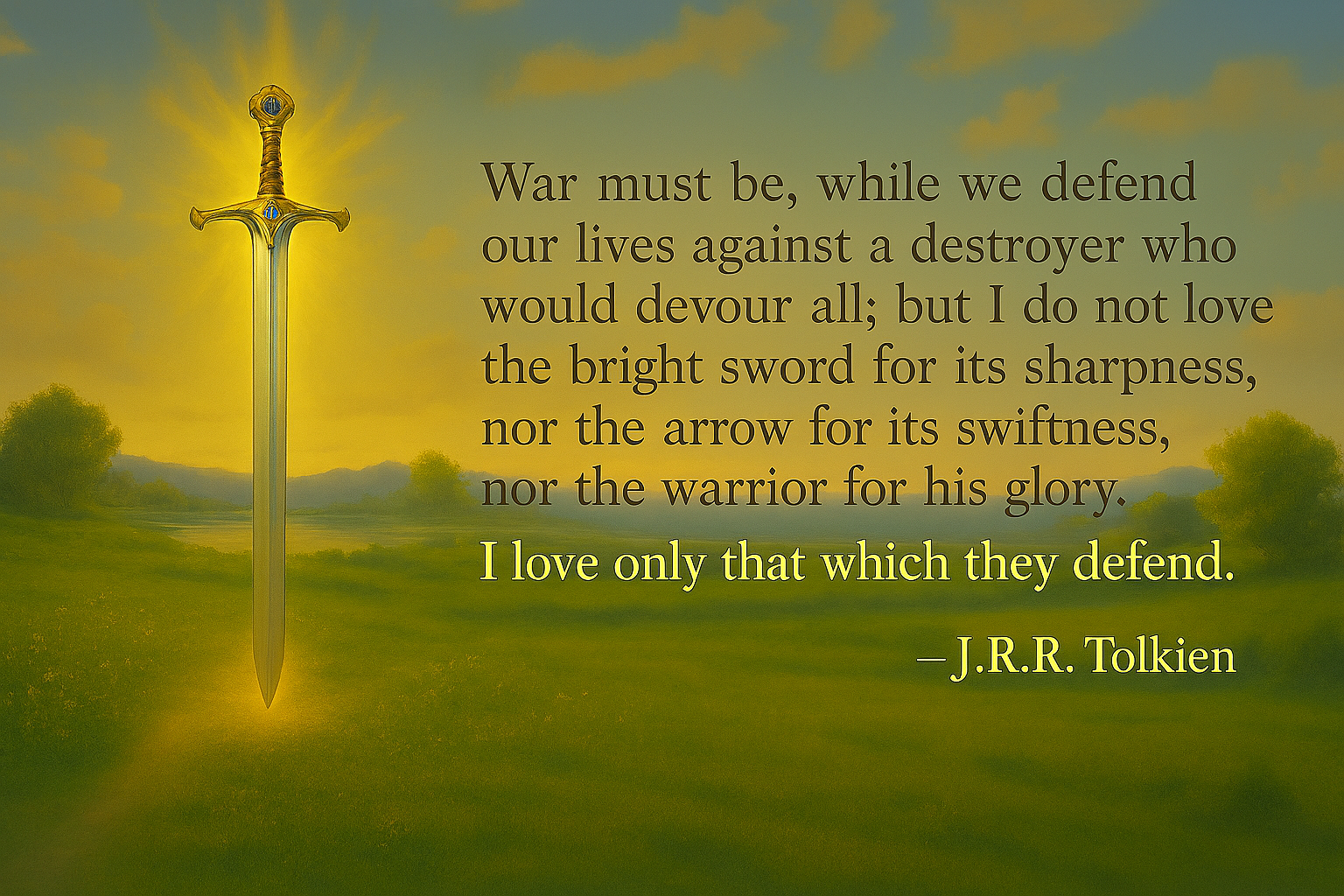
Spoken by Faramir, in The Two Towers.
Permalink | Read 532 times | Comments (0)
Category Inspiration: [first] [previous] [next] [newest]
This may be the most inspirational pig story since Charlotte's Web.
I've recently discovered Mollie Engelhart, who is both a regenerative farmer, à la my hero Joel Salatin, and an excellent writer. Also more:
Mollie Engelhart, regenerative farmer and rancher at Sovereignty Ranch, is committed to food sovereignty, soil regeneration, and educating on homesteading and self-sufficiency. She is the author of “Debunked by Nature”: Debunk Everything You Thought You Knew About Food, Farming, and Freedom—a raw, riveting account of her journey from vegan chef and LA restaurateur to hands-in-the-dirt farmer, and how nature shattered her cultural programming.
The title of Engelhart's article this morning is "The Pig Who Refused to Be Bacon." Good enough, but I think I would have called it "The Pig Who Lived." 
Brave Hart stands as a reminder that will matters. That spirit matters. That individual actions can shift outcomes in ways we cannot predict.... And every time I see her, mud on her sides, babies tucked against her belly, I’m reminded: The fight you think you’ve lost may be the one that changes everything.
Permalink | Read 534 times | Comments (0)
Category Inspiration: [first] [previous] [next] [newest]
It is Epiphany. The Twelve Days of the Christmas Season are ended. And yet I will honor their departure with one more Christmas post.
I hope you enjoy this setting of the poem "Noël," written by J. R. R. Tolkien in 1936, rediscovered in 2013, and revealed to me by a fellow lover of the Good, the True, and the Beautiful.
Permalink | Read 524 times | Comments (0)
Category Inspiration: [first] [previous] [next] [newest]
It's Christmas Eve, and I have many things to say but no time to write. Instead, I offer this beautiful King's College Choir rendition of O Come, All Ye Faithful, with its glorious descant, and on the last verse the magnificent Willcocks chord on "Word."
You're welcome! Have a
Very Merry Christmas!
Permalink | Read 618 times | Comments (0)
Category Everyday Life: [first] [previous] [next] [newest] Inspiration: [first] [previous] [next] [newest]
“Afraid of heights?” Helmer asked. “Perfect. You really are a mixed-up lad. You come here full of defiance and anger, and then you show up and you’re a horrible, hobbled mess. You spend a week with me, and now you’re such an efficient student it’s scaring me and I begin to think you might someday be some kind of decent soldier. And now this."
“I’m willing to work and overcome anything, sir. Including this,” Picket choked out.
“Don’t worry,” Helmer said. “It’s just another enemy to be taken down in the end.”
From S. D. Smith's The Green Ember.
Permalink | Read 464 times | Comments (0)
Category Inspiration: [first] [previous] [next] [newest]
Permalink | Read 592 times | Comments (0)
Category Inspiration: [first] [previous] [next] [newest]

