
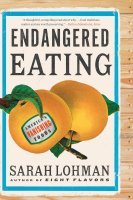
 Endangered Eating: America's Vanishing Foods by Sarah Lohman (W. W. Norton & Company, 2023)
The first Sarah Lohman book I read was her excellent, if overly-political, Eight Flavors. After waiting nearly two more years for a good price on Endangered Eating, which is the book of hers that had first caught my eye, I gave up and bought it. It probably was not worth the $10 I spent because it is now available in our library; that's what I get for being impatient. But it's not a bad thing to support people who can write well.
The negatives that I saw in Eight Flavors are in Endangered Eating to an even greater extent, so let's get them over with first.
- No matter how many times Lohman emphasizes the point, native Americans and black Africans did not live in perfect, idyllic societies before meeting white people. And all the problems of the world cannot be attributed to white, European, heterosexual, Christian men. These points were pounded into my head in school starting in fourth grade, and reinforced in some of my favorite childhood books. I bought into the concept, even to the extent of determining that I would have to become a Catholic, that being the only way I could opt out of the hated WASP designation. (I didn't, having discovered other alternatives to Catholicism as I grew older, but that's how strongly I felt.) I'm done with that now, and have no patience with those who push that attitude. Foremost, it is patently false; secondarily I refuse to let my own history, heritage, and culture be the only one it's not acceptible to celebrate and be proud of.
- Nor does her ranting change the fact that capitalism is the economic system most likely to allow liberty and prosperity to thrive, and to be spread most fairly amongst the population.
- In Lohmans' writing, the inconsistency of racial/ethnic capitalization drives me crazy. A person is Black, or Indigenous -- but white, or brown. It makes no sense and happens too often to be an unintentional slur.
- As I've said repeatedly, there's no point in pushing people to accept language that for many of us has always been considered off-limits, offensive, and vile, while at the same time putting formerly-acceptible words on the naughty list. I would say that goes tenfold for formal writing, e.g. books. I find the language in this book unacceptable, even as spoken language, but especially in a book that wants me to take it seriously.
- And what's this new averson to the word "slave"? Everywhere she could use that simple and heretofore useful word, she replaces it with "enslaved," as if making the word into two syllables somehow makes the concept less horrible. (I can't read "enslaved" without thinking of Robert Heinlein's Citizen of the Galaxy, and Thorby Baslim's frustrations trying to talk with those who don't understand the condition of slavery. When his grandfather insists on referring to Thorby's former condition by a more acceptible name, Thorby retorts, I was sold and I was a slave!)
I guess I should have been warned about the political sermonizing; not only from my experience with Eight Flavors but also from this description in the introduction.
He looked confused when he spotted me—a tattooed, blue-haired young woman—trudging up his driveway.
Politics I can generally ignore if the content is good, but I was also disappointed in that. Not that the stories weren't fascinating, but from reading the previews I had expected something different. I have for years been greatly concerned over the obvious fact that our crops, our livestock, and our food supply in general are being bred/engineered primarily for something other than nutrition and flavor. For convenience, for pest resistence, for super-production, for robustness during transport, for long shelf-life—but taste and healthfulness fall far down on the list. I had hoped that Endangered Eating would address this problem, and although it touches on it, that is not the focus. I was particularly disappointed in the section on apples, the promise of which alone encouraged me to buy the book. As it turns out, however, Lohman is not concerned with the great diminution of apple varieties and taste in general, but only for the production of apple cider—and only the production of alcoholic cider. There's not one mention of the violence that the act of pasteurization does to the flavor of regular cider, nor of the breeding of apples for sweetness, which has resulted in several new varieties all of which taste insipid to me. The wide variety of flavorful, tart apples has completely disappeared, not only from our grocery stores but even from the specialty stores like Whole Foods and Sprouts. At least that's true in Florida—when we travel north in the fall it is not so much for the colorful leaf displays as to be able to taste good apples again.
My own frustrations aside, Endangered Eating is well-written and engaging. You don't have to like Lohman's politics, nor her focus, to appreciate that.
Here is a handful of passages I made note of while enjoying the book:
I admired the efforts of the costumed performers but struggled with the idea of appropriating historical Islamic culture to celebrate the American date industry.
I will comment no further here on the pressure not to "appropriate" other cultures other than to say that it is as ludicrous as telling a Chinese violinist that she can't play Bach because she isn't German.
As consumers, what we expect from food is consistency. We have an expectation that every package of dates (or craisins, or red seedless grapes, or whatever) we buy from the grocery store will taste the same.
Add that to the above list of what the industry values more than good nutrition and flavor in our food. Having once been privileged to have access to an orchard where the juice they sold varied by what variety of orange was in season (sadly, it was out and turned into a housing development), I can say with authority that the determination to make every glass of orange juice taste the same is an abomination.
In these early plantations, the cane grown was all native Hawaiian varieties. Laborers harvested cane by hand and cut it with a cane knife, a short machete with a hook on the end. Fresh-cut cane was carried to oxcarts and transported to the mill, which was a small machine, about a foot square, mounted outdoors on a pillar. Cane was fed into the side of the mill and passed back and forth through the rollers by two workers, while a third man led a mule or ox in a circle attached to a long wooden arm that powered the rollers’ movement. The juice flowed out a tap in the side and was collected for processing.
I noted this passage because it reminded me of our trip to Brazil in 1978. This process was very like the roadside stands where one could watch the sugar cane go from stalk to juice, and then drink the sweet liquid. The juice was more along the lines of maple sap than syrup: it tasted mostly like water that was somewhat sweet. But by looking at the teeth of the vendors, one could guess that drinking cane juice instead of water (which was common in the cane fields) was generally not a good idea.
By the mid-twentieth century, work at a Hawaiian sugar plantation meant a stable, well-paying job with union protection. But a workplace that respects its workers is too expensive for capitalism; sugar production was moved to countries without unions and worker protections, where the bottom line was as low as possible. Hawaii could not compete with growers in India, Brazil, and the Dominican Republic. In those countries, land costs as well as labor costs are lower, and sugar production is often subsidized by the government. American consumers expect a low price on a bag of white cane sugar, and one of the results of this expectation was the end of sugar cultivation in Hawaii.
I won't argue with the evils of choosing cost as the primary value in any industry, but I will note that when a government subsidizes a product, that is hardly free-market capitalism.
Rum is a colonial by-product. While sugarcane is native to the Pacific, Western colonizers brought the technology to process sugar into molasses, and then to process molasses into rum. So, is it appropriate to take kupuna kō [Hawaiian legacy sugarcane] and use it to make a product that came from Hawaii’s colonizers?
...
Before I came to Hawaii, I had loved the idea of preserving a traditional crop through a craft spirit. But now, the idea wasn’t sitting as pleasantly. When white Americans came to Hawaii, they forced Hawaiians to reject their own culture. The missionaries replaced the Hawaiians’ religion, encouraged them to cover their bodies with Western clothes, and prevented them from dancing the hula. The plantation owners replaced diverse Hawaiian agriculture with monocrops and eventually replaced the Hawaiian queen with their own government. But colonizers will allow a part of a culture to exist as long as it is prettily packaged for white, Western consumption. Docile, smiling hula girls are acceptable; so is Hawaiian music when it’s sung by white Americans like Elvis Presley or Annette Funicello. The distilleries on Hawaii use the images and stories of Hawaiian culture in their branding. How long before single-varietal-pressed legacy sugarcane juice appears in organic markets next to the coconut water? And when it does, will it be a blessing that preserves kupuna kō, or cultural appropriation that steals identity—and profits—from native Hawaiians?
...
Hawaiian legacy sugarcane collections...mean that an endangered plant is being preserved. But many Hawaiians feel kupuna kō should never be commercialized. There are already Hawaiians out there individually preserving their traditions in a rapidly changing world, as their ancestors did before them. An outsider like me can’t know how many stands of kupuna kō grow in backyards and how many varieties have continued to grow for generations, passed down in the same family. There’s a part of me that feels that these backyard stands of kupuna kō, harvested and sliced into chunks for thirsty kids, are the best kind of preservation. Not everything is for everyone, and Hawaiians have had enough taken from them.
The destruction of the native plants left the marsh vulnerable to salt-tolerant invasive plants, in particular, the ecosystem-destroying trio of purple loosestrife, narrow-leaf cattail, and, worst of all, phragmites.
Invasive phragmites, a genus of reed grasses, arrived on the East Coast in the early nineteenth century, probably from Europe. Phragmites spread rapidly with the construction of the highway system in the 1950s, its seeds latching on to cars and semi trucks and spreading to susceptible areas like the depleted Mentor Marsh. If you’ve ever driven on a highway, you’ve seen phragmites; one of its favorite habitats is the polluted ditches alongside roadways. It’s very recognizable by its feather-duster-like seed heads. It’s often over 14 feet tall and grows in dense patches, choking out native vegetation, creating a monoculture and biological desert.
Lohman is talking here about the destruction of wild rice habitats in the northern Midwest, but the destructive power of phragmites, and the difficulty of eradicating it, is well known to those of us on the coast of Long Island Sound.
Today, there are fewer than 100 apple varieties grown commercially. ... By the 1920s, apple growers focused on only a few varieties of “culinary apples” designed to succeed in grocery stores.
Many of the earliest Southern cookbooks were written by white women but filled with recipes created by Black cooks. Today, we look at these cookbooks through the lens of stolen, usually uncredited, culture.
I asked David how his quest to locate lost Southern culinary plants began. He traced the movement back to chef Alice Waters in the 1970s. She had inspired chefs to seek out produce that tasted like something, often heirloom varieties. “Grains and vegetables created since the early twentieth century were not sensory tested,” David explained. “Taste was always a secondary consideration to productivity, early maturation, processability, disease resistance, pest resistance. There was this call, where are the ingredients?” He said Waters insisted on “asserting the primacy of taste over other qualities in a plant.”
The Carolina Runner peanut’s small size made it harder to harvest by hand than newer cultivars, and the new machinery was designed for larger nuts. The Carolina Runner may have been the best-tasting, but out of convenience it was rapidly replaced by other varieties. The last Carolina Runner went into the ground in the late 1920s, and by the 1950s, it was thought to be not just functionally extinct but extinct extinct. Gone.... Then, nearly a century later, when David Shields was able to acquire twenty of the rarest peanuts on the planet, he sent them to Clemson University’s Coastal Research and Education Center outside of Charleston.
A rare success in recovering lost foods! This reminds me of the people who saved much local and ethnic music by traveling from small community to small community and making a record of the people's music. Mass media and massive agriculture are doing their best to erase local cultures and foods, but backwater villages and the backyards of old houses may still have much to offer.

