
I've written often enough about threats to the fundamental right of parents to educate their own children: the dreadful situation for homeschoolers in Germany, my concerns for Switzerland, and the unwarranted judicial intrusion in family life and education touched closer to home, in California. California ultimately upheld the legitimacy of home education, but it appears North Carolina is the next battleground.
As with the Terri Schiavo case, it is family problems that allowed the court's nose into this tent. It illustrates a serious problem with our "no fault" attitude towards divorce: despite the husband's admitted, ongoing, adulterous affair, his desire to send his children to public school has been allowed to trump his wife's desire to continue homeschooling. What is truly worrisome, as it touches homeschooling is the judge's power and attitude, as well as whatever precedent his decision may set.(Quotations are from two separate articles, here and here.)
[Venessa] Mills was forced to defend her right to homeschool during divorce proceedings brought on by her husband's unfaithfulness.....Even with abundant evidence showing the Mills children are well adjusted and well educated, Judge [Ned] Mangum ruled overwhelmingly against Mrs. Mills on every point. He stated the children would do better in public school despite the fact that they are currently at or beyond their grade level. Evidence showed two children tested several grades ahead.
When issuing his verdict Judge Mangum stated his decision was not ideologically or religiously motivated. However, he told Mrs. Mills public school will "challenge the ideas you've taught them."
The judge...explained his goal in ordering the children to register and attend a public school was to make sure they have a "more well-rounded education."
"I thought Ms. Mills had done a good job [in homeschooling]," he said. "It was great for them to have that access, and [I had] no problems with homeschooling. I said public schooling would be a good complement."
The judge said the husband has not been supportive of his wife's homeschooling, and "it accomplished its purposes. It now was appropriate to have them back in public school."
I can't help wondering what qualifies the judge to determine that the family's homeschooling had "accomplished its purposes." What purposes? Purposes for whom?
Mangum said he made the determination on his guiding principle, "What's in the best interest of the minor children," and conceded it was putting his judgment in place of the mother's.
What, indeed? Eternal vigilance is the price of liberty.[T]he judge also ordered a mental health evaluation for the mother – but not the father – as part of the divorce proceedings, in what [family friend and fellow homeschooler Robyn Williams] described as an attack on the "mother's conservative Christian beliefs."
"This judge clearly took personal issue with Venessa's stance on education and faith, even though her children are doing great. If her right to homeschool can be taken away so easily, what will this mean for homeschoolers state wide, or even nationally?" Williams asked.
I'm going to use my proverb until it catches on: The wise man recognizes truth in the words of his enemies. And the prudent man defends even his enemies from unjust accusations. It's time to annoy some of my readers yet again.
Many years ago I listened, against my will, to part of a Rush Limbaugh radio show. I was disgusted by the self-aggrandizing bombast, and even more by the sarcastic, mocking humor. Since then I've read bits and pieces of many of his newsletters, however, and have to admit that amongst the bombast, mockery, and occasional misinformation, there is some important truth. Oh, how hard it is not to let our selves get in the way of our message! And how many people are blinded to the truth because of the way we present it! However, that is another issue.What troubles me is the heat Limbaugh has taken because he insists that he wants President Obama's policies to fail. How awful of him, how immoral, how intolerant, partisan, and mean! How could anyone wish the president to fail in his efforts to bring prosperity and respect back to our nation? Personally, I am too selfish to wish Obama to fail. I don't have enough years ahead of me not to hope for a quick recovery. That doesn't change the fact that I can envision scenarios in which Limbaugh's attitude is not only proper, but heroic.
When I watch a three-year-old climbing a piece of playground equipment, I want him to succeed. But if that same child were attempting to climb a trellis that reached from the ground to the top of a tall house, and I knew that much of the wood was rotten and likely to collapse under his weight, I would want him to fail, and fail quickly. The sooner his efforts were stymied, the better: let his injuries be a wounded dignity, or even a broken arm, rather than a broken neck or death!
You can say that Rush Limbaugh is an arrogant, sarcastic blow-hard, and I'll agree with you. You can insist that he is wrong in believing that Obama's policies are disastrous, and I'll hope you are right. But don't castigate him for not cheering on the president. If you thought the Pied Piper were kidnapping your children, would you be right to hope for his success?
I am reproducing John C. Wright's latest post in its entirety because I desperately want my liberal readers to tell me why he is wrong, and many of you don't bother to click through when I merely provide links. Three things keep me from utter despair over the course we are following: (1) denial; (2) knowing that God—not the President, not the media, and not the corporate CEOs—is ultimately in charge, and will bring good out of even our most boneheaded mistakes; and (3) our children, and young people in general, are still enthusiastic and optimistic. Maybe they're in denial, too, but as long as they don't give up we will make it through.
Adding more to the debt than all previous presidents combined
In The Wall Street Journal, Michael Boskin writes:
Mr. Obama's $3.6 trillion budget blueprint, by his own admission, redefines the role of government in our economy and society. The budget more than doubles the national debt held by the public, adding more to the debt than all previous presidents—from George Washington to George W. Bush — combined. It reduces defense spending to a level not sustained since the dangerous days before World War II, while increasing nondefense spending (relative to GDP) to the highest level in U.S. history. And it would raise taxes to historically high levels (again, relative to GDP). And all of this before addressing the impending explosion in Social Security and Medicare costs.
Mark Steyn makes this comment on Boskin:
What emerges from such a blueprint will not be America. The United States will survive as a geographical designation, a collection of zip codes, but what goes on within them will be a Euro-Canadian form of societal arrangement
My comment: With this amount of money, NASA could have built an Arthur C Clarkian space elevator. Out of one hundred dollar bills.
What astonishes me is the sheer economic illiteracy of this course and its defenders. During FDR's disastrous New Deal (which made the depression from a one-season market correction into a decades-long nightmare. Dow levels did not return to their 1920's figures until the late 1950's, a years after FDR was dead and WWII was over) at least FDR had two excuses: first, Keynes talked such charming goobledegook that anyone might get confused; and (2) a depression of this magnitude had never happened before, so experience was no clear guide.
The supporters of the current administration do not have those excuses. First, the current spending makes no sense even from a Keynesian point of view. Second, the lesson learned from the Great Depression is clear enough with anyone who has eyes to see.
Keynes suggested that massive public works projects would tax savings and increase borrowing, lowering the interest rate. This is a bone-headed idea, but it is not insane. It is wrong, but not evil. The current administration suggests that massive transfer payment from the most productive to the least productive sector of society, with moneys spend on consumption goods rather than investment, will somehow stimulate .... something. The rhetoric is a little vague on the intended consequences. The consumption goods in this case include socialized retirement savings (known as social security), socialized medicine, socialized education to the college level, socialization of the banking and lending industry (thanks, Bush!) and pork projects whose wastefulness beggars exaggeration.
In the Wall Street Journal, Reason Foundation Founder Robert Poole’s op-ed lists just some of the pork our children and grandchildren, for the rest of their lives, will be making interest payments on.A wish list that is 11,391 projects strong! What vital infrastructure projects would cash-strapped taxpayers get for their $73 billion? Here's a sampling: - Hercules, Calif., wants $2.5 million in hard-earned taxpayer money for a "Waterfront Duck Pond Park," and another $200,000 for a dog park.
- Euless, Texas, wants $15 million for the Midway Park Family Life Center, which, you'll be glad to note, includes both a senior center and aquatic facility.
- Natchez, Miss., "needs" a new $9.5 million sports complex "which would allow our city to host major regional and national sports tournaments."
- Henderson, Nev., is asking for $20 million to help "develop a 60 acre multi-use sports field complex."
- Brigham City, Utah, wants $15 million for a sports park.
- Arlington, Texas, needs $4 million to expand its tennis center.
- Miami, Fla., needs $15 million for a "Moore Park Community Center, Tennis Center and Day Care" facility. The city is also desperate for $3.6 million to build a covered basketball court and a new tennis court at Robert King High Park. Then there's the $94 million Orange Bowl parking garage you are being asked to pay for.
- La Porte, Texas, wants $7.6 million for a "Life Style Center." And Oakland, Calif., needs $1 million for Fruitvale Latino Cultural and Performing Arts Center.
At some point, this degree of economic irrationality tips over from good-hearted-but-wrong-headed eurosocialist nonsense, into corrupt-headed Soviet-style totalitarianism. After a certain point, a certain degree of negligence when it comes to how the world actually works is not longer excusible; and it is not negligence, but depravity.
In my judgment, we have reached that level of depravity.
This is not the normal back-and-forth of partisan politics. This is damage to the Republic which could spell the end of it. Nations do not survive as nations once they are bankrupt and addicted to government power. Oh, will no doubt continue to call ourselves the United States of America, with the same sincerity that Spanish and German princes were called The Holy Roman Emperor, long after the Fall of Rome.
Meanwhile, bank stocks bottom out, the Dow continues to plummet, unemployment in all sectors EXCEPT GOVERNMENT continues to rise (Big Brother is hiring), and the Conservative movement's main concern seems to be a name-calling match between Rush Limbaugh and David Frum. (For those of you who did not notice, President Obama used his vampire hypnosis powers learned from the Secret Masters of Tibet to declare Rush the leader of the Republican Party, and, for some reason not clear to me, Republicans scurried to agree with him.)
The sheer triviality of the media coverage of this is beyond belief and without parallel in history. Meanwhile we are at war with a ruthless, well funded, and highly motivated enemy, who operates from a decentralized power structure, difficult or impossible to locate and destroy. Meanwhile our defense budget is being slashed to levels (as percent of GDP) as low as it was between the Great War and World War Two. Those with long memories recall the sequel to that.
Instead of drilling here and drilling now, the new administration's energy policy ignores the three viable sources of energy on planet earth, coal, petrol, and nuclear. Instead the government will be replacing storm windows in all government buildings, on the taxpayer's tab.
While I support free trade as an economic matter, as a military matter, it is unwise to by oil from Middle Eastern regimes who fund our enemies. As a miltiary matter, it is unwise to borrow money from Red China. Whenever Peking decides it would be expedient politically to bankrupt their own rising (and unruly) middle class, they can sever trade relations with us, and call in their debts. Certainly they would suffer from this. But their Party elite would not suffer. We would suffer more. Again, our elite would not suffer.
Meanwhile, our European allies, far from being delighted to return to American alliance once the dreaded Darth Bush term expired, discover that protectionism is the order of the day. The collapse of our economy -- due in large part, perhaps entirely, to the Democrat party's socialist experiments in the housing market -- collapses their economy. The economically sane thing to do at such times is to lower trade barriers. A depression is the worst time for protectionism. But the new adminitration has rushed through protectionist schemes, tarriffs, and so on, in the name of the emergency, so our European allies are being left to fend for themselves.
Meanwhile, Iran is working on a nuke, and the Iranian leader promises to destroy Israel, a nation whom the new administration has no interest in supporting.
Meanwhile, in other topics, the corruption and degeneration of art, of literature, of morals, of notions of truth and beauty, vice and virtue, continue to degrade. Ignorance is rampant; the public school system has failed; the aesthetes praise only mind-jarringly grotesque and talentless rubbish; the nuclear family decays; and the California Supreme Court seriously debates whether to overrule the voter's sovereignty regarding Prop 8 in California. The only thing sacred to the Left is sexual perversion. Whatever is abnormal, sterile, morally empty and self-destructive, to them, looks fine and fair.
Meanwhile, the administration plans to make any and all state restrictions on infanticide unlawful. The administration seeks to appoint the most abortion-friendly candidate imaginable to the leadership of the department of health and human services. The billions of infants slain so far is not enough: Moloch is not pleased because the pyramid of tiny skulls is not piled high enough.
Call your Congressman. For each call they receive, the politicians calculate that a certain number of other voters feel the same, but did not call. In other words, if you make the effort to complain, the complaint is amplified in their ears.
Permalink | Comments | Edit
Category Politics Random Musings
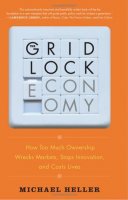 The Gridlock Economy, by Michael Heller (Basic Books, New York, 2008)
Peter V.—who now keeps most of his insightful commentary behind the Facebook wall, so I can't provide a link—alerted me to The Gridlock Economy, which I touched on in the first Casting the Net. Since then I obtained the book through Interlibrary Loan, and thanks to my Lenten disciplines, finished reading it last night. Now I can get the library monkey off my back and return this long-overdue book. (To be fair to them, the library has not been nagging me about it. But I was brought up to view an overdue library book as an unpaid debt, and my own conscience does quite enough nagging. In maturity—I think once I passed the half-century mark—I came to realize that keeping a book a little longer and paying a fine was an acceptable strategy and more reasonable than returning it unfinished. But I still imagine that I'm keeping hoards of folks in durance vile by limiting their access to the book.)
The Gridlock Economy, like many modern books, could have used a better editor. The author suffers from Presbyterian Preacher Syndrome—the habit of saying something three times when once would have done better; we gave up reading it aloud because that made the repetition more painfully obvious. Nonetheless, it's worth making the effort. If you don't read the book, at least check out the website. For those without the time to do even that, consider this.
In the discussion that followed my post on Chinese piracy, I wondered how patent and copyright law could stifle the creativity and innovation they were designed to encourage. Gridlock Economy provides an answer: ownership has splintered out of control. So many people (more likely, organizations) own rights to small parts of a creative endeavor that securing permission to use them all is unreasonably expensive, if not outright impossible. From the arts to medicine to telecommunication and hundreds if not thousands of other fields, when division of ownership meets our litigious society, it slams the brakes on progress. Here is an example that hit home to me, because we recently watched a PBS rebroadcast of Eyes on the Prize.
For millions of Americans, Dr. [Martin Luther] King came alive through the Emmy Award-winning public television documentary Eyes on the Prize....To make this fourteen-hour documentary, filmmaker Henry Hampton talked with hundreds of people who knew Dr. King—fellow activists, family members, journalists, and friends—and drew from many sources in a variety of media: video footage from 82 archives, almost 275 still photographs from 93 archives, and some 120 songs.
To put these materials into the film, Hampton had to secure licenses from their copyright owners. Otherwise he faced possible lawsuits. Many of these licenses expired in 1987 after the film was first broadcast. Over time, rights to these video clips, images, and songs changed hands. Often, the original permission did not include rights to a television rebroadcast or use in new media such as DVDs. Because the Eyes on the Prize filmmakers lacked broad permission to use the underlying sources, the film could not be shown again. It sat unwatched for years.
[The film] could not easily be made today. Licensing all the pieces of intellectual property would be too daunting. Along with the film's other creators, [Dr. Clayborne Carson] has spent many frustrating years trying to bring Eyes on the Prize out of the vault. The Ford Foundation donated six hundred thousand dollars to help buy licenses; other donors gave hundreds of thousands more. Even with these contributions, and a lot of volunteer efforts, the negotiations took nearly twenty years.
What caused the gridlock? Suppose the filmmakers used a film clip of an interview. People who were honored to appear in the original documentary can now demand payment for inclusion in the DVD. Owners of copyrighted songs sung in the background as Dr. King marched can demand compensation. So can the interviewer or narrator. And Dr. King's estate can request compensation for use of his likeness in the film.
To re-release the film, the producers had to jump through a thousand hoops, a process called "clearing rights" in the trade. Clearing rights is not cheap or fast....Bringing the film to DVD meant identifying and locating each of the partial owners or their heirs, then negotiating payment to, or a release from, every single one of them.
Clearing rights is especially complex for music. When the Eyes on the Prize team could not get the rights to a song, the music had to be removed and replaced without "damaging the integrity of the sequence," according to Rena Koserasky, music supervisor for the project. "We're not talking about digital formats, we're talking about actual reels of material. It's difficult and very time-consuming."
In 2006, the team effort finally succeeded in clearing the rights to (or replacing) each element of the film. Eyes on the Prize was re-released.
Michael Heller calls his theory of gridlock "the tragedy of the anti-commons." "Commons" is property available to all, such as the village land where our New England ancestors grazed their livestock, or the rivers, back when anyone with a net could gather food for his family. The trouble with property held in common is that incentive to protect and improve it is reduced. Rivers become over-fished because one person's decision to limit his catch is undone by his neighbor, who sees this as an opportunity to get more fish for himself. Short-term thinking is rewarded, and everyone loses in the long term. Wars are fought over such things: one reason Iraq was interested in taking over Kuwait was that both countries were pulling oil from the same field.
The concept of private property is a very effective means of encouraging responsible use of a resource, and even innovation. Alas, I no longer remember the source, but we read, or watched, something just recently about the agricultural progress that was made when common land was enclosed, thus giving farmers both incentive and ability to improve their breeds and conserve their land. (Land enclosure movements have negative consequences as well, but that's another issue.) However, when property—or more precisely, control of property—is fragmented into too many pieces the problem can turn from overuse to underuse.
I don't agree that underuse is always a problem. If a big company wants to build a shopping center and is stymied by a few holdouts who don't want to sell their family homes, that's just fine with me, even if the shopping center increases the market value of the property a thousand fold. Occasionally Michael Heller puts me in mind of my father's uncle, who couldn't see a tall, straight tree without thinking of its logging value. Nonetheless, Heller has convinced me that fragmented ownership, the anti-commons, frequently leads to situations that do nobody any good.
In 1887, John Brown bought eight acres of land in Rankin County, Mississippi. He was part of the great wave of freed slaves who invested their life savings in farmland. John lived a long life, and when he died in 1835, he did not leave a will. So ownership of his land split among his wife and children. In time they all also died without wills, so the land passed to their children and grandchildren. One of these children, Willie Brown, began consolidating ownership in the land by buying the interests of five of John's nine children: Frances, Minnie, Adda, Joe, and Lizzie. By the time Willie passed away, he had accumulated a 41/72 share in the family farm, which he left to his wife, Ruth.
In 1978, Ruth asked a court to divide the farm so that she would own her share of the land outright. The other sixty-six Brown heirs would then own the balance, in shares ranging from 1/178 of the farm down to 1/19,440. The court refused to partition the parcel by drawing a line on the land; it was too complicated. Instead, the judge ordered the land sold and the money divided among the heirs. As often happens in such forced sales, a single outside company was the only bidder. In this case it was a local white-owned lumber company that wanted to cut the timber.
Even though the family collectively valued the farm far above its auction price, no Brown heir placed a bid. Why? Partly because U.S. law often requires cash paid in full at such auction sales, a rule that makes bidding impossible for most ordinary owners. No single Brown heir could top the lumber company's lowball bid. There was no simple mechanism through which the heirs could quickly organize a joint family bid—a missing legal tool that commonly affects scattered heir owners. Ruth got a little cash from the sale—not nearly enough to replace the farm and nothing like enough to compensate her family for losing the locus of its cohesion and tradition.
Had Ruth known the outcome, she would never have gone to court. But many times there is no choice. Opportunists prey on owners of splintered property by convincing one small shareholder to sell his interest, and then forcing the sale—which even the smallest shareholder can do—thus acquiring the entire property at a fire-sale price. Opportunists are in every field, and to my mind a great deal of the problem is the separation of patents and copyrights not only into pieces and parts, but away from those whose ingenuity brought them forth in the first place. Patent and copyright "trolls," whose only business is to search out and buy up pieces of intellectual property for the purpose of squeezing money out of someone who wants to put them to use, strike me as little better than blackmailers.
Anti-commons tragedies are rampant on the leading edge of discovery, where legal rights are not only splintered but also still in flux. Research laboratories abandon promising lines of inquiry because the cost of finding and assembling all the necessary rights is so high—and even higher if you miss one, no matter how minor, and find yourself hauled into court. Academic researchers become scofflaws, ignoring patents in hopes that the owners will not bother to sue them, at least not until the efforts produce something profitable. Commercial labs cannot afford to take that chance. Underuse is hard to quantify; who can say what has not been created, what medical discoveries have not been made?
Another question The Gridlock Economy answered for me was why the government was interested in forcing the conversion of broadcast television from analog to digital, and why some folks want to stop broadcast TV altogether. It turns out that the low-frequency spectrum it uses is very prime real estate indeed, and currently very inefficiently used. This is one reason why our cell phone and wireless broadband services are far behind places like Japan and Europe. One cell tower at 700MHz can provide the same coverage as ten towers at 2400 MHz.
This book was published in early 2008, and offers this example of a Tragedy of the Anti-Commons from a year ago:
Not long ago, mortgage bankers sized up borrowers before making loans; lenders were a phone call away if home owners had trouble repaying. Not anymore. Investment banks engineered new mortgage instruments that gave larger loans on riskier terms to people with weaker credit. Banks pooled these new mortgages together, then split the pools into bonds with varying risk levels. The details were complex, but the results were magical: financial engineering seemed to transform dodgy mortgages into safe bonds. So long as interest rates stayed low and house values high, everyone made money.
But not for long. Fragmenting mortgage ownership broke the link between borrower and lender. When rates rose and prices dropped, the gridlock features of the new financial instruments came to the fore. There were so many partial owners of pooled mortgages that no one cared to act like an old-fashioned mortgage banker with careful underwriting and loan servicing. Until recently, foreclosure had been the banker's last resort because it's costly for everyone, including the lender. But in the new world of too many owners, widespread foreclosures became inevitable. Scattered owners of pooled mortgages could not easily reach agreement to restructure troubled loans. Today, there's no one for a borrower to talk to at the other end of the phone.
There's a regulatory gridlock story here as well. Mortgage regulation is still based on the old one-mortgage, one-banker model....New financial instruments fall between multiple federal and state regulators. No single agency can protect the integrity of the financial system as a whole, but each is powerful enough to block the others from stepping on its bureaucratic turf. Regulatory gridlock meant that no one checked as hundreds of billions in dangerous mortgage bonds were created and sold.
To his great credit, Michael Heller offers up no stock villains, and proposes no one solution to the problem. He sees the answer in (1) awareness of the problem, and (2) willingness to explore a variety of solutions public and private, legislated and informal. The Gridlock Economy is an eye- and mind-opening new perspective.
George Friedman's The Next 100 Years: A Forecast for the 21st Century is not yet available, but there's a long and fascinating excerpt at InvestorsInsight. If some of Friedman's predictions seem nonsensical, the same cannot be said about his conclusion that the least reliable predictor of the future is our expectations. In the immortal words of investment prospectuses, "past performance is no guarantee of future return."
Friedman dramatically illustrates his point by imagining what observers standing at each even decade from 1900 to 2000 might reasonably have expected the future to be like. In most cases they would have been proven wrong within a decade.Here are some of his unreasonable predictions—but consider his reasoning before rejecting them altogether:
American power and influence is not on the wane, but rather ascending.
The war between the United States and the radical Islamists is virtually over and will be little remembered in 100 years.
America's next challenge will be Russia, which will rise, bring on another Cold War, then collapse once again.
Despite appearances, China will be a threat only to itself.
Japan, Turkey, and Poland will become major world powers along with the United States
Increasing tensions will result in a mid-century global war. This war will be science fiction-like in its execution, and will lead to dramatic technical advances, including space-based solar power, which will jump-start a massive economic boom.
The most important dynamic of the 21st century will be falling birthrates leading to world population decline. Countries hungry for laborers will openly compete for immigrants rather than turning them away.
Thanks in large measure to the immigration-induced population and power shift, the final crisis of the 21st century will be a major conflict between the United States and an increasingly influential and aggressive Mexico.
Friedman may be 'way off base in his conclusions, or he may be prescient. Where I am certain he is correct is in his assertion that we must expect the unexpected. To that end I'm beginning what I hope will be several posts on ways we might prepare to meet whatever is coming our way.
To conclude the beginning, here are a couple of Friedman's thoughts that I found both frightening and comforting:
It is the delight of all societies to belittle their political leaders, and leaders surely do make mistakes. But the mistakes they make, when carefully examined, are rarely stupid. More likely, mistakes are forced on them by circumstance. We would all like to believe that we—or our favorite candidate—would never have acted so stupidly. It is rarely true. Geopolitics therefore does not take the individual leader very seriously, any more than economics takes the individual businessman too seriously.
The twenty-first century will be like all other centuries. There will be wars, there will be poverty, there will be triumphs and defeats. There will be tragedy and good luck. People will go to work, make money, have children, fall in love, and come to hate. That is the one thing that is not cyclical. It is the permanent human condition.
From this you might begin to guess the tenor of my upcoming posts. Some things never change, and therefore there are ways to face the uncertain future, ways that involve work but not worry, preparation but not panic. I take as the theme of my approach this admonition given by God to the Israelites, who had been conquered and dragged away into exile in Babylon (Jeremiah 29:5-7):
Build houses and settle down; plant gardens and eat what they produce. Marry and have sons and daughters; find wives for your sons and give your daughters in marriage, so that they too may have sons and daughters. Increase in number there; do not decrease. Also, seek the peace and prosperity of the city to which I have carried you into exile. Pray to the LORD for it, because if it prospers, you too will prosper.
Permalink | Comments | Edit
Category Politics Random Musings
It doesn't really matter that Barack Obama was not my candidate of choice (see my election series, Part 1, Part 2, and Part 3 for some of the reasons why); as a friend said, "I didn't vote for him, but I hope he's the best president ever." What boggles my mind is the adulation, ethusiasm, and outright joy that Inauguration Day 2009 brings—it's not all media hype. I can't imagine any presidential inauguration inspiring that kind of joy in me. At best I usually manage feelings of relief that the worst candidate did not win. But perhaps that's just a character flaw: I find it hard to get that enthusiastic about anything. We recently returned from our daughter's fabulous wedding to a wonderful man, and though I am pleased and enthusiastic and joyful, even for that event I can't imagine participating in the kind of jubliant demonstration associated with Obama's inauguration. Be that as it may, I truly wish our new president the best, and pray for him, because he will need it.
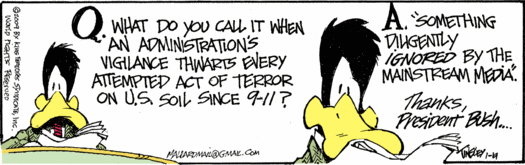
And yet my primary commentary on this Inauguration Day is a thank you to outgoing President Bush. History alone will tell, but as far as I can see the evidence so far pronounces George W. Bush a good man but an unfortunate and often unwise president, the same judgment I gave to Jimmy Carter. Nonetheless, he had his successes, and a very important one was highlighted by yesterday's Mallard Fillmore.
Permalink | Comments | Edit
Category Politics Random Musings
This morning Google News reported the following two stories sequentially [emphasis added]:
An 11th-hour ruling from the Bush administration gives health care workers, hospitals, and insurers more leeway to refuse health services for moral or religious reasons.
The rule, issued today, becomes effective in 30 days. Its main provisions widen the number of health workers and institutions that may refuse, based on "sincere religious belief or moral conviction," to provide care or referrals to patients.
"This rule protects the right of medical providers to care for their patients in accord with their conscience," says Health and Human Services Secretary Michael O. Leavitt....
A wide number of medical groups strongly oppose the new ruling. These groups include the American Medical Association (AMA), the American Nurses Association, the American Academy of Family Physicians, the American Academy of Pediatrics, and 27 state medical associations.
"Today's regulation issued by HHS under the guise of 'protecting' the conscience of health care providers, is yet another reminder of the outgoing administration's implicit contempt for women's right to accurate and complete reproductive health information and legal medical procedures," says a statement from the American College of Obstetricians and Gynecologists.
Shocking revelation: Santa Clara University professor mirrors famous torture study
Replicating one of the most controversial behavioral experiments in history, a Santa Clara University psychologist has found that people will follow orders from an authority figure to administer what they believe are painful electric shocks.
More than two-thirds of volunteers in the research study had to be stopped from administering 150 volt shocks of electricity, despite hearing a person's cries of pain, professor Jerry M. Burger concluded in a study published in the January issue of the journal American Psychologist.
"In a dramatic way, it illustrates that under certain circumstances people will act in very surprising and disturbing ways,'' said Burger.
The study, using paid volunteers from the South Bay, is similar to the famous 1974 "obedience study'' by the late Yale University psychologist Stanley Milgram. In the wake of Nazi war criminal Adolf Eichmann's trial, Milgram was troubled by the willingness of people to obey authorities — even if it conflicted with their own conscience.
Because I have often written about Germany's persecution of parents who believe the education of their children is best accomplished outside of the state public schools (this post will lead you to some of the other stories), it's a pleasure to be able to bring some good news as well: Prosecutors are dropping charges against the Brause family, which had faced up to two years in prison and the loss of their children. If this seems a "Well, duh!" kind of accomplisment, it is important to remember that it was not so long ago that we were celebrating such events as great victories in the U. S.
[T]he announcement came after the court received a detailed psychiatric report that there is no psychological harm to the children from homeschooling. The report also stated that the children have not been harmed [academically], which is evidenced by [the] exit exams [of the two oldest children] from high school
Lest we complacently conclude that the plight of homeschoolers in Germany is Germany's problem, not ours, American citizenship is not a sufficient defense if you live in Germany and want to teach your own children. An American family living in Berlin was recently ordered to court because of their homeschooling, and under legal advice the mother and children have fled to the United States until the situation can be resolved.
I'm delighted to see evidence of progress anywhere in the world, and also for the reminder that "watch, work, and pray" never ceases to be necessary.I've known for a long time that the plight of homeschoolers in Germany is dire, as I've written before (for example, here, here, and here); I've also known that the situation in Switzerland is worrisome, legal in some cantons, illegal in others, and sometimes in between. The Swiss are careful to point out that they are not German so I have hope that they will distinguish themselves by moving in the direction of more liberty. It wasn't that long ago, after all, that homeschooling in the United States was similarly at risk. However, Principled Discovery has discovered some alarming news. (Thanks, DSTB.)
According to the Tages Anzeiger, one of the most widely read newspapers in Switzerland, homeschooling is about to become severely restricted in the Canton of Zurich.
Private Education: Parents threaten with disobedience
December 4, 2008
Beginning next summer at the latest, parents will only be allowed to educated their children at home when they have a teacher’s certificate. Eight families are resisting—with all means. Tages Anzeiger
The article goes on to say that this new regulation will affect fifty families, but apparently only these eight families have chosen to fight. The Education Director has thus far rejected all offers of compromise. If they continue and do not win their cases, the families face fines of up to 5000 Francs (about $4,100) and a possible citation for disobedience of official orders.
Read the whole story. Those with a working knowledge of German may want to read the Tages Anzeige article directly; I can only hope it is the translation that makes the language sound strident and authoritarian.
The most chilling words are in the law that was not passed, so perhaps the Swiss will be more resistent to educational tyrrany than the Germans.
That, alas, is what many people, even in the United States, mean when they talk about the "socialization issue" with homeschoolers. It's not that they worry that homeschooled children won't learn how to get along with other people, but that they will learn to think independently and not conform.Private schools should teach the same world view as taught in public schools.
We bought some luggage today. Amongst the choices, we found an American Tourister set that would do the job, but decided to look a bit further. Then we found some Swiss luggage that made my heart sing. It was billed as being made by the same people who make the Swiss Army knife, was an arresting red color easy to spot on an airport carousel, and was marked with a Swiss cross emblem. Besides, it was Swiss! Must be good, right? It was also more than twice the price of the other set, another supposed indicator of quailty.
After further investigation, we went for the lower cost, because there was no convincing evidence that the construction was any less durable, even if it did lack the je ne sais quoi factor. We would have happily paid the additional money, however, had the luggage really been made in Switzerland. But no, both the Swiss Army bags and the American Tourister were...made in China.What older person hasn't looked into the mirror, whether physical or metaphorical, and noticed, "I'm becoming my mother/father!"? I've observed both tendencies in myself, but the latest revelation is that I'm becoming my husband.
For much of my young life it was illegal in the United States to buy or import products made in China. Aware of this, I looked with awe upon a cheap Chinese toy in a Canadian gift shop, wondering perhaps if it might blow up in my hands or impart some poison into my body. Still, when the ban was lifted, I saw no reason not to buy the Chinese products that began to trickle onto our shelves. I grew frustrated with Porter's insistence on buying products made in the U.S.A. whenever possible, and embarrassed at his constant checking for the origin of items in the stores. I'll admit it: I laughed at his parochialism. After all, don't Chinese families have as much right to live and eat and make money as American families?
I'm no longer laughing. Porter was ahead of his time. The trickle of products became a flood, and our choice now often is buy Chinese or do without. Now I'm the one scrutinizing the labels, and rejoicing when I can find products made in the United States, Canada, the U.K, Switzerland, Indonesia, Bangladesh, even Vietnam, though the last not without some misgivings. I made the transition before the revelation of poisoned toys, toothpaste, medicines, and food products from China, mostly because it had become a challenge, almost a game, to find alternatives. But the game has turned deadly.
I'm glad we've gone beyond the days of pretending that Mainland China did not exist; it's right to continue talk, trade, tourism, and other forms of exchange between our countries. And I'm still in favor of Chinese families eating. But we're fools to put ourselves into a position of dependence with respect to a country so large, so potentially powerful, and so willing to ignore basic standards of decency, like not stealing and not poisoning children. We've already proven how dangerous it is to be dependent on other countries' oil; this is no better.
Three years ago I reviewed The Real War Against America, the story of one company's battle with Chinese pirates. At the time I thought the title a bit over the top; now I'm not so sure. Not that I think the Chinese are deliberately attacking our country—though the weakness is certainly there should they want to exploit it—the actions are more amoral than immoral. But "amoral" is perhaps worse; it might be easier to deal with someone who knows he is doing wrong than one who just doesn't get the point.
Take, for example, a recent article in Coin World, which highlighted a Chinese coin counterfeiter who sells his goods on eBay. The issue is so serious that the magazine has made the articles available for free: Part 1, and Part 2. You need to give them an e-mail address, but nothing more is required. Be sure to uncheck the box asking to be kept informed, however—unless you really want to be added to their mailing list. What I find particularly scary is the man's complete openness about his work, because what he is doing is completely legal as far as China is concerned. That he is lying, cheating, and stealing apparently makes no impression on him.
Then there is this overheard conversation, true in fact but with details blurred to protect the innocent...or a faulty memory, whichever you like. It was between a Chinese (Mainland, not Taiwanese) immigrant to the U. S. and a co-worker, and went something like this.
Co-worker: What religion do people have in China?
Immigrant: No religion at all.
Co-worker: None at all?
Immigrant: Only money. If they can make money by cheating you, they will cheat. If you're not Chinese and they can make money by cheating you, so much the better.
I've met wonderful people from China. It's a beautiful country and I'd love to visit it some day. I don't think twice about buying goods from my favorite local Chinese grocery store (though perhaps I should). And I'm not willing (yet) to make the sacrifice of not buying anything that comes from China. Nonetheless, we can't have the harmlessness of the dove for long without the wisdom of the serpent, and I'm being a lot more careful now about my purchases. The Chinese, as a people, are no more steeped in Original Sin than Americans, Bengalis, or Danes. But when counterfeiting accounts for eight percent of a country's GDP, and one instance after another is revealed of poisonous ingredients substituted for legitimate ones to save money, I'd rather—until we have convincing assurance of repentence—I'd rather support countries with better records.
[Li'l Writer Guy is clearly in violation of the rules of his cloister. Must...do...penance....]
A recent news story highlights the perils of giving birth in Afghanistan. It's a great thing that midwives are being trained to help improve the country's appalling maternal mortality rate, which is as bad as it gets unless you give birth in Sierra Leone. However, the article indicates to me that we are training them in the medical model of care when it comes to childbirth. Given that childbirth is a natural and normal process for all but a small percentage of births, lack of access to (or willingness to use) doctors and hospitals is hardly the main problem. Promoting the Midwives' Model of Care along with good nutrition and prenatal care would probably do more than anything else to reduce the grip fear, pain, and death on Afghani mothers.
Afghanistan needs Ina May Gaskin—albeit with a bit of censorship required, especially the part about orgasmic childbirth. That wouldn't go over with the imams, no, not at all....I've said before that most so-called conspiracies can be more readily explained by simple human stupidity. Take, for example, the recent brouhaha over NASA's Goddard Institute for Space Studies, whose climate data for October reported temperatures to be an astonishing three-quarters of a degree above normal. It turns out the data was badly skewed because in several cases September's data had been used rather than October's.
Some of the commentary I've read accuses the GISS of deliberately putting out a false report, but I see no need to propose a more complicated explanation when a simple one will do: The GISS was expecting to see warming, so they didn't question the data. This is why scientific experiments are double-blind whenever possible. In lieu of that, it might be wise to have your enemies proofread your work: those on the other side of the global warming debate found the error quickly.Maybe commenter Phil had the right idea after all. Since the government is bound to foul up even the best plan when it involves too much money and power, doing nothing might have been the better course. We had a liquidity crisis from which we probably could have recovered with relative ease had the government bought up massive amounts of undervalued bank debt and sold it at a profit when stability returned. That would have been a $700 million investment, not a bailout.
Instead, we're all but nationalizing our banks, and now Paulson wants to turn this into a bona fide bailout, pouring money into credit card debt, which must be the worst possible kind short of getting involved with a Mafia moneylender. (A friend's credit card company, which recently raised his interest rate to thirty-four percent, might be taking lessons from the Mafia, except that his kneecaps are still intact.) I know we can't change immediately from a society based on massive debt to something more sane, but do we have to discourage reasonable behavior?
It's like Florida taxing people who know better than to build high-rise condominiums on the beach to support those who don't care if a hurricane blows down the building as long as the state continues to underwrite insurance for them.
