Today was a walking day, which we began by heading in the direction of Kofu. Our first stop was the Yamanashi Prefectural Museum of Art. This gem is one reason we chose to narrow the focus of our visit to Japan to "Janet's World." I doubt it would be included in any package tour of Japan, but it is a lovely collection of artwork, ancient and modern, Japanese and Western, including a significant number of paintings by Millet. Most of the descriptions were in Japanese, but that didn't prevent our greatly enjoying the pictures. A museum docent tried hard to explain the pictures to Janet, who was clearly the only one of us with whom she had a chance of success. Janet's ability to communicate in Japanese is amazing, and even though it does not extend to the more technical terms related to art, she still managed to convey some of the meaning to us.
Remembering our pleasant experience of yesterday, we purchased more "soft cream" to enjoy while wandering the museum grounds. It was nowhere near the quality of the KEEP ice cream, but nonetheless my blueberry cone was delicious. Our admission ticket was also good for admission to the nearby Prefectural Museum of Literature, which we enjoyed but passed through much more quickly than we had the art museum.
Walking onwards towards Kofu, we next stopped at the Crystal Museum. This is a small but lovely display of natural and carved crystals that reminded me of our trip to Brazil. Indeed, many of the stones at the museum are of Brazilian origin. Although the carved works were beautiful in their own way, I found I much more enjoyed looking at the natural pieces.
As we continued our walk into the center of Kofu, we began to look forward to lunch. Janet had great plans to take us to the Organic Café (completely different from the one in Kiyosato). Alas, when we arrived, tired and hungry, we discovered that it is closed on Tuesdays! We proceeded on to Janet's favorite yakitori place, though without a lot of hope since she didn't think it would be open till dinnertime, which turned out to be the case. No matter. We were in downtown Kofu; there should be plenty of opportunities to eat. The following scenario unfolded like a scene from a movie:
Three hungry and footsore tourists are seeking a place to eat in the big city. They spot a sandwich board in front of a building, advertising a restaurant on the third floor, and agree that it sounds attractive. Climbing the stairs, they meet their first obstacle: the stairway ends in a locked door at the second floor.
(Janet) It's not uncommon in Japan for places to be accessible only by elevator.
They enter the elevator and Janet presses the button for the third floor.
(Janet) Sometimes the best places are tucked away.
(Porter) Sometimes.
The elevator door opens to reveal…trash. Not just any trash, not just bags of trash, but a huge collection of random debris, boards, papers, and piles of food, including a prominent, large, whole onion. Trash that has been in place for some time, piled against the door of an elevator clearly not expected to be in use. Trash that begins to fall towards the elevator car and its shocked occupants….
(Linda) And maybe not.
(Porter) Going down!
The door succeeds in closing in advance of the impending trashslide, and the elevator soon deposits our heroes, still hungry but laughing hysterically, back onto the street.
Eventually we found a very nice Italian restaurant were Janet and I enjoyed some pizza that she said was genuine Italian-style, with fresh mozzarella, tomatoes, and basil, and Porter had a seafood dish.
Refreshed and rejuvenated, we continued out trek to Kofu Castle. This 16th century structure has been partially restored and should not be missed by visitors to the area. Not only is it interesting, historically, but the grounds are covered with cherry trees, which were beginning to blossom for our visit. The restoration process is ongoing, and they are working on the trebuchet....
By dinnertime the yakitori restaurant was open, and we could see why Janet likes it. Small, intimate, and filled with Japanese diners, it was clearly a popular spot, and we ate our fill of various forms of meat, of various flavors, grilled and served on skewers.
The time had finally come to do the tourist thing: shopping. Not a favorite thing to do for any of us, but we ventured into Okajima, a large department store near Kofu eki. There we found a few interesting items to bring back as omiyage for our return to the United States. Janet made a purchase as well: The Lion, the Witch, and the Wardrobe in Japanese. Although she is comfortable with the katakana and hiragana alphabets, learning kanji is daunting. (The Japanese language has four written forms, used simultaneously: kanji, the ideographs taken from Chinese; hiragana, a syllabic alphabet used for native Japanese words; katakana, a syllabic alphabet used for words of foreign origin; and romaji, Japanese syllables transcribed into the Latin alphabet.) Although Janet claims the book is 'way over her head, that she bought it does not surprise me, since she has always believed in what she calls "learning to swim by drowning."
It was raining when we came out of the store, so we dashed from shelter to shelter as we made our way to the train. The walk into Kofu had been a lot of fun, but in the dark and the rain, as tired as we were, riding the train back to Ryuo was the only reasonable choice. Even though Ryuo is only one stop away, most of the rain had stopped by the time we made the walk from Ryuo eki to Janet's apartment. Nonetheless, hot tea and cocoa by the kerosene heater were most welcome! Janet, with more energy or discipline than the rest of us, when out again to pay her phone bill and buy milk, then stayed up till 2:30 a.m practicing kanji.
A stay at a Japanese-style hotel includes breakfast, and we had arranged for ours to be at 8:00. This was truly a Japanese experience, as the table was not one with a pit underneath, so finding a comfortable position for sitting was an issue. The food, however, was delicious, and quite varied, including rice, miso soup, and a variety of vegetables, including more pickled plum.
While waiting for Kasia to come get us, we conversed with the young man at the front desk, who I believe was the son of the owner. That's how we made the discovery that one of his friends is also a JET teacher, and knows Janet! When Kasia we drove to a place in the mountains where we hoped to hike and see some waterfalls. There was a guard/caretaker there who met us and apparently raised some objections, though I don't know what they were. He and Kasia conversed in Japanese, and he led us to a small shrine, instructing us in a pattern of clapping and bowing. Porter, Janet, and I did not want to participate, but if Kasia objected she didn't complain, and she was the only one of us he could see, so we got away with merely standing respectfully. After that we were cleared to go, and he led us to a footbridge swaying high over the river.I am not comfortable with heights, as those who saw me
working on our roof will readily attest, but I had no problems with the
swinging, bouncing bridge. For one
thing, there were hand rails, which made all the difference in the world, and for
another—well, the motion was
very familiar to me, being almost exactly the same as that I'd experienced many
times on Tom Sawyer's Island at Disney's
We hadn't gone far before coming to a smaller, fixed bridge with a gate that barred our way. The warning sign was all kanji, and Janet's and Kasia's best efforts at deciphering it were that the trail was closed until April.
At first we backed down, and went off on a different trail, but that led away from the river and was clearly not what we wanted. Kasia pointed out that the caretaker had actually given us his permission (after apparently appeasing his conscience at the shrine), and it was, after all, very nearly April. So we cheerfully untied the gate and went on.
The climb was steep, but not difficult because there were metal stair-and-handrail structures to aid traversal of the toughest parts. For the most part they seemed sturdy enough even to me, although at one point the trail detoured because one of the bridges had fallen into the ravine instead of providing an easy way across it…. After enjoying the river, the woods, and the hike for a while, we began to think about lunch, and retraced our steps, very glad to have braved the warning sign. The weather was perfect for our adventure, the first warm spring day of the season, according to Kasia.
While climbing downhill, I landed wrong on a place where the metal stair was buckled instead of straight, and twisted my ankle. Janet, who was behind me, must have begun praying immediately, because although the pain was sharp my ankle felt as good as new after no more than a half dozen steps. That was a relief, to be sure!
For lunch Kasia took us to the Organic Café, one of her favorite restaurants. Once again the meal (fixed, though it changes daily) contained small servings of many different foods, including the only brown Japanese rice we saw during the entire trip. There was only one item I was not able to eat, and that's because it looked, felt, and even tasted so much like a large glob of pork fat. I knew that couldn't possible be, since this was a vegetarian restaurant, but still my stomach rebelled. Subsequently we learned that it was some form of marinated potato! Such is the power of mental images, even inaccurate ones.
For dessert we made a trip to one of the most famous spots in Kiyosato, the Kiyosato Educational Experiment Project (KEEP). In the early 1900's, an American named Paul Rusch brought Christianity and dairy farming to the area, as part of his commitment to "bring food, health, faith, and hope for youth to a desperately poor region of rural Japan," particularly after World War II. The area is now famous for its dairy products, and our experience at KEEP was a good example of why.
One popular dessert in
We slept well last night and felt better this morning, which is a good
thing because we had another busy day ahead of us. After making a leisurely start to the morning,
we took a long bicycle trip (fortunately, these are getting easier all the
time). The destination was the
On our way home we stopped for the lunch buffet at Maman Pumpkin's. Now I can say that the very best French fries
I have ever eaten were at an Indian restaurant in
After a brief stop back at Janet's place, we once again made the walk
to Ryuo eki. This time the train ride
was a long one, to the Kiyosato area (northwestern part of the
The concert was an intimate one, held at a sake brewery. The sake from Kiyosato is famous because of
the excellent quality of the water from the mountains. We were settled down in a small room and
offered various drinks; Porter tried the sake, and I can attest to the
wonderful taste of the mountain water. The
concert itself was great:
- Sonata for cello and piano (Debussy)
- FantasieSuite op. 75 (Schumann)
- (wonderful
encore from a Bach Unaccompanied Cello Suite)
- Intermission,
after which Kasia and the pianist were joined by friends playing guitar, saxophone, and
electric bass
- Song of the Birds (Pablo
Casals)
- A-TIN (Lee Eigyoku, who doubled as the guitar
player)
- Michelangero 70 (Astor
Piazzolla)
- Libertango (Astor
Piazzolla)
- (Encore of Libertango
and something else I can't remember)
After the concert we moved upstairs to a traditional
Japanese dinner. (Fortunately, we sat
Western-style at the table.) There were
many, many courses of mostly unidentifiable food. I tried everything, but didn't feel bad about
not finishing everything, as there was so much food that would have been
impossible. For example, I ate only 50%
of my baby squid, tiny little things with a decent flavor though a rather
unpleasant crunch to the head, I
thought. There was tempura, but made
with vegetable I'd never tasted before, "special spring vegetables" a
local, seasonal delicacy. The man across
the table from me asked if I didn't find them bitter; they were, but that
didn't stop them from being good. There
were all sorts of different pickled vegetables and fruits, and many other
dishes I can't remember. There was so
much to eat I didn't even finish the very delicious noodles. It was a pleasant experience to eat just what
I felt like eating and to stop when I was full.
Somehow with American meals I feel obliged to eat what is set before me,
either in order not to insult the hostess, or because (at a restaurant) we're
paying for it all. Not that we weren't
paying for it in
We spend the night in Kiyosato, not only because the evening ended late, but in order to experience a Japanese-style hotel. This was located just down the street, and we were escorted there by the bass player, who incidentally built his own instrument, and is excited about getting together with Janet to play Irish music.
It appeared that we were the only guests in the hotel. We never saw anyone else, and there was only one bath prepared instead of one for each sex. This is as close as we got to an onsen on our visit. It wasn't as nice, and the view wasn't as good, but at least we had part of the shower-outside-the-tub, soak-afterwards-all-together experience. A real onsen wouldn't have been much fun for Porter, as there the men and women are separated and he would have been alone.
We were provided slippers when we entered the hotel. (Once again, we left our shoes at the door.) There were also separate bathroom slippers in the communal bathroom…I mean toilet—it was completely separate from the bath. The bath was on the first floor, but the toilet on the second, across from our room. You wear your own slippers into the facility, but switch to the specialty slippers before entering the toilet area. In our own room we left our slippers in the entryway, as even slippers are not allowed on the tatami mats.
The centerpiece of the room was a low table set with tea and snacks. Later, that was moved to the side and our futons and warm, fluffy quilts set out. There were a television set and a telephone in the room, although we used neither. Yukatas were provided for our convenience (although they were all too small to be quite convenient for me), along with toothbrushes and shaving supplies. Once again the source of heat was a kerosene heater. As usual, we switched it off at night, but the futon quilts easily took up the slack. By this time we had become pros at sleeping on the floor, and so had a good night's rest. My only complaint was that some of the previous occupants had obviously been smokers, as the tatami retained the smell of cigarette smoke.I was up first this morning, turning the heater on, making tea, and finishing up the potato salad. We all left early for school; yes, Janet had to work on Saturday. The Japanese schools end their year in March, and this was the day of the closing ceremony. Bike riding went better, though it was still a bit scary. Janet rides this route twice a day; no wonder she is in such good shape. When I could divert my attention from trying not to fall into a ditch, I enjoyed the scenery, though Janet was disappointed we couldn't see the great view of
Our next stop was the teachers' meeting, at which Janet
introduced us, and I managed to say yoroshiku onegaishimasu (roughly translated, "pleased to meet
you," but more accurately says something like, "your favor be upon
me.") I had been chanting it the
whole bike ride, hoping my tongue and memory wouldn't fail me at the critical
moment. At the meeting we delivered the
all-important omiyage, the small gifts so common in Japanese culture. Thanks to Janet's advice we were able to
provide something very popular:
Hallowe'en candy, i.e. small, individually wrapped candies, preferably
chocolate. That, along with bottles of
maple syrup for special gifts, was what we brought as our "gifts from
A few words about
the school, as I saw it in our brief glimpse.
The students all wear uniforms, and to my mind looked and acted quite a
bit younger than American students at the same level (roughly grades
10-12). Part of this is due, no doubt,
to their generally smaller stature, and the fact that the girls wear no
makeup. The latter, I must say, was a
refreshing change, as was the lack of bored, worldly-wise expressions on their
faces. One of the teachers later asked
me if I found their students to be less mature and independent than their
American counterparts, clearly expecting me to say yes. But it's more complicated than that. I hope Janet will give a more detailed,
accurate analysis sometime—mine is just an outsider's first impression. I would say that American students are in
general less close to their families, and more inclined to challenge their
teachers and other authorities, but being extremely dependent on their peers,
pop culture, and fashion, they don't begin to approach true independence of
thought and will, much less anything close to maturity.
Say what you will about the custom of expecting the students to stand
on the gym floor, in straight rows, while listening to the interminable
speeches of the closing ceremony, but they did it, and for the most part
without fidgeting. They did better than
I did for sure, and I had a wall to lean against. (Granted, they at least understood the
speeches….) Is that important, or even
reasonable? Maybe not, but it did
demonstrate a degree of self control few American high school students possess.
As Janet has mentioned before, the gym is unheated. Well, apparently they do have heaters, but
she has not yet observed them actually in use, even when you could see your
breath in the room. So she had us well
prepared, not only with layers of clothing but with double socks and wonderful
little adhesive packets that turn warm once you open them. Stuck on the small of your back, they do a
lovely job of mitigating the outside temperature. (Porter chose to use his to warm his feet;
remember, we were in slippers.) Thanks
to such preparation, the cold was not a problem. One of my favorite parts of the ceremony was
singing the school song, since Janet had provided the music along with a romaji
(transliterated syllables) version for us.
The Japanese students are in many ways more regulated than American
students. They wear uniforms, they begin
and end each class by bowing to the teacher, and they are required to keep the
school clean. They also have little
choice in the classes they take. For the
most part, each class of students stays together and takes the same courses;
it's the teachers who move from room to room.
On the other hand, they also have freedoms very unusual in American high
schools. Janet particularly enjoys
talking informally with the students, who are free to wander the halls, and
visit the teachers' offices, during their lunch break and after school. We met many students that way, and some were
bold enough to try a few phrases of English with us, and even ask a question or
two.
As I mentioned, the students are responsible for keeping the school
clean. (Janet's office doesn't have
enough work to fill the full time allotted to cleaning, so she frequently uses
it as an excuse to engage the students in English conversation.) If the level of cleanliness isn't perfect,
I'd still rank it higher than that achieved by the professional custodial staff
in the American public schools of my experience.
Wanting to give us a true Japanese experience, Janet had bought us obento
lunches. I can't say as I recognized
much of what I ate, but most of it was pretty good. Any resemblance to the "lunch
boxes" I've experienced in American Japanese lunches was limited to
format, however, not content.
After lunch Janet attended a meeting honoring departing teachers, but
she'd decided we'd heard enough incomprehensible speeches and set us up in the
language lab to watch the movie Swing Girls, which is set in a Japanese
high school and in everything from students to scenery to the local town
mirrors her experience remarkably.
Fuji-san consented to show her face in the afternoon, and we enjoyed
the view from the school. After our ride
home, which seemed shorter and easier than the ride into school, we walked to
the Ryuo eki (station) and took the train to church. Actually this involved changing trains in
I'm afraid at this point I was 'way too exhausted to appreciate the service. I needed my earplugs to survive the music
("It's never this loud," said Janet.) I did recognize a couple of the songs,
however, and enjoyed the experience of singing them in both English and
Japanese. The church is
interdenominational and international, with members of the congregation, mostly
young people, from
For years we slept on a mattress on the floor, and we've always enjoyed camping, but both of us found it hard to sleep the first night. I think it had less to do with the futon and more to do with jet lag, but for whatever reason, both of us were awake much of the night. I also discovered that whatever body chemicals turn off bladder activity at "night" are basing their timekeeping on something other than darkness and desire for sleep. Nonetheless, we felt much better in the morning, so we must have slept a reasonable amount.
Porter was up first and turned on the kerosene heater, so the living room was toasty when the rest of us arose. We saw a little ofJanet made us a traditional Japanese breakfast this morning: rice, miso soup (with tofu and pumpkin), and a delicious Japanese omelet called tamagoyaki. Since her lunches and dinners are almost always Japanese, she usually eats a more Western-style breakfast, but this was definitely a worthwhile experience. It's helpful to be reminded that many cultures do not sharply distinguish breakfast from other meals the way we do.
It could have been a disaster, but was not: while brushing my teeth this morning, one of
my teeth simply fell out! Although the
timing could have been better, it was not totally unexpected. The tooth represented one of my first crowns,
and my only root canal, and back in November the crown had come off. When the dentist re-cemented it, she
commented that there was not much tooth left to hold the crown, and next time a
bridge would be required. I was hoping
for more than four months' grace, but am grateful it broke off cleanly with no
pain and only a small rough edge that would be fine if I could keep my tongue
away from it, so we didn't have to seek out emergency dental care in
Our next adventure was a walking tour of Ryuo. The name of her town I found to be one of the most difficult Japanese words to pronounce. It means "Dragon King" and the closest I could get to the correct pronunciation was "lieu-oh." With some of the native speakers the initial consonant sounds more like a "d," but thinking of it as a "d" makes the pronunciation worse. We English speakers have a habit of saying that the Japanese can't pronounce "r," but they have just as good a case for saying that we can't pronounce that letter. Regardless of pronunciation, the tour of the town was lovely. We walked through Janet's neighborhood, observing the houses with their tile roofs, a few with solar energy devices, futons airing ubiquitously.
Water and land are not wasted on lawns here, but many homes have large garden plots. These are watered through a system of irrigation ditches that run from the river and along most streets. Now when Janet had mentioned the risk of falling into a ditch while riding her bike, I had pictured an America-style ditch, vegetation-covered soil with sloping sides. Wrong. These are concrete, rectangular, and deep, a true hazard for unwary drivers, bike riders, and pedestrians. In some places they are covered, but mostly they are open, unguarded trenches along the roadside.
I wonder if it worries the homeowners that they are watering their rice and vegetables with water that is well mixed with road runoff, not to mention the trash that accumulates in the ditches. In pre-automotive days, whatever washed into the system was probably good for fertilizer, but I'd be concerned about toxic contaminants now.
On our walk we visited the City Hall, the library where
Janet had first met her friend Niko, the local shrine, and a beautiful park
with model Japanese gardens and walking paths through labeled (in Japanese, of
course) trees and plants. It was too
hazy for a view of
We stopped at a small store to pick up some interesting
Japanese snacks and generally look around and take in the culture. As might be expected, some things were
strange and others very familiar. We
could have purchased the same brand of vitamins I buy at Albertsons; however, Albertsons doesn't sell "sick
masks." When you are sick in
Returning to Janet's apartment, we switched from pedestrian to bicycle travel. Janet had borrowed bikes for us from two generous friends, which was wonderful as pedal power was a major means of locomotion for the week. Our first ride was rather rough, for several reasons. Several months ago Porter and I had been in pretty good shape for biking, thanks to our routine of four bike rides a week, including a long one on Saturdays. But that was interrupted by eight weeks of being out of town, followed by an accident that totaled Porter's bike the second week after our return. He replaced the bicycle a week before our trip, but that was not enough time to re-train our muscles. Secondly, standard Japanese bicycles are quite different from American ones. On the plus side, the seats are much more comfortable! But they are so low that our legs didn't come close to full extension when pedaling, which resulted in strain on the knees and much loss of power. The arrangement is supposedly more stable (which is important, as you will see) and allows you to wait at intersections without getting off the seat; you just put your feet down. However, it meant that even in the lowest gear I could not ride up the hill that led to our luncheon destination. When I realized this and decided to walk my bike up the rest of the way, my body was still in American mode: to dismount, I flung my leg over the seat and down. The seat being so much lower, however, in the process I kicked the back wheel, which sent me sprawling. Porter, behind me, was surprised I wasn't badly hurt, from the looks of the fall, but I wasn't, not in the slightest. [The problem also works in reverse: on my first ride after returning home, I nearly fell over trying to put my foot on the ground while remaining seated.]
Janet was pleased to be able to take us on roads that she
found much less scary than the routes she had used earlier in her stay. I'm glad I didn't know just how bad the
earlier routes were when she was taking them, and equally glad we decided to
bring our helmets with us. (Bike helmets
are rarely seen in
Nonetheless, we made it safely to the top of the hill and a very lovely restaurant. Shedding our shoes at the entrance, we were seated at a low table designed to accommodate inflexible Western bodies: we were able to sit as we are accustomed with our legs extending into a pit below the table. Our Japanese fellow-diners ate sitting in seiza, which is apparently comfortable if you are used to it, but quite painful to me.
The reason for attending this particular restaurant was to eat houtou, a local specialty dish with wide, thick noodles in a large bowl of soup. I won't name the many ingredients in the soup because I can't; this was the first of many experiences of eating by faith not by sight. It was good, and very filling. Water and tea was plentiful at the table. While waiting for our food, we enjoyed the beautiful view.
After lunch we biked to
We rode home without accident, feeling more comfortable with our bikes, though I was still very nervous between the traffic and the ditch. The construction of the houses and roads is such that there are many blind corners, and we had to learn to use (and trust) the large, convex mirrors set up at the intersections.
For dinner, we walked into downtown Ryuo for kaiten-zushi. This is a sort of fast-food sushi, not the very best (but quite good for all that!), popular with those in a hurry, families, and groups of people with varying appetites. Customers are seated at tables along a long, winding conveyor belt upon which various sushi dishes and accompaniments revolve. Diners merely reach out and grab whatever looks interesting. The tables are provided with chopsticks, napkins, condiments, cups, glasses, cold water, hot water, and green tea powder. There's also a small terminal from which you can place special orders, which eventually come by on the conveyor, labeled with your table number. At the end, you summon the waitress, who totals your bill based on the number (and sometimes color) of the plates you have accumulated. I wasn't very hungry (we'd had a huge lunch), but enjoyed shrimp and several plates of my favorite tamago (egg) sushi.
After walking back home we were definitely ready for bed, but Janet stayed up late making potato salad for tomorrow night's church dinner.I'm going to try to give a detailed picture of our trip to Japan, though the posts may come slowly, as they are long. Well, the first one is long, anyway. After that I was too busy to take detailed notes, so they may shrink with time. No promises, however.
A friend (very good friend!) picked us up at 4:25 a.m. and drove us to the airport. All went smoothly—although there was a surprising amount of traffic for that hour—and we had checked our three bags and made it through security and to the gate by about 5:25, just an hour after departure. This gave us more than an hour's wait before boarding, but I'd much rather be a lot early than a little late. While waiting, we ate breakfast at Burger King/Cinnabon. Later I listened to some HIPPO language lessons, trying to distract myself from the ubiquitous television broadcasts.Our Continental Airlines flight to Newark was very nice, with drinks offered not once but twice, a chocolate chip muffin, and free headsets. Not that we used the headsets; they were for "entertainment"—TV sitcoms. But they may be nice to have for future flights, and on most flights they cost $5, the stewardess said. The weather was sunny and clear, and from my seat on the plane's right side I saw the seacoast for much of the flight.
In Newark we had a long walk from one gate to the other, but did not have to go outside the secure area. Porter bought a fruit smoothie of some sort, and I spent our waiting time eavesdropping on some of the other passengers, more than half of whom were Japanese. Most of the speech, of course, all blurred together for me, but the words I know stood out clearly, such as arigato gozaimasu (thank you), demo (but), ju-ji ni (at ten o'clock), and kudasai (please). Pre-flight instructions were usually given in Japanese, then English. Of them I only recognized pasupo-to (sound it out) and kudasai.
The plane seats were arranged in rows of three sets of three with two aisles, much less roomy than on our trip to New Zealand nearly 10 years ago. We had a window and an aisle seat, but the person who had the middle seat asked if she could have the aisle, so Porter switched with her. At least that's what I though she said; Porter thought she was asking for my window seat; since there was a language barrier, I can't be sure. In any case, next time we won't be so generous. Or rather, next time we'll take two aisle seats in the first place. Window seats are wonderful on short flights, but this one was even smaller than the already-cramped other seats because of the curve of the plane, and being able to move around easily is of prime importance on a very long flight.
Our seatmate was from Tokyo and had been visiting friends in New York City. No doubt a product of the same educational system in which Janet is teaching, she studied English in junior high school, high school, and college. Though she apologized for her English, we communicated very well most of the time. Still, I would have expected much more fluency from so many years of study. They learn grammar and vocabulary, but there is little emphasis on pronunciation and actual communication.
I was glad not to have eaten in Newark, as there was more food on the plane than we needed for being so sedentary. First a dinner of salmon, rice, carrots, cauliflower, and beans, with a salad of lettuce and smoked salmon, a roll and butter, and a brownie. Later they came by with a cheeseburger and ice cream, and finally eggs, potatoes, sausage, fruit, roll, and a cookie! (There was a choice for two of the three, and Porter had chicken for this one.) Meals were served with both Western utensils and chopsticks. The whole flight was bilingual and bicultural.
What I wanted most of all was liquid, and drank tea or water whenever I could. Apparently that was a common need, as whenever I pressed the call button, a stewardess appeared with water without having to be asked.
Despite what the stewardess had said on our previous flight, headsets were free this time, too. We didn't even have to use the coupons we had been given when we printed our boarding passes. Each seat had its own video screen and choice of movies to watch and audio channels to listen to. I spent a little time on the classical music channel, but mostly used my own CD player to listen to my Pimsleur Japanese lessons. I had not planned to watch a movie, but our seatmate pointed out one called Touch which she said was about a Japanese high school. It was a good movie, too. Even with the English subtitles, I know I missed some subtleties—the songs made no sense at all—and I caught almost no words of the Japanese. One interesting glimpse into another culture: there is a place in the movie where a small boy and his mother pray at what I take to be a family shrine, and it seems, in context, a most natural and reasonable thing to do, rather than strange and foreign.
It's hard to say this about an all-day trip, but there wasn't enough time to do all I wanted: write in my diary, listen to Pimsleur, watch the movie, practice katakana, read…plus all the eating! I didn't even touch my World of Puzzles magazine. I managed to sleep a little, but usually in 15-20 minute stretches as there was always something to wake me up.
We did get a nice view of Alaska, but mostly had to keep our window shades closed because the sun was so bright. And hot! My window shade became almost too hot to touch despite an outside temperature 50-70 degrees below zero.
We landed at Tokyo's Narita airport a little before three, said "sayonara" to our seatmate, and walked into Japan! There was a long walk and a train ride to the main terminal, where we presented our passports and entrance papers, received our stamps, and retrieved our luggage. Praise God, all came through just fine. There was a drug-sniffing dog being led around the baggage claim area, but when we went through customs they didn't even open our bags. As we walked out the door, there was Janet waiting for us!
It was so good to see her! She looks great, and confidently and competently guided us to where we waited for the bus to her town of Ryuo. I had not realized how far Narita airport is from Tokyo—and in the opposite direction from Ryuo. The bus ride was four hours long. But there was plenty to look at, and to talk about. Janet kept me busy trying to figure out katakana words on signs. That was fun, but what I really needed was sleep, and felt much better after a short nap on the bus.
Janet's friends and fellow teachers, Yuko and Naito Sensei, met us at the bus stop and drove us to Janet's apartment. We needed two cars—rather small—to handle both us and our luggage. We could easily have brought fewer bags, but brought more to be able to take some of Janet's stuff back to the U.S. for her.
Janet had intended to take us to a kaiten-zushi place for dinner (explanation to follow), but it was after eight by the time we arrived, and we were exhausted, so we had snacks in her apartment.
The first thing I noticed about her second-floor apartment was the smell of kerosene in the entryway. (That's where the kerosene jugs are stored.) Her main source of heat is a small kerosene heater in the living room. (This is typical for Japan, as far as I can tell.) Her bedroom has a small electric heater, which I think she just brought out for us, and there is also a kotatsu table in the living room…but I'm getting ahead of myself.
Of course in Japan you take off your shoes in the entryway, and Janet had slippers waiting for us. Turning to the right after entering takes you to the toilet, which is separate from the bathroom. It's a "normal," Western-style toilet with one fabulous feature: the tank lid is a faucet/sink arrangement. Flushing the toilet causes water to pour out of the faucet for handwashing purposes; the water drains into the toilet tank and is used for the next flush. What an economical, ecological idea!
Directly ahead and to the left from the entry is the kitchen with table and chairs, small refrigerator, microwave, toaster over, two-burner pilotless stove, a small cabinet with dishes, and shelves with lots of packages with labels in Japanese. There's a window over the sink, but the glass is textured so you can't actually see out without opening it.
Next comes the bathroom area, with a sink outside the door, and a very cool bath/shower system. The shower is outside of the tub, and the shower head, on a flexible tube, can be positioned at a high or medium level, or hand-held. The tub itself (used after showering) is short but delightfully deep.
Off of the kitchen are two additional rooms. The bedroom is a "six tatami mat room" (measure of size) and the tatami mat feels so good on bare or stocking feet! Janet had two futons laid out that took up most of the floor, though traditionally they are folded up and put away each day to provide more space. She doesn't need the extra space because she lives alone and also has a living room, to which I will return in a moment.
The living room opens out onto a balcony, on which is a small washing machine. Apparently clothes dryers are scarce in Japan, and balconies are necessary for drying clothes. Not to mention for airing futons, which must be done regularly. The futons are draped over the railing, and held in place with big plastic clips. There's also a very clever device with many clothespins in a small space, which hangs from a bar on the balcony or can be brought inside when the weather is not felicitous for drying. This is the balcony from which there is often a wonderful view of Mt. Fuji, but of course we could not see it in the dark.
Janet, like many Japanese people, lives on the floor. In the living room (wooden floor with rug, not tatami) the focal point is the kotatsu table and surrounding cushions. This low table features a heating element on its underside, and a quilt that hangs over the sides to keep the warmth in. Sitting at the table with your feet underneath is a delightful luxury in cold weather, though of course it would be nicer if I were as flexible as the Japanese are. Janet had the table beautifully arranged with Japanese snacks; I particularly liked the mochi, and Porter the spicy rice crackers. We all liked the chocolate! We relaxed, ate, and talked for a while before collapsing onto our futons.This has nothing to do with Japan, except that a link to the site was waiting for me in an e-mail when we returned. I scored "38% Dixie. You are definitely a Yankee." This is more fun than most e-mail quizzes, and includes information on regional speech variations. (The friend who sent it to me is very selective in what she passes on.) Enjoy!
Test your own speech habits here.Permalink | Comments | Edit
Category Just for Fun
The first thing I did this morning was fall out of bed. After 11 days of sleeping on a futon in Japan, the floor was two and a half feet lower than my half-awake body expected.
Eventually I will post a more chronological story of my version of our trip to Japan; in the meantime, Janet has an excellent rendition on her blog.Modern American Christians know so little about worship, and I include myself as chief of sinners. I find it a difficult concept because we have few practical referents. Being in Japan has opened my eyes just a little to what we are missing.
Experiencing, albeit briefly, a culture where it is natural to show respect and give honor by bowing gives much more meaning to worship practices like kneeling, bowing, and genuflecting. If we Americans knew more about physical acts of respect in everyday life, we might know more about worship.
And if we lived with Mt. Fuji dominating the landscape, we might know more about awe and reverence. Seeing her suddenly appear, as the haze lifted, was an experience that made me understand a bit why she is seen as a goddess. Fujisan towers with indescribable splendor over the other, much closer, and otherwise quite impressive mountains that ring Janet's Kofu Valley. Seeing her first thing in the morning, from Janet's balcony window, makes my knees weak and causes involunatary exclamations of amazement. I feel like greeting her personally.And yet we (I) claim to worship, not a spectacular mountain, but the Creator of that mountain, of all moutains, of all that is, was, and ever will be. How often is that evident in our church services, let alone our lives? Truly our understanding is minuscule and our faith paltry!
Chronological stories from our trip to Japan will have to wait until I have more time, but I'll try to fit in an occasionally tidbit here and there.
Many people have heard of the really fancy Japanese toilets, the ones with heated seats and more buttons than a DVD player, including Cover-Up Sound, Wash, and Blow Dry. I haven't had the opportunity to try anything but the warm seat feature (especially nice in unheated bathrooms), but we'd certainly have one if they were readily available at a reasonable price in the United States. I suppose we could special order one for an outrageous sum, but they aren't that wonderful.
It would take not money, but a societal attitude change, to make another of the great Japanese toilets available in the United States: the "squatty potty." Nearly flush with the ground (pardon the pun), these toilets are particularly great for public places, as they are much easier to keep clean than the kind we are accustomed to. They are also surprisingly easy to use. Before I tried one, I couldn't picture using it successfully, but it's really no problem at all.
My favorite Japanese toilet is the kind in Janet's apartment. It's a "normal" toilet with one fabulous feature: the tank lid is a faucet/sink arrangement. Flushing the toilet causes water to pour out of the faucet for handwashing purposes; the water drains into the toilet tank and is used for the next flush. What an economical, ecological idea!When the OPO brought renowned flutist James Galway to town we enjoyed that concert tremendously. Last night’s Celtic Fantasy, featuring OPO principal flutist Aaron Goldman was every bit as delightful, if not more so. As Galway had done, Aaron played both flute and pennywhistle with grace and beauty and skill. Memo to the Orlando Philharmonic: James Galway is no doubt a very busy and expensive performer. Forget the big names: give us more Aaron Goldman!
(In the interest of full disclosure: I've been introduced to Mr. Goldman but can't say I know him. He does automatically gain a place in my heart by being a graduate of the Eastman School of Music. Jesus said, "Where your treasure is, there will your heart be also," and a great deal of our treasure, not to mention one of our Greatest Treasures, went to Eastman. The other Greatest Treasure went to Carnegie Mellon University, which was also honored in this concert, though the orchestra may not have been aware of that fact.)
Featured on the program:- Four Scottish Dances (Malcolm Arnold)
- Irish Rhapsody (Victor Herbert)
- Gaelic Love Songs for Flute (Edward McGuire)
- Orkney Wedding, with Sunrise (Sir Peter Maxwell Davies) (With a bagpiper at the end!)
- Scotland the Brave (More bagpipers; for a while, I thought I was back at Carnegie Mellon's graduation.)
- O'Sullivan's March from "Rob Roy"
- Danny Boy (A good arrangement but nothing can beat Greg Barker's.)
- Itsbynne Reel (Say that out loud.)
- Island Fiddle Suite (Scott MacMillan) (With Irish dancers! My heart leaped when they came out, and I noted the curly wigs and the crowns. :) I know they were Irish dancers because they're from a school of Irish dance, but I wish Janet had been there to explain some things. I recognized some of the dances, though I couldn't name them, and noted that the dancers' hands were straight at their sides, as I expected. But at other times their hand were on their hips, or above their heads, or linked with those of other dancers, which I didn't expect.)
- Invernia
- Riverdance (with whistle)
- and an encore, with whistle
Forget the green beer. After having discovered genuine Irish ancestors in my heritage, I'm even more convinced that any good celebration of St. Patrick's Day must include singing his very own hymn, usually called St. Patrick's Breastplate or I Bind unto Myself Today. The words are attributed to St. Patrick himself, with the modern, metrical version provided by Cecil Frances Alexander.
The challenge in St. Patrick's for first time singers is finding the flow; the first verse is shorter than the rest, one or two verses (depending on the version) are sung to a different tune, and usually you must turn the page to complete this hymn. (In my favorite hymnal it covers four pages!)
The tunes are Irish and easily singable, however, and the words packed with theology, beauty, and joy. Do yourself and St. Patrick a favor, and honor him on this day by becoming acquainted with this grand and glorious expression of ancient Celtic Christian faith.
The Oremus Hymnal includes the commonly sung verses and page numbers for St. Patrick's Breastplate in a large collection of hymnals.
The Cyber Hymnal includes two additional verses that are rarely sung but give even more of a feel for the ancient Celtic culture out of which which it arose.
This Irish Culture and Customs site has a non-metrical translation of the poem.Switching hemispheres, we decided instead to use a $10 coupon to check out the new the Habana Grill Cuban restaurant. How excited we were to discover that it was our old Don Pepe’s renewed! We had enjoyed Don Pepe’s for years, having been introduced to it when Heather was taking Spanish in high school. However, the plaza in which it was located underwent major demolition and reconstruction, and Don Pepe’s disappeared, we feared forever.
From the Orlando Sentinel (originally the Chicago Tribune):
A significant part of the growth in home-schooling has been among
Christian conservatives who shunned public and private schools for
reasons that included curriculum, school violence and social trends.
These parents often seek highly structured curricula suited to their
conservative beliefs.
But those who practice unschooling tend
to do so because they think the school system does not allow children
to learn to their full potential.
This ranks right up in fatuousness with such statements as "blacks do better at athletics, and Asians do better at academics." As a Christian conservative who chose to homeschool because the school system does not allow children to learn to their full potential, and whose educational philosophy leans much more toward unschooling than not, I find the characterization insulting.
"There is nothing like the texture of kids having contact with each other, making friends and relating to different adults in a school setting," said David Tokofsky, a longtime educator and member of the Los Angeles Unified School District Board of Education.
He may be right; there is nothing like it. Making friends and relating to people of all ages outside of a school setting is so far superior to what goes by that name in school that I'm surprised he dared mention the subject.For many years before he died, my father would come visit us for a month each year around February (usually a good month to exchange Pennsylvania for Florida temporarily). Once a week he would take us to lunch at the Sakura, the best Japanese restaurant in our experience, including the time when all the restaurants of Boston were at hand.
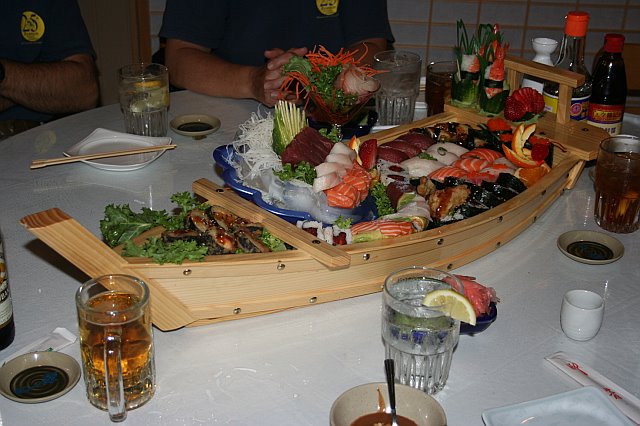
Alas, when we returned from Massachusetts we were able to enjoy only one more meal at the Sakura before it closed. We've spent the last three years searching for a substitute, to no avail. The Asian restaurant that took its place isn't bad, however, and that's where we headed last Monday night. We remembered too late that it is closed on Mondays, but that disappointment quickly turned into a blessing.We decided instead to try out a new (to us) restaurant called the Sake Moon. Or maybe Saikyo; it appears to go by both names. Whatever it's called, I call it fantastic. At last we are consoled for the loss of the Sakura. We ordered the Sushi Boat for One—it was more than enough for the two of us—and were treated to the best sushi I've had in at least three years.
What's more, Sake Moon serves not only Japanese but also Vietnamese food. The owners are Vietnamese, as I discovered when I attempted some of my newly-acquired Japanese phrases. (They graciously then taught me to say "thank you" in Vietnamese.) We returned today for lunch, and were nearly as pleased with the summer rolls and pho as we had been with the sushi. We did not dine in Vietnam alone, but mixed our Asian cuisine today; the vegetable tempura was served with delightful accompaniments of California roll, goyza, Japanese egg roll, soup, salad, and rice, all delicious. And I learned to say "hello" in Vietnamese.
We'll be back; Sake Moon is close to home and reasonably priced. Besides, I have a lot more Vietnamese to learn....
Here's a picture from a subsequent visit of the Sushi Boat for Three (which easily served five).