
I left the new family to their own devices on Saturday morning, when Stephan's mom whisked me away for an adventure. There is a small farm in nearby Riehen which, as I understand it, specializes in biodiversity/heritage breed conservation of berry plants. On this day, they opened their farm to the public for tasting! We could take nothing away, not even by purchase, but were welcome to taste and enjoy all we wanted.
(Somewhere therein is a metaphor for life, I'm certain.)
There were tiny strawberries with the sweet, strong flavor I remember from my childhood, from the wild plants that once grew profusely in the field near our house in New York. My mother would make the most delightful strawberry jam imaginable from what berries escaped immediate consumption.

The raspberries had clearly been the most popular among those who had come before us, but there were still plenty left for tasting, including a white variety.


Even more to my delight, though less popular in general, were the tiny black raspberries, again from my childhood; we called them "black caps."

And one more childhood memory; this one will be shared by my younger siblings, whose memories are more solid of our time in Pennsylvania.


Some fruits were new to me. A former neighbor had black and red currant bushes, but she moved soon after we became acquainted, and the bushes were cut down. This was probably my first taste of fresh currants in over 30 years. The black were my least favorite of all the tastes there, but the red and the white were exquisite.

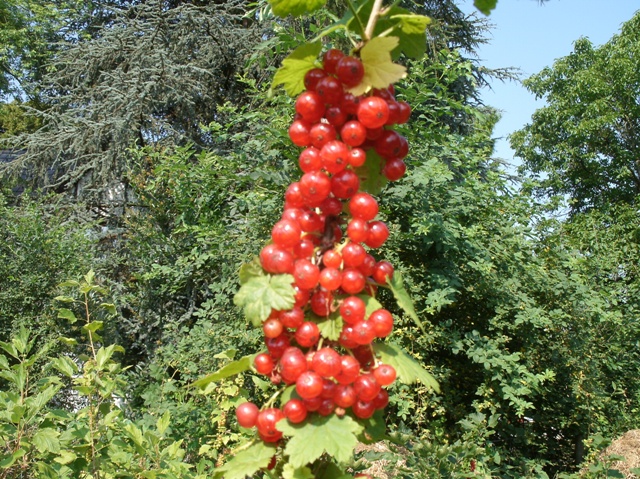
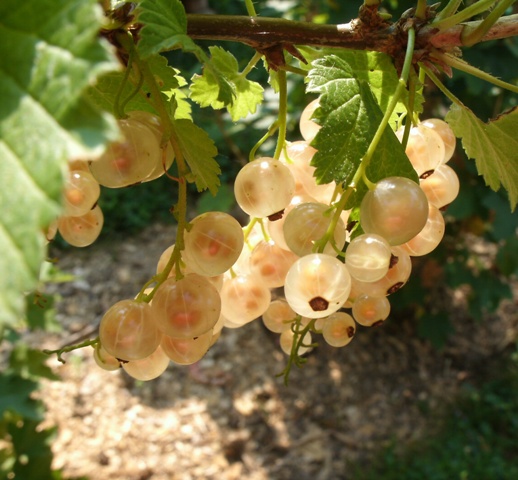
Finally, there were the gooseberries (green) and the jostaberries (purple). Having cut my teeth on (and learned spelling from) English novels, I'd heard of gooseberries, but had never, to my knowledge, tasted one. They are delicious. The jostaberries—a somewhat complex mixture of gooseberry and black currant—tasted strange at first, but that impression soon evolved into a nice, tart flavor.


(As usual, you can click on the images to see the full version.)
Not everything was ready for tasting.

As might be expected from a farm specializing in diversity, there was no such flavor as, say, "raspberry," any more than "orange" can cover the vast spectrum of Citrus sinensis. Half the fun was moving from one bush to another apparently the same, and being surprised by the change in taste.
Over half a century I have watched our choices for food (and much else) expand astronomically, and yet at the same time contract. We can eat food from all over the world at nearly any time of the year, and appreciate ethnic recipes of which our ancestors knew nothing. Yet at the same time our choices within a particular food are narrowing, perhaps dangerously. Milk is milk, orange juice is orange juice, tomatoes are tomatoes (or red tomato-like substances in the grocery stores), hamburger is hamburger, and we know nothing of the rich variability within a single food.
My gratitude is great to the Creator who wove such diversity into his work, to the gardeners who lovingly, carefully work to nurture and extend that diversity, and the heritage breed preservationists whose efforts may allow us once again to recover the flavors that delighted our ancestors.
Permalink | Comments | Edit
Category Travels Everyday Life Food Conservationist Living
I try not to say too much about our current Federal administration, even though much of what they are doing scares me. (Yes, this is restraint. Believe me.) So when they say something I actually like, it's fun to be able to acknowledge it. (HT Margaret Gorodetzer via Facebook, and Joan Lowy/the Huffington Post.)
With the caveat that I haven't investigated the story at all, Transportation Secretary Ray LaHood is my current hero for his recognition that walking, biking, and public transit are important ways of getting from one place to another in daily life, not just recreation or the last refuge of losers who have lost their drivers' licenses Talk is not action, but it's a beginning.
LaHood says the government is going to give bicycling – and walking, too – the same importance as automobiles in transportation planning and the selection of projects for federal money. The former Republican congressman quietly announced the "sea change" in transportation policy last month. "This is the end of favoring motorized transportation at the expense of non-motorized," he wrote in his government blog.
LaHood's blog was accompanied by a [Department of Transportation] policy statement urging states and transportation agencies to treat "walking and bicycling as equals with other transportation modes." It recommends, among other things, including biking and walking lanes on bridges and clearing snow from bike paths.
The new policy is an extension of the Obama administration's livability initiative, which regards the creation of alternatives to driving – buses, streetcars, trolleys and trains, as well as biking and walking – as central to solving the nation's transportation woes.
Alas, this is just a recommendation, but it's an attitude that needs supporting. A sane transportation policy is long overdue that sees beyond "more roads and bigger."
Permalink | Comments | Edit
Category Politics Conservationist Living
"Cash for Clunkers," Appliance Edition. I've been looking forward to Florida's appliance rebate program ever since I first heard rumor of it. Our refrigerator was old when we bought it used in 2001, and I'm sure it uses up much more energy than a refrigerator should. Plus, who knows how long it will last?
Actually, that question is spurious. Our neighbors bought a new, high-end appliance a few years ago and it has required multiple repairs—even while still under warranty—whereas our old clunker is still going strong, albeit with strange nocturnal (and diurnal) noises. Still, you never know.
However, this is no "shop carefully, get the best deal, purchase your appliance, and apply for the rebate" program.
A website, the address of which hasn't yet been released, will be launched Thursday to give consumers step-by-step instructions and also be used to take the reservations beginning April 16. ... [C]ustomers will be expected to register online for a reservation after making their purchase and before applying for the rebate. After reserving a spot, customers must then fill out a rebate application form, available online or at some retailers. The application, with original receipts, must be submitted no later than May 10. Demand for the rebates is expected to be high, and Florida has just $17.6 million for the program. Though it's scheduled to run for 10 days starting April 16, the program will end when the funds dry up.
In Iowa, high demand exhausted the $2.9 million budget for its rebate program less than eight hours after it began, not before causing both the Web site and the phone system for the program to crash. Ditto for Minnesota, where a $5 million budget was gone in a day.
[T]he Florida program will offer no guarantee of a rebate for customers who purchase an eligible appliance and go online to reserve a spot, only to find out that the rebate money is already gone.
Sounds more like a feeding frenzy to me.
No rainchecks. Bait and switch. Lure the customer in with the hope of a rebate, then "tough luck, Charlie" after the purchase has been made. If a corporation tried this they'd be hauled into court.
One local appliance dealer said hopefully, "I still believe there are people out there with the funds available to buy, but they're not motivated," said Kimball. "I think this will motivate them."
Or not. Perhaps the recession has alerted people that having funds available does not imply an obligation to spend them.Permalink | Comments | Edit
Category Everyday Life Conservationist Living
Sometimes the difference between a useless tool and a helpful one, or a good tool and a great one, is merely a matter of imagination.
I dislike decorative trinkets, and most especially if they must be dusted. My mother-in-law, however, loved them, and we received many gifts that were more in line with her preferences than mine. Thus I wasn't entirely pleased when she proudly presented me with a Charleston, South Carolina sweetgrass basket, beautiful as it was. But inspiration hit, and instead of hanging it as a wall decoration, I put the basket on a desk in our entranceway. Not only does it look lovely, but in an instant I solved my perennial "where are my keys?" problem! Because the basket gets continual use, it never needs dusting, and its presence must have saved me, over the years, hours of searching time. The right tool in the right place.
Clothes dryers are rare in Europe, Japan, and no doubt most other places in the world. It was a bit of a shock to me, I'll admit, to find myself relying on clotheslines while visiting such highly advanced countries as Japan and Switzerland. Growing up, my family did not get a dryer until after my brother was born — about the same time we purchased a television set — but I was seven and it didn't have much effect on me. My mother, I'm certain, felt differently. True, I love clotheslines and the smell of sun- and wind-dried clothing (and sheets!), and when we lived in Rochester and Boston I used them whenever I could, i.e. on warm, sunny days. (My initial efforts in Florida were miserable failures because the high humidity made the clothes musty, and the lack of wind made them stiff.) However, I consider the clothes dryer one of the blessings of civilization, and if you doubt me, I have just two things to say: wet winter clothes, and diapers.
Still, somehow the very civilized Europeans and Japanese are managing without them, for which I respect them a lot, unless "managing" includes relying on paper diapers. I suspect their laundry detergents must have fabric softeners blended into them, as the clothes, hung indoors with nary a bit of sun or breeze, are not the stiff boards I experienced here on still days. I don't like fabric softeners, but nonetheless found inspiration to take another look at the possibilities. Also inspiring was this very cool Japanese "clothesline" that we brought back with us after visiting the country. (Remember that clicking on the picture will show the full version.)

Initially we hung the nifty device on the back porch. It was handy for hanging bathing suits and swim towels, but not much else, and didn't get much use. But at one point — I forget the occasion — I moved it into our laundry room, aka garage, where I discovered that newly-laundered clothes hung there avoid the mustiness I encountered when trying to dry our laundry outside. (Some of you may be wondering why the hot Florida does not dry clothes instantly. It may, for all I know, but our back yard doesn't get much sun at all, and the neighbors would have something to say about a clothesline in the front. I'm happy they're not objecting to our vegetable garden.) And the stiffness? A few minutes tumbling in the dryer, with no heat, takes care of that. I don't use the Japanese dryer for large loads, but running clothes need to be washed immediately, and not left to stew until we've accumulated a full load, so I was doing many small washes, which are inefficient (and expensive) to dry in the electric dryer. For these, the Japanese dryer is the perfect solution — and now a formerly underutilized tool is a great asset. The right tool in the right place.
So, one of those handy hook-and-clip devices is very useful — but how about two? From our daughter and son-in-law we received a little one in the form of an octopus, very cute but too light to replace the one which I had recently moved from the back porch. It hung around for a few months as a mere decoration until inspiration hit again.

I love to use plastic, zip-lock bags, but hate to throw them in the trash, so for years I have been washing and reusing them. Drying was always a problem, however, and though I tried several solutions I was not completely satisfied with any of them. Until now. Look how perfectly the octopus hangs above the dish drainer, holding the bags in a position for maximum drainage and contact with the drying air! Most definitely, the right tool in the right place!
In these examples I have found the right tool in something that we already had, but were not using to its best advantage. I'm convinced, however, that there's a wider lesson here. I'm generally a "make do," and "good enough" kind of person, which can be a good thing, but I'm learning that not only my productivity but also my enjoyment can improve greatly if I will make the effort and take the time to find the right tool. Even if that means jettisoning something I have in favor of buying something that will work better. But — Don Aslett's excellent advice to the contrary — maybe we shouldn't jettison things irretrievably right away. We may have the right tool in the wrong place.Permalink | Comments | Edit
Category Everyday Life Conservationist Living
What do hippies and Christians have in common? A lot more than you might think.
The stereotypes: Hippies are free-lovin', goddess-worshipping ultra-liberals who rebel against society's norms and customs; Christians are moralistic, hyper-conservative corporate capitalists; and never the twain shall break bread together.
Quite the contrary. Christians and hippie types alike tend to look at society's conventions with a skeptical eye.I first noticed this in the early days of homeschooling, when our "fellow travellers" were united by just one thing: an unconventional view of the meaning and purpose of education. This view made good friends and staunch allies of conservative Raymond Moore and liberal John Holt, vocal and active leaders in the movement who had little else in common.
Years later I saw the same pattern in the home birth movement. Then in small and home-based businesses, and on small, sustainable, organic farms.
The Good Shepherds is an inspiring and encouraging article on the last.
Scott was skeptical when his wife said that she felt God wanted the family to raise sheep. "Excuse me," Scott replied. "I can't even stand to mow my own yard. What makes you think I'm going to start doing things like that?" ... Today, Lamb of God farm supplies about 40 families every week of the summer with fresh fruits and vegetables, and sells produce at farmers' markets around Chicago. Wool from their sheep is sold at a nearby knitting store, owned by their daughter. ... It would [now] take a miracle to get him to suit up again for a corporate boardroom, Scott says. "[Farming] is the most satisfying work I've ever done. It's because God's got his hand in it. There's something very elemental about tending this piece of his creation."
Called Christian agrarians, these families are tapping into broader cultural trends: interest in organic and locally produced food, back-to-the-land movements, and conservation and environmental concerns. They are resisting other trends: large-scale conventional agriculture, population flight from rural communities, and fragmented suburban life.
Joel Salatin is a kind of elder statesman of this small movement. He's been working Polyface Farm in Virginia since he was a kid, and he has made a living at it since graduating from college. Though it would be fair to call him an evangelical and an environmentalist, Salatin fights labels. He calls himself a "Christian libertarian environmentalist capitalist." He complains that evangelicals have been inconsistent. "We look at the liberal, who wants to abort babies and hug trees. We say, 'What is it with you?' " he says. "Well they look at you and me and say, 'What is this about you pro-lifers who want to genetically engineer food and eradicate everything?' "
Neither liberals nor traditional evangelicals are flocking to the countryside, but another group is, says Salatin. "Thirty years ago, 80 percent of all visitors to our farm were hippie, cosmic-worshipping, nirvana earth muffins," he says in his typical rambling manner. "Today, 80 percent are Christian homeschoolers."
"Once you opt out of the conventional paradigm [of public schooling] and find it satisfying, then you begin searching for other paradigms to opt out of," Salatin says. [F]amilies that homeschool often start looking for ways for fathers to leave their office jobs. "How do I leave my Dilbert cubicle at the end of an expressway," Salatin says, "and instead invest in my family, my kids, my community?"
Homeschoolers, home birthers, homemakers, family businesses, and small farmers—for whom I pray daily—may never be more than fringe groups in our society. Not everyone—and perhaps only a few—can follow all, or any of these paths. But we would do well to encourage them, to cultivate and not penalize their growth, for they may be the remnant that preserves the good we are rapidly forgetting, like the dedicated conservators who raise heritage crops and farm animals. As Neil Postman said, in another context, Those ... who resist the spirit of the age will contribute to what might be called the Monastery Effect, for they will help to keep alive a humane tradition.Every year on his 550-acre farm, 450 acres of which is wooded, Joel Salatin produces 40,000 pounds of beef, 30,000 pounds of pork, 10,000 broiler chickens, 1,200 turkeys, 1,000 rabbits, and 35,000 dozen eggs. In The Omnivore's Dilemma, Michael Pollan says the land, despite being used so intensely, "will be in no way diminished by the process—in fact it will be the better for it."
That's partly because Salatin's methods are vastly different from those of most contemporary farmers. In contrast to industrially produced chickens that can't leave their cages, that need to have their beaks cut off so they don't peck at each other, and that are ridden with disease, Salatin allows his chickens to poke freely around his pasture.
Salatin says he is just copying creation. "We use God's design and take it as a template," he says. "Our overriding question is not how do we grow the chicks bigger and faster and cheaper. The goal that we have is how do we … create a habitat that allows the chicken to fully express her 'chickenness.' "
Every day, Salatin moves his cows to a fresh spot of grass. The cows eat all day. At night, Salatin moves them to another spot. He then moves his chickens to where the cows were. The chickens eat the bugs and larvae growing in the cowpats. This "sanitation crew" cleans up after his cows. "Just like in nature, birds always follow herbivores, like the egret on the rhino's nose," he explains. Chickens' droppings, combined with cows', fertilize the grass, which in two weeks will have regrown enough to be ready for the cows again.
Symbiotic relationships are at work all over Salatin's farm. Without fertilizer, without hormones, and without cows and chickens forced into industrial factories, Salatin produces a healthy amount of food—and it is healthy food, too, for which customers come directly to him and pay top dollar. "What is it worth to have chicken that reduces your cholesterol instead of increasing it?" Salatin says. "We've had our chickens tested. They're 25 times cleaner than what's in the supermarket."
Permalink | Comments | Edit
Category Random Musings Conservationist Living
I don't know why anyone would want to annoy a worm, but apparently lemon balm does the trick. I had some less-than-perfect leaves that I didn't use in making my lemon balm tea, so I fed them to the worms. Rather, I put the leaves in their bin; feeding was out of the question. The next time I checked, all the worms were huddled on the side of the bin furthest from the leaves. They didn't seem particularly unhappy, but they didn't return to the other side until a few days after I removed the offending foliage.
Permalink | Comments | Edit
Category Everyday Life Conservationist Living
Making vegetables grow in our nutrient-poor, nematode-rich sand soil is always a challenge. After the initial shock of moving here from a world where one puts the seeds in the ground and stands back, we pretty much gave up on gardens until a couple of years ago. We do a little better each year, but at least financially the balance sheet is still dismal.
One plant that is still thriving, even in the oppressive Florida summer heat, is our lemon balm. We planted it this year for no other reason than that it was available at Lowes (or Home Depot, I forget which) and I remembered that Porter had remarked on how good it smelled when we encountered it at Leu Gardens. We let it grow untouched for a long time, mostly because I didn't know what to do with it, but when a friend mentioned making lemon balm tea, I had my answer.
Now I brew a pot of tea with one regular PG Tips tea bag and a handful of bruised, fresh lemon balm leaves. I don't know how it tastes hot, as we're not in that season, but I can attest that it makes a wonderful iced tea. I generally prefer my tea unflavored, but at least for now I can't get enough of this delicious combination.
Permalink | Comments | Edit
Category Food Conservationist Living
The worms have completely devoured their Carnegie Mellon t-shirt moisture mat, except for places—stitching, and part of the design, I think—that were not natural fiber. Therefore, since they are now more mature, and have clearly excelled in their majors of eating and excreting, I hereby declare that they have graduated, and confer upon them a new moisture mat.

Permalink | Comments | Edit
Category Everyday Life Conservationist Living
On June 12—tomorrow—Food, Inc. opens. As usual, we'll probably wait for the DVD, but it's definitely one I want to see. Do I really want to hear more about the dangers of our factory farming system? Unfortunately, yes. True, it produces plenteous, apparenly low-cost food—we spend less of our paychecks on food than in any time in our history—but the true costs are hidden, and high. Did you know that 90% of the items in our grocery stores contain some form of corn or soy? That our supply of beef, chicken, potatoes, and many other foods is driven by the fast-food industry? One reason I'm looking forward to the movie is that supposedly it is not entirely a doom and gloom horror flick, but also celebrates the power of the individual to make a difference. We shall see. Thanks to DSTB for the alert.
Here's the official Food, Inc. website, where you can see the trailer.
And a PBS show about the movie.
 Last Child in the Woods: Saving Our Children from Nature-Deficit Disorder, by Richard Louv (Algonquin Books, Chapel Hill, North Carolina, 2005)
I'm sorry to say I gave this book short shrift, but reading time has been scarce lately, and I must return it to the library today. I can say, however, that it is a must-read for anyone who is not already convinced that children need, as one of life's basic necessities, plenty of time in the natural world: hiking, camping, and learning with their families, building forts and tree houses, exploring on their own, and just being in the world of bugs and fish, stars and sand dunes, trees and caverns. If for you this kind of exhortation is preaching to the choir, it's probably still worth at least skimming it as much as I did, if only for the shock value of learning that today's children are even more cut off from such activities than you had imagined.
I grew up on the edge of a new housing development; unlike the projects I see today, this one was slow to develop, and so we enjoyed many years of free exploration in woods and field: climbing trees, building tree houses, following streams, skating on frozen ponds, and observing wildlife. Nowadays such activity is often illegal.
The cumulative impact of overdevelopment, multiplying park rules...environmental regulations, building regulations, community covenants, and fear of litigation sends a chilling message to our children that their free-range play is unwelcome, that organized sports on manicured playing fields is the only officially sanctioned form of outdoor recreation.
Children's play has become boxed in, tied up, neatly organized, and often commercial. Parks favor sports fields—often used more by adults than children—rather than space for free play.
[V]acant lots are vanishing, and the nature of suburban development is changing. Suburban fields that might have been left open in earlier decades are being erased, replaced by denser, planned developments with manicured green areas maintained through strict covenants.
It takes time—loose, unstructured dreamtime—to experience nature in a meaningful way. Unless parents are vigilant, such time becomes a scarce resource, not because they intend it to shrink, but because time is consumed by multiple, invisible forces; because our culture currently places so little value on natural play.
Fear is the most potent force that prevents parents from allowing their children the freedom they themselves enjoyed when they were young. Fear is the emotion that separates a developing child from the full, essential benefits of nature. Fear of traffic, of crime, of stranger-danger—and of nature itself.
The author deals well with this fear, debunking some myths, and more importantly encouraging parents to help ther children avoid and handle genuine dangers, teaching them specific skills and offering "controlled risk" situations for growth.
"Every year since 1950, the number of American children gunned down has doubled." So goes a widely quoted statement, which originated in a Children's Defense Fund report in the mid-1990s.
I like that one. Do the math.
Some of our most prominent and revered conservationists developed their love of nature through direct childhood experiences, including such now-distained activities as hunting, fishing, and pinging seagulls with a BB gun. Today's environmentalists predominantly trace their activism to their own unstructured play in natural habitats. Many of these same environmentalists, however, are curiously uninterested in reaching the next generation, or providing for them the same experiences that nurtured their own love of nature—perhaps, the author suggests, because children, overpopulation, and environmental degradation are solidly linked in their minds. If so, they—and the environment they love—may suffer the same fate as the Shakers. Even the national parks are in danger of losing support, as fewer families visit them for camping and wilderness hiking.
As [national park] officials work to make parks safer and more accessible, the outdoors often ends up feeling more like Disneyland than wilderness. Some kids end up disappointed that the parks aren't more Disneyesque. When middle school students sent me their reflections on nature, one boy reported visiting Utah's Rainbow Bridge National Monument, the world's largest natural bridge, which was carved out of the cliffs above modern-day Lake Powell over thousands of years. "The bridge was somewhat disappointing. It was not as perfect as in the brochure," the boy wrote. His parents enhanced the family vacation by renting Jet Skis.
Even when I was young, the Girl Scouts were far inferior to the Boy Scouts when it came to wilderness skills and experiences, but the situation for girls has gotten far worse. Madhu Narayan and Karyl T. O'Brien are executives with the Girl Scouts in the San Diego, California area.
[The] overwhelming majority of Girl Scout programs are unconcerned with nature. Included (along with selling cookies) are such offerings as Teaching Tolerance, Tobacco Prevention, Golf Clinic, Self-Improvement, Science Festival, EZ Defense, and Financial Literacy. Soon, Camp CEO will bring businesswomen to a natural setting to mentor girls in job interviewing, product development, and marketing. The divide between past and future is seen best at the Girl Scout camps in mountains east of the city: one is billed as traditional, with open-air cabins and tents hidden in the trees; the newer camp looks like a little suburbia with street lights. "I flipped when I learned that girls weren't allowed to climb trees at our camps," says O'Brien. Liability is an increasing concern. "When I was a kid, you fell down, you got up, so what; you learned to deal with consequences. I broke this arm twice," says Narayan. "Today, if a parent sends a kid to you without a scratch, they better come back that way."
There's more book, but no more time.
Permalink | Comments | Edit
Category Reviews Children & Family Issues Conservationist Living
 Worms Eat My Garbage, by Mary Appelhof (Flower Press, Kalamazoo, Michigan, 1997)
Long, long ago, John Holt introduced me to Worms Eat My Garbage. Whether it was in one of his books, or in the magazine Growing Without Schooling, I don't remember. What I do remember is that worms ate his garbage. John Holt lived in an apartment in downtown Boston; if he could manage a small worm farm there, what was my excuse? It would be many years before I finally joined the movement, but here we are.
The book I borrowed from the library is the second edition; the original was written in 1982. Both are somewhat dated, and offer much more detail about making your own worm bins that I needed, being quite happy with our out-of-the-box Can-o-Worms. It's also oriented towards people of northern climes, offering more advice on dealing with cold weather than hot.
I'm glad I borrowed the book, because while I was glad to read it, I don't feel the need to keep it as a reference. There's plenty of information about worm farming online now, too. But for those of us who prefer the comfort of reading a physical book, it's a good introduction to the subject of vermiculture and vermicomposting.Permalink | Comments | Edit
Category Reviews Conservationist Living
The people who sold us our worm farm gave us this advice for giving the worms a special treat: put some melon in their bin. Red wiggler worms love melon, they assured us, and will mob any pieces you give them. On the way home from church yesterday, we bought a watermelon from a local farmer. It was red, sweet, dripping, and delicious...and I couldn't wait to share the remains with the worms.
When I last checked, they hadn't shown any interest, possibly because I froze the melon pieces first, so they would also provide some Worm A/C. I'll check again tomorrow. However, I can report that they are going absolutely bananas for their Carnegie Mellon moisture mat.


On the left is what it looked like when I first put it in the bin, not quite two months ago. On the right, what it looks like now. If you click on the picture and enlarge it, you'll see a few worms (red-brown), some melon (green and pink), a lot of castings (brown), and the shredded-paper bedding showing through a large hole that they have eaten through the middle. (The green is another piece of cloth on which I place the frozen water bottle for cooling; I've pulled it aside so you can see the hole.) What you can't see is the masses of worms swarming under and through the mat; "infesting" would be a good word.
It's true: Worms love melons. But they can't spell.Permalink | Comments | Edit
Category Everyday Life Conservationist Living
In Switzerland you must bring your own bags to the grocery store, or buy them there. We've tried variations on that theme here, with little success. Thirty years ago one of our stores in New York started using cardboard boxes instead of bags, and paid five cents for every one you brought back and reused. That the store went out of business not much later was probably not due to that particular policy, but it certainly put an end to it. At one time or another the stores here in Florida would pay a nickel for each reused bag, and some still do. But, frankly, five cents isn't enough incentive one way or another.
Then several stores began selling reusable "green" bags. A good idea, but I couldn't see buying them, even for the low $1 price, when we had plenty of bags at home I could use—especially since the new bags are made in China. I don't boycott Chinese products altogether, but their dominance makes me nervous, and I like to find alternatives when I can. Besides, it just seems ridiculous to ship products halfway across the world in the name of protecting the environment. Despite having bags at home that would do, however, I never got around to making the switch...
...until a dear and practical family member gave me three Trader Joe's bags for Christmas. Knowing my aversion to Chinese bags, she found me some made in Vietnam—not much better, perhaps, but at least an alternative. They were better than our existing bags: the right shape for groceries, and one was even insulated for cold items. Soon I was hooked, and even acquired some more (Chinese) bags when our store offered them "free with purchase" on a couple of occasions. They live in the back of the car and are thus always handy, which is a good thing because if I had to remember to bring them with me I'd forget half the time. On the occasions when I walk to the grocery store I still follow in the tradition of my father, and use my good ol' L.L. Bean pack basket.
There's no economic incentive to use the reusable bags, not even the aforementioned nickels. I know myself: I wouldn't continue the practice if it were difficult or awkward. But it's not. The reusable bags are a lot more fun to handle than the floppy plastic ones: they're sturdy, hold more, stand upright, and don't accumulate in large quantities that must be returned to the store for recycling. What amazes me is how many of those plastic grocery store bags I'm now saving. After only a few months of using the new bags, I deliberately left them in the car for one trip because I had run out of plastic bags at home. Such a situation would have been unthinkable last year.
Permalink | Comments | Edit
Category Everyday Life Conservationist Living
Our worms now have more living space: we put the second level onto their condominium/college dorm. There's still a small amount of uneaten food in their first level, but that section is full, and I think they need more food. They've been munching on their Carnegie Mellon t-shirt moisture mat, and while I know they will eventually consume it no matter what I do, I'd rather tempt them with kitchen waste.
Permalink | Comments | Edit
Category Everyday Life Conservationist Living
I think the U.S. Postal Service is great. Sure, there are occasional mistakes, like the one that resulted in some of our mail still being delivered to my sister's house five years after a temporary forwarding order expired. That is an exception, however; for the most part, the USPS does its job exceedingly well, I think. I'm sure my good feelings are in large measure due to the workers at our local post office, who happen to be an amazingly friendly and helpful crew. Folks go out of their way to do business at our post office. It was one of those helpful clerks who told me, after our forwarding debacle, never to forward or even hold mail if at all possible. The very best vacation plan is still to have a friend check your mailbox for you.
Thus when a friend posted Going Postal, a long and negative article about the USPS, I barely bothered to skim it. And yet my eye was caught by this information about the Swiss postal system, which I find most intriguing. (The above-mentioned excellent clerks also told me that the Swiss mail system is the best in Europe, if not the world.)The Swiss Post is a world leader in postal business-model innovation with operations in 16 countries across three continents. Despite its home-country’s population of only seven million, it generates $9 billion in revenue and earns an impressive 10 percent profit. It has aggressively rolled-up, partnered on or internally launched a variety of Internet-ready businesses that offer services such as document imaging, electronic document signature, electronic postage that costs less than paper stamps, and an international shipping network. Its annual report states that it generates 20 percent of its revenues from outside Switzerland. It is still 100 percent government owned, and its profits go to the general fund, but it acts more like a private corporation responsible to shareholders.
That’s not all. The Swiss know that paper mail volumes will continue to decline and that the Internet isn’t going away. So the forward-looking Swiss Post has been the first in Europe to introduce a service to deliver paper-originating postal mail via the Internet, called Swiss Post Box.
Swiss Post Box is powered by technology from Seattle-based Earth Class Mail. The service emails multi-sided color images of incoming envelopes and parcels to their recipients as soon as the mail reaches the first sorting center nearest where it was collected by the post office. While the mail and parcels are held in an automated temporary cache, recipients decide which mail pieces they want to have opened and scanned to PDF inside an ultra-secure scanning center at the Post Office (where confidential documents for Swiss banks are also scanned), and which are to be delivered physically to the address on the envelope, redirected to another address, shredded, recycled or archived for safekeeping. Three-quarters of the mail ends up leaving that first sorting center bound straight for recycling, either after being scanned to PDF or discarded unopened by customer’s choice. The energy savings implications are obvious.
Permalink | Comments | Edit
Category Conservationist Living

