
The Holy Saturday (Easter Eve) message sent from our Artemis II astronauts of course reminded me immediately of the Christmas Eve message from the Apollo 8 astronauts. I apologize that I can only provide the link; YouTube does not yet have a good video for me to share.
Here's the Apollo 8 broadcast. It's much more beautiful and majestic, but each is a welcome word on the eve of a major holy day from those looking back at us from their voyage between the earth and the moon.
Permalink | Read 189 times | Comments (0)
Category Inspiration: [first] [previous]
Traditionally sung on Palm Sunday, Ride On, Ride On in Majesty is a musical journey through Holy Week, from Jesus' triumphal entry into Jerusalem (Palm Sunday) through his crucifixion (Good Friday) to his glorious Resurrection (Easter).
Ride on! ride on in majesty!
Hark! all the tribes hosanna cry;
Thy humble beast pursues his road
with palms and scattered garments strowed.
Ride on! ride on in majesty!
In lowly pomp ride on to die;
O Christ, thy triumphs now begin
o'er captive death and conquered sin.
Ride on! ride on in majesty!
The angel armies of the sky
look down with sad and wond'ring eyes
to see the approaching sacrifice.
Ride on! ride on in majesty!
Thy last and fiercest strife is nigh;
the Father on his sapphire throne
awaits his own anointed Son.
Ride on! ride on in majesty!
In lowly pomp ride on to die;
bow thy meek head to mortal pain,
then take, O God, thy power, and reign.
I can't have a favorite line in such a wonderful hymn, but if I did, it would be "The Father on his sapphire throne awaits his own anointed Son." Nothing that happened during Holy Week came as a surprise, but was known and expected since the beginning of time. It was not, as a priest tried to tell us one Easter, something that caught Jesus off guard, but rather the very sequence of events for which he was born—and he knew it.
Today is Good Friday. But Easter is coming!
The Father on his sapphire throne awaits his own anointed Son.
Permalink | Read 186 times | Comments (0)
Category Music: [first] [previous] Inspiration: [first] [previous] [newest] Here I Stand: [first] [previous]
Here's a very short Facebook reel that I have found worthwhile and encouraging. Some of you may pass it by simply because it is Glenn Beck speaking, and I'd be in sympathy with that reaction. There are some people—he's not one, but there certainly are some people—with whom I have a hard time following my own motto, "The wise man recognizes truth in the words of his enemies." If you feel that way about Glenn Beck, don't torture yourself.
But I appreciate hearing wisdom and truth spoken calmly, clearly, and succinctly, facing reality without anger and without fear. I share it for those of my readers who may find it inspiring.
Permalink | Read 344 times | Comments (2)
Category Inspiration: [first] [previous] [next] [newest] Here I Stand: [first] [previous] [newest]
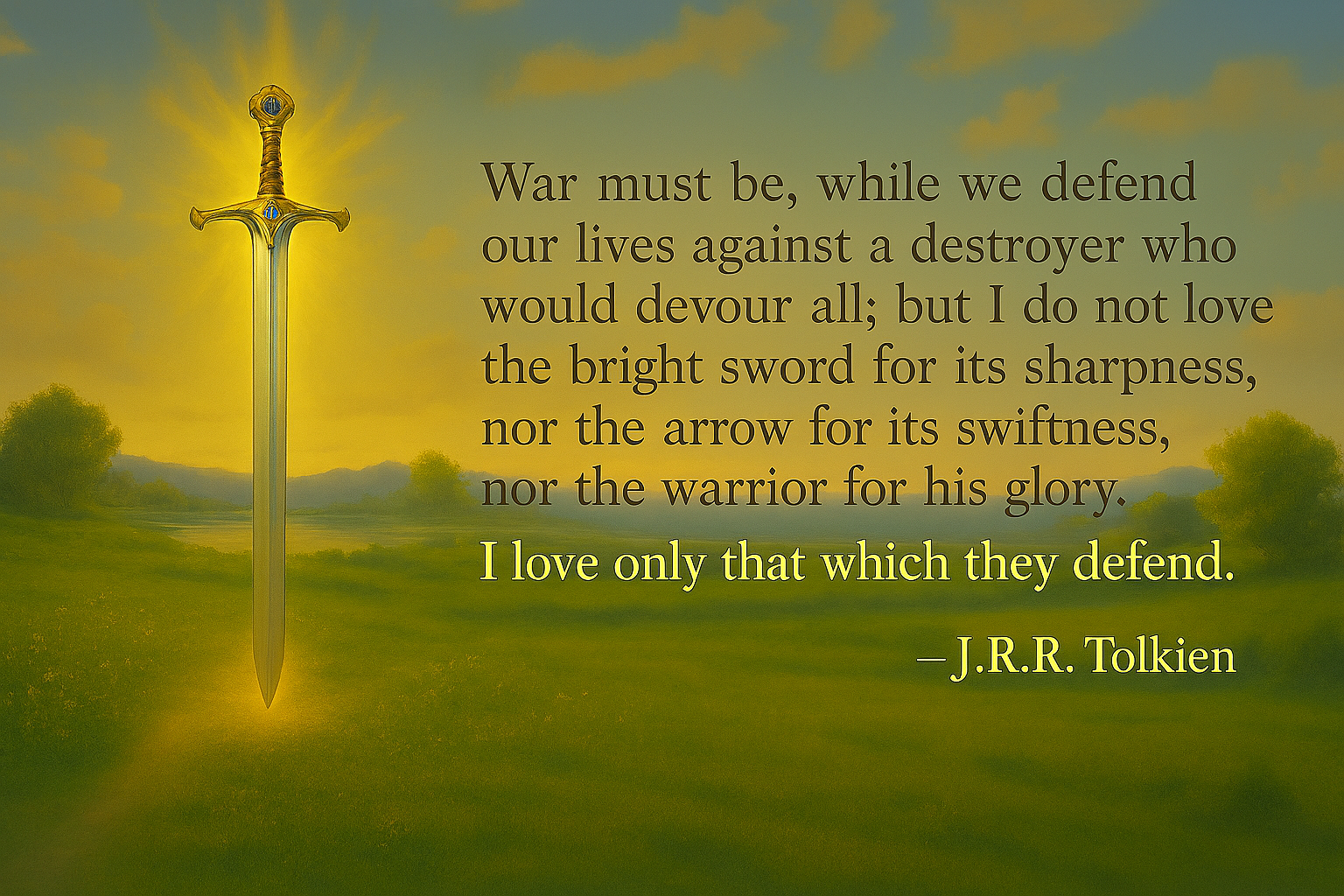
Spoken by Faramir, in The Two Towers.
Permalink | Read 390 times | Comments (0)
Category Inspiration: [first] [previous] [next] [newest]
This may be the most inspirational pig story since Charlotte's Web.
I've recently discovered Mollie Engelhart, who is both a regenerative farmer, à la my hero Joel Salatin, and an excellent writer. Also more:
Mollie Engelhart, regenerative farmer and rancher at Sovereignty Ranch, is committed to food sovereignty, soil regeneration, and educating on homesteading and self-sufficiency. She is the author of “Debunked by Nature”: Debunk Everything You Thought You Knew About Food, Farming, and Freedom—a raw, riveting account of her journey from vegan chef and LA restaurateur to hands-in-the-dirt farmer, and how nature shattered her cultural programming.
The title of Engelhart's article this morning is "The Pig Who Refused to Be Bacon." Good enough, but I think I would have called it "The Pig Who Lived." 
Brave Hart stands as a reminder that will matters. That spirit matters. That individual actions can shift outcomes in ways we cannot predict.... And every time I see her, mud on her sides, babies tucked against her belly, I’m reminded: The fight you think you’ve lost may be the one that changes everything.
Permalink | Read 364 times | Comments (0)
Category Inspiration: [first] [previous] [next] [newest]
It is Epiphany. The Twelve Days of the Christmas Season are ended. And yet I will honor their departure with one more Christmas post.
I hope you enjoy this setting of the poem "Noël," written by J. R. R. Tolkien in 1936, rediscovered in 2013, and revealed to me by a fellow lover of the Good, the True, and the Beautiful.
Permalink | Read 417 times | Comments (0)
Category Inspiration: [first] [previous] [next] [newest]
It's Christmas Eve, and I have many things to say but no time to write. Instead, I offer this beautiful King's College Choir rendition of O Come, All Ye Faithful, with its glorious descant, and on the last verse the magnificent Willcocks chord on "Word."
You're welcome! Have a
Very Merry Christmas!
Permalink | Read 502 times | Comments (0)
Category Everyday Life: [first] [previous] [next] [newest] Inspiration: [first] [previous] [next] [newest]
“Afraid of heights?” Helmer asked. “Perfect. You really are a mixed-up lad. You come here full of defiance and anger, and then you show up and you’re a horrible, hobbled mess. You spend a week with me, and now you’re such an efficient student it’s scaring me and I begin to think you might someday be some kind of decent soldier. And now this."
“I’m willing to work and overcome anything, sir. Including this,” Picket choked out.
“Don’t worry,” Helmer said. “It’s just another enemy to be taken down in the end.”
From S. D. Smith's The Green Ember.
Permalink | Read 353 times | Comments (0)
Category Inspiration: [first] [previous] [next] [newest]
Permalink | Read 459 times | Comments (0)
Category Inspiration: [first] [previous] [next] [newest]
Forevergreen is a new, short, animated film. I know nothing about it except that a friend recommended it, and I found it enjoyable and moving. I belive this preview (of the entire film) will only be available for free for a week, so if you're interested, watch it soon. It's 13 minutes long.
Permalink | Read 585 times | Comments (1)
Category Children & Family Issues: [first] [previous] [newest] Conservationist Living: [first] [previous] [newest] Inspiration: [first] [previous] [next] [newest]
Working my way through my father's vast collection of writings, I occasionally find a gem I wish to share.
(Okay, so "vast" is a relative adjective, and perhaps an exaggeration—it's not as if I'm working through the letters of C. S. Lewis or something—but in personal terms it's accurate.)
This came from Dad's 1987 journal documenting his Elderhostel experience at Ferrum College, in Ferrum, Virginia. The program is now called Road Scholar, and no longer has the age restriction, but at that time it was primarily for those over 65, that being the age at which most people retired and could go on such adventures.
Also at the college were a group of gifted 6th graders from nearby Martinsville. They also were at the ice cream social and were told by their teachers to mix with the old folks, so it turned out to be a pleasant evening. I think the future governor of Virginia may have been amongst them. One of the women asked the boy about what they were doing, and then said, "I'll bet you didn't expect to see so many old folks here."
He replied, "I don't know, I haven't seen any yet."
Smart and wise. I could envision voting for him.
Permalink | Read 591 times | Comments (0)
Category Travels: [first] [previous] [next] [newest] Random Musings: [first] [previous] [next] [newest] Inspiration: [first] [previous] [next] [newest] Glimpses of the Past: [first] [previous] [next] [newest]
On this 610th anniversary of the Battle of Agincourt, it's time to reprise (again) Kenneth Branagh's version of Henry V's famous speech. (Shakespeare's version, that is.)
Permalink | Read 680 times | Comments (0)
Category Inspiration: [first] [previous] [next] [newest]
I see a lot of people—not only in America but from around the world—saying, or displaying on t-shirts, or social media posts, and the like, "I am Charlie Kirk." I have absolutely no problem with that and appreciate the impulse.
I do wonder what the French are thinking, since theirs was the first "Je suis Charlie"; it's hard to believe that was ten years ago.
Although I understand the sentiment, I can't at the moment bring myself to join in. It feels far too audacious, like saying, "I am Mother Teresa." The more I see of Charlie Kirk in action, the more I know that I will never be as energetic, motivated, intelligent, knowledgeable, patient, calm under pressure, forgiving, nor as loving of my opponents as he was.
I am not Charlie Kirk.
But watching him does make me want to be a better me.
I hate click-bait titles. Especially those of the "X humiliates Y" sort, most of which turn out to be inaccurate. I wish more people had this attitude, expressed in George MacDonald's Annals of a Quiet Neighbourhood.
When I am successful, in any argument, my one dread is of humiliating my opponent. Indeed I cannot bear it. It humiliates me. And if you want him to think about anything, you must leave him room, and not give him such associations with the question that the very idea of it will be painful and irritating to him. Let him have a hand in the convincing of himself.
This rare understanding is what I've seen constantly as I look into the phenomenon of Charlie Kirk. It's a big reason why his death is such a loss to our country and the world. May all of us who are seeking to learn from him take this to heart.
Watt's Law for Relationships: Power equals Strength times Humility.
Permalink | Read 598 times | Comments (0)
Category Inspiration: [first] [previous] [next] [newest]
Although I read all of the original Harry Potter books when they first came out, I saw only a few of the films. Thanks to a friend's gift, however, we've recently been watching the early ones, and I was able to enjoy them thoroughly because it's been so long since I read the books that I can't whine about the differences.
A few days ago we viewed Goblet of Fire for the first time. You can imagine the powerful impact of the following scene. I knew I had to find it online and share it here.
Permalink | Read 1196 times | Comments (0)
Category Reviews: [first] [previous] [next] [newest] Politics: [first] [previous] [next] [newest] Everyday Life: [first] [previous] [next] [newest] Inspiration: [first] [previous] [next] [newest] Here I Stand: [first] [previous] [next] [newest] Heroes: [first] [previous] [next] [newest]

