
As if I don't already have a huge backblog, Jon keeps posting things in Google Reader/Facebook that I think those who can't see them will be interested in. In this case, since I can't comment at GeekDad, I'll comment here.
When GeekDad's son was 12 years old he entered his school's science fair, which called for inventing something new and useful.[A]fter various aborted attempts and blind alleys, ;he' came up with the idea of a self-buttering toaster....The device Andy designed was intricate yet simple: a wood and steel construction that held a slice of bread at an angle in front of a carefully wound matrix of nichrome wire heating elements. While the bread toasted, the heat from the wires melted a glop of butter on a perforated metal holder positioned over the bread. The butter dripped through the holes and on to the toasting bread. Voila! There was a slice of automatically buttered toast....When the judges came to Andy’s table, the toaster worked perfectly. With self-assurance and a smile, he handed each judge a slice of warm, buttery Wonder Bread for a snack.
But when the winners were announced, Andy’s name wasn’t called. Crestfallen, he approached the judges and asked, “Why didn’t I get a ribbon?” “Well, Andy,” said a judge, “we thought your machine was dangerous. After all, it uses electricity and it gets very hot.” “Of course it does. It’s a toaster,” he protested. “It’s supposed to get hot and use electricity. If it didn’t, it wouldn’t be a toaster.” Unswayed by logic, the judges would not reconsider.
First place went to a girl who made a cap and vest for her hamster.
Further commentary would be superfluous, but I'll share one of our own frustrating experiences with science fairs. I know that at higher levels kids are doing projects with names like ALPHA-Lipoic Acid: Towards a Novel Neuroprotective Treatment for Alzheimer's Associated Cognitive Dysfunction in a Drosophila Model, but how they get there from here is a mystery to me.
When Janet was in kindergarten, our school district, which is county-wide and consists of many elementary schools, held what they called a Curriculum Fair, including not ony science but also mathematics and social studies. All students were required to participate on the local school level, and Janet chose mathematics.
Through this and other science fair experiences we learned to be content with the knowlege gained and not give much credence to the judgements of others, positive or negative. But somewhere, somehow, our top students are finding reward and encouragment for high-quality work, even if it "uses electricity and gets very hot."Her project, which I suggested, was to consider the numbers 0 through 20, to write down all the combinations of two numbers whose sum was a given number, and to note how many such combinations there were for each number. The work was all her own, and she discovered that, for each number, the number of combinations was always one more than the number itself. She also noticed that she could write the problems so that the first addend ran from 0 up to the number, and the second addend ran from the number down to 0. She made observations, formed her hypotheses (how she loved the word "hypothesis”), and checked them for the remaining numbers, finding them to be true. It was a fun and valuable project, and to my mind demonstrated true mathematical thinking at an appropriate level.
Her teachers thought so, too, and her work earned first place at the school level. Not so the district judges, where she was given an "honorable mention." It's difficult to comment on this without sounding like a ridiculous stage mom or helicopter parent, but I was offended more as a mathematician than as a mother. There was no opportunity to talk with the judges and attempt to discern their logic, but based on their choice of winners they appeared to be impressed by surveys and charts. In my admittedly not-so-humble opinion, Janet's was far and away the best kindergarten project there, certainly the only one that considered real mathematical questions and showed mathematical thinking.
Daniel Hauser, a 13-year-old boy with cancer, is being forced to receive treatment that both he and his parents have refused.
I often find myself in the minority when I argue for parental rights. Doctors, teachers, social workers, and "concerned citizens" fret over the idea that parents should be allowed to make decisions that they believe are not in the bests interests of their children. In one sense it's hard to blame them, as these are often people who are in a position to see better than most the consequences of physical, emotional, and educational neglect and abuse."It is imperative that Daniel receive the attention of an oncologist as soon as possible," wrote Brown County District Judge John R. Rodenberg in an order to "apprehend and detain....His best interests require it."
However, I insist that, other than in exceptional and egregious cases of insanity or malicious, criminal intent on the part of the parents, we cannot afford to entrust the care of children to anyone else, least of all a bureaucracy. There's a quote from Rabindranath Tagore that I like: He alone may chastise who loves. I would also say, "He alone may decide who loves." No one else, ultimately, can be trusted. The judge in this case may be right, he may even be wise, but in no way can we pretend he loves Daniel.
Do I think parents make stupid mistakes? Yes, yes, yes! I've made enough myself. This is where the community comes in, providing education, encouragement, and role models—but never, unless in cases of proven criminality, legal coercion.
Medical ethicists say parents generally have a legal right to make decisions for their children, but there is a limit. "You have a right, but not an open-ended right," Arthur Caplan, director of the center for bioethics at the University of Pennsylvania, said last week. "You can't compromise the life of your child."
Sounds noble, but consider what it could lead do. Forced Caesarean sections if a doctor thinks childbirth might be risky? Forced sterilizations of "unfit parents"? Court-ordered immunization of children using controversial vaccines? Jehovah's Witnesses are already being court-ordered to compromise their children's souls through blood transfusions. (For the record, I don't agree that blood transfusions are a spiritual danger, though they may be a physical one. But choose your own belief—what if a court ordered you to do something you knew would harm your child?) It means very little to me that the overwhelming majority of medical opinion be against the parents; at one point in time, the overwhelming majority of medical opinion was in favor of bloodletting as a treatment, and many patients died because of it.
If the rights and responsibilities for children are not to rest securely with the parents, where shall they lie? Whom do you trust more than yourself to make decisions for your family? I trust (and rely on) many sources for advice, example, and support, but none—least of all a bureaucracy—for the final decision. Parents can and will be wrong, but they are still the best hope for children. The argument is often made that "if one child is saved" through bureaucratic intervention, that is sufficient justification. What this logic misses is how many children are irreparably damaged by such intervention. First, do no harm.Permalink | Comments
Category Health Children & Family Issues
It seems appropriate that Katherine Dalton's The Immoral Life of Children should appear on the Front Porch Republic just after a conversation I had with Heather about children's art books. A friend of hers uses a particular homeschooling curriculum that she likes, but finds herself censoring certain illustrations in the art history sections that she deems inappropriate for elementary-age children.
I happen to disagree with this mother's approach. Not that there isn't plenty of so-called art that I wouldn't want our grandchildren to see—pretty much the same art that I don't want to see, myself—but I have no objection to art nudes, per se, even for young children. It may be that the Supreme Court will soon be unable to tell the difference between Michelangelo's David (picture alert) and something indecent, but I can. :) However, I don't understand the publisher of that curriculum. If I think (as I do) that there are works of art which everyone should be able to recognize and appreciate, and if the list happens to include nudes (as it does), nonetheless I can't think of any potentially offensive work that is critical for an elementary-aged child to view. Any introduction to art necessarily excludes vastly more than it includes; one ought to be able to put together quite an impressive elementary-age art curriculum without tempting mothers to deface the pages of the books. What bothers me more is that this mother's over-protectiveness seemingly precludes taking her child to an art museum, an omission I think of much graver consequence.But I hail and commend this woman as a contrast to most of us, who, perhaps for fear of being thought overprotective ourselves, close our eyes to the onslaught of evil our little ones cannot avoid without our help—if at all. Dalton's article is at the very least a reminder that not being able to do everything is no excuse for not doing what we can.
A few weeks ago a friend’s ten-year-old daughter came home from school, turned to her mother with a frown, and speaking low, so as to stay out of earshot of a younger sibling, asked, “Mom, what does the word ‘contraception’ mean, and what does a sponge have to do with it?” You would think she’d been talking to a classmate, but no; as it happened she had read this in a book on Ancient Rome....[T]he information came from an Usborne book. In other words, it came from a book written and designed for children.
[My own fourth-grade daughter] and her father tackle the Jumble word puzzle which lies opposite the comics page in our increasingly thin Louisville Courier-Journal. This is a new game for them, and it took a day or two for my husband and I to notice that right above ATCATK and YLROLWD lies the “Annie’s Mailbox” column, with its sad parade of grief, trouble and abuse. We cut or fold the page now....I have to scan the covers of the political/literary magazines I take; I ran a permanent marker through a cover headline in the Atlantic the other month, in order to be able to keep the magazine around the house till I’d read it....Women’s and health magazines are typically so indecent that on the rare occasions I have one around I hide it.
[W]ith the exception of certain slurs there is no limit on what is deemed appropriate public language, and that what is appropriate language for adults is assumed to be appropriate for the children who follow in their wake. News is reported in a way that takes for granted children either aren’t listening or don’t matter.
The definition of adult-appropriate language and topics has changed in the last three or four decades to include words and speculations no one would have discussed before, outside a law court or an exceedingly frank one-gender get-together. These words leap out from everywhere—the TV, radio, newsstand, book store display, and conversations overheard on the sidewalk....If there is any outlet in our media-saturated culture that isn’t actively working to turn ten-year-olds into case-hardened 22-year-olds, I would like to know what it is. Around here, Louisville’s classical music station WUOL is the only thing that comes to mind.
I don’t need to listen to news radio when the children are around, and I can bowdlerize the paper, and my children don’t surf the Internet yet. But books—we all love books, and since my children love to read it has become impossible for me, without becoming a high-octane helicopter parent, to vet all their reading. The Usborne book is a good example of many grammar school-age books that are unexceptionable except for one or two little ticking bombs of age-inappropriate information, buried on page X. These clues to adult life show up in fiction, historical fiction, “fun facts” books and history. I’m aware of some of them, but have missed many others. As we ascend to the pre-teen and teen list, they will become Legion.
[E]verything can be handled well with good communication—everything except a ten-year-old’s concerned astonishment about what these strangely intimate details of adulthood can possibly mean. We can try to comfort, but any further explanation at this age will only make things weirder. There is plenty that even the most curious ten-year-old doesn’t want to know. Not really, and not yet. Unfortunately, we live in a world of people who are dying to tell her. We have to counter their words with our own, when what we really want on certain topics is silence.
Thinking back to the issue of the art nudes reminds me of another time, and another situation, in which children learned about sex, death, and other hard issues of life at an early age, yet which I consider good, not bad: on the farm. Context matters. There is a crucial difference between observing pigs mate and watching a steamy sex scene on television. To paraphrase Potter Stewart, I may not be able to define the difference adequately, but I know it when I see it. Sadly, the chances of a modern child seeing the former are about as slim as his chances of avoiding the latter.Whatever my children may or may not be reading, I can see that they must grow up....We will have to talk about moral behavior with a directness my own mother never used with me—because the culture we live in is making all kinds of arguments on the other side, all the time, explicitly, in a way it didn’t when my mother was young. I can’t protect my children from the ugliness of a lot of history, if they’re going to learn any, or from all the horrors of our current wars and other countries’ conflicts. I have no illusions I can protect them from pain, death or the knowledge of evil. I don’t even desire to protect them from everything, since they must learn to stand up and fight on their own, and love the good on their own. But it is a heck of a thing, to live in a culture that works so actively and in so many thousands of ways, big and small, to undermine every possible standard–even the chastity of children.
Permalink | Comments
Category Children & Family Issues
For every presidential election in recent history (meaning at least the last 30), I have had one overriding concern: the nomination of Supreme Court justices. I was asked once why it would be a problem if President Obama merely replaces retiring liberal justices with more liberals—other than missing the opportunity to "pack" the court to my liking. That's when I realized that I don't want a biased Supreme Court, at least not in the sense my friend was implying. But neither do I want a "balanced" Supreme Court. I want one that will rule based on the Constitution, whether they are for or against me. I don't want the Judiciary taking over the role of the Legislature. If our Justices are chosen based on their positions on particular issues rather than for their position vis–à–vis the Constitution and the Law, I think we have little hope for real justice.
But enough heavy thinking! Mallard Fillmore can make me smile, even about such an important issue.

Permalink | Comments
Category Politics Just for Fun
As if Wolfram|Alpha weren't enough to lure me away from productive work, Phil (not the Phil who comments here) posts this news story.
You get the picture.
(Oh, Janet—look what happens when you lure your mother to the computer for a phone call and then go out for the evening! )
Permalink | Comments
Category Just for Fun
James Burke's first Connections series drove home the idea that change in one area can have unexpected impact in far different fields. The Butterfly Effect reminds us that the tiniest difference may lead to great changes. The invention of the automobile was one event that led to vast societal changes no one could have predicted. Television was another. Then the Internet. Within the Internet, there was Google, which may be the Tree of the Knowledge of Good and Evil in our time, who knows? And now there is Wolfram|Alpha.
Take time to check out the Stephen Wolfram's introduction. The demonstration explains faster and better than I can the power of this not-just-another-search-engine. It's still in its infancy, and I was easily able to come up with searches it did not understand. But what it can do already is amazing.Wolfram|Alpha's long-term goal is to make all systematic knowledge immediately computable and accessible to everyone. We aim to collect and curate all objective data; implement every known model, method, and algorithm; and make it possible to compute whatever can be computed about anything. Our goal is to build on the achievements of science and other systematizations of knowledge to provide a single source that can be relied on by everyone for definitive answers to factual queries.
Wolfram|Alpha aims to bring expert-level knowledge and capabilities to the broadest possible range of people—spanning all professions and education levels. Our goal is to accept completely free-form input, and to serve as a knowledge engine that generates powerful results and presents them with maximum clarity.
Wolfram|Alpha is an ambitious, long-term intellectual endeavor that we intend will deliver increasing capabilities over the years and decades to come. With a world-class team and participation from top outside experts in countless fields, our goal is to create something that will stand as a major milestone of 21st century intellectual achievement.
Permalink | Comments
Category Computing Random Musings
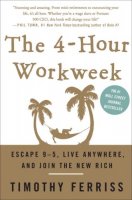 The 4-Hour Workweek: Escape 9 - 5, Live Anywhere, and Join the New Rich, by Timothy Ferriss (Crown Publishers, New York, 2007)
— Arabian Proverb
I discovered this proverb recently, and it goes well with my own, "The wise man recognizes truth in the words of his enemies," which I use to remind myself that there may be much to learn from people with whom I disagree, even on critical issues.
Janet found Tim Ferriss online. I found some of his ideas familiar—I think I read something about him, or watched someone's posted YouTube video from him...or something. (This is the problem with information glut. I used to be able to tell you, not only the book where I found certain information, but often the section of the page. No more. Did I read it in a book? On a blog? See it on YouTube? Hear it on the radio? I have no idea.)
It would be easy to be turned off by Tim Ferriss. He comes across as brash, self-centered, bombastic, and as subtle as an infomercial, and I'm certain his moral compass points several degrees shy of north.* But to ignore him on that basis would be a mistake. In amongst the infomercial fodder there is some truth, and some really good ideas.Ferris may be the polar opposite of the denizens of the Front Porch Republic, and thus a good balancing viewpoint for me. The FPR values localism, meaningful work, community, neighborhoods, and staying put. Ferriss not only thinks outside the box, he has no box. His "work" is impersonal, mostly outsourced, and of value to him only for funding his dreams. The world is his home. No tourist he: he can put three months' intense work into learning a new language, plunk himself down in the middle of a foreign city, find a cheap apartment, and totally immerse himself in the local culture for three weeks, three months, or three years, all the while maintaining his business seamlessly. If I find his attitude towards work and his lack of roots disturbing, I find his love of other places, languages, and cultures admirable.
Ferriss has looked at the "traditional" view of working long, hard, and faithfully at a job while saving money so one can finally enjoy life at retirement, and shouted a resounding "No!" It's hard to blame him, given that advancement and security are no longer the rewards of faithful service, the work-week has stretched from 40 hours to 60 or 80, and savings can be wiped out in an instant. His suggestion is not to retire at all, but to organize one's life to fund frequent "mini-retirements" throughout life. One of the differences between those he calls the New Rich and those stuck in the old way of thinking is that the latter want to be able to buy all the they want to have, while the New Rich want to be able to do all the things they want to do and be all the things they want to be.
Ideas fly from Tim Ferriss like popcorn from a popper with the lid off. (Is that analogy still viable in these days of microwave popcorn?) Even if you don't want to outsource your everyday life to India, I think you'll enjoy these excerpts.
Some people remain convinced that just a bit more money will make things right. Their goals are arbitrary moving targets: $300,000 in the bank, $1,000,000 in the portfolio, $100,000 a year instead of $50,000, etc. Julie's goal made intrinsic sense: come back with the same number of children she had left with.
She reclined in her seat and glanced across the aisle past her sleeping husband, Marc, counting as she had done thousands of times—one, two, three. So far so good. In 12 hours, they would all be back in Paris, safe and sound. That was assuming the plane from New Caledonia held together, of course.
New Caledonia?
Nestled in the tropics of the Coral Sea, New Caledonia was a French territory and where Julie and Marc had just sold the sailboat that took them 15,000 miles around the world....All said and done, their 15-month exploration of the globe, from the gondola-rich waterways of Venice to the tribal shores of Polynesia, had cost between $18, 000 and $19,000. Less than rent and baguettes in Paris....
The trip had been a dream for almost two decades, relegated to the back of the line behind an ever-growing list of responsibilities. Each passing moment brought a new list of reasons for putting it off. One day, Julie realized that if she didn't do it now, she would never do it....
One year of preparation and one 30-day trial run with her husband later, they set sail on the trip of a lifetime. Julie realized almost as soon as the anchor lifted that, far from being a reason not to travel and seek adventure, children are perhaps the best reason of all to do both.
Pre-trip, her three little boys had fought like banshees at the drop of a hat. In the process of learning to coexist in a floating bedroom, they learned patience, as much for themselves as for the sanity of their parents. Pre-trip, books were about as appealing as eating sand. Given the alternative of staring at a wall on the open sea, all three learned to love books. Pulling them out of school for one academic year and exposing them to new environments had proven to be the best investment in their education to date.
Now sitting in the plane, Julie looked out at the clouds as the wing cut past them, already thinking of their next plans: to find a place in the mountains and ski all year long, using income from a sail-rigging workshop to fund the slopes and more travel.
Dreamlining. That's what Ferriss calls his version of setting and achieving goals.
For all their [complaining] about what's holding them back, most people have a lot of trouble coming up with the defined dreams they're being held from.
He includes a number of questions designed to help you clarify your desires and determine the cost of actually accomplishing them. The whole procedure is a lot of work, but a quick take-away is that if you stare down both your desires and your fears, it may cost a lot less than you think to fulfill your dreams. I'm convinced that he's onto something here, especially on a smaller scale. How often do we defer trips or purchases or projects that would make our lives (or someone else's) more delightful, because we've never clearly defined the issue and determined the cost? We'll curse a recalcitrant piece of equipment for months, then curse ourselves when we finally get around to fixing it and discover the solution was a $5 part and 20 minutes of work. Often my unexamined mental image of how much something will cost (in money, time, or effort) is vastly inaccurate. For years I put off scanning my father's journals because I couldn't imagine finding time for such a mammoth job—and suffered much fear that fire or flood would destroy the only copy of this family treasure. When I finally sat down and did the calculations, I discovered that by setting aside a manageable half hour a day for the project I could complete it in just eight months. And I did.
Speaking of fear, Ferriss names it as a major culprit holding us back, and urges us not to allow our fears to remain amorphous. Define them clearly (as Yoda said, "Named must your fear be before banish it you can"), consider worst-case scenarios and how you might recover from them, deterimine the possibilities of positive outcomes, and do a risk/benefit analysis, not forgetting to include the costs of not taking action.
Usually, what we most fear doing is what we most need to do. That phone call, that conversation, whatever the action might be—it is fear of the unknown that prevents us from doing what we need to do. Define the worst case, accept it, and do it.....What we fear doing most is usually what we most need to do.
Jean-Marc Hachey landed in West Africa as a volunteer, with high hopes of lending a helping hand....He arrived in Ghana in the early 1980s, in the middle of a coup d'etat, at the peak of hyperinflation, and just in time for the worst drought in a decade.... He had also missed the memo. The national menu had changed, and they were out of luxuries like bread and clean water. He would be surviving for four months on a slushlike concoction of corn meal and spinach....
Jean-Mark had passed the point of no return, but it didn't matter. After two weeks of adjusting to the breakfast, lunch, and dinner...he had no desire to escape. The most basic of foods and good friends proved to be the only real necessities, and what would seem like a disaster from the outside was the most life-affirming epiphany he'd ever experienced: The worst really wasn't that bad. To enjoy life, you don't need fancy nonsense, but you do need to control your time and realize that most things just aren't as serious as you make them out to be. Now 48, Jean-Marc lives in a nice home in Ontario, but could live without it. He has cash, but could fall into poverty tomorrow and it wouldn't matter. Some of his fondest memories still include nothing but friends and gruel.
The 80/20 Principle: 80% of the results come from 20% of the effort and time. Applying this analysis to his business was life-changing, and it applies to much more than business.
Out of more than 120 wholesale customers, a mere 5 were bringing in 95% of the revenue. I was spending 98% of my time chasing the remainder, as the aforementioned 5 ordered regularly without any follow-up calls, persuasion, or cajoling....All, and I mean 100%, of my problems and complaints came from this unproductive majority, with the exception of two large customers who were simply world-class experts of the "here is the fire I started, now you put it out" approach to business. I put all of these unproductive customers on passive mode: If they ordered, great--let them fax in the order. If not, I would do absolutely no chasing: no phone calls, no e-mail, nothing.
That left the two larger customers to deal with, who were professional ball breakers but contributed about 10% to the bottom line at the time. You'll always have a few of these, and it is a quandary that causes all sorts of problems, not the least of which is self-hatred and depression. Up to that point, I had taken their browbeating, insults, time-consuming arguments, and tirades as a cost of doing business. I realized...that these two people were the source of nearly al my unhappiness and anger throughout the day, and it usually spilled over into my personal time....I finally concluded the obvious: The effect on my self-esteem and state of mind just wasn't worth the financial gain....The customers are always right, aren't they? Part of doing business, right? ["No," rather more rudely put, followed by an explanation of how he "fired" these customers, one of which he lost and the other of which changed his behavior and remained.]
I then identified the common characteristics of my top-five customers and secured three or so similarly profiled buyers in the following week. Remember, more customers is not automatically more income. More customers is not the goal and often translates into 90% more housekeeping and a paltry 1-3% increase in income....I duplicated my strengths, in this case my top producers, and focused on increasing the size and frequency of their orders. The end result? I went from chasing and appeasing 120 customers to simply receiving large orders from 8, with absolutely no pleading phone calls or e-mail haranguing. My monthly income [doubled] in four weeks and my weekly hours immediately dropped form over 80 to approximately 15. Mot important, I was happy with myself and felt both optimistic and liberated for the first time in over two years."
Parkinson's Law: Work expands so as to fill the time available for its completion.
[A] task will swell in (perceived) importance and complexity in relation to the time allotted for its completion. It is the magic of the imminent deadline. If I give you 24 hours to complete a project, the time pressure forces you to focus on execution, and you have no choice but to do only the bare essentials. If I give you a week to complete the same task, it's six days of making a mountain out of a molehill. If I give you two months...it becomes a mental monster. The end product of the shorter deadline is almost inevitably of equal or higher quality due to greater focus.
The best solution is to use both [laws] together: Identify the few critical tasks that contribute most...and schedule them with very short and clear deadlines.
No multitasking allowed.
You should have, at most, two primary goals or tasks per day. Do them separately from start to finish without distraction. Divided attention will result in more frequent interruptions, lapses in concentration, poorer net results, and less gratification.
Okay, so I really fail at that one. It may work for some jobs, and I acknowledge I multitask too much, but I defy any parent to do a good job following the letter of this law.
Battling information glut. What information consumes is rather obvious: it consumes the attention of its recipients. (Herbert Simon)
[Develop] an uncanny ability to be selectively ignorant....It is imperative that you learn to ignore or redirect all information and interruptions that are irrelevant, unimportant, or unactionable. Most are all three. The first step is to develop and maintain a low-information diet. Just as modern man consumes both too many calories and calories of no nutritional value, information workers eat data both in excess and from the wrong sources.
[E]-mail...is the greatest single interruption in the modern world. Check e-mail twice per day, once...just prior to lunch, and again at 4:00 p.m. Never check e-mail first thing in the morning. Instead, complete your most important task before 11:00 a.m.
This obviously won't work for Lime Daley. Ferriss makes it work for his business (indeed, he checks e-mail only once a week) by outsourcing the work, and that is not the Lime Daley way. But I know I don't need to check e-mail nearly as often as I do (nor blogs, for that matter), and I have already benefitted from the small steps I've taken to tame the beast. Not going online first thing in the morning is liberating!
To live is to learn.
Though you can upgrade your brain domestically, raveling and relocating provides unique conditions that make progress much faster. The different surroundings act as a counterpoint and mirror for your own prejudices, making weaknesses that much easier to fix. I rarely travel somewhere without deciding first how I'll obsess on a specific skill...I tend to focus on language acquisition and one kinesthetic skill. [Sports are especially good because you don't need superior language skills, but he recommends dancing, hiking, chess, or almost anything that encourages interaction with the community in which you've chosen to live.]
Language learning deserves special mention. It is, bar none, the best thing you can do to hone clear thinking. Quite aside from the fact that it is impossible to understand a culture without understanding its language, acquiring a new language makes you aware of your own language: your own thoughts. The benefits of becoming fluent in a foreign tongue are as underestimated as the difficulty is overestimated. Thousands of theoretical linguists will disagree but I know from research and personal experimentation with more than a dozen languages that (1) adults can learn languages much faster than children when constant 9-5 work is removed and that (2) it is possible to become conversationally fluent in any language in six months or less. At four hours per day, six months can be whittled down to less than three months....I learned six languages after failing Spanish in high school, and you can do the same with the right tools.
Do I recommend The 4-Hour Workweek? Yes. Now that I've read it from the library, will I buy it? Probably not. There's a lot in there of little interest to me, business practices and tricks that leave me feeling a little queasy. (Although I'll admit I learned a thing or two about Google ads and pay-per-click.) But even though it contributes to the information overload Ferriss decries, I say it's worth a quick reading, borrowing if you can, buying if you can't. (It's only $13 on Amazon.) There are definitely ideas worth wrestling with. You can also check out the website.
Permalink | Comments
Category Reviews Random Musings
Dipping once again into the blogging backlog.
It's old (from October 2008), and long, but this Financial Crisis for Beginners from InvestorsInsight is definitely worthwhile if you want a better understanding of what happened to the credit markets and why. Here are a few excerpts to give you a taste.
Historically local banks took deposits from savings account customers and lent money to homebuyers. They paid 1% for the savings accounts and collected 6% on the mortgages, and the spread (5 percentage points in this case) was more than enough to compensate for any homebuyers who couldn't pay their mortgages. (The numbers are illustrative only.)...Then, as any explanation of the subprime crisis says, banks started reselling and securitizing mortgages. But what does it mean to resell (let alone securitize) a mortgage?
To [banks], a mortgage is a product. This product gives them a monthly stream of payments...from their perspective, they are "buying" the stream of payments by paying you the loan amount....If Bank A resells your mortgage to Bank B, Bank B buys your payment stream from Bank A in exchange for a lump sum of money....[I]n practice, Bank B (or C, or D, …) is often an investment bank. And Bank B often securitizes your mortgage. This means they take your mortgage and combine it with many (thousands of) similar mortgages....Now you have a pool of [mortgages, which] as a whole has a price—the amount someone would pay to get all of those payment streams of that riskiness. In a securitization, the investment bank divides the pool up into many small slices [also referred to as tranches]....Each slice can be bought and sold separately, and each slice entitles the buyer to [a fraction] of the payments streaming into that pool. The price of these slices is based on current assumptions about the riskiness of those payments....The problem is that at the time those mortgages were securitized, the buyers assumed that housing prices could only go up, and therefore the payments were not very risky [hence prices were high].
Let's say you are an investment bank and you paid $1 million for a slice of a securities offering (a pool). You put that on your books as an asset...valued at $1 million. However, a year later, that slice is only worth $200,000 (you know this because other people selling similar slices of similar pools are only getting 20 cents on the dollar). You generally have to mark your holding to market (account for its current market value), which means now that asset is valued at $200,000 on your balance sheet. This is an $800,000 writedown, and it counts as a loss on your income (profit and loss) statement.
The next problem is that, over the last two decades, most of our banks have become giant proprietary trading rooms, meaning that they buy and sell securities for profit. Let's say you start a bank with $10 million of your own money. That's your "capital." You go out and borrow $90 million from other people, typically by selling bonds, which are promises to pay back the money at some interest rate. Then you take the $100 million and buy some stuff (like slices of mortgage pools), which pays you a higher interest rate than you are paying on your bonds. Suddenly you are making money hand over fist. But then let's say that housing prices start falling, securitized subprime mortgages start plummeting in value, and your $100 million in assets are now only worth $80 million. Since the value of your debt ($90 million) hasn't changed, you are technically insolvent at this point, because your losses exceed your capital; put another way, the money coming in from your slices of mortgage pools isn't enough to pay your bondholders.
[S]ince the Lehman bankruptcy on September 15, the crisis has moved into a new phase. In this phase, financial institutions are facing liquidity runs, or bank runs, whether or not they are solvent. How can this happen?...[B]anks tend to borrow short and lend long. [A typical mortgage is for 30 years, and the bank can't require the homeowner to pay it off early, while savings deposits tend to be short-term, perhaps a withdraw-on-demand savings account or a two-year certificate of deposit.] In the classic case, the bank takes money from depositors and loans it out as mortgages....If every depositor tries to withdraw his money at the same time, the bank can't call in its mortgages, and there won't be enough cash for everyone. Now why would this happen, since it is unlikely that everyone will need his cash at the same time? It happens if each depositor starts worrying that his...money might not be safe...then everyone tries to withdraw his money at the same time.
In ordinary times, bank runs don't happen. First, the FDIC insures all deposit accounts up to $100,000 [now $250,000] per account holder, precisely to prevent this kind of panic. However, in a real bank many of the liabilities are not deposit accounts and hence are not insured. Second, banks can ordinarily borrow money "against" their assets; that is, a bank with $100 in good mortgages can borrow almost $100 from another bank...by pledging those mortgages as collateral. [Securities] can also be used to raise short-term money.
These are no ordinary times, however. The fundamental problem is that all players in the financial system have realized that a bank that is solvent...can still be subject to a bank run. Once that happens, Bank A doesn't want to lend money to Bank B for two reasons: first, Bank A wants to hold onto its cash in case it becomes the target of a bank run; and second, Bank A is afraid that Bank B could be the target of a bank run, and hence is afraid that if it lends to Bank B it won't get its money back. Like all such panics, of course, this becomes self-fulfilling. [When perfectly solvent banks try to replace or renew their short-term loans—remember, they lend long and borrow short—they can't because no one is willing to lend them money.]....The key characteristic of such a crisis is that banks can be hit by bank runs—and go bankrupt—even if their assets are worth more than their liabilities.
There's a lot more, including an explanation of such TLAs as CDS and CDO, but if I put too much here it won't count as "excerpts." Besides, my head's still spinning.
Permalink | Comments
Category Random Musings
The people who sold us our worm farm gave us this advice for giving the worms a special treat: put some melon in their bin. Red wiggler worms love melon, they assured us, and will mob any pieces you give them. On the way home from church yesterday, we bought a watermelon from a local farmer. It was red, sweet, dripping, and delicious...and I couldn't wait to share the remains with the worms.
When I last checked, they hadn't shown any interest, possibly because I froze the melon pieces first, so they would also provide some Worm A/C. I'll check again tomorrow. However, I can report that they are going absolutely bananas for their Carnegie Mellon moisture mat.


On the left is what it looked like when I first put it in the bin, not quite two months ago. On the right, what it looks like now. If you click on the picture and enlarge it, you'll see a few worms (red-brown), some melon (green and pink), a lot of castings (brown), and the shredded-paper bedding showing through a large hole that they have eaten through the middle. (The green is another piece of cloth on which I place the frozen water bottle for cooling; I've pulled it aside so you can see the hole.) What you can't see is the masses of worms swarming under and through the mat; "infesting" would be a good word.
It's true: Worms love melons. But they can't spell.Permalink | Comments
Category Everyday Life Conservationist Living
God Grew Tired of Us (Newmarket Films, 2006)
Subtitled The Story of the Lost Boys of Sudan, this award-winning, PG-rated film tells the stories of three Sudanese men who, as chldren, fled the genocide in their country, walked over a thousand miles through difficult terrain and terrible deprivation, first to Ethiopia and finally to a refugee camp in Kenya. After many years in the camp, they were brought to the United States to live.
Steering clear, for the most part, of political issues, the film is simultaneously horrifying, inspiring, and even funny, such as the time one of the boys picked up a bottle of Pepsi and proclaimed, "In Africa we call this Coca-Cola." I'm sure the Coke folks loved that. Two of the boys were resettled in Pittsburgh, so there are some fun shots for Pittsburgers, including one of the good ol' 86B bus. One of the boys—now men—works at Whole Foods, so it's possible I might even have seen him.Having observed the resettlement of many Southeast Asian refugees after the Vietnam War—some with great success, some with little—I was all the more impressed by the boys' ability to adjust to such a radically different culture. It helped greatly, I'm sure, that they had already had a good start at mental and physical development before entering the starving times, and also that there was a school at the refugee camp, so that their English was already quite good when they arrived in America. God Grew Tired of US does a nice job of pointing out negative aspects of American culture without indulging in America-bashing. The men honor their new country without forgetting or dishonoring their homeland.
It is, however, a tad embarrassing to see the men reacting to bikini-clad women on television, and bemused by our Christmas traditions. "Can you tell me about this Santa Claus? In Africa, Christmas is about Jesus being born." And downright heartbreaking to hear them talk about the loneliness here, how people pass each other without greeting, and how neighbors don't know each other. They speak with sincere longing for the community spirit they had in their homeland, on their trek, and in the refugee camp. It reminded me of a friend of Janet's, from Russia, who was happy that in America we don't stand in long lines for little choice in food, but sad that we don't have the mealtime camaraderie common in Russia. Saddest of all, perhaps, was one man's observation—this may have been in the DVD commentary rather than the movie itself—that family is of great importance in the Sudan, but that in America it's very difficult to have children unless you can get someone else to take care of them for you.
Watch the trailer.A Sane Woman's Guide to Raising a Large Family, by Mary Ostyn (Gibbs Smith, Layton, Utah, 2009)
This book sounded useful to Heather, who wishes both to have a large family and to retain her sanity, so we bought it for her as a Mother's Day gift. Naturally, I read it first. (Book-gift recipients are accustomed to that behavior from me, I'm afraid.)
I recommend A Sane Woman's Guide to all families who aspire to sanity, even if their hopes don't include a large family. Although I don't agree with all of Mary Ostyn's advice, it's a surprisingly useful collection of ideas in a slim 192 pages, amusingly presented. Here's the table of contents for a quick preview, followed by a few, rather random, excerpts.
- Growing a Family: Are We Crazy to Want Another Baby?
- Money: Just How Broke Are We Going to Be?
- Making Space: Will We Need a Shoehorn to Fit Another Bed?
- Kids and Activities: Is It Still "Home Sweet Home" If I'm Never There?
- Affordable Vacations: Is a Disney Vacation a Childhood Essential? [Absolutely not. But a Central Florida vacation is, if your grandparents live in the Orlando area.]
- The Supermom Myth: Where is My Supersuit?
- Parenthood and Stress: Will Bedtime Ever Come?
- Parenting Hacks: Isn't There a Better Way to Do This?
- Likeable Kids: Will Grandma Be Worn Out by Our Brood?
- School Success: What if My Kid Isn't an Honor Student?
- Encouraging Sibling Friendships: Why Can't They Be Friends?
- Celebrating Each Child: Will They Know How Special They Are to Me?
- Conclusion: Never Alone
Making it work on a moderate income comes down to clarity of purpose. What do our children need most from us? They need love. They need food, clothes, and shelter. The need clear expectations and responsibilities. The need time just to be kids....But they do not need huge allowances, rooms of their own, TVs in their rooms, and name-brand clothes.
Though I am a tightwad at heart, years of mothering a large family have made me a reluctant fan of high-quality components in certain places [e.g. faucets, carpets and other flooring, cabinets, and doorknobs].
Every household should have a good collection of books....The library is a wonderful resource as well. But kids should be able to find something to read anytime, not just when you have time to hit the library.
My mom taught me to sort laundry the traditional way: whites, lights, mediums, darks, and towels. As a new wife, I dutifully emulated my mom's approach. A few kids later, I got lax and tried the "grab any heap and chuck it in the washer" approach. To my surprise, the laundry didn't look much different. Sure, there were those few rare occasions when I forgot about that new red shirt and my (very secure) hubby ended up wearing pink underwear to work. But those times were rare. My casual approach saved minutes every day and decreased our quality of life not one bit.
Instead of aiming to get out the door five minutes before I had to get out the door, I started aiming to leave half an hour sooner. Don't get me wrong: I've never managed to actually leave half an hour early. But often I manage to walk out the door five or ten minutes ahead of schedule. After years of unsuccessfully trying to beat the clock, let me tell you, that's a sweet, sweet feeling.
A huge key when dealing with poky homework-doers is to give children ownership of the problem. Make sure they know what they're supposed to do and remind them that nothing else is going to happen till this is done. Then leave them be. Sometimes kids will need a session or two of staring at the problems till bedtime to decide to work. Sprinkle a bit of exercise in there even if the work isn't done. Chasing the dog around the yard for ten minutes is sometimes just the thing to break the logjam in the child's brain and motivate them to finish the work. But stick to your guns and require that the work get done.
My husband and I only had two kids when we realized that the whining had to quit in our house. We made a serious push to stop rewarding that behavior. Though it didn't end entirely—we still fight the battle some days—it did diminish the level dramatically, which made my job as mom much more enjoyable.
Pick a few essential house rules and stick to them. Here are the rules we have at our house:
- Be respectful to your parents.
- Be kind to each other.
- Work hard without complaining.
Once the child knows what behavior you expect, give consequences with every offense. Too often we parents think we are being merciful when we give kids one more chance to obey, but, really, we are training them to disobey....Kids are smart, and they learn quickly when it is in their best interest. And here's the truth: learning to obey the first time you say it is in everyone's best interest. It makes for a happier family.
Over the years, I've learned to vary the consequence [for misbehavior] depending on the occasion. If a child doesn't cooperate during work time, he'll need to work during part of his playtime. If a kid is cranky and argumentative, maybe he'd benefit from an earlier bedtime. If a child destroys his bedroom, he cleans up the mess. Kids who hurt siblings can make up for it by doing a chore for the hurt sibling....Most kids do not like to do extra work. I will often give a disobedient child an extra job to atone for defiance....If kids learn that misbehavior takes away their free time, they'll be less likely to do the same thing again. I also find that getting a bit of assistance helps me feel more positive towards the child.
I've stopped berating children about the state of their rooms right before they fall asleep at night. No kid needs the last words of the day from mom to be a lecture, no matter how well deserved. Better to brush the clutter aside and end the day on a positive note.
When you're feeding half a dozen kids, you'd go nuts trying to be a short order cook for each and every child. So you offer fewer choices, and kids learn to be more flexible. Here's another thing that moms of many know: kids almost never starve themselves, despite their parents' fears. If they're given a reasonable variety of food, they'll eat enough to live on. Really.
Thomas Edison once said, "Opportunity is missed by most people because it is dressed in overalls and looks like work." By training our kids to work, we are making it more likely they will see those opportunities when they come along in life. Training should start young. Even a twelve-month old can help put blocks into a bucket. Kids need to know that everyone in your family helps out, and they need to learn that complaining will not get them out of work. In fact, at our house, complaining is a great way to earn an extra task. Even an indignant "Uh!" means kids need to practice giving the right answer in the right tone of voice...Don't just give children busywork. Kids are competent....It is better to overestimate your children's ability a bit and then train them to the task. Don't keep kids doing the same overly simplistic jobs for years. Promote them!
One of the best things we can give our kids is the right kind of praise. Words of affirmation come naturally to many parents these days....The problem is that kids get used to being applauded for the simplest things....Rather than giving huge applause for every action, it is better to praise specifics and to match the level of praise to the amount of effort that the child made....The most powerful praise focuses on things that children can control. We should notice effort. We should notice concentration. We should especially notice when kids have worked hard on a project. In the end, hard work will get kids farther than native ability.
Here's something that a lot of people don't realize. All kids come out of school with "gaps," no matter what type of schooling they've had....But if we can instill in our children an ethic of hard work, the ability to read, and a curiosity about the worlds, they will have the tools they need to overcome any gaps they may have.
When I notice my kids picking on other children's weaknesses, I pick a quiet time to speak directly to the person who is being unkind. "Have you noticed how Ben really hates to wear his glasses?" Usually the child will admit that he has. If he pretends ignorance of the issue, I'll explain the other child's feelings in a non-accusatory way and ask the child if he will help me support his brother. "Could you help me make sure nobody teases him about his glasses? Let me know if anyone does, okay?" Enlisting the child's help as his brother's protector will often discourage teasing. You may not even have to mention the child's part in the teasing. Most likely his conscience will do that work. If we can teach our children to make allowance for the weaknesses of others, we will be encouraging a kinder gentler spirit in our home.
A Sane Woman's Guide to Raising a Large Family is a quick first-time read, during which most people will find sound principles worth re-reading a time or two. It's also well-written, and the tone is not condescending.I've come to realize that fighting between children is most intense when they are having a hard time getting their own needs met. If a kid is feeling neglected or out of sorts, he can't have the emotional energy to speak gently to another child, to forgive, to be kind. Often I can trace an increase of fighting in the family directly to a too-busy schedule, especially a too-busy momma, or to a too-great focus on accomplishment at the expense of family fun.
Permalink | Comments
Category Education Children & Family Issues
In the back corners of my "to blog about" list, I finally found In Defense of "The Rich," by Larry Elder. I'd originally bookmarked it because of the facts about charitable giving (see below); I'd remembered, from another source, George W. Bush's impressive record in this matter, but couldn't find it when I needed it in a debate with my brother. This article gave the hard numbers for my hazy memory, but at that point it was but l’esprit de l’escalier, so I filed it under "sometime"...you know.
But sometime is now here, and I find that the article has several good points, and complements my previous post, Think You're Rich? Or Poor?A recent poll commissioned by Investor's Business Daily asked, in effect, "What share [of the tax burden] do you think the rich pay?" Their findings? Most people are completely clueless about the amount the rich actually do pay.
The top 5 percent (those making more than $153,542) pay 60 percent of all federal income taxes. The rich (aka the top 1 percent of income earners, those making more than $388,806 a year)...pay 40 percent of all federal income taxes. The top 1 percent's taxes comprise 17 percent of the federal government's revenue from all sources, including corporate taxes, excise taxes, social insurance and retirement receipts.
[Of those polled,] 36 percent thought the rich contribute 10 percent or less of all federal income taxes. Another 15 percent thought the rich pay between 10 and 20 percent, while another 10 percent thought the rich's share is between 20 and 30 percent. In other words, most people thought the rich pay less—far less—than they actually do. Only 12 percent of those polled thought the rich pay more than 40 percent.
A U.S. News & World Report blogger went to the Democratic National Convention in Denver and conducted an informal poll of 24 DNC delegates. He asked them, "What should 'the rich' pay in income taxes?" Half the respondents said "25 percent"; 25 percent said "20 percent"; 12 percent said "30 percent"; and another 12 percent said "35 percent." The average DNC delegate wanted the rich to pay 25.6 percent, which is lower than what the rich pay now.
Thirty percent of American voters pay nothing—zero, zip, nada—in federal income taxes.
And here's the above-mentioned charitable giving data.
- In 2007, President George W. Bush and his wife had an adjusted gross income of $923,807...and donated $165,660 to charity—or 18 percent of their income.
- Vice President and Mrs. Cheney, in 2007, had a taxable income of $3.04 million...and donated $166,547 to charity—or 5.5 percent of their income.
- Barack Obama and his wife, Michelle, earned between $200,000 and $300,000 a year between 2000 and 2004, and they donated less than 1 percent to charity. When their income soared to $4.2 million in 2007, their charitable contributions went up to 5 percent.
- Joe and Jill Biden...made $319,853 and gave $995 to charity in 2007, or 0.3 percent of their income. And that was during the year Biden was running for president. Over the past 10 years, the Bidens earned $2,450,042 and gave $3,690 to charity—or 0.1 percent of their income.
Liberal families earn about 6 percent more than conservative families, yet conservative households donate about 30 percent more to charity than do liberal households. And conservatives give more than just to their own churches and other houses of worship. Conservatives, especially religious conservatives, give far more money and donate more of their time to nonreligious charitable causes than do liberals—especially secular liberals.
Permalink | Comments
Category Politics Random Musings
I thought I was finished writing about Judy's trial and the circumstances that led to it, but Jon wrote some excellent comments in response to a discussion at allnurses.com, and they're worth repeating here. (Following the link will take you to the page where Jon's comments are; from there you can see the whole thread if you'd like.)
To the EMT who would get children out of the parents' custody because they don't agree with his advice: That is completely horrible, and unacceptable for any case but perhaps some sort of huge abuse problem. Perhaps you haven't seen what sort of issues there are once the state steps in to take care of the children. Way worse than 99% of the parents that are out there.
The EMT's comment is worth quoting here. Let those who take our basic liberties for granted observe both his attitude and the fact that he said it's "very easy" to have a baby declared in need of protective custody, at least for long enough to strong-arm the parents into obedience.
Actually we can force the mother to go to the hospital, it's kind of a trick but unless there is a religious reason for the baby not to go, we say that the parent's action[s] are placing the child at risk of injury and have the police put the baby in protective custody (very easy to do) and transport the baby, but they're attached so mom has to go.
Back to Jon. Some people suggested that 911 should have been called earlier, that having EMTs there sooner would have made a difference in the outcome.
We do have a phone. In my mind, once a baby is partially out of the mother, there isn't much that an EMT is going to be able to do, so not worth calling. (Now that I've seen what experience the EMTs have with babies (out of the 6 EMTs and physician that showed up, one had seen a baby delivered before, the rest testified that they had never seen a baby that small—10 pounds—or young before. They had no experience with umbilical cords, and depended on the midwife to properly handle that. They had no experience with infant CPR, and one testified that our midwife was doing things incorrectly, but upon further research into infant CPR (I never had infant CPR certification myself, just adult and child) [I] saw that Judy was doing exactly the right thing, and the EMT was referring to child CPR, which doesn't apply to a 10 minute old baby.
As for legality of things, I refer you to the Diane Goslin case last year, where it was clearly stated that PA law does not treat midwifery as the practice of medicine. So, the only thing left was to charge our midwife with the practice of midwifery without a certificate, which for some strange reason, PA requires a certificate, but doesn't have any means of getting a certificate. Many midwives practice openly in this state, sign birth certificate, do the blood tests, apply for social security cards, etc. and the state accepts them. As far as I can tell, it is legal in PA to be a non-nurse midwife. Hopefully this case will urge the legislators to fix the law where they have created a law that is not possible to live by, and the hundred or so non-nurse midwives currently in the state should have some way of following that law.
"The Daleys have used both a certified nurse and unlicensed midwives. Mr. Daley said he is more comfortable with the latter because they are less 'medical' and don't overcompensate for risks in fear of legal liability."
Hopefully that statement came out right—it was given over the phone to one of the newspapers—he didn't write everything I said, and you can probably twist those words to mean things that I didn't mean. I think it is crazy that some doctors think that there "aren't any risks in childbirth if you are in a hospital," and I think that is precisely the reason that there are so many lawsuits—they set themselves up to be perfect, and say that every other case was negligent, etc. In our case, 78 other babies died that year in the county, in hospitals, and none of those deaths resulted in the county pressing charges. I don't know whether the parents pressed civil charges in any of those deaths—they didn't make the news if they did.
One point that someone brought up is that even with a judge who (given his closing remarks) was quite against midwifery, and the actions of this particular midwife, but still could not find her guilty of anything [deserving a penalty of] more than $100 (though presumably he tried as hard as he could) shows that there really isn't a problem with midwifery in Pennsylvania.
As for other facts of the case, you might be interested in our version of the story, most of which did not get published elsewhere, even if it did get mentioned in the various hearings. I was fairly unprepared for the prosecution to not be interested in facts and the truth, but rather just winning the case. I expected the county to want to find out what happened, and have that judged, rather than twisting my words, (even trying to get me to not be able to testify), and coming to our house to yell at us unless we agreed to change our story. Very bizarre.
Link to Isaac's story (You can click on the "page" links at the bottom of the page if you want to start at the beginning; otherwise, you'll be reading in reverse chronological order.)
Lastly, [to] those people who said that our midwife should have left a laboring mother, or call 911 "to cover her behind", seems kind of strange to me. I wouldn't expect any health care provider to stop providing care, unless it was a danger to themselves (i.e. fallen power line, avalanche, etc). Judy (presumably) knew that she didn't have to worry about being sued by us, and so was able to make medical decisions and not legal decisions. Too many medical professionals are making legal decisions rather than medical decisions. I don't blame them, since Americans like to sue people, and I don't know what the answer is, other than never using those professionals, and seeking out people (like the doctors and midwives that we do use) who agree, at least partially, with that statement.
It comes down to an issue of responsibility. I think it is crazy that the government thinks that they should prosecute someone who was acting on the wishes of their client. I think it makes far more sense for the government to prosecute us—and if we had older children I would have been concerned for their safety, since the government can easily take away our kids any time they feel like it, and like the EMT commenting above, lots of people seem to think that is a perfectly acceptable way of dealing with issues.
I was told early on that the state would not come after us, because then it would look bad, and they would definitely lose the case. The media coverage was particularly poor early on, and contained numerous factual errors, and so even our neighbors assumed that we were pressing charges. Pretty much everyone I have talked to has been very surprised to hear that our government is pressing charges on our behalf, without our consent. One humorous point in the trial was when the judge corrected the prosecution when she said that Judy wasn't a certified midwife—that one of "her" witnesses had testified that she was. Apparently, the prosecution is allowed to argue against the defense witnesses, but not her own. Thus, she had to reluctantly accept what my wife said, but then changed her mind about calling me, since that would result in me being "her" witness, and she knew that wouldn't work, given that only three people witnesses what happened that day, and all three are against the prosecution.
I think if the medical examiner hadn't hated midwives so much, we would have had a much fairer trial, and this would have been over a long time ago. He believes that all midwives, (CNMs or otherwise) have no place in childbirth, except maybe in a jungle in Brazil, and should be prosecuted on that basis alone (that we were in Pittsburgh).
I found it humorous that one of the prosecution's detectives recommended to the district attorney that the charges be dropped, that they weren't going to be able to win. He had the luxury of coming into the case later on, so wouldn't lose "face" by dropping the charges. The original detective and prosecutioner would have to admit they had wasted tens of thousands of dollars if they dropped the charges so late.
Hopefully, people in Pittsburgh and Allegheny county will realize what a waste this was, and can figure out how to stop the county from pursuing frivolous charges against people who don't want to be "protected" by the state.
From a subsequent post by Jon:
Oh, I forgot to say, (in response to [someone's comment about the Amish) that I don't know if you think we are Amish (we aren't, though I do see some positives in the lifestyle they lead).
And the media often asks us if we made decisions about a midwife based on religious beliefs (I gather that makes for a more sensational story in the media). I sort of find that question odd. We don't go to a church that believes in home births or anti-doctors or something like that—though there are some who see the legal/medical quandary we (the United States) have gotten ourselves into, and so agree on some level.
But, as best as I can tell, all decisions a person makes are based on their religious or philosophical beliefs. A person's world view has to affect how they see the world and what decisions they make. So, every decision I make (where to work, live and even whether to post on this forum) are all "religious" decisions.
[The] reason I am posting here is so that folks get the true story—when I testified in the trial, I affirmed to tell the whole truth, but the prosecution made it impossible for me to do so, and so the judge and the media did not hear what actually happened. And I suspect the defense attorney knew that things were going to be dropped, and so didn't find it worthwhile to correct certain points.
Here Jon provided a link to his comment here, on The Trial, Part II, for examples of how it was impossible to "tell the truth, the whole truth, and nothing but the truth" at the trial. [Jon has my complete sympathy. I don't know how I would manage in such a situation; I get frustrated merely trying to answer surveys that claim to want my opinion but accept only multiple-choice answers that often don't come close to the truth.] I've excerpted his comment here.
Hence the vital importance of a free press. Kudos to Jon for making the effort to tell the truth on allnurses.com, and to that forum for publishing his remarks.The questioning was pretty rough. The prosecution made up a number of stories, saying, "Isn't it true that you..." or "Do you remember testifying previously..." and the ends of the sentences were really random stuff. In retrospect, I think the prosecution's goal was to try to get us irritated, which she succeeded with me, and didn't with Judi [not Judy, who was on trial, but a different midwife, who testified for the defense]. I don't know if her stories were also intended to try to convince the judge that they actually happened even though I said they didn't.
Maybe prosecutors need to take an oath of telling the whole truth as well as the witnesses.
I can't remember most of what was asked of me now; I do remember one question of Judi: Do you use pitocin? No. What if I told you that I had talked to some people who said that you did use pitocin? Uhh... I've never used it. Okay, my next question is....
I am not sure if that was supposed to try to make Judi nervous that Lisa [the prosecutor] had actually talked to someone. It seems like a silly thing to bluff on.
Lisa said that when I called her after being told I would be arrested if I didn't talk to her that I said Lee [the defense attorney] was my lawyer, and when she said he wasn't, I insisted that he was. I wish I recorded more of my phone conversations, because that is a complete fabrication. I said that I had talked to Lee, and he had said she couldn't serve me a subpoena to show up at her office. She asked if I had legal counsel, and I said that I had the one friend that we talked to sometimes, but no, we didn't have anyone officially representing us.
I am not sure how she could have possibly heard that as "Lee is my lawyer."She also asked whether Judy had told me that Isaac could die during a breech birth, and whether she had told me that my wife could die of hemorrhaging, and if I actually cared about my children or not. I guess in writing you miss out on the facial expressions and tone of voice. It was quite entertaining.
She also accused me of not answering her questions, but then when I tried to answer them, by asking clarifying questions, she would say, "YES or NO, Mr. Daley."
One line of questioning went like this:
Q. Do you remember Judy telling you that everything would be okay?
A. No.
Q. Do you remember testifying at the open inquest?
A. Yes.
Q. Do you remember saying at that point that Judy said everything would be okay?
A. No.Q. Here is your testimony, read from here to here.
Q. Now do you remember testifying that Judy said everything would be okay?
A. No.
Q. WHAT?!?!?! So, you are now testifying today that what you testified previously was incorrect?
A. No.
Q. It says right here: "She said that Lucille said that everything would be okay." Now do you remember?
A. No.
Q. WHATHAHATATA??!?!?!?!
A. I said that Lucille said that, not Judy.
Quite frustrating,Similar line of questioning regarding whether Judy had done any vaginal exams. Again, back and forth, until she accused me of lying, and changing my testimony. (My current testimony is that I don't remember if she did or not.) What Lisa quoted me as saying 5.5 years ago is: "There was a, probably, I think, when she got there, she did a vaginal exam to see in terms of dilation, whatever. I wasn't particularly interested in that part of it, so I wasn't paying attention." And she somehow took that to mean that I was sure then, and had changed my mind now.
While questioning me about whether I thought we should have transported or not, I said that I didn't think it was a good idea to transport a mom with a baby half hanging out of her. (It seems medical folks are split about 50-50 on that decision—some people say you can always transport, other people say you shouldn't.) Lisa's follow-up question was: And what medical institution did you get your medical degree at?
I guess her idea is that you can't have any opinions about your own medical care.
Permalink | Comments
Category Children & Family Issues
In Switzerland you must bring your own bags to the grocery store, or buy them there. We've tried variations on that theme here, with little success. Thirty years ago one of our stores in New York started using cardboard boxes instead of bags, and paid five cents for every one you brought back and reused. That the store went out of business not much later was probably not due to that particular policy, but it certainly put an end to it. At one time or another the stores here in Florida would pay a nickel for each reused bag, and some still do. But, frankly, five cents isn't enough incentive one way or another.
Then several stores began selling reusable "green" bags. A good idea, but I couldn't see buying them, even for the low $1 price, when we had plenty of bags at home I could use—especially since the new bags are made in China. I don't boycott Chinese products altogether, but their dominance makes me nervous, and I like to find alternatives when I can. Besides, it just seems ridiculous to ship products halfway across the world in the name of protecting the environment. Despite having bags at home that would do, however, I never got around to making the switch...
...until a dear and practical family member gave me three Trader Joe's bags for Christmas. Knowing my aversion to Chinese bags, she found me some made in Vietnam—not much better, perhaps, but at least an alternative. They were better than our existing bags: the right shape for groceries, and one was even insulated for cold items. Soon I was hooked, and even acquired some more (Chinese) bags when our store offered them "free with purchase" on a couple of occasions. They live in the back of the car and are thus always handy, which is a good thing because if I had to remember to bring them with me I'd forget half the time. On the occasions when I walk to the grocery store I still follow in the tradition of my father, and use my good ol' L.L. Bean pack basket.
There's no economic incentive to use the reusable bags, not even the aforementioned nickels. I know myself: I wouldn't continue the practice if it were difficult or awkward. But it's not. The reusable bags are a lot more fun to handle than the floppy plastic ones: they're sturdy, hold more, stand upright, and don't accumulate in large quantities that must be returned to the store for recycling. What amazes me is how many of those plastic grocery store bags I'm now saving. After only a few months of using the new bags, I deliberately left them in the car for one trip because I had run out of plastic bags at home. Such a situation would have been unthinkable last year.
Permalink | Comments
Category Everyday Life Conservationist Living
Our worms now have more living space: we put the second level onto their condominium/college dorm. There's still a small amount of uneaten food in their first level, but that section is full, and I think they need more food. They've been munching on their Carnegie Mellon t-shirt moisture mat, and while I know they will eventually consume it no matter what I do, I'd rather tempt them with kitchen waste.
Permalink | Comments
Category Everyday Life Conservationist Living


