
We celebrated my birthday with a three-way phone call (Florida/Pittsburgh/Basel), good wishes from family and friends, and a dinner at the Kobé Japanese Steakhouse. We'd been to the Kobé before, but that was probably 15 years ago. Their teppanyaki service doesn't remind me in the least of our experiences in Japan, but that doesn't mean the food wasn't good. We didn't even spring for the $80 Wagyu beef; the $18 sirloin was quite delicious enough. And the $15 birthday bribe was worth a bit of mild embarrassment.
Today was a bigger birthday, with a slightly bigger celebration. For our part, we once again joined the Greater Geneva Grande Award Marching Band for Geneva, Florida's genuine, old-fashioned, small-town Independence Day celebration, the only Independence Day parade in Central Florida to occur on July 4th. I love Geneva's celebration—I hope that it is not a bad sign that the cow-chip toss game used plastic "chips" this year—and I love the band even more. It was 15 years ago that we first marched with some of those great folks!As usual, I made loud crashing noises with cymbals, and Porter kept the band members well hydrated. He's had that job ever since our first gig, Atlanta's Independence Day parade in 1993. Geneva lacks the television coverage, the long parade route, the melting tar in the pavement under our feet, and the real, desperate need for frequent hydration—in Atlanta we were the only band not to have someone faint—but his efforts and antics are no less appreciated.


Geneva's Master of Ceremonies challenged us to take this patriotic quiz in today's Orlando Sentinel, claiming that he only missed two questions. I was more than pleased that I missed none at all, though on one question I used my multiple-choice test taking skills more than my real knowledge. (Porter, of course, easily got them all right.) The pride was somewhat short-lived, however, since I found the full version of the test and only scored 90%. That would still be a respectable score if I did not have the nagging feeling that I've seen that test somewhere before, so it doesn't really count.
I hope you all had a great day, however you celebrated!Permalink | Comments | Edit
Category Everyday Life
For a monolingual person, I have an inordinate love of languages. Not only is multi-lingualism increasingly important in today's world, but it does wonderful things for the brain—from increased brain growth in babies to decreased dementia in the elderly. I wish the great resources available for teaching young children another language had been around when our kids were little, and I wish I had more aggressively pursued what there was. Be that as it may, I am only a language dilettante, enjoying learning a few phrases of Japanese before our trip there, brushing up on my minimal high school French, and listening to the language CDs from the Hippo Family Clubs. I wish I were multi-lingual, but face the reality that at my age it just isn't going to happen.
Nonetheless, I should be able to learn, if I put the time and effort into it, enough of a language to get along reasonably well with basic, necessary communication. Which brings me to the question of why I find myself attracted to almost any language other than the two that would be of the most immediate practical use to learn: Spanish and German.The source of my prejudice against Spanish was not hard to discern: I don't react well to threats and pressure, and the increasing dominance of Spanish in Florida makes me feel about that language the way many Québécois feel about English. Unreasonable prejudice, I know, but at least I understand its origins.
German is another matter. Anticipating many future trips to Switzerland, not to mention German-speaking grandchildren, learning German should be a high priority. And it will, when I can talk myself past the mental block. But why the reluctance? Why does the German language sound ugly and angry to me? Sophie Scholl helped me untangle this puzzle: My association with German and Germany is too much influenced by World War II.
Not that I ever experienced WWII myself, nor did my parents express any particular anti-German sentiment. But when I was growing up, the memory was yet green in American culture, and Germans were not presented positively in the books we read, the movies we saw, the television shows we watched, and even the games we played. The bad guys barked "Heil Hitler!" and "Seig heil!" and "Ya voll!" and spewed angry-sounding, though incomprehensible, strings of harsh consonants. For some reason, perhaps because I grew up on the East Coast rather than the West, Japanese was spared this treatment.
I'm sure that German words out of the mouth of a young grandchild will sound perfectly lovely.
And fortunately for me, Schwyzerdütsch k'valt mir goed. (Real Swiss German speakers please forgive my attempt at spelling what I hear.)
Having worked my way (the first time) through the Pimsleur Swiss German lessons (unfortunately there are only 10 of them), I can now say hello, goodbye, please, and thank you, ask you to repeat what you just said, tell you my name, and ask how to get to Bahnhofstrasse or Marktgasse. I can also order a restaurant meal—though only if it's Gschnätzlets mit rösti—and a drink, if I'm willing to have coffee, beer, wine, or mineral water, which means I'd get pretty thirsty if it weren't for those great Swiss public drinking fountains. I can make a date with you; that is, if you're willing to come at 9:30, 10:00, 1:30, or 2:00.
Schwyzerdütsch ish schön! Especially if spoken by someone you love.Permalink | Comments | Edit
Category Education Everyday Life
I shouldn't be surprised when what is said in comic strips mirrors opinions expressed by essayists in more serious venues. After all, both get their inspiration from the same human condition, and humor is an efficient and effective way to make a point. Nonetheless, I always take note when I hear the same message from widely divergent sources, as happened when I read in close succession Francis Schaeffer's The God Who Is There and John Taylor Gatto's The Underground History of American Education. When an evangelical Protestant theologian living in Switzerland and a self-described lapsed Catholic schoolteacher from Pittsburgh, writing on issues that apparently differ markedly, make the same historical and philosophical point, perhaps I had better listen.
The conjunction of Mallard Fillmore and Mike Thomas, about which I wrote yesterday, is less portentous, perhaps, but today's has signficant social and philosophical implications.Safe Havens is one of the quirkier comic strips I like to read, but if the following strip is incomprehensible to you, it's not because you don't understand about the mermaid, the grandmother's ghost, the genetically-altered animals now serving as roadies. I follow all that and was still confused.
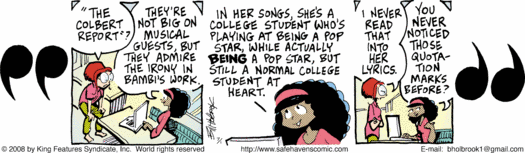
Yesterday's mail brought a letter from Ken Myers, whose Mars Hill Audio Journal I enjoy greatly. The purpose of the letter was an appeal for support, but the content shed light on the Safe Havens strip.
With my children grown, I have been blessedly even more clueless of pop kid culture than I was when they were young, but I did hear the name Hannah Montana thanks to a friend of Heather's who blogged about the effort she went through to secure concert tickets for her Hannah Montana-crazy daughter. That's all I knew though—she sings, and she's enormously popular with the younger set. Thanks to Myers' letter, however, I know—and worry—more.
So that's the Safe Havens strip, complete with "ironizing quotation marks."
- Miley Cyrus (now 15) plays the lead character on Hannah Montana, a character named Miley Stewart. Stewart has migrated west from her humble Tennessee origins to live in Malibu, to pursue her dreams as a superstar singer known to the public as Hannah Montana. Hannah Montana is thus a persona, an alternate identity assumed by Miley Stewart. Miley Stewart is also a character, performed by Miley Cyrus. What makes it even more reflexive is that Miley Cyrus performs in concert as Hannah Montana, bypassing Ms. Stewart entirely. One might ask if Miley Cyrus is really a celebrity pop sensation, or whether she just pretends to be a pop sensation when she’s in character.
- The image in Vanity Fair of Miley Cyrus [apparently nude, though provocatively draped in a sheet]…has evoked intense media scrutiny and widespread parental anxiety over the apparently important question: Has this wholesome role model been stained by this arguably provocative photo.
- The question moms (and dads) need to be asking is not whether Miley/Miley/Hannah is going to go all Britney on them, but whether their six- and seven-year-old daughters really benefit from having as a guide to growing up a performer playing a performer playing a performer. Just as the most important lesson taught by Sesame Street is that learning must be fun, so the most important lesson taught by Hannah Montana may be that growing up is about learning how to perform one’s life, how to define your identity as a desirable commodity, how to assemble and project the brand called Me.
- The culture of celebrity and personal performance which permeates our society is profoundly destructive. It’s not simply that being well-known for simply being well-known (in Daniel Boorstin’s classic formulation) is a thin and vapid achievement. More fundamentally disordering is the way in which the deeply sensed notion of “identity as performance” promoted in the culture of celebrity undercuts the very idea of reality or real life; more than the work of nihilistic philosophers, the prominence of performers in our society nudges us toward referring to “reality” (with the ironizing quotation marks) rather than to Reality.
Permalink | Comments | Edit
Category Children & Family Issues Random Musings
Mike Thomas, an Orlando Sentinel columnist, has had a special place in our hearts ever since he interviewed Heather for a magazine article about her summer camp experiences. That I often disagree with his opinions in no way keeps me from appreciating his intelligence and writing skills.
His recent column, The Sea Is Coming, makes the excellent point that, whatever we do or don't do about global warming, or global cooling, we in Florida are fighting a losing battle against natural forces. Florida's coastline comes and goes, advances and retreats, and the worst thing we can do is to cover it with lots of big, expensive buildings. The second worst is to encourage that overgrowth, as we do, with government-subsidized property insurance—considered necessary because real insurance companies know how foolish it is to build one's house upon the sand while standing in a hurricane's path.Mike also takes the time to explain to younger generations why some of us older folks refuse to take too seriously all the global warming hysteria. We've lived long enough to see theories come and theories go, and hear the cry of "Wolf! Wolf!" once too often. That doesn't stop me from being in favor of fuel-efficient cars, public transit, and non-motorized transportation, along with recyling, sustainable agriculture, water conservation, and other ways to make our envionmental impact more beneficial than harmful. But my opinions and actions in these matters are more in spite of the hype than because of it.
[I]n 1975, Newsweek ran a story warning climate change could cause famines and political unrest. This was based on growing scientific evidence Earth was cooling. There even was a proposal to keep the polar ice cap from expanding by covering it with black soot.
Mike's article was on my "possible blog fodder" list for a while, but Mallard Fillmore's comic of yesterday pushed it to the top of the list.

[Insert whistling here]
Front entrance lights and tiles


Kitchen bar lights and hand-crafted wine rack


Yep, he did it all, plus about a dozen more cool things on a smaller scale!

Permalink | Comments | Edit
Category Everyday Life
Sophie Scholl: The Final Days is a simply made but powerful German film (with English subtitles) about a young woman arrested for treason after distributing some anti-Nazi leaflets. Don't expect a happy ending; the setting is Nazi Germany, where happy endings were few. Nonetheless I recommend the movie highly. Such depictions of goodness and heroism are rare—much less without resorting to graphic violence or sentimentalism.
Four things struck me in particular:
Sophie's courage, while lamentably rare, was of an everyday kind. She is no saint, no Mother Teresa, no doer of grand deeds. Initially, she seems less like a serious member of an underground resistance movement and more like a young college activist with no serious understanding of the dangers of the game she is playing. Indeed, as the scenario works out, she is often dazed, as if she can't believe what is happening. Yet this is where her courage shines: she is calmly, grimly, and articulately faithful to her beliefs. Whether or not Sophie Scholl's actions made a bit of difference in ending the Nazi insanity is debatable; what is clear is that her kind of heroism is within reach of everyone, and comes not from being especially saintly, but from character established and nourished over the years, resulting in a well-ingrained habit of doing the right thing despite the cost.
The horror that was Nazi Germany did not happen overnight. Ordinary people, attempting to live ordinary lives—working, playing, learning, raising families—found themselves gradually entrapped by a system which multiplied minor evils into great obscenities, rewarded playground bullies with power and authority, and convinced normal folks that compromise and complicity were necessary for survival.
One reviewer (I don't remember who deserves the credit, or the blame) noted that Sophie Scholl: Die letzten Tage is a German film, and remarked with pleasure that it was good to see Germany dealing with its darker history. I'm not so sure. It's awfully easy to repent of other people's sins. Sophie Scholl is now a hero in Germany, especially among young people. From the Wikipedia article: [I]n 2003, Germans were invited by ZDF Television to participate in a nation-wide competition to choose the top ten most important Germans of all time. Voters under the age of 40 helped catapult Sophie and her brother Hans Scholl into fourth place, winning over Bach, Goethe, Gutenberg, Bismarck, Willy Brandt and Albert Einstein. If the votes of young viewers alone had been counted, Sophie and Hans Scholl would have be[en] ranked first. No one under 40 could have participated in the Nazi terrors, and it's quite unlikely that their parents did. Repentance is a grand thing, but it's important not to let our horror at a past regime distract us from similar evils, extant or potential, in our present lives.
Without negating one bit of the evil that Hitler perpetrated, it's hard not to detect a bit of racism in our treatment of Nazi Germany. The 20th century alone is filled with insane dictators and horrific blood baths: Joseph Stalin, Mao Zedong, Pol Pot, Idi Amin, Saddam Hussein, Nicolae Ceausescu.... You can add plenty more to the list, yet Adolf Hitler, Nazi Germany, and the Holocaust are put forth again and again as the ultimate evil. It is almost as if we look at Asians, Africans, and even Eastern Europeans and expect them to be uncivilized...but Germany? How could such horrors arise in Western Europe? I know, it doesn't take much knowledge of European history to find plenty of evil in the West—which is why it smacks of racism to give Hitler such prominence.
Perhaps one reason we are so shaken by Nazi Germany is that much of the harm that was done was within the law. The purpose and the glory of the law is to protect the people; when ideologues use it instead as a weapon against a country's own citizens, we are right to be frightened.
I don't recall the era of the 1960s with fondness; it wasn't all bad, but it was a messy, unkind time that accelerated our culture's decline in the areas of civility and decent behavior. However, there must be more of the 60s in my make-up than I thought: I'm finding good reasons to distrust The Man. :)
Just as the National Education Association adamantly opposes home education, the American Medical Association, unnerved, perhaps, by Ricki Lake's popular home birth movie, The Business of Being Born, has taken direct aim at home birth.* Reaction against yet one more threat to personal freedom has come from across the political spectrum, from the far left to the far right. Congratulations to the AMA for provoking agreement between pro-choice and pro-life groups.
Naturally one would expect professional associations for doctors (and teachers, and plumbers for that matter) to fear and oppose anything that threatens to take even a small amount of business away from their members. This conflict of interest, however, does make it difficult to believe that the driving motivation for their actions is altruistic. They would do better, I think, to consider the advice of wise Gamaliel to the Sanhedrin (Acts 5:12-39) when they threatened to kill Peter and the other apostles who were disrupting Jerusalem (and the Sanhedrin's business) with their stories about Jesus:
Leave these men alone! Let them go! For if their purpose or activity is of human origin, it will fail. But if it is from God, you will not be able to stop these men; you will only find yourselves fighting against God.
*If you follow this link to the U.S. News and World Report article, some of you will be particularly interested to note the first comment.
In considering the Supreme Court's nullification of Louisiana's law that allows a death sentence for one convicted of raping a child, I asked, Shouldn't the question before the Court be, "Is there anything in the Constitution of the United States that prohibits the State of Louisiana from imposing this sentence?"
The Court's subsequent decision on the District of Columbia's ban on individual ownership of handguns addressed the issue in just that way: Is there anything in the Constitution that prohibits the city from imposing such a law? "Yes," they concluded— although the vote was shockingly close. The Second Amendment confers a right to gun ownership that this law attempts to take away. I applaud the decision, not because I like the idea of a gun in the hand of every irresponsible idiot, but because it was the right answer to the right question. If our society has diverged so much from our origins that the "right of the people to keep and bear arms" is no longer tenable, we, the people of the United States, have the right and power to take it away via a new Constitutional amendment. The Court's job is to examine the law in light of the Constitution as it stands
I have not taken the time to read the entire, lengthy decision, but even a cursory glance shows how critical to sound decision-making is a good understanding of not only law, but also history, grammar, linguistics, and above all logic.As I wrote earlier, one important idea I took from Marcus Buckingham's The One Thing You Need to Know is the value of expending more energy in our areas of strength than in where we are weak. Self-evident? Maybe, but in practice we often tend to do the opposite.
John Stackhouse's review of another Buckingham book, Go Put Your Strengths to Work, inspired me to reserve it at our library. Although the "I gotta be me" philosophy taken to extremes can lead to unwholesome, selfish attitudes and dereliction of duty, we err in the other direction by not recognizing that God made us who we are and not someone else for a reason. To ignore that design is not only to insult our Creator, but also to risk missing out on the good he would do to and through us.
Buckingham’s counsel—available in this book, on his website, and via other media—coincides powerfully with the counsel of the apostle Paul, who told the early Christians under his care to recognize their inherent particularity, to rejoice in it, to honour each other’s differences, and to work together for mutual benefit. In fact, Paul provides for us an image so apt that it is surprising Buckingham never makes use of it: the parts of the human body working in all of their particularity for each other’s good: eye, ear, hand, foot, and so on (I Corinthians 12).
Life is short, distractions and demands are many, and we can misspend ‘way too much of our time and effort on matters that don’t matter, or in work to which we are neither inclined nor suited. Buckingham’s book is, like all wisdom, deceptively simple and clear, and I’ve found it to be effective. It has helped me move away from activities that I am not good at, or even some that I am, but don’t have much heart for, toward those through which I can do the most good for others and enjoy myself best while doing them.
Permalink | Comments | Edit
Category Random Musings
In an earlier post on the Lisbon Treaty, I stated
I"m watching, and here's an example I saw today. The U. S. Supreme Court has nullified a Louisiana law allowing for a sentence of the death penalty following conviction for the rape of a child under 12.[I]n the U.S. we have seen state laws gradually subsumed more and more by national regulation, so that fleeing to Pennsylvania from a repressive law in New York is not as easy as it once was. I'm not saying this is always bad, but it can be, and bears watching.
However devastating the crime to children, Justice Anthony Kennedy wrote in his majority opinion, "the death penalty is not a proportional punishment for the rape of a child." His four liberal colleagues joined him, while the four more conservative justices dissented.
There has not been an execution in the United States for a crime that did not also involve the death of the victim in 44 years, a factor that weighed in Kennedy's decision.... Kennedy said the absence of any recent executions for rape and the small number of states that allow it demonstrate "there is a national consensus against capital punishment for the crime of child rape."
What's wrong here? Why are the judges debating the heinousness of the crime, and why are they judging by perceived national consensus? Shouldn't the question before the Court be, "Is there anything in the Constitution of the United States that prohibits the State of Louisiana from imposing this sentence?"
That, as they say, is why we pay them the big bucks. Questions of the legitimacy of the death penalty and what might be suitable punishment for a man who repeatedly rapes a five-year-old girl can be debated by the voters and their representatives in each state. The purview of those nine experts in Constitutional Law is the Constitution itself.Permalink | Comments | Edit
Category Politics Random Musings
The role of joking in the way we deal with one another is a concern of mine, as I've said before. Thanks to Groshlink I've found another excellent essay on the topic, The Gospel and Humor by Tim Keller, pastor of Redeemer Presbyterian Church in New York City. Unfortunately, the article is in PDF format, and you have to weave amongst some other articles to read it, but it's worthwhile. To get you started—and to give those who won't follow the link a taste of what he says—here are some excerpts.
- Your humor has a lot to do with how you regard yourself. Many people use humor to put down others, keep themselves in the driver’s seat in a conversation and setting, and to remind the hearers of their superior vantage point. They use humor not to defuse tension and put people at ease, but to deliberately belittle the opposing view. Rather than showing respect and doing the hard work of true disagreement, they mock others’ points of view and dismiss them without actually engaging the argument.
- There are [also] some people who constantly, bitterly, mock themselves. At first it looks like a form of humility, or realism, but really it is just as self-absorbed as the other version. It is a sign of an inner dis-ease with one’s self, a profound spiritual restlessness.
- There is another kind of self-righteousness...that produces a person with little or no sense of humor. Moralistic persons often have no sense of irony because they take themselves too seriously, or because they are too self-conscious and self-absorbed in their own struggles to be habitually joyful.
- The gospel, however, creates a gentle sense of irony. Our doctrine of sin keeps us from being over-awed by anyone (especially ourselves) or shocked, shocked by any behavior. We find a lot to laugh at, starting with our own weaknesses. They don’t threaten us any more because our ultimate worth is not based on our record or performance. Our doctrine of grace and redemption also keeps us from seeing any situation as hopeless. This groundnote of joy and peace makes humor spontaneous and natural.
- In gospel-shaped humor we don’t only poke fun at ourselves, we also can gently poke fun at others, especially our friends. But it is always humor that takes the other seriously and ultimately builds them up as a show of affection. “We are not to be perpetually solemn. We must play. But our merriment must be of that kind (and it is, in fact, the merriest kind) which exists between people who have, from the outset, taken each other seriously—no flippancy, no superiority, no presumption.” (C.S. Lewis, “The Weight of Glory”)
Permalink | Comments | Edit
Category Random Musings
Scott Adams strikes again, with a definitely nerdy variation on this popular saying:

Permalink | Comments | Edit
Category Just for Fun
You may have noticed I've been posting a lot recently. At one point I decided to try to write a post a day for the month of June. There were two reasons for this. The first—and this doesn't matter for those who use feedreaders, but not everyone does—is that I want to give people a reason to stop by frequently; if you don't write anything new, people get out of the habit. At least I did, before I let Bloglines keep track of things for me.
The second, more compelling, reason is the accumulating backlog of things impelling me to write. Books lined up for review; interesting tidbits of news and commentary I figure folks might otherwise not encounter; and the everyday happenings in our lives, which is my attempt to close somewhat the 1000 or more (sometimes much more) mile distance between us and those we love. The only problem with this system is that the list grows even as it shrinks. But at least I'm holding my own this month. I suppose I could post more often (this is actually my second post of the day), but there is more to life—like laundry, as the persistent dryer buzzer is now reminding me.Permalink | Comments | Edit
Category Everyday Life
Confessions of a Medical Heretic, by Robert S. Mendelsohn, M. D. (McGraw-Hill, 1979)
A quick review of this so I can get it off my desk and back on the bookshelf: There's no doubt that modern medicine has lengthened and improved our lives; the underside of that story is that modern medicine has also shortened our lives, and in many ways diminished their quality. If you're not already half convinced of the second part of that statement, you'll find Dr. Mendelsohn's style hard to get through. I believe him, and I still wanted to scream by about the 40th time he beat to death his otherwise illuminating analogy of modern medicine as a religion.It's worth reading, however, especially if your faith in doctors, hospitals, and prescription medications is strong. A little exposure to the harm that has been done in the name of health care is enough to let in some creeping doubts that nationalizing this commodity is the right path to take. At the very least it will make you a little more alert next time you step into a medical facility.
Sceptics will be quick to point out that the book was written in 1979, but if anyone thinks the basic situation has improved in the last 30 years, I'll point out that while progress has been made in some areas, the underlying philosophies and approaches remain.
I am not denouncing all of modern medicine, much less renouncing it. Mendelsohn himself has good things to say, especially about emergency medicine. But even religion shouldn't be taken completely on faith. An awareness of the dangers lurking behind hospital doors can be very good for our health.I love student recitals. Our kids attended the Suzuki Music Institute of Central Florida for nearly 10 years, so I think I've heard more than my share of recitals. Granted, the quality of music and musicianship was nothing compared with the Eastman School of Music recitals we subsequently enjoyed, but I can honestly say I was never bored, not even by the beginners, nor by hearing the same beginning songs again and again. It was fun hearing the differences, not only from one child to another, but particularly as each child grew and advanced from one recital to another.
Nonetheless, I know that to many people the phrase "student recital" evokes horrifying thoughts of squeaks and off-pitch notes and shaky rhythms, over and over again as student follows student in a seemingly endless parade of classical or modern pieces the audience doesn't know and doesn't understand.Acutely aware of this herself, when the director of the Ellison School of Music planned a summer recital for her students, she was determined that the event be both memorable and fun. Last night we attended their Kaleidoscope Summer Concert, and can say without a doubt that it was both. I say that even though I would like to have heard more classical and modern music that I didn't understand. :)
Seating was at tables, cabaret-style, with delicious food (and real lemonade) from the Tropical Heat Organic Market and Delicatessen.
Pre-, post-, and entr'acte music was provided by the amazing duo of professional musicians Ashley Lochead (vocals) and Dan Flick (guitar/violin). There was also a special guest appearance by a delightful young guy named Justin who really should be a professional singer himself, and a brief but memorable vision of beautiful, blond singers with equally beautiful voices across three generations. In addition to singing, the show featured interpretive dance, skits, and lovely costumes. The students ranged in age from maybe six to adult, including some high school students of considerable talent and training.
For the younger set, there was—perhaps understandably—a heavy emphasis on songs from recent Disney movies, with the older singers concentrating on "golden oldies" from the 40s and 50s, musical theater, movie music, and some just plain fun songs, like "Taylor, the Latte Boy." No doubt you all are 'way ahead of us, and are already familiar with that song, but if not, you can find it on YouTube. One particularly memorable song/skit was a collaboration between two older boys and a little girl on "I Just Can't Wait to Be King" and "Hakuna Matata" from The Lion King.
It was altogether a delightful evening, more like a good place for a Saturday night date than an occasion to show proud parents what they're getting for the money they spend on music lessons. If you're in town for the next recital, you don't want to miss it. And judging by the quality of the singers in this performance, if you're looking for voice lessons in the north Orlando area, you don't want to miss the Ellison School of Music.
