
I'm attacking my dauntingly long backblog again, applying the delete key ruthlessly on articles that are merely interesting. Whatever the inverse of to decimate is, that's what I've done, killing off nine of every 10, and putting Li'l Writer Guy to work on what remains. Casting the Net—which I'm reviving after a layoff long enough to have taken a baby from conception to the time most obstetricians would insist on induction—will pick up the ones of heightened interest that aren't compelling enough to demand a full post.
The good news? It's getting a lot easier to look good in school: Be on time, dress neatly, look interested, interact with the professor, do the homework—and the professor will love you, if you don't shock him into a heart attack.
Blunting the American Edge Kara Miller, who teaches at Babson College in Massachusetts, reports that, as a rule (there are always exceptions), her foreign students are far more knowledgeable, engaged, and ambitious than her American students.
Chinese undergraduates have consistently impressed me with their work ethic, though I have seen similar habits in students from India, Thailand, Brazil, and Venezuela. ... [T]heir respect for professors—and for knowledge itself—is palpable. The students listen intently to everything I say, whether in class or during office hours, and try to engage in the conversation. Too many 18-year-old Americans, meanwhile, text one another under their desks (certain they are sly enough to go unnoticed), check e-mail, decline to take notes, and appear tired and disengaged.
At their best, American students marry knowledge and innovation, resulting in some astoundingly creative work. But creativity without knowledge—a common phenomenon—is just not enough. Too many American students simply lack the basics. ... We’ve got a knowledge gap, spurred by a work-ethic gap.
It gets worse The pseudonymous John Smith, a 40-something professor at a liberal arts college, is quitting his dream-becoming-nightmare job.
[M]ost of today’s college students, especially those that come to college straight from high school, are unnecessarily coddled. Professors and administrators seek to “nurture” and “engage” and they are doing so at the expense of teaching. The result: a discernable and precipitous decline in the quality of college students. More of them come to campus with dreadful study habits. Too few of them read for pleasure. Too many drink and smoke excessively. They are terribly ill-prepared for four years of hard work, and most dangerously, they do not think that college should be arduous. Instead they perceive college as an overnight recreation center in which they exercise, eat, and in between playing extracurricular sports, they carry books around. ... My students are brutally honest—they tell me with candor and without shame that their peers think of college as a four year cruise without a destination.
No doubt these students deserve some blame for their lethargy, but some culpability lies with their professors, and the administrators who ostensibly but unsuccessfully provide vision and direction. ... Far too many of my colleagues are ... showing up late, popping in videos during class, assigning group projects, or sitting in a circle and asking students how they feel. Why they have abandoned classroom rigor is something that only they can answer. ... [T]hey feed the mindset that all students are exceptional by awarding high grades, honors and special prizes to the intellectually inferior.
Intellectual sparring ... about ideas—among students and faculty—has been replaced by one-sided, partisan drivel (for example, Obama = admirable. McCain = terrible and, for the record, I [voted] for Obama).
I know that I’ll miss the good [students]. Any good professor treasures the joy of seeing in a student’s eyes the “ah-ha—now I get it” moment. It cannot be replicated, nor can it be easily described. It is sadly ever increasingly rare. In fact I think I am doing a genuine service to the better students by leaving. I cannot in good conscience dumb down a lecture, knowing full well that the gifted and talented have read four chapters beyond the syllabus, and that they are not being sufficiently challenged. [emphasis added]
But there's hope Georgetown University professor Patrick Deneen sees much of what Smith sees, and concludes the problem is much more widespread, and deeper, than the classroom.
At the elite institutions where I have taught I don't see so much evidence of the "cruise ship" mentality as much as the "credentialing" rat race. But for that reason, much of the analysis remains valid: the decline of intellectual exchange (among both students and faculty), the absence of leisure reading, the constant anxiety about grades and "gaming the system" to ensure a pristine transcript for the next credentialing stage - all of these aspects of [Smith's] essay ring true to me.
What [Smith doesn't spend any time considering are the cultural conditions that led to this pass. ... Arguably one of the key and essential features of the liberal arts education was the transmission of cultural restraint: how to govern our appetites, how to achieve the liberty of self-rule, how to pass from that condition of childhood to adulthood. ... [Smith] laments the decline of the college because of what no longer happens in the classroom. If that is the last bastion of what is supposed to be worthwhile about the role of the college in transmitting and reinforcing good culture, then the battle was already lost long before [he] entered the professoriate. I find myself at times viewing the wreckage with similar temptations to hopelessness: but then I encounter students and faculty who understand the scope of the destruction and in the wreckage try to build something new and better. Renewing a culture is almost impossible, but it begins not with despair, but with chastened hope, a small community of those who understand, and a willingness to show by example a better way. [emphasis added]
Apology for homeschooling No, not an "I'm sorry" apology, though there are some elements of adolescent shyness in this new homeschooling father's essay, but apology in the old sense of a defense. Despite a slightly annoying "we're not that kind of homeschooler" attitude, it's an amusing presentation of "the best way to answer a curious stranger's questions" versus "the whole truth."
Mrs. GSP: Do you use a curriculum?
Me: Oh, sure! Absolutely.
Real answer: Give me a break! These kids are 5 years old. ... That said, you could argue that Leslie has developed a fairly demanding curriculum. But that word comes with certain expectations that don't fit here. It isn't written down, it doesn't run on a set schedule, and it isn't based on lesson plans, piles of worksheets or a fixed rotation from subject to subject....Mrs. GSP: What do you do about socialization?
Me: Oh, we've got a nice support network. They have a circle of friends. They do lots of classes and activities. They go to birthday parties and stuff.
Real answer: My public answer is OK, as far as it goes. But hang on a minute, lady: What do you mean by "socialization"? ... Ordinary schools tend to socialize children by way of enclosed, age-homogeneous pods, while home schooling tends to socialize children through a wide range of interactions with older kids, younger kids and adults, as well as peers. ... Do we regret not exposing our kids to the intense cultural melting pot of New York's school system? Sometimes, sure. But we're also not exposing them to bullying, arbitrary systems of order and discipline, age-inappropriate standards of behavior, and the hegemony of corporatized kid culture. Desmond and Nini have never heard of "Transformers," and we're OK with that.
The follow-up article is better, a hilarious, yet serious look at the results of their homemade curriculum based on myths and other stories of the ancient world.
[The children] were playing on the floor with a random assemblage of building blocks, figurines and toy vehicles, like a zillion other 5-year-olds around the world. ... I made some wry dad comment: Hindu gods at a Greek temple, ha ha ha. Literally jumping up and down with excitement, Desmond set me straight: "We're playing ancient times, Daddy, when there was trade between Greece and India! They traded stuff, and they traded ideas!" Now, I'm not vouching for the soundness of Desmond's scholarship. Ancient contact between Greek and Indian civilization is plausible, according to historians, but entirely hypothetical. Furthermore, if it did happen it almost certainly did not involve motor vehicles. See, the way elephant-headed Ganesh and blue-skinned Vishnu are incarnated in Nini and Desmond's game, they look an awful lot like little die-cast metal cars. ...
Like many kids their age, Desmond and Nini had developed a fascination with the world of the Piston Cup and Radiator Springs [from the movie Cars]. They had an encyclopedic knowledge of the movie's characters and personal histories ... Well, I thought, if they can have this complex connection to Lightning McQueen, Doc Hudson, and Tow Mater, why not to Isis, Osiris, and Anubis? Or Zeus, Athena, and Aphrodite? At a time when they were so clearly eager to learn about the world around them, might it be possible to introduce them to its history in an age-appropriate and systematic way? ...
Right now, I have to go watch the story of how Ganesh got his elephant head (after losing his human one in an unfortunate misunderstanding), acted out by a couple of little kids with toy cars.
Permalink | Comments | Edit
Category Education Children & Family Issues
One thing I find attractive about Christianity is the balance it achieves between the physical and the spiritual: when the heart of one's belief is that God became fully human while remaining fully God, it's hard to pretend that the spiritual and the physical are not both of supreme importance—and perhaps less separable than we would like them to be. Psychologists are finding this truth in a surprising form.
Researchers have sought to determine whether the temperature of an object in someone’s hands determines how “warm” or “cold” he considers a person he meets, whether the heft of a held object affects how “weighty” people consider topics they are presented with, or whether people think of the powerful as physically more elevated than the less powerful. What they have found is that, in fact, we do.
[S]ubjects were casually asked to hold a cup of either iced or hot coffee ... then a few minutes later asked to rate the personality of a person who was described to them. The hot coffee group, it turned out, consistently described a warmer person—rating them as happier, more generous, more sociable, good-natured, and more caring—than the iced coffee group. ...[S]ubjects were given clipboards [of two different weights, and] were asked to estimate the value of several foreign currencies.... [T]he subjects who took the questionnaire on the heavier clipboards...not only judged the foreign currencies to be more valuable, they gave more careful, considered answers to the questions they were asked. ... [S]ubjects who were asked to recall an unethical act, then given the choice between a pencil and an antiseptic wipe, were far more likely to choose the cleansing wipe than people who had been asked to recall an ethical act.
Permalink | Comments | Edit
Category Random Musings
Ever wonder why British and American spellings are different if we theoretically speak the same language? Color vs. colour, traveling vs. travelling, center vs. centre, aluminum vs. aluminium—are these inconsistencies merely some sadist's design to torment the multicultural child?* If so, Noah Webster was the man, but he thought he was making things easier.
We've been enjoying tremendously the Teaching Company lectures on the History of the English Language. I can't recommend it enough: we've learned many fascinating things about the evolution of our native tongue. Recently the course touched on American lexicographer Noah Webster.
Dictionary-making has long been a battle between descriptivism and prescriptivism: Should a dictionary merely reflect the language as it is, or should it be an authoritative recording of the language as it should be? Noah Webster came down on the side of the prescriptivists, and he had definite ideas of how to clean up and simplify the language bequeathed unto us by those Brits we had so recently sent packing.
So he changed colour to color and centre to center, which he decreed made more sense. Aluminum vs. aluminium is a more compicated story: Sir Humphry Davy, who named the element, kept changing his mind, calling it first alumium, then aluminum, then aluminium. Scientists preferred aluminium, but Noah Webster latched onto aluminum, and as the metal became common enough to enter popular discourse, to what did writers turn for authoritative spelling? Webster's American Dictionary of the English Language.
Permalink | Comments | Edit
Category Random Musings
I'm working on getting Li'l Writer Guy home from Switzerland, but in the meantime, enjoy this wonderful story of a three-year-old who saved her father's life by walking to a nearby fire station and asking for help. Note both that young children can be much more competent than we generally expect these days, and that this competence did not arise in a vacuum, but had been nurtured by her parents. It doesn't have to be, in the words of the reporter, "very un-three-year-old-like."
I can't embed the video, but you can find it on the right of the above-linked page, or here. (H/T Free-Range Kids.)
Permalink | Comments | Edit
Category Education Children & Family Issues
The Caller ID number was local; in fact, it was from the town where our church is located, so I answered the phone, fully expecting a recorded message about upcoming parish events.
Instead, it was a live person. Because she asked to speak with a family member who is currently nearly 5000 miles away, I asked if I could take a message.
"There ain't no message," the caller responded. "I'll call back."
Well. There ain't none of our friends who talk like that, so I figured this was a solicitation call of some sort and hung up. (I'm tempted to tell the next caller that I'm voting in the upcoming election for anyone who does not call to solicit my vote.) But I wonder. Who would entrust his message to someone who talked like that to potential customers/voters?
Then again, I shouldn't be so hard on her. She was probably a minimum-wage hireling, and I've seen worse from official business documents, major newspapers, and professional websites. I know that language evolves, but "anything goes" cannot be the mark of a higher civilization.
Permalink | Comments | Edit
Category Everyday Life
New Year's Resolution #8—in which I detail my renewed attempts at organizing my life—notwithstanding, my dear friend, whose birthday it is today, knows well that it will be a long time before I am half as organized as she was 30 years ago, if not from birth.
Thus it will be a disappointment, perhaps, but no surprise, that my new scheme is not well enough in place for a real, physical birthday card to be arriving at her lovely home in today's mail. There's hope for next year, but in the meantime, since she is a Faithful Reader and can be counted on to see this post, if not on the day, at least close to it, I offer this substitute:
Happy Birthday, my friend!
You have been an organizational inspiration to me ever since you taught me that laziness is the best motivator. (And yes, it is easier to have the spices in alphabetical order!)
Permalink | Comments | Edit
Category Everyday Life
Just as with #2 Rediscover Feasting, there's a lot more to this resolution than meets the eye. But if I called this resolution "Get Organized," it would sound boring and not a few of my readers would laugh.
I'm not naturally an organized person, and I've made many attempts to "get my life together." Some have been more successful than others, but none has stood the Stress Test: Nearly any system can work when conditions are right, but the only one worth implementing is one that won't fall apart when the floodwaters of life start to rise. In my case, "floodwaters" is loosely defined to include any disruption in my schedule, bad or good: from hurricanes and illnesses to vacations and visitors.
That's why I'm so excited about Getting Things Done: I saw how well Janet's implementation (and she's still tuning it) worked as she made the transition from teacher/graduate student to full-time, first-time mother, a definite stress test, and definitely successful. I've only just begun to try to implement some of the GTD ideas in my life, and I'm not Janet, but there are promising signs. If I can avoid any significant stress tests before I get it securely in place, I have great hope.
What does this have to do with enjoying spontaneity? To paraphrase Winston Churchill: Organization is not the end. It is not even the beginning of the end. But it is, perhaps, the end of the beginning. It's very difficult for me to relax (see Resolution #3) and enjoy spontaneous activities—or planned activities for that matter—when the thousand-and-one items on my personal to-do list are whispering, nagging, or screaming at me from my subconscious mind. Whether or not other people would agree with me on the importance or urgency of the items on this list is not the point.
In order to hang out with friends or take a long, aimless walk and truly have nothing on your mind, you’ve got to know where all your actionable items are located, what they are, and that they will wait. And you need to be able to do that in a few seconds, not days. (GTD)
GTD is not, first and foremost, about getting things done. It's a consolidation loan for the disorganized: all your activity debts—everything you must do, should do, or might want to do—are gathered into one system, with a plan for paying them off in small, easy, but consistent steps. In the process, mental health improves, creativity is unleashed, and ... Things Get Done. That's the theory: we'll see if I will soon be able to say, as Janet did:
[GTD] turned my life around from always feeling overwhelmed and behind to feeling like I knew where I stood and how to get where I wanted to go. This freed my mind up to enjoy time relaxing with people rather than always worrying about the known and unknown things I had to do.
Then I will have a chance of being able to enjoy spontaneity.
Progress Report
#1 Read More Books Now that's more like it! I'm back on track with six books in July. I was partly inspired by knowing I had only one month to enjoy Janet and Stephan's library, and partly because it's easy do what the people around you are doing, and Janet and Stephan are often to be found book-in-hand. Even when they are also baby-in-hand.
#2 Rediscover Feasting In the land of fabulous bread, cheese, and chocolate, how can you not feast? The trick is in returning to "ordinary time" at home. I'm still working on it.
#3 Learn to Relax I bought a book on Alexander Technique from Janet's teacher, though I only read half of it this month—when I remembered that I would be taking it home with me, I switched my attention to books I would be leaving behind. I've been trying to increase my awareness of my muscles and trying to learn to relax them. I also hope to learn something from observing Stephan's way of reacting slowly and calmly to situations, instead of with my normal adrenaline surge....
#4 Like More Things For progress on this resolution I highly recommend spending six weeks in a foreign country. Make that living six weeks in a foreign country. There's something about living daily life that transforms the new from strange to comfortable—or even delightful.
#5 Pay Attention I keep forgetting about this one. I got distracted during a critical turn on a walk in Bern and didn't realize what I had missed until I was required to retrace my steps on my own—but I eventually figured it out. In other areas of life—such as my inveterate multi-tasking—I need to work harder even to think about this resolution, let alone make progress.
#6 Cast Away Fear Solo travel, living in a foreign country, and childbirth provide good opportunities for practicing Philippians 4:6. If my victories are baby steps, they are steps nonetheless, and I'm happy about them.
#7 Talk Less, Listen More Whether or not it was visible to those around me, I made some progress here. It's easier when the conversation is in a foreign language. :)
Permalink | Comments | Edit
Category Everyday Life
... When you're doing a crossword puzzle, the clue is "big name in chips," and you immediately think "Intel."
The answer was "Wise."
Permalink | Comments | Edit
Category Everyday Life
I've mentioned Steph Shaw before, when I wrote about Kevin Michael Johnson's Kickstarter campaign (successfully completed; The Raid is moving forward).
Now Steph has her own Kickstarter project: creating a full-length album of her new songs.

I've teamed up with producer Sean McClowry here in NYC & we've narrowed down our fav songs for my record. I'm excited to be bringing you all some new music.
The songs are all written.
Producer is on board.
What next?Well, the cool thing about this project is that, since I'm an independent artist, I basically have total creative freedom -- no record label peeking over my shoulder. However, that also means that it's up to me to come up with the funds to take this on.
Go Steph!
Permalink | Comments | Edit
Category Everyday Life
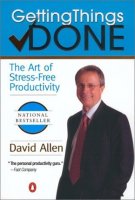 Getting Things Done: The Art of Stress-Free Productivity by David Allen (Penguin, New York, 2001)
For now, I can't do any better than to refer you to Janet's review of Getting Things Done. I found it a difficult book to read, even unpleasant, because it's not well written, and makes my mind feel like a hamster on a wheel: running a lot but not getting anywhere.
But if Allen's book is disappointing, his ideas still inspire me—even if I did have to come at the ideas the wrong way around, from what other people have said about them. Most inspirational was seeing Janet's version of the system in action, though I know I would have gotten more out of her explanations—and maybe out of the book—if I'd attempted to implement some of the ideas myself, first.
The book wasn't nearly as much fun to read as Don Aslett's books on controlling clutter, but I think they have a lot in common. Getting Things Done is a lot about controlling the clutter in our minds.
"What's the next action?" The answer to Allen's favorite question is, "Implementation." But that's not really an answer, since "implementation" isn't a discrete action, but a mammoth project. I hope to accomplish some baby steps this week, and—eventually—report back on the results.
Catching up a bit, since I missed July 4:
Happy Independence Day
to my country, and
Happy Schweizer Bundesfeier
(Fête nationale Suisse, Festa nazionale svizzera, and Fiasta naziunala Svizra)
to my country-in-law!

Permalink | Comments | Edit
Category Everyday Life
I was a Brownie, then a Girl Scout as a child. Even then I was somewhat disenchanted, as I knew—thanks to my father's experience as a Scoutmaster for the Boy Scouts—how much more interesting the program, the experiences, and the skills learned would have been if only I'd had that Y chromosome.
Nonetheless, we had a good time, thanks to my father, who took us mountain climbing and taught us to build fires and tie knots, just as he had his Boy Scouts, and to a renegade leader who battled the Girl Scout bureaucrats for the right to take our troop on a tour of Europe.
By the time our own girls were of age, however, the Girl Scout program had, in my opinion, degenerated much further, becoming more "relevant," more "modern"—and even less fun. What worked for us was the YMCA Indian Princess/Indian Guide program with its regular campouts and greater freedom to customize the local tribe's activities.
If we had young children now, I don't know what we'd do; the Y program has changed, whether for better or worse I know not. But I do know what we would NOT do: subject our girls to the new Girl Scouts.
Two years shy of their 100th birthday, the Girl Scouts are going through a midlife crisis of sorts, rethinking everything except their cookie recipes.
Struggling to maintain its relevance after years of declining membership, the organization is rolling out a rebranding campaign — for the first time in 30 years — throughout the country this month, trying to shed the quaint image of crafts and campfire songs and reposition itself as an agent of change for girls.
This fall, the Girl Scouts of Southwest Texas ... plans to introduce a new initiative, called Gamma Sigma. ... “Gamma Sigma suggests a club with sororitylike traditions like pinning and candlelight ceremonies that appeal to girls,” said Ann Maria Chavez, the council’s chief executive.
Traditional badges are out. Gamma Sigma will have speakers, workshops and experiences intended to bolster girls’ self-esteem and decision-making, Ms. Chavez said.
Can you say, "B-O-R-I-N-G"?
At least they're not messing with my Thin Mints.
Permalink | Comments | Edit
Category Random Musings
Permalink | Comments | Edit
Category Travels Everyday Life
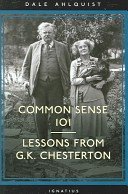 Common Sense 101: Lessons from G. K. Chesterton by Dale Ahlquist (Ignatius Press, San Francisco, 2006)
I tried to take a shortcut. With only three days before leaving the J&S Library behind, I chose this instead of a book by Chesterton himself. Although somewhat unsatisfactory, it was probably the right thing to do: The summary has left me thirsting for the Real Thing.
Many times throughout the book I found myself wanting to say to the author—as I wanted to say to the editor of Chesterton's Eugenics and Other Evils, which I reviewed in January—"Enough of what you think Chesterton is saying; I want to hear more of what he has to say!" But Chesterton can be tough sledding at first, so reading a historical and contextual introduction is not a bad idea. Dale Ahlquist is the president of the American Chesterton Society, which might be another good place to begin.
Although there is much I could quote from Common Sense 101, I'll refrain until I have the direct words from one Ahlquist would freely admit is the better writer. Instead, I'll include a Christmas poem, not by Chesterton, but by his wife, Frances Blogg* Chesterton.
How far is it to Bethlehem?
Not very far.
Shall we find the stable-room
Lit by a star?
Can we see the little Child?
Is He within?
If we lift the wooden latch,
May we go in?
May we stroke the creatures there —
Ox, ass, or sheep?
May we peep like them and see
Jesus asleep?
If we touch His tiny hand,
Will He awake?
Will He know we've come so far
Just for His sake?
Great kings have precious gifts,
And we have naught;
Little smiles and little tears
Are all we brought.
For all weary children
Mary must weep;
Here, on His bed of straw,
Sleep, children, sleep.
God, in His mother's arms,
Babes in the byre,
Sleep, as they sleep who find
Their heart's desire.

