For me, September 11, 2001 might as well be yesterday. But not one of our 13 grandchildren was alive when my generation had its "Pearl Harbor" moment, and realized that our country is not invulnerable. Even for the eldest grandchild, it must feel as ancient as the division of Germany into East and West feels to me.
To mark this 25th anniversary of the day our world turned upside down, I offer two choir anthems that were written shortly after the events. Robert Kerr wrote Prayer for Peace for the Orlando Deanery Boychoir, and we had the privilege of singing it ourselves when Rob was our choir director.
Lord, grant us wisdom in our hour of need.
And give us vision, that we clearly see,
Your loving nature, Your mercies' might.
Bring us from darkness in to Your light.
Lord, touch our nation with Your healing hand.
And give us comfort o'er all the land.
Reveal Yourself to us and make us whole,
Reside within each heart and soul.
For there are battles we must fight,
And stand with courage for what is right.
Against the evil which infects us still,
Lord, give us conviction to know Your will.
Please help the strong to defend the weak,
But not in anger or revenge to seek,
So through Your justice let conflict cease.
Oh, unify us, and bring us peace.
For there are battles we must fight,
And stand with courage for what is right.
Against all evil, sin, and wrong,
Give us conviction to carry on!
Alleluia!
Lord, bless our soldiers across the sea,
And help them to set more people free.
And in their hearts, may they have pride to sing,
"God bless America,"
God bless America, Let freedom ring!
Our current choir sings this next anthem, A Prayer for Our Time by Pamela and Joseph Martin, for every 9/11 anniversary and at other appropriate times. This recording is really of us; thanks to Noah's work, we finally have a sound system that doesn't totally mangle the music—though I apologize for the extraneous sounds that crept in through a microphone error. The version below should start and stop at the right places, but if you can't see the embedded video, the link above takes you directly to YouTube and you'll have to scroll forward to timestamp 58:34.
Our God to thee we pray.
Heal our nation Lord today.
God of mercy, grant us courage, give us peace.
Give us peace, give us peace.
When evil draws its angry sword
And seeks to sever freedom's cord,
When death and darkness shake our faith
In God's unfailing power to save.
Eternal Father, ever be our courage in the time of need.
When war is raged by faceless foes
Who battle peace with fiery blows,
When storms of hate and fear assail
Our Father's mighty arm prevails.
Eternal Father, ever be
Our refuge in the time of need.
There is no tyrant who can stand
Against our sure defender's hand.
No threat or danger can defeat
The strong and righteous Prince of Peace.
Eternal Father, ever be our fortress in the time of need.
Amen!
And amen! The United States of America is even more vulnerable now than it was a quarter of a century ago, and our enemies more sophisticated and more effective. The crude events of September 11, 2001 brought our country together, along with much of the world. The more subtle attacks of our enemies throughout the intervening years are ripping us apart. "Deliver us from evil" is no longer just a line in the Lord's Prayer, but a desperate plea.
Permalink | Read 261 times | Comments (0)
Category Politics: [first] [previous] [newest] Music: [first] [previous] Inspiration: [first] [previous] [next] [newest] Glimpses of the Past: [first] [previous] Heroes: [first] [previous] [newest]
Traditionally sung on Palm Sunday, Ride On, Ride On in Majesty is a musical journey through Holy Week, from Jesus' triumphal entry into Jerusalem (Palm Sunday) through his crucifixion (Good Friday) to his glorious Resurrection (Easter).
Ride on! ride on in majesty!
Hark! all the tribes hosanna cry;
Thy humble beast pursues his road
with palms and scattered garments strowed.
Ride on! ride on in majesty!
In lowly pomp ride on to die;
O Christ, thy triumphs now begin
o'er captive death and conquered sin.
Ride on! ride on in majesty!
The angel armies of the sky
look down with sad and wond'ring eyes
to see the approaching sacrifice.
Ride on! ride on in majesty!
Thy last and fiercest strife is nigh;
the Father on his sapphire throne
awaits his own anointed Son.
Ride on! ride on in majesty!
In lowly pomp ride on to die;
bow thy meek head to mortal pain,
then take, O God, thy power, and reign.
I can't have a favorite line in such a wonderful hymn, but if I did, it would be "The Father on his sapphire throne awaits his own anointed Son." Nothing that happened during Holy Week came as a surprise, but was known and expected since the beginning of time. It was not, as a priest tried to tell us one Easter, something that caught Jesus off guard, but rather the very sequence of events for which he was born—and he knew it.
Today is Good Friday. But Easter is coming!
The Father on his sapphire throne awaits his own anointed Son.
Here's another fun video from Charles Cornell, the guy who brought us an amusing look at the Pirates of the Caribbean and the Lord of the Rings soundtracks. Here, he takes a look at the music theory hidden in Happy Birthday.
As I've mentioned before, a great advantage of being in a denomination that celebrates the Church Year is that Christmas is not just one day, but 12, and lasts until Epiphany comes, on January 6. So today you get a Christmas carol, and not just any Christmas carol. Coventry Carol was nothing special to me until the we lost our firstborn grandson at the end of November. Intellectually, I celebrated Christmas as usual, but emotionally I simply could not handle all the songs about the joyful birth of a baby boy.
Coventry Carol remembers that the birth of Jesus brought about the Massacre of the Innocents as King Herod sought to destroy the future king he had heard about. It was the perfect carol for that year.
Herod the king, in his raging,
Chargèd he hath this day
His men of might in his own sight
All young children to slay.
That woe is me, poor child, for thee
And ever mourn and may
For thy parting neither say nor sing,
“Bye bye, lully, lullay.”
Which brings me to one of my latest YouTube channel finds, The Salisbury Organist, for a different look into this haunting carol.
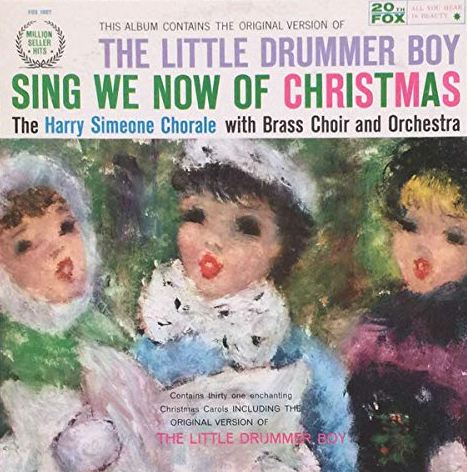
We have so many wonderful Christmas albums, collected for well over half a century, many wonderful, wonderful works reaching from the 21st century back to almost as long as Christmas music has existed.
But the one that most strongly and emotionally says Christmas to me is the Harry Simeone Chorale album, "Sing We Now of Christmas." It was released in 1959 and is my earliest memory of Christmas music. To my great joy, I recently found the album available on YouTube. The cover is a little confusing, because it shows the title as "The Little Drummer Boy," and the image is different. But the songs are the same. This link, Sing We Now of Christmas, will take you to a playlist where you can hear the whole album in order, or return and play your favorites.
I realize that my love of this recording of Christmas songs is wrapped up in the aura of a very happy childhood and all that I loved about the Christmas season, so your mileage may vary. But, as objectively as I can manage, I maintain it's one of the best compilations for telling the story of Christmas coherently through song while including both the old familiar carols and lesser-known songs from more distant times and places.
A modern song based on a 19th-century French novel played in the style of Irish music on a hammered dulcimer! Unfortunately, it's a YouTube Short, and I see no way to embed it here, as I do with their regular videos. But you can add a little brightness to your day if you click on this link.
I publish this here because I know there are people with whom it will resonate, although it apparently runs contrary to the experience of the majority. Why else would they be so anxious to banish silence from our lives?
A prime example is our water aerobics classes at the local community therapeutic pool. The warm-water exercise is worth the struggle for me, but it is indeed a struggle, every time. For some reason the instructors believe that people exercise better when accompanied by loud music and a headache-inducing drum beat. We've managed to find the instructors who will at least keep the volume down to where I no longer have to wear earplugs, but the incessant noise and throbbing beat continue.
To my fellow classmates who may think I am rude, unfriendly, or merely unhappy, I don't mean to be any of the above. But please don't tell me to smile. It takes so much effort to fight the sensory assault that social politeness is often a casualty.
With one exception: All too rarely, we play games with small beach balls: bouncing, hitting, throwing, challenging just ourselves or in competition with others. It's not unkindly competitive—half the fun is figuring out how to include everyone of varying skill and physical ability levels—but it's exciting, and when we're doing that I manage to tune out the music almost completely. I have no idea why. It's the most active of the physical work we do in those classes, and yet it is the only time I feel relaxed and free.
Often I even smile.
I'd never heard of the Church Dog books nor the church that they're associated with, but family is family, and our choir family is so proud of the young daughter of two of our singers. Our director knows a lot that's going on in the Central Florida music, church, and theatrical scenes; he recommended that she audition for the Church Dog music video that's just been released—and she won the solo part! I don't think her parents would mind my mentioning her by name, but I'm not taking any chances. If she becomes famous, I'll link to this in an "I knew her when" post. 
It's not exactly my kind of music, but she's my kind of kid.
It's been quite an emotional day. First, the Bishop of Central Florida came to our church to celebrate 20+ confirmations, which for a church our size is pretty impressive. Naturally there was special music, including the amazing Prayer of Saint Gregory, which will give some of you the hint that we had at least one trumpet (actually, we had two).
We got home just in time to watch the livestream of Charlie Kirk's memorial service at State Farm Stadium in Arizona. One of the advantages of having a pilot in the house is that I was able to confim my suspicion that there would be a no-fly zone around the venue, given the circumstances and all the people at high risk who were there. Probably the president's presence alone would have been enough reason for all the security.
Why did I watch the whole, very long, event—I, who am very jealous of my time, especially on Sunday afternoons? I'm not sure. It took me back to 1968, when I sat in front of our little black and white television, mesmerized by the events around Robert F. Kennedy's assassination. And more recently, watching Queen Elizabeth's funeral.
I think this one was even longer than the queen's. It didn't have nearly as much royalty, dignity, and pomp, but it was remarkable in its own way. It was part worship service, part memorial, part tent revival (complete with altar call), part political rally. In many places it was very powerful, as people shared their memories of Charlie and testified to his brilliance, his wisdom, his character, and his faith. In the past 11 days I have watched more of Charlie's speeches and conversations and encounters than in all my time previously, and the memorial service only confirmed the impression he left on me.
It's amazing to me how they managed to pull off such an enormous event—the stadium can hold over 70,000 people and it was packed; I have no idea how many people filled the overflow area where they watched on screens. The security alone must have been a nightmare.
Some of you will recognize the name of the man who led the worship part of the service: Chris Tomlin.
My one criticism is that it was too long, with too many speakers. By far the majority of them—from Charlie's wife to his pastor to the president of Hillsdale College to Tucker Carlson to a large number of high-level political figures—were excellent and their stories very moving. But there were a few they could have done without. Many of the Turning Point staff naturally wanted a chance to memorialize their leader, but a couple of them, well, let's just say they're very young and need some more maturity and life experience. They were understandably angry and grieving, but their somewhat hot-headed triumphalism made me cringe.
Overall, I'd call it worth watching, especially if you want to understand a little more why Charlie Kirk's death has affected so many people so deeply. I think it could be made manageable by watching at higher speed and with a fast-forward button in your hand. But no testimonial can replace actually listening to what Charlie had to say, in context. He was a remarkable human being.
Okay, so there's a lot I could post (and plan to) that's more important than this, but having visited New Zealand and our lovely Kiwi friends (nearly 25 years ago now) the country, and the Maori, have a special place in my heart. Said heart was especially warmed today when I saw this video of a group of Maori performing a Haka dance at a London vigil for Charlie Kirk. I'm sorry I can't embed it here; I hope you can see it. Not that it will mean much if you haven't been to New Zealand, but maybe you can appreciate the tribute, anyway.
You can learn a bit more about Haka from the Wikipedia article.
Haka includes various forms serving different ceremonial purposes. These functions include: [emphasis mine]
- welcoming guests (haka pōwhiri)
- fare-welling and mourning the deceased (waiata tangi)
- giving advice or instructions (waiata tohutohu)
- restoring self-respect (pātere)
- intimidating adversaries (peruperu – war dance)
- and transmitting social and political messages (haka taparahi, ngeri)
Many years ago, when Inspector Morse first aired on PBS, we watched several episodes, and have since enjoyed the whole series, plus the spin-offs Lewis (aka Inspector Lewis) and Endeavour. The stories, especially the more recent ones, often reflect objectionably "Hollywood" values, and there's a tinge of darkness that might not make them good fare for one who is already depressed. But it's hard to have police shows and murder mysteries without darkness, and the series are so very well crafted and acted that even the depressing parts are more like the spices that add depth and flavor to a stew.
And I love the music by composer Barrington Pheloung.
Here's the Morse theme:
The theme for Lewis (aka Inspector Lewis) I didn't find as moving as that for Morse and Endeavour, but it fits the show, which might be my favorite of the three due to Lewis' sidekick James Hathaway (played by Laurence Fox) and their interactions.
Endeavour brings back a variation on the original theme. I love those horns!
Sandwiched between 3:14 (Pi Day) and 3:17 (St. Patrick's Day) is
3:16 (Greatest Love Day)
John 3:16, that is.
For God so loved the world, that he gave his only begotten Son, that whosoever believeth in him should not perish, but have everlasting life.
In honor of which I present this beautiful anthem, John Stainer's God So Loved the World. No, that's not our choir. But Porter and I have sung this many times and it's one of our favorites.
I rarely post the music that our choir sings in church, because our sound system, which works well enough for sermons, is absolutely horrible for music. I have no idea why; Noah, who knows quite about about sound boards, says that ours is fine, better than what he has worked with in his home church. But something is so wrong I rarely can find the strength to listen to our recorded services, much less share them.
Yesterday, when our choir sang Ola Gjeilo's Lux Beata Trinitas, Noah played the oboe part on his clarinet, and recorded the audio on his phone, producing a much better recording, which I am pleased to share. We have sung a few of Gjeilo's choral works, and they are beautiful. Also, on our Viking cruise of the Baltic, we were pleased to discover a number of his instrumental works on the music channel in our stateroom—perhaps because he is Norwegian.
We sang the anthem during Communion. It was sort of a practice run, as we were missing some key choir members, but I think we did pretty well even so! We certainly enjoyed ourselves, and it seemed to be fitting as Communion music.
You were expecting maybe Happy New Year?
Well, of course I wish you that as well.
But in our house, Christmas lasts 12 days. Here are some 8th Day of Christmas treats from our second-oldest grandson, who is playing all parts.
This where-are-they-now? post is particularly for our children, and any others who played in the Florida Symphony Youth Orchestra with John Dupuis. John made a big splash in those days with his composing, including writing a piece that was recorded by the Seattle Symphony Orchestra and used at the Islands of Adventure theme park opening in Orlando. This was exciting for all of us, and I wish I could feature his Atlantis here, as it remains one of my favorite pieces of music. With a beginning like that, I fully expected to start seeing John's name on movie credits, as the music he composed back then had a distinct movie soundtrack feel to them.
But most of us grow up and get regular jobs. John certainly has done well, even if working in the school system is not as exciting as working in Hollywood. And he continues to compose. Recently he alerted me to one of his new works, called "Melodia Perpetua." Written for string orchestra students, it doesn't have the complexity of the works he wrote for the FSYO, but you can still hear the distinctive Dupuis sound, which was a joy to hear and brought back such good memories.
I actually wouldn't wish a Hollywood life on anyone. But I was told by another composer that the advantage of writing for shows is that you don't actually have to be there; composers were working remotely long before it became de rigueur. So I'll keep hoping you're secretly working on that movie music dream, John! I'd even go see the film, and I almost never do such a thing....

