
 Indoctrinate U (On the Fence Films, 2007)
Indoctrinate U has been on my "watch list" for a while, but I hadn't been able to make myself take the time. It's not available from Netflix, but I found it on YouTube, in nine parts of about 10 minutes each. Today it came up on my "get this done today" list, so I thought I'd watch one or two of the segments. But they don't end in good places, and anyway I got hooked, so I watched the whole thing.
This documentary on discrimination, intolerance, and anti-diversity in American higher education is obviously not a high-budget film, though I'm sure it's better in the original format. I agree with Janet's comment that "it only pointed out the problems and didn't discuss any causes or better yet, idea for fixing the problems," and fear she may be right that it might be more divisive than helpful. Nonetheless, it's an important film to watch for anyone attending, planning to attend, or sending money to a college or university. I am not advocating staying away from college; but do be aware of the larger picture.
Although the film looks with some nostalgia on university life in the 1960's, there was plenty of intolerance for diversity of thought even then, though it was not, as now, enshrined in the bureaucracy, and the hard sciences (where I was) were mostly free of that, at least as far as the students were concerned. Our professors had a hard enough time teaching us math and physics, and didn't feel that taking time for political discussion would help us understand differential equations any better. I'm told by math professor friends that that has now changed. One, who has taught both in the United States and in Africa, expressed frustration that her American university required her to teach her not only calculus, but also the importance of African mathematics. I'm not sure what "African mathematics" might be that is important for a university math major to learn (I missed it in my classes), but I wouldn't be surprised if in the future the important mathematicians are African—because her African students are eager to learn the content, not the politics, of math.
The investigator for Indoctrinate U has been criticized for his confrontational approach, but while I do think one cannot expect to see a university president without an appointment, as journalists go, he was about as mild and polite as you can get.
Yes, the film is one-sided, and not only because they couldn't get anyone from the university side to talk seriously with them. It presents, however, a side that is not usually heard—indeed, is often censored, mocked, threatened, and attacked—and can be forgiven for being a little strident.
Here is the first segment; from there YouTube will provide links to the remaining eight. Be patient with the first couple, as at least I found the emphasis on affirmative action less interesting than the general topic of free speech on campus, which is more clearly presented in later parts. (There is a small number of profanities—quoting from a threat to a student and from the title of a play—that are bleeped out if you get the "clean" version, but the download versions are unaltered.)
I wish they had made more of a distinction between public and private colleges. To me, there's a huge difference between what a private school chooses to allow or forbid, and what a taxpayer-funded school does. But in either case, if the school is presenting itself as a bastion of diversity, tolerance, and academic freedom, evidence to the contrary needs to be heard. Caveat emptor.
Is there a solution? Confronting the universities with their own stated diversity policies is a start: Janet had some success at her school that way. In the long run, I think the biggest difference will be made by India and the Internet. American universities have long enjoyed near-monopolistic dominance in their field. However, as it did for their manufacturing and information technology counterparts, that privilege is coming to an end. When people have choices, change happens.Janet alerted me to Jamie Oliver; DSTB followed up with what is apparently a new show on ABC. It starts next Friday, but the pilot was shown last night; fortunately it's available both at the show site and Hulu, so I was able to watch it. Jamie's attempt to get the people of Huntington, West Virginia to take a healthier approach to eating has the faults of American commercial television (just as does Who Do You Think You Are?), but it's not bad and (so far) is not as over the top as what I've seen of his British shows. If his personality is a little too dramatic for my taste, there's no doubting the sincerity of his preaching and his mission. His gospel is good, fresh food, and in this episode he takes on school lunches.
[Excuse me, school meals. The only meal these children eat at home is dinner. In Oliver's unfeigned horror at the meals served at our public schools, he misses what strikes me as the more important point: Why are all these children eating school food? Why aren't they bringing lunches from home, and why, for Pete's sake, don't they eat breakfast before going to school? If the schools are going to offer food, certainly it should be healthy food, but where are the parents? There's absolutely no need to subject one's children to American public school food, good or bad. The school lunch (and now breakfast) program does serve a useful purpose, making sure children whose parents can't provide meals for them aren't trying to learn on empty stomachs. That's a good thing. But somehow the whole system got skewed; I know that the goal of the school lunch program at our kids' school was to have everyone participate. (We didn't.) I saw not one lunchbox in the show. I hope that while he teaches the adults how easy it is to put together healthy meals, he also teaches the kids how easy it is to make their own healthy lunches. But that's another issue; I know I'm taking on a Great American Icon by dissing the school lunch program.]
My favorite character in the show was one of the school lunch ladies, appropriately named Alice. She wasn't the one in charge, but as Oliver said, "It's obvious that the real boss is Alice," and "Alice is a force to be reckoned with." There are some delightfully obvious similarities—but the real Boss, Alice Davis Porter Wightman, would have agreed with Jamie about the food.
One place I disagree with him is his incomprehensible aversion to pizza for breakfast. Granted, the pizza the children were being served didn't look good for any meal, but I'll stake my recent breakfast pizza against anyone's milk-and-cereal or bacon-and-eggs: Homemade crust; homemade "tomato sauce" which was not only tomato but a whole bunch of other veggies cooked so it still looked and tasted like tomato sauce (only better); green, red, and hot peppers; mushrooms; onions; garlic; and spinach. Yes, it also had cheese and, yes pepperoni—but so what? The balance was great...and so was the pizza. Far more veggies than most American breakfasts—or British either, I'll bet.
As long as I can watch it on my computer, with a pause button and while doing other things, I think I'll enjoy checking out Jamie Oliver's progress in upcoming episodes.Cleaning out old things, found this Hagar the Horrible comic, probably from last October. (The link is to the current comic; if you can't see the image below—some feedreaders strip images—you'll have to click through to the original post.)
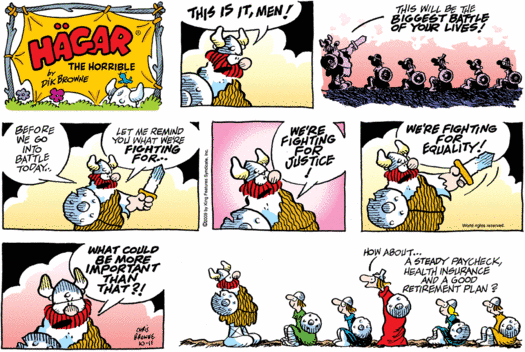
Permalink | Comments | Edit
Category Random Musings
Today was a wonderful, sunny-but-not-too-hot day, perfect for the Winter Park Sidewalk Art Festival. This is a huge annual event, with artists from all over the country, and Canada, too. Northern states are particularly well represented, but they come for more than the weather, as the presence of David Levy from Davis, California attests.
David Levy. Therein lies a tale.
Many years ago, some good friends from upstate New York gave us a gorgeous cutting board, made of strips of wood in a multi-colored zig-zag pattern. Yes, we do use it as a cutting board, although it was a good two years I think before I could bring myself to set a knife to such beauty. As we were strolling among the booths I suddenly exclaimed to Porter, "That's our cutting board!" The pattern was unmistakable, although I'll admit I actually only thought it was like our cutting board. When we returned home, however, I flipped ours over and read clearly, "David Levy, Davis, CA." California, New York, Florida—this guy gets around.
I wore my Vibram Five Fingers shoes (which will eventually get their own post) and a Carnegie Mellon t-shirt, both of which drew interested comments. Another fun thing was seeing the storefront which when the renovations are complete will house our very own Penzey's!Permalink | Comments | Edit
Category Everyday Life
Our census form arrived. In a word: B-O-R-I-N-G.
It's a good thing for future genealogists that we have so many other forms of record-keeping, because they won't get much from the 2010 census. Name, sex, date of birth, race in excruciating detail if you're Hispanic, Asian, or Pacific Islander (Dominican? Hmong? Fijian?), relationship to head-of-household (now inoffensively called "Person 1" — also in excruciating detail, distinguishing, for example, between biological and adopted children, which genealogists will love, if no one else). That's only if you're one of the first six people in the household. For Persons 7 through 12 they don't care about your race or exact relationship. And if you're the 11th child in the family? Apparently you're out of luck, but I suspect that may be covered by the "we may call for additional information" caveat that goes with the questions for Persons 7 - 12, since there's also a place to indicate the total number of people in the household.
I wrote before about the interesting information in previous censuses, but I'll repeat it for this occasion.
- 1820 - Not much besides a breakdown by age range, color, slave/free/citizenship status, and whether in agriculture, commerce, or manufacturing.
- 1830 - Was anyone in the household blind?
- 1850 - A big year for genealogists—the first time everyone was listed by name, rather than merely by head-of-household. Place of birth was also added. Other questions concerned value of real estate owned, school attendance, literacy, and whether or not the person was "deaf, dumb, blind, insane, idiotic, pauper, or convict?"
- 1870 - Were the person's parents of foreign birth?
- 1880 - Another good one for genealogists, as they started asking where the person's parents were born, and also marital status. The sick/disabled status was expanded and broken down instead of being lumped together.
- 1890 - Lots of great data for genealogists here; unfortunately all but a very small number of these records were destroyed in a fire. The racial breakdown for this census was "White, Black, Mulatto, Quadroon, Octoroon, Chinese, Japanese, or Indian."
- 1900 - How many years married, how many children born to mothers, how many of those still living—through this census I found my grandfather's sister. Lots of questions about employment and living situations. Also year of immigration, and naturalization status.
- 1910 - Mother tongue of person and his parents; number of years of present marriage, and whether the marriage is first or subsequent. Is the person an employee, employer, or self-employed?
- 1930 - The race question gets more specific: Enumerators were to enter "W" for white, "Neg" for black, "Mex" for Mexican, "In" for American Indian, "Ch" for Chinese, "Jp" for Japanese, "Fil" for Filipino, "Hin" for Hindu, and "Kor" for Korean. All other races were to be written out in full.
- 1940 - April 1, 2012 is the date genealogists are waiting for: the 1940 census data will finally be released. (There's a 72-year wait for reasons of privacy.) It should be fascinating, as it includes many detailed questions about the family's housing situation, including lighting, sanitary facilities, heating, number of rooms, and much more. Unfortunately, these detailed questions were only asked of five percent of the population.
- 1950 - This is getting closer to home, but we won't see it till 2022. I wonder what they had to say about our house, if we were lucky enough to win the 5% sample lottery.
- 1960 - I'll be in this one! I hope I live to see it. Alas, for most of us this will be a really dull census, as most households were only asked for age, sex, race, and marital status data. B-O-R-I-N-G!
Permalink | Comments | Edit
Category Genealogy Everyday Life
 Between Heaven and Hell: A Dialog Somewhere Beyond Death with John F. Kennedy, C. S. Lewis & Aldous Huxley, by Peter Kreeft (InterVarsity Press, Downers Grove, Illinois, 2008)
The Philosophy of Tolkien: The Worldview Behind "The Lord of the Rings," by Peter Kreeft (Ignatius Press, San Francisco, 2005)
Someone recommended to me Peter Kreeft's Jesus-Shock. But our library doesn't have it, and before ordering it I decided it would be a good thing to sample his books that I could borrow—my previous experience with Peter Kreeft being pretty much limited to the banner we saw at MIT, advertising his upcoming visit. Hence the unexpected addition of two new books to my reading list while there are still so many at home waiting to be read! At least they are short books that didn't take long to read.
They probably should have taken much longer to read, as there's a lot of philosophy there, and philosophy is a subject of which I know very little. One benefit of both books is reducing that ignorance a little bit, as did the only other book about philosophy I've read, Sophie's World.
Between Heaven and Hell is the shorter of the two, and reads very quickly. It is set up as a Socratic dialog among John F. Kennedy, C. S. Lewis, and Aldous Huxley, who died within hours of each other and represent what Kreeft calls the three most influential philosophies of life: modern Western humanism, ancient Western theism, and ancient Eastern pantheism. The dialog is somewhat rigged by Kreeft's obvious sympathies for Lewis, but that doesn't stop it from being a clear presentation of the various philosophical issues and differences.
Of the two, The Philosophy of Tolkien is my favorite. For someone who loves Tolkien's works, and especially The Lord of the Rings, it is an interesting glimpse into the man behind the books, and his way of thinking. Someone who doesn't already love the books, however, might find it a bit dry, though like Between Heaven and Hell it is also a good examination of some basic philosophical issues. Kreeft tackles 50 questions, such as Does God Exist? Are angels real? Is nature really beautiful? Is death good or bad? Is there real magic? Is knowledge always good?, Is beauty always good? Why is music so powerful? Is small beautiful? How powerful is evil? and Does mercy trump justice? His approach, as he explains in the introduction, generally uses four tools:
- an explanation of the meaning and importance of the question;
- a key quotation from The Lord of the Rings showing how Tolkien answered the question (many more passages are given in the Concordance to The Lord of the Rings in the Appendix);
- a quotation from Tolkien's other writings (usually a letter) that explains or comments on the theme in The Lord of the Rings;
- a quotation from C. S. Lewis, Tolkien's closest friend, showing the same philosophy directly stated.
The promising Concordance is less useful if you, like me, have a different version of the book(s) from Kreeft. With the help of Everyman's Reference Book, the Internet, it can be handy for anyone. That's the way I was able to find the source of one of the many quotations, my Motto of the Week, the wise counsel of Gandalf:
To cast aside regret and fear. To do the deed at hand.
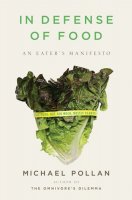 In Defense of Food: An Eater's Manifesto, by Michael Pollan (Penguin, New York, 2008)
I'm in the middle (okay, the beginning) of two rather hefty books at the moment, Susan Wise Bauer's The History of the Ancient World, and my latest review book from Thomas Nelson, The Chronological Guide to the Bible. It's great to be reading the two of them together, though that means it will be a long time before I can review either one.
And now longer still, as the library e-mailed to let me know that I'd made it to the top of the waiting list for In Defense of Food. Michael Pollan is shaping up to be the next John Taylor Gatto for me: a modern author whose books I simply can't resist and can't put down. Reading was the easy part; reviewing without quoting from every page is the difficulty. The book is bristling with my neon green and pink sticky notes.
C. S. Lewis, writing more than half a century ago about the unhealthy state of our sexual appetites, made this comparison with our approach to food:
The biological purpose of sex is children, just as the biological purpose of eating is to repair the body. Now if we eat whenever we feel inclined and just as much as we want, it is quite true most of us will eat too much: but not terrifically too much. One man may eat enough for two, but he does not eat enough for ten. The appetite goes a little beyond its biological purpose, but not enormously. But if a healthy young man indulged his sexual appetite whenever he felt inclined, and if each act produced a baby, then in ten years he might easily populate a small village. This appetite is in ludicrous and preposterous excess of its function.
Or take it another way. You can get a large audience together for a striptease act—that is, to watch a girl undress on the stage. Now suppose you come to a country where you could fill a theatre by simply bringing a covered plate on to the stage and then slowly lifting the cover so as to let every one see, just before the lights went out, that it contained a mutton chop or a bit of bacon, would you not think that in that country something had gone wrong with the appetite for food?
And indeed it has. Americans are obsessed with food, simultaneously overweight and undernourished, eating more and enjoying it less. Although the causes of our unhealthy relationship with food are many and complex, much is explained by the simple idea that we have abdicated our responsibility for what and how we eat in favor of the expert opinion of professionals. Never mind that the experts change their minds dramatically with alarming and almost predictable frequency. Reading In Defense of Food, I was struck by a feeling of same song, next verse. It's a strikingly familiar story to anyone who has considered the arenas of childbirth, medical care, education and even entertainment, in which we have ceded our rights and responsibilities to others.
The good news? Our eating disorders are not our fault, but the cumulative effect of bad science, bad advice, and the biases of a whole lot of people in government, academia, and the food and medical industries who realize that there is much more profit in a Twinkie than a carrot. The better news? We can change. We can take back the responsibility for our own food choices.
Eat food. Not too much. Mostly plants. Pollan begins with this succinct expression of how to eat right. In the final section he fleshes out these thoughts with some practical suggestions, and in between he covers the dangers of nutritionism—regarding food as nothing more than a delivery system for nutrients—and why the Western diet appears largely responsible for what he calls the diseases of civilization.
I'm going to ignore most of my colorful sticky notes, but here are some favorites:
USDA figures show a decline in the nutrient content of the forty-three crops it has tracked since the 1950s. In one recent analysis, vitamin C declined by 20 percent, iron by 15 percent, riboflavin by 38 percent, calcium by 16 percent....To put this in concrete terms, you now have to eat three apples to get the same amount of iron as you would have gotten from a single 1940 apple, and you'd have to eat several more slices of bread to get your recommended daily allowance of zinc than you would have a century ago.
Paul Rozin is a psychologist at the University of Pennsylvania who has dreamed up some of the more imaginative survey questions ever asked of American eaters; the answers he's collected offer a pretty good index to our current befuddlement and anxiety about eating.... In one experiment, he showed the words "chocolate cake" to a group of Americans and recorded their word associations. "Guilt" was the top response. If that strikes you as unexceptional, consider the response of the French eaters to the same prompt: "celebration."
A few years ago, Rozin presented a group of Americans with the following sentence: "Assume you are alone on a desert island for one year and you can have water and one other food. Pick the food that you think would be best for your health." The choices were corn, alfalfa sprouts, hot dogs, spinach, peaches, bananas, and milk chocolate. The most popular choice was bananas (42 percent), followed by spinach (27 percent), corn (12 percent), alfalfa sprouts (7 percent), peaches (5 percent), hot dogs (4 percent), and milk chocolate (3 percent). Only 7 percent of the participants chose one of the two foods that would in fact best support survival: hot dogs and milk chocolate.
Pollan's Omnivore's Dilemma is a book well worth reading, but In Defense of Food is well worth buying, if only to be able to lend it out. It's in my Amazon shopping cart even now.
 The Brothers Karamazov, by Fyodor Dostoevsky
(Hovel Audio, read by Simon Vance, abridged by Thomas R. Beyer)
I normally don't care for abridged versions of books, but this version was a free download from Christianaudio.com. Since I've never read any of the great Russian novels, as an introduction, it's probably a good thing that this was abridged. If and when I read the actual book, I'll have a better chance of keeping all the characters straight, and of not getting lost in all the diversions. Having heard all the Russian names read aloud will no doubt be helpful, too. This version is 19 1/4 hours long; you can download the full 40-hour version from LibriVox if you'd like. There are also several online versions of the text, including one in the original Russian, if you're so inclined.
At first even the half-sized version seemed very long and tedious indeed. By about halfway through, however, I began to look forward to hearing more of the story on my daily walks. I don't know if it really got more interesting, or if I finally began to sort out the story. You can tell it was written as a serial, and if he wasn't paid by the word, Dostoevsky sure writes that way. For all the length, there's little plot and less action, though a great deal of character development and philosophical discussion. I can't fault that, as this is a trait I treasure in the novels of George MacDonald; perhaps the Scottish character and viewpoint was easier for me to grasp than the Russian. That the ending is less than satisfactory was explained when I learned that this was Dostoevsky's last novel, and that he had intended it to be only the beginning of a larger (!) story.
Through several hours of listening I was not glad to be hearing the book, only that when done I would at least have some familiarity with this great classic book. But now I'm interested enough to think I might, someday, read it in its entirety. Maybe. Someday. I have an awfully large backlog of unread books as it is....Article 1, Section 2 of the U. S. Constitution lays the groundwork for conducting a periodic census in order to provide proportional representation in the House of Representatives.
The House of Representatives shall be composed of Members chosen every second Year by the People of the several States.... Representatives and direct Taxes shall be apportioned among the several States which may be included within this Union, according to their respective Numbers, which shall be determined by adding to the whole Number of free Persons, including those bound to Service for a Term of Years, and excluding Indians not taxed, three fifths of all other Persons....
This was modified somewhat by the 14th Amendment, to wit
Representatives shall be apportioned among the several States according to their respective numbers, counting the whole number of persons in each State, excluding Indians not taxed.
This week we received in the mail, not the census form itself, but a letter from the U. S. Census Bureau informing us that the form would be delivered soon. In it we are told the reason we should "fill it out and mail it in promptly."
Your response is important. Results from the 2010 Census will be used to help each community get its fair share of government funds for highways, schools, health facilities, and many other programs you and your neighbors need. Without a complete, accurate census, your community may not receive its fair share.
How did we get from determining appropriate representation in the Federal government to getting our "fair share" of governmental programs that we "need"? Surely this inversion of John F. Kennedy's Ask not what your country can do for you—ask what you can do for your country borders on travesty.
Then again, I know that the true value of the census is not representative government, nor the people's pork, but to provide future genealogists with information about their ancestors. I used to think the census takers asked too many nosy questions. Funny how one's perspective can change.It's not a topic I'd intended to blog about, even though I'd read the AP article, Top home-school texts dismiss Darwin, evolution. But I wrote so much in a comment to a friend's Facebook post (thanks, Liz!), I figure it's a shame not to make a second use of the effort.
Our own homeschooling experience left me not particularly impressed with the efforts of specifically Christian publishers, beginning with the discovery that the A Beka kindergarten book I'd bought taught that winter is a time of snow, with no mention of the large part of the world where
that isn't true. I suspect most books at the kindergarten level are about
as bad, but A Beka is based in Pensacola, Florida, and should have
known better.
Nonetheless, I can't get very excited about the evolutionary shortcomings of some homeschooling textbooks. I'm more upset that mainstream publishers often won't sell to homeschoolers. Standard textbooks have plenty of problems as well, whether in science or history or literature, and the only hope of getting a reasonably clear story is to have plenty of resources, along with some training in logic. I well remember the astonishment I felt in college upon discovering that most of my (public) high school classes had lied to me. Not on purpose, perhaps, but by vast simplification they had left out most of the complexity, uncertainty, and beauty of the subjects.
Textbooks can sometimes be helpful, especially at the higher level, and most especially in subjects like math, but at best they are an introduction, or a supplement, and should be accompanied by other resources and experience as much as possible. Whatever your source of materials, if you don't include some dissenting voices, you're doing your students a disfavor. So why the fuss about these particular books?
I'm also one to cheer the underdog, because, having seen from inside how scientific publishing works, I know that Truth is pretty far down on the list when it comes to deciding what goes into the much-vaunted "peer-reviewed journals." There's a long history of established opinion being wrong, too.
But most of all, I'm in favor of the choice of what to teach and what materials to use being left up to the PARENTS and at some point the STUDENTS. If the kids grow up not knowing anything about evolution, that's bad—but in my mind no worse than if they grow up not knowing that there are serious disagreements and questions even among evolutionists, or not reading Shakespeare, or reading Judy Blume, or watching Saturday morning cartoons on television, or not learning to play the piano, or eating junk food, or a thousand other areas in which parents don't want ME making their childrearing decisions for them.
It's risky to leave the nurture and education of the next generation in the hands of their parents, but it's the safest risk we'll ever run, and necessary. If civilization is to survive, we need diversity—as every good evolutionist should agree.Permalink | Comments | Edit
Category Education Children & Family Issues
Not that we're anywhere near January 1, but I seem to have begun a habit of making a new resolution on the 8th of the month, so why not?
If you look at the three I've made so far, it does seem as if I'm working on a book entitled, 12 Joyful Resolutions that Will Change Your Life. Maybe I am. Happy resolutions are so much more fun to keep! Not any easier, however, especially when, like this one, they are vague and not easily measurable.
I was casting around for the next resolution—in fact, I had a couple of others in mind—when this one came to me, out of the blue. It's a good one, though. For more than 25 years, any complaints I bring to a doctor have been met with two responses: (1) you're getting older, and (2) you're under too much stress. The former no resolution will help, but the latter bears examination. It's not so much that my life is stressful—even when it was far more stressful than it is at the moment—but that I let it control me. I react badly to stress, carrying it around in my mind and body, as anyone knows who has given me a shoulder massage. My blood pressure is edging up, too—not a problem yet, but I don't want it to become one. Perhaps when I was younger my body could handle these assaults, but—see #1 above. So it's time to get a handle on stress: to learn to relax.
Easier said than done, and I'm not sure exactly how I'll approach it. Some ideas include:
Stress relief
- Exercise, with increased frequency, intensity, and consistency
- Periods of intentional relaxation/deep breathing/meditation
- Conscious awareness of my muscles at various times during the day, especially when working at the computer, and deliberate relaxation
- Getting more, and more consistent, sleep
Stress reduction
- Renewed attempts at organizing my life, aiming for George MacDonald's "labor without perturbation, readiness without hurry, no haste and no hesitation" (This is a huge area, and could have several subheadings, but I'll leave it open for now.)
- Increased time spent in prayer
Increased time. Alas, that is what all of the above will take, and shortage of time is probably the greatest cause of stress all by itself. But what good is a resolution if it is too easy?
So...what about my previous resolutions?
#1 Read More Books Still going great; I've read 15 books so far this year. Unless I read several short books in parallel, my rate should slow down this month, as I'm now tackling Susan Wise Bauer's 800+ page The History of the Ancient World: From the Earliest Accounts to the Fall of Rome.
#2 Rediscover Feasting This one's harder to measure, and I'm not totally satisfied. But I'm not unsatisfied, either. I've experimented with fasting, and discovered that I can fast for a day each week without any hardship at all. They say that for fasting to be a spiritual discipline you should dedicate to prayer the time you would have spent preparing food and eating. I don't think that's necessary, but in any case I'll take the physical discipline for now. At the moment, fasting works much better if I'm kept busy with distracting tasks. The silence of prayer only makes the stomach growling more obvious.
As for "ordinary time," I'm mostly focusing on healthier foods. For one thing, I've discovered that I like oatmeal (especially the more flavorful steel-cut oats) with no salt or sugar added! I dropped the salt quite a while ago, but doing without sugar was a revelation. I do add raisins, however.
And feasting itself? Not much progress there. One thing I've determined is that feasts were meant to be shared, preferably with several people. I'd like to have people over for dinner once a week, the perfect opportunity for feasting. The trouble is that while I love fixing meals for guests, I loathe making the social arrangements, especially when most people are so busy and it takes several back-and-forth rounds to fix a date. After a few attempts I tend to give up. Definite room for improvement here.Permalink | Comments | Edit
Category Everyday Life
 Homeschooling for the Rest of Us: How Your One-of-a-Kind Family Can Make Homeschooling and Real Life Work, by Sonya Haskins
(Bethany House, Minneapolis, 2010)
Sonya Haskins is a calm and reasonable voice speaking to the homeschooler—and potential homeschooler—who is overwhelmed and intimidated by the image of the "perfect" homeschooling experience: "Matching outfits, polite toddlers, award-winning students, fifteen-passenger vans, and family Web sites." (Raymond and Dorothy Moore did the same thing in the 1980s with Homeschool Burnout, which was updated and revised in the 1990s as The Successful Homeschool Family Handbook.) There's a lot of hype, confusion, and contradictory information out there, and Haskins' practical, back-to-basics approach and helpful suggestions will reassure timid beginners that they can, indeed, safely navigate the homeschooling waters.
It's a pity, then, that she "narrowcasts" her message to a small branch of Christian homeschoolers. Most of her suggestions are excellent and appropriate for anyone, but the evangelistic message and the assumptions of a young-earth Creationism are bound to make the general audience uneasy about the rest of the book. If its focus were broadened, this could become a classic introduction to homeschooling. But perhaps the author (or publisher) is not looking for "classic": the annoying sidebars and references to websites give it the feel of a magazine or "disposable book." As I said, a pity, because there's much good here.
A book of under 200 pages cannot hope to be both broad and detailed; Haskins elects for broad—one reason why it's good introductory material—but still manages to provide helpful lists and examples.
Rather than propounding one method of homeschooling, Homeschooling for the Rest of Us generally presents suggestions appropriate for many approaches. If she has an overarching philosophy, it is that character building is of primary importance.
Several years ago a mom came to me and asked how she should start homeschooling her children, then ages six and four. I suggested three things: reading to them frequently, training them to obey, and spending the first year or two focusing on relationships. In my opinion, it is that third step that isn't emphasized enough in homeschool households. We forget how important it is to teach our children how to get along, respect one another, and love others. Parents have plenty of time to introduce academics, field trips, and outside activities, but if children don't learn how to develop positive relationships while they are young, it is difficult for them to attain this ability later.
I meet parents all the time who are so proud that their two-year-old can recite the alphabet, but when the parent tells the child not to do something, she does it anyway. You can teach an obedient child new things, but it is very difficult to teach a disobedient child anything!
She is quite right, and I always say that the most important factor in determining the potential success of a homeschool situation is how well the parent and child get along. Emphasizing academic excellence while allowing character to slide is setting a child up for ultimate failure. Unfortunately, Haskins swings the pendulum too far the other way. Her lackadaisical approach to academics is likely to be taken by those who are already too lax academically as an excuse to do even less. Young children can learn obedience and the alphabet as well.
A basic belief among Christian homeschoolers is that the education of children is at heart a parental responsibility, not a governmental responsibility. Homeschooling for the Rest of Us goes an important step further, making the critical point that, ultimately, education is the responsibility of the student. (Unschoolers and secular writers such as John Holt and John Taylor Gatto would agree.)
Before the mid-1800s, the burden of education was not on the government. Nor was it on the parents.... Students knew that the burden of education was on their shoulders. If they wanted to learn something, they borrowed books or found someone who could teach them what they wanted to know. Education was considered a privilege.
When your child takes control of his or her education, this doesn't mean you throw discipline, structure, and guidance out the window. It simply means that you allow your child to be the one responsible for his education.... You may choose to continue with a schedule.... You might even choose to have a structured curriculum. But do not waste time every day arguing with a child about doing his schoolwork.
Here are a few more of my favorite quotes:
Over the years, I've discovered that the problem usually is not that [naysayers] disagree with the concept of homeschooling, but they think you disapprove of their choice to send their child to public or private school. Each of you surely loves your child, and opinions differ on many parenting issues, including discipline, eating habits, and clothing choices. But strangely, while friends can politely disagree on many things, it's often education choices that cause relationship problems.
[W]e parents should treat our children fairly, but there is a huge difference between fair and equal.
If you're still feeling pressure because experts or others tell you to "do it this way" or "if you'd only follow my plan, your life will be perfect, your children will obey, and they will love learning" or any other "just do it my way" kinds of statements, my advice is simple: Find different experts!
I'm not convinced that Homeschooling for the Rest of Us is a book worth buying, though at $10 it's hard to complain much. In any case, if you're new to homeschooling, frustrated in your own homeschooling efforts, or merely curious, and if you can appreciate—or at least ignore—the narrowness of its theological focus, it's a book well worth reading. But please don't let her minimalist approach to academics deprive your children of the educational excellence they can and should achieve.
Ralph Vaughan Williams: Fantasia on
a Theme by Thomas Tallis
Mozart: Concerto No. 1 for Flute in G Major, K. 313 (285c)
Dvorak: Symphony No. 7 in D minor, op. 70
Permalink | Comments | Edit
Category Reviews Everyday Life
 Pirates of the Caribbean: The Curse of the Black Pearl (Walt Disney Pictures, 2003, PG-13)
I realize I'm seven years behind most of the rest of the country in watching this movie, but at last I understand why our nephews love it so much. Maybe it's another example of the value of low expectations, but I can't remember the last time I enjoyed a movie so much. Just pure fun. Probably not grandchild material yet, but I wouldn't rate it worse than PG myself.
Sure, it's as unrealistic as Indiana Jones, and they break the rules of physics, biology, history, and more, but it's easy to suspend disbelief because it's not pretending to be real, or true to a book I love. It's plain fun, like the Disney Pirates of the Caribbean ride that inspired it. Perhaps the ride is one reason I enjoyed the movie so. Having had virtually unlimited access to the Disney parks when the kids were growing up, we became very familiar with this ride, and catching references to it in the movie is more fun than finding hidden Mickeys in the parks. The music is great, too.
We missed having Janet around, though. She would have told us in the beginning, "Hey, that guy played Legolas in The Lord of the Rings," whereas we only figured it out when the credits scrolled by.I had to watch it, since my genealogical organizations, websites, and contacts kept bringing it to my attention: NBC's new genealogy show, Who Do You Think You Are? My reactions? Mixed.
Each week, apparently, the show will present an investigation into the family history of one person. Supposedly these are famous people; I haven't heard of any of them, but that helps me concentrate on the data, which I find more interesting anyway.
As I watched, I tried not to take the jaundiced position of expert amongst novices. Not that I'm an expert in genealogy by any means, but I do know a whole lot more than I did when I began nearly eight years ago, and had to make a point of remembering those initial days of knowing nothing and being amazed by everything. Not that making new discoveries ever gets routine. But I would be very dull on a show like that, since I react to such revelations with "that's interesting," or maybe "that's really cool," but do not keep repeating, in an overly loud and dramatic voice, "Oh my God!" and "That's un-be-LEEV-able!"
The hyper-dramatic approach was not limited to the featured guest, but part and parcel of the show, and that did drive me nuts, even more so than the constant commercial breaks, which at least provided an opportunity to get the dishes done. There is about 15 minutes of really excellent material in the show, and if they hadn't stretched it out to an hour, it would have been great. It was fun to follow the research that led to the 49-er ancestor in California, and the accused witch in Massachusetts. Enough fun that I may watch the next episode, but now that I know you can watch it on Hulu, I won't feel obligated to plan my life around 8 p.m. on Fridays.
On a personal note, the best part was seeing my Boston home-away-from-home, Li'l Writer Guy's sanctum sanctorum, the sixth floor reading room of the New England Historic Genealogical Society's library.
Recently I let my Ancestry.com membership lapse, on the grounds that they had doubled the cost. It's a wonderful resource, but I couldn't let such an increase go unprotested, and was in a period of life when I couldn't use it effectively, anyway. The membership had been costing me $150/year, which I had decided was worthwhile to keep the service available no matter how much or how little I used it. I've not yet decided that it's worth $300, but have been hoping Ancestry will have a special membership sale sometime when I can rejoin. The question now hangs in the air: Will Who Do You Think You Are? encourage Ancestry to offer such a sale? Or will it inspire a flood of new demand that will keep the price high?
