
Noah took me for a spin in a Cessna Skylane recently.

This is not our plane.
This is an F-22 Raptor, here from Langley Air Force Base in Virginia for a local air show. We taxied past it on our way to the runway. Fun fact: That plane is from the same unit that shot down the Chinese balloon a few years ago. Was it the same plane? We'll never know, but it's fun to imagine. According to Wikipedia, "On February 4, 2023, an F-22 Raptor took off from the base and shot down a Chinese balloon, marking the jet's first-ever combat air kill."
Our Skylane flight was not without its own excitement. Noah was performing maneuvers and at one point he cut the power and practiced landing as if the engine had failed. It was perfectly safe—he didn't turn the engine off, just put it into idle—but it was still thrilling to think that we were making the approach and landing without power.
Permalink | Read 90 times | Comments (0)
Category Everyday Life: [first] [previous]
This is not the first time God has decided that his plans are better than mine; nor shall it be the last.
After a long year of depending on supply priests to lead our Sunday services, and on non-ordained staff and congregational volunteers to provide for the needs of our people, our church has called a new rector. It will be good to get someone who will belong to us, who will be the "Father" a priest is supposed to be for his flock.
But there's a problem. After all those months of praying for "a man after your own heart, who will lead us in right thinking, right belief, right action, right worship, wisdom, and love," God's answer to that prayer was ... a woman.
I'm all for women, and for women using their gifts, skills, and talents in church. After many years in a denomination that limited church leadership to men only, I know how narrow and hard-hearted a church without feminine influence can become.
I'm also okay with women pastors and priests, at least on a theoretical level. As far as practical experience goes, however, I find their record less than stellar: some good ones, some okay, and a few truly awful. Of course that is true of male pastors as well, but on the whole I feel men do a better job, or at least are better prepared for it. I'd rather hear a man preach than a woman. Furthermore, I don't believe women should be bishops, or even rectors. I'm a big fan of mothers, but especially in a denomination that calls its priests "Father," I believe the church should be led by someone who could actually be a father. Whether a priest should have that title at all is another issue, which I'll not deal with now—but "Mother" just doesn't cut it. "Mother Church" is not an individual person, and anyone titled "Mother So-and-so" sounds like a superior sort of nun. If I must call our new rector "Mother Lo," I'll probably have to resort to "hey, you." (No disrespect meant, but it reminds me of how I interacted with my mother-in-law. She didn't want to be called "Mrs. Wightman," and I couldn't make myself call her "Alice." So we generally managed to get along without names.) A mother is not a father, and vice versa. A church, like a family, needs a father to lead it.
But hey—I've endured pastors who were out-and-out heretical, pastors whose sermons were always three times as long as they should have been, leaders who made me think they cut all the seminary classes where they were supposed to have learned people skills, and preachers whose sermons never got past the very beginnings of the Christian life. However, every one of them also had strong points, and some were fantastic. I long ago stopped hoping to find a church that would be everything I wanted, or needed.
Church life is a family dinner, not a restaurant meal.
Our choir director assures me that I will love Rev. Lo, and he's a pretty good judge of such things, so that's encouraging. I'm looking forward to seeing how God demonstrates that his disappointing answer to my prayer was the best outcome for our church—even if I only get the answer Job received to his questions: I know what I'm doing, and you do not.
Permalink | Read 218 times | Comments (0)
Category Random Musings: [first] [previous] [newest] Everyday Life: [first] [previous] [newest]
Autumn came gently this year. Yes, we have notable seasons in Florida, just not the ones taught to preschool children.
(Well I remember, when our children were that age, looking through a kindergarten workbook from a well-known publisher, and recognizing in a lesson on the seasons the same old spring, summer, winter, and fall that I knew from my childhood—especially the mounds of snow in winter. Good for a child in more northern climes, I noted, but certainly confusing for those growing up in Florida. That would not have been so remarkable except that I looked at the beginning of the book and discovered that the publisher was based in Pensacola, Florida. I have viewed that publisher with suspicion ever since, though the city's record-obliterating 9-inch snowfall in January of 2025 might allow them to claim they were merely being prophetic.)
Autumn can be a scary time in our part of the world, as it arrives in the middle of peak hurricane season. But sometimes it is gentle, and makes itself known first in the early morning, when the soft breeze on my cheek is suddenly cool, and the very air announces that pleasant temperatures have not forgotten us. It is much like the early signs of spring in my youth, when drops of water formed on the icicles in the afternoon sunshine, and the sound of trickling streams of snow-melt promised that warmth was returning. (The music of snow-melt is still one of my favorite memories.)
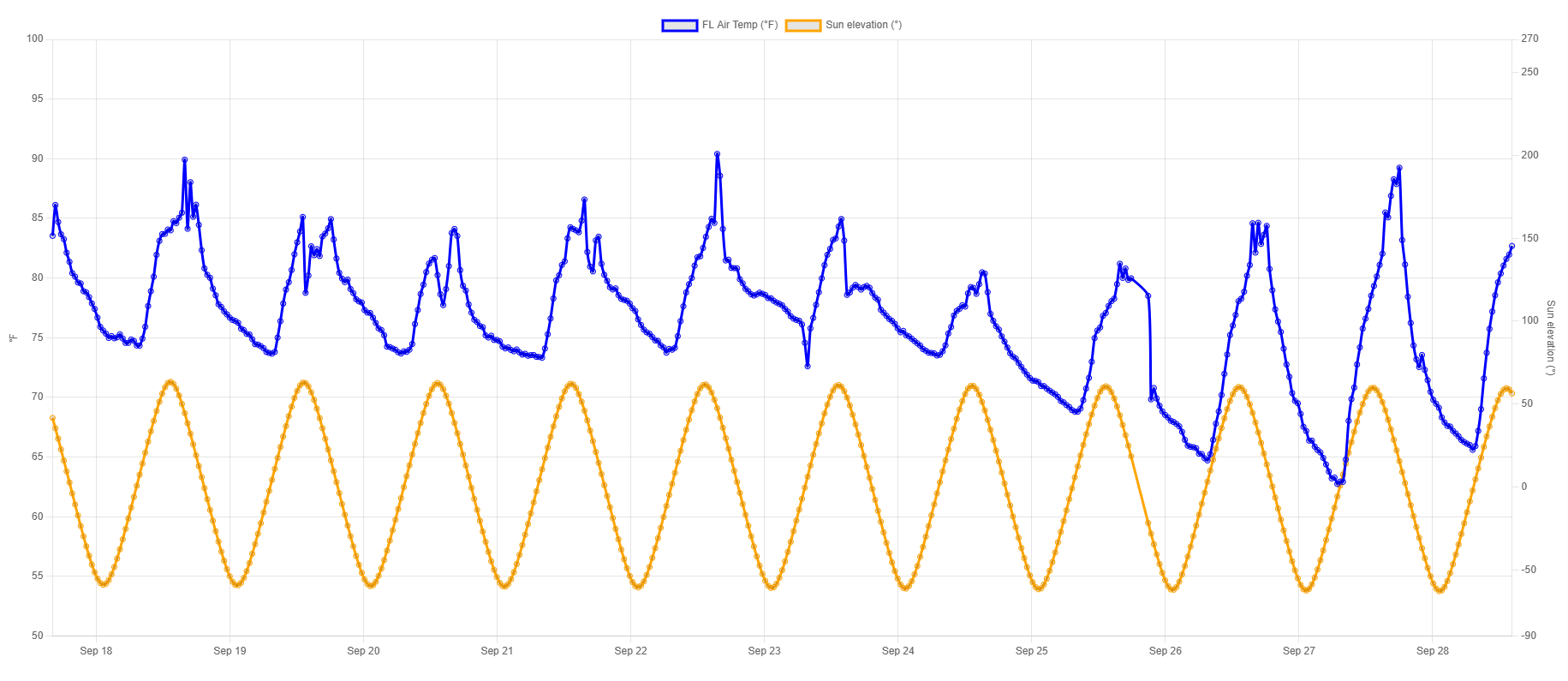
There will still be days of blistering heat, just as there will be late snows in the spring. "One swallow does not a summer make." But Noah has been keeping track of the temperatures outside my office window (blue line), and you can see clearly that fall is creeping in on little cat feet.
Permalink | Read 332 times | Comments (0)
Category Everyday Life: [first] [previous] [next] [newest]
Our two-year-old granddaughter is a sweet, tender little girl. With four older brothers.
Recently she was overheard crooning this little lullaby while rocking her doll:
Little baby Jesus,
I love you.
Sing with me.
Rock, baby,
Will FALL!
At the word "fall," she chucked the baby across the room.
Undoubtedly she figured the baby enjoyed the ride as much as she enjoys playing with the guys in her life, who swing her around until she's dizzy, toss her high into the air, and give her rough, bouncy "horsey rides."
Such play is just what her developing vestibular system needs. My own aging vestibular system has a different opinion.
Permalink | Read 262 times | Comments (1)
Category Children & Family Issues: [first] [previous] [next] [newest] Everyday Life: [first] [previous] [next] [newest] Just for Fun: [first] [previous]
In winter I get up at night
And dress by yellow candlelight.
In summer, quite the other way,
I have to go to bed by day.
I cannot wait for the return of Standard Time!
The above lines by Robert Louis Stevenson return to me every morning these days. In point of fact, I have been "dressing by yellow candlelight" all summer, too. In Orlando, the earliest sunrise is about 6:30 EDT, which occurs in early June, and the latest sunset about 8:30 EDT, in late June. According to reality (sun time as opposed to clock time), these numbers are 5:30 for the earliest sunrise, and 7:30 for the latest sunset, which my own body clock finds much more reasonable.
Recently I came upon the advice that the first thing we should do when we awaken in the morning—specifically, within the first 10 minutes—is to expose our eyes to sunlight.
I'm a big fan of sunshine—I live in the Sunshine State after all—but my immediate reaction was the impossibility of following that advice for anyone who, like me, is up well before the sun peeks over the horizon. And what about Alaskans and Scandinavians?
I decided to ask Claude for the extremes of sunrise and sunset for Central Florida, and that led into the following conversation:
My prompt: These thoughts were inspired by reading someone's theory that it's important for our metabolic health that our eyes take in actual sunlight during the first 10 minutes or so after waking up. My reaction was that that sounds good, but it's not going to happen with any consistency, not only because of modern artificial light, but because the times of sunlight vary so much geographically. Have you ever heard of that theory? If so, what do you know about it?
Claude's response:
Yes — that's a real and pretty widely discussed idea, most associated these days with Andrew Huberman (Stanford neuroscientist with a popular podcast), though the underlying science predates him by decades in circadian biology research.
The core mechanism, briefly: Your eyes have specialized retinal cells (ipRGCs — intrinsically photosensitive retinal ganglion cells) that don't contribute to vision but feed directly into your suprachiasmatic nucleus, the brain's master circadian clock. Bright light exposure early in the day — especially the low-angle light around sunrise, which is rich in certain wavelengths — helps set that clock, which cascades into timing for cortisol release, melatonin onset later that night, and various metabolic processes (insulin sensitivity, body temperature rhythm, etc.).
What's solid: The general principle that morning light exposure helps anchor circadian rhythms is well-established in sleep and chronobiology research, going back to work in the 1980s-90s. Poor circadian alignment is genuinely linked to worse metabolic outcomes — shift workers, for instance, show elevated rates of metabolic syndrome. Light intensity matters a lot: outdoor light even on an overcast day is far brighter than typical indoor lighting (think 1,000-10,000+ lux outside vs. 100-300 lux in a typical room).
Where it gets oversold: The specific claims — that it has to be within the first 10 minutes, that it has to be actual sunrise, that you need a precise duration — go well beyond what the research actually nails down. Most of the underlying studies show benefits from "bright light exposure earlier in the day" generally, not a narrow 10-minute window. That kind of precision makes for a compelling podcast soundbite but isn't something the science actually demands.
Your instinct is right, too: the practical version of this advice — "get outside in the morning when you can" — is useful and low-cost. The rigid, must-be-within-minutes-of-waking version runs into exactly the problems you flagged: it's not achievable consistently for people with early alarms in winter, night-shift workers, or anyone at high latitudes where sunrise might be 9 AM in December. A "rule" that only works for early risers near the equator in summer isn't a robust health principle — it's a lifestyle-compatible one, dressed up as more universal than it is.
My next prompt: Thanks—although I would push back on the idea that it "works for early risers," since I am routinely up before the sun in Orlando (no alarm clock, just the way my body works), and natural light isn't available until much later. It's good to know that it's still helpful to get out in the sun once it shows up to the party.
Claude's response:
Fair pushback, and you're right — I stated that carelessly. "Early riser" doesn't line up with "sunlight available at wake time" at all; those are two different things that just happen to overlap for people whose wake time is late enough (or whose local sunrise is early enough) to coincide. You're up before the sun regardless of the clock, so the "within 10 minutes of waking" version of the rule was never going to apply to you no matter how you set your schedule.
The more accurate framing is probably: get bright light exposure reasonably early in your day, whenever the sun actually shows up relative to your own wake time — not tied to the moment you open your eyes. The circadian benefit comes from getting that light signal before too much of the day has passed, not from some magic window immediately post-wake. So for you, sun exposure shortly after sunrise (even if that's an hour or two after you're already up) should still be doing useful work — you're just not getting it in the first few minutes, and that's fine.
That is not only comforting but makes real sense. We humans could not have been designed (or evolved, if you prefer; for this point it makes no difference) to have our well-being depend on a very narrow window of time that has been unavailable for most of the population since long before the invention of electric lights.
It's also good to know that the anti-natural clock machinations of the government can't take away the benefits of early morning sunshine.
But I still can't wait for the return of Standard Time.
It hurts to have your name stolen.
I'm not talking about identity theft, horrific as that is, but something deeper, more personal. I think of all the Kevins in Europe, where "Kevin isn't a name; it's a diagnosis." All the women whose parents innocently named them "Alexa." My own husband, Porter, whose name precludes calling for him in an airport or train station.
And heaven help the many lovely people I know named "Karen."
Recently, heaven got a little assistance from Mikayla Hedrick, in her article "Get me the manager: In defense of Karens." Well worth the short read, and maybe sending the article to a beleaguered Karen you know.
The Millennial and Gen Z generations who adopted the term grew up with a “Karen” as their elementary school teacher, or the mom down the block, or, like me, as their aunt. Now, those Karens are middle-aged women, a thankless season in the lives of females everywhere, and the pejorative is hurled upon them ceaselessly.
They’ve been accused of racism, of being too quick to call the police, of caring too much about their neighbor’s lawn, and of being a causeless nag at a perfectly good restaurant.
And because I was not a Karen...I said nothing.
No one came to defend our mothers, aunts, or middle-school teachers. They were early victims of rising wokeness, and most of us fed them to the wolves without thinking twice. Conservatives who would later reject the labels of DEI culture said nothing while their wives subliminally imbibed the idea that to be a middle-aged woman who cared enough to join the PTA may subject them to internet bullying and character defamation: all hidden behind the label “Karen.”
That ends now.
Rather than perpetuating the stereotype that a “Karen” is a nuisance whose behavior should be avoided, it’s time to admit that it’s Karens who make the world go round.
While working diligently to resurrect a sense of perpetual racial tension, the label “Karen” has cunningly inflamed prejudice, not against women of a certain race, but against all women of a certain age.
It’s the rightful role of the middle-aged woman to guard her community — to ensure its safety, cleanliness, and standards. But standards aren’t cool anymore. If you care too much about such things, you’re mocked with the air of a middle-school bully taunting you for doing your homework.
And the middle-aged woman is the personification of standards.
She is the mother who has known you since birth and can tell you’re slacking off, even when no one else can. She is the neighbor who is tired of you driving into the cul-de-sac blasting loud music when you know good and well that the babies are sleeping.
She is no longer the gullible maiden you can charm with sweet words. She is a matriarch in training and can see right through your BS.
That’s her job in the neighborhood, and that’s her role in the country.
Don’t try to push Democratic Socialism on a real Karen. She will remind you that you still haven’t paid her back for that window you broke as a kid. Don’t expect her to toe the line on your new pronouns. And definitely don’t let her catch you looting a Walgreens in the name of “justice,” because she will personally escort your butt to prison.
She’s not here to play.
And that’s why she’s demeaned. Because she is a vanguard in a culture that wants to get away with everything.
No thank you.
I’ll take safe streets, good service, and the ladies keeping it all together for the rest of us.
Permalink | Read 344 times | Comments (0)
Category Children & Family Issues: [first] [previous] [next] [newest] Random Musings: [first] [previous] [next] [newest] Everyday Life: [first] [previous] [next] [newest] Here I Stand: [first] [previous] [newest]
When we moved to Florida more than 40 years ago, the heavenly smell from an orange juice factory frequenly wafted over our new house. As we drove around we frequently encountered citrus groves, and just outside of our neighborhood a farm stand sold Page oranges. Technically a Page orange is not an orange, but a cross between a clementine and a tangelo, thus 3/4 tangerine and 1/4 grapefruit. But these small, round orange-colored glories are by far my favorite citrus fruit, now nearly impossible to obtain. In the image below, the juice on the right is the best unpasteurized, non-adulterated, not-from-concentrate orange juice I could buy from the grocery store, and the juice on the left was squeezed from Page oranges.

Sadly, a series of devastating freezes in the mid-1980's drove the citrus industry out of Central Florida, as the owners of our local orchards were faced with the expense of replanting their entire crops—or selling out to developers who were eager to obtain the land on which their dead trees were sitting.
One of our first projects at our new house was to plant a Marsh white grapefruit tree. We nursed it through the freezing time, and for years it provided some of the best grapefruit I've ever eaten. After our local source of Page oranges disappeared, we doubled our "citrus grove" by adding a Page orange tree, and we enjoyed its fruit for many years.
The unusually cold weather of the 1980's moderated, sparing our trees, but the troubles of Florida's citrus industry were far from over. Production peaked in the 90's but the turn of the century brought one deadly attack after another: the Mediterranean fruit fly (Medfly), citrus canker, and several hurricanes that destroyed trees and spread disease and pests all over the state. The pressures of growth and development swallowed many struggling groves. And then in 2005 came citrus greening, a vicious bacterial infection spread by the invasive Asian citrus psyllid, which came to us from China through Mexico. That absolutely devastated Florida's groves, taking our own two trees with them.
The bridges don't fall down immediately. — Bret Weinstein
It's been 20 years since citrus greening came to our state, and the full effects accumulated slowly. Other than the deaths of our own trees, I didn't realize the extent of the damage until about a year ago when I picked up a carton of orange juice from the grocery store. Our favorite brand had long been Florida's Natural, which was reliably not from concentrate, guaranteed squeezed from Florida oranges. But that day I stood there in the middle of Publix, staring at a container of orange liquid that was neither natural nor from Florida: it was made from concentrate, and from Brazilian oranges. Keeping the Florida's Natural name took a lot of chutzpah.
For more of the story, including some out-of-the-box efforts being made to keep the industry alive while searching for a permanent solution, you can read the informative article from which I have pulled a few quotes (emphasis mine).
Florida harvested a record 244 million boxes of oranges during the 1997–1998 season. This year, the Department of Agriculture estimates that Florida will produce only 12.2 million boxes, a stunning 95 percent drop in a little less than 30 years.
Occasional freezes, catastrophic hurricanes, and an on-and-off, decades-long battle with the citrus canker disease proved to be frustrating setbacks for many orange growers, but the destruction of Florida’s citrus industry kicked into high gear in 2005.
The Asian citrus psyllid feeds on citrus tree leaves, causing the plant to contract a bacterial infection known as huanglongbing, commonly called citrus greening. The disease causes rapid root loss, slowly draining the life from healthy trees as they try to absorb and retain nutrients. There is no known cure.
Citrus greening has slashed total U.S. orange production by 80 percent and grapefruit production by 88 percent since 2000, according to a report from the American Farm Bureau Federation. California has now overtaken Florida to become the United States’ largest citrus producer, and nations such as Egypt and South Africa now export more oranges worldwide.
But Florida citrus farmers are not giving up.
Permalink | Read 361 times | Comments (0)
Category Hurricanes and Such: [first] [previous] [newest] Health: [first] [previous] [next] [newest] Everyday Life: [first] [previous] [next] [newest] Food: [first] [previous] [next] [newest]
It is my habit to walk in the early mornings, taking laps around our pool; they're short, but they add up, and the predawn time is gentle and the coolest part of the day. There's something magical about watching the world gradually become visible, and hearing the morning symphony change from insects and frogs to awakening birds.
Just before 5:30, today added something that brings back a smile even as I write about it. On one of my rounds my eye was caught by a spot of light in the east. That's not unusual, as we see the lights of many planes on their way to or from the Orlando International Airport. But this light was orange.
Moving to where I could better discern what my peripheral vision had picked up, I realized that I had one of the best views ever of a launch from Cape Canaveral. The rocket was high in the sky by the time the sight cleared our roof, but it had been launched at an unusually good angle, coming nearly straight toward us. As I determined later, it was the Starlink 10-42 mission, the record-breaking 36th flight for this particular booster.
The orange plume in the clear, dark sky was stunning, and I watched until it winked out at MECO (Main Engine Cutoff).
Permalink | Read 444 times | Comments (0)
Category Everyday Life: [first] [previous] [next] [newest]
The flag still stands for freedom, and they can't take that away.
You know you're aging as fast as the country when you tell people you were almost a quarter of a century old when America celebrated her 200th birthday, and they say, "Oh, wow...." But I remember celebrating the Bicentennial in Philadelphia, and hearing President Ford speak there.
I approached this post feeling entirely inadequate to write about America's 250th birthday. It demands something more profound, more intense than I can give at the moment, despite my deep feelings. I love our country now more than I ever have, perhaps because never in all my decades as an American have I felt our freedom to be in more danger, and the number of those attempting to take it away—or give it away—to be so overwhelming. But the flag still stands for freedom.
Lee Greenwood's God Bless the USA was from my children's era, not mine, and it doesn't often come to mind when I think about patriotic songs. But the other day I heard it, unexpectedly, and it equally unexpectedly brought tears to my eyes. I paused and stood taller as if I were hearing our national anthem. It's a fitting tribute to a great country.
If tomorrow all the things were gone
I'd worked for all my life
And I had to start again
With just my children and my wife
I'd thank my lucky stars
To be living here today
'Cause the flag still stands for freedom
And they can't take that away
And I'm proud to be an American
Where at least I know I'm free
And I won't forget the men who died
Who gave that right to me
And I'd gladly stand up
Next to you and defend her still today
'Cause there ain't no doubt I love this land
God bless the USA
From the lakes of Minnesota
To the hills of Tennessee
Across the plains of Texas
From sea to shining sea
From Detroit down to Houston
And New York to L.A
Well there's pride in every American heart
And it's time we stand and say
That I'm proud to be an American
Where at least I know I'm free
And I won't forget the men who died
Who gave that right to me
And I'd gladly stand up
Next to you and defend her still today
'Cause there ain't no doubt I love this land
God bless the USA
And I'm proud to be an American
Where at least I know I'm free
And I won't forget the men who died
Who gave that right to me
And I'd gladly stand up
Next to you and defend her still today
'Cause there ain't no doubt I love this land
God bless the USA
Permalink | Read 403 times | Comments (0)
Category Everyday Life: [first] [previous] [next] [newest] Here I Stand: [first] [previous] [next] [newest]
I'm not unsympathetic to those who are genuinely suffering in the heat. I spent the first 30+ years of my life in the Northeast, where air conditioning was almost unheard of, even in critical care hospitals. The laboratory where I worked in the 1970's only had air conditioning in the computer rooms, and that only because—like art—the machines would not work under conditions that people were expected to endure with patience. Even in Florida, my grandparents' house, like most buildings before the late 20th century, had no air conditioning. (It was, however, intelligently built: two blocks from the ocean, and constructed for maximum cross-ventilation, to take advantage of every breeze.) I know unrelenting heat.
So how did we manage?
- Buildings, like my grandparents' house, were built to take the heat into account, with cross-ventilating windows, breezy porches, and shady trees arching over the roofs. Central Florida as it is built now could not exist without the HVAC industry.
- House windows were habitually opened as soon as the outside air cooled off at night, which it did most weeks of the year in the Northeast, and closed when the day began to heat up. This practice has a power that I didn't fully appreciate until we moved to Florida, where the nighttime cooling is ofttimes non-existent.
- Swimming: in ponds, lakes, pools, and/or the ocean. Plastic kiddie pools and running through the sprinkler helped a lot, too. When we first moved to Florida, we kept the A/C set in the 80's, and spent a lot of time in the pool. That kept us cool, but took a terrible toll on our energy. Once we gave in and brought the inside temperature down to the high 70's, we used the pool less—but got a lot more accomplished.
- Another advantage the more northern climes have is that the really unbearable temperatures are only for a short time. When we lived in Rochester, there were usually only two or three weeks in the summer when I was reduced to nursing my baby while immersed in a cool-water bath, and planning excursions based on whether or not the destination was air conditioned. In Florida, sans A/C, that would be the majority of the year.
- A few very lucky people had jobs in air conditioned buildings. As for the rest of us: we suffered; we endured; we dialed down our activities to keep our bodies cooler and our minds saner. And we looked forward to the first hints of autumn.
But that was then, and this is now, and now what makes it possible to have a comfortable, productive society is air conditioning. It's no secret that the closest thing the American South has to a secular saint is Willis Carrier. Air conditioning is as critical in the Sun Belt as heating is in the Snow Belt. Having heard people seriously suggest that the cause of France's heat wave is American air conditioning, I can only say, "Come back and talk to me about giving up my A/C after you've lived a winter in your country without heating." Better yet, discover air conditioning for yourself. Even if you only need it for a few weeks out of the year, you'll feel better, and can be pleased with how low your A/C bills are compared with ours, just as we Southerners feel better about our heating bills in winter when we look at yours.
You might also consider investing in public places of respite, as I've seen in various cities here, where people can come in to get warm, or to get cool, depending on the season. As I said in my last post, one can stand a much greater intensity and duration of heat or cold if one can occasionally retreat to a more comfortable situation.
And gelaterias. We all need more gelaterias.
Permalink | Read 421 times | Comments (2)
Category Health: [first] [previous] [next] [newest] Politics: [first] [previous] [next] [newest] Everyday Life: [first] [previous] [next] [newest] Conservationist Living: [first] [previous] [next] [newest]
Now that we're back from three weeks in the Mediterranean region, people are wondering how we survived Europe's heat wave. The answer is simple: the same way we survive Florida's summers. Nowhere that we went did the temperatures exceed Florida's numbers: high 80's to low 90's were the worst we experienced. That's actual temperature. Having lived more than seven decades with that as my measure of ambient temperature, my brain rebels against the modern "feels like" idea, which always makes me feel more miserable than I am. For what it's worth, the UV Index at its highest in a day was generally 8—like a normal Connecticut summer. In Florida at this time of year that number is routinely 12. I was barely aware of the UV Index until I acquired the dminder app for my phone to help me keep track of the vitamin D my body is making. If I'm wearing shorts and a t-shirt, a 15-minute walk in the midday sun at UVI 12 easily gets me 1500 IUs (and a warning that it's time to go inside). On the UV Index scale, 1-2 is considered Low, 3-5 Moderate, 6-7 High, 8-10 Very High, and 11+ Extreme.
Our first four days were in Florence, and were undeniably hot, because we wanted to make the most of our short time there. Our hotel was convenient to everything we wanted to see, so we walked everywhere and were on the go most of the time the sun was up. (Sane Floridians avoid the midday hours outside if possible. "Mad dogs and Englishmen," you know.) The Mediterranean sun was intense, the humidity was high, the cobbled sidewalks a challenge to walk on, and Florence's many staircases a trial for legs accustomed to flat surfaces. What made this only a minor inconvenience?
- This was early in our trip, when we were fresh and eager.
- Hats and sunglasses. Generally I hate wearing a hat, but keeping the sun off my face was a necessity.
- A Floridian's practiced eye for finding shade. Walk on the shady side of the street. Rest in a shady spot. It makes a significant difference, even when the humidity is high.
- Air-conditioned respites. This is huge. As with cold in the winter, one can stand a much greater intensity and duration of heat if one can occasionally retreat to a more comfortable situation. In our case, we spent much of our time walking from one museum to another, and generally recognize that great art survives better in a hospitable climate. So do people, but art refuses to be bullied. The museums were comfortably air conditioned—not the frigid situation one finds in Florida restaurants, for example, which is why I keep a sweatshirt in the car at all times and occasionally pull it out even during the hottest summer days.
- We didn't hesitate to adjust our schedule to accommodate our physical needs.
- Frequent gelato stops. Never underestimate the importance of this Italian staple.
For the remainder of our trip, we were on a Princess cruise, visiting Italy, Greece, Turkey, and Montenegro. The ship itself was over-airconditioned, but an occasional trip to the blistering sun of the top decks took care of that nicely. And the otherwise-excessive A/C was admittedly glorious upon returning from a long, midday excursion of hiking, under a cloudless sky, through ancient ruins.
Overall, to those who asked us how we managed in Europe's "terrible heat wave," my first thought was always, "What heat wave?"
But I do understand unrelenting heat, as I'll explain in my next post.

Our resident pilot-in-training has now obtained his Commercial license! Despite what it sounds like, that doesn't mean you might catch a glimpse of him in the cockpit next time you take a flight. However, he is now eligible to earn money as a pilot—it's the next step in the process. Earning a Commercial license requires more training, new manoeuvers, many more flight hours, and a lot of "book learning," culminating in a written exam, an oral exam, and the nerve-wracking, practical "check ride" flight. We're very proud of him!
P.S. He still makes great desserts, too.
Permalink | Read 424 times | Comments (2)
Category Everyday Life: [first] [previous] [next] [newest]
I've been out of the country for three weeks, and I never look at Tik Tok anyway, but I hear that it has been blowing up with European visitors to America (mostly thanks to the World Cup), expressing their pleasure, appreciation, and astonishment at how different their experiences were compared with all they had been told about the U.S. Some of those commentaries made it into Facebook Reels, and I enjoyed seeing them. Everything from the trivial (discovering ranch dressing) to the profoundly encouraging (finding that the Americans they met were friendly, helpful, and delightful—not at all they way we had been portrayed to them back home.
It works both ways, too. During our recent three weeks in Europe, we met many new people from many different countries, including England, Scotland, Canada, Norway, Sweden, Greece, Italy, Germany, Montenegro, Turkey, South Africa, Zimbabwe, Vietnam, Brazil, and the Philippines. We discovered that without exception they were interesting people, delightful to converse with, rational and reasonable, and that we held much in common. What's more, I saw no anti-American sentiment at all. I'm sure it exists, but in three weeks among ordinary folks, we met only friends.
...Not one, not two, not three, but FOUR armadillos cavorting all around.
They are voracious bug eaters, and welcome. I see them most often in the early morning, just before dawn. When I can't really see them, let alone capture them with my camera.
Permalink | Read 387 times | Comments (1)
Category Everyday Life: [first] [previous] [next] [newest]
In my More Fun post, I mentioned that my "I've had fun before" cartoon was a "four-way collaboration among me, my grandson, Copilot, and Claude." Here's more about that.
For a long time, I've had simmering in my mind the idea of making a cartoon (meme?) illustrating my frustration with having a far different sense of what activities are enjoyable, or pleasurable, or "fun" than much of the world I live in. The point of the cartoon would be the idea that I've experienced what the world calls fun, and I find it overrated. After finding my father's own commentary on fun, I was inspired to bring the idea to fruition.
My first roadblock was finding a suitable background image for the cartoon, something that illustrated what people conventionally vew as fun, or a fun activity. Searching through clipart and online images was not producing helpful results, and Copilot, which I usually use when I need to create a drawing, was not doing the job this time. Having found Claude extremely helpful in other projects, I decided to move into its space and give it the problem.
Claude was great at helping me figure out just what I wanted the image to convey, but then I ran into a major snag:
Claude can't draw.
This is where my grandson entered the scene. He suggested that I ask Claude to write a prompt for me to use with Copilot to help it understand what I was trying to do. This Claude did with ease, and Copilot nailed the idea in an image. I then refined the image through several back-and-forth sessions: Claude looking at the image and pointing out what worked well with my ideas and what needed tweaking, me questioning Claude for its opinion on what changes might make the point more clearly, and then going back to Copilot to implement the results. Eventually, we reached the "good enough is better than perfect" stage, and the cartoon was born.
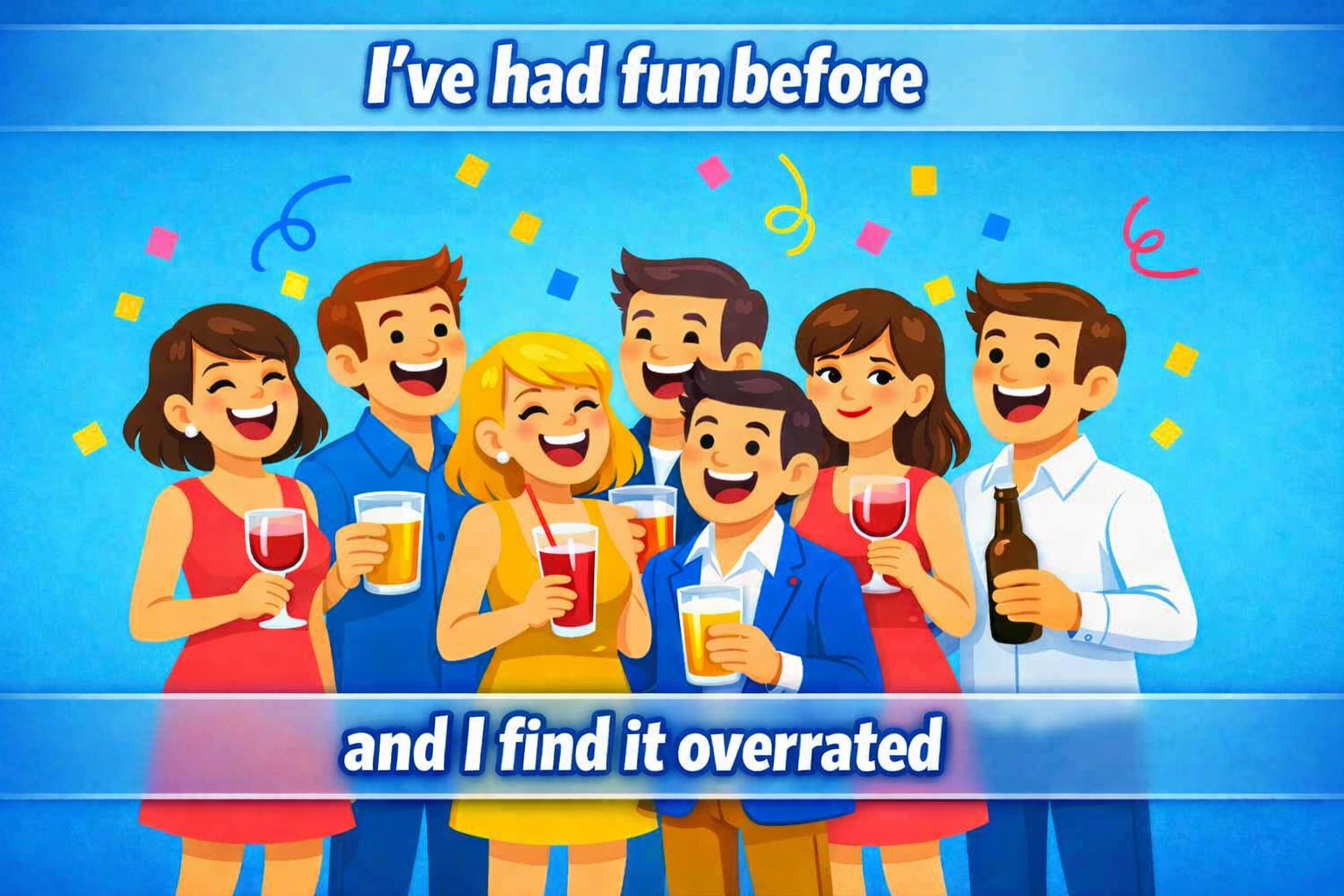
I found the process to be an interesting collaboration. Working with Copilot felt like dealing with an excellent artist who was a bit slow on the uptake. Claude couldn't draw but was smarter and had a good eye. Noah provided the key that nudged me out of the rut I was in, and I put it all together. Claude called it a perfect creative team:
- Copilot: the talented studio artist who executes brilliantly but needs very clear direction
- Claude: the creative director with opinions but no hands
- Your grandson: the spark of inspiration
- You: the producer who held the vision, made the calls, and knew when it was done
I call it fun.
Permalink | Read 394 times | Comments (0)
Category Everyday Life: [first] [previous] [next] [newest] Just for Fun: [first] [previous] [next] [newest] Inspiration: [first] [previous] [next] [newest] AI Adventures: [first] [previous] [next] [newest]

